
Zoology, the scientific study of animals, is far too vast to be treated as a single subject.
Ask a marine biologist studying coral-reef fish and a wildlife researcher tracking wolf packs what they “do for a living,” and you’ll get two completely different answers — yet both are zoologists.
That’s because zoology has branched out over centuries into dozens of specialized fields, each one zooming in on a different piece of the animal kingdom’s puzzle.
Whether you’re a student picking a career path, a curious reader, or someone building a foundation in life sciences, understanding the branches of zoology gives you a map of just how deep and diverse this field really is.
In this article, we’ll break down the major branches of zoology, explain what each one studies, and show how they connect to form our overall understanding of animal life.
What Is Zoology, Really?
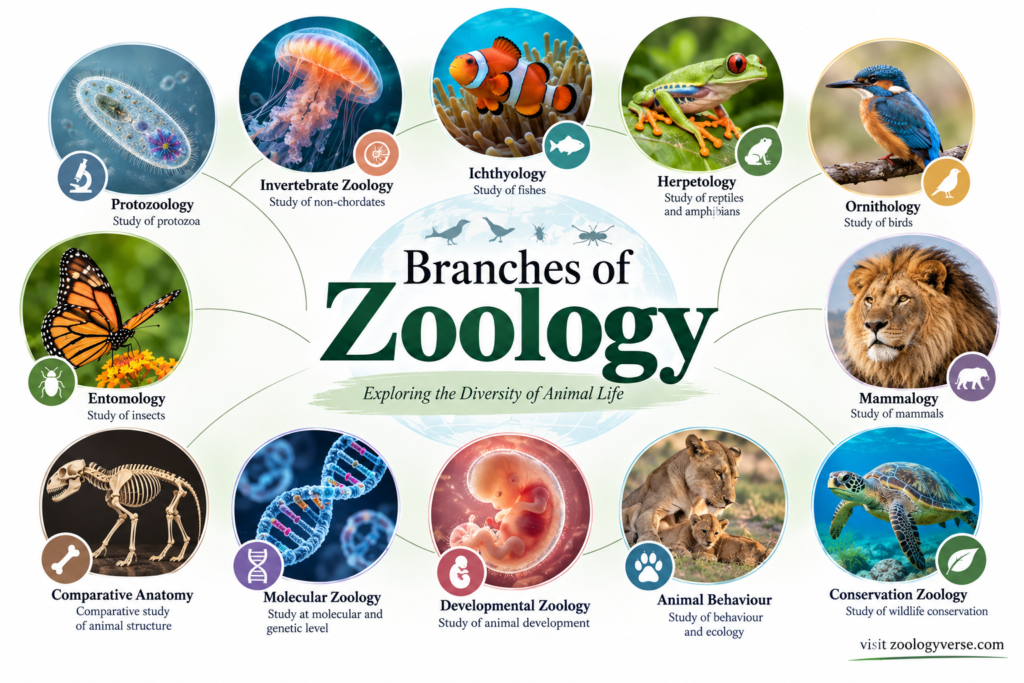
Before diving into the branches of zoology, it helps to define the trunk. Zoology comes from the Greek words zoon (animal) and logos (study), and at its core, it’s the branch of biology dedicated to understanding animals — their structure, function, classification, behavior, distribution, and evolutionary history. Because animals range from microscopic protozoa to blue whales, no single scientist can master it all. That’s exactly why specialization happened naturally over time.
Major Branches of Zoology
Taxonomy and Systematics
Taxonomy is the branch responsible for naming, classifying, and organizing animals into groups based on shared characteristics.
Systematics goes a step further, studying the evolutionary relationships between these groups.
Together, they form the backbone of zoology — without a classification system, communicating about animal species would be chaotic.
This is why every organism has a standardized scientific name under the binomial nomenclature system introduced by Carl Linnaeus.
Anatomy and Morphology
Anatomy focuses on the internal structure of animals — bones, muscles, organs, and tissues — while morphology studies the external form and structural features.
These branches help scientists understand how an animal’s body is built to support its lifestyle, whether that’s a bird’s hollow bones for flight or a fish’s streamlined body for swimming.
Physiology
Zoological physiology examines how animal bodies function — digestion, respiration, circulation, reproduction, and nervous system activity.
It answers the “how does this work” questions, such as how a camel survives without water for days or how a hibernating bear slows its metabolism.
Embryology
Embryology, also called developmental biology, studies how animals grow from a fertilized egg into a fully formed organism.
It reveals fascinating patterns, such as how early-stage embryos of very different species can look remarkably similar, offering clues about shared evolutionary ancestry.
Genetics
Zoological genetics explores heredity — how traits are passed from parent to offspring through DNA.
This branch has become increasingly important in modern zoology, helping researchers understand everything from coat color inheritance in animals to genetic diversity in endangered species conservation programs.
Evolutionary Biology
This branch investigates how animal species change over time through natural selection, genetic drift, and adaptation.
Evolutionary biology explains why certain species thrive in specific environments and how entirely new species emerge over long periods.
Ecology
Animal ecology studies how organisms interact with each other and their environment.
It covers population dynamics, food webs, habitat relationships, and the impact of environmental changes on animal communities. With climate change and habitat loss accelerating, ecological zoology has never been more relevant.
Ethology (Animal Behavior)
Ethology is the study of animal behavior, particularly in natural settings.
It covers everything from mating rituals and social hierarchies to migration patterns and communication methods. Famous ethologists like Jane Goodall and Konrad Lorenz shaped much of what we know about animal cognition and social structures today.
Paleozoology
Paleozoology studies animal life through fossil records, helping scientists reconstruct extinct species and understand prehistoric ecosystems.
This branch bridges zoology and paleontology, offering insight into how modern animals evolved from ancient ancestors.
Parasitology
This branch focuses specifically on parasites and their relationships with host animals.
Parasitology is crucial for both wildlife health and human medicine, since many parasites that affect livestock and wild animals can also impact human populations.
branches of zoology Based on Animal Groups
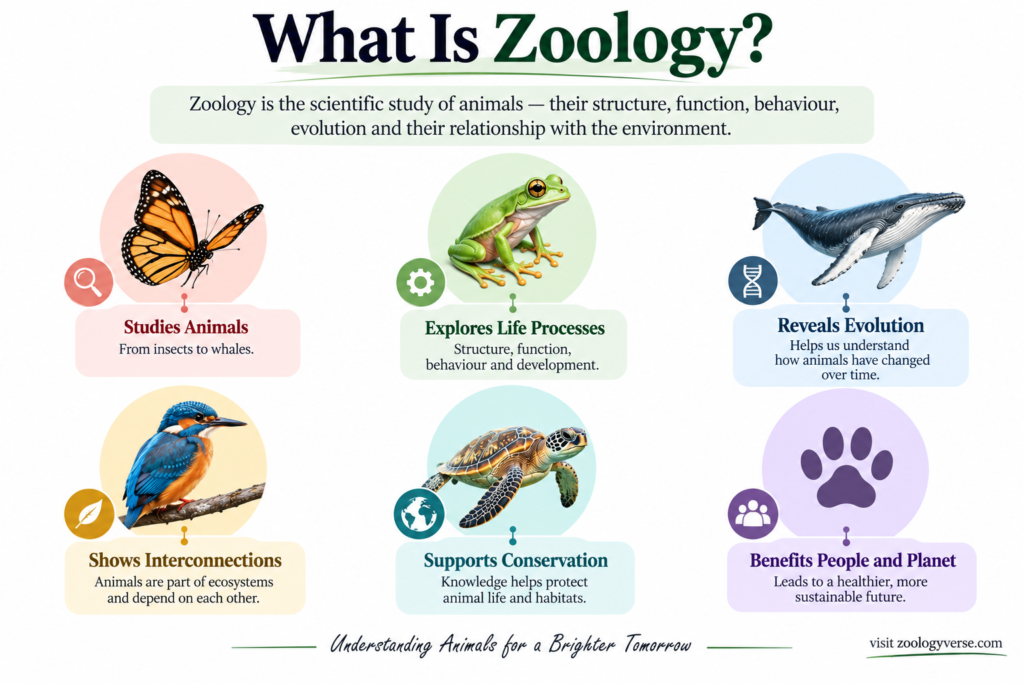
Beyond these functional branches, zoology is also divided by the type of animal being studied:
- Entomology – the study of insects, the most diverse group of animals on Earth
- Ichthyology – the study of fish
- Herpetology – the study of reptiles and amphibians
- Ornithology – the study of birds
- Mammalogy – the study of mammals
- Malacology – the study of mollusks
- Carcinology – the study of crustaceans
- Protozoology – the study of single-celled protozoans
Each of these specialized fields allows researchers to become true experts in the biology, behavior, and conservation needs of a specific animal group.
Applied Branches of Zoology
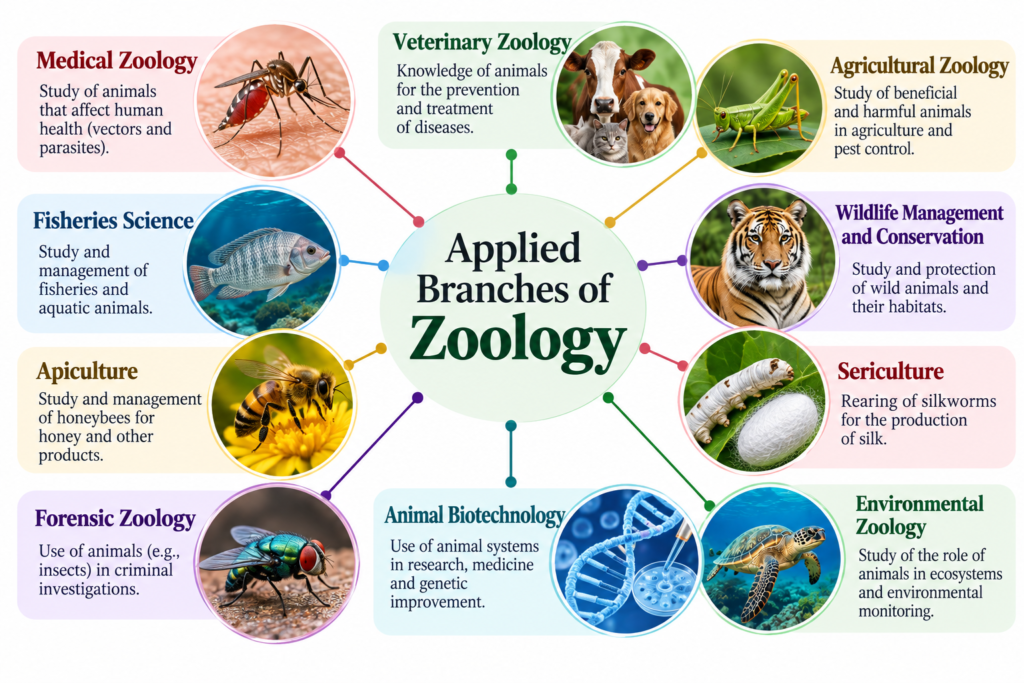
Zoology isn’t just theoretical — many branches have direct real-world applications:
- Wildlife Biology focuses on conservation and management of wild animal populations.
- Veterinary Science, while technically its own discipline, draws heavily on zoological anatomy and physiology to treat animals.
- Animal Husbandry and Agricultural Zoology apply zoological knowledge to livestock breeding and farming practices.
- Marine Biology studies animals living in oceans, seas, and other saltwater ecosystems, overlapping heavily with ichthyology and invertebrate zoology.
Why Studying the Branches of Zoology Matters
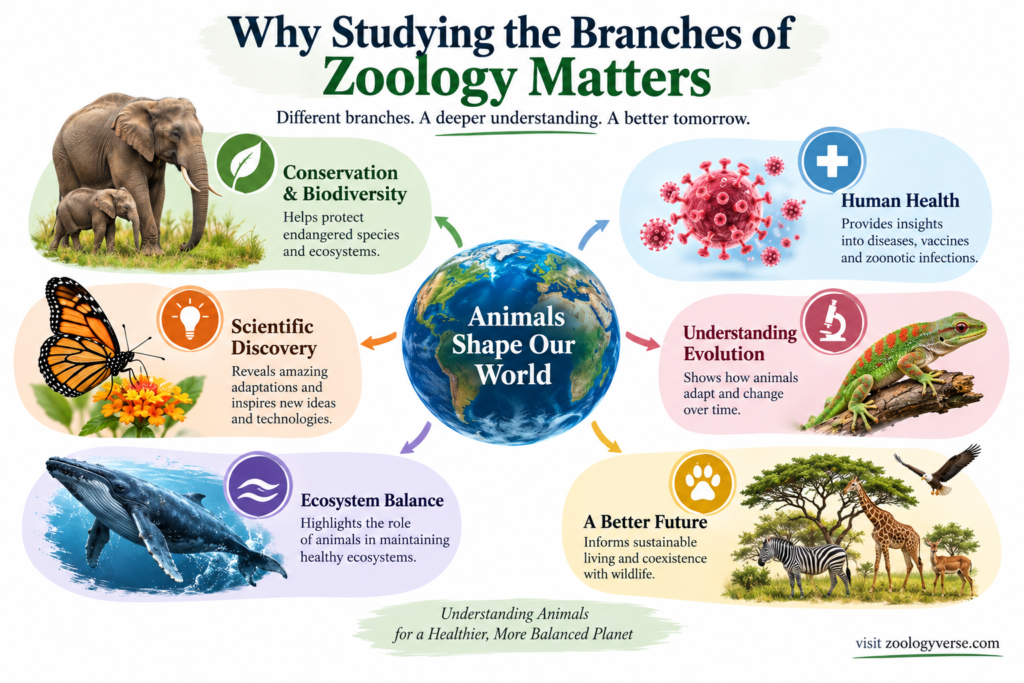
Understanding these branches isn’t just academic trivia — it shapes how we address real global challenges.
Conservation biologists rely on ecology and genetics to protect endangered species.
Public health officials depend on parasitology to control disease outbreaks.
Wildlife policy relies on ethology and population ecology to design better habitat protections.
In short, the branches of zoology work together like puzzle pieces, and no single one tells the full story of animal life on its own.
Key Takeaways
- Zoology is broadly divided into functional branches (anatomy, physiology, genetics, ecology, ethology) and taxonomic branches (entomology, ichthyology, ornithology, etc.)
- Each branches of zoology answers a different question about animal life — structure, function, behavior, or classification
- Applied branches of zoology like wildlife biology and marine biology connect zoological research to conservation and real-world problem-solving
- No branches of zoology works in isolation; together they build a complete picture of the animal kingdom
Frequently Asked Questions
How many branches of zoology are there?
There isn’t a fixed number, since zoology continues to branch into more specialized sub-fields as research advances. However, most textbooks recognize around 10–15 major branches, plus numerous animal-group-specific fields like entomology and ornithology.
What is the difference between zoology and biology?
Biology is the broader study of all living organisms, including plants, fungi, and microorganisms. Zoology is a specialized branch of biology that focuses exclusively on animals.
Which branch of zoology studies animal behavior?
Ethology is the branch dedicated to studying animal behavior, including social interactions, communication, and instinctual patterns.
Can someone specialize in more than one branch of zoology?
Yes. Many zoologists combine branches — for example, a researcher might work in both ecology and ethology to study how environmental changes affect animal social behavior.
Is marine biology a branch of zoology?
Marine biology overlaps significantly with zoology, particularly ichthyology and invertebrate zoology, but it also includes the study of marine plants and microorganisms, making it a broader interdisciplinary field.
Recommended Study Resource
Integrated Principles of Zoology
by Jr. Hickman, Cleveland P. (Author), Larry S. Roberts (Author), Susan L. Keen (Author), David L. Eisenhour (Author)
Rastogi Publications MODERN TEXT BOOK OF ZOOLOGY: INVERTEBRATES (Z-1)
by Prof. R. L. Kotpal (Author)
As an Amazon Associate I earn from qualifying purchases.
Discover more from Zoologyverse
Subscribe to get the latest posts sent to your email.