
1. Population Genetics: Understanding Evolution at the Population Level
Evolution is fundamentally a process that occurs within populations over successive generations. Although individual organisms may grow, develop, reproduce and respond to environmental conditions, their inherited genetic composition does not change through evolutionary processes during their lifetime. Instead, evolution involves changes in the genetic constitution of populations across generations. The scientific study of these changes forms the foundation of Population Genetics.
Population Genetics is a branch of evolutionary biology that investigates the genetic composition of populations and the factors responsible for changes in that composition over time. It combines the principles of Mendelian genetics, evolutionary theory and mathematical analysis to explain how hereditary characteristics are distributed among individuals and how their frequencies change from one generation to another.
A population contains individuals belonging to the same species that occupy a particular geographical area and have the potential to interbreed. These individuals collectively possess a shared collection of genes known as the gene pool. The gene pool includes all the alleles present in a population at a particular time. Differences in the distribution and frequency of these alleles contribute to the genetic diversity observed among individuals.
One of the central concepts in Population Genetics is allele frequency, which refers to the proportion of a particular allele among all copies of a gene present in a population. For example, if a population contains two alleles, A and a, their relative frequencies determine the genetic composition of that population. Changes in these frequencies across generations provide a measurable indication of evolutionary change.
Genetic variation is another essential component of population-level evolution. Individuals within a population may differ in their inherited characteristics because of mutations, genetic recombination, chromosome rearrangements and other processes. Such variation provides the raw material upon which natural selection and other evolutionary mechanisms act.
In some populations, multiple alternative forms of a gene occur at appreciable frequencies. This condition is known as genetic polymorphism. It contributes to the maintenance of genetic diversity and may influence the ability of populations to respond to environmental changes.
Population Genetics provides a quantitative explanation of how evolutionary mechanisms operate. It examines the effects of mutation, natural selection, genetic drift, gene flow and non-random mating on the genetic composition of populations. These processes may alter allele frequencies, maintain genetic diversity or contribute to reproductive isolation and speciation.
Population Genetics forms an essential foundation of modern evolutionary biology. The integration of Mendelian inheritance with Darwinian natural selection is explained in greater detail in our article on Trends in Evolution.
The subject also provides the theoretical foundation for the Modern Synthetic Theory of Evolution, which integrates Darwinian natural selection with Mendelian inheritance and population-level genetic changes. By studying the distribution and transmission of hereditary variation, Population Genetics explains how small genetic changes within populations can contribute to broader evolutionary patterns over geological time.
Thus, Population Genetics connects the principles of inheritance with the mechanisms of evolution and provides a scientific framework for understanding the origin, maintenance and transformation of genetic diversity in natural populations.
2. Historical Development of Population Genetics
The development of Population Genetics represents an important turning point in evolutionary biology because it provided a mathematical and genetic explanation of how evolution occurs within populations. Before its establishment, evolutionary theory was largely concerned with natural selection, variation and the inheritance of characteristics. However, the precise relationship between Mendelian inheritance and evolutionary change remained incompletely understood.
The integration of Mendelian genetics, mathematical models and Darwinian evolutionary theory during the early twentieth century established the foundation of modern Population Genetics.
2.1 Early Ideas About Heredity and Evolution
During the nineteenth century, Charles Darwin proposed natural selection as the principal mechanism responsible for evolutionary change. According to Darwin, individuals within a population differ in their characteristics, and those possessing favourable variations are more likely to survive and reproduce.
However, Darwin did not have a satisfactory understanding of the genetic mechanism responsible for the transmission of variations from parents to offspring. The rediscovery of Gregor Mendel’s work in 1900 provided an important explanation of inheritance.
Mendel demonstrated that hereditary characteristics are transmitted through discrete units, now known as genes. His principles of segregation and independent assortment explained how alternative forms of genes are inherited across generations.
The integration of Mendelian inheritance with Darwinian natural selection became essential for the development of Population Genetics. It established that evolutionary change could be understood through changes in the distribution of inherited genetic variants within populations.
2.2 Rediscovery of Mendelian Principles
The rediscovery of Mendel’s experiments by Hugo de Vries, Carl Correns and Erich von Tschermak in 1900 stimulated renewed interest in heredity.
Mendel’s work demonstrated that hereditary factors do not simply blend together in offspring. Instead, they are transmitted as discrete units and can retain their identity across generations.
This discovery helped explain the genetic basis of variation. Alternative forms of a gene, called alleles, could be inherited and maintained within populations.
The concept of allele frequency subsequently became important for understanding how the genetic composition of populations changes over time.
2.3 Hardy-Weinberg Principle (1908)
An important milestone in the development of Population Genetics was the formulation of the Hardy-Weinberg principle in 1908.
The principle was independently developed by the English mathematician Godfrey Harold Hardy and the German physician Wilhelm Weinberg.
They demonstrated that allele and genotype frequencies remain constant from generation to generation under specific ideal conditions, provided that no evolutionary forces disturb the population.
For a population containing two alleles, A and a, the relationship is represented as:
[
p+q=1
]
Where:
- (p) = frequency of allele A
- (q) = frequency of allele a
The expected genotype frequencies are represented by:
[
p^2+2pq+q^2=1
]
Where:
- (p^2) = frequency of homozygous dominant genotype (AA)
- (2pq) = frequency of heterozygous genotype (Aa)
- (q^2) = frequency of homozygous recessive genotype (aa)
The Hardy-Weinberg principle established a mathematical baseline against which evolutionary changes could be measured. It became one of the fundamental tools of Population Genetics.
2.4 Contributions of Ronald A. Fisher
Ronald A. Fisher was one of the principal founders of modern Population Genetics. He made important contributions by combining Mendelian genetics with mathematical and statistical approaches.
In 1918, Fisher published his influential paper, The Correlation Between Relatives on the Supposition of Mendelian Inheritance. He demonstrated how continuous variation in quantitative characteristics could be explained through the combined effects of multiple Mendelian genes.
In 1930, he published The Genetical Theory of Natural Selection, which provided a mathematical treatment of natural selection and its evolutionary consequences.
Fisher explained how natural selection changes the genetic composition of populations by favouring individuals carrying advantageous hereditary variants.
His work established an important mathematical foundation for understanding the relationship between genetic variation, inheritance and evolutionary adaptation.
2.5 Contributions of J. B. S. Haldane
John Burdon Sanderson Haldane made significant contributions to the mathematical study of natural selection.
Through a series of papers published during the 1920s and 1930s, he investigated how selection acts on different genetic combinations and changes allele frequencies across generations.
His work examined several important evolutionary processes, including:
- Selection against harmful recessive alleles.
- The spread of advantageous mutations.
- Changes in allele frequencies under different selection conditions.
- The evolutionary consequences of mutation and migration.
In 1932, Haldane published The Causes of Evolution, which presented mathematical explanations of several evolutionary mechanisms.
His contributions demonstrated that evolutionary processes could be investigated quantitatively rather than only through descriptive observations.
2.6 Contributions of Sewall Wright
Sewall Wright was another major founder of modern Population Genetics. His research focused particularly on genetic drift, inbreeding and the genetic structure of populations.
Wright demonstrated that allele frequencies could change because of random sampling effects, even in the absence of natural selection. This process is known as genetic drift.
He also developed the concept of the adaptive landscape to explain how populations may move through different combinations of genetic characteristics under the influence of selection and random processes.
His work highlighted the importance of population size and genetic structure in determining evolutionary outcomes.
2.7 Integration into the Modern Synthetic Theory
The mathematical foundations established by Fisher, Haldane and Wright were later integrated with experimental genetics, natural history, taxonomy and palaeontology.
Theodosius Dobzhansky played a particularly important role in connecting laboratory genetics with natural populations. His 1937 book, Genetics and the Origin of Species, demonstrated how genetic variation and evolutionary mechanisms could explain the formation of species.
Other scientists, including Ernst Mayr, George Gaylord Simpson and G. Ledyard Stebbins, contributed to extending the synthesis across zoology, palaeontology, systematics and botany.
Population Genetics consequently became a central component of the Modern Synthetic Theory of Evolution. It provided the theoretical framework for explaining evolutionary change through alterations in allele frequencies and the action of evolutionary mechanisms within populations.
The historical development of Population Genetics therefore reflects the gradual integration of Mendelian inheritance, mathematical analysis and Darwinian natural selection into a unified explanation of evolution.
3. Basic Concepts and Terminology of Population Genetics
Understanding Population Genetics requires familiarity with several fundamental genetic and evolutionary concepts. These concepts explain how hereditary information is distributed within populations, how genetic differences arise and how changes in genetic composition contribute to evolution.
The genetic structure of a population is determined by the genes and alleles carried by its individuals. Their distribution, inheritance and transmission across generations provide the basis for studying evolutionary changes.
3.1 Population
A population is a group of individuals belonging to the same species that occupy a particular geographical area at a given time and have the potential to interbreed.
Individuals within a population generally share a common reproductive pool and exchange genetic material through reproduction. However, they may differ in their genetic characteristics, physical appearance, physiological properties and behaviour.
For example, all individuals of a particular frog species inhabiting a pond may constitute a local population. Similarly, a group of deer living and breeding within a forest region may represent a population.
A population is the basic unit of study in Population Genetics because evolutionary changes are measured through alterations in its genetic composition over successive generations.
3.2 Gene
A gene is a functional unit of heredity consisting of a specific sequence of DNA that contributes to the production of a functional RNA molecule or protein.
Genes occupy specific positions on chromosomes known as loci. They contain hereditary information that influences biological characteristics and can be transmitted from parents to offspring.
In Population Genetics, genes are studied in terms of their distribution and transmission within populations. Differences in gene sequences contribute to inherited variation among individuals.
3.3 Alleles
Alleles are alternative forms of the same gene that occupy the same locus on homologous chromosomes.
For example, a gene controlling a particular inherited characteristic may possess two alternative alleles, represented as A and a.
In a diploid organism, two copies of an autosomal gene are generally present, one inherited from each parent. Depending on the alleles inherited, an individual may possess one of the following genotypes:
- AA – Homozygous dominant
- Aa – Heterozygous
- aa – Homozygous recessive
Allelic differences contribute to genetic variation within populations. The relative abundance of different alleles is an important measure of population genetic composition.
3.4 Gene Pool
The gene pool refers to the total collection of genes and their alleles present in all reproductive individuals of a population at a particular time.
It represents the overall genetic resources available within that population.
For example, consider a diploid population containing 100 individuals. If a particular gene has two alleles, A and a, the population contains 200 copies of that gene, assuming all individuals are diploid and the locus is present in both homologous chromosomes.
If 120 copies are allele A and 80 copies are allele a, the gene pool contains both alleles in different proportions.
The gene pool is important because evolutionary change involves alterations in the distribution and frequency of inherited genetic variants within populations.
3.5 Allele Frequency
Allele frequency is the proportion of a particular allele among all copies of a gene at a specific locus in a population.
It is generally expressed as a fraction or percentage. For a gene having two alleles, A and a, their frequencies are represented by p and q, respectively.
[
p+q=1
]
Where:
- (p) = frequency of allele A
- (q) = frequency of allele a
Consider a population of 100 diploid individuals containing the following genotypes:
| Genotype | Number of individuals |
|---|---|
| AA | 40 |
| Aa | 40 |
| aa | 20 |
| Total | 100 |
The total number of allele copies is:
[
2N=2\times100=200
]
The number of A alleles is:
[
(2\times40)+40=120
]
The number of a alleles is:
[
(2\times20)+40=80
]
Therefore:
[
p=\frac{120}{200}=0.6
]
[
q=\frac{80}{200}=0.4
]
Thus, the frequency of allele A is 60%, whereas the frequency of allele a is 40%.
Allele frequencies provide a quantitative method for examining changes in population genetic composition across generations.
3.6 Genotype Frequency
Genotype frequency refers to the proportion of individuals in a population that possess a particular genotype.
For example, if a population contains 100 individuals and 40 of them have genotype AA, the frequency of AA is:
[
f(AA)=\frac{40}{100}=0.4
]
Similarly:
[
f(Aa)=\frac{40}{100}=0.4
]
[
f(aa)=\frac{20}{100}=0.2
]
The sum of genotype frequencies is always equal to one when all possible genotypes at the locus are included:
[
f(AA)+f(Aa)+f(aa)=1
]
Genotype frequencies are useful for studying inheritance patterns, mating systems and the genetic structure of populations.
3.7 Genetic Variation
Genetic variation refers to differences in DNA sequences, alleles or inherited genetic characteristics among individuals belonging to the same population or species.
It is an essential component of biological diversity and provides the raw material for evolutionary change.
Genetic variation may arise through several mechanisms:
- Mutation – changes in DNA sequences that can introduce new alleles.
- Genetic recombination – the formation of new combinations of existing alleles during meiosis.
- Independent assortment – the random distribution of homologous chromosomes into gametes.
- Gene flow – the movement of alleles between populations through migration and reproduction.
Genetic variation may influence characteristics such as body size, coloration, disease resistance, physiological performance and reproductive success.
Populations containing sufficient genetic variation may have a greater capacity to respond to changing environmental conditions, although the outcome depends on the nature of the variation and the selective pressures involved.
3.8 Genetic Polymorphism
Genetic polymorphism refers to the occurrence of two or more genetically distinct forms or alleles within a population at appreciable frequencies.
It represents an important aspect of genetic diversity and may be maintained through different evolutionary processes.
For example, human ABO blood groups represent a well-known case of genetic polymorphism. The ABO blood group system involves three major alleles: (I^A), (I^B) and (i).
Different combinations of these alleles produce four major blood group phenotypes:
- Group A
- Group B
- Group AB
- Group O
Another example is colour polymorphism in certain animal species, where individuals of the same population exhibit distinct inherited colour forms.
Genetic polymorphism may be maintained through balancing selection, mutation, gene flow and other evolutionary processes.
3.9 Homozygosity and Heterozygosity
Homozygosity and heterozygosity describe the allelic condition of an individual at a particular gene locus.
Homozygosity occurs when an individual possesses two identical alleles at a locus. For example, AA and aa are homozygous genotypes.
Heterozygosity occurs when an individual possesses two different alleles at a locus. For example, Aa represents a heterozygous genotype.
Heterozygosity is often used as an indicator of genetic diversity within individuals and populations. Reduced heterozygosity may occur in small or isolated populations because of inbreeding and genetic drift.
3.10 Genetic Structure of a Population
The genetic structure of a population refers to the distribution of alleles and genotypes among its individuals.
It is influenced by several factors, including:
- Population size.
- Mating patterns.
- Mutation.
- Natural selection.
- Genetic drift.
- Gene flow.
- Geographic isolation.
The genetic structure may differ between populations of the same species because they experience different environmental conditions, evolutionary pressures and patterns of reproduction.
The study of population genetic structure helps explain genetic differentiation, adaptation and the evolutionary relationships among populations.
These fundamental concepts provide the terminology and quantitative foundation required to understand the mathematical principles and evolutionary mechanisms studied in Population Genetics.
4. Hardy-Weinberg Principle and Genetic Equilibrium
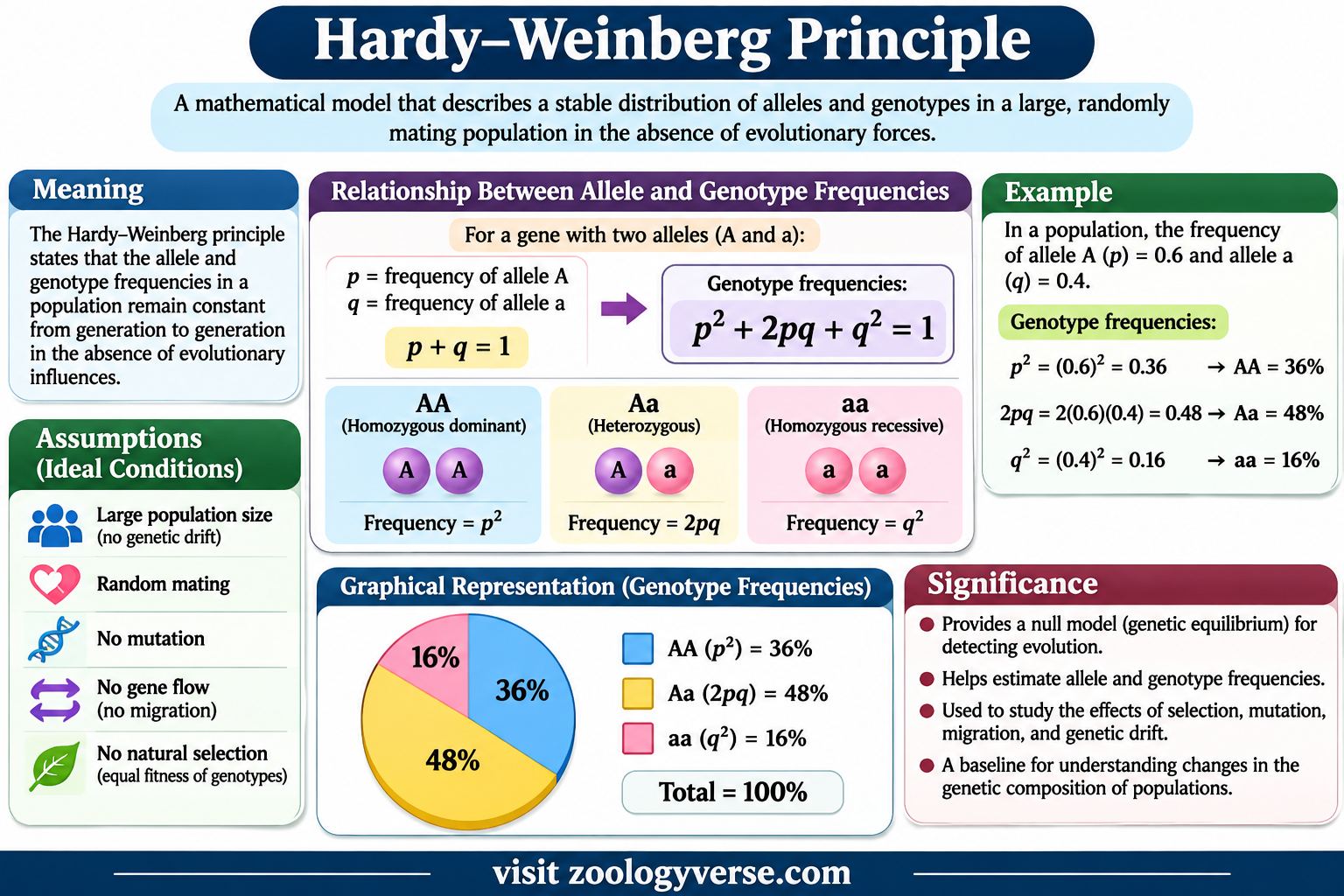
The Hardy-Weinberg principle is one of the most important mathematical foundations of Population Genetics. It explains the relationship between allele frequencies and genotype frequencies in a population and provides a theoretical model for understanding genetic equilibrium.
The principle establishes that allele and genotype frequencies remain constant from generation to generation when a population satisfies a specific set of ideal conditions. Any deviation from the expected equilibrium may indicate the influence of evolutionary forces or other factors affecting the population.
4.1 Definition of the Hardy-Weinberg Principle
The Hardy-Weinberg principle states that in a sufficiently large, randomly mating population, allele and genotype frequencies remain constant across generations in the absence of mutation, migration, natural selection and genetic drift.
This condition is known as Hardy-Weinberg equilibrium or genetic equilibrium.
The principle was independently formulated in 1908 by Godfrey Harold Hardy and Wilhelm Weinberg.
It provides a mathematical baseline for determining whether a population is undergoing evolutionary change at a particular genetic locus.
4.2 Mathematical Representation
Consider a population in which a particular gene has two alleles, A and a.
Let:
- (p) = frequency of allele A.
- (q) = frequency of allele a.
Since these are the only two alleles considered:
[
p+q=1
]
Under random mating, the expected genotype frequencies are obtained by expanding the expression:
[
(p+q)^2=1
]
Therefore:
[
p^2+2pq+q^2=1
]
Where:
| Expression | Genotype | Meaning |
|---|---|---|
| (p^2) | AA | Homozygous dominant |
| (2pq) | Aa | Heterozygous |
| (q^2) | aa | Homozygous recessive |
The equation predicts the genotype frequencies expected when the population is in Hardy-Weinberg equilibrium.
4.3 Explanation Through a Numerical Example
Consider a population in which the frequency of allele A is 0.7 and the frequency of allele a is 0.3.
Therefore:
[
p=0.7,\qquad q=0.3
]
According to the Hardy-Weinberg equation:
[
p^2+2pq+q^2=1
]
Substituting the values:
[
(0.7)^2+2(0.7)(0.3)+(0.3)^2=1
]
[
0.49+0.42+0.09=1
]
Thus, the expected genotype frequencies are:
| Genotype | Calculation | Expected frequency | Percentage |
|---|---|---|---|
| AA | (p^2) | 0.49 | 49% |
| Aa | (2pq) | 0.42 | 42% |
| aa | (q^2) | 0.09 | 9% |
| Total | 1.00 | 100% |
This means that under Hardy-Weinberg equilibrium, approximately 49% of individuals are expected to possess genotype AA, 42% genotype Aa and 9% genotype aa.
4.4 Conditions Required for Hardy-Weinberg Equilibrium
The Hardy-Weinberg principle operates under several ideal conditions. These assumptions describe a theoretical population in which evolutionary forces do not alter allele frequencies.
1. Large Population Size
The population should be sufficiently large to minimise random changes in allele frequencies caused by sampling effects.
In small populations, genetic drift can produce considerable fluctuations in allele frequencies, potentially resulting in the loss or fixation of alleles.
2. Random Mating
Individuals should mate randomly with respect to the gene being studied.
Random mating allows genotype frequencies to follow the expected proportions under the Hardy-Weinberg model.
Non-random mating, including inbreeding and assortative mating, may alter genotype frequencies even when allele frequencies remain unchanged.
3. Absence of Mutation
No new alleles should be introduced through mutation, and existing alleles should not be converted into alternative forms.
Mutation can introduce new genetic variants and may gradually alter allele frequencies.
4. Absence of Migration or Gene Flow
There should be no movement of individuals or reproductive genetic material into or out of the population.
Migration can introduce new alleles or change the relative frequencies of existing alleles.
5. Absence of Natural Selection
All genotypes should have equal survival and reproductive success.
If individuals carrying particular genotypes reproduce more successfully than others, natural selection may change allele frequencies across generations.
6. Normal Mendelian Inheritance
Alleles should be transmitted according to the expected Mendelian patterns of inheritance, without segregation distortion or other unusual transmission effects.
These conditions together establish the theoretical basis of genetic equilibrium.
4.5 Significance of the Hardy-Weinberg Principle
The Hardy-Weinberg principle has several important applications in evolutionary biology and Population Genetics.
1. Detection of Evolutionary Change
It provides a reference model for identifying changes in allele and genotype frequencies. Deviations from expected frequencies may indicate that evolutionary forces are acting on a population.
2. Estimation of Allele Frequencies
The principle allows researchers to estimate allele frequencies from genotype data when its assumptions are appropriate.
3. Study of Recessive Genetic Disorders
The frequency of recessive alleles and affected homozygous individuals can be estimated in suitable populations.
For example, if the frequency of a recessive phenotype is known, the frequency of the recessive allele may be estimated using:
[
q^2=\text{frequency of recessive homozygotes}
]
Therefore:
[
q=\sqrt{q^2}
]
4. Understanding Genetic Structure
The model helps compare observed genotype frequencies with expected frequencies and provides information about the genetic organisation of populations.
5. Foundation for Evolutionary Studies
It establishes the theoretical connection between inheritance and evolution by demonstrating that allele frequencies remain stable under specified conditions. Evolutionary mechanisms can then be studied in terms of their effects on this equilibrium.
The Hardy-Weinberg principle provides a theoretical baseline for identifying evolutionary changes in populations. These changes can be understood through different forms of evolutionary evidence, discussed in our detailed article on Evidences of Evolution: Types, Examples and Importance.
4.6 Limitations of the Hardy-Weinberg Principle
Although the Hardy-Weinberg principle is highly useful, it describes an idealised population rather than the complete complexity of natural populations.
Most natural populations experience one or more departures from its assumptions.
For example:
- Natural populations may be relatively small and experience genetic drift.
- Migration may introduce new alleles.
- Mutations may generate new genetic variants.
- Natural selection may favour particular genotypes.
- Inbreeding and other non-random mating patterns may alter genotype frequencies.
- Populations may be subdivided into geographically or reproductively structured groups.
Therefore, Hardy-Weinberg equilibrium should be considered a theoretical reference model rather than a condition that all natural populations continuously maintain.
4.7 Hardy-Weinberg Equilibrium and Evolution
The Hardy-Weinberg principle provides an important way to distinguish genetic stability from evolutionary change.
When allele frequencies remain constant across generations, the population is considered to be in equilibrium at the studied locus.
However, when allele frequencies change over successive generations, the population is undergoing evolution at that locus.
Mutation, natural selection, genetic drift and gene flow are among the major processes responsible for such changes.
Thus, the Hardy-Weinberg principle provides the mathematical foundation for studying evolutionary mechanisms and understanding how changes in genetic composition contribute to evolution.
5. Factors Affecting Allele Frequencies in Populations
The genetic composition of a population is not necessarily constant across generations. Various biological and environmental processes influence the transmission, distribution and reproductive success of alleles. These processes can alter allele frequencies, modify genetic diversity and contribute to evolutionary change.
In Population Genetics, changes in allele frequencies are considered a fundamental indicator of evolution. The major evolutionary forces responsible for these changes include mutation, natural selection, genetic drift and gene flow. Non-random mating also influences population genetic structure, particularly genotype frequencies.
5.1 Mutation
Mutation refers to a permanent change in the nucleotide sequence of genetic material. It is an important ultimate source of new genetic variation because it can produce new alleles that were not previously present in a population.
Mutations may occur spontaneously during DNA replication or may be induced by external factors such as radiation and certain chemicals.
Types of Mutations
1. Gene Mutations
Gene mutations involve changes in the nucleotide sequence of a particular gene. They may occur through:
- Substitution: Replacement of one nucleotide by another.
- Insertion: Addition of one or more nucleotides.
- Deletion: Removal of one or more nucleotides.
These changes may alter the structure or function of the resulting gene product.
2. Chromosomal Mutations
Chromosomal mutations involve structural changes in chromosomes, including:
- Deletion: Loss of a chromosome segment.
- Duplication: Repetition of a chromosome segment.
- Inversion: Reversal of a chromosome segment.
- Translocation: Transfer of a chromosome segment to another chromosome or location.
3. Genomic Mutations
Genomic mutations involve changes in chromosome number. Examples include aneuploidy and polyploidy.
Evolutionary Importance of Mutation
Mutation introduces new alleles into populations and increases the potential range of inherited characteristics.
Its evolutionary importance includes:
- Providing new genetic variants.
- Increasing the genetic diversity of populations.
- Supplying new alleles upon which natural selection can act.
- Contributing to adaptation and evolutionary diversification.
- Producing genetic changes that may eventually contribute to reproductive isolation.
Although many mutations are neutral or harmful, some may provide advantages under particular environmental conditions.
5.2 Natural Selection
Natural selection is an evolutionary process in which individuals possessing inherited characteristics that improve survival or reproductive success tend to contribute more offspring to subsequent generations.
It is one of the major mechanisms responsible for adaptive evolution.
Natural selection acts on phenotypic differences among individuals, but evolutionary changes occur when the underlying inherited variants become more or less common across generations.
Types of Natural Selection
1. Directional Selection
Directional selection favours individuals at one extreme of a phenotypic distribution.
As a result, the population may gradually shift towards the favoured characteristic.
Example: The development of antibiotic resistance in bacterial populations when resistant variants survive and reproduce during antibiotic exposure.
2. Stabilizing Selection
Stabilizing selection favours intermediate phenotypes and selects against individuals at both extremes.
It tends to reduce phenotypic variation around the average value.
Example: Human birth weight, where extremely low and extremely high birth weights are associated with greater risks of mortality than intermediate birth weights.
3. Disruptive Selection
Disruptive selection favours individuals at both extremes of a phenotypic distribution while selecting against intermediate forms.
Under suitable conditions, it may contribute to population divergence and evolutionary diversification.
Evolutionary Importance of Natural Selection
Natural selection changes the relative reproductive contribution of different genetic variants.
Its major effects include:
- Increasing the frequency of advantageous alleles.
- Reducing the frequency of disadvantageous alleles under particular conditions.
- Promoting adaptation to environmental conditions.
- Maintaining certain genetic variants through balancing selection.
- Contributing to reproductive isolation and speciation when populations experience different selective pressures.
Natural selection does not produce variations according to the needs of organisms. Instead, it acts on inherited variations that already exist or arise through mutation and recombination.
5.3 Genetic Drift
Genetic drift refers to random changes in allele frequencies caused by chance events in populations.
Unlike natural selection, genetic drift does not depend on whether an allele provides an adaptive advantage. An allele may increase or decrease in frequency simply because of random differences in reproductive success.
Genetic drift is particularly influential in small populations, where random sampling effects can produce substantial changes in genetic composition.
Types of Genetic Drift
1. Founder Effect
The founder effect occurs when a new population is established by a small number of individuals from a larger original population.
The founding individuals carry only a portion of the original population’s genetic diversity. Consequently, some alleles may become unusually common or may be absent in the newly established population.
Example: Certain inherited genetic disorders occur at relatively high frequencies in populations descended from small founder groups.
2. Bottleneck Effect
The bottleneck effect occurs when a population experiences a sudden and substantial reduction in size due to events such as natural disasters, disease outbreaks, habitat destruction or overhunting.
The surviving individuals represent only a random sample of the original population’s genetic diversity.
As a result, allele frequencies may change considerably, and genetic diversity may be reduced.
Evolutionary Importance of Genetic Drift
Genetic drift has several important evolutionary consequences:
- It produces random changes in allele frequencies.
- It may cause the loss of rare alleles.
- It can lead to the fixation of particular alleles.
- It often reduces genetic diversity in small populations.
- It can increase genetic differences between isolated populations.
- It contributes to evolutionary divergence independently of natural selection.
5.4 Gene Flow
Gene flow refers to the movement of alleles between populations through the migration and subsequent reproduction of individuals or through the transfer of reproductive material.
It is an important process responsible for the exchange of genetic material among populations.
For example, when individuals migrate from one population to another and successfully reproduce, they may introduce alleles that were previously uncommon or absent in the recipient population.
Causes of Gene Flow
Gene flow may occur through:
- Migration of animals between geographical regions.
- Movement of pollen between plant populations.
- Dispersal of seeds to new locations.
- Movement of aquatic organisms between connected habitats.
- Interbreeding between neighbouring populations.
Evolutionary Importance of Gene Flow
Gene flow influences the genetic composition of populations in several ways:
- It introduces new alleles into recipient populations.
- It may increase genetic variation within populations.
- It can reduce genetic differences between populations.
- It may counteract the effects of genetic drift.
- It can spread advantageous alleles across geographical regions.
- It may reduce local adaptation when incoming alleles are less suited to local environmental conditions.
The evolutionary effects of gene flow depend on its intensity, direction and interaction with other evolutionary processes.
5.5 Non-Random Mating
Non-random mating occurs when individuals do not select mates randomly with respect to particular characteristics or genetic relationships.
It can influence the distribution of genotypes within populations and may affect the frequency of homozygous and heterozygous individuals.
However, non-random mating does not necessarily change allele frequencies by itself.
Types of Non-Random Mating
1. Inbreeding
Inbreeding involves mating between individuals that are more closely related than expected under random mating.
It increases homozygosity and may increase the probability that harmful recessive alleles occur in homozygous individuals.
2. Positive Assortative Mating
Positive assortative mating occurs when individuals with similar phenotypic or genetic characteristics preferentially mate with one another.
It generally increases homozygosity at the loci associated with the selected characteristics.
3. Negative Assortative Mating
Negative assortative mating occurs when individuals with dissimilar characteristics preferentially mate.
It may increase heterozygosity at the relevant loci.
Evolutionary Importance of Non-Random Mating
Non-random mating influences genotype frequencies, patterns of genetic diversity and reproductive relationships among individuals.
Its effects may interact with natural selection, genetic drift and population subdivision to influence long-term evolutionary changes.
5.6 Comparison of Major Evolutionary Forces
| Evolutionary force | Principal effect | Effect on genetic variation |
|---|---|---|
| Mutation | Introduces new alleles | Provides new genetic variants |
| Natural selection | Changes reproductive success of genotypes | May increase or decrease variation |
| Genetic drift | Randomly changes allele frequencies | Often reduces variation within small populations |
| Gene flow | Transfers alleles between populations | Often increases variation within recipient populations |
| Non-random mating | Alters genotype combinations | Changes homozygosity and heterozygosity |
These evolutionary forces do not operate independently in nature. Their combined effects determine the genetic composition and evolutionary trajectory of populations.
For example, mutation may introduce a new allele, natural selection may favour it, gene flow may spread it between populations, and genetic drift may randomly alter its frequency, particularly in small populations.
Therefore, understanding these processes is essential for explaining how genetic diversity is maintained, modified and distributed within natural populations.
6. Genetic Variation and Its Sources in Populations
Genetic variation is one of the most important requirements for evolutionary change. Individuals belonging to the same population are not genetically identical. They possess differences in their DNA sequences, alleles and combinations of hereditary characteristics. These differences contribute to the genetic diversity observed within and between populations.
In Population Genetics, genetic variation is studied to understand how hereditary differences arise, how they are transmitted across generations and how they influence the evolutionary potential of populations.
Genetic variation provides the raw material for natural selection and other evolutionary processes. Without heritable differences, populations would have limited capacity to undergo adaptive evolutionary changes in response to environmental conditions.
6.1 Meaning and Nature of Genetic Variation
Genetic variation refers to differences in genetic composition among individuals of the same population or species. These differences may involve single nucleotides, entire genes, chromosome structures or chromosome numbers.
Genetic variation may be expressed through differences in:
- Body size and shape.
- Skin, coat or body coloration.
- Physiological characteristics.
- Disease resistance.
- Metabolic activities.
- Reproductive characteristics.
- Behavioural traits.
For example, individuals belonging to a population of butterflies may exhibit different wing colour patterns due to inherited genetic differences. Similarly, individuals within a bacterial population may differ in their susceptibility to antibiotics.
Some genetic differences produce visible phenotypic variations, whereas others may have no immediately observable effect.
6.2 Sources of Genetic Variation
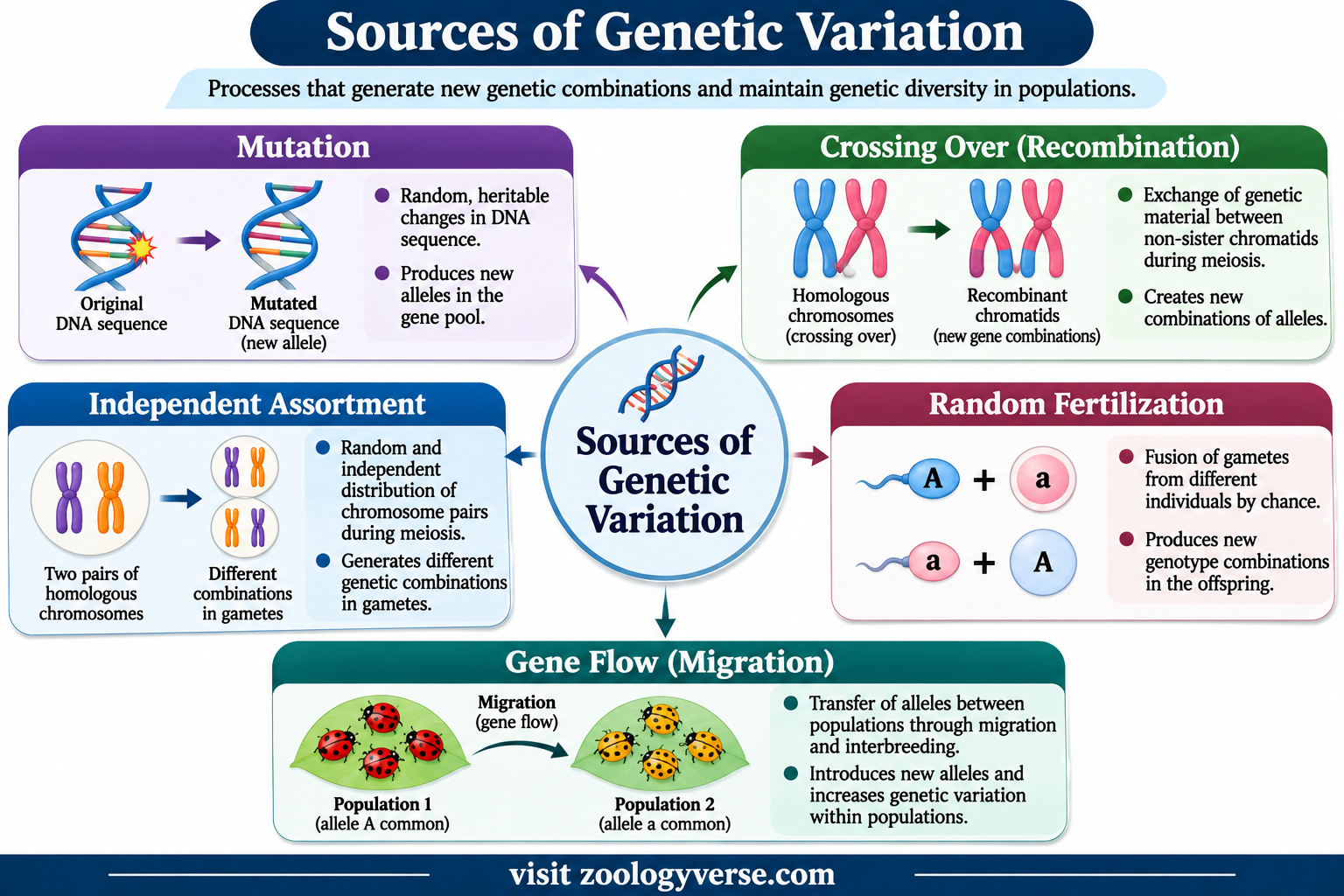
Genetic variation originates through several biological mechanisms. The most important sources include mutation, genetic recombination, independent assortment, random fertilization and gene flow.
6.2.1 Mutation
Mutation is a permanent alteration in the genetic material that may introduce a new allele into a population.
It is the ultimate source of new alleles and therefore provides the initial genetic material for many evolutionary changes.
Mutations may occur spontaneously during DNA replication or may be induced by mutagenic agents such as ultraviolet radiation, ionizing radiation and certain chemicals.
Depending on their effects, mutations may be classified as:
- Beneficial mutations: Increase reproductive success under particular environmental conditions.
- Harmful mutations: Reduce survival or reproductive success.
- Neutral mutations: Have no significant effect on fitness under the conditions in which they occur.
Mutations may affect a single nucleotide, a larger DNA segment or chromosome structure and number.
6.2.2 Genetic Recombination
Genetic recombination refers to the formation of new combinations of alleles through the exchange and rearrangement of genetic material.
It occurs primarily during meiosis in sexually reproducing organisms.
One important mechanism is crossing over, which takes place during prophase I of meiosis. During this process, homologous chromosomes exchange corresponding segments, producing recombinant chromosomes.
Recombination creates new combinations of existing alleles and increases genetic diversity among offspring.
For example, if homologous chromosomes carry different alleles at several loci, crossing over may produce gametes containing combinations of alleles that were not present together on the original parental chromosomes.
6.2.3 Independent Assortment of Chromosomes
Independent assortment is the random orientation and separation of homologous chromosome pairs during meiosis.
During metaphase I, homologous chromosome pairs align independently of one another. Their subsequent separation produces different combinations of maternal and paternal chromosomes in gametes.
In humans, who possess 23 pairs of chromosomes, independent assortment alone can produce:
[
2^{23}=8,388,608
]
possible combinations of chromosomes in gametes, without considering crossing over.
This enormous number of possible combinations contributes substantially to genetic diversity among offspring.
6.2.4 Random Fertilization
Random fertilization occurs when any genetically distinct sperm cell may fuse with any genetically distinct egg cell.
Since each gamete carries a different combination of parental alleles, fertilization generates numerous possible genetic combinations in offspring.
In humans, the combination of independent assortment and random fertilization produces an exceptionally large number of possible genetic combinations, even before considering recombination.
Random fertilization therefore contributes to variation among individuals within sexually reproducing populations.
6.2.5 Gene Flow
Gene flow introduces genetic material into a population through the movement and reproduction of individuals or the transfer of gametes, pollen and other reproductive material.
When individuals from different populations interbreed, alleles may be transferred between their populations.
For example, pollen carried by wind or insects may introduce alleles from one plant population into another. Similarly, migration of animals between geographical regions may facilitate the exchange of genetic material.
Gene flow can increase genetic variation within a recipient population and reduce genetic differences between populations.
6.3 Types of Genetic Variation
Genetic variation can be classified according to the nature and extent of the genetic differences involved.
6.3.1 Nucleotide-Level Variation
Nucleotide-level variation involves differences in individual DNA bases or short DNA sequences.
Single nucleotide polymorphisms (SNPs) are common examples. They occur when individuals differ at a particular nucleotide position in their DNA.
Such variations may occur within coding or non-coding regions and may influence biological characteristics depending on their location and functional effects.
6.3.2 Gene-Level Variation
Gene-level variation involves alternative forms of genes or differences in their sequences.
Different alleles of a gene may produce variations in protein structure, gene expression or other biological functions.
The ABO blood group system in humans is a well-known example of inherited gene-level variation.
6.3.3 Chromosomal Variation
Chromosomal variation involves differences in chromosome structure or number.
Structural variations include deletions, duplications, inversions and translocations. Numerical variations include changes such as aneuploidy and polyploidy.
Some chromosomal changes can influence fertility, development and evolutionary relationships among populations.
6.4 Continuous and Discontinuous Variation
Genetic variation may also be studied according to the distribution of phenotypic characteristics.
Continuous Variation
Continuous variation occurs when a characteristic exhibits a range of intermediate values rather than distinct categories.
Examples include:
- Human height.
- Body weight.
- Skin pigmentation.
- Certain physiological measurements.
Such characteristics are frequently influenced by multiple genes and environmental factors.
Discontinuous Variation
Discontinuous variation occurs when individuals can be classified into distinct phenotypic categories without a continuous range of intermediate forms.
Examples include:
- ABO blood groups in humans.
- Certain inherited genetic conditions.
- Some distinct colour morphs in animal populations.
Discontinuous traits may be controlled by one or a few genes, although their expression can also be influenced by other genetic and environmental factors.
6.5 Importance of Genetic Variation in Evolution
Genetic variation plays a central role in the evolutionary process because it provides differences upon which evolutionary mechanisms can act.
Its major evolutionary contributions include:
1. Raw Material for Natural Selection
Natural selection requires inherited differences among individuals. Genetic variation provides the alternative alleles and phenotypic characteristics upon which selection can act.
2. Adaptation to Environmental Changes
When environmental conditions change, individuals carrying certain inherited variants may have greater reproductive success. Over generations, these variants may become more common in the population.
3. Maintenance of Genetic Diversity
The presence of multiple alleles and genetic combinations contributes to the diversity of populations. This diversity may be maintained by mutation, gene flow and balancing selection.
4. Resistance to Diseases
Genetic differences may influence susceptibility to pathogens and infectious diseases. Certain inherited variants may provide resistance under particular environmental conditions.
5. Evolutionary Diversification
Differences in genetic composition may accumulate between geographically or reproductively isolated populations. Over time, these differences may contribute to reproductive isolation and speciation.
6. Conservation of Biological Diversity
Genetic diversity is important for the long-term survival of endangered species. Populations with very low genetic variation may have reduced capacity to respond to environmental changes and emerging diseases.
6.6 Genetic Variation and Population Fitness
The evolutionary consequences of genetic variation depend on the characteristics of the variants present and the environmental conditions in which populations exist.
A genetically diverse population may contain individuals with different physiological and behavioural characteristics. If environmental conditions change, some of these inherited differences may become advantageous.
However, greater genetic variation does not automatically guarantee higher fitness. The effects of particular alleles depend on their interactions with other genes, environmental conditions and reproductive circumstances.
For this reason, the study of genetic variation is essential for understanding adaptation, population persistence and evolutionary change.
Genetic variation connects inheritance with evolution by providing the inherited differences that can be modified in frequency and distribution through successive generations.
7. Genetic Polymorphism and Its Evolutionary Significance
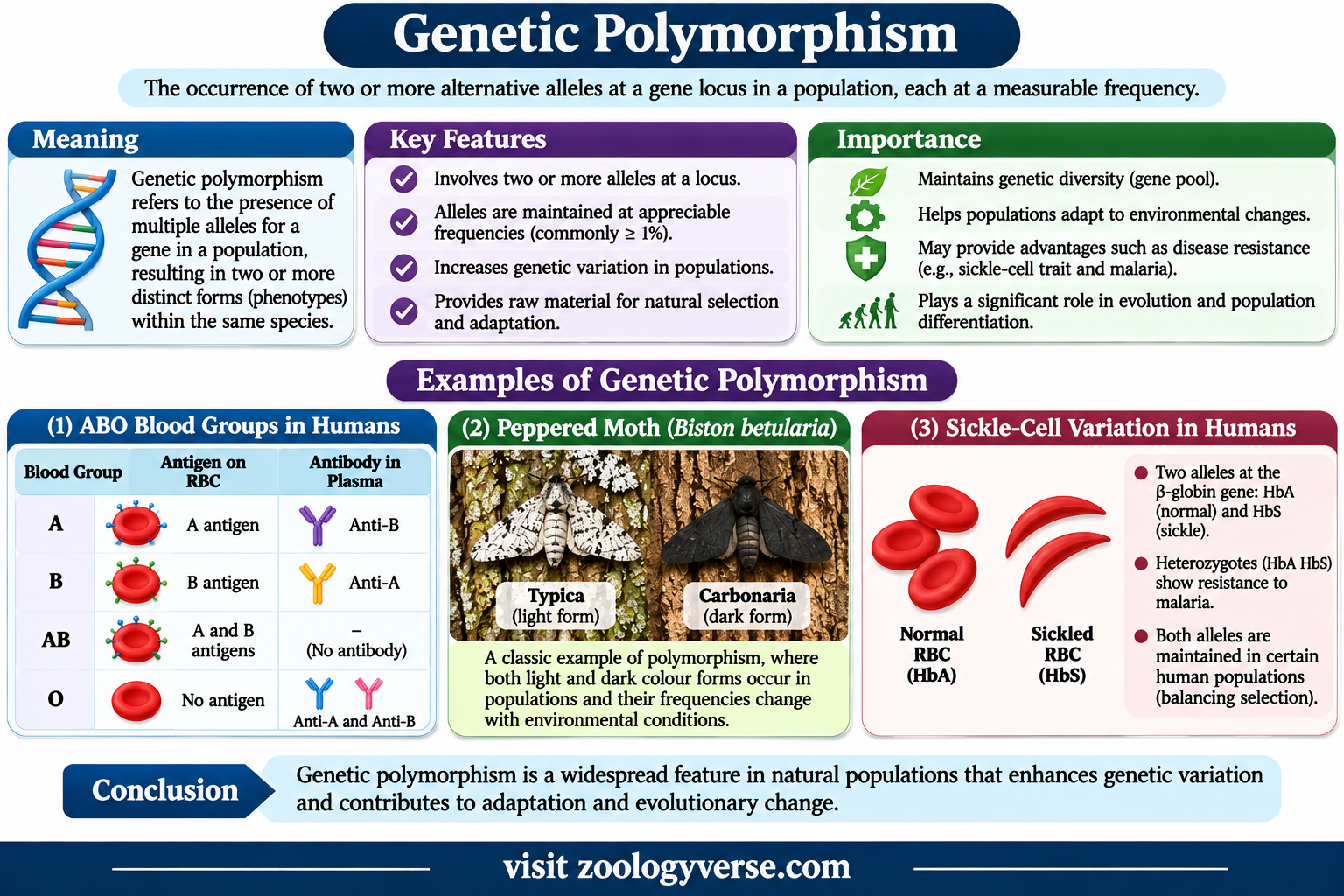
Genetic polymorphism is an important feature of natural populations in which two or more genetically distinct forms occur at appreciable frequencies. It represents the coexistence of alternative alleles or inherited phenotypic forms within the same population.
The study of genetic polymorphism helps explain how genetic diversity is maintained, how populations respond to environmental changes and how different evolutionary mechanisms influence the distribution of alleles. It is also important for understanding adaptation, disease resistance and the long-term evolutionary potential of species.
7.1 Definition of Genetic Polymorphism
Genetic polymorphism refers to the occurrence of two or more genetically determined forms or alleles within an interbreeding population at appreciable frequencies.
The term polymorphism is derived from two Greek words: poly, meaning many, and morphe, meaning form.
In genetics, polymorphism generally describes the presence of alternative forms of a genetic characteristic within a population. These forms may produce observable phenotypic differences or may involve variations in DNA sequences that are not directly visible.
For example, the human ABO blood group system exhibits genetic polymorphism because multiple alleles occur within human populations and produce different blood group phenotypes.
Genetic polymorphism is important because it demonstrates that populations can maintain multiple inherited variants rather than becoming genetically uniform.
7.2 Types of Genetic Polymorphism
Genetic polymorphism can be classified into different categories according to the nature of the genetic differences and their phenotypic expression.
7.2.1 DNA Sequence Polymorphism
DNA sequence polymorphism refers to differences in nucleotide sequences among individuals of a population.
These differences may involve a single nucleotide or larger segments of DNA.
One common example is a single nucleotide polymorphism (SNP), in which individuals differ at a particular nucleotide position in their DNA sequence.
SNPs are widely used in genetic studies to investigate inherited variation, population relationships and disease-associated genetic differences.
7.2.2 Biochemical Polymorphism
Biochemical polymorphism refers to the occurrence of alternative forms of proteins or enzymes within a population.
These differences may result from variations in the genes responsible for producing particular proteins.
For example, different molecular forms of certain enzymes may be detected through biochemical techniques such as electrophoresis.
Biochemical polymorphism provides useful information about genetic differences that may not be visible through external morphology.
7.2.3 Morphological Polymorphism
Morphological polymorphism involves the occurrence of distinct external or structural forms within a population.
Examples include:
- Different body colour patterns in insects.
- Alternative shell colour patterns in certain molluscs.
- Different body forms in some aquatic organisms.
- Distinct colour morphs in certain reptiles and amphibians.
Morphological polymorphism may be influenced by genetic factors, environmental conditions or interactions between genes and the environment. Therefore, the genetic basis of each observed form must be established before it is considered a genetically maintained polymorphism.
7.2.4 Chromosomal Polymorphism
Chromosomal polymorphism refers to the presence of different chromosome arrangements or structural variants within a population or species.
It may involve:
- Chromosomal inversions.
- Translocations.
- Differences in chromosome structure.
- Certain chromosome number variations.
Such differences may influence recombination, fertility and genetic differentiation between populations.
7.3 Examples of Genetic Polymorphism
Several well-known examples demonstrate the occurrence of polymorphism in natural populations.
7.3.1 ABO Blood Group System in Humans
The ABO blood group system is one of the most familiar examples of genetic polymorphism.
It is controlled by three major alleles:
- (I^A)
- (I^B)
- (i)
The alleles (I^A) and (I^B) are codominant, whereas both are dominant over allele (i).
The different combinations produce four major blood group phenotypes:
| Genotype | Blood group |
|---|---|
| (I^AI^A) or (I^Ai) | A |
| (I^BI^B) or (I^Bi) | B |
| (I^AI^B) | AB |
| (ii) | O |
The ABO system demonstrates how multiple alleles can occur at a single gene locus and produce distinct phenotypes within human populations.
7.3.2 Colour Polymorphism in the Peppered Moth
The peppered moth, Biston betularia, provides a classic example of colour variation associated with natural selection.
Two well-known colour forms are:
- Light-coloured form.
- Dark melanic form.
During industrialisation in Britain, pollution darkened many tree surfaces and reduced the visibility of light-coloured moths in some environments. Dark-coloured moths consequently experienced a survival advantage in these conditions because they were less conspicuous to predators.
After pollution levels declined and tree surfaces became lighter, the relative advantage of the dark form decreased in many areas.
This example demonstrates how environmental conditions can influence the relative reproductive success of inherited colour variants.
7.3.3 Sickle-Cell Polymorphism in Humans
Sickle-cell polymorphism is associated with variation in the haemoglobin beta-chain gene.
The sickle-cell allele produces an altered form of haemoglobin known as haemoglobin S.
Individuals carrying two copies of the sickle-cell allele may develop sickle-cell disease. Individuals carrying one normal allele and one sickle-cell allele generally have the sickle-cell trait.
In regions where malaria has historically been common, heterozygous individuals may have increased protection against severe malaria compared with individuals carrying two normal alleles.
This advantage can contribute to the maintenance of both alleles within certain populations through heterozygote advantage, a form of balancing selection.
7.3.4 Colour Polymorphism in Animals
Different colour forms occur within populations of several animal species.
For example, some reptiles, amphibians and insects exhibit alternative colour patterns that may influence camouflage, thermoregulation, communication or interactions with predators.
The maintenance of such forms depends on their genetic basis and the ecological conditions affecting their survival and reproduction.
7.4 Mechanisms Maintaining Genetic Polymorphism
Multiple evolutionary mechanisms can contribute to the maintenance of alternative alleles within populations.
7.4.1 Balancing Selection
Balancing selection refers to evolutionary processes that maintain two or more alleles within a population rather than consistently favouring only one allele.
It may operate through:
Heterozygote Advantage
Heterozygote advantage occurs when individuals possessing two different alleles at a locus have higher fitness than either type of homozygote.
The sickle-cell and malaria example is a well-known illustration.
Frequency-Dependent Selection
Frequency-dependent selection occurs when the fitness of a phenotype or genotype depends on how common or rare it is within a population.
In negative frequency-dependent selection, rare forms may possess a reproductive or survival advantage because predators, parasites or competitors encounter them less frequently.
Spatially or Temporally Varying Selection
Different alleles may be favoured under different environmental conditions or at different times.
When environmental conditions vary across geographical regions or generations, multiple alleles may be maintained within the wider population.
7.4.2 Mutation
Mutation continually introduces new genetic variants into populations.
Although individual mutations may be rare, recurrent mutation can contribute to the maintenance of genetic diversity, particularly when combined with other evolutionary mechanisms.
7.4.3 Gene Flow
Gene flow transfers alleles between populations through migration and reproduction.
It may introduce genetic variants into populations where they were previously absent or uncommon, thereby contributing to genetic diversity.
7.4.4 Genetic Drift and Population Structure
Genetic drift randomly changes allele frequencies, particularly in small populations.
Although drift can eliminate polymorphism within isolated populations, population subdivision and differences in random genetic changes between populations can contribute to genetic differentiation across a species.
7.5 Evolutionary Significance of Genetic Polymorphism
Genetic polymorphism has several important consequences for evolutionary processes.
1. Maintenance of Genetic Diversity
It allows multiple alleles to coexist within populations and contributes to their overall genetic diversity.
2. Environmental Adaptation
Different genetic variants may provide advantages under different environmental conditions. Their coexistence may increase the range of responses available to a population.
3. Disease Resistance
Some genetic variants influence resistance or susceptibility to infectious diseases. The sickle-cell and malaria relationship illustrates how disease-related selection can maintain genetic variation.
4. Evolutionary Potential
The presence of alternative alleles provides genetic material upon which natural selection and other evolutionary processes can act.
5. Population Differentiation
Differences in the frequency of polymorphic alleles can help researchers study genetic relationships and evolutionary divergence between populations.
6. Conservation Biology
Understanding polymorphism is important for conservation because the loss of genetic variants may reduce the evolutionary potential of small or endangered populations.
Genetic polymorphism contributes to inherited differences within populations, while the accumulation of genetic differences can contribute to the formation of new species. Learn more about how species are defined and distinguished in our article on the Species Concept.
7.6 Genetic Polymorphism and Adaptation
Genetic polymorphism and adaptation are closely related, but they are not identical concepts.
Polymorphism describes the coexistence of different genetic forms, whereas adaptation refers to inherited characteristics that improve reproductive success under particular environmental conditions.
Some polymorphisms are maintained because different forms provide advantages in different ecological or genetic circumstances. Others may be neutral and persist through mutation, drift or gene flow.
Therefore, the presence of multiple genetic forms does not automatically indicate that every form is adaptive.
The evolutionary significance of a polymorphism depends on its genetic basis, its effects on fitness and the ecological conditions experienced by the population.
Genetic polymorphism consequently provides an important framework for understanding how genetic diversity is maintained and how populations retain the capacity for evolutionary change.
8. Applications and Importance of Population Genetics
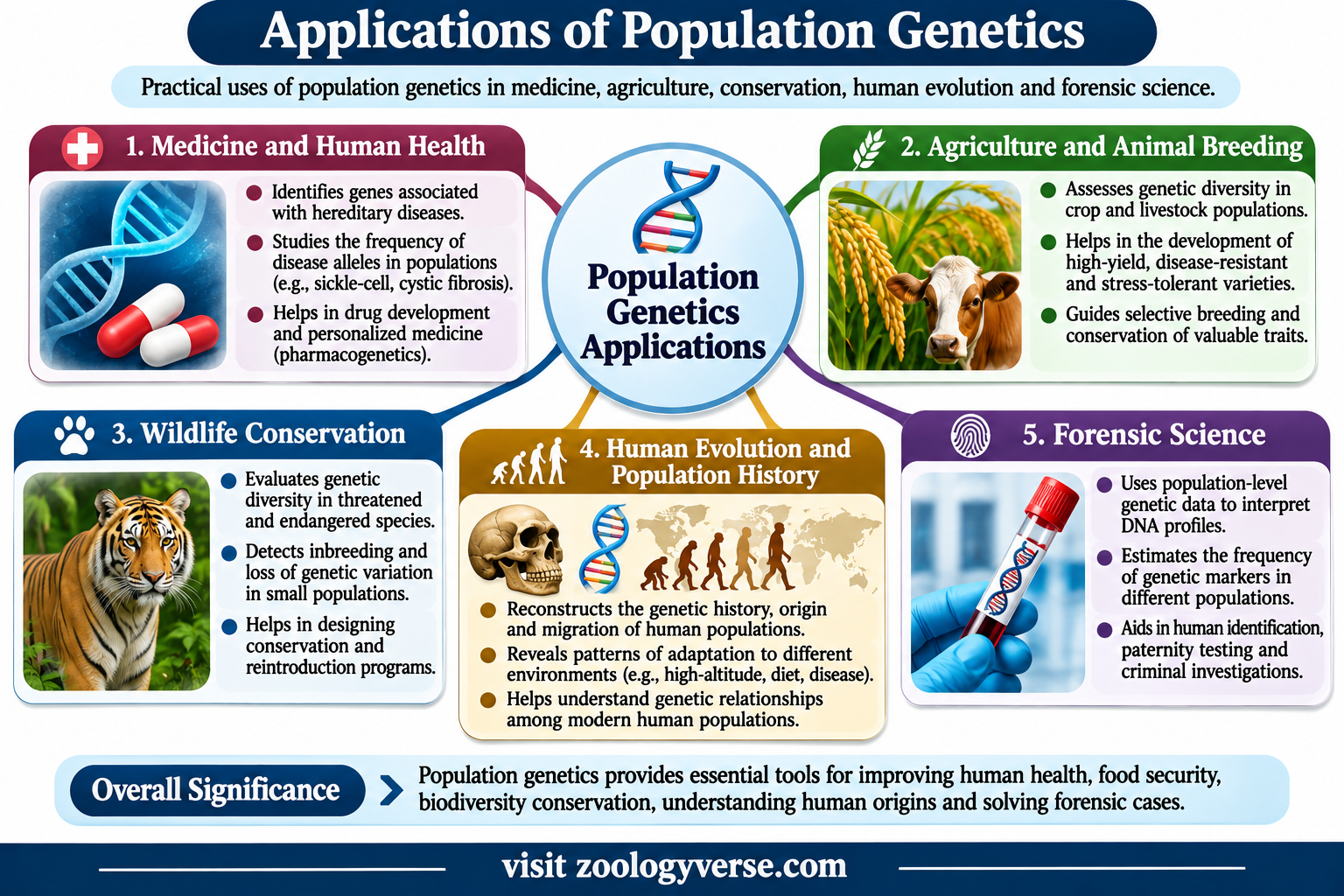
Population Genetics has wide applications in evolutionary biology, ecology, medicine, agriculture, conservation biology and forensic science. By examining the distribution of alleles and genotypes within populations, scientists can understand inherited diversity, investigate evolutionary relationships and predict how populations may respond to environmental changes.
Its importance extends beyond theoretical evolutionary studies because genetic information is increasingly used in practical fields such as disease research, wildlife management, crop improvement and biodiversity conservation.
8.1 Understanding Evolutionary Processes
One of the major applications of Population Genetics is the scientific investigation of evolution.
Evolution involves changes in inherited genetic characteristics across generations. By studying allele frequencies and genotype distributions, researchers can identify the effects of mutation, natural selection, genetic drift and gene flow.
Population-level genetic studies help explain:
- How advantageous alleles increase in frequency.
- How harmful or neutral alleles may persist.
- How isolated populations become genetically differentiated.
- How environmental conditions influence evolutionary change.
- How genetic differences accumulate during speciation.
These studies provide quantitative evidence for evolutionary processes and connect Mendelian inheritance with the broader patterns of biological evolution.
8.2 Study of Adaptation and Natural Selection
Population Genetics helps researchers understand how organisms adapt to changing environmental conditions.
Natural selection acts on inherited differences among individuals. When particular genetic variants improve survival or reproductive success, their frequencies may increase over successive generations.
Examples include:
Antibiotic Resistance in Bacteria
Bacterial populations may contain genetic variants that provide resistance to particular antibiotics. When antibiotics are used, susceptible bacteria may be eliminated more readily, whereas resistant bacteria may survive and reproduce.
Over generations, resistance-associated alleles can become more common in the bacterial population.
Insecticide Resistance
Insect populations may contain inherited variations that influence their susceptibility to insecticides. Repeated exposure can favour resistant individuals, resulting in an increase in resistance-associated genetic variants.
Environmental Adaptation
Populations living under different environmental conditions may experience different selective pressures. Genetic variants that are advantageous in one environment may not provide the same advantage in another.
Thus, Population Genetics provides a framework for studying the genetic basis of adaptation.
8.3 Medical Genetics and Human Health
Population Genetics is important in medical research because the frequency and distribution of inherited genetic variants influence the occurrence of many genetic disorders.
It helps researchers investigate:
- The frequency of disease-associated alleles.
- Inherited susceptibility to particular diseases.
- Patterns of genetic disorders in different populations.
- The effects of inbreeding on recessive genetic conditions.
- Genetic variation associated with drug responses.
For example, the distribution of sickle-cell alleles is influenced by historical and geographical patterns of malaria transmission.
Similarly, population-level genetic studies help identify inherited variants associated with conditions such as cystic fibrosis, thalassaemia and certain hereditary cancers.
Population-level information is also useful in understanding differences in drug metabolism and pharmacogenetic responses, although individual treatment decisions require appropriate clinical assessment.
8.4 Conservation Biology and Wildlife Management
Conservation biology uses genetic information to protect endangered species and maintain their long-term survival.
Small and isolated populations are particularly vulnerable to genetic drift, inbreeding and loss of genetic diversity.
Population Genetics helps conservation scientists evaluate the genetic health of threatened populations.
Its applications include:
1. Assessment of Genetic Diversity
Researchers examine the distribution of alleles and genetic variants to determine the level of diversity within endangered populations.
2. Detection of Inbreeding
Genetic studies help identify mating between related individuals and assess the possibility of increased homozygosity.
3. Identification of Population Structure
Genetic information helps determine whether a species consists of several distinct populations or a more interconnected population network.
4. Wildlife Translocation
Genetic data can help guide the movement of individuals between populations to improve genetic diversity while considering local adaptation and the risk of outbreeding problems.
5. Management of Endangered Species
Genetic studies support decisions concerning captive breeding, habitat connectivity and the maintenance of viable wild populations.
Thus, genetic information is an important component of modern wildlife conservation programmes.
8.5 Agriculture and Animal Breeding
Population Genetics has significant applications in the improvement of agricultural plants and domesticated animals.
Plant and animal breeders use genetic principles to understand inherited characteristics and select individuals possessing desirable traits.
Applications in Plant Breeding
Population-level genetic studies help identify and maintain useful genetic variants associated with:
- Higher crop yield.
- Disease resistance.
- Drought tolerance.
- Improved nutritional quality.
- Environmental adaptability.
Genetic diversity is especially important in crop improvement because it provides the variation required for developing new plant varieties.
Applications in Animal Breeding
In animal breeding, genetic information is used to improve characteristics such as:
- Milk production.
- Meat quality.
- Growth rate.
- Reproductive performance.
- Disease resistance.
Breeding programmes aim to increase the frequency of desirable inherited characteristics while managing inbreeding and maintaining sufficient genetic diversity.
8.6 Study of Human Population History
Population Genetics is widely used to investigate human evolutionary history, migration and relationships among populations.
Differences in allele frequencies and patterns of genetic variation provide information about historical population movements and ancestry.
Molecular genetic studies can help researchers investigate:
- Historical migration routes.
- Population expansion and contraction.
- Genetic relationships among human populations.
- Genetic admixture between populations.
- The effects of geographical isolation.
The study of mitochondrial DNA, Y-chromosomal markers and genome-wide variation has contributed substantially to research on human population history.
However, genetic similarities and differences should be interpreted carefully because human genetic variation is complex and does not divide neatly into rigid biological categories.
8.7 Understanding Speciation and Evolutionary Relationships
Population Genetics contributes to the study of speciation by explaining how genetic differences accumulate between populations.
When populations become geographically or reproductively isolated, their genetic compositions may gradually diverge through mutation, selection and genetic drift.
Over time, reproductive barriers may develop, reducing or preventing successful interbreeding.
Genetic comparisons can therefore help researchers:
- Identify genetic differentiation between populations.
- Investigate reproductive isolation.
- Examine gene flow between related species.
- Study hybridisation.
- Reconstruct evolutionary relationships.
Population-level genetic analysis is particularly useful for understanding the early stages of evolutionary divergence.
8.8 Forensic Science and Population Identification
Population Genetics also has applications in forensic science.
DNA profiling examines inherited genetic markers to compare biological samples and investigate possible relationships between individuals.
Population genetic information is used to estimate how frequently particular genetic profiles occur in reference populations.
These frequency estimates help assess the evidential significance of DNA matches.
Forensic interpretation requires appropriate reference databases, validated statistical methods and careful consideration of population structure.
8.9 Epidemiology and Infectious Disease Research
Population-level genetic studies are useful in understanding the spread and evolution of infectious organisms.
Researchers can examine genetic differences among pathogen populations to investigate:
- Patterns of disease transmission.
- The emergence of new genetic variants.
- The spread of drug resistance.
- Changes in pathogen populations over time.
- Evolutionary relationships between pathogen strains.
For example, genomic surveillance of bacterial and viral populations can help track the emergence and geographical spread of particular variants.
Such information supports disease monitoring and public health research.
8.10 Importance in Modern Biological Research
Population Genetics provides an important theoretical and methodological foundation for several modern biological disciplines.
Its contributions include:
- Explaining evolutionary change through measurable genetic differences.
- Connecting Mendelian inheritance with population-level evolution.
- Identifying the effects of evolutionary forces on genetic composition.
- Understanding the origin and maintenance of genetic diversity.
- Supporting the conservation of endangered species.
- Improving crop and livestock breeding programmes.
- Investigating genetic factors associated with human diseases.
- Understanding the evolutionary history and relationships of populations.
The development of molecular biology, DNA sequencing and computational genetics has further expanded the applications of Population Genetics.
Modern genome-wide studies allow researchers to examine thousands or millions of genetic markers simultaneously, providing detailed information about population structure, migration, selection and evolutionary relationships.
Consequently, Population Genetics remains an essential field for understanding biological diversity and applying evolutionary principles to practical problems in medicine, agriculture, conservation and public health.
9. Relationship Between Population Genetics and Evolution
Population Genetics and evolutionary biology are closely interconnected because both investigate the genetic changes responsible for biological diversity and evolutionary transformation. Population Genetics provides the mathematical and genetic framework for understanding how evolutionary processes operate within populations, whereas evolutionary biology examines the broader patterns and consequences of these changes over time.
The relationship between these two fields is fundamental to the Modern Synthetic Theory of Evolution, which explains evolution through changes in inherited genetic characteristics across successive generations.
9.1 Population as the Basic Unit of Evolution
An individual organism may undergo growth, development and physiological changes during its lifetime, but these changes do not necessarily represent biological evolution.
Evolutionary change occurs when inherited genetic characteristics become more or less common in a population across generations.
A population contains a collection of individuals capable of exchanging genetic material through reproduction. The combined hereditary information of its reproductive members forms its gene pool.
When the relative frequencies of alleles within this gene pool change over successive generations, the population undergoes genetic evolution.
For example, if an allele associated with antibiotic resistance becomes increasingly common in a bacterial population following repeated antibiotic exposure, the genetic composition of that population has changed.
Thus, Population Genetics establishes the population as the principal unit in which evolutionary change can be measured.
9.2 Changes in Allele Frequencies as Evidence of Evolution
One of the central contributions of Population Genetics is the use of allele frequencies to measure evolutionary change.
An allele frequency represents the proportion of a particular allele among all copies of a gene at a specific locus within a population.
If allele frequencies remain constant across generations under the conditions of the Hardy-Weinberg principle, the population is considered to be in genetic equilibrium at that locus.
However, when allele frequencies change, the population is undergoing evolution at that locus.
Such changes may occur through:
- Mutation introducing new alleles.
- Natural selection favouring particular inherited variants.
- Genetic drift randomly changing allele frequencies.
- Gene flow transferring alleles between populations.
These mechanisms explain how evolutionary change can be studied quantitatively.
9.3 Role of Genetic Variation in Evolution
Genetic variation provides the inherited differences required for evolutionary processes to operate.
Individuals within a population may possess different alleles and genetic combinations. These differences can influence their survival, reproductive success and responses to environmental conditions.
For example, individuals carrying genetic variants that provide resistance to a particular disease may have greater reproductive success when that disease becomes common.
Natural selection may consequently increase the frequency of resistance-associated alleles over successive generations.
However, not all genetic differences are advantageous. Some may be neutral, while others may reduce reproductive success under particular conditions.
The presence and distribution of inherited variation therefore influence the evolutionary possibilities available to a population.
9.4 Interaction Between Evolutionary Mechanisms
Evolution is influenced by several mechanisms that may operate simultaneously within natural populations.
Population Genetics explains how these mechanisms interact to modify the genetic composition of populations.
1. Mutation and Natural Selection
Mutation introduces new alleles, while natural selection may increase or decrease their frequencies depending on their effects on reproductive success.
2. Genetic Drift and Natural Selection
Genetic drift produces random changes in allele frequencies, whereas natural selection produces non-random changes associated with differences in fitness. Both processes can influence evolutionary outcomes.
3. Gene Flow and Genetic Differentiation
Gene flow transfers alleles between populations and often reduces genetic differences between them. Reduced gene flow may allow populations to become increasingly genetically differentiated.
4. Recombination and Natural Selection
Recombination produces new combinations of existing alleles. Natural selection can subsequently influence the frequencies of these combinations according to their effects on fitness.
The combined effects of these processes determine the genetic trajectory of populations.
9.5 Population Differentiation and Evolutionary Divergence
When populations of the same species become geographically separated or experience limited reproductive exchange, their genetic compositions may gradually diverge.
Different populations may experience distinct mutations, environmental conditions, selective pressures and random changes in allele frequencies.
Over successive generations, these processes can produce differences in their genetic structures.
For example, populations living in different geographical environments may develop distinct adaptations because of differences in climate, food availability, predators and other ecological conditions.
Genetic differentiation may become increasingly pronounced when gene flow between populations is restricted.
9.6 Population Genetics and Speciation
Speciation is the evolutionary process through which new species arise from ancestral populations.
Population Genetics contributes to understanding speciation by explaining how genetic differences accumulate and how reproductive isolation develops.
When populations become isolated, several processes may contribute to their divergence:
- Mutation introduces new genetic variants.
- Natural selection favours different characteristics under different environmental conditions.
- Genetic drift produces random differences in allele frequencies.
- Reduced gene flow allows genetic differences to accumulate.
- Changes in reproductive characteristics may contribute to reproductive isolation.
Over time, reproductive barriers may become sufficiently strong that individuals from diverging populations can no longer successfully interbreed to produce fertile offspring under natural conditions.
However, speciation does not always follow a single pathway, and the relative importance of different evolutionary mechanisms varies among organisms.
9.7 Microevolution and Macroevolution
Population Genetics provides the genetic foundation for understanding microevolution, which involves changes in allele frequencies within populations across generations.
Microevolutionary changes may occur through mutation, natural selection, genetic drift and gene flow.
When genetic changes accumulate over longer evolutionary periods, they may contribute to broader evolutionary patterns, including speciation, adaptive radiation and diversification.
These large-scale patterns are studied under macroevolution.
The relationship between microevolution and macroevolution is important because changes occurring within populations can contribute to the origin and diversification of species over evolutionary time.
The accumulation of genetic changes over evolutionary time is closely associated with the fossil record, which provides evidence of biological diversification and extinction. Explore our article on the Geological Time Scale, Fossil Record and Mass Extinctions.
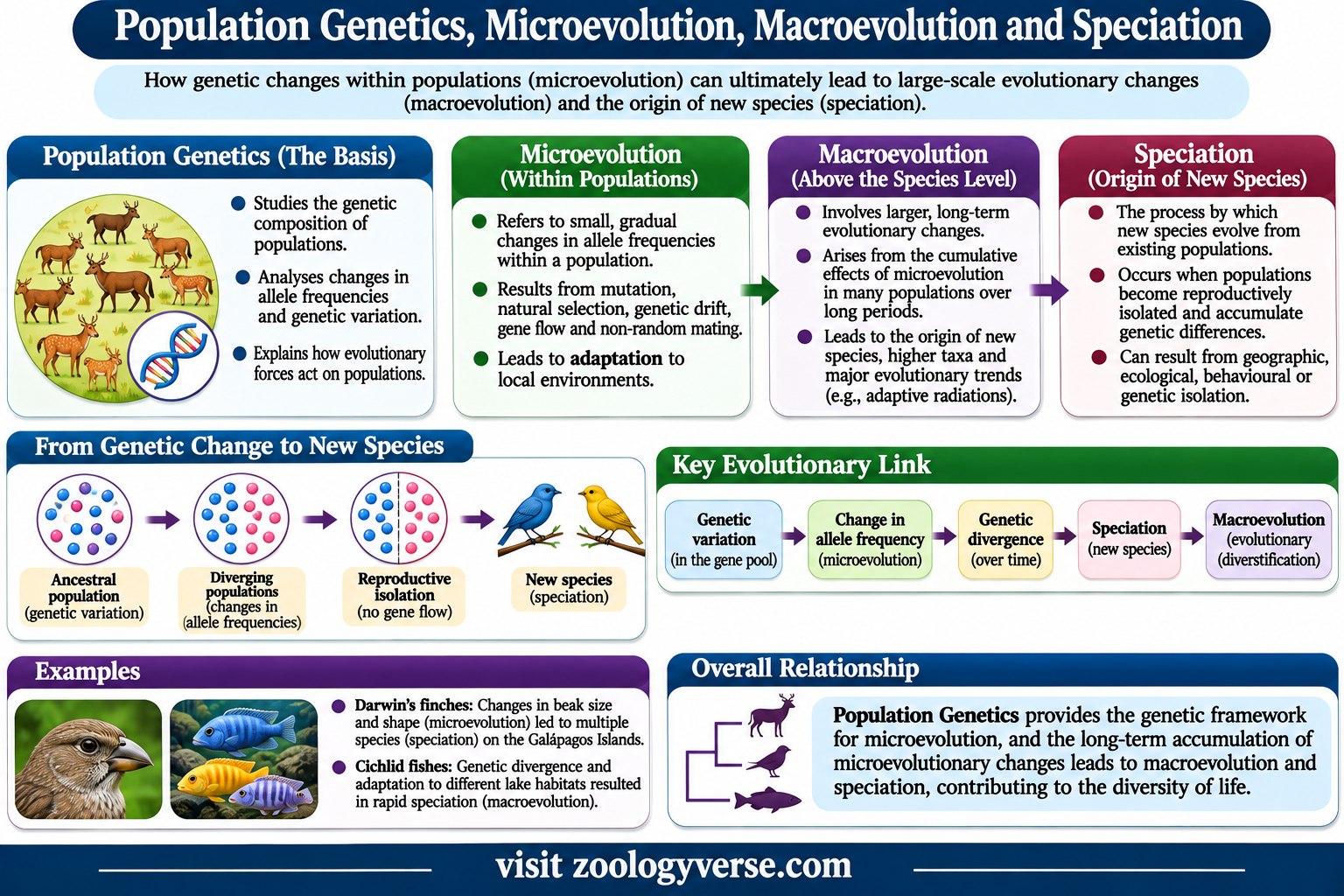
9.8 Population Genetics and the Modern Synthetic Theory of Evolution
The Modern Synthetic Theory of Evolution integrates Darwinian natural selection with Mendelian genetics and population-level evolutionary processes.
Population Genetics forms one of its central foundations because it explains how hereditary variation is distributed within populations and how evolutionary mechanisms change its frequency.
The work of Ronald Fisher, J. B. S. Haldane and Sewall Wright established mathematical models for studying natural selection, mutation, genetic drift and other evolutionary processes.
Later, scientists such as Theodosius Dobzhansky connected these mathematical principles with observations of genetic variation in natural populations.
This integration established a unified explanation of evolutionary change through inherited variation and alterations in population genetic composition.
Population Genetics forms one of the central foundations of the Modern Synthetic Theory of Evolution, which combines Mendelian genetics with Darwinian natural selection to explain evolutionary change. Read our detailed article on the Modern Synthetic Theory of Evolution to understand this integration.
9.9 Significance of the Relationship
The relationship between Population Genetics and evolution has several important implications:
- It explains how evolution can be measured through changes in allele frequencies.
- It establishes the genetic basis of evolutionary variation.
- It provides mathematical models for understanding evolutionary mechanisms.
- It explains the development of adaptation through natural selection.
- It helps investigate genetic differentiation between populations.
- It provides a framework for studying reproductive isolation and speciation.
- It connects small-scale genetic changes with broader evolutionary patterns.
Therefore, Population Genetics is not separate from evolutionary biology; it provides one of its most important theoretical foundations. By explaining how genetic composition changes within populations, it helps clarify the mechanisms responsible for adaptation, divergence and the long-term diversification of life.
10. Examples of Population Genetics in Natural Populations
The principles of Population Genetics can be understood more clearly through examples from natural populations. Studies of bacteria, insects, humans, birds and other organisms demonstrate how genetic variation is distributed and how evolutionary mechanisms influence the genetic composition of populations.
These examples illustrate the effects of natural selection, genetic drift, gene flow, mutation and balancing selection under different ecological conditions.
10.1 Antibiotic Resistance in Bacterial Populations
Antibiotic resistance is one of the most important examples of evolutionary change in microorganisms.
Bacterial populations may contain genetic variants that differ in their susceptibility to particular antibiotics. Resistance may arise through spontaneous mutations or the acquisition of resistance genes from other bacteria.
When an antibiotic is applied, susceptible bacteria are generally eliminated more effectively, whereas bacteria carrying appropriate resistance mechanisms may survive and reproduce.
As resistant bacteria multiply, resistance-associated genetic variants can become increasingly common in the population.
Antibiotic resistance may develop through several mechanisms, including:
- Production of enzymes that inactivate antibiotics.
- Modification of antibiotic target sites.
- Reduced permeability of bacterial cell membranes.
- Active removal of antibiotics through efflux pumps.
- Acquisition of resistance genes through horizontal gene transfer.
This example demonstrates how genetic variation and natural selection contribute to changes in the genetic composition of bacterial populations.
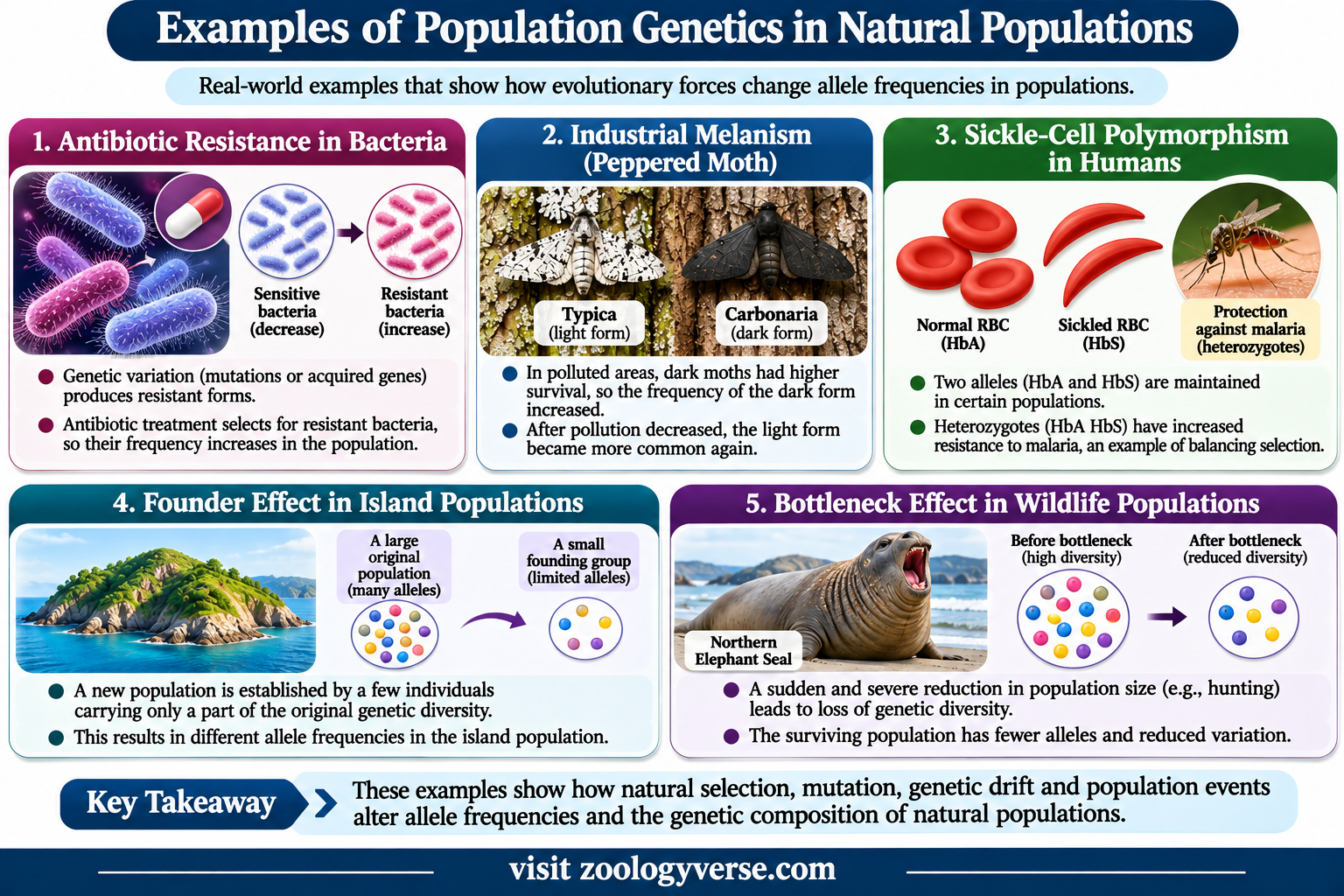
10.2 Industrial Melanism in the Peppered Moth
Industrial melanism in the peppered moth, Biston betularia, is a classical example used to explain natural selection and changes in the frequency of inherited colour forms.
During the industrial revolution in Britain, air pollution caused dark deposits to accumulate on tree trunks and reduced the growth of pale lichens in many industrial regions.
Two major colour forms of the moth were observed:
- Typica – The lighter, speckled form.
- Carbonaria – The darker melanic form.
In heavily polluted environments, darker moths became less conspicuous against darkened tree surfaces and often experienced lower predation by birds.
Consequently, the frequency of the dark form increased in many industrial regions.
After improvements in air quality and the recovery of lichens, lighter moths became more effectively camouflaged in many locations, and the frequency of the dark form declined.
This example demonstrates how environmental conditions can influence the relative reproductive success of inherited variants and alter their frequencies in populations.
10.3 Sickle-Cell Polymorphism and Malaria Resistance
Sickle-cell polymorphism in human populations provides an important example of balancing selection.
The condition is associated with a variant of the beta-globin gene that produces haemoglobin S (HbS).
Individuals with two copies of the HbS allele may develop sickle-cell disease, whereas heterozygous individuals generally have the sickle-cell trait.
In regions where malaria is common, individuals carrying one normal haemoglobin allele and one HbS allele may have increased protection against severe malaria compared with individuals carrying two normal alleles.
This heterozygote advantage contributes to the maintenance of both alleles in certain populations.
The example demonstrates that an allele associated with a harmful condition in homozygous individuals may nevertheless persist because of its beneficial effects in heterozygotes under particular environmental conditions.
10.4 Founder Effect in Island Populations
The founder effect occurs when a small number of individuals establish a new population in a geographical region.
Since the founding individuals carry only a limited sample of the genetic diversity of the original population, the newly established population may possess different allele frequencies.
For example, when a few individuals colonise an isolated island, certain alleles may become unusually common simply because the founding group happened to carry them.
Over successive generations, genetic drift may further modify the genetic composition of the isolated population.
The founder effect demonstrates how random sampling during population establishment can produce genetic differences between populations.
10.5 Bottleneck Effect in Wildlife Populations
The bottleneck effect occurs when a population undergoes a sudden and substantial reduction in size.
Natural disasters, disease outbreaks, habitat destruction, hunting and environmental changes may reduce population numbers considerably.
The surviving individuals represent only a portion of the original population’s genetic diversity.
As a result, some alleles may be lost, while others may become more common by chance.
A frequently discussed example is the northern elephant seal, whose population was severely reduced by nineteenth-century hunting. The surviving population experienced a substantial loss of genetic diversity.
This example illustrates the effects of a population bottleneck on genetic diversity and the long-term genetic composition of a species.
10.6 Genetic Variation in Darwin’s Finches
Darwin’s finches of the Galápagos Islands provide important examples of evolutionary diversification and adaptation.
Different finch populations exhibit variation in beak size and shape, which is associated with differences in feeding habits and food availability.
During periods of environmental change, such as drought, the availability of particular food resources may change.
Finches possessing beak characteristics better suited to the available food may experience higher survival and reproductive success.
Over generations, natural selection can influence the distribution of inherited beak characteristics within populations.
Studies of these birds demonstrate how ecological conditions and inherited variation interact to produce evolutionary change.
10.7 Gene Flow in Plant Populations
Gene flow is frequently observed in plant populations through the movement of pollen and seeds.
For example, pollen grains may be carried by wind or pollinating insects from one plant population to another.
When pollen successfully fertilises flowers in a different population, alleles may be transferred between the two populations.
Similarly, seeds dispersed by animals, wind or water may establish new plants in different geographical regions.
Gene flow can introduce new genetic variants into recipient populations and reduce genetic differences between neighbouring populations.
However, extensive gene flow may also reduce local adaptation when incoming alleles are less advantageous under the recipient population’s environmental conditions.
10.8 Genetic Drift in Small Populations
Genetic drift is particularly influential in small populations because random reproductive events can produce substantial changes in allele frequencies.
For example, consider a small population of animals containing two alleles, A and a, at a particular gene locus.
If only a few individuals reproduce successfully in one generation, their offspring may receive a disproportionately large number of copies of one allele simply by chance.
As a result, allele frequencies may change even when neither allele provides a survival or reproductive advantage.
Over many generations, genetic drift may lead to the complete loss or fixation of an allele.
This example illustrates why small and isolated populations are especially vulnerable to random genetic changes and the loss of genetic diversity.
10.9 Comparative Summary of Examples
| Example | Major evolutionary mechanism | Genetic consequence |
|---|---|---|
| Antibiotic resistance in bacteria | Natural selection and horizontal gene transfer | Increase in resistance-associated variants |
| Peppered moth | Natural selection | Changes in colour-form frequencies |
| Sickle-cell polymorphism | Balancing selection | Maintenance of alternative haemoglobin alleles |
| Founder effect | Genetic drift | Different allele frequencies in a new population |
| Bottleneck effect | Genetic drift | Loss of genetic diversity |
| Darwin’s finches | Natural selection | Changes in inherited beak characteristics |
| Plant pollen dispersal | Gene flow | Exchange of alleles between populations |
| Small isolated populations | Genetic drift | Random changes in allele frequencies |
These examples demonstrate that population-level evolutionary changes occur through several interacting mechanisms. Their relative importance depends on population size, environmental conditions, reproductive patterns and the availability of inherited genetic variation.
The study of these natural examples provides practical evidence for the principles of Population Genetics and helps explain how genetic diversity changes across generations.
11. Limitations and Challenges in Population Genetics
Population Genetics provides a mathematical and biological framework for understanding evolutionary changes within populations. However, studying the genetic composition of natural populations involves several theoretical, methodological and practical challenges.
Natural populations are complex systems influenced by multiple interacting evolutionary mechanisms. Their genetic composition may change because of mutation, natural selection, genetic drift, migration, population structure and environmental conditions. Consequently, interpreting genetic data requires careful consideration of biological and ecological factors.
11.1 Complexity of Natural Populations
One major challenge in Population Genetics is the complexity of natural populations.
Theoretical models often use simplified assumptions to explain genetic changes. For example, the Hardy-Weinberg principle assumes random mating, a very large population and the absence of evolutionary forces such as mutation, migration and natural selection.
However, natural populations rarely satisfy all these conditions simultaneously.
Individuals may belong to different breeding groups, occupy separate geographical regions or experience different environmental conditions. Such factors can influence allele frequencies and genotype distributions.
Therefore, theoretical models must be interpreted in relation to the actual biological characteristics of the population being studied.
11.2 Difficulty in Measuring Genetic Variation
Genetic variation may occur at different levels, including nucleotide sequences, genes and chromosomes.
Detecting and measuring this variation requires suitable molecular and statistical techniques.
Some genetic differences are easily identified through visible characteristics, whereas others require advanced methods such as DNA sequencing, molecular markers and genome-wide analysis.
Additional difficulties include:
- Identifying rare genetic variants.
- Distinguishing inherited variation from environmental effects.
- Determining the functional significance of genetic differences.
- Detecting structural variations in complex genomes.
- Comparing genetic diversity across populations using consistent methods.
Consequently, accurate measurement of genetic diversity requires appropriate sampling and analytical techniques.
11.3 Influence of Multiple Evolutionary Forces
Natural populations are usually influenced by several evolutionary mechanisms simultaneously.
Mutation introduces new alleles, natural selection changes their reproductive success, genetic drift produces random changes, and gene flow transfers genetic material between populations.
These processes may interact in different ways.
For example, natural selection may favour a particular allele, while genetic drift may randomly reduce its frequency in a small population.
Similarly, gene flow may introduce new alleles that influence local adaptation.
Separating the individual effects of these mechanisms can therefore be difficult, particularly when several processes operate simultaneously.
11.4 Environmental Influence on Genetic Expression
The expression of genetic characteristics may be influenced by environmental conditions.
Temperature, nutrition, disease, habitat conditions and other environmental factors can affect the phenotype produced by a particular genotype.
This interaction between genetic and environmental influences makes it difficult to determine whether an observed phenotypic difference is caused primarily by inherited genetic variation or environmental conditions.
For example, body size in animals may be influenced by genetic differences as well as nutrition and environmental conditions during development.
Therefore, population-level studies must distinguish genetic differences from environmentally induced phenotypic variation.
11.5 Problems Associated with Population Sampling
Accurate genetic analysis requires representative samples of the population being investigated.
However, obtaining such samples may be difficult, particularly in widely distributed, rare, migratory or endangered species.
Sampling problems may arise because:
- Some individuals are difficult to locate.
- Different geographical regions may be sampled unevenly.
- Rare alleles may be missed in small samples.
- Individuals from the same family may be overrepresented.
- Seasonal migration may influence the composition of sampled groups.
Inadequate sampling may produce misleading estimates of allele frequencies and genetic diversity.
11.6 Limitations of Hardy-Weinberg Models
The Hardy-Weinberg principle provides a useful theoretical model, but its assumptions are not always satisfied in natural populations.
Population size may be limited, mating may be non-random, and evolutionary forces may continuously influence genetic composition.
Furthermore, departures from Hardy-Weinberg expectations do not necessarily identify a single evolutionary mechanism.
For example, an excess of homozygous individuals may result from inbreeding, population subdivision or other factors.
Therefore, additional biological information and statistical analysis are often necessary to interpret deviations from equilibrium.
11.7 Genetic Drift in Small Populations
Genetic drift can create major challenges for small and isolated populations.
Random changes in allele frequencies may result in the loss of rare alleles and reduced genetic diversity.
Small populations may also experience increased inbreeding, which can raise the probability of harmful recessive alleles occurring in homozygous individuals.
These processes are particularly important in conservation biology because endangered populations may have limited genetic diversity and reduced capacity to respond to environmental changes.
11.8 Distinguishing Selection from Genetic Drift
One of the important challenges in evolutionary research is determining whether changes in allele frequencies are caused by natural selection or random genetic drift.
An allele may become more common because it provides a reproductive advantage, or its frequency may increase simply through chance.
Both processes can produce changes in genetic composition, but their evolutionary implications differ.
Researchers use population comparisons, molecular data, statistical models and ecological information to investigate whether particular genetic variants have been influenced by selection.
However, distinguishing these mechanisms may remain difficult when population sizes are small or historical genetic information is unavailable.
11.9 Computational and Statistical Challenges
Modern Population Genetics increasingly depends on computational methods for analysing large genetic datasets.
DNA sequencing and genome-wide studies can generate enormous amounts of information, requiring specialised statistical and computational techniques.
Major challenges include:
- Processing large genomic datasets.
- Identifying genetic variants accurately.
- Estimating population structure.
- Detecting signatures of natural selection.
- Reconstructing historical population sizes.
- Analysing migration and admixture.
- Distinguishing genuine biological signals from technical errors.
The reliability of conclusions depends on the quality of genetic data, the assumptions of analytical models and the appropriateness of statistical methods.
11.10 Ethical and Practical Considerations
Population-level genetic research may involve sensitive information, particularly in studies of human populations.
Genetic data can reveal information about biological relationships, inherited disease risks and population history.
Therefore, researchers must consider:
- Informed consent where human participants are involved.
- Protection of genetic privacy.
- Secure storage and responsible use of genetic data.
- Appropriate interpretation of population differences.
- Avoidance of misleading or discriminatory conclusions.
In wildlife research, practical concerns include the ethical collection of biological samples and minimising disturbance to threatened species.
11.11 Overall Challenges
| Challenge | Major concern |
|---|---|
| Natural population complexity | Ideal theoretical assumptions may not apply |
| Measurement of variation | Some genetic differences are difficult to detect |
| Multiple evolutionary forces | Their individual effects may be difficult to separate |
| Environmental influence | Phenotypic differences may not reflect genetic differences alone |
| Sampling limitations | Samples may not represent the entire population |
| Hardy-Weinberg assumptions | Natural populations may deviate from equilibrium |
| Genetic drift | Small populations may lose genetic diversity |
| Selection versus drift | Distinguishing adaptive and random changes |
| Computational analysis | Large genomic datasets require advanced methods |
| Ethical considerations | Responsible collection and use of genetic information |
Despite these challenges, Population Genetics remains an essential field for understanding the genetic basis of evolution. Improvements in molecular biology, DNA sequencing, statistical modelling and computational analysis continue to increase the accuracy and scope of population-level evolutionary research.
12. Conclusion
Population Genetics provides the fundamental genetic and mathematical framework for understanding evolutionary changes within natural populations. It explains how hereditary characteristics are distributed, inherited and modified across successive generations through changes in allele and genotype frequencies.
The study of the gene pool, allele frequency, genetic variation and genetic polymorphism helps explain the genetic composition of populations and their capacity for evolutionary change. The Hardy-Weinberg principle provides a theoretical model of genetic equilibrium, while deviations from this equilibrium help researchers investigate the influence of evolutionary mechanisms.
Mutation, natural selection, genetic drift and gene flow are the major forces responsible for changes in population genetic composition. Non-random mating also influences genotype distributions and patterns of genetic diversity. Their combined effects determine how populations respond to environmental conditions, develop adaptations and undergo evolutionary divergence.
Genetic variation provides the raw material for evolutionary processes, whereas genetic polymorphism demonstrates how alternative inherited forms can coexist within populations. These concepts are particularly important for understanding adaptation, disease resistance, population differentiation and the origin of new species.
The applications of Population Genetics extend beyond evolutionary biology into medicine, agriculture, wildlife conservation, forensic science and infectious disease research. Modern molecular techniques and genomic analysis have further expanded the ability to investigate genetic diversity and evolutionary relationships.
Overall, Population Genetics connects Mendelian inheritance with Darwinian evolution and forms a central foundation of the Modern Synthetic Theory of Evolution. By explaining how genetic composition changes within populations, it provides a scientific understanding of adaptation, biodiversity and the evolutionary diversification of life.
13. References
A. Academic Books
- Dobzhansky, T. (1937). Genetics and the Origin of Species. Columbia University Press.
- Fisher, R. A. (1930). The Genetical Theory of Natural Selection. Oxford University Press.
- Hartl, D. L., & Clark, A. G. (2007). Principles of Population Genetics (4th ed.). Sinauer Associates.
- Hedrick, P. W. (2011). Genetics of Populations (4th ed.). Jones & Bartlett Learning.
- Mayr, E. (1942). Systematics and the Origin of Species. Columbia University Press.
- Wright, S. (1931). Evolution in Mendelian populations. Genetics, 16(2), 97–159.
B. Online Academic and Educational Resources
- OpenStax. Biology 2e – Population Evolution.
https://openstax.org/books/biology-2e/pages/19-1-population-evolution - OpenStax. Biology 2e – Population Genetics.
https://openstax.org/books/biology-2e/pages/19-2-population-genetics - OpenStax. Biology 2e – Chapter Summary: Evolution of Populations.
https://openstax.org/books/biology-2e/pages/19-chapter-summary - Oxford University Press. An Introduction to Population Genetics.
https://learninglink.oup.com/access/nielsen-1e
C. Historical and Foundational Papers
- Hardy, G. H. (1908). Mendelian proportions in a mixed population. Science, 28(706), 49–50.
- Weinberg, W. (1908). Über den Nachweis der Vererbung beim Menschen. Jahreshefte des Vereins für vaterländische Naturkunde in Württemberg, 64, 369–382.
Discover more from Zoologyverse
Subscribe to get the latest posts sent to your email.