
Evolution is the process through which the heritable characteristics of populations change over successive generations.
In simple terms, it describes how populations of organisms change through time and how present-day organisms are related to organisms that lived in the past.
The study of evolution can be approached at several levels. Changes may be observed in morphology, anatomy, behavior, populations, genes, genomes and molecules.
One important concept in evolutionary biology is the idea of Trends in Evolution.
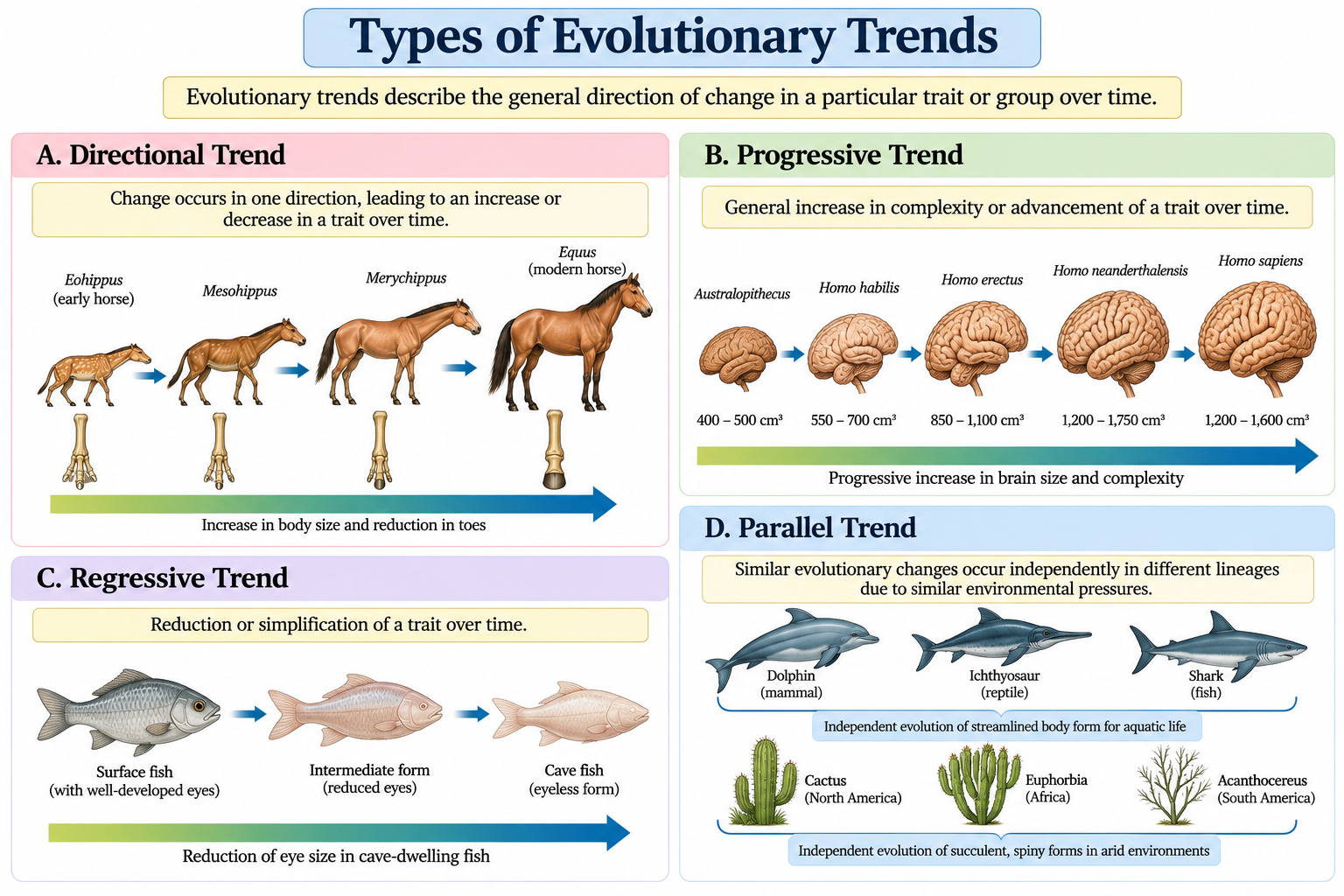
Evolution does not necessarily proceed in a single predetermined direction. However, when a particular trait shows a persistent directional pattern over a substantial period of evolutionary history, scientists may describe that pattern as an evolutionary trend.
Trends in Evolution help us understand how particular biological characteristics change and diversify over long periods of evolutionary history.
What Is Trends in Evolution
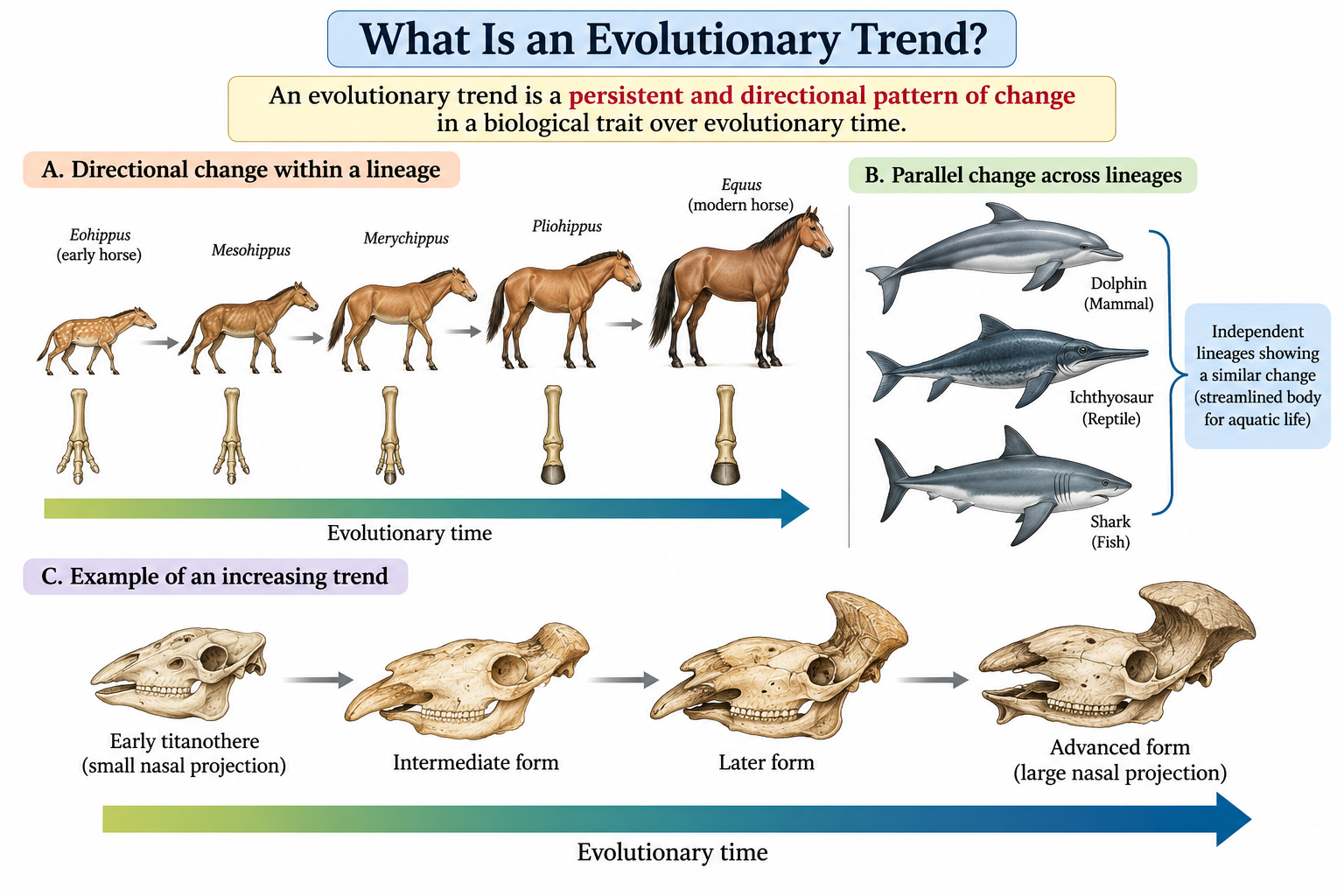
An evolutionary trend is a persistent and recognizable pattern of directional change in a biological trait over evolutionary time.
A trend may occur:
- within a single evolutionary lineage,
- across several related lineages,
- or across a larger group of organisms.
The important point is that not every change represents Trends in Evolution. A trait may fluctuate randomly through generations without showing a consistent direction. A trend requires evidence of a persistent pattern rather than a temporary or random fluctuation.
Modern evolutionary biology therefore treats trends as patterns that need to be demonstrated using evidence such as fossils, comparative anatomy, molecular data and population-level studies.
Trends in Evolution is a persistent directional pattern of change in a biological trait over evolutionary time.
The study of Trends in Evolution helps scientists identify recurring patterns of change within and between evolutionary lineages.
Trends in Evolution: Major Patterns
Trends in Evolution help us understand how particular biological characteristics change and diversify over long periods of evolutionary history. These Trends in Evolution can occur within a single lineage or independently across different lineages.
Characteristics of Trends in Evolution
Important characteristics of Trends in Evolution include:
- They occur over evolutionary time rather than within a single individual’s lifetime.
- They involve heritable characteristics.
- They may occur within one lineage or independently in several lineages.
- They represent a pattern, rather than a single evolutionary event.
- The direction of the trend may be associated with natural selection, developmental constraints, ecological factors, genetic processes or other evolutionary mechanisms.
- A trend does not necessarily mean that evolution is progressing toward a predetermined goal.
This last point is particularly important. A trend toward a particular trait should not automatically be interpreted as evidence that evolution is moving toward “higher” or “better” organisms. Evolutionary trends are patterns observed in evolutionary history, not evidence of a predetermined evolutionary destination.
Types of Trends in Evolution
Evolutionary trends can be broadly understood in several ways.
1. Directional Change Within a Lineage
A lineage may show a persistent change in one trait over many generations.
For example, fossil sequences may demonstrate that a particular anatomical structure gradually increased or decreased in size.
The titanothere fossil record provides a classic example.
Similar evolutionary changes may occur independently in several lineages.
For example, different groups may independently evolve similar modifications in body form when exposed to comparable environmental or ecological pressures.
However, similarity between lineages does not always mean that exactly the same evolutionary process occurred. Parallel evolution, convergent evolution and evolutionary trends are related but distinct concepts.
Different Trends in Evolution can be identified by examining fossils, comparative anatomy, developmental patterns, and molecular evidence.
Example of Trends in Evolution: Titanotheres
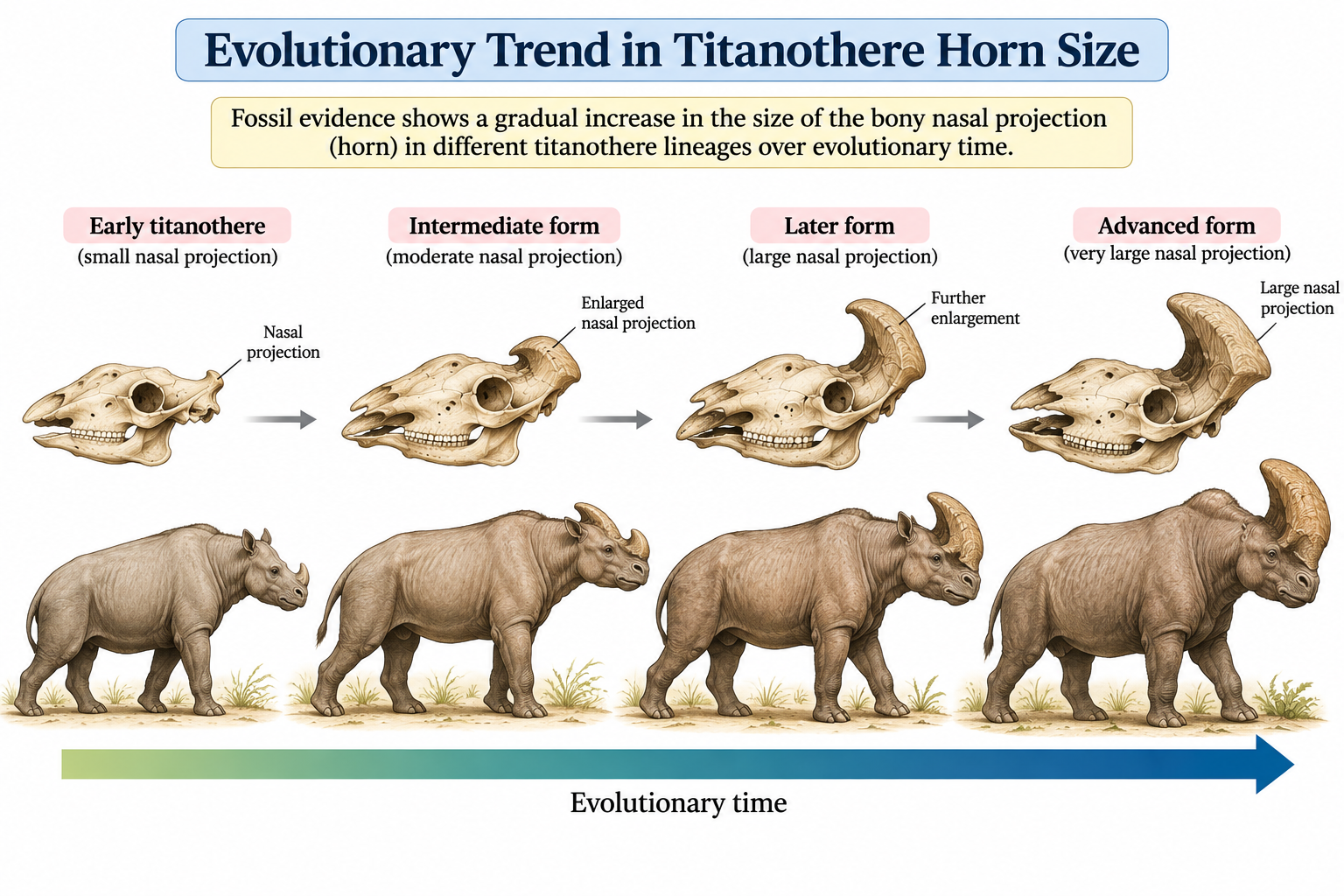
Titanotheres were extinct mammals related to modern horses and rhinoceroses. Fossil skulls provide evidence of changes in their cranial structures through time.
The Berkeley Evolution 101 material similarly uses titanothere horn size as an example of a long-term evolutionary pattern. However, it emphasizes that the exact cause of the trend is not necessarily obvious. Possible explanations include selection associated with body size or direct selection related to the function of the structures.
The titanothere fossil record provides an important example of Trends in Evolution, particularly a directional change in the size of the nasal projection.
This illustrates an important principle:
Observing an evolutionary trend does not automatically reveal its cause.
Trends in Evolution and Body Size
Body size is another trait frequently discussed in relation to evolutionary trends.
Over the history of life, there has been an increase in the maximum body size reached by some organisms. However, this does not mean that every lineage has evolved toward larger body size.
Many organisms have remained small, while some lineages have evolved larger body sizes and others have become smaller.
Therefore, statements such as “evolution always produces larger organisms” or “evolution always produces greater complexity” are incorrect. Evolutionary patterns can differ greatly among lineages and environments.
Trends in Evolution in Human Evolution
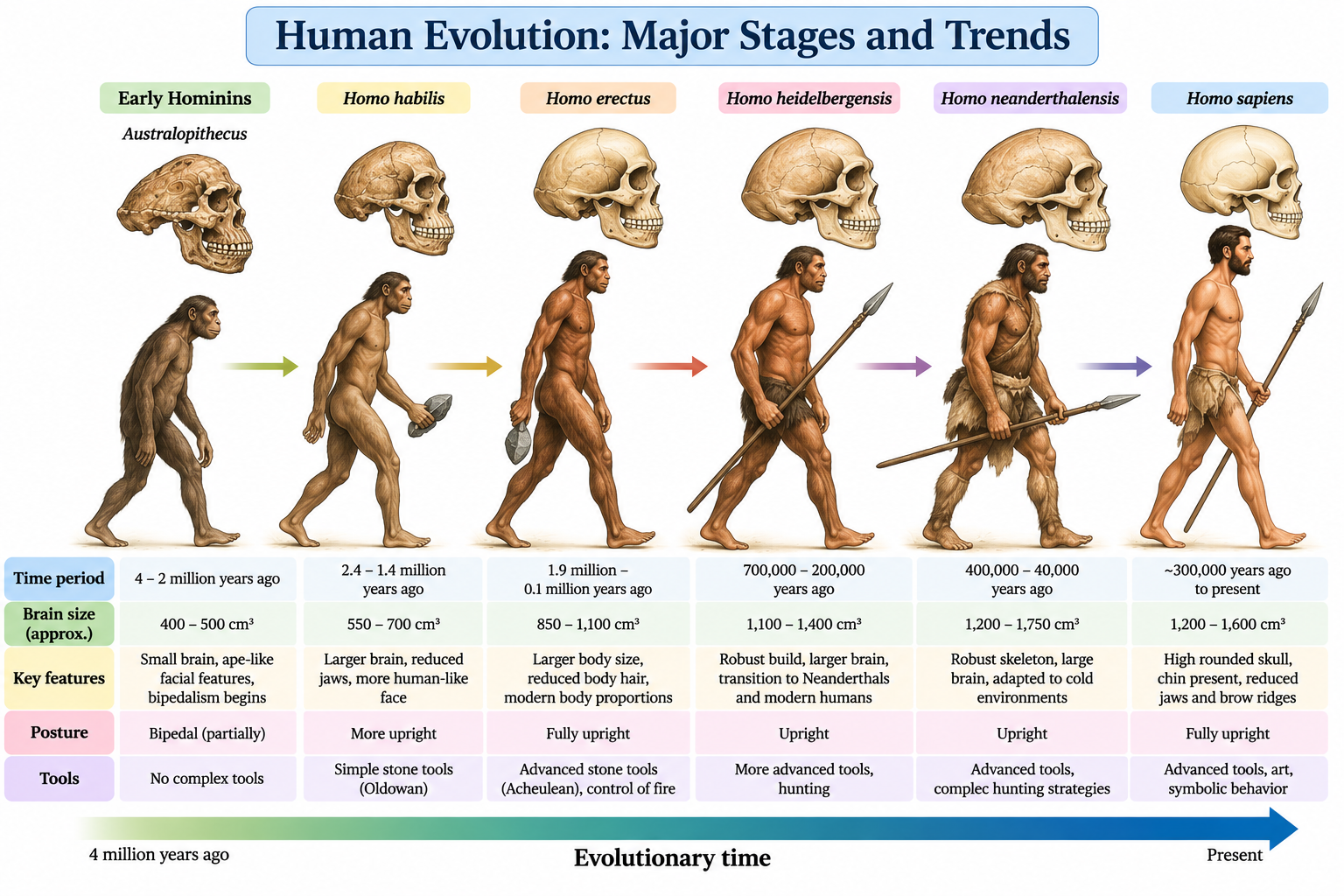
Human evolution is another area where evolutionary changes can be studied through fossils and anatomical evidence.
However, human evolution should not be understood as a simple straight-line progression from an ape-like ancestor to modern humans.
Human evolution is better represented as a branching evolutionary history, with multiple hominin lineages existing at different times. Some lineages became extinct while others contributed to later populations.
Important evolutionary changes studied in hominins include:
- changes in skull shape,
- changes in dentition,
- changes in body proportions,
- changes associated with bipedal locomotion,
- changes in brain size,
- changes in tool use and behavior.
Thus, human evolution provides an example of how evolutionary history involves branching, extinction and modification rather than a simple ladder of progress.
Human evolution also demonstrates important Trends in Evolution, including changes in skull shape, body proportions, locomotion, and brain size.
The Giraffe Neck: A Historical Example
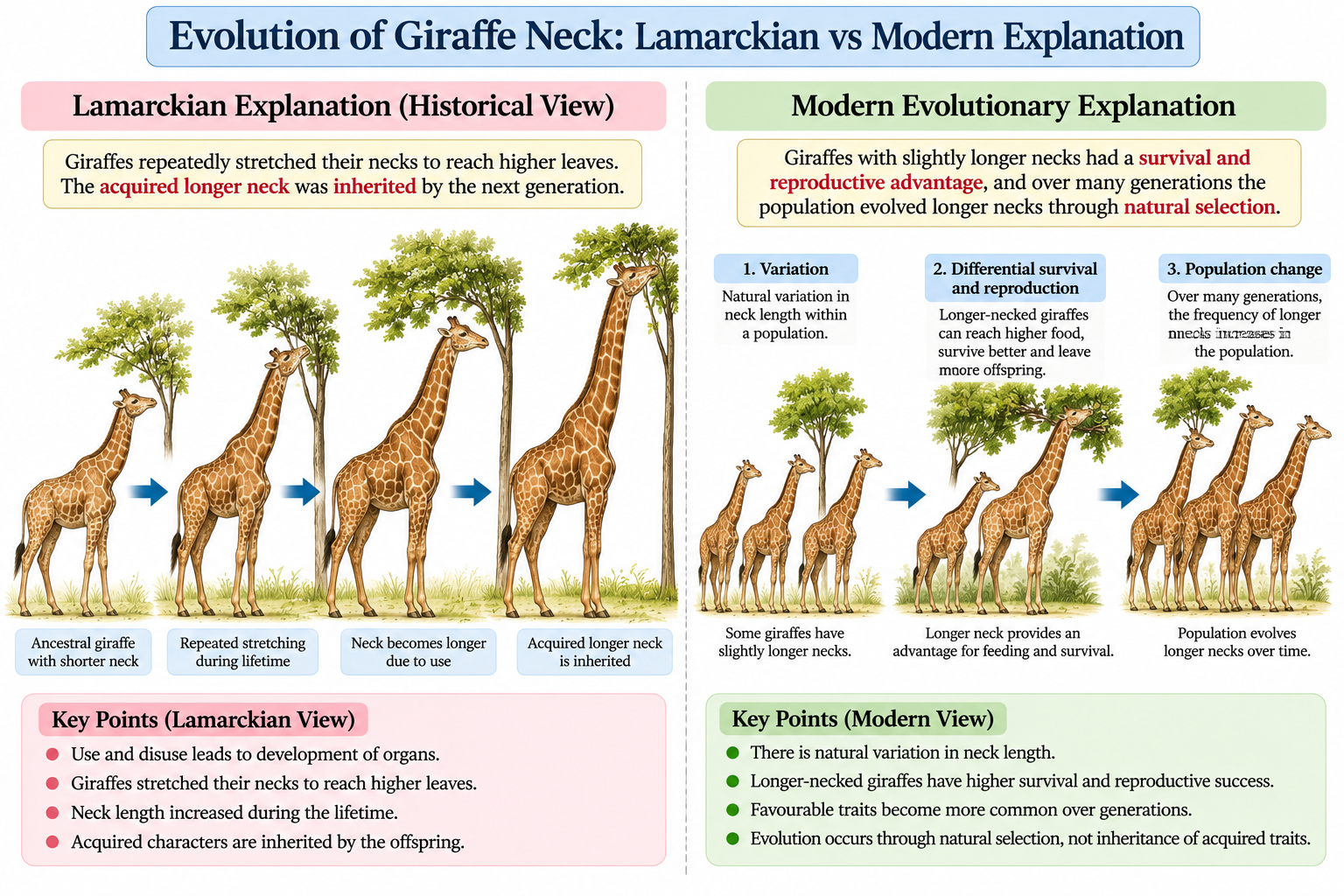
According to the historical Lamarckian explanation, giraffes repeatedly stretched their necks to reach higher leaves, and the acquired characteristic was thought to be inherited by their offspring.
This is historically important in the development of evolutionary thought, but it should not be presented as the modern genetic explanation for giraffe neck evolution.
Modern Trends in Evolution biology explains adaptations through mechanisms involving heritable variation, natural selection and population-level genetic change, among other processes.
The giraffe example is therefore useful for understanding the history of evolutionary theories, rather than as evidence for inheritance of acquired characteristics.
What Is Molecular Evolution?
Molecular evolution is the study of changes in DNA, RNA and proteins across generations.
The NCBI Medical Subject Headings database similarly defines molecular evolution as cumulative change at the level of DNA, RNA and proteins over successive generations.
Molecular evolution allows scientists to study evolutionary relationships at the genetic level.
For example, DNA sequences from different organisms can be compared to determine:
- genetic similarities,
- genetic differences,
- common ancestry,
- evolutionary divergence,
- mutation patterns,
- gene family relationships.
Molecular evidence has expanded our understanding of Trends in Evolution by allowing scientists to compare DNA, RNA, and protein sequences.
Gene and Genome Evolution
A gene is a functional unit of heredity that contains information involved in producing functional biological products or regulating biological processes.
Genome evolution refers to changes in the structure, content or organization of a genome over time.
Genome evolution can involve:
- nucleotide substitutions,
- insertions and deletions,
- gene duplication,
- gene loss,
- chromosome rearrangements,
- transposable elements,
- whole-genome duplication,
- horizontal gene transfer.
These processes contribute to the diversity of genomes found across organisms.
Major Mechanisms Involved in Gene Evolution
The presentation emphasizes three important contributors to gene evolution:
- Mutation
- Horizontal gene transfer
- Sexual reproduction
These mechanisms influence genetic variation and therefore contribute to evolutionary change.
1. Mutation
A mutation is a change in the DNA sequence.
Mutations can introduce new genetic variants into a population.
| Effect | Meaning |
|---|---|
| Beneficial | Increases fitness under particular conditions |
| Neutral | Has little or no detectable effect on fitness |
| Harmful | Reduces fitness under particular conditions |
Types of effects of mutations
Not every mutation contributes to evolution.
For example, a mutation occurring in a somatic cell usually is not inherited by offspring. In contrast, mutations occurring in cells that contribute genetic material to offspring can become heritable.
Mutation and evolution
Mutation provides new genetic variation, while evolutionary forces such as natural selection and genetic drift influence what happens to that variation within populations.
2. Horizontal Gene Transfer
Horizontal gene transfer (HGT) is the movement of genetic material between organisms other than through parent-to-offspring inheritance.
It is also called lateral gene transfer.
The presentation identifies HGT as particularly important in bacteria and archaea and discusses transformation, transduction and conjugation.
The three major mechanisms are:
Transformation
Transformation occurs when a competent cell takes up DNA from its surroundings and incorporates some of that genetic material.
Transduction
Transduction occurs when a bacteriophage transfers bacterial DNA from one bacterial cell to another.
Conjugation
Conjugation involves direct cell-to-cell transfer of DNA, commonly through plasmids and specialized conjugative machinery.
These three mechanisms are well-established routes of bacterial horizontal gene transfer.
Important correction: The PPT mentions “translation” in the list of HGT mechanisms. The correct term in this context is transduction. Translation is the cellular process of producing proteins from mRNA and is not a mechanism of horizontal gene transfer.
Horizontal gene transfer is particularly important in microbial evolution because it can rapidly introduce genetic material into a population. It can contribute, for example, to the spread of genes associated with antibiotic resistance and other adaptive traits.
3. Sexual Reproduction and Evolution
Sexual reproduction involves the production and fusion of specialized reproductive cells called gametes. The presentation includes sexual reproduction as an important component of gene evolution.
Sexual reproduction does not usually create entirely new alleles by itself. Instead, it produces new combinations of existing genetic variants through processes such as:
- meiosis,
- independent assortment,
- crossing over,
- recombination,
- random fertilization.
This genetic reshuffling increases variation among offspring and can influence how populations respond to natural selection.
Evolution of Gene Families
A gene family is a group of related genes that originated from a common ancestral gene and often retain sequence or functional similarities.
Gene families are important because they show how a single ancestral gene can give rise to multiple related genes with different or overlapping functions.
A classic example is the globin gene family, which contains related genes involved in oxygen transport and storage.
Formation of Gene Families
- Gene duplication
- Gene conversion
Gene Duplication
Gene duplication occurs when a DNA region containing a gene is copied, producing an additional gene copy.
The duplicated copy can subsequently accumulate mutations.
Because one copy may retain the original function, the other copy may have greater evolutionary freedom.
Possible outcomes include:
- retention of both copies with similar functions,
- division of the original function between copies,
- evolution of a new function,
- loss or degeneration of one copy.
Gene duplication is therefore an important source of genetic novelty and gene family expansion.
Simple example
Ancestral gene → duplication → two gene copies → mutations → different functions
This is one of the major ways complex gene families can evolve.
Gene Conversion
Gene conversion is a non-reciprocal process in which information from one DNA sequence is copied into another homologous sequence, causing the recipient sequence to become more similar to the donor.
Gene conversion can occur:
- between allelic sequences, or
- between related duplicated sequences.
It can influence the evolution of gene families by maintaining similarity between related genes, generating sequence changes and contributing to concerted evolution.
Assessment of Molecular Variation
Molecular evolution can be investigated by examining genetic variation within and between populations.
Modern molecular approaches can examine:
- DNA sequence variation,
- single nucleotide changes,
- genetic markers,
- gene frequencies,
- genome sequences,
- protein variation.
Such information helps researchers investigate population structure, evolutionary relationships and genetic diversity.
Understanding Trends in Evolution also requires examining the evolutionary forces that change allele frequencies within populations.
Evolutionary Forces
Changes in allele frequencies within populations are central to evolutionary genetics.
- Natural selection
- Gene flow
- Genetic drift
Mutation and recombination are also fundamental sources and reshufflers of genetic variation.
Natural Selection
Natural selection occurs when heritable differences among individuals influence their survival or reproductive success, causing some variants to become more common in subsequent generations.
For natural selection to produce evolutionary change, there must generally be:
- variation among individuals,
- some heritable component to that variation,
- differences in survival or reproductive success.
Natural selection can produce adaptations when environmental conditions consistently favor particular heritable characteristics.
Gene Flow
Gene flow is the movement of alleles between populations.
It can occur when individuals or reproductive cells move between populations and successfully reproduce.
For example:
Population A → migration → Population B → introduction of alleles → change in allele frequencies
Gene flow can introduce genetic variation into a population and can reduce genetic differences between populations.
The presentation also describes gene flow as the transfer of genetic variation from one population to another.
Genetic Drift
Genetic drift is a change in allele frequencies caused by random sampling effects.
Unlike natural selection, genetic drift does not require an allele to provide an advantage.
Its effects are particularly pronounced in small populations.
For example, if only a few individuals survive a random environmental event, the alleles carried by those individuals may become unusually common in the next generation.
Two important examples of genetic drift are:
- Bottleneck effect
- Founder effect
Genetic drift can cause alleles to become fixed or disappear simply through chance.
Natural Selection vs Gene Flow vs Genetic Drift
| Evolutionary force | Main feature | Role in evolution |
|---|---|---|
| Natural selection | Differential survival and reproduction | Can produce adaptation |
| Gene flow | Movement of alleles between populations | Introduces or removes variation |
| Genetic drift | Random change in allele frequencies | Can increase or eliminate alleles by chance |
| Mutation | Change in DNA sequence | Generates new genetic variants |
| Sexual reproduction | Recombination of parental genomes | Produces new combinations of existing variants |
How Molecular Evolution and Trends in evolution Are Connected
Evolutionary trends can be studied at both the organismal and molecular levels.
For example:
DNA mutation → genetic variation → change in allele frequencies → phenotypic variation → evolutionary change
At a larger scale:
Genetic changes → phenotypic changes → population divergence → lineage diversification → evolutionary patterns
Thus, molecular evolution provides one of the mechanisms underlying the broader patterns observed in evolutionary history.
Are Trends in evolution Predictable?
Evolutionary trends should not be interpreted as evidence that evolution has a fixed destination.
Evolution is influenced by several interacting factors, including:
- mutation,
- natural selection,
- genetic drift,
- gene flow,
- recombination,
- developmental constraints,
- ecological conditions,
- historical contingency.
A particular trend may therefore occur in one lineage but not another.
Research on evolutionary trends emphasizes that detecting a directional pattern is only the beginning; explaining why that pattern occurred can be much more complicated.
Key Takeaways
- Evolution is the change in heritable characteristics of populations over generations.
- Trends in Evolution is a persistent directional pattern of change through evolutionary time.
- Trends can occur within individual lineages or across multiple lineages.
- Fossil sequences can provide evidence for morphological evolutionary trends.
- Titanotheres provide a classic example of a fossil-based evolutionary trend.
- Molecular evolution involves changes in DNA, RNA and proteins across generations.
- Mutation introduces new genetic variation.
- Horizontal gene transfer can move genetic material between organisms, especially in prokaryotes.
- Sexual reproduction generates new combinations of existing genetic variation.
- Gene duplication is an important mechanism in the evolution of gene families.
- Gene conversion can alter the similarity and evolution of related DNA sequences.
- Natural selection, gene flow and genetic drift can change allele frequencies.
- Evolutionary trends do not imply that evolution has a predetermined goal.
Frequently Asked Questions
What is meant by trends in evolution?
Trends in evolution are persistent patterns of directional change in biological traits over evolutionary time. They may occur within one lineage or across several lineages.
What is an example of an evolutionary trend?
The fossil record of titanotheres provides a classic example. Several titanothere lineages show a long-term pattern involving increasing size of their prominent nasal structures.
What is molecular evolution?
Molecular evolution is the study of cumulative changes in DNA, RNA and proteins over successive generations.
What are the major mechanisms of gene evolution?
Important mechanisms include mutation, recombination associated with sexual reproduction, horizontal gene transfer in many microorganisms, gene duplication and gene conversion.
Why is gene duplication important in evolution?
Gene duplication creates an additional copy of a gene. The duplicate can accumulate changes and potentially acquire a specialized or novel function, contributing to genetic novelty.
What are the three major mechanisms of horizontal gene transfer in bacteria?
The major mechanisms are transformation, transduction and conjugation.
What is genetic drift?
Genetic drift is a random change in allele frequencies caused by chance. Its effects are generally stronger in small populations.
Is evolution always directional?
No. Evolution does not always proceed in one direction. Some traits may fluctuate, remain relatively stable, or change in different directions in different lineages. An evolutionary trend refers specifically to a persistent pattern of directional change.
Conclusion
Overall, Trends in Evolution provide a useful framework for studying long-term biological change while recognizing that evolution does not follow a predetermined path.
Trends in evolution describe recognizable patterns of change that occur over evolutionary time. They can be observed through fossil evidence, comparative anatomy, population genetics and molecular data.
The study of evolutionary trends becomes more meaningful when combined with molecular evolution. Changes in DNA and genomes provide the underlying genetic variation, while mutation, recombination, natural selection, genetic drift and gene flow influence how populations change.
Gene duplication and gene conversion further demonstrate how genomes can acquire new variation and how gene families evolve over time. Horizontal gene transfer adds another important dimension, particularly in microbial evolution.
Ultimately, evolution is not a simple ladder of progress. It is a branching and dynamic process shaped by genetic variation, inheritance, environmental conditions, chance and selection. Understanding these processes helps explain both the diversity of living organisms and the evolutionary history recorded in fossils and genomes.
References
- NCBI – Molecular Evolution, Medical Subject Headings (MeSH) — definition of molecular evolution.
- University of California, Berkeley – Evolution 101: Trends in Evolution — evolutionary trends and titanothere example.
- Gregory, T. R. – Evolutionary Trends, Evolution: Education and Outreach — discussion of long-term evolutionary trends.
- OpenStax – Population Genetics — natural selection, genetic drift and evolutionary forces.
- OpenStax – Mechanisms of Evolution — mutation, natural selection, gene flow and genetic drift.
- Thomas & Nielsen – Mechanisms of and Barriers to Horizontal Gene Transfer Between Bacteria — mechanisms of transformation, transduction and conjugation.
- Gene Conversion and Evolution of Gene Families – PMC — role of gene conversion in gene-family evolution.
- The Early Stages of Duplicate Gene Evolution – PNAS/PMC — gene duplication and evolutionary novelty.
Discover more from Zoologyverse
Subscribe to get the latest posts sent to your email.