
Introduction
Argonauta, also known as the paper nautilus, is a fascinating genus of pelagic octopods belonging to the family Argonautidae. Often mistaken for the true nautilus (a shelled cephalopod), the Argonauta is unique for the intricate, delicate, paper-thin shell that the female secretes and uses to house her eggs and potentially for buoyancy and respiration. This article will delve into the classification, unique biology, and distinguishing features of this intriguing marine creature.
Classification of Argonauta
Argonauta belongs to the class Cephalopoda, a group of marine mollusks that includes squids, octopuses, and cuttlefish, renowned for their bilateral body symmetry, a prominent head, and a set of arms or tentacles.
| Taxonomic Rank | Group | Characterization |
| Kingdom | Animalia | Multicellular, eukaryotic, heterotrophic organisms. |
| Phylum | Mollusca | Soft-bodied, invertebrate animals typically possessing a mantle, radula, and specialized nervous system. |
| Class | Cephalopoda | Marine mollusks with a distinct head, eight or ten arms, and often an ink sac; highly intelligent. |
| Subclass | Coleoidea | Cephalopods lacking an external shell (or possessing a small internal one), such as squids, cuttlefish, and octopuses. |
| Superorder | Octopodiformes | Eight-limbed coleoids, including octopods and the extinct Vampyromorphida. |
| Order | Octopoda | Cephalopods with eight arms, lacking fins (with some exceptions) and generally having a soft body. |
| Family | Argonautidae | Pelagic octopods characterized by extreme sexual dimorphism and the female’s unique, non-nacreous egg case (the “shell”). |
| Genus | Argonauta | The paper nautilus itself, distinguished by the female’s specialized dorsal arms that secrete the shell-like egg case. |
The key distinguishing feature that separates the Argonautidae from other Octopoda is the presence of the female’s brood chamber, which superficially resembles a shell but is biologically distinct from the calcified shells of true nautiluses.
Habit and Habitat of Argonauta
Argonauta species are holopelagic (living entirely in the open ocean) and are found primarily in the tropical and subtropical open waters of the world’s oceans. They are not bottom dwellers like many coastal octopuses; instead, they drift in the water column, often near the surface.4
Pelagic Lifestyle
Their pelagic habit means they are constantly swimming or drifting. The females, with their fragile shells, are more buoyant and tend to inhabit the upper water layers where they hunt and brood their young. The shell itself may play a role in buoyancy, trapping air at the surface to maintain position, though its primary function is reproduction. The tiny males are also pelagic but are rarely observed due to their diminutive size and relatively short lifespan.
Diet and Predation
Argonauta are active predators, feeding on small crustaceans, various mollusks, and sometimes small fish. They employ the typical octopod strategy of seizing their prey with their arms and using their beak to consume it. Conversely, they are prey for a range of larger marine animals, including tunas, dolphins, and other cephalopods. The females can use their shells as a form of defense, pulling themselves inside and using their arms to clasp the opening shut. They can also use their siphon to jet water, rapidly propelling themselves away from danger, a common cephalopod escape mechanism.
Geographical Distribution of Argonauta
The various species of Argonauta have a broad, circumglobal distribution in the warmer parts of the Atlantic, Pacific, and Indian Oceans.8
- Tropical and Subtropical Zones: They are most abundant in the warm, nutrient-rich currents of the mid-latitudes.
- Drifting: Their range is often influenced by ocean currents, which carry them across vast distances. Occasionally, their shells wash up on beaches in temperate zones, giving evidence of their extended range or suggesting they were carried far by storms or currents.
- Species Variation: While the genus is widespread, individual species, such as Argonauta argo (the greatest paper nautilus), have slightly different distribution patterns, but all remain within the pelagic zone (the water column itself, not near the bottom).
General Characteristics and Extreme Sexual Dimorphism
The Argonaut is a spectacular example of sexual dimorphism (a difference in form between male and female of the same species) that is perhaps the most extreme among all octopods.
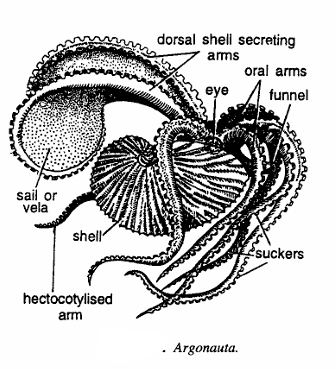
- Commonly called as ‘Paper Nautilus’.
- It is actually not a Nautilus but is more closely related to Octopus.
- Sexual dimorphism is commendable.
- Male is approximately 25 cm long and without shell while female is about 25 cm long and possess characteristic external shell.
- Shell is thin symmetrical, spiral without septa secreted by terminal expansions of two specialized dorsal arms called as Sail or Vela.
- Shell carries eggs, the name ‘Paper Nautilus’ refers to the thinness and fragility of dry shell.
- Third arm in the male is hectocotylised and used for conveying spermatophores into the mantle cavity of the female.
- It can be entirely separated from the male and left in the mantle cavity of the female.
- Funnel protrudes between arms.
The Female Argonauta
- Size: Females are significantly larger, often reaching a mantle length of about 10 cm, with their shell spanning up to 30 cm in the largest species (A. argo).
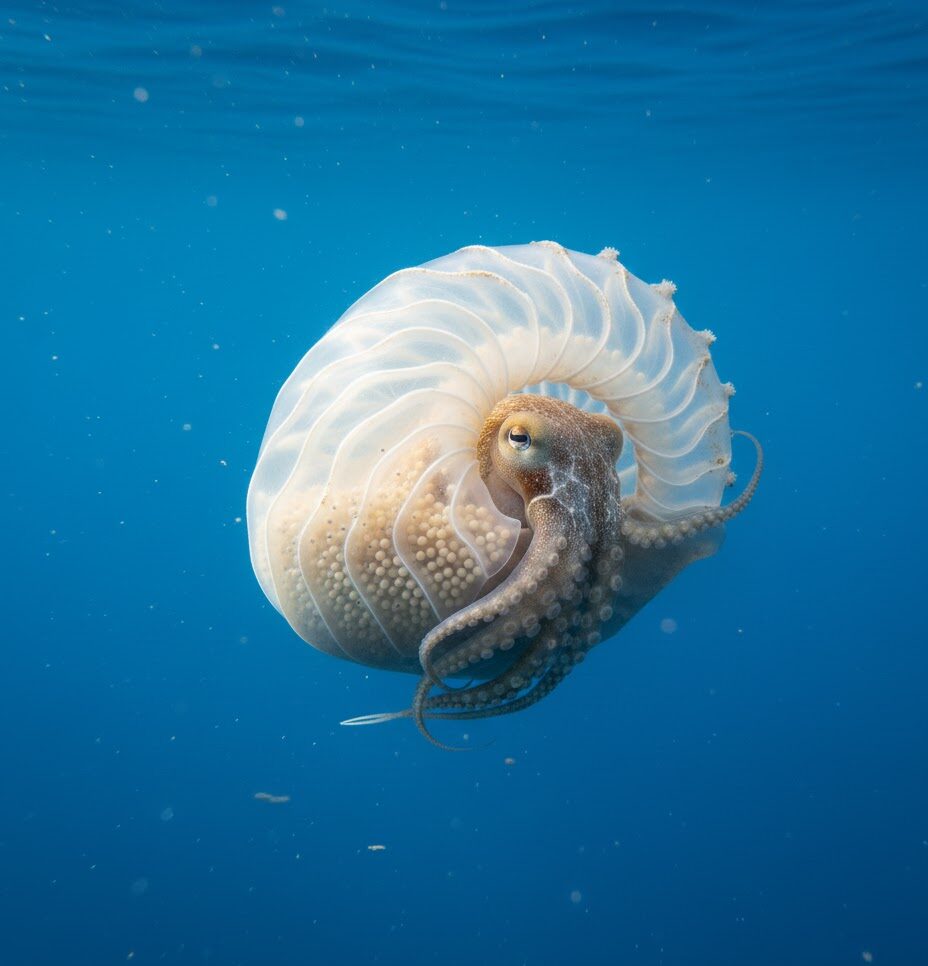
- The Shell (Egg Case): This is the defining feature. It is not a true shell secreted by the mantle and attached to the body, but an egg case secreted by specialized, expanded dorsal arms (the first pair). It is composed of calcite and lacks the nacreous layer of the true nautilus shell. The female lives within this structure, which serves as a brood chamber for her eggs, attaching them to the inner coils.
- Locomotion: She uses her shell, arms, and siphon for movement and orientation in the water column.
The Male Argonauta
- Size: Males are tiny, often less than 1 cm in mantle length, making them hundreds of times smaller than the female. They are believed to be the smallest known cephalopods.
- Shell: Males do not secrete a shell and look like typical, small octopuses.
- Hectocotylus: The male possesses a highly modified third left arm called the hectocotylus. This arm is dedicated solely to reproduction. It contains the spermatophores (packets of sperm). When the male is ready to mate, the hectocotylus detaches and is deposited into the female’s mantle cavity, where it releases the sperm.

Special Features and Ecological Significance
Beyond the extreme size difference and the female’s unique shell, Argonauta exhibits several other remarkable traits.
Respiration and Buoyancy in the Shell
The female’s shell is crucial for respiration. The trapped air bubble within the shell allows the female to regulate her buoyancy and maintain a preferred depth. She can adjust the volume of gas and water inside the shell by manipulating the siphon and arms.18 Furthermore, she uses her soft body and arms to constantly pump water over the eggs inside the shell, ensuring adequate oxygenation for the developing embryos.
The Detachable Hectocotylus
The discovery of the male’s detachable arm is a historical curiosity. Early naturalists found these arms inside the mantle cavities of females and mistakenly identified them as parasitic worms, naming them Hectocotylus. It was Cuvier in the 19th century who correctly identified them as the reproductive arm of the male Argonauta, a significant moment in cephalopod biology.
Defensive Coloration
Like many octopuses, Argonauta has chromatophores (pigment-containing cells) in its skin, allowing it to rapidly change color for camouflage, particularly the males and younger females who lack the protective shell.19 They also possess an ink sac and can release a cloud of dark ink to confuse predators.20
Identification and Common Species🔎
Identifying an Argonauta generally relies on the characteristics of the female and her shell, as the males are rarely encountered.
Identification of the Shell
The female’s egg case is distinctive:
- Material: It is white, opaque, and non-nacreous (not pearly).
- Shape: It is beautifully coiled and fluted, often with two rows of tubercles (small bumps) along the outer ridge.
- Fragility: It is exceptionally thin and brittle, hence the common name “paper nautilus.”
Key Species
While the entire genus is fascinating, a few species are well-known:
- Argonauta argo (Great or Greater Paper Nautilus): This is the largest species, with females producing shells up to 30 cm across. It is widely distributed.
- Argonauta nodosa (Knotty Paper Nautilus): Known for the more pronounced, knobby tubercles along the keel (ridge) of the shell.
- Argonauta hians (Muddy or Less Paper Nautilus): Characterized by a slightly narrower, more elongated shell aperture.
In conclusion, Argonauta represents a pinnacle of evolutionary adaptation within the Octopoda. Its extreme sexual dimorphism, the female’s ingeniously constructed egg-case/brood-chamber, and its life spent drifting in the open ocean make it one of the most remarkable and visually stunning invertebrates in the marine ecosystem.
References
- World Register of Marine Species (WoRMS) – Argonauta Genus Page
- Content: Provides the official, accepted taxonomic classification (Kingdom, Phylum, Class, etc.) for the genus Argonauta, including the valid species.
- Link: https://www.marinespecies.org/aphia.php?p=taxdetails&id=137676
- Animal Diversity Web (University of Michigan) – Argonauta argo Information
- Content: General overview of physical description, habitat, geographic range, and feeding habits of the largest species, A. argo.
- Link: https://animaldiversity.org/accounts/Argonauta_argo/
- The Cephalopod Page – Argonauta argo
- Content: Detailed information on sexual dimorphism (dwarf males, large females), the structure of the female’s egg case, and the use of the hectocotylus arm in males for fertilization.
- Link: http://www.thecephalopodpage.org/MarineInvertebrateZoology/Argonautaargo.html
- Proceedings of the Royal Society B: The argonaut shell: gas-mediated buoyancy control in a pelagic octopus
- Content: This is the key scientific paper (Finn & Norman, 2010) that established the shell’s function as a hydrostatic structure used to trap air and control buoyancy, in addition to its role as a brood chamber.
- Link: https://royalsocietypublishing.org/doi/abs/10.1098/rspb.2010.0155
- ResearchGate – PDF of the Buoyancy Control Paper
- Content: Provides access to the full text/abstract of the Finn & Norman (2010) paper, detailing the air-gulping mechanism used by the female argonaut to achieve neutral buoyancy.
- Link: https://www.researchgate.net/publication/44613041_The_argonaut_shell_Gas-mediated_buoyancy_control_in_a_pelagic_octopus
Discover more from Zoologyverse
Subscribe to get the latest posts sent to your email.
wow| what a interesting facts