
Introduction to Food Chain vs Food Web
Every ecosystem contains organisms that depend on one another for food, energy and nutrients. Green plants capture solar energy through photosynthesis, herbivores feed on plants, and carnivores obtain energy by eating other animals. These feeding relationships connect organisms and help maintain the functioning of ecosystems.
The concepts of a food chain and a food web explain how energy and nutrients move between organisms. A food chain represents a single pathway of energy transfer, whereas a food web shows several interconnected feeding pathways within an ecosystem. Understanding the food chain vs food web comparison helps explain why organisms depend on multiple food sources and how changes in one population can affect other species.
For example, grass may be eaten by a grasshopper, which is consumed by a frog and then by a snake. This is a simple food chain. In a natural grassland, however, grasshoppers may also be eaten by birds, frogs may consume several kinds of insects, and snakes may feed on frogs, rodents and small birds. These overlapping relationships form a food web.
The study of food chains and food webs is an important part of ecology because it helps explain trophic levels, energy flow, predator–prey relationships, ecosystem stability and the effects of environmental disturbances. It also provides a foundation for understanding ecological pyramids, which represent the distribution of organisms, biomass or energy across trophic levels.
What Is a Food Chain?
A food chain is a linear sequence of organisms through which energy and nutrients pass as one organism consumes another. It shows a single feeding pathway within an ecosystem, beginning with a producer or another food source and continuing through different consumers.
Most terrestrial food chains begin with green plants, while aquatic food chains commonly start with phytoplankton, algae or other photosynthetic organisms. These producers convert light energy into chemical energy, which becomes available to animals when they feed on plants or other organisms.
For example:
Grass → Grasshopper → Frog → Snake → Hawk
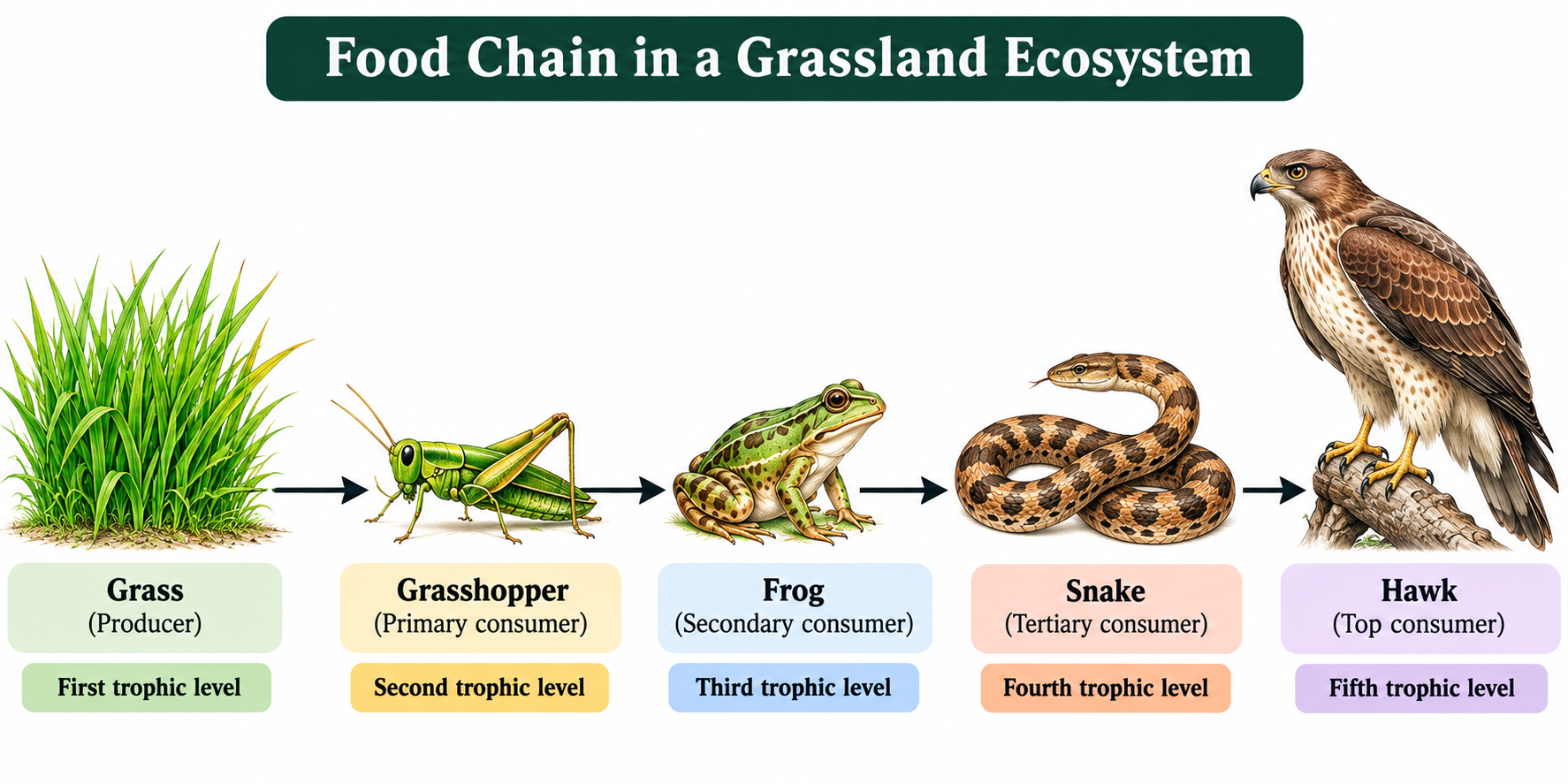
In this food chain, grass produces organic food through photosynthesis. The grasshopper feeds on grass, the frog eats the grasshopper, the snake preys on the frog, and the hawk may feed on the snake. Each organism represents a feeding position, known as a trophic level.
A food chain is a simplified model of feeding relationships. In nature, an organism may eat several kinds of food and may itself be consumed by different predators. Therefore, a single food chain represents only one pathway within the larger network of feeding relationships called a food web. This distinction is central to understanding food chain vs food web in ecology. <Cite refs={[“turn502685search0”]}/>
Components of a Food Chain
A food chain contains several components that describe how energy passes from one organism to another.
1. Producers
Producers, also called autotrophs, prepare organic food from inorganic substances. Most producers use sunlight as their energy source through photosynthesis.
Examples include:
- Green grasses and other terrestrial plants
- Algae and phytoplankton in aquatic ecosystems
- Photosynthetic bacteria
Producers form the first trophic level in a typical grazing food chain. They provide the energy-rich organic matter on which herbivores and, indirectly, higher-level consumers depend. In some ecosystems, such as deep-sea hydrothermal vents, chemosynthetic microorganisms act as primary producers by using energy from chemical reactions rather than sunlight.
2. Primary Consumers
Primary consumers feed directly on producers. They are commonly herbivores, although their feeding habits vary with the ecosystem.
Examples include grasshoppers that eat grass, rabbits that feed on leaves, and zooplankton that consume phytoplankton. Primary consumers usually occupy the second trophic level of a grazing food chain.
3. Secondary Consumers
Secondary consumers feed on primary consumers. Many are carnivores, such as frogs that eat insects, small predatory fish that consume zooplankton, and spiders that capture herbivorous insects.
They generally occupy the third trophic level in a simple grazing food chain. However, the trophic position of an organism can vary according to its diet; some animals feed at more than one trophic level.
4. Tertiary and Higher-Level Consumers
Tertiary consumers feed on secondary consumers, while higher-level consumers may prey on organisms from still higher or lower positions in a food chain. The exact number of consumer levels depends on the ecosystem and the availability of energy.
For example, in the chain below, the hawk acts as a higher-level consumer:
Grass → Grasshopper → Frog → Snake → Hawk
The hawk may be a top predator in this particular pathway, but it is not necessarily the top predator in every ecosystem or food chain in which it occurs.
5. Decomposers and Detritivores
Dead organisms, fallen leaves, animal remains and waste products contain organic matter that remains available to other organisms. Decomposers, such as bacteria and fungi, break down complex organic material into simpler substances. Detritivores, such as earthworms and many woodlice, consume dead organic matter and help fragment it.
Their activity releases nutrients that can return to the environment and be absorbed by producers. Decomposers are therefore essential to nutrient cycling, although they are not simply the final step of every food chain. They can act on dead material originating from organisms at multiple trophic levels.
Types of Food Chains
Food chains are commonly classified into two major types according to the material at their starting point: the grazing food chain and the detritus food chain.
1. Grazing Food Chain
A grazing food chain begins with living producers, such as green plants or phytoplankton. Energy captured by producers passes to herbivores and then to carnivores through feeding.
Example of a terrestrial grazing food chain:
Grass → Grasshopper → Frog → Snake
Example of an aquatic grazing food chain:
Phytoplankton → Zooplankton → Small Fish → Large Fish
In the terrestrial example, the grasshopper obtains energy by eating grass, and the frog obtains energy by consuming the grasshopper. In the aquatic example, zooplankton feed on phytoplankton, and small fish consume zooplankton. Larger fish may then prey on smaller fish.
Grazing food chains are important for explaining how energy stored in living producers becomes available to consumers.
2. Detritus Food Chain
A detritus food chain begins with dead and decaying organic matter, known as detritus, rather than directly with living green plants. Detritus includes fallen leaves, dead roots, animal remains and organic waste.
Example:
Dead leaves → Earthworm → Bird → Hawk
In this example, earthworms consume or process organic matter, birds feed on earthworms, and hawks may prey on the birds. The exact organisms involved differ among ecosystems.
Detritus food chains are particularly important in forest floors, soil ecosystems, wetlands and aquatic sediments, where dead organic material supports diverse communities of decomposers and detritivores. Decomposition also releases nutrients that producers can reuse.
The grazing and detritus pathways are interconnected. Plant material may enter a grazing food chain when eaten by a herbivore, or it may enter a detritus food chain after it dies and begins to decompose. Both pathways contribute to ecosystem functioning.
Examples of Food Chains in Different Ecosystems
Food chains vary according to the producers, consumers and environmental conditions found in an ecosystem.
| Ecosystem | Example of a food chain | Main feeding relationship |
|---|---|---|
| Grassland | Grass → Grasshopper → Frog → Snake → Hawk | Plant energy passes through herbivores and predators |
| Forest | Leaves → Caterpillar → Small bird → Hawk | Insects transfer energy from plants to birds |
| Pond | Phytoplankton → Zooplankton → Small fish → Large fish | Energy passes through plankton and predatory fish |
| Marine | Phytoplankton → Zooplankton → Small fish → Tuna | Energy passes through plankton and predatory fish |
| Detritus-based soil pathway | Dead leaves → Earthworm → Bird | Consumers obtain energy from dead organic matter |
These examples are simplified representations. Real organisms may consume multiple food sources, and their predators may feed on several different species. For this reason, individual food chains should be understood as pathways within a wider food web rather than as complete descriptions of an ecosystem.
What Is a Food Web?
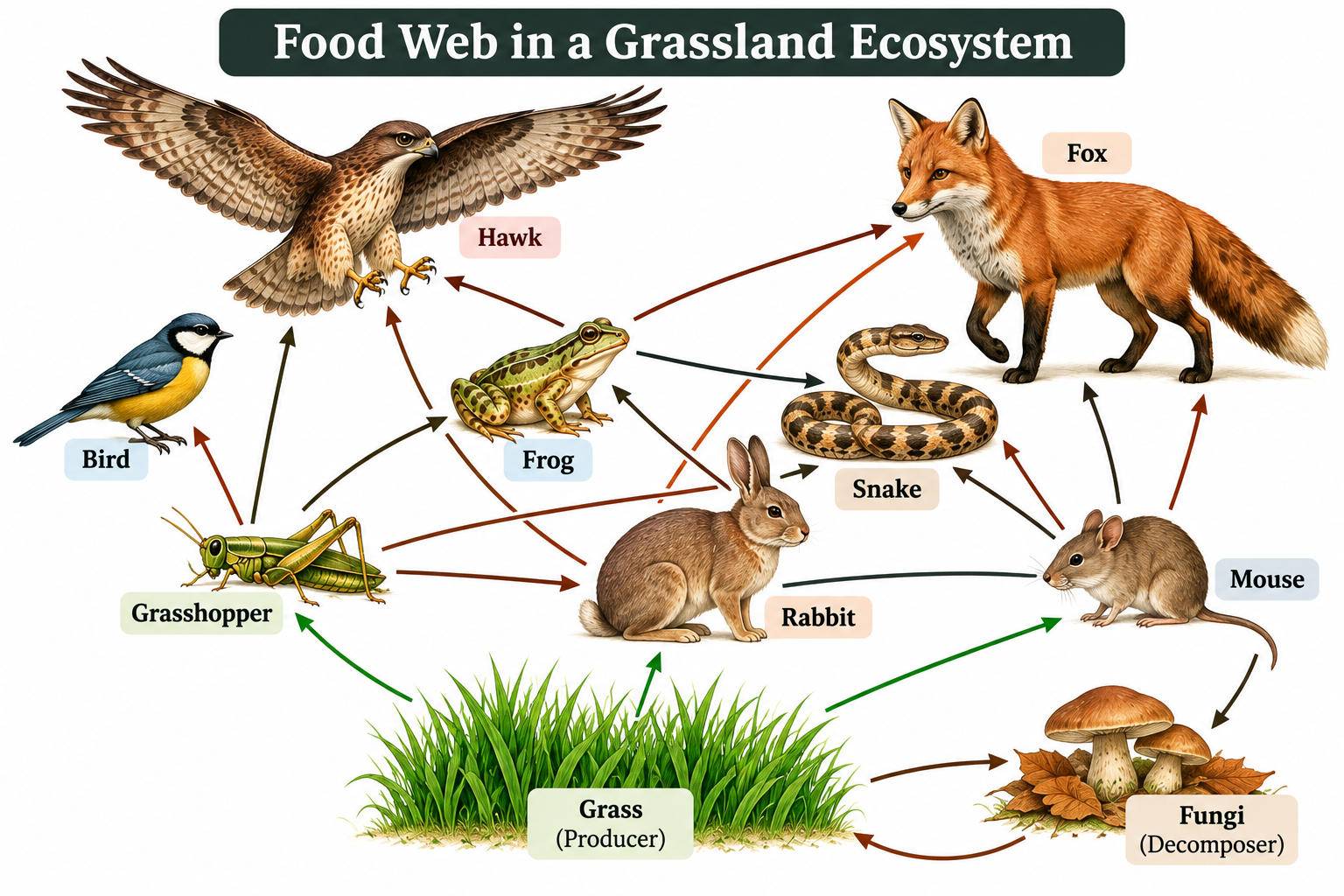
A food web is a network of interconnected food chains that represents the feeding relationships among organisms within an ecosystem. It illustrates how energy and nutrients pass through multiple feeding pathways rather than following a single linear sequence.
In natural ecosystems, most organisms depend on more than one food source. For example, a frog may eat grasshoppers, flies and other insects, while snakes may feed on frogs, rodents and small birds. These overlapping feeding relationships create a complex network.
Understanding food chain vs food web is essential in ecology because food chains show individual feeding pathways, whereas food webs illustrate the broader connections between organisms. Food webs help ecologists study trophic interactions, predator–prey relationships, ecosystem stability and the consequences of population changes.
Components of a Food Web
1. Producers
Producers are autotrophic organisms that manufacture organic food using sunlight or chemical energy. They form the foundation of most food webs.
Examples include green plants, algae, phytoplankton and certain bacteria.
In grassland ecosystems, grasses support herbivores such as rabbits and grasshoppers. In aquatic ecosystems, phytoplankton provide food for zooplankton and other primary consumers.
2. Primary Consumers
Primary consumers feed directly on producers. They include herbivores such as grasshoppers, rabbits, caterpillars, deer and plant-eating zooplankton.
A single producer may support several primary consumers. For example, grass may be eaten by rabbits, grasshoppers and grazing mammals, connecting multiple feeding pathways.
3. Secondary Consumers
Secondary consumers obtain energy by feeding on primary consumers. Examples include frogs, spiders, insectivorous birds and small predatory fish.
A frog may consume different insects, while those insects may also be eaten by birds and spiders. Such overlapping interactions create connections between food chains.
4. Tertiary and Higher-Level Consumers
Tertiary consumers feed on secondary consumers. Depending on the ecosystem, examples may include snakes, larger predatory fish and birds of prey.
Higher-level predators may feed at several trophic levels. Their position within a food web depends on the prey they consume.
5. Omnivores
Omnivores consume both plant and animal material. Examples include crows, bears, humans and many fish species.
Because omnivores obtain food from different trophic levels, they create additional connections within food webs.
6. Decomposers and Detritivores
Decomposers, such as bacteria and fungi, break down dead organic material. Detritivores, including earthworms and certain crustaceans, consume dead plant and animal matter.
These organisms contribute to decomposition and nutrient recycling. Nutrients released during decomposition become available for uptake by producers, supporting continued ecosystem productivity.
Examples of Food Webs in Different Ecosystems
1. Grassland Food Web
A grassland food web contains producers such as grasses and herbs, herbivores such as grasshoppers and rabbits, and predators such as frogs, snakes, foxes and hawks.
Examples of interconnected pathways include:
- Grass → Grasshopper → Frog → Snake
- Grass → Grasshopper → Bird → Hawk
- Grass → Rabbit → Fox
- Grass seeds → Mouse → Snake
- Mouse → Hawk
These pathways form a food web because some organisms participate in more than one feeding relationship. For instance, a hawk may feed on both birds and rodents, while a snake may consume frogs and mice.
2. Forest Food Web
Forest food webs contain trees, shrubs, insects, herbivorous mammals, birds, reptiles, carnivores and decomposers.
Examples include:
- Leaves → Caterpillar → Small bird → Hawk
- Seeds → Mouse → Owl
- Leaves → Deer → Tiger
- Dead leaves → Fungi and bacteria
Forest ecosystems also contain extensive detrital pathways. Fallen leaves, dead wood and animal remains support decomposers, which release nutrients into the soil.
3. Pond Food Web
A pond food web connects aquatic plants, phytoplankton, zooplankton, insects, snails, fish, amphibians and aquatic predators.
Examples include:
- Phytoplankton → Zooplankton → Small fish → Large fish
- Aquatic plants → Snail → Fish
- Algae → Tadpole → Fish
- Aquatic insects → Frog → Water snake
The feeding relationships depend on the species present. Many aquatic organisms consume multiple types of food, creating connections between grazing and detrital pathways.
4. Marine Food Web
Marine food webs contain microscopic producers, zooplankton, crustaceans, fish, seabirds and marine mammals.
Examples include:
- Phytoplankton → Zooplankton → Small fish → Tuna
- Phytoplankton → Krill → Baleen whale
- Small fish → Seabird
- Small fish → Large predatory fish → Shark
Marine food webs can extend across large areas because many species migrate, change diets during development or feed in different habitats.
How to Read a Food-Web Diagram
Food-web diagrams use arrows to indicate the direction of energy transfer.
The arrow points from the organism being consumed towards the organism that consumes it.
For example:
Grass → Grasshopper → Frog
This indicates that the grasshopper obtains energy from grass, while the frog obtains energy by eating the grasshopper.
In a food web, multiple arrows may connect the same organism to different food sources or predators. These connections help illustrate how changes in one population may influence other organisms.
Food-web diagrams are simplified scientific models. They do not necessarily include every species or feeding interaction, but they provide a useful representation of the relationships that support ecosystem functioning.
Difference Between Food Chain and Food Web
A food chain and a food web are two related ecological concepts that explain feeding relationships and energy transfer within an ecosystem. However, they differ in their structure, complexity and representation of interactions between organisms.
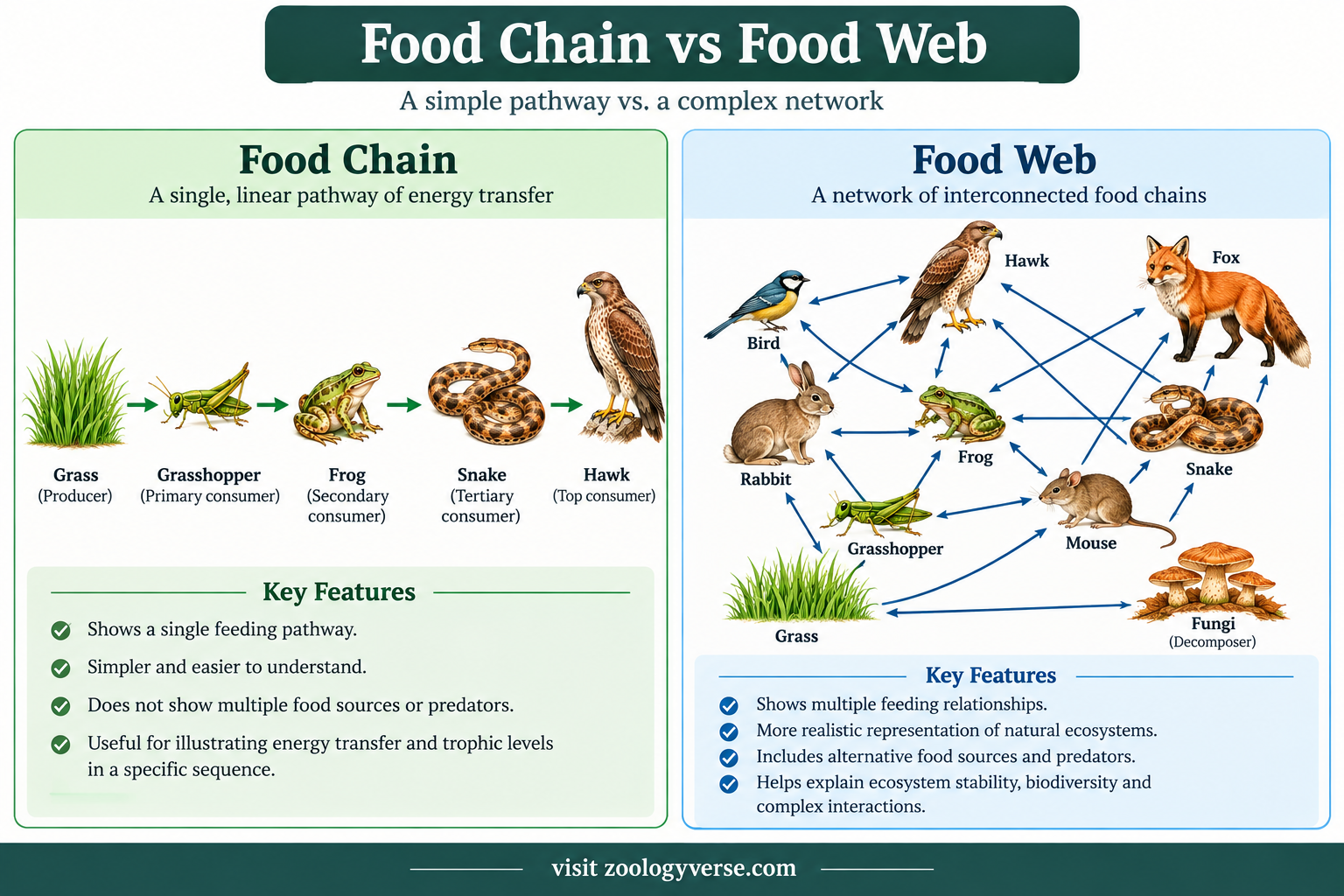
A food chain shows a single, linear pathway through which energy passes from one organism to another. A food web combines multiple interconnected food chains to represent the numerous feeding relationships found in a natural ecosystem.
The food chain vs food web comparison helps explain why a food chain is useful for studying a particular feeding pathway, while a food web provides a broader understanding of ecosystem interactions.
Comparison Table: Food Chain vs Food Web
| Basis of comparison | Food Chain | Food Web |
|---|---|---|
| Definition | A linear sequence of organisms connected through feeding relationships. | A network of interconnected food chains within an ecosystem. |
| Structure | Simple and linear. | Complex and interconnected. |
| Feeding pathways | Represents one pathway of energy transfer at a time. | Represents multiple feeding pathways. |
| Food sources | An organism is shown feeding on a particular food source in the selected pathway. | An organism may be connected to several food sources. |
| Predator relationships | Usually shows a limited number of predator–prey relationships. | Shows several overlapping predator–prey relationships. |
| Trophic relationships | Represents a simplified sequence of trophic levels. | Represents feeding relationships across multiple trophic levels. |
| Energy transfer | Illustrates energy transfer along one selected pathway. | Illustrates energy transfer through multiple pathways. |
| Complexity | Relatively easy to construct and interpret. | More complex because of numerous feeding connections. |
| Ecological realism | Simplifies feeding relationships and may not represent the full diet of organisms. | Generally provides a more realistic representation of feeding relationships. |
| Response to changes | A change in one population may affect organisms along the represented pathway. | A change in one population may affect several connected pathways. |
| Dependence on food sources | The selected pathway shows a particular feeding relationship. | Many organisms have alternative food sources, although not all can readily replace their preferred prey. |
| Example | Grass → Grasshopper → Frog → Snake. | Grass supports grasshoppers and rabbits, while frogs, birds, snakes and foxes participate in several connected feeding pathways. |
Example Illustrating the Difference
Consider a grassland ecosystem containing grass, grasshoppers, rabbits, frogs, mice, snakes, foxes and hawks.
A single food chain might be:
Grass → Grasshopper → Frog → Snake
This sequence represents one pathway through which energy moves. It does not show all the other organisms that eat grasshoppers or all the prey consumed by snakes.
A food web provides a broader representation by including several pathways:
- Grass → Grasshopper → Frog → Snake
- Grass → Grasshopper → Bird → Hawk
- Grass → Rabbit → Fox
- Grass seeds → Mouse → Snake
- Mouse → Hawk
These pathways overlap because organisms can have multiple predators or food sources. For example, a hawk may consume mice and birds, while a snake may feed on frogs and mice.
Thus, a food chain helps explain an individual feeding pathway, whereas a food web reveals the interconnected relationships that characterize the ecosystem.
Why Is a Food Web More Representative of a Natural Ecosystem?
Most organisms do not rely exclusively on one food source. Their diets may change with food availability, season, age or habitat. Similarly, predators may consume different prey species, and the same prey species may be hunted by multiple predators.
A food web represents these overlapping relationships more effectively than an isolated food chain. It can also help ecologists investigate how changes in species abundance may influence other organisms.
For example, if a particular insect population declines, insect-eating birds may experience reduced food availability. Some birds may switch to other prey, while predators that depend on those birds may also be affected. The actual outcome depends on the species involved, alternative food sources and the wider ecosystem.
However, a food web does not guarantee that an ecosystem will remain stable after a disturbance. The loss of a species can have substantial consequences when that species performs an important ecological role or provides food for many other organisms.
Both food chains and food webs are therefore useful models. Food chains simplify individual feeding pathways, while food webs help explain the broader structure and complexity of ecological communities.
Trophic Levels in Food Chains and Food Webs
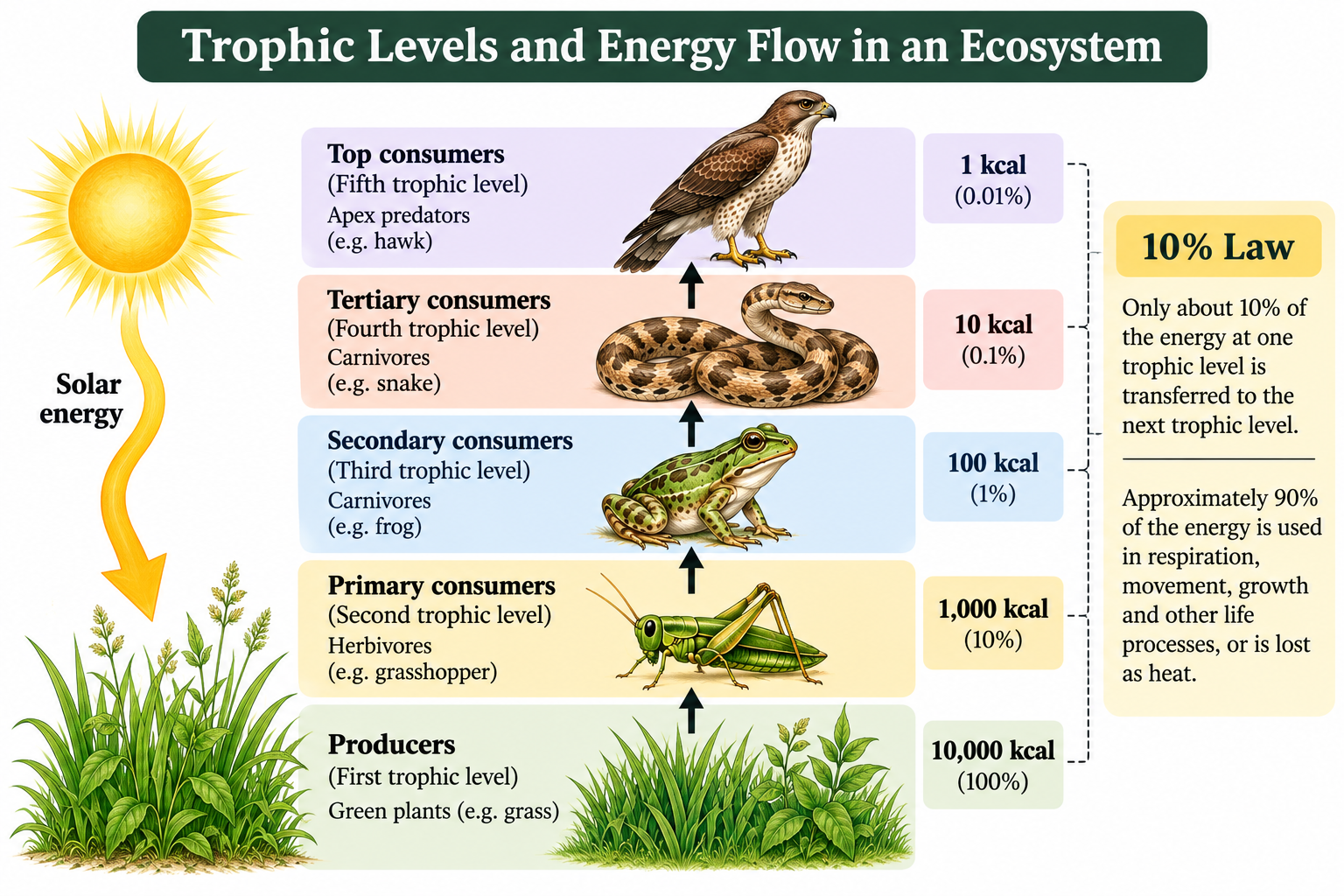
A trophic level is the feeding position occupied by an organism in a food chain or food web. It indicates how an organism obtains energy and its relationship with other organisms in the ecosystem. Trophic levels help explain the movement of energy from producers to consumers and the transfer of organic matter through feeding relationships.
In a simple food chain, each successive trophic level represents another step in the transfer of energy. However, in a natural food web, an organism may feed at different trophic levels depending on its diet. This is an important point when understanding the relationship between a food chain and a food web.
Major Trophic Levels
1. First Trophic Level: Producers
Producers occupy the first trophic level in most ecosystems. They manufacture organic food through photosynthesis or, in some environments, chemosynthesis.
Examples include grasses, trees, algae and phytoplankton.
Producers convert external energy into chemical energy stored in organic compounds. This stored energy supports herbivores and other consumers.
2. Second Trophic Level: Primary Consumers
Primary consumers feed directly on producers and are commonly herbivores.
Examples include grasshoppers, rabbits, deer and zooplankton that consume phytoplankton.
In the food chain below, the grasshopper occupies the second trophic level:
Grass → Grasshopper → Frog → Snake
3. Third Trophic Level: Secondary Consumers
Secondary consumers feed on primary consumers. They are often carnivores or omnivores.
Examples include frogs that eat grasshoppers, spiders that capture herbivorous insects and small fish that consume zooplankton.
In the example above, the frog occupies the third trophic level.
4. Fourth Trophic Level: Tertiary Consumers
Tertiary consumers feed on secondary consumers. Examples may include snakes that eat frogs and large predatory fish that consume smaller carnivorous fish.
In the grassland food chain, the snake occupies the fourth trophic level.
5. Higher Trophic Levels: Top Consumers
Some food chains contain additional consumer levels. Predators at the highest level of a particular pathway may be described as top predators or apex predators.
For example:
Grass → Grasshopper → Frog → Snake → Hawk
In this simplified pathway, the hawk occupies the fifth trophic level. Its exact ecological position depends on what it eats in the ecosystem being studied.
Trophic Levels in a Food Web
In a food web, trophic levels are not always arranged in a single, fixed sequence. Omnivores may consume both plants and animals, allowing them to feed at different trophic levels. Some predators also consume prey from more than one trophic level.
For example, a bird that eats seeds and insects obtains energy directly from producers through seeds and indirectly through insects. Its trophic position therefore depends on the proportions of these foods in its diet.
Decomposers also act on dead organic matter originating from producers and consumers at different trophic levels. They help recycle nutrients, although the energy they obtain is eventually dissipated as heat through metabolic processes.
Why Are Trophic Levels Important?
Trophic levels help ecologists understand several important features of ecosystems:
- Energy transfer: They show how energy passes from producers to consumers through feeding.
- Energy loss: Only a portion of the energy available at one trophic level becomes incorporated into the biomass of the next level.
- Population patterns: The amount of available food and energy can influence the abundance of organisms at different trophic levels.
- Predator–prey relationships: They help identify feeding positions and interactions among organisms.
- Ecological pyramids: They provide the framework for representing the number of organisms, biomass or energy at successive trophic levels.
The concept of trophic levels also connects directly with ecological pyramids. For a detailed explanation of how energy, biomass and organism numbers are represented at different levels, see our article on ecological pyramids.
Understanding trophic levels makes it easier to interpret both simple food chains and complex food webs, while recognizing that real feeding relationships are often more flexible than a linear diagram suggests.
Energy Flow Through Food Chains and Food Webs
Energy flow is the transfer of energy from one organism to another through feeding relationships. It is a fundamental process in every ecosystem because organisms require energy for growth, movement, reproduction, maintenance and other life activities.
The Sun is the primary energy source for most ecosystems. Producers, such as green plants and phytoplankton, capture sunlight through photosynthesis and convert it into chemical energy stored in organic compounds. Consumers obtain this energy by eating producers or other consumers.
In the food chain vs food web comparison, both models explain energy transfer, but they represent it differently. A food chain illustrates energy movement along one pathway, whereas a food web shows how energy moves through several interconnected feeding pathways.
How Does Energy Flow Through a Food Chain?
Energy moves through a food chain in a sequence of feeding relationships.
For example:
Sunlight → Grass → Grasshopper → Frog → Snake
The process occurs in the following stages:
1. Energy capture by producers
Grass absorbs sunlight and uses photosynthesis to produce organic compounds. Some of the captured energy becomes stored in plant tissues and is available to herbivores.
2. Transfer to primary consumers
A grasshopper eats grass and obtains some of the chemical energy stored in plant material. However, not all the energy consumed becomes part of the grasshopper’s biomass. Some is used for metabolism, some is lost as heat, and some remains in uneaten or undigested material.
3. Transfer to secondary consumers
A frog eats the grasshopper and obtains energy from the organic compounds in its prey. The frog uses some of this energy for respiration, movement, growth and other biological processes.
4. Transfer to higher-level consumers
A snake may eat the frog and obtain some of the energy stored in the frog’s tissues. The energy available to the snake is less than the energy originally captured by the grass because energy is used and dissipated at each trophic level.
Therefore, energy transfer through a food chain is not completely efficient.
How Does Energy Flow Through a Food Web?
In a food web, energy moves through multiple connected feeding pathways. A single producer may support several herbivores, and those herbivores may be eaten by different predators.
For example, energy stored in grass may pass to grasshoppers, rabbits and mice. Grasshoppers may be eaten by frogs and birds, while rabbits and mice may be consumed by snakes, foxes or hawks.
These relationships create alternative pathways through which energy can reach higher-level consumers.
A food web can therefore help ecologists examine how different species contribute to energy transfer. If one food source becomes scarce, some consumers may switch to alternatives. However, this flexibility varies among species, and alternative prey may not provide enough energy to replace the missing food source.
The 10% Law of Energy Transfer
The 10% law, proposed by ecologist Raymond Lindeman in his study of trophic dynamics, is a simplified ecological principle stating that approximately 10% of the energy available at one trophic level is transferred to the next level. The remaining energy is used in biological processes, dissipated as heat or remains in material that is not consumed or assimilated by the next trophic level.
The actual percentage varies among ecosystems and feeding relationships. Therefore, the 10% value should be treated as a useful approximation rather than a fixed rule for every organism.
Consider the following illustrative example:
| Trophic level | Illustrative energy available |
|---|---|
| Producers | 10,000 kJ |
| Primary consumers | 1,000 kJ |
| Secondary consumers | 100 kJ |
| Tertiary consumers | 10 kJ |
This example assumes approximately 10% transfer between successive levels. It demonstrates why the energy available to consumers generally decreases at higher trophic levels.
Why Is Energy Flow Unidirectional?
Energy flow through an ecosystem is described as unidirectional because energy enters, passes through organisms and eventually dissipates as heat. Unlike nutrients, energy is not continuously recycled back to producers in the same form.
Producers capture energy from sunlight or chemical sources. Consumers transfer some of that energy through feeding, and organisms release energy as heat during cellular respiration and other metabolic activities.
Nutrients such as carbon, nitrogen and phosphorus can cycle between organisms and the environment. Energy, by contrast, requires a continuing external input to sustain ecosystem processes.
Energy Flow in Grazing and Detritus Food Chains
Energy can enter consumer pathways through both living producers and dead organic matter.
Grazing food chain: Energy moves from living producers to herbivores and then to predators.
Example: Grass → Grasshopper → Frog.
Detritus food chain: Energy stored in dead organic material passes to detritivores and decomposers.
Example: Dead leaves → Earthworm → Bird.
These pathways are interconnected. Some plant material is eaten while the plant is alive, while other material enters the detrital pathway after leaves, roots or entire organisms die.
Why Is Energy Flow Important in Ecosystems?
Energy flow influences ecosystem productivity, food availability, population sizes and the number of trophic levels that can be supported.
- Supports life processes: Organisms need energy for growth, movement, reproduction and maintenance.
- Limits trophic levels: As energy becomes less available at successive levels, ecosystems generally support less biomass at higher trophic levels.
- Influences food-web structure: The availability of energy and prey affects which feeding relationships can be maintained.
- Explains ecological pyramids: Energy pyramids illustrate the reduction in available energy across trophic levels.
- Supports ecosystem comparisons: Studying energy transfer helps ecologists compare productivity and the functioning of different habitats.
Energy flow is therefore central to understanding the food chain vs food web relationship. Both models describe the transfer of energy, but a food web better illustrates the multiple pathways through which energy moves in a natural ecosystem.
Importance of Food Chains and Food Webs
Food chains and food webs are essential concepts in ecology because they explain how organisms obtain food, transfer energy and depend on other species for survival. They also help scientists understand ecosystem functioning, population regulation and the consequences of environmental disturbances.
Although both models describe feeding relationships, the food chain vs food web comparison highlights two different levels of ecological understanding: a food chain focuses on one feeding pathway, while a food web shows the interconnected relationships among many organisms.
1. Explain Energy Transfer
Food chains and food webs show how energy captured by producers becomes available to consumers. Plants and phytoplankton convert external energy into chemical energy, which passes to herbivores and then to predators through feeding.
Understanding these pathways helps explain why energy availability generally decreases at higher trophic levels and why ecosystems require a continuous energy input.
2. Show Feeding Relationships
These models help identify which organisms serve as food for others. A food chain illustrates a particular sequence, while a food web reveals multiple feeding relationships within the same ecosystem.
For example, grass may support grasshoppers, rabbits and mice. These animals may then be consumed by frogs, snakes, foxes, owls or hawks, depending on the ecosystem. Mapping these interactions helps ecologists understand how species are connected.
3. Help Understand Population Regulation
Predators can influence the abundance of their prey, while the availability of food can influence predator populations. These relationships contribute to population regulation, although population size is also affected by competition, disease, climate, habitat availability and other factors.
For example, a decline in a prey population may reduce food availability for its predators. Conversely, changes in predator abundance may influence the survival of prey species.
4. Explain Ecosystem Stability and Resilience
A food web may contain alternative feeding pathways that allow some consumers to switch food sources when their preferred prey becomes scarce. These alternatives can sometimes reduce the effects of a disturbance.
However, a complex food web is not automatically stable. The loss of a highly influential species or a major food source can affect many connected organisms. Ecosystem responses depend on the species involved, the strength of their interactions and the availability of alternatives.
5. Help Identify the Effects of Species Loss
When a species disappears from an ecosystem, the consequences can extend beyond that species alone. Predators may lose a food source, prey populations may increase, and competition among remaining species may change.
Food-web analysis helps scientists identify these possible effects and investigate how biodiversity loss may alter ecosystem processes.
6. Support Wildlife Conservation
Understanding feeding relationships is useful in wildlife conservation because protecting one species often requires maintaining the organisms and habitats on which it depends.
For example, conserving a predatory bird may require protecting suitable nesting sites, prey populations and the wider habitat. Similarly, the recovery of a threatened herbivore may depend on the availability of appropriate vegetation and safe breeding areas.
Food-web knowledge can therefore help guide habitat management, species recovery programmes and ecosystem restoration.
7. Explain Ecological Pyramids
Food chains and food webs are closely related to ecological pyramids, which represent the number of organisms, biomass or energy at successive trophic levels.
Energy pyramids, in particular, illustrate why less energy is generally available to organisms at higher trophic levels. For a detailed explanation, see the ZoologyVerse article on ecological pyramids.
8. Support Ecosystem Management and Research
Ecologists use feeding relationships to study the effects of pollution, invasive species, overfishing, habitat destruction and climate change. Understanding how species interact can help predict possible ecological consequences and identify priorities for conservation.
For instance, introducing a non-native predator may reduce native prey populations and alter feeding relationships throughout an ecosystem. Food-web studies can help researchers investigate these effects and develop appropriate management strategies.
In summary, food chains provide a clear way to study individual feeding pathways, while food webs offer a broader view of ecological connections. Both are valuable tools for understanding energy transfer, biodiversity, population interactions and ecosystem conservation.
Limitations and Ecological Significance of Food Chains and Food Webs
Food chains and food webs are useful models for understanding feeding relationships, energy transfer and ecosystem interactions. However, both simplify complex natural processes and have limitations when used to describe entire ecosystems.
Limitations of Food Chains
1. Represent only one feeding pathway
A food chain shows a single sequence of feeding relationships. It does not normally represent all the food sources an organism uses or all the predators that may consume it.
2. Oversimplify natural ecosystems
In nature, organisms often feed on multiple species. A simple chain cannot fully represent these overlapping relationships, seasonal changes in diet or differences in feeding behaviour.
3. Do not fully represent omnivores
Omnivores consume both plant and animal material. Their trophic position may vary according to their diet, which is difficult to show accurately in a single linear sequence.
4. Provide limited information about ecosystem responses
A food chain can illustrate how a change in one population might affect organisms along that pathway. However, it cannot adequately show alternative feeding pathways that may reduce or amplify the effects of a disturbance.
Limitations of Food Webs
1. Can become difficult to interpret
Food webs may contain numerous species and feeding relationships. Large diagrams can become complicated, making it difficult to identify individual pathways or interpret the importance of particular interactions.
2. May not include every interaction
A food web is usually a simplified representation of selected organisms and feeding relationships. It may omit rare interactions, microscopic organisms, parasites, seasonal changes or differences in diet across life stages.
3. Feeding relationships change over time
Food availability, seasonal conditions, migration and changes in population size can alter feeding interactions. A food-web diagram may represent only a particular period or set of conditions.
4. Do not always show the strength of interactions
An arrow may indicate that one organism eats another, but it does not necessarily show how frequently the interaction occurs or how much energy is transferred. Additional data are needed to understand the relative importance of different feeding relationships.
5. Cannot independently predict ecosystem stability
A food web can help identify connected species and possible effects of disturbances, but the number of connections alone does not determine ecosystem stability. The outcome depends on factors such as interaction strength, species characteristics, environmental conditions and alternative food sources.
Ecological Significance of Food Chains and Food Webs
Despite their limitations, these models are fundamental tools for ecological research and education.
- Understanding ecosystem organization: They identify feeding relationships and the trophic positions of organisms.
- Studying energy transfer: They help explain how energy moves from producers to consumers and why less energy is generally available at higher trophic levels.
- Investigating ecological disturbances: They help researchers explore how pollution, habitat loss, invasive species and population changes may affect other organisms.
- Supporting biodiversity conservation: They reveal dependencies between species and help identify important food sources and ecological relationships.
- Improving ecosystem management: They contribute to research on wildlife conservation, fisheries, habitat restoration and the management of threatened species.
The distinction between a food chain and a food web is particularly useful when selecting an ecological model. A food chain is appropriate for illustrating a specific feeding pathway, while a food web is more suitable for examining the interconnected feeding relationships of an ecosystem. Using both models provides a clearer understanding of how organisms interact and how ecological changes may spread through communities.
Frequently Asked Questions (FAQs)
What is the main difference between a food chain and a food web?
What is a food chain? Give an example.
Example: Grass → Grasshopper → Frog → Snake.
What is a food web? Give an example.
Why is a food web more realistic than a food chain?
What are the main types of food chains?
What are trophic levels?
In which direction do arrows point in a food chain?
Why does energy decrease at higher trophic levels?
What role do decomposers play in food chains and food webs?
Can an organism belong to more than one food chain?
How do food chains and food webs help in wildlife conservation?
What happens if one species disappears from a food web?
Conclusion
Food chains and food webs are fundamental concepts in ecology that explain how organisms obtain food, transfer energy and depend on one another for survival. A food chain represents a single pathway of energy transfer, whereas a food web connects multiple feeding pathways to illustrate the complex relationships found in natural ecosystems.
The food chain vs food web comparison highlights the difference between a simplified feeding sequence and a broader network of ecological interactions. Both models help explain trophic levels, predator–prey relationships, energy transfer and the consequences of changes in species populations.
Food chains are useful for studying individual feeding pathways, while food webs provide a more comprehensive view of ecosystem organization. Together, they help ecologists understand biodiversity, investigate environmental disturbances and develop strategies for wildlife conservation and ecosystem management.
Studying these feeding relationships also provides a foundation for understanding ecological pyramids, energy flow and nutrient cycling. Recognizing how organisms depend on one another is essential for appreciating the interconnected nature of ecosystems and the importance of conserving their biodiversity.
References
- OpenStax. (2018). Biology 2e: 46.1 Ecology of Ecosystems. OpenStax, Rice University. https://openstax.org/books/biology-2e/pages/46-1-ecology-of-ecosystems
- OpenStax. (2018). Biology 2e: 46.2 Energy Flow through Ecosystems. OpenStax, Rice University. https://openstax.org/books/biology-2e/pages/46-2-energy-flow-through-ecosystems
- Khan Academy. Food Chains and Food Webs. https://www.khanacademy.org/science/biology/ap-biology/ap-ecology/ap-intro-to-ecosystems/a/food-chains-food-webs
- National Geographic Society. Food Chains and Webs. National Geographic Education. https://education.nationalgeographic.org/resource/resource-library-food-chains-and-webs/
- OpenStax. Concepts of Biology: 20.1 Energy Flow through Ecosystems. OpenStax, Rice University. https://openstax.org/books/concepts-biology/pages/20-1-energy-flow-through-ecosystems
Discover more from Zoologyverse
Subscribe to get the latest posts sent to your email.