
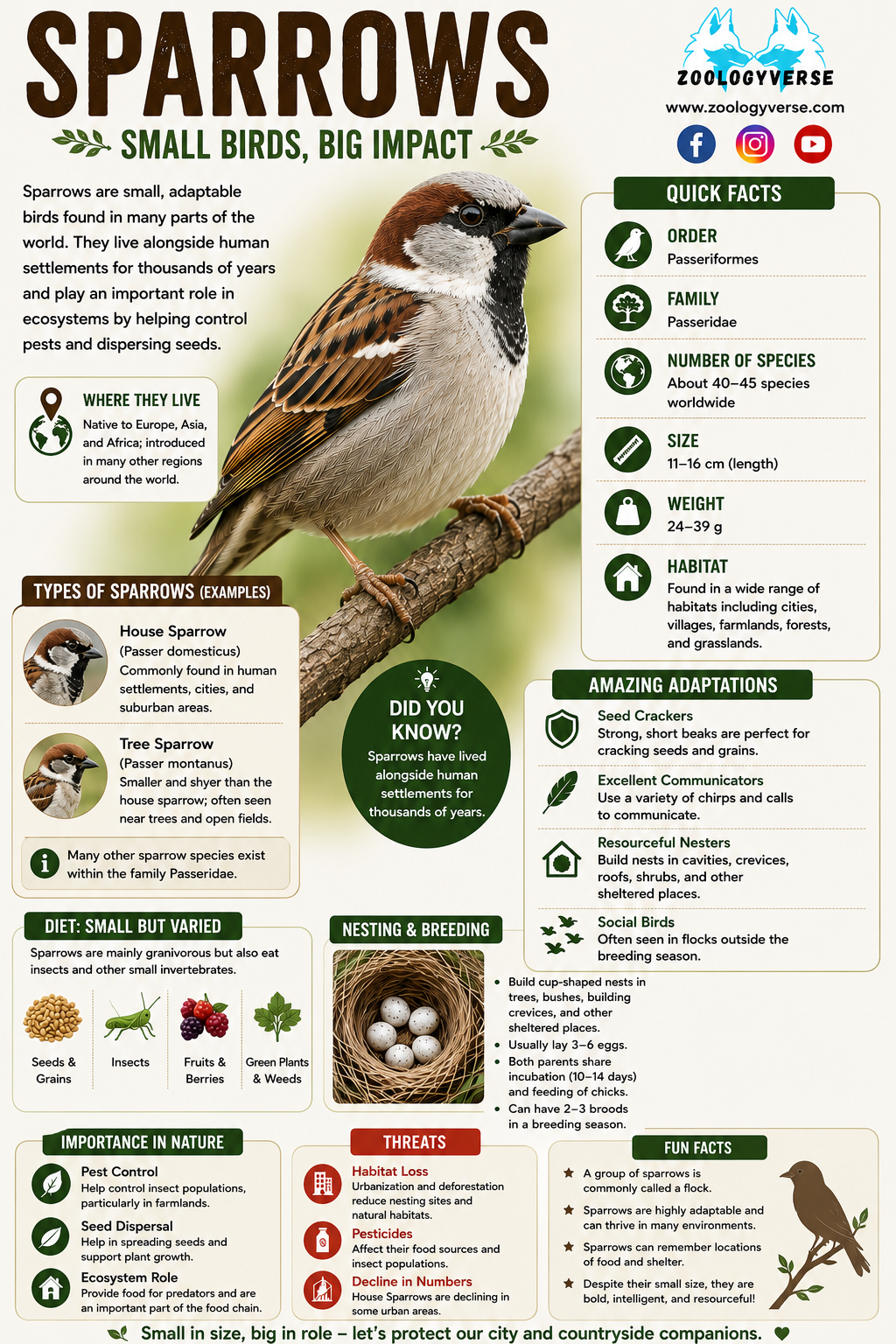
Passer domesticus, commonly known as the House Sparrow, is one of the most widespread and familiar birds across the world.
Closely associated with human settlements, this small, social passerine thrives in towns, villages, farms, and urban environments.
Recognizable by its stout body, conical seed-eating beak, and chirping calls, the House Sparrow displays remarkable adaptability and strong flocking behavior.
Although once extremely common, many populations have declined in several regions due to habitat loss, pollution, reduced food availability, and urban changes.
Despite these challenges, Passer domesticus remains an important species for ecological studies, urban biodiversity, and community awareness.
For Practical Study 🧪
Classification of Passer domesticus
| Rank | Classification | Characteristic |
|---|---|---|
| Kingdom | Animalia | Multicellular, heterotrophic animals |
| Phylum | Chordata | Dorsal tubular nerve cord, notochord and gill-slits present. |
| Group | Craniata | Definite head, Cranium with brain present. |
| Sub-phylum | Vertebrata | Vertebral column present. |
| Division | Gnathostomata | Jaws and paired appendages present |
| Super Class | Tetrapoda | Paired limbs, lungs, cornified skin and bony skeleton. |
| Class | Aves | Biped and feathered vertebrates. |
| Sub-Class | Neornithes | True birds. Metacarpals fused. |
| Super-Order | Neognathae | Modern birds. no teeth. sternum keeled. |
| Order | Passeriformes | Perching bird. Toes 3 in front and behind. |
| Family | Passeridae | Old World sparrows |
| Genus | Passer | Old World sparrows |
| Species | Passer domesticus | House Sparrow |
Geographical Distribution
Passer domesticus is abundantly found in Sri Lanka, Myanmar, Pakistan and India, and has been introduced to North America, South America, Australia and New Zealand.
Habit and Habitat
Most familiar companion bird freely moving and nesting in the houses.
They act as commensal to man.
In winter they feed on cultivated areas in flocks. They are gregarious.
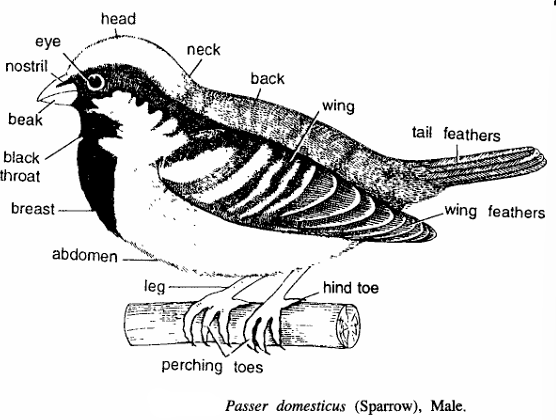
Comments
- Passer Domesticus is common house sparrow.
- It is a small bird measuring 10 to 16 cm in length.
- Body divisible into head, neck, back, breast and abdomen, Head contains eyes and beak.
- Sexual dimorphism is distinct, Female is ash white, while male is earthy brown with blackish throat and breast and white abdomen.
- Eyes small and the beak is short and conical.
- Beak adapted for seed eating.
- Breast and abdomen bulging.
- Wing and wing feathers folded over body, Tail feathers elongated.
- Feet adapted for perching. Toes- 3 in front and 1 behind.
- Nesting practically throughout the year. Some make elaborate nests; lay 3-8 eggs.
- Young naked and blind at hatching, require feeding and care by parents before becoming independent
Special Features
- The sparrows are both useful and harmful to mankind. They destroy several agricultural pests. They destroy vegetable and flower buds.
Identification
Since this bird has earthy brown body and above features, hence it is Passer domesticus.
Quick Identification of Passer domesticus
| Feature | Description |
|---|---|
| Common name | House Sparrow |
| Scientific name | Passer domesticus |
| Class | Aves |
| Order | Passeriformes |
| Family | Passeridae |
| Body | Small, compact passerine bird |
| Male plumage | Grey crown, chestnut-brown nape and mantle, black bib and pale underparts |
| Female plumage | Mainly brown and buff with a prominent pale eyebrow stripe |
| Bill | Short, stout and conical |
| Wings | Rounded with brown and buff patterning |
| Feet | Adapted for perching and walking |
| Key feature | Strong sexual dimorphism, especially in head and breast coloration |
Physical Characteristics of Passer domesticus
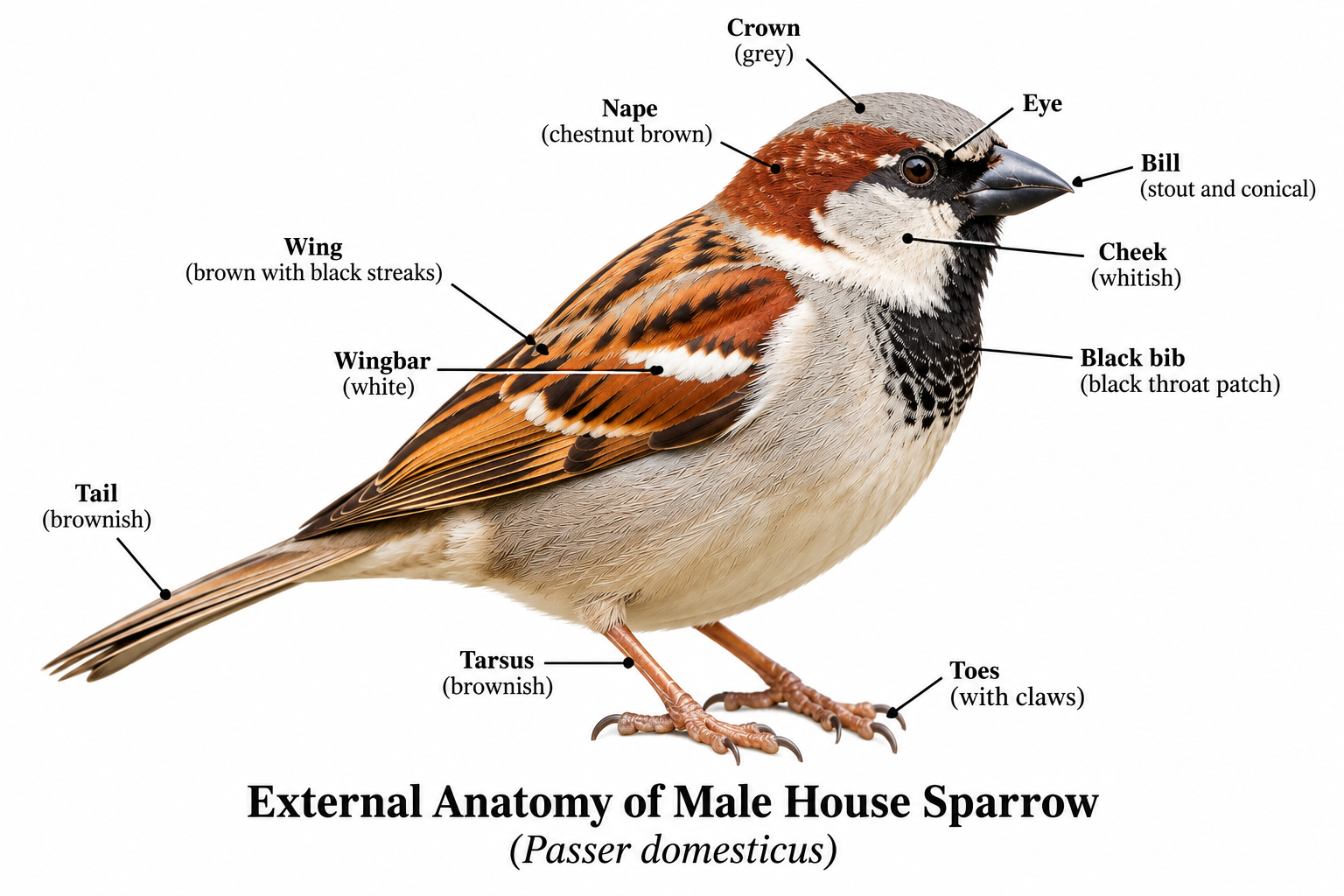
The House Sparrow is a small, compact passerine with a rounded head, short tail and stout conical bill. Its plumage differs noticeably between males and females.
- Head: The breeding male has a grey crown, white cheeks and chestnut-brown areas around the neck and head.
- Bill: The bill is short, thick and conical, well suited for handling seeds and grains.
- Upperparts: The back and wings show brown, black and buff patterning.
- Underparts: The underparts are generally pale, while the male has a prominent black bib extending over the throat and upper breast.
- Wings: The wings are rounded and show contrasting brown and buff markings, with a pale wingbar.
- Tail: The tail is relatively short compared with many other sparrow-like birds.
- Feet: The feet are adapted for perching and walking on the ground.
- Female plumage: Females are mainly buffy-brown with darker streaking on the back and a noticeable pale eyebrow stripe.
- Body size: Adults are approximately 15–17 cm long, with a wingspan of about 19–25 cm.
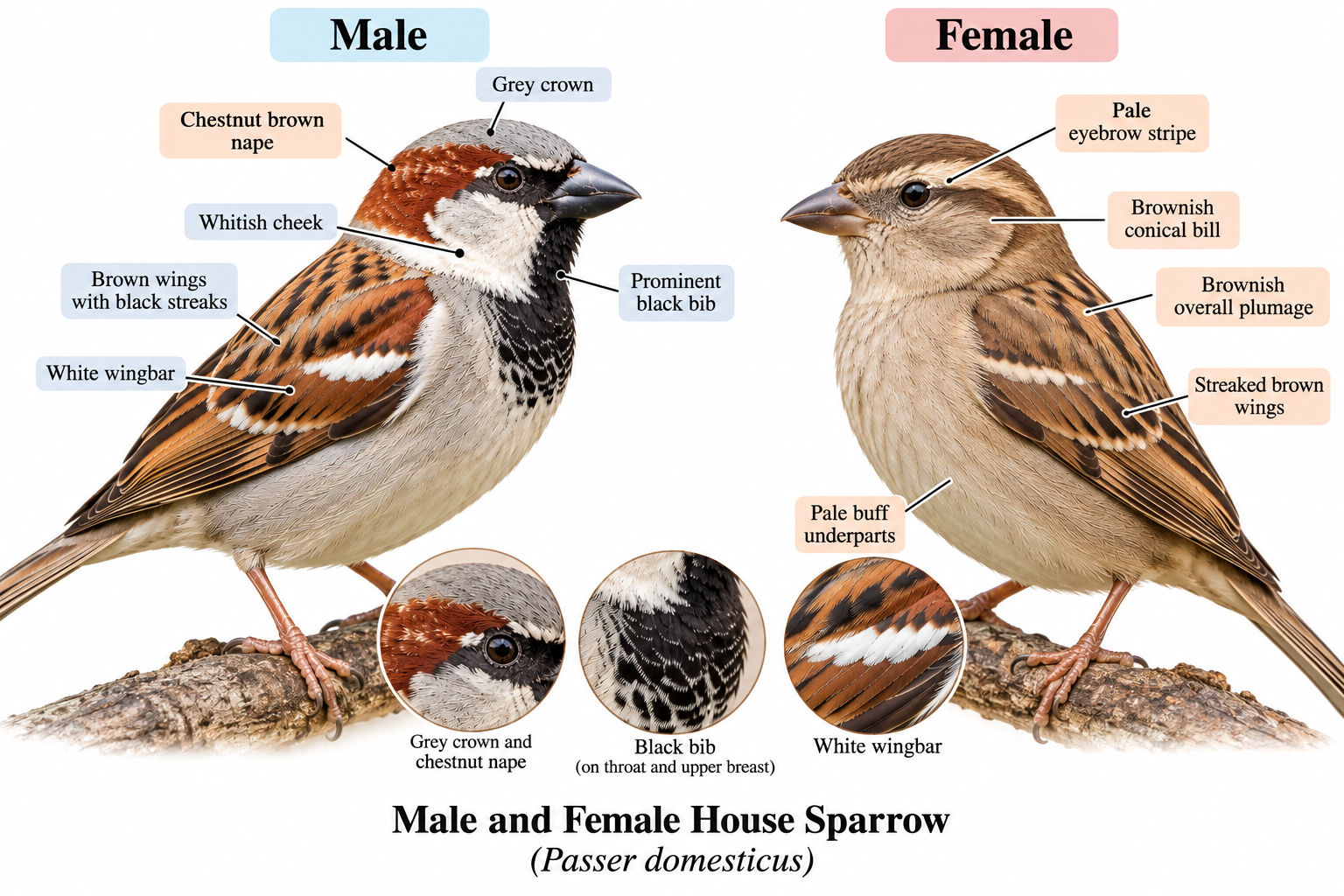
Sexual Dimorphism in Passer domesticus
The House Sparrow shows clear sexual dimorphism, particularly in the coloration of the head, throat and upperparts.
- Male: The breeding male has a grey crown, chestnut-brown areas around the nape and sides of the neck, white cheeks and a distinctive black bib or throat patch.
- Female: The female is mainly brown and buff, with darker streaking on the back and a conspicuous pale eyebrow stripe. She lacks the male’s black bib and chestnut head markings.
- Juveniles: Young birds generally resemble females in their subdued brownish plumage.
- Seasonal variation: The male’s appearance can become more pronounced during the breeding season as worn feather tips expose the darker and brighter underlying plumage.
These differences make plumage pattern one of the easiest ways to distinguish adult male and female House Sparrows.
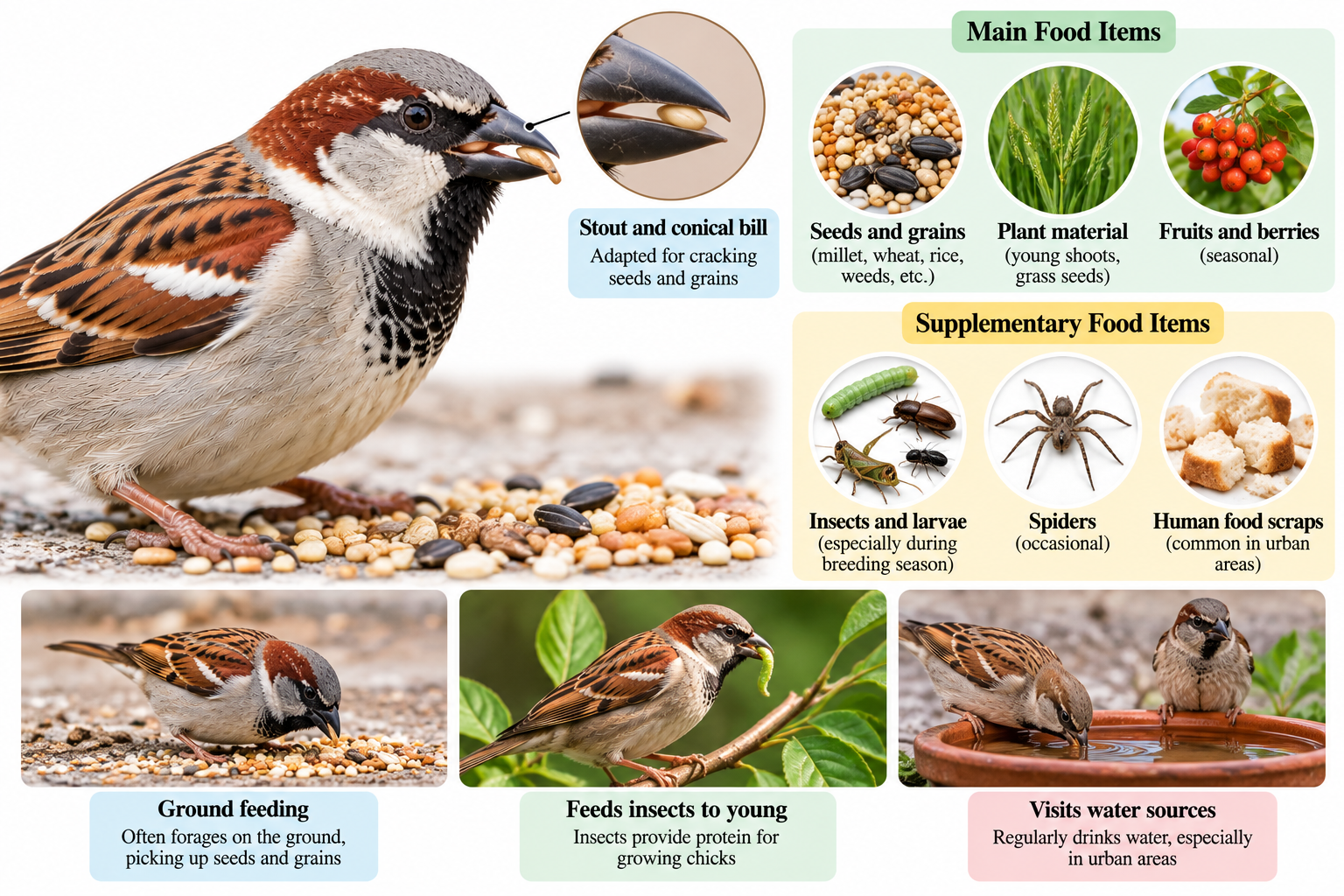
Feeding and Dietary Adaptations of Passer domesticus
The House Sparrow is an omnivorous and opportunistic feeder. Its diet varies with season and food availability.
- Seeds and grains: Form an important part of the adult diet, including grains and grass seeds.
- Plant material: It may also consume fruits and other plant-based foods when available.
- Insects: Insects and other small invertebrates become particularly important during the breeding season.
- Feeding young: Adults provide insects and other animal food to growing chicks, supplying protein needed for development.
- Strong conical bill: The short, stout bill is well suited for picking up and handling seeds and grains.
- Ground foraging: House Sparrows commonly hop and forage on the ground, particularly around human settlements and cultivated areas.
This flexible diet helps P. domesticus exploit both natural food resources and food associated with human environments.
Nesting and Reproduction in Passer domesticus
House Sparrows are cavity-nesting birds that commonly use spaces in buildings and other structures for breeding. They may also nest in tree cavities and nest boxes.
- Nest site: Common sites include holes and cavities in buildings, eaves, signs, streetlights and nest boxes.
- Nest material: Nests are made from dried vegetation and lined with finer materials such as feathers and other soft material.
- Eggs: A clutch may contain several eggs, with 1–8 eggs recorded.
- Incubation: Eggs generally hatch after about 10–14 days.
- Nestlings: Young remain in the nest for approximately 10–14 days before fledging.
- Multiple broods: House Sparrows can produce more than one brood during a breeding season.
- Parental care: Adults feed and care for the young until they become independent.
House Sparrows frequently reuse suitable nesting sites, and their close association with human structures is an important feature of their breeding ecology.
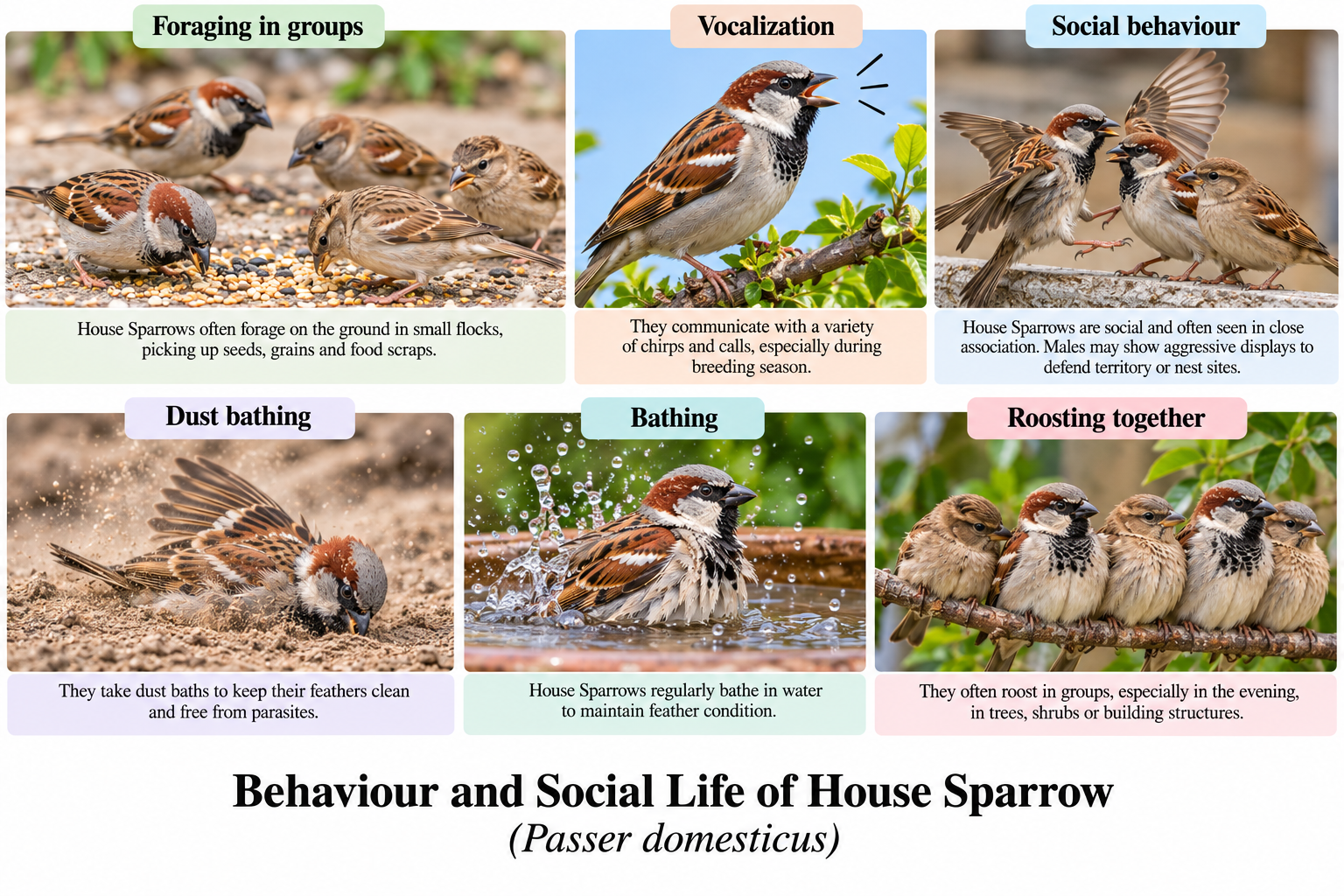
Behaviour and Social Life of Passer domesticus
The House Sparrow is a social and adaptable passerine that often lives in groups, particularly where food and nesting sites are abundant.
- Social behaviour: House Sparrows commonly forage and roost in groups and may form larger flocks outside the breeding period.
- Foraging: They frequently forage on the ground, moving by short hops while searching for seeds and other food.
- Vocal communication: A series of chirping and chattering calls helps maintain contact between individuals and is especially noticeable around breeding and nesting sites.
- Territorial behaviour: Breeding pairs may defend the immediate area around their nest from competing sparrows.
- Roosting: Groups may gather at communal roosting sites, particularly where suitable vegetation or structures provide shelter.
- Adaptability: The species readily uses human-dominated environments such as towns, villages, agricultural areas and buildings.
Its ability to exploit varied food sources and nesting opportunities has allowed the House Sparrow to live successfully alongside humans in many parts of the world.
Ecological Role and Human Association of Passer domesticus
The House Sparrow is closely associated with human settlements and interacts with both natural and urban food webs.
- Seed consumption: By feeding on seeds and grains, House Sparrows participate in the movement of plant material through food webs.
- Insect consumption: Their consumption of insects and other invertebrates contributes to local predator–prey interactions.
- Food for predators: House Sparrows can serve as prey for various birds of prey and other predators.
- Urban ecosystem: They commonly use buildings, gardens, agricultural fields and other human-modified habitats for feeding, shelter and nesting.
- Human association: The species has adapted well to many environments created or modified by people and frequently nests in cavities associated with buildings.
- Ecological interactions: Their feeding, nesting and flocking behaviour connects them with a variety of organisms within urban, rural and agricultural ecosystems.
Conservation Status of Passer domesticus
The House Sparrow has a broad global distribution and remains a common species in many regions. However, population trends can vary between locations, particularly in urban and agricultural environments.
- IUCN status: Least Concern (LC)
- Population: Generally widespread, although declines have been reported in some local populations.
- Potential local pressures: Loss of suitable nesting cavities, changes in food availability, urban habitat changes and environmental pollution may affect some populations.
- Conservation: Maintaining green spaces, vegetation, suitable nesting sites and diverse food resources can help support local House Sparrow populations.
Frequently Asked Questions
What is the scientific name of the House Sparrow?
The scientific name of the House Sparrow is Passer domesticus.
Which family does the House Sparrow belong to?
It belongs to the family Passeridae, the family of Old World sparrows.
How can male and female House Sparrows be distinguished?
The adult male has a grey crown, chestnut-brown head and neck markings, and a prominent black bib. The female is mainly brown and buff with a pale eyebrow stripe.
What does the House Sparrow eat?
It feeds mainly on seeds and grains but also consumes fruits, insects and other small invertebrates. Insects are particularly important when adults are feeding young.
Where does the House Sparrow build its nest?
It commonly nests in cavities in buildings, eaves, roofs, nest boxes and other structures. It can also use natural cavities.
Is the House Sparrow an omnivore?
Yes. Its flexible diet includes both plant material and animal food such as insects and other invertebrates.
What is the IUCN status of the House Sparrow?
The House Sparrow is currently classified as Least Concern (LC) globally.
Why is the House Sparrow commonly found near humans?
It can exploit food, shelter and nesting cavities associated with buildings, gardens, farms and other human-modified environments.
Recommended Study Resource
Practical Zoology Vertebrate 12/Ed
by Ss Lal (Author)
Rastogi Publications MODERN TEXT BOOK OF ZOOLOGY: VERTEBRATES (Z-3)
by Prof. R. L. Kotpal (Author)
As an Amazon Associate I earn from qualifying purchases.
References
- ITIS — Passer domesticus (House Sparrow): taxonomy and accepted scientific name.
- Cornell Lab of Ornithology — House Sparrow: identification, behaviour, diet and life history.
- eBird — House Sparrow (Passer domesticus): identification and distribution.
- worldanimalrescuenetwork.org-wildlife-guides-sparrow
- House Sparrow Passer domesticus Species Factsheet
Discover more from Zoologyverse
Subscribe to get the latest posts sent to your email.