
What Is Phylum Cephalochordata?
Phylum Cephalochordata is a small group of marine chordates that retain the main chordate characteristics throughout their adult life.
They are commonly known as lancelets or amphioxus.
Cephalochordates have a small, elongated, fish-like body and usually live partially buried in shallow marine sediments.
Their body contains a notochord, dorsal hollow nerve cord, pharyngeal gill slits, and post-anal tail, which remain present throughout life.
The most familiar example is Branchiostoma, commonly called Amphioxus.
Unlike vertebrates, cephalochordates do not have a vertebral column or a distinct skull.
Cephalochordata is particularly important in zoology because these animals provide a useful example of a simple chordate body plan and help in understanding the evolution of more complex chordates.
General Characteristics of Cephalochordata
The important characteristics of Phylum Cephalochordata are:
- Cephalochordates are exclusively marine animals.
- Their body is small, elongated, laterally compressed, and fish-like.
- They are generally bilaterally symmetrical and triploblastic.
- The notochord extends from the anterior end to the posterior end and persists throughout life.
- A dorsal hollow nerve cord is present along the length of the body.
- The pharynx contains numerous gill slits, which are important for filter feeding and respiration.
- A post-anal tail is present throughout life and helps in swimming.
- The body is divided into head, trunk, and tail regions, although a distinct vertebrate-type head is absent.
- They have a complete digestive system with a mouth and anus.
- The circulatory system is closed, but a true heart is absent.
- Excretion is mainly carried out by specialized protonephridia containing solenocytes.
- Cephalochordates are generally dioecious, with separate male and female individuals.
- Fertilization is usually external and takes place in seawater.
- They are mainly filter feeders, obtaining food particles from water.
- Important examples include Branchiostoma (Amphioxus) and related lancelets.
Classification of Cephalochordata
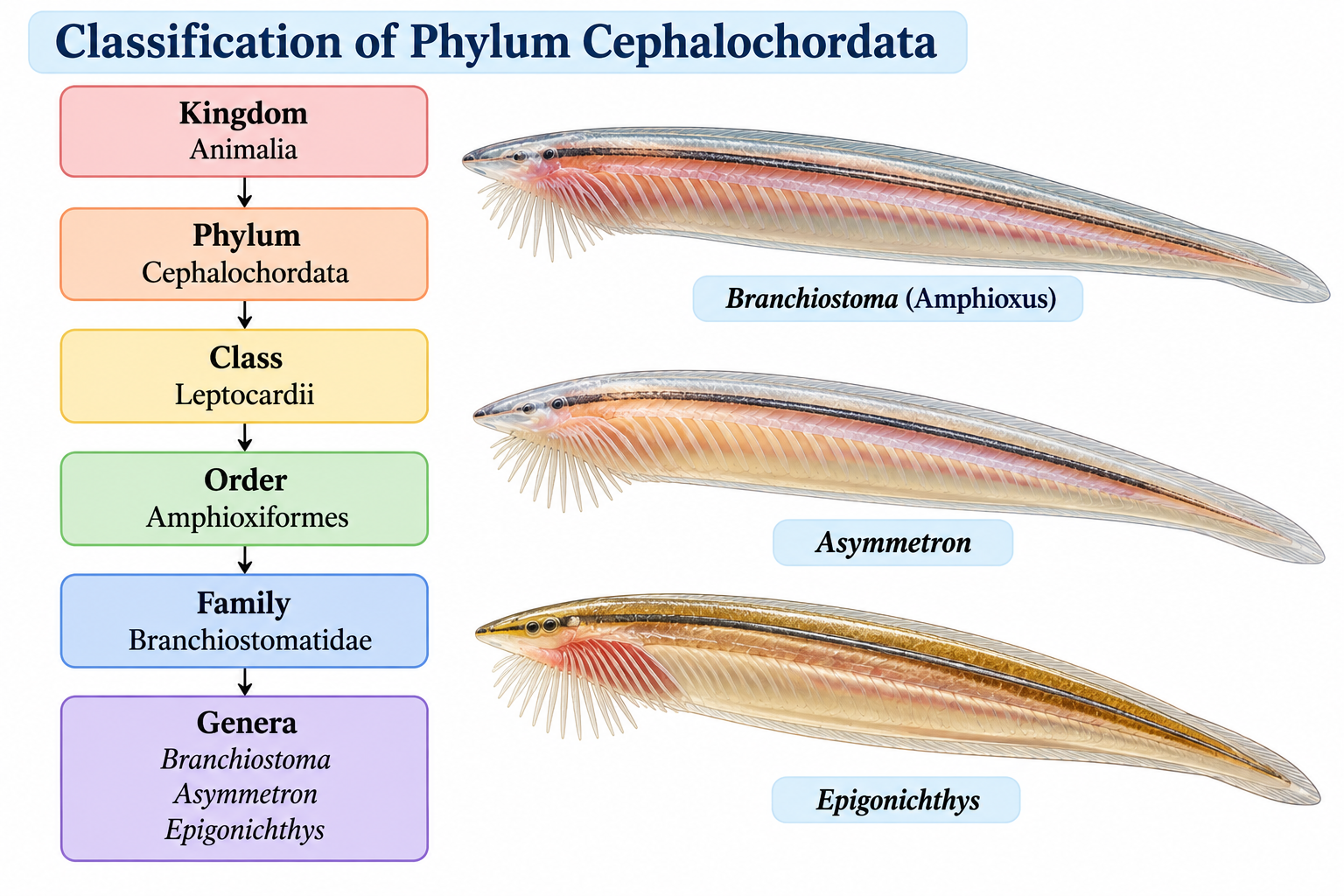
Phylum Cephalochordata is a small and relatively uniform group of marine chordates. It contains a single living class.
Class Leptocardii
Leptocardii includes the living cephalochordates, commonly known as lancelets or amphioxus.
Important features:
- Small, elongated, fish-like marine animals.
- The notochord extends from the anterior to the posterior end and remains throughout life.
- Numerous pharyngeal gill slits are present.
- They are mainly filter feeders.
- Adults usually live partially buried in sandy or shallow marine sediments.
Examples:
Branchiostoma (Amphioxus), Asymmetron, Epigonichthys
Body Structure of Cephalochordates
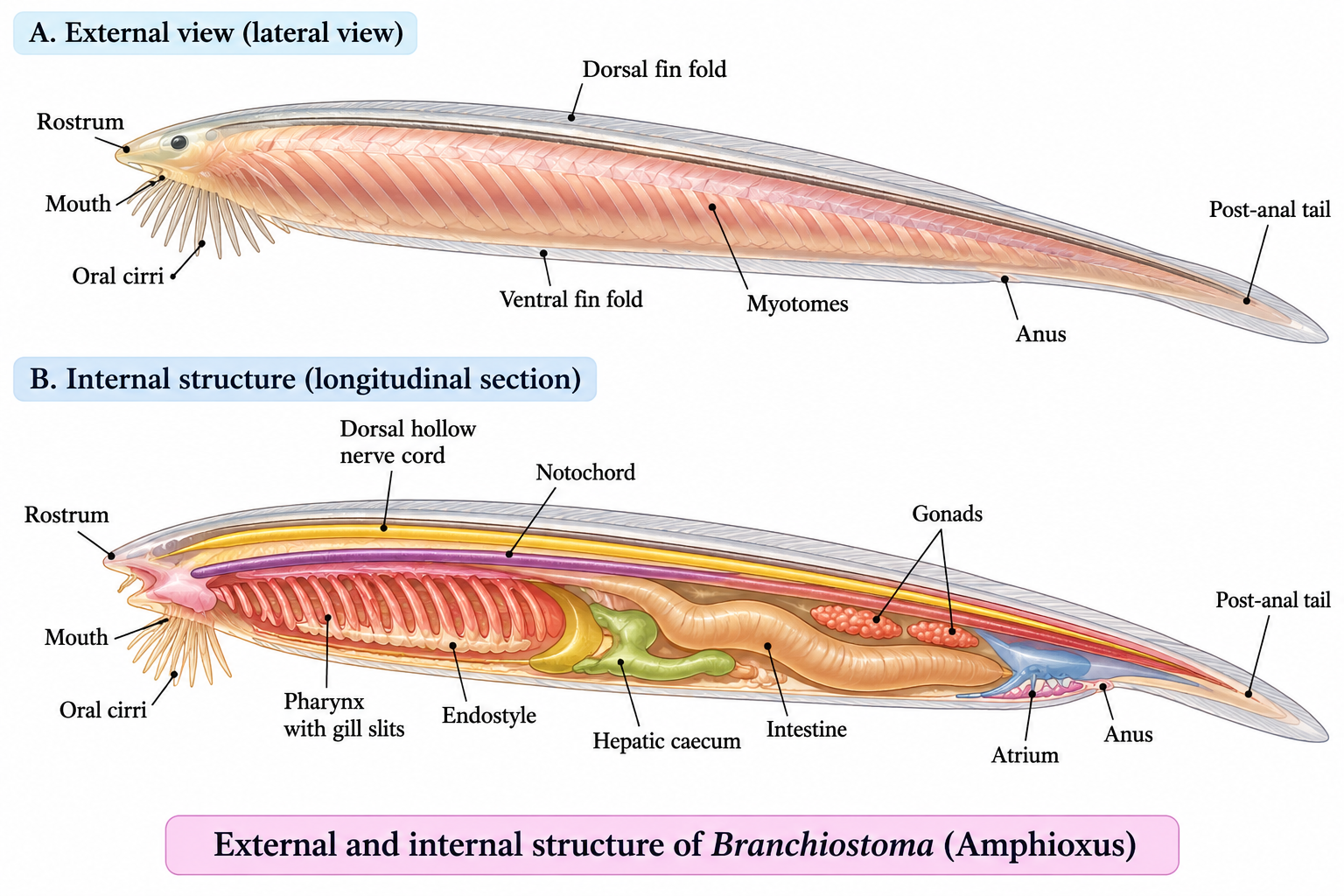
The body of a typical cephalochordate such as Branchiostoma is small, elongated, laterally compressed, and fish-like. It is usually a few centimetres long and is adapted for swimming and living partially buried in marine sand.
The notochord extends from the anterior end to the posterior end of the body and remains present throughout the animal’s life. It provides support and also helps in swimming by resisting the contraction of the surrounding muscles.
A dorsal hollow nerve cord runs above the notochord along the length of the body. At the anterior end, it is slightly enlarged but does not form a true vertebrate brain.
The pharynx is large and contains numerous pharyngeal gill slits. These openings allow water to pass through the pharynx during filter feeding and also contribute to respiration.
The body contains segmented blocks of muscles called myotomes. Their alternating contractions produce the side-to-side movements used for swimming.
The posterior end forms a well-developed post-anal tail, which assists in locomotion. The mouth is surrounded by oral cirri, which help prevent large particles from entering the pharynx.
Overall, the body structure of cephalochordates retains the major chordate features in a relatively simple form, making them important for understanding the basic chordate body plan.
Digestive System of Cephalochordates
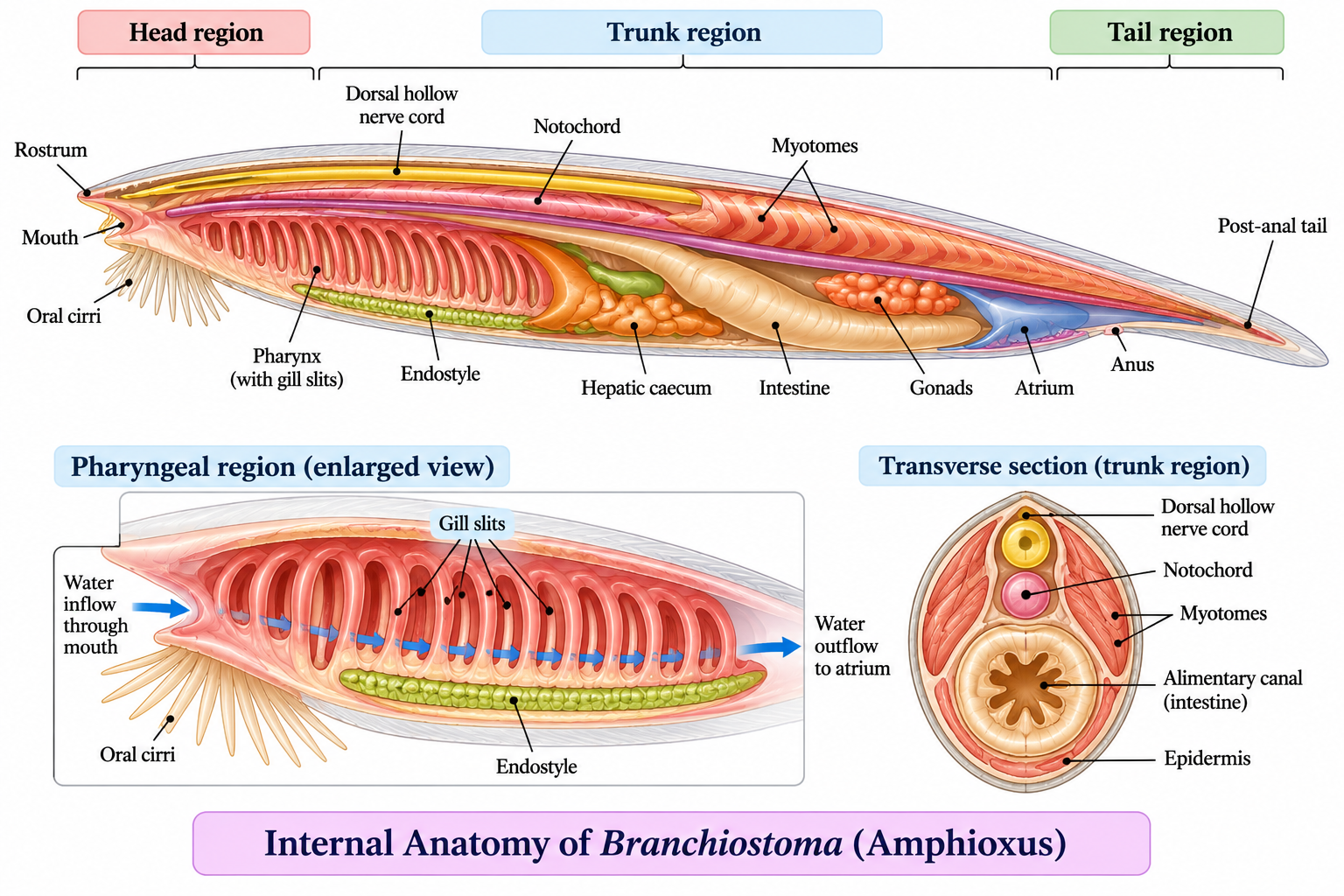
The digestive system of cephalochordates is complete, with a separate mouth and anus. It is closely adapted to their filter-feeding mode of life.
Water carrying microscopic food particles enters through the mouth, which is surrounded by oral cirri. The cirri help prevent larger particles from entering the digestive tract.
The water then passes into the large pharynx, which contains numerous pharyngeal gill slits. A mucus-producing structure called the endostyle traps food particles from the water.
Cilia move the mucus and trapped food toward the oesophagus and then into the intestine. Digestion and absorption of nutrients take place mainly in the digestive tract.
A specialized diverticulum called the hepatic caecum extends from the intestine and contributes to digestion and nutrient processing.
Finally, undigested material passes through the intestine and is expelled through the anus, which is located near the posterior end of the body.
Respiratory System of Cephalochordates
Respiration in cephalochordates mainly occurs through the pharyngeal gill slits and the general body surface.
Water enters through the mouth and passes into the large pharynx. It then moves through the numerous pharyngeal gill slits into the surrounding atrial cavity and finally leaves the body through the atriopore.
The walls of the pharyngeal region contain a network of blood vessels. Oxygen from the water diffuses into the blood, while carbon dioxide passes from the blood into the water.
The continuous movement of water through the pharynx therefore supports both filter feeding and respiration.
In addition to the pharyngeal region, gaseous exchange can occur through the body surface, especially because of the thin and relatively permeable body wall.
The respiratory system of cephalochordates is therefore simple but efficient and is closely associated with their filter-feeding lifestyle.
Circulatory System of Cephalochordates
Cephalochordates have a closed circulatory system in which blood remains within a network of blood vessels. Unlike vertebrates, they do not have a true heart.
Instead, the movement of blood is maintained by the rhythmic contractions of several contractile blood vessels. The dorsal and ventral blood vessels are connected by smaller vessels that distribute blood to different parts of the body.
The ventral aorta carries blood toward the pharyngeal region. Blood passes through vessels associated with the pharyngeal gill bars, where oxygen is absorbed from the surrounding water.
Oxygenated blood is then carried through vessels toward the dorsal side and distributed to the body tissues. The hepatic portal system carries blood from the digestive region to the hepatic caecum before it enters the general circulation.
The circulatory system transports oxygen, nutrients, hormones, and metabolic wastes throughout the body and supports the active muscular movements required for swimming.
Excretory System of Cephalochordates
The excretory system of cephalochordates consists mainly of specialized protonephridia located in the pharyngeal region. These structures help remove metabolic wastes from the body.
Each protonephridium contains specialized cells called solenocytes. These cells have long, flagellated processes that help move fluid and waste products through the excretory tubules.
The excretory tubules open into the atrium, allowing waste materials to be released into the surrounding water through the atriopore.
The excretory system is relatively simple compared with that of vertebrates but is well suited to the small body size and marine habitat of cephalochordates. Thus, protonephridia with solenocytes are the main excretory structures of Cephalochordata.
Nervous System of Cephalochordates
The nervous system of cephalochordates consists mainly of a dorsal hollow nerve cord that extends along the length of the body. It lies above the notochord and is one of the most important chordate features retained throughout life.
At the anterior end, the nerve cord is slightly enlarged to form a simple cerebral vesicle. It is not a highly developed brain like that of vertebrates.
The nerve cord gives off dorsal and ventral nerve roots that supply different regions of the body. These nerves help coordinate swimming movements and responses to environmental stimuli.
Cephalochordates also possess several sensory structures, including sensory cells and receptors associated with the oral region and body surface. These help detect changes in water movement, touch, and other environmental conditions. The nervous system of Cephalochordata is therefore relatively simple but retains the basic dorsal hollow nerve cord characteristic of chordates.
Reproduction and Development of Cephalochordates
Cephalochordates are generally dioecious, meaning male and female reproductive organs occur in separate individuals. The gonads are present in the trunk region and are arranged along the sides of the body.
During reproduction, mature eggs and sperm are released into the surrounding seawater through openings associated with the atrial cavity. Fertilization is therefore usually external.
The fertilized egg undergoes cleavage and develops into a free-swimming larva. The larva gradually develops the characteristic chordate features, including the notochord, dorsal hollow nerve cord, pharyngeal region, and post-anal tail.
The larva undergoes metamorphosis and develops into the adult form. Unlike urochordates, the major chordate structures are retained in the adult cephalochordate.
The reproductive and developmental features of Cephalochordata are important for understanding the basic developmental pattern and evolutionary history of chordates.
Examples of Cephalochordata
Phylum Cephalochordata contains a small number of marine animals commonly known as lancelets. The following are important examples:
Branchiostoma
Branchiostoma, commonly called Amphioxus or lancelet, is the best-known example of Cephalochordata. It has an elongated body and retains the notochord, dorsal hollow nerve cord, pharyngeal gill slits, and post-anal tail throughout life.
Asymmetron
Asymmetron is a marine lancelet found in shallow coastal waters. Like other cephalochordates, it has a simple fish-like body and feeds mainly by filter feeding.
Epigonichthys
Epigonichthys is another genus of lancelets belonging to Cephalochordata. It occurs in marine environments and shares the characteristic chordate features of the group.
Among these, Branchiostoma is the most commonly used example in zoology textbooks and practical studies.
Importance of Cephalochordata in Zoology
Cephalochordates are important in zoology because they retain the major chordate characteristics throughout their adult life. This makes them useful for understanding the basic organization of chordates.
The presence of a notochord, dorsal hollow nerve cord, pharyngeal gill slits, and post-anal tail provides a simple example of the fundamental chordate body plan.
Cephalochordates are also important in the study of evolution and comparative anatomy. Their relatively simple organization helps scientists compare primitive chordate features with the more specialized structures found in vertebrates.
Their embryonic development is also useful for studying how important chordate structures develop and become organized. For zoology students, Branchiostoma is particularly important because it is commonly used as a representative example of Cephalochordata in textbooks, practical classes, and examinations.
Cephalochordata vs Urochordata
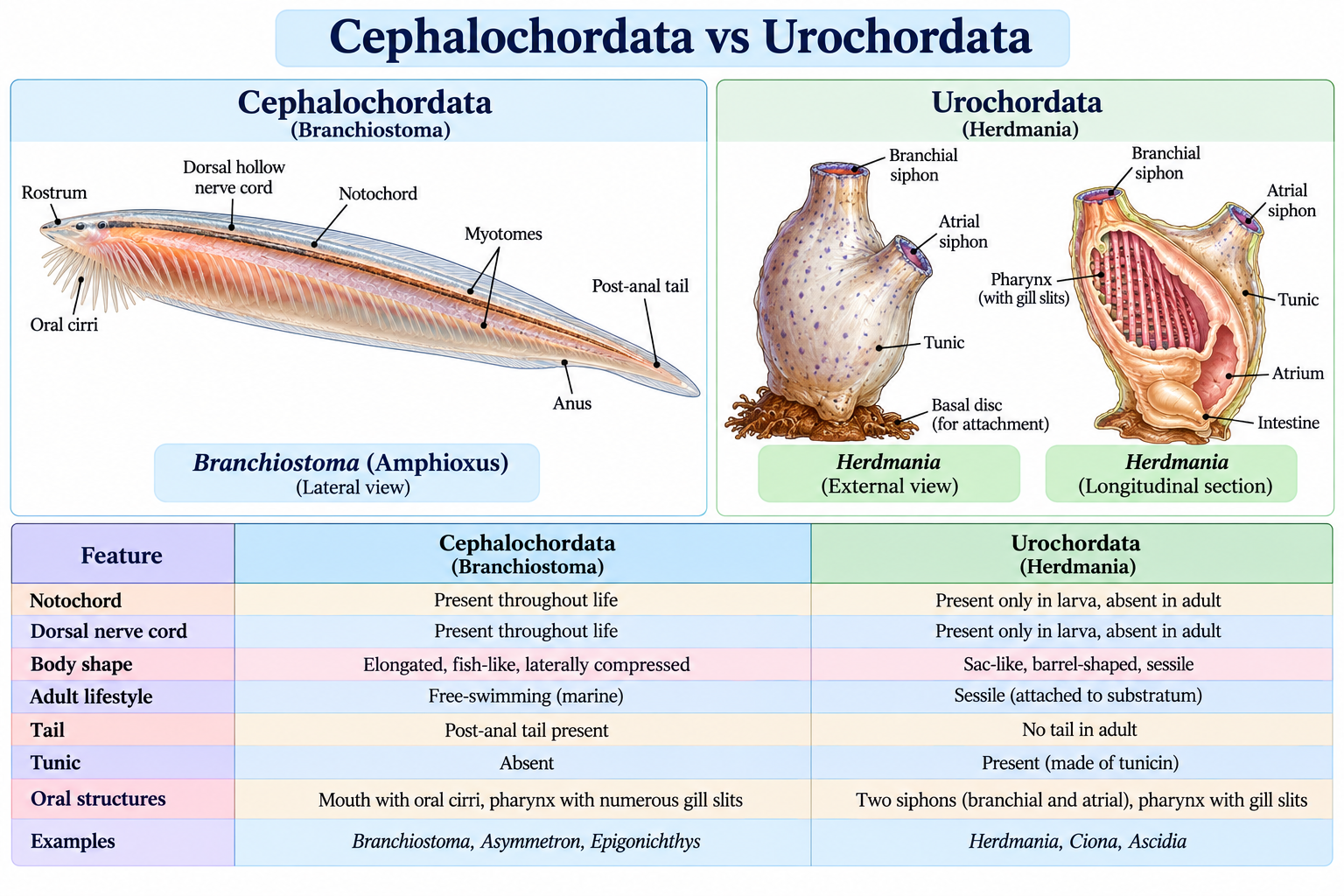
Cephalochordata Vs Urochordata are both groups of invertebrate chordates, but they differ in their body structure, development, and lifestyle.
| Feature | Cephalochordata | Urochordata |
|---|---|---|
| Common name | Lancelets or amphioxus | Tunicates or sea squirts |
| Adult habitat | Marine; often partially buried in sand | Marine; many adults are attached to a substrate |
| Notochord | Extends from head to tail and persists throughout life | Mainly present in the larval tail |
| Dorsal nerve cord | Persists throughout life | Prominent mainly in the larval stage |
| Body form | Small, elongated and fish-like | Usually sac-like or barrel-shaped in adults |
| Post-anal tail | Present throughout life | Usually lost during metamorphosis in ascidiaceans |
| Tunic | Absent | Present |
| Pharyngeal gill slits | Numerous and well developed | Numerous and well developed |
| Examples | Branchiostoma, Asymmetron | Herdmania, Ascidia, Salpa |
The key difference is that cephalochordates retain the main chordate features throughout life, whereas many urochordates show their chordate characteristics most clearly during the larval stage.
Key Takeaways
- Cephalochordata is a small group of exclusively marine chordates.
- They are commonly called lancelets or amphioxus.
- The notochord extends from the anterior to the posterior end and remains throughout life.
- A dorsal hollow nerve cord is present throughout life.
- Numerous pharyngeal gill slits are present and help in filter feeding and respiration.
- A well-developed post-anal tail is present throughout life.
- Cephalochordates have a closed circulatory system but no true heart.
- Excretion is mainly carried out by protonephridia containing solenocytes.
- Important examples include Branchiostoma, Asymmetron, and Epigonichthys.
- Cephalochordata is important for studying chordate organization, comparative anatomy, development, and evolution.
Frequently Asked Questions
What is Phylum Cephalochordata?
Phylum Cephalochordata is a group of small, exclusively marine chordates commonly known as lancelets or amphioxus.
What is the most common example of Cephalochordata?
Branchiostoma, commonly called Amphioxus, is the best-known example of Cephalochordata.
Does the notochord persist in adult cephalochordates?
Yes. The notochord extends from the anterior to the posterior end and remains present throughout the adult life.
What are the main characteristics of Cephalochordata?
The major characteristics include a notochord, dorsal hollow nerve cord, pharyngeal gill slits, and post-anal tail, all of which persist in the adult.
How do cephalochordates feed?
They are mainly filter feeders. Water containing food particles enters through the mouth and passes through the pharynx, where mucus and cilia help trap and transport food particles.
Do cephalochordates have a heart?
No. Cephalochordates do not have a true heart. Blood circulation is maintained by the rhythmic contractions of certain blood vessels.
Where do cephalochordates live?
They are marine animals, commonly found in shallow coastal waters where they may partially bury themselves in sandy sediments.
How is Cephalochordata different from Urochordata?
The major difference is that cephalochordates retain their notochord and dorsal nerve cord throughout life, whereas these structures are mainly prominent during the larval stage in most urochordates.
Recommended Study Resource
A Text Book Of Zoology Chordata
by B.D. Singh (Author)
General Zoology
by Arthur Sperry Pearse (Author)
As an Amazon Associate I earn from qualifying purchases.
References
- OpenStax – Biology 2e: Chordates
- NCBI Taxonomy – Branchiostoma
- Integrated Taxonomic Information System (ITIS) – Branchiostoma
- NOAA Fisheries COPEPEDIA – Branchiostoma
Discover more from Zoologyverse
Subscribe to get the latest posts sent to your email.