
Scoliodon (Dogfish) is a small coastal shark belonging to the family Carcharhinidae. The species commonly studied in zoology practicals is Scoliodon laticaudus Müller & Henle, 1838, commonly called the spadenose shark or Indian dogshark. It is a small, streamlined cartilaginous fish occurring mainly in tropical and subtropical coastal waters of the Indo-West Pacific.
The animal is well adapted for active swimming and predatory life. Its cartilaginous endoskeleton, placoid scales, separate gill openings, paired fins, heterocercal tail and sharp teeth are characteristic features of a shark. Scoliodon laticaudus is also viviparous, with embryos developing inside the female before birth.
For Practical Study
The following notes are arranged in a practical examination format for easy study and identification.
Classification of Scoliodon (Dogfish)
| Rank | Classification | Characteristic |
|---|---|---|
| Kingdom | Animalia | Multicellular, heterotrophic organisms without a cell wall. |
| Phylum | Chordata | Dorsal nerve cord and other chordate features are present during development. |
| Subphylum | Vertebrata | Cranium and vertebral column are present. |
| Division | Gnathostomata* | Jaws and paired appendages are present. |
| Superclass | Pisces* | Traditional zoological grouping of aquatic vertebrates with fins and gills. |
| Class | Chondrichthyes | Endoskeleton is predominantly cartilaginous |
| Subclass | Elasmobranchii | Includes sharks and rays |
| Order | Carcharhiniformes | Group of ground sharks including the family Carcharhinidae. |
| Family | Carcharhinidae | Requiem sharks with streamlined bodies and well-developed fins. |
| Genus | Scoliodon | Small spadenose sharks with a distinctive flattened, pointed snout. |
Note: Pisces and Gnathostomata are retained here because they occur in traditional zoology practical classifications. Modern taxonomic databases place Scoliodon laticaudus within Elasmobranchii → Carcharhiniformes → Carcharhinidae.
Geographical Distribution
Scoliodon laticaudus has an Indo-West Pacific distribution. It has been recorded from the Persian Gulf and parts of the western Indian Ocean, including Somalia, Tanzania and Mozambique, and from Pakistan and India eastward through Indonesia, Japan, China and Taiwan. It has also been reported from Australia.
In the Indian region, the species occurs in coastal waters and has also been reported from areas associated with estuarine and riverine environments.
Habit and Habitat
The dogfish is primarily a marine, demersal and coastal shark. It is recorded from shallow waters at approximately 10–13 m depth and occurs over rocky coastal substrates. It may also occur in brackish environments and in the lower reaches of tropical rivers.
Although it can enter brackish and riverine environments, FishBase notes that it is uncertain whether the species can survive in completely freshwater conditions for extended periods. It is also known to form large schools.

Characteristics of Scoliodon
- Body is elongated, fusiform and streamlined.
- The body is adapted for active swimming.
- The skin bears numerous placoid denticles, giving it a rough texture.
- The snout is characteristically short, broad and flattened, producing the spadenose appearance.
- The dorsal surface is generally bronze-grey, while the underside is white.
- The fins may be somewhat darker than the body.
- The mouth is situated on the ventral side of the head.
- Teeth are sharp and arranged in several rows.
- Five pairs of separate gill openings are present.
- An operculum is absent.
- The endoskeleton is predominantly cartilaginous.
- Paired pectoral and pelvic fins are present.
- The tail is heterocercal, with the vertebral column extending into the upper caudal lobe.
- The animal is carnivorous and feeds on small aquatic animals.
- Recorded food items include small bony fishes, shrimps and cuttlefish.
Special Features
Cartilaginous endoskeleton:
The internal skeleton is predominantly made of cartilage rather than bone, which is a fundamental characteristic of Chondrichthyes.
Placoid denticles:
The skin is covered with tooth-like dermal denticles. These structures contribute to the rough texture of the skin and are characteristic of sharks.
Separate gill openings:
Five pairs of gill openings occur separately on the sides of the head. They are not enclosed within an operculum.
Heterocercal caudal fin:
The vertebral column extends into the upper lobe of the tail, producing a heterocercal caudal fin that assists in propulsion.
Ventral mouth:
The mouth is located on the underside of the head, a characteristic feature associated with the predatory feeding habit of sharks.
Viviparous reproduction:
Scoliodon laticaudus is viviparous. Embryos develop within the female and are nourished during development. FishBase records an unusual columnar placenta, with reported litter sizes ranging from 1 to 14 young. Young are approximately 13–15 cm in total length at birth.
Small body size:
The confirmed maximum reported length is about 100 cm total length. Reports of individuals reaching 120 cm are considered unconfirmed.
Identification
Scoliodon laticaudus is identified by its small streamlined body, flattened spadenose snout, placoid denticles, ventral mouth, five separate gill openings and heterocercal tail.
See Also :- dissection of Scoliodon / Scoliodon fish slides
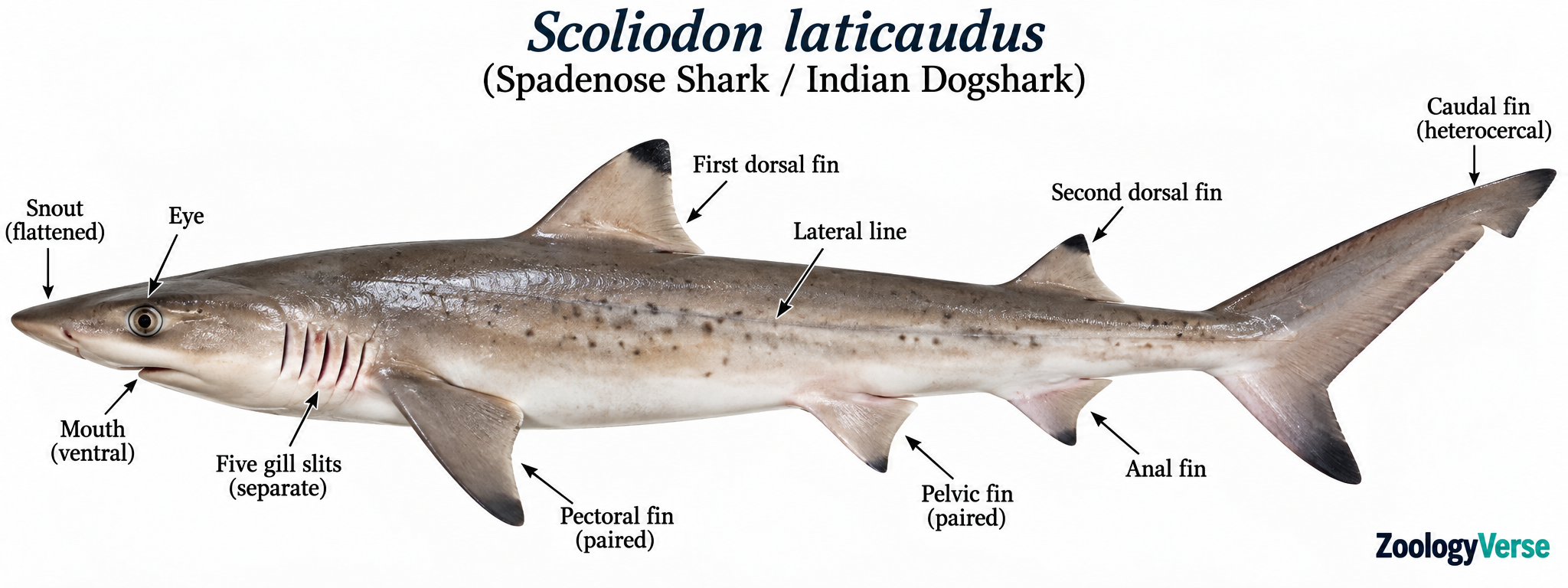
External Morphology of Scoliodon
The external body form of Scoliodon shows the typical streamlined organization of a shark and is adapted for efficient swimming.
- Body :- The body is elongated, fusiform and streamlined. This shape reduces resistance while swimming and allows the shark to move efficiently through coastal waters.
- Head and Snout :- The head is broad and the snout is characteristically short, broad and flattened. This distinctive snout gives the species its common name, spadenose shark.
- Eyes :- The eyes are situated laterally on the head and are adapted for detecting movement and objects in the surrounding water.
- Mouth :- The mouth is situated on the ventral surface of the head. It contains several rows of sharp teeth used for grasping and cutting prey.
- Gill Openings :- Five pairs of separate gill openings occur laterally behind the head. Unlike bony fishes, these openings are not covered by an operculum.
- Fins :- Scoliodon possesses paired pectoral and pelvic fins supported by the pectoral girdle and pelvic girdle and unpaired dorsal, anal and caudal fins. There are two dorsal fins. The caudal fin is heterocercal and asymmetrical.
- Skin :- The skin is covered with minute placoid denticles. These dermal structures are characteristic of sharks and contribute to the rough texture of the skin.
Digestive System of Scoliodon
The digestive system of Scoliodon is adapted for a carnivorous diet.
The principal parts of the digestive tract are:
Mouth → Buccal cavity → Pharynx → Oesophagus → Stomach → Intestine → Rectum → Cloaca
- Mouth and Buccal Cavity :- The mouth contains sharp teeth that help capture and hold prey. Food passes from the mouth into the buccal cavity and pharynx.
- Oesophagus :- The short oesophagus connects the pharynx with the stomach and conducts swallowed food towards the stomach.
- Stomach :- The stomach is a muscular organ where food is stored temporarily and digestion begins.
- Intestine :- The intestine receives partially digested food from the stomach. A spiral valve increases the effective absorptive surface and slows the passage of food.
- Rectum and Cloaca :- The posterior part of the digestive tract leads towards the rectum and finally opens into the cloaca.
For a comparative account, see the digestive system in vertebrates.
Respiratory System of Scoliodon
Respiration in Scoliodon occurs through the gills.
Water enters the mouth and pharyngeal region and passes over the gill surfaces, where gaseous exchange takes place. Oxygen dissolved in water diffuses into the blood, while carbon dioxide passes from the blood into the surrounding water.
Important Respiratory Features
- Five pairs of separate gill openings are present.
- Gills are located in the pharyngeal region.
- Gill surfaces contain numerous structures that provide a large area for gaseous exchange.
- There is no operculum as found in bony fishes.
- Continuous movement of water across the gills allows respiration.
The arrangement of separate gill slits is one of the useful features for identifying Scoliodon as a shark.
For a comparative account, see the respiratory System in Vertebrates.
Reproduction in Scoliodon
Scoliodon laticaudus is viviparous. The embryos develop inside the female and are nourished during development.
The species has internal fertilization, as in other sharks. The male transfers sperm to the female using modified pelvic fins called claspers.
Embryonic development takes place within the female reproductive tract. The species is reported to have a specialized form of placental nourishment during development.
Litter size has been reported to range from approximately 1 to 14 young, and newborn individuals are considerably larger than the embryos at early developmental stages.
Viviparity provides developing embryos with protection within the female and allows relatively well-developed young to be produced.
Feeding and Food
The species is carnivorous and feeds mainly on relatively small aquatic animals. Recorded prey include small bony fishes, shrimps and cuttlefish.
Its streamlined body, jaws and sharp teeth are well suited to predatory feeding. The species may occur in large schools, particularly in suitable coastal habitats.
Economic Importance
Scoliodon laticaudus is utilized as a fishery resource in parts of its distribution. FishBase records its use for human consumption and notes that it may also be processed into fishmeal or used as bait. It is also recorded as a by-catch of inshore demersal gillnet fisheries.
From an educational perspective, the species is particularly important because it represents several characteristic features of elasmobranch fishes, including a cartilaginous skeleton, placoid denticles, separate gill openings and a heterocercal tail.
Conservation Status
According to the IUCN Red List information recorded by FishBase, Scoliodon laticaudus is classified as Near Threatened (NT). The assessment date is 29 April 2020. FishBase also records the species as a common by-catch in some inshore demersal fisheries and reports low resilience. Because the species is associated with coastal habitats and may be affected by fishing pressure, continued monitoring of populations and fisheries interactions is relevant to its conservation
Scoliodon and Bony Fish: Important Differences
| Feature | Scoliodon | Typical Bony Fish |
|---|---|---|
| Endoskeleton | Mainly cartilaginous | Mainly bony |
| Skin | Placoid denticles | Usually cycloid, ctenoid or other bony-fish scales |
| Gill openings | Five separate pairs of gill slits | Usually covered by an operculum |
| Operculum | Absent | Usually present |
| Mouth | Ventral/subterminal | Commonly terminal |
| Caudal fin | Heterocercal | Usually homocercal |
| Swim bladder | Absent | Usually present |
| Fertilization | Internal | Commonly external, although exceptions occur |
| Reproduction | Viviparity occurs in Scoliodon | Reproductive modes vary among bony fishes |
Key Takeaways: Scoliodon
- Scoliodon laticaudus is a small cartilaginous shark belonging to the family Carcharhinidae.
- It has a streamlined body and broad, flattened spadenose snout, which are useful identification features.
- The skin bears placoid denticles, while the endoskeleton is mainly cartilaginous.
- Five pairs of separate gill openings are present, and an operculum is absent.
- It has paired pectoral and pelvic fins, two dorsal fins, one anal fin, and a heterocercal caudal fin.
- Scoliodon is mainly a coastal, demersal and carnivorous shark that may also occur in brackish environments.
- It is viviparous, with embryos developing within the female.
- For practical identification, the most important features are the flattened snout, placoid denticles, five separate gill slits, cartilaginous skeleton and heterocercal tail.
- Scoliodon laticaudus is currently assessed as Near Threatened (NT) on the IUCN Red List.
FAQs
What is Scoliodon?
What is the classification of Scoliodon?
What is the common name of Scoliodon laticaudus?
What are the important characteristics of Scoliodon?
Is Scoliodon viviparous?
Where is Scoliodon found?
Recommended Study Resource
Sharks of the World
by Rodney Steel (Author)
Practical Zoology: Vertebrate
by S. S. Lal (Author)
As an Amazon Associate I earn from qualifying purchases.
Related reading :- Circulatory System in Vertebrates
References
- FishBase. Scoliodon laticaudus Müller & Henle, 1838 — Species Summary.
- FishBase. Scoliodon laticaudus — Field Guide and species information.
- NRLD – 330976 : Scoliodon laticaudus.
- IUCN Red List. Scoliodon laticaudus conservation assessment.
- Scoliodon laticaudus Müller & Henle, 1838
Discover more from Zoologyverse
Subscribe to get the latest posts sent to your email.
Pingback: Dissecton of Scoliodon | Zoologyverse
Pingback: FISH SLIDES (SCOLIODON) | Zoologyverse