Presentations (PPTs)
Visit Slideshare for all presentations :- Click Here
Recent Posts
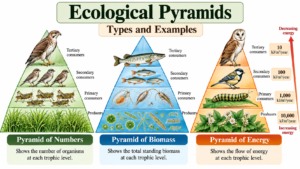
- Ecological Pyramids: Types and Examples
 Ecological pyramids are graphical representations of the trophic structure of an ecosystem. They illustrate the distribution of the number of organisms, biomass, or energy across different trophic levels, beginning with producers and extending to consumers. These diagrams help explain how organisms are organized within food chains and how energy and biological material are distributed throughout… Read more: Ecological Pyramids: Types and Examples
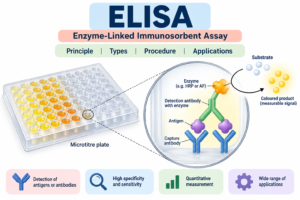
 - ELISA: Principle, Types, Procedure and Applications
 ELISA (Enzyme-Linked Immunosorbent Assay) ELISA (Enzyme-Linked Immunosorbent Assay) is a widely used immunological technique that detects and quantifies specific antigens or antibodies in biological samples. It is based on the specific interaction between an antigen and its corresponding antibody, combined with an enzyme-mediated reaction that produces a measurable signal. ELISA is commonly performed in microplate… Read more: ELISA: Principle, Types, Procedure and Applications
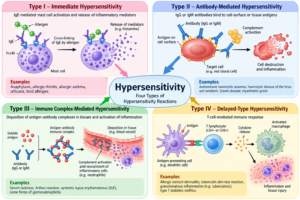
 - Hypersensitivity: Types, Mechanisms and ExamplesHypersensitivity refers to an exaggerated, inappropriate, or damaging immune response that occurs when the immune system reacts to an antigen or other stimulus. Although immune responses normally protect the body against infections and harmful substances, certain reactions can injure healthy tissues and contribute to disease. Hypersensitivity reactions may occur in response to environmental allergens, medications,… Read more: Hypersensitivity: Types, Mechanisms and Examples
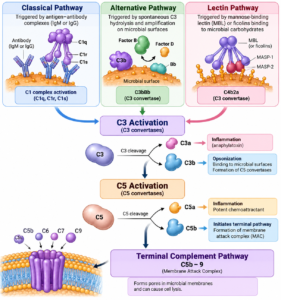
- Complement Pathways: Classical, Alternative & Lectin
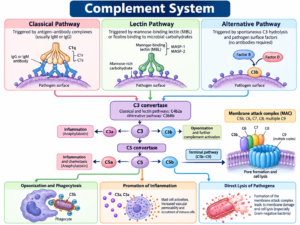
 The Complement Pathways are three interconnected mechanisms through which complement proteins become activated to support immune defence. These pathways are known as the classical pathway, alternative pathway, and lectin pathway. Although they differ in their initiating triggers and recognition mechanisms, all three contribute to the elimination of pathogens through inflammation, opsonization, and activation of the… Read more: Complement Pathways: Classical, Alternative & Lectin
 - Complement System: Pathways, Functions and Activation
 The Complement System is an important part of the immune system that helps the body recognize and eliminate invading microorganisms. It consists of a group of soluble proteins and cell-surface proteins present in blood plasma and other body fluids. These proteins work together in a coordinated cascade to strengthen immune defence against bacteria, viruses, fungi,… Read more: Complement System: Pathways, Functions and Activation
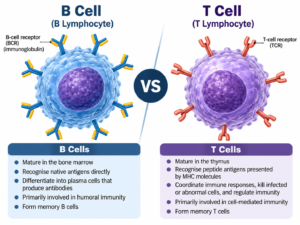
 - B Cells vs T Cells: Differences and FunctionsUnderstanding B cells vs T cells is important for explaining how adaptive immunity recognises specific threats and responds effectively to them. Although these lymphocytes have distinct functions, they work together to provide coordinated protection against a wide range of infections. The immune system protects the body against pathogens, foreign substances, and abnormal cells through the… Read more: B Cells vs T Cells: Differences and Functions
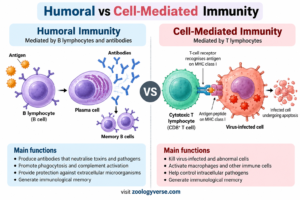
- Humoral vs Cell-Mediated Immunity: Key DifferencesUnderstanding humoral vs cell-mediated immunity helps explain how B cells, T cells, and antibodies work together to protect the body. Although these mechanisms have distinct functions, they are interconnected and often cooperate to produce an effective immune response. The immune system protects the body against pathogens, foreign substances, and abnormal cells through a coordinated network… Read more: Humoral vs Cell-Mediated Immunity: Key Differences
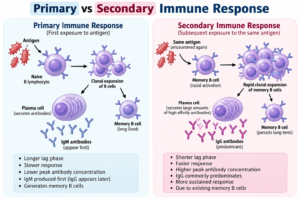
- Primary vs Secondary Immune Response: DifferencesThe primary vs secondary immune response comparison explains how the immune system reacts during its first and subsequent exposures to the same antigen. The primary immune response occurs when the body encounters an antigen for the first time. It develops relatively slowly because antigen-specific B and T lymphocytes must first recognize the antigen and become… Read more: Primary vs Secondary Immune Response: Differences
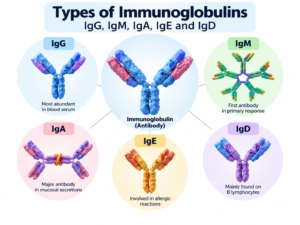
- Types of Immunoglobulins: IgG, IgM, IgA, IgE, IgDThe five types of immunoglobulins found in humans are IgG, IgM, IgA, IgE and IgD. Although they share a common basic molecular design, they differ in their heavy-chain structure, distribution in the body, ability to activate immune mechanisms and specific biological functions. Immunoglobulins, commonly known as antibodies, are specialized glycoproteins produced by plasma cells, which… Read more: Types of Immunoglobulins: IgG, IgM, IgA, IgE, IgD
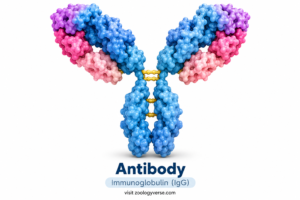
- Antibody Structure: Parts, Regions and FunctionsThe antibody structure is closely related to its biological function. A typical immunoglobulin G (IgG) molecule has a characteristic Y-shaped arrangement consisting of two identical heavy chains and two identical light chains. These polypeptide chains are connected by disulfide bonds and stabilized by additional molecular interactions. The two arms contain antigen-binding sites, while the stem… Read more: Antibody Structure: Parts, Regions and Functions
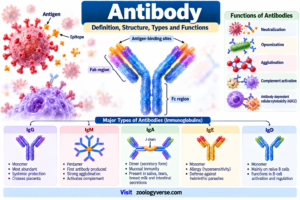
- Antibody: Definition, Structure, Types and FunctionsAn antibody is a specialized protein of the adaptive immune system that recognizes and binds specific molecular structures called antigens. Antibodies are also known as immunoglobulins (Ig) and are produced mainly by plasma cells derived from activated B lymphocytes. Antibodies play a central role in humoral immunity. They can neutralize toxins and viruses, prevent microorganisms… Read more: Antibody: Definition, Structure, Types and Functions
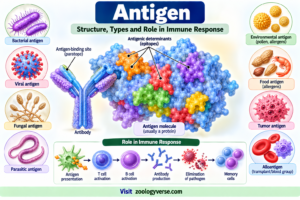
- Antigen: Definition, Types, Structure and FunctionsAn antigen is a substance or molecular structure that can be specifically recognized and bound by components of the adaptive immune system, particularly antibodies, B-cell receptors (BCRs), or T-cell receptors (TCRs). Antigens are central to immunology because immune recognition begins when the immune system detects particular molecular features on or derived from a substance. Antigens… Read more: Antigen: Definition, Types, Structure and Functions