
If you’ve ever stood in front of a pond, a garden enclosure, or a pet store tank and wondered whether you’re looking at a turtle, a tortoise, or a terrapin, you’re not alone. The turtle vs tortoise vs terrapin question is one of the most searched mix-ups in the reptile world, and honestly, it’s easy to see why — all three belong to the same reptile order, Testudines, and share the most obvious feature of all: a hard, protective shell.
But once you look past the shell, turtles, tortoises, and terrapins live very different lives. One spends most of its time underwater, another almost never touches water at all, and the third splits its time between land and freshwater. Understanding the difference between turtle and tortoise (and where the terrapin fits in) comes down to habitat, shell shape, feet, diet, and lifespan. Let’s break each one down.
Turtle vs Tortoise vs Terrapin
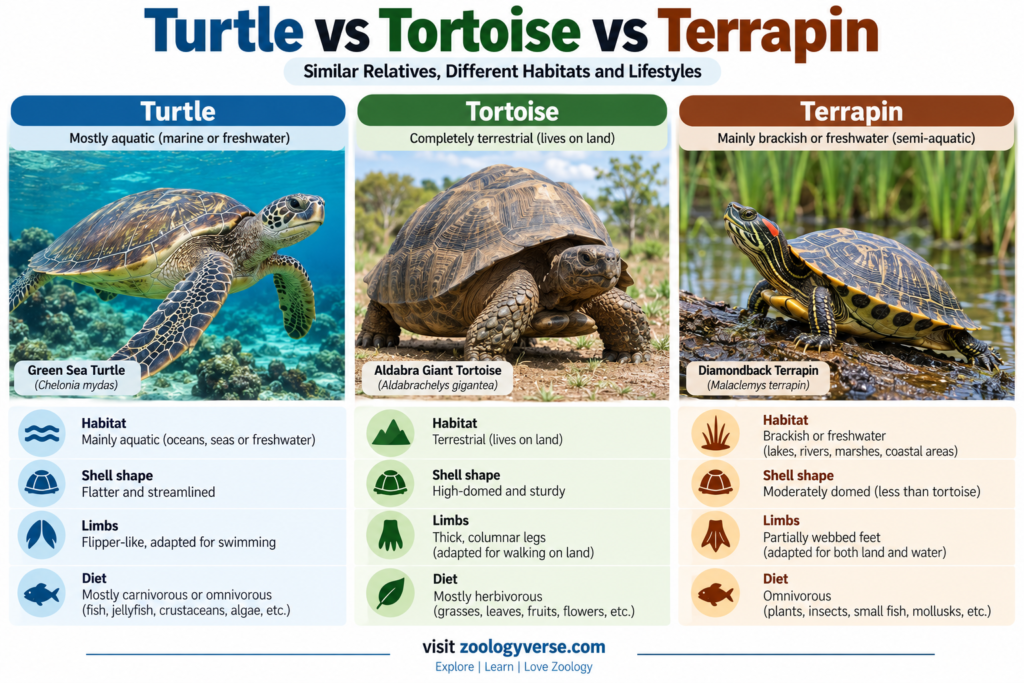
- Turtles live mainly in water (ocean or freshwater) and have flatter, streamlined shells with webbed or flipper-like limbs for swimming.
- Tortoises live entirely on land, have high-domed, heavy shells, and thick, stumpy elephant-like legs built for walking, not swimming.
- Terrapins are a middle ground — small to medium reptiles that live in freshwater or brackish water but also come onto land regularly to bask and nest.
In short: every tortoise and terrapin is technically part of the broader turtle family (order Testudines), but not every turtle is a tortoise or a terrapin. Think of “turtle” as the umbrella term, with “tortoise” and “terrapin” as more specific lifestyle categories underneath it.
Turtle vs Tortoise vs Terrapin: Comparison Table
| Feature | Turtle | Tortoise | Terrapin |
|---|---|---|---|
| Habitat | Ocean or freshwater | Land only | Freshwater/brackish water + land |
| Shell shape | Flat, streamlined, lightweight | Domed, heavy, rounded | Moderately domed, sturdier than turtles |
| Feet/Limbs | Webbed feet or flippers | Thick, column-like legs | Webbed feet with claws |
| Diet | Omnivorous (varies by species) | Mostly herbivorous | Omnivorous |
| Lifespan | 20–100+ years (species dependent) | 80–150+ years | 15–40 years |
| Swimming ability | Excellent | Cannot swim | Good swimmer |
| Example species | Green sea turtle, Painted turtle | Galápagos tortoise, Sulcata tortoise | Diamondback terrapin, Red-eared slider (regionally called terrapin) |
What Is a Turtle?
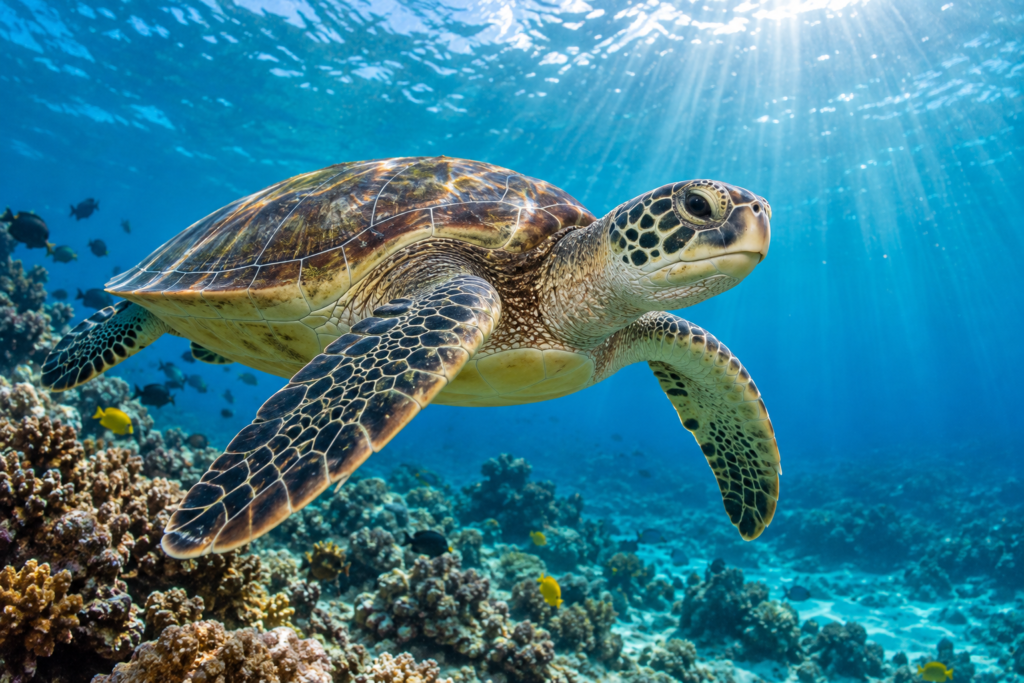
A turtle is any reptile belonging to the order Testudines — this is the scientific umbrella that also includes tortoises and terrapins. In everyday, common usage though, “turtle” usually refers specifically to species that spend most of their lives in water, whether that’s the ocean (sea turtles) or freshwater lakes, rivers, and ponds (freshwater turtles).
Turtles have evolved a body built for swimming. Their shells are flatter and more hydrodynamic than a tortoise’s, reducing drag in the water, and their limbs are either fully webbed or shaped into paddle-like flippers, as seen in sea turtles. Because they rely on water for feeding, breeding, and escaping predators, most turtles are excellent swimmers and can hold their breath for long stretches while submerged.
Diet varies widely across turtle species — some are strict carnivores, feeding on fish, insects, and mollusks, while others are omnivores that also eat aquatic plants and algae.
What Is a Tortoise?
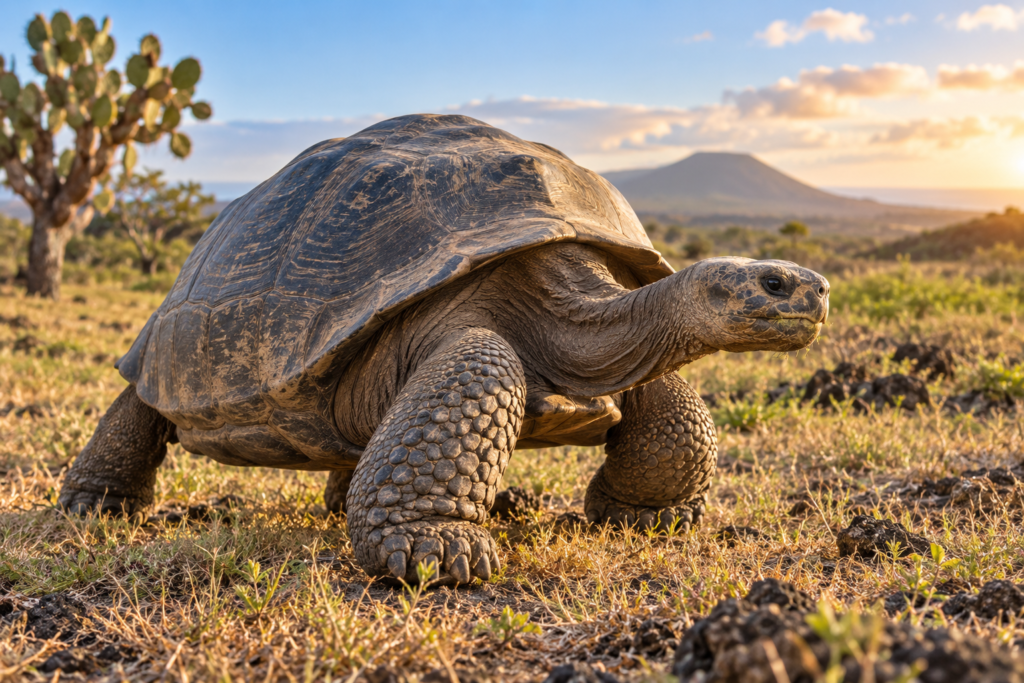
A tortoise is a land-dwelling reptile, and it’s the most distinct member of the turtle vs tortoise vs terrapin comparison. Unlike turtles and terrapins, tortoises cannot swim and will drown if left in deep water for too long. Everything about their body reflects a life on solid ground.
Their shells are noticeably high-domed and heavy, offering strong protection against land predators, while their legs are thick, sturdy, and column-shaped — often described as “elephant-like” — built to support their weight while walking across dry terrain rather than paddling through water.
Tortoises are largely herbivorous, grazing on grasses, leafy greens, fruits, and flowers. This slower, plant-based lifestyle is part of why tortoises are famous for their extraordinary lifespans, with giant species like the Galápagos tortoise regularly living well past 100 years.
What Is a Terrapin?
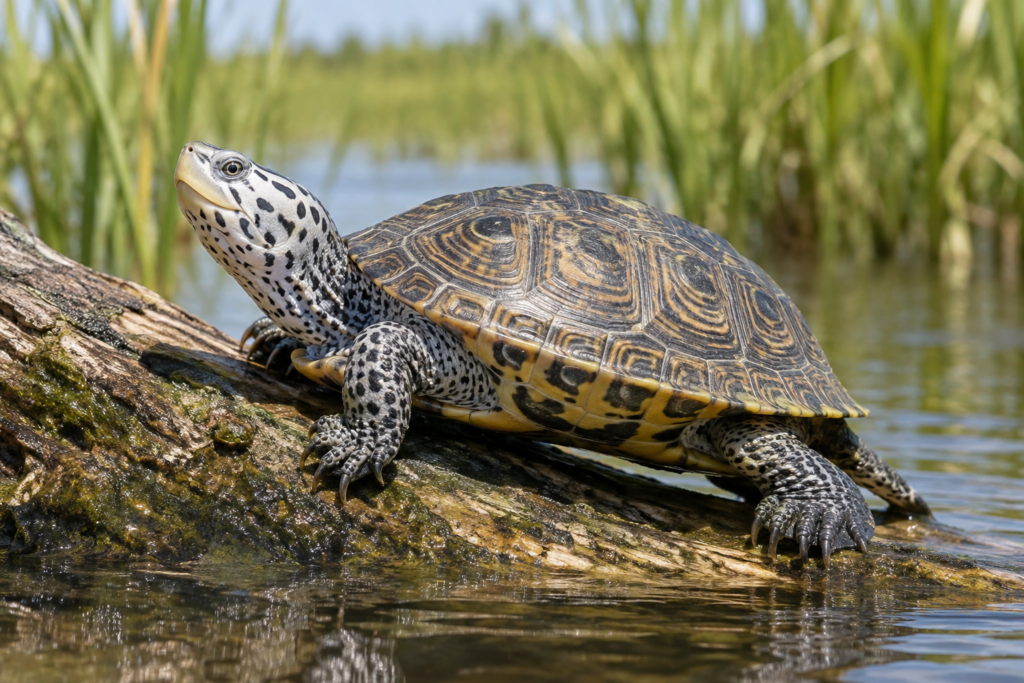
The terrapin sits right in the middle of the turtle vs tortoise vs terrapin spectrum. Terrapins are semi-aquatic reptiles that live in freshwater or brackish (part-salty) water such as marshes, swamps, and estuaries, but unlike fully aquatic turtles, they regularly climb out onto land to bask in the sun or lay their eggs.
Physically, terrapins look like a blend of the other two: they have webbed feet with claws for swimming and digging, along with a shell that’s sturdier and slightly more domed than a typical water turtle’s, offering a bit more land-based protection. The diamondback terrapin, found along the U.S. Atlantic and Gulf coasts, is the most well-known example.
It’s worth noting that “terrapin” isn’t used the same way everywhere — in British English, it often refers to any small freshwater turtle, while in American English it’s typically reserved for the diamondback terrapin specifically.
Key Differences at a Glance
- Habitat is the biggest divider: tortoises never enter water voluntarily, turtles rarely leave it, and terrapins move between both.
- Shell shape follows lifestyle: flat and light for swimming (turtle), domed and heavy for protection on land (tortoise), and a practical in-between for terrapins.
- Legs tell the story: webbed feet or flippers mean a swimmer; thick, rounded legs mean a walker.
- Lifespan varies dramatically: tortoises typically outlive turtles and terrapins by a wide margin, thanks to their slow metabolism and herbivorous diet.
- All three are reptiles under one order: Testudines is the scientific classification that unites turtles, tortoises, and terrapins as relatives, even though their day-to-day lives look very different.
Key Takeaways
- Turtle, tortoise, and terrapin are not three unrelated animals — they’re all part of the same reptile order, Testudines, separated mainly by habitat and lifestyle.
- Tortoises are land-only and cannot swim; turtles are water-based and excellent swimmers; terrapins live in both worlds.
- Shell shape and leg structure are the fastest visual clues: domed shell + stumpy legs = tortoise; flat shell + webbed feet/flippers = turtle or terrapin.
- Tortoises tend to live the longest, often exceeding a century, due to their herbivorous diet and slow lifestyle.
- Regional language differs — what’s called a “terrapin” in the UK may simply be called a “turtle” in the US.
Recommended Study Resource
Turtles of the World
by Franck Bonin (Author), Bernard Devaux (Author), Alain Dupre (Author), Peter C. H. Pritchard (Translator)
Turtles: The Animal Answer Guide (The Animal Answer Guides: Q&A for the Curious Naturalist)
by Whit Gibbons (Author), Judy Greene (Author), Cris Hagen (Photographer)
As an Amazon Associate I earn from qualifying purchases.
Frequently Asked Questions
Is a terrapin the same as a turtle?
Not exactly. A terrapin is a type of turtle in the broader scientific sense (order Testudines), but it specifically refers to species that live in freshwater or brackish water and come onto land regularly — unlike fully aquatic turtles or fully land-based tortoises.
Can tortoises swim like turtles?
No. Tortoises are not built for swimming — their heavy, domed shells and thick legs make them sink rather than float, and they can drown if stuck in deep water for an extended time.
What is the main difference between turtle and tortoise?
The main difference between turtle and tortoise comes down to habitat and body structure: turtles live in water and have flat, streamlined shells with webbed feet or flippers, while tortoises live entirely on land and have domed shells with thick, sturdy legs.
Which lives longer: turtle, tortoise, or terrapin?
Tortoises generally live the longest, with some giant species surviving over 100–150 years. Turtles can also live several decades depending on the species, while terrapins usually have shorter lifespans, often between 15 and 40 years.
Do turtles, tortoises, and terrapins all lay eggs on land?
Yes. Regardless of habitat, all three lay their eggs on land in nests dug into soil or sand, since reptile eggs need to breathe air and cannot develop underwater.
Are terrapins good pets?
Terrapins, especially species like the red-eared slider, are commonly kept as pets, but they need both a water area for swimming and a dry basking spot, along with proper UV lighting to stay healthy.
Discover more from Zoologyverse
Subscribe to get the latest posts sent to your email.