
Lepus is a genus of mammals belonging to the family Leporidae and order Lagomorpha. The female reproductive system of Lepus is specialized for the production of ova, transport of gametes, fertilization, development of embryos, and birth of young.
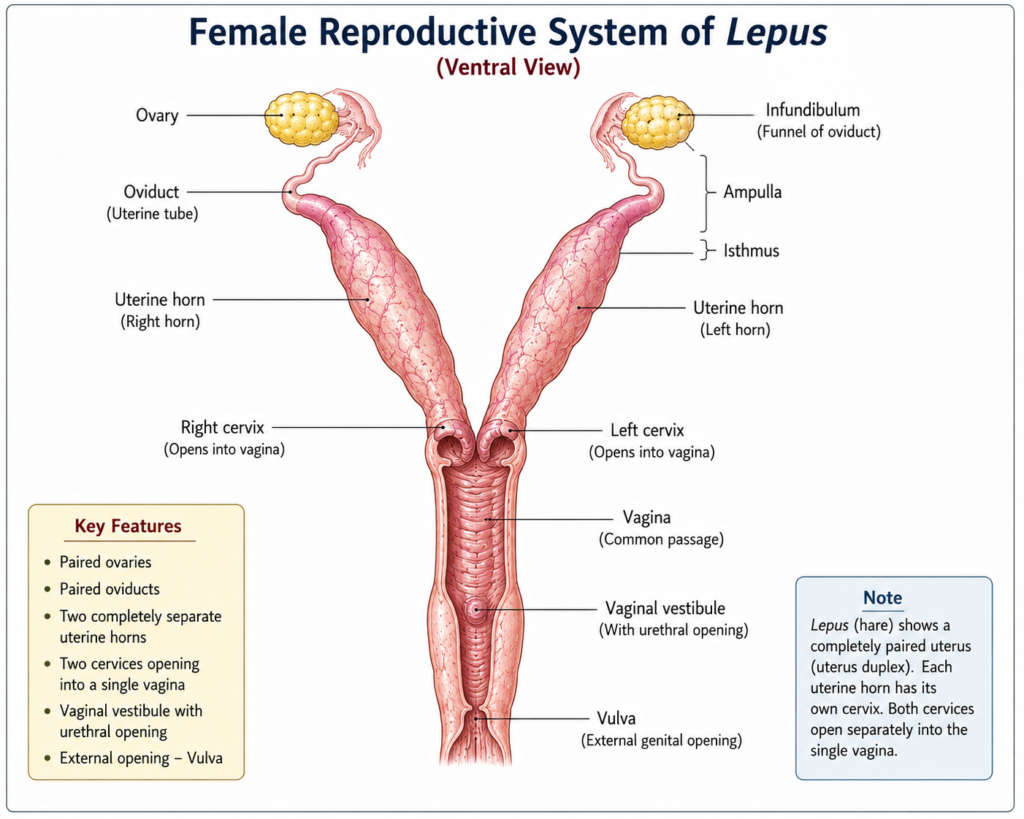
The female reproductive system of Lepus follows the general mammalian plan but has an important leporid characteristic: the uterus is completely paired, with two uterine horns that function as separate uteri and have two distinct cervices opening into a single vagina. This condition is well documented in the closely related domestic rabbit, Oryctolagus cuniculus, and is described as a uterus duplex.
The major components of the female reproductive system are:
- A pair of ovaries
- A pair of oviducts
- Two uterine horns (separate uteri)
- Two cervices
- A single vagina
- Vaginal vestibule
- Vulva and clitoris
- Associated supporting ligaments and reproductive tissues
Scientific note: Detailed anatomical information is more readily available for the domestic rabbit, Oryctolagus cuniculus, than for species of Lepus. Since both belong to the family Leporidae, rabbit anatomy provides useful comparative information, but rabbit-specific measurements and microscopic findings should not automatically be presented as exact characteristics of every Lepus species.
General Organization of the Female Reproductive System of Lepus
The female reproductive tract can be divided into the gonads, genital ducts, and external genital structures.
The paired ovaries are the primary female reproductive organs. They produce ova and secrete hormones such as estrogen and progesterone.
The oviducts receive the ova after ovulation and provide the site where fertilization can occur. Each oviduct connects the ovarian region with its corresponding uterine horn.
Unlike the simple uterus of humans, the leporid uterus is strongly specialized. In rabbits, the two uterine horns remain completely separate and each has its own cervix. The two cervices open independently into the single vagina.
The vagina continues caudally into the vaginal vestibule and opens externally through the vulva.
Ovaries
The ovaries are a pair of female gonads and are the primary reproductive organs.
Their major functions are:
- Production and maturation of female gametes
- Ovulation
- Secretion of ovarian hormones
- Formation of corpora lutea after ovulation
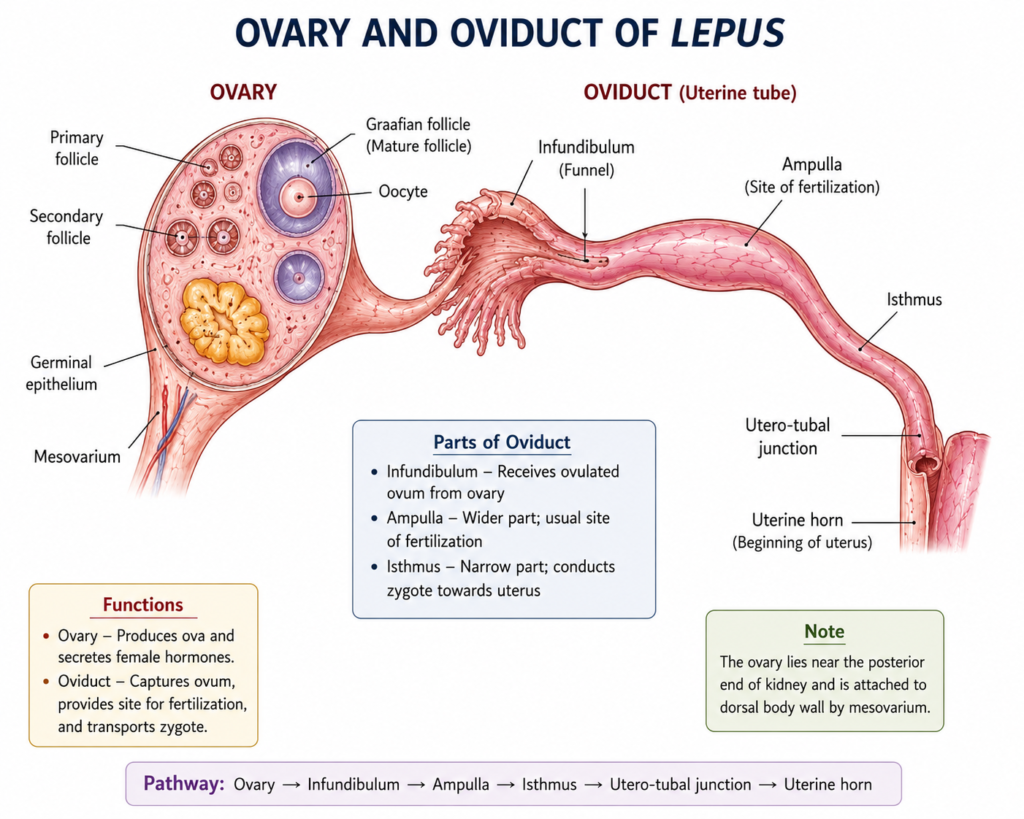
In the closely related domestic rabbit, the ovaries are relatively small and oval-shaped and are positioned near the posterior or posterolateral region of the kidneys. They are attached to the dorsal body wall by the mesovarium and are associated with surrounding adipose tissue.
Structure of the Ovary
The ovary contains developing ovarian follicles, which contain the developing oocyte.
Follicles occur at different stages of development. Following ovulation, the follicular tissue undergoes changes and may form a corpus luteum, an endocrine structure involved in reproductive hormone production.
The ovarian surface is associated with a thin covering, while the internal tissue contains follicles and vascular connective tissue.
In anatomical studies of female rabbits, the ovaries are described as oval structures with variable internal echotexture depending on the reproductive state.
Oviducts
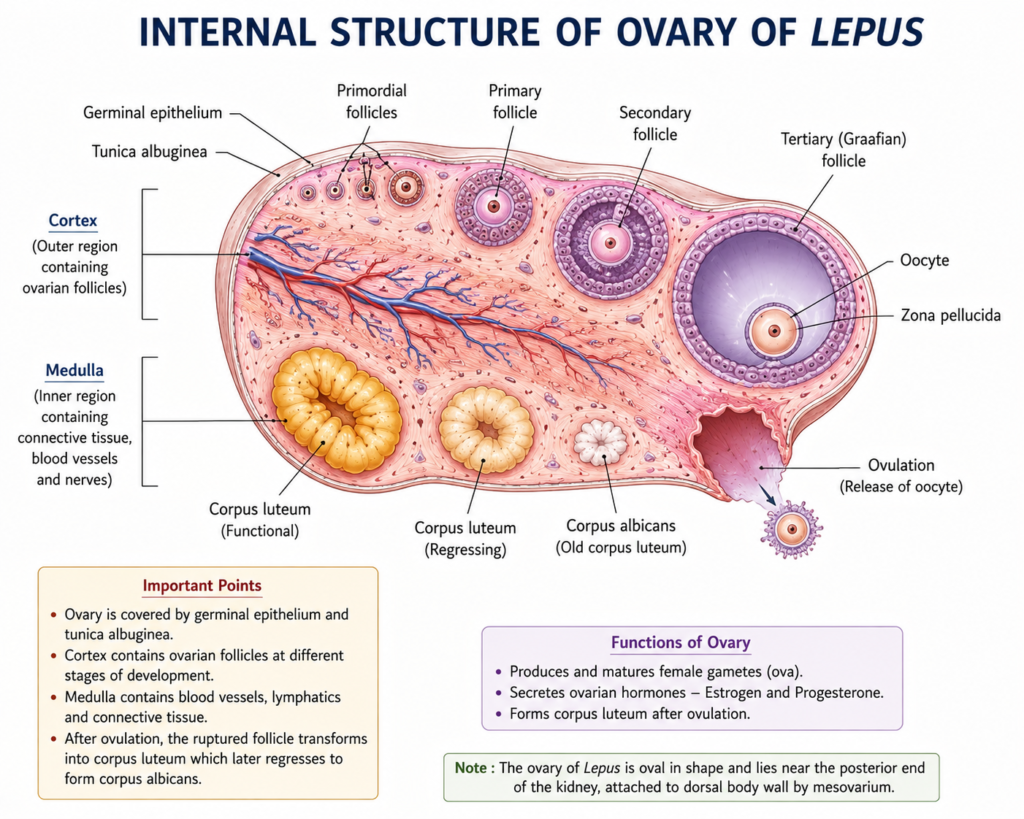
Each ovary is associated with a slender oviduct, also called the uterine tube.
The oviduct is responsible for:
- Receiving the ovulated oocyte
- Transporting the oocyte
- Providing the environment for fertilization
- Transporting the early embryo toward the uterus
The oviduct is divided into recognizable regions, including the infundibulum, ampulla, and isthmus.
Infundibulum
The infundibulum is the expanded, funnel-like region near the ovary. Its opening helps receive the ovulated oocyte.
Ampulla
The ampulla is the wider portion of the oviduct. In mammals generally, fertilization commonly occurs within the ampullary region of the oviduct.
Isthmus
The isthmus is the narrower portion of the oviduct that connects toward the uterus.
Rabbit anatomical studies describe the oviduct as a tubular structure with distinct regions and a close relationship with the ovary and uterine horn.
The pathway is therefore:
Ovary → infundibulum → ampulla → isthmus → uterine horn
Uterus
The uterus is one of the most distinctive parts of the female reproductive tract in leporids.
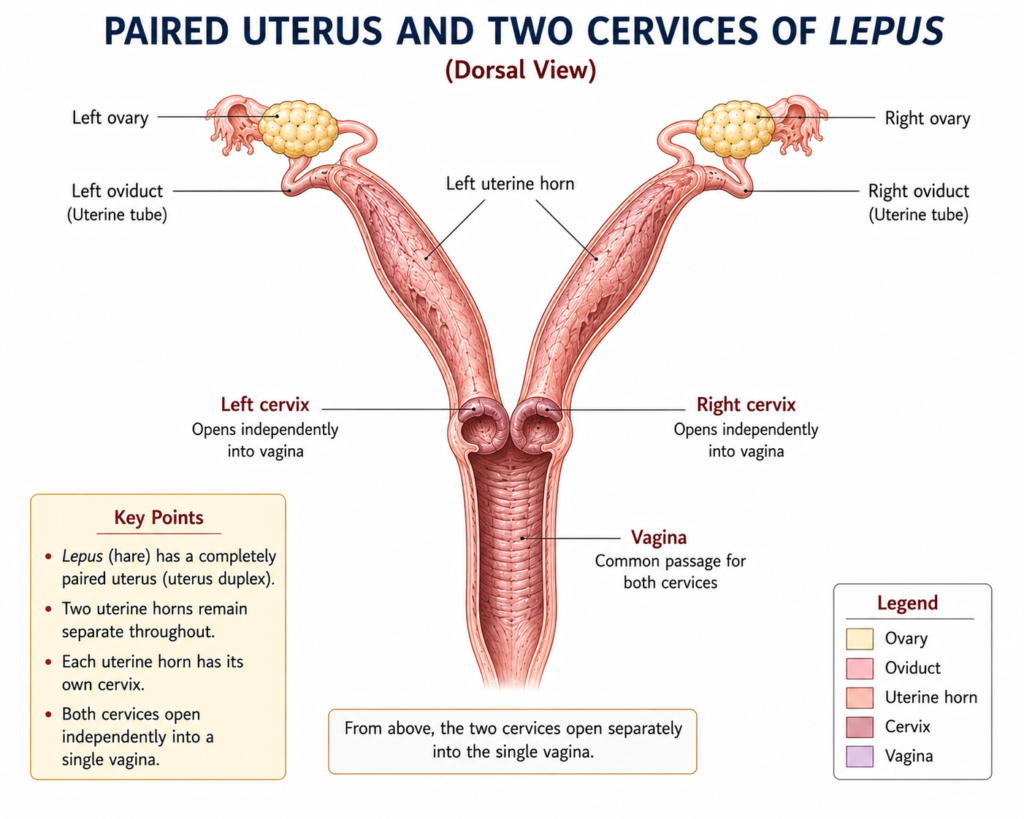
In rabbits, the uterus is completely paired, meaning that the two uterine horns do not fuse into a single uterine body. This condition is commonly described as a uterus duplex. Each uterine horn functions as a separate uterus and possesses its own cervix.
The two uterine horns extend from the corresponding oviducts and are supported within the pelvic and abdominal region.
Functions of the Uterus
The uterus provides the environment for:
- Transport and reception of the early embryo
- Implantation
- Placental development
- Embryonic and fetal development
- Uterine contractions during parturition
The uterine wall contains smooth muscle and glandular tissue that undergo structural and functional changes during the reproductive cycle and pregnancy.
Uterine Horns
There are two distinct uterine horns:
- Right uterine horn
- Left uterine horn
Each horn communicates separately with its corresponding cervix.
This arrangement allows pregnancies to occur in either uterine horn independently.
Cervix
The cervix is the caudal, muscular portion of each uterus that connects the uterine cavity with the vagina.
A particularly important feature of the leporid female reproductive system is that there are two cervices, rather than one common cervix.
Each uterine horn has its own cervical canal:
Right uterus → right cervix → vagina
Left uterus → left cervix → vagina
Detailed anatomical descriptions of rabbits confirm the presence of two separate cervices and two independent cervical canals.
The cervix helps regulate communication between the uterus and vagina and provides a protective barrier between the uterine environment and the lower reproductive tract.
Vagina
The vagina is a single, unpaired muscular tube that receives the two cervical openings cranially and continues caudally toward the external genital opening.
In rabbits, the vagina is relatively long and forms the common passage for the two separate cervical canals.
Its functions include:
- Receiving the penis during copulation
- Providing a passage for sperm
- Serving as the birth canal
- Providing the passage toward the exterior of the reproductive tract
The vagina is therefore an important common chamber connecting the paired uterine system with the external genitalia.
Vaginal Vestibule
The caudal portion of the female reproductive tract forms the vaginal vestibule.
In the rabbit, the urethra opens into the caudoventral part of the vaginal tract, marking the distinction between the true vaginal body and the more caudal vestibular region.
Thus, the female reproductive tract has the following arrangement:
Uterine horns → cervices → vagina → vaginal vestibule → external opening
The urinary and reproductive pathways become closely associated in the vestibular region.
External Genitalia
The external genital structures include the vulva and clitoris.
Vulva
The vulva forms the external opening of the female reproductive tract. It consists of the external lips surrounding the urogenital opening.
The appearance of the vulva can also change with reproductive condition in female rabbits. However, such changes are physiological rather than structural components of the reproductive tract.
Clitoris
The clitoris is an erectile sensory structure located within the external genital region.
It is homologous developmentally to the penis of the male and contains erectile tissue and sensory structures.
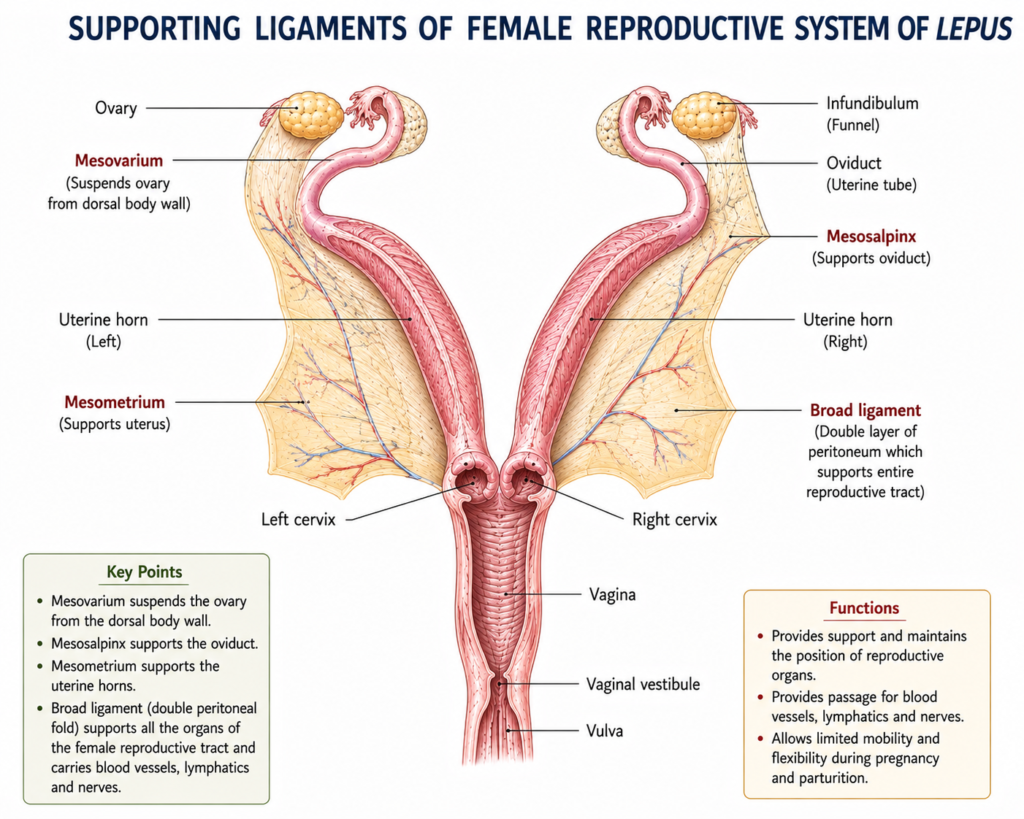
Supporting Ligaments
The female reproductive organs are supported within the abdominal and pelvic regions by folds of the broad ligament.
Important supporting components include:
- Mesovarium — supports the ovary
- Mesosalpinx — associated with the oviduct
- Mesometrium — supports the uterus
In rabbits, the broad ligament can contain considerable adipose tissue and contributes to the support of the paired reproductive tract.
These supporting tissues also provide pathways for blood vessels, nerves, and other structures associated with the reproductive organs.
Blood Supply of the Reproductive Tract
The female reproductive organs receive a rich vascular supply.
Studies in adult female rabbits identify the ovarian and uterine arteries as major arterial supplies to the reproductive tract.
The ovarian artery supplies the ovary and also gives branches toward the oviduct and uterine horn. The uterine artery supplies the uterus and gives branches associated with the reproductive tract.
This extensive blood supply is important for:
- Follicular development
- Ovulation
- Hormone-dependent changes
- Uterine preparation
- Pregnancy
- Placental function
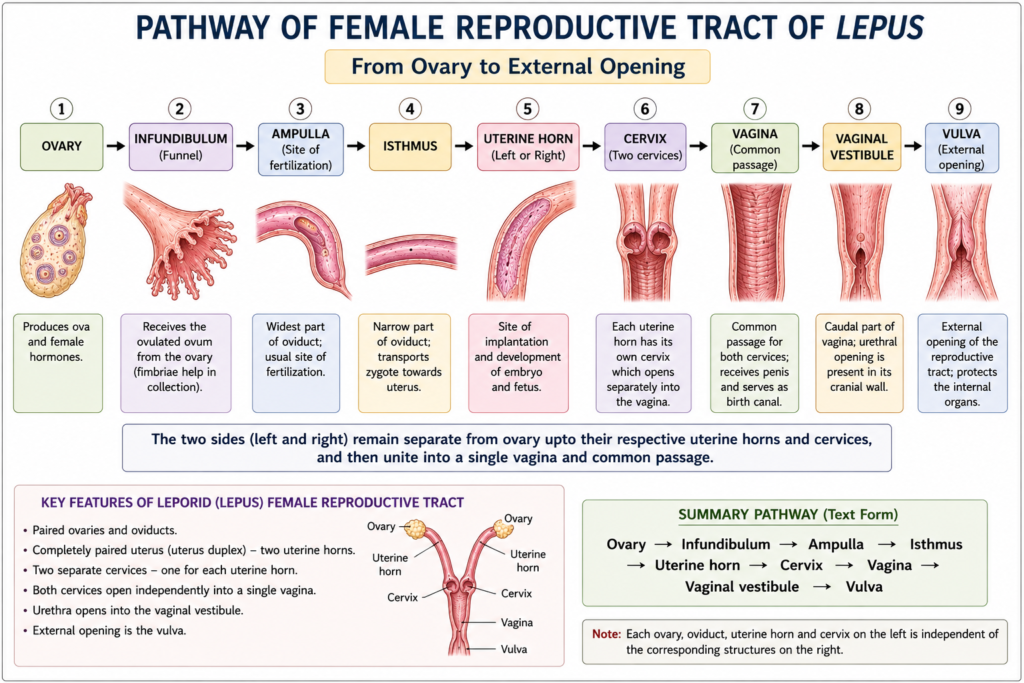
Complete Pathway of the Female Reproductive Tract
The anatomical pathway can be summarized as:
Ovary
↓
Infundibulum of oviduct
↓
Ampulla
↓
Isthmus
↓
Uterine horn
↓
Cervix
↓
Vagina
↓
Vaginal vestibule
↓
Vulva
The two sides of the reproductive tract remain separate from the ovaries through the uterine horns and cervices until they enter the single vagina.
Functional Organization of Female Reproductive System of Lepus
| Structure | Principal function |
|---|---|
| Ovary | Produces oocytes and ovarian hormones |
| Oviduct | Receives and transports the oocyte; site of fertilization |
| Infundibulum | Receives the ovulated oocyte |
| Ampulla | Wider oviductal region associated with fertilization |
| Isthmus | Transports oocyte/early embryo toward uterus |
| Uterine horn | Site of implantation and embryonic/fetal development |
| Cervix | Connects each uterus with the vagina |
| Vagina | Receives sperm and acts as the birth canal |
| Vaginal vestibule | Common caudal passage associated with reproductive and urinary openings |
| Vulva | External opening and protection of the reproductive tract |
| Clitoris | Sensory erectile organ |
| Broad ligament | Supports the reproductive organs |
Important Distinctive Features
The female reproductive system of Lepus and other leporids can be recognized by several important anatomical features.
1. Paired ovaries
There are two ovaries, one on each side of the reproductive tract.
2. Paired oviducts
Each ovary is associated with its own oviduct.
3. Completely separated uterine horns
Unlike humans, the two uterine horns remain completely separate in the rabbit.
4. Two cervices
Each uterine horn has its own cervix, producing a double-cervix arrangement.
5. Single vagina
The two cervical canals open into a common vagina.
6. Vaginal vestibule
The urethral opening is associated with the caudal vestibular region of the reproductive tract.
These features make the female reproductive tract of leporids particularly interesting from a comparative-anatomy perspective.
Key Takeaways
- The female reproductive system of Lepus consists primarily of paired ovaries, paired oviducts, paired uterine horns, two cervices, a single vagina, vaginal vestibule, and external genitalia.
- The ovaries produce ova and female reproductive hormones.
- The oviducts receive and transport the ovulated oocytes.
- The uterus is completely paired in the rabbit/leporid pattern, with separate right and left uterine horns.
- Each uterine horn has its own cervix, producing two cervical canals.
- Both cervices open into a single vagina.
- The vaginal vestibule forms the caudal part of the reproductive tract and is associated with the urethral opening.
- The vulva and clitoris form important components of the external genitalia.
- The reproductive tract is supported by structures associated with the broad ligament, mesovarium, mesosalpinx, and mesometrium.
- Detailed anatomical studies of Oryctolagus cuniculus provide useful comparative information for understanding leporid reproductive anatomy.
Frequently Asked Questions
What are the main parts of the female reproductive system of Lepus?
The main parts are the paired ovaries, oviducts, uterine horns, two cervices, vagina, vaginal vestibule, vulva, and clitoris.
How many ovaries does a female Lepus have?
A female Lepus has two ovaries, one on each side of the reproductive tract.
Does Lepus have a single uterus?
The leporid reproductive pattern is distinctive. In the domestic rabbit, the uterus is completely paired, with two separate uterine horns and no common uterine body.
How many cervices are present?
In rabbits, there are two cervices, one associated with each uterine horn. Each cervical canal opens separately into the vagina.
What is the function of the oviduct?
The oviduct receives the ovulated oocyte, transports it toward the uterus, and provides the location where fertilization can occur.
What is the function of the uterus?
The uterus provides the environment for implantation and development of the embryos and fetuses.
What is the difference between the vagina and vaginal vestibule?
The vagina is the main unpaired reproductive passage connecting the two cervices with the caudal reproductive tract. The vestibule is the more caudal region associated with the external genital opening and the urethral opening.
Scientific Note on Lepus and Rabbit Anatomy
Detailed anatomical and histological literature is much more extensive for the domestic rabbit, Oryctolagus cuniculus, than for individual species of Lepus. Both genera belong to the family Leporidae and share the characteristic general organization of the leporid female reproductive tract.
Therefore, rabbit studies are useful for explaining structures such as the paired uterus, double cervix, oviducts, vagina, and supporting ligaments. However, measurements and species-specific microscopic observations obtained from Oryctolagus cuniculus should not automatically be treated as exact measurements or characteristics of every Lepus species.
This distinction is especially important in a comparative zoology article because it keeps the anatomical description scientifically accurate while still making use of the detailed reproductive anatomy available for leporids.
Conclusion
The female reproductive system of Lepus is a specialized mammalian reproductive system adapted for oocyte production, fertilization, implantation, pregnancy, and birth. It consists of paired ovaries and oviducts, a distinctly paired uterine system, two cervices, a single vagina, vaginal vestibule, and external genital structures.
The most characteristic feature of the leporid reproductive tract is the completely separated uterus with two uterine horns and two cervices. In the domestic rabbit, each uterine horn communicates independently with its cervix, while both cervices open into the single vagina.
The ovaries produce the female gametes and reproductive hormones, the oviducts transport the oocytes and provide the usual site of fertilization, and the uterus provides the environment required for embryonic and fetal development. The vagina and vestibule form the caudal reproductive passage, while the vulva and clitoris constitute important external genital structures.
Detailed studies of Oryctolagus cuniculus provide an important comparative foundation for understanding the female reproductive anatomy of Lepus. Nevertheless, species-specific anatomical differences should be acknowledged whenever rabbit data are used to describe Lepus.
References
- International Harmonization of Nomenclature and Diagnostic Criteria (INHAND): Nonproliferative and Proliferative Lesions of the Rabbit. Detailed description of rabbit uterine and cervical anatomy, including the completely paired uterus and two cervices.
- Ultrasonographic appearance and histopathological findings of the genital tract in healthy nulliparous female rabbits (Oryctolagus cuniculus). Provides anatomical and histological observations of the ovaries, oviducts, uterine horns, cervices and vagina.
- Reproductive anatomy of the female rabbit. Detailed veterinary description of the ovaries, oviducts, paired uterus, cervices, vagina, vestibule and external genitalia.
- Ovarian, uterine, and luteal vascular perfusions during follicular and luteal phases in adult cyclic female rabbits. Provides information on the vascular anatomy of the female rabbit reproductive tract.
- Parker, T. Jeffrey. A Manual of Zoology (1900). Historical comparative anatomical illustration of the rabbit female reproductive tract, including the ovary, oviduct, uterus and vagina.
Discover more from Zoologyverse
Subscribe to get the latest posts sent to your email.