
Introduction to Golgi Body
Every eukaryotic cell has a well-organized system for producing, processing, and transporting molecules.
Among the organelles involved in this system, the Golgi body plays a central role. It acts as an intracellular processing and distribution center, receiving proteins and lipids from the endoplasmic reticulum, modifying them, and directing them to their appropriate destinations.
The Golgi body, also known as the Golgi apparatus or Golgi complex, is made up of a series of flattened, membrane-bound sacs called cisternae, along with associated tubules and vesicles.
Its structure is highly organized, with a receiving cis face and a shipping trans face. As molecules move through the Golgi, they undergo specific modifications that prepare them for secretion, incorporation into cell membranes, delivery to lysosomes, or transport to other cellular compartments.
Key Takeaways
- The Golgi body, also called the Golgi apparatus or Golgi complex, is a membrane-bound organelle of eukaryotic cells.
- It consists mainly of flattened membrane sacs called cisternae, together with associated tubules and vesicles.
- The Golgi has a distinct cis-to-trans polarity: the cis side receives material from the endoplasmic reticulum (ER), while the trans side sorts and dispatches processed material.
- Its major functions include modification, sorting, packaging, and distribution of proteins and lipids.
- The Golgi performs important forms of glycosylation and sulfation and contributes to the formation and trafficking of lysosomal enzymes.
- In plant cells, the Golgi also synthesizes important cell-wall polysaccharides such as pectins and hemicelluloses.
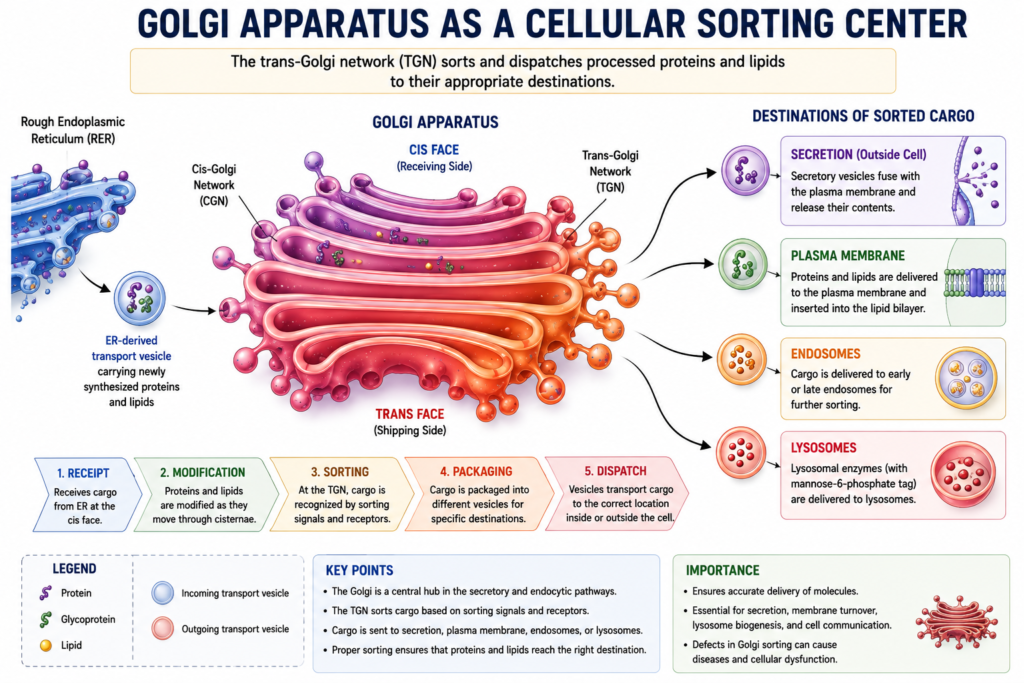
- The trans-Golgi network (TGN) acts as an important sorting and distribution station for cargo leaving the Golgi.
What Is the Golgi Body?
The Golgi body is a specialized membrane-bound organelle involved in processing and directing proteins and lipids within eukaryotic cells.
It is also known as the Golgi apparatus or Golgi complex.
Materials produced in the endoplasmic reticulum are transported to the Golgi, where they undergo further modification before being sent to their appropriate destinations.
In this sense, the Golgi functions as a cellular processing, sorting, and distribution center rather than simply a storage structure.
The Golgi is particularly prominent in cells that are actively involved in secretion.
For example, secretory cells of glands and many cells involved in producing extracellular materials contain well-developed Golgi apparatuses.
The organelle was discovered and described by the Italian scientist Camillo Golgi in the late nineteenth century.
Structure of the Golgi Body
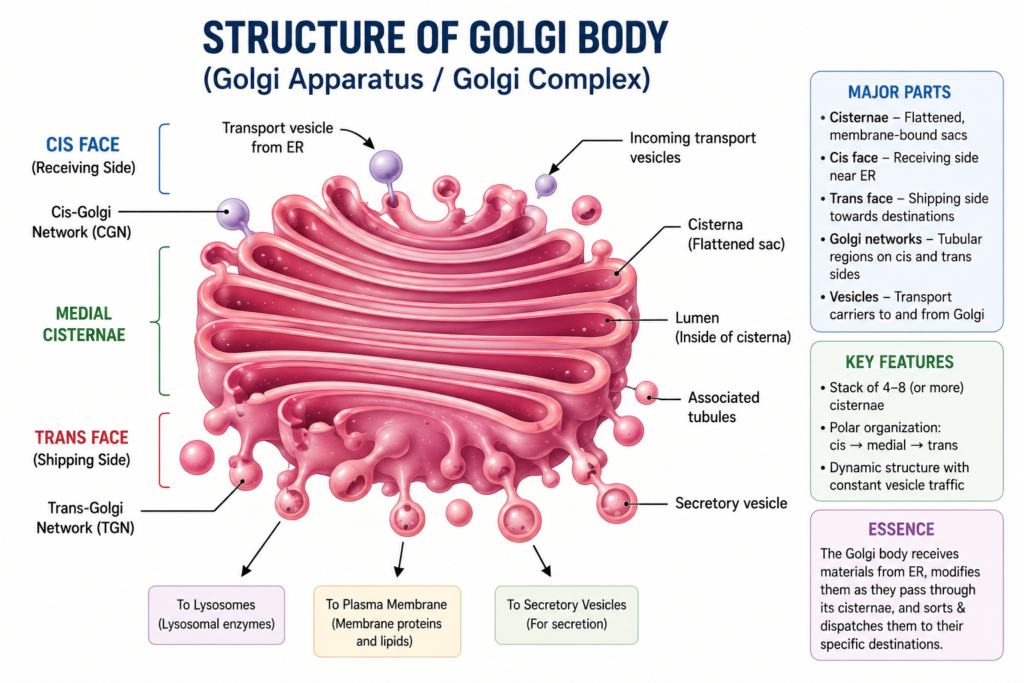
The Golgi apparatus has a characteristic stacked and polarized organization. Its basic structural units are flattened, membrane-bound sacs called cisternae.
Small vesicles and tubular structures are commonly associated with the edges of the cisternae.
A typical mammalian Golgi stack commonly contains several cisternae, although the number and organization can vary considerably among cell types and organisms.
The cisternae are not simply identical sacs placed together; different regions contain different sets of enzymes and therefore carry out different processing reactions.
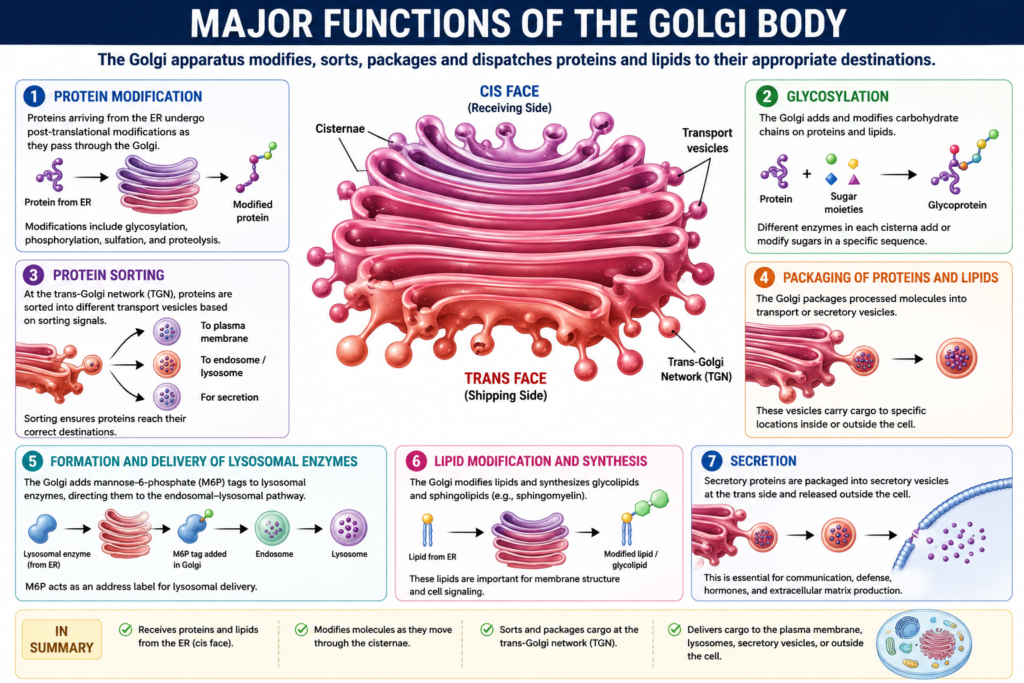
The major structural regions can be understood from the cis face toward the trans face.
1. Cisternae
- Cisternae are flattened, membrane-bound sacs that form the main body of the Golgi apparatus.
- They are arranged in stacks and contain enzymes responsible for sequential processing of proteins and lipids.
- Their membranes lack ribosomes, distinguishing them from rough endoplasmic reticulum.
- The cisternae may also contain small openings called fenestrae, and their edges can extend into tubules.
- Vesicles can bud from or fuse with these membrane regions during intracellular transport.
2. Cis Face
- The cis face is the receiving side of the Golgi apparatus. It is generally located closer to the endoplasmic reticulum.
- Transport carriers originating from the ER deliver newly synthesized proteins and lipids to the Golgi through the ER-Golgi transport pathway.
- The cis region therefore represents the entry side of the Golgi.
- The cis side is associated with the cis-Golgi network (CGN), which helps receive and organize incoming material.
3. Medial Cisternae
- Between the cis and trans regions are the medial cisternae.
- This region contains different processing enzymes from those found in the cis and trans regions.
- As cargo passes through successive Golgi compartments, its carbohydrate groups and other molecular features can be modified step by step.
4. Trans Face
- The trans face forms the exit side of the Golgi. Processed cargo moves toward this region before being sorted and packaged for delivery.
- The trans region is connected with the trans-Golgi network (TGN), a more tubular and interconnected membrane system that acts as an important sorting station.
5. Transport and Secretory Vesicles
- The Golgi is surrounded by numerous membrane-bound vesicles.
- Some vesicles deliver cargo to the Golgi, while others transport material away from the Golgi.
- Additional vesicles participate in retrieval pathways, returning certain proteins to earlier compartments.
- Thus, vesicles provide an essential connection between the ER, Golgi, endosomes, lysosomes, and plasma membrane.
How Does the Golgi Body Work?
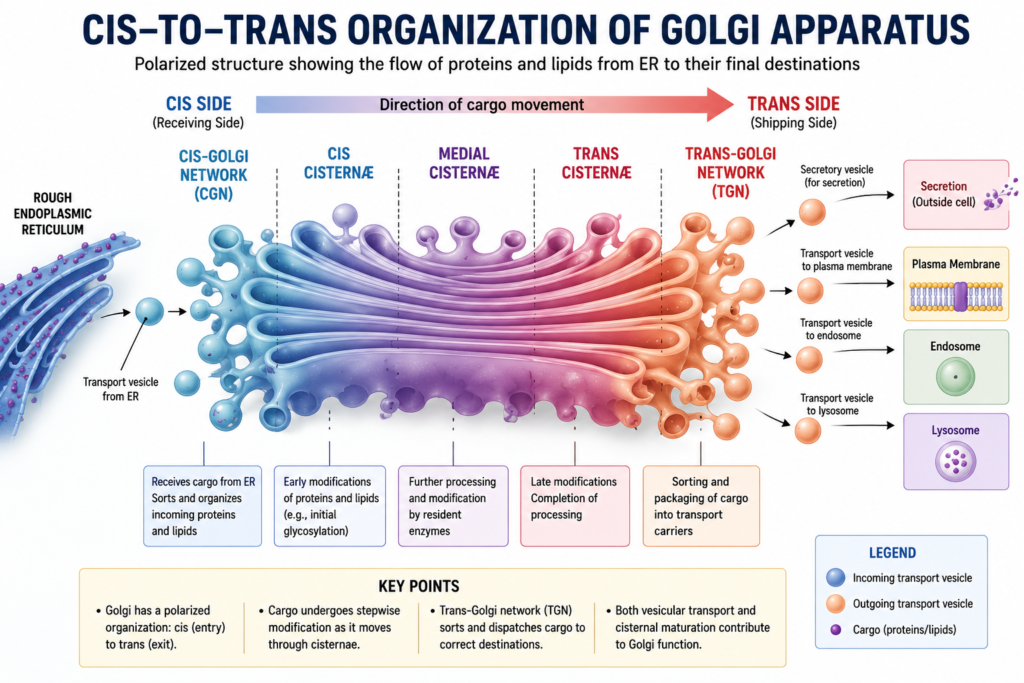
The Golgi works as part of the secretory pathway.
Proteins destined for secretion, the plasma membrane, lysosomes, or certain other compartments are first synthesized on ribosomes associated with the rough ER.
Properly processed cargo leaves the ER in transport vesicles and reaches the Golgi.
Once inside the Golgi system, the cargo moves through functionally distinct regions.
During this journey, enzymes modify the molecules and prepare them for their final destinations.
A simplified pathway is:
Rough ER → ER-Golgi transport carriers → Cis-Golgi → Medial Golgi → Trans-Golgi → Trans-Golgi network → Target destination
The actual mechanisms of intra-Golgi transport are more complex than this simple linear representation.
Evidence supports roles for both vesicular transport and cisternal maturation, and modern models recognize that these mechanisms can work together.
Functions of the Golgi Body
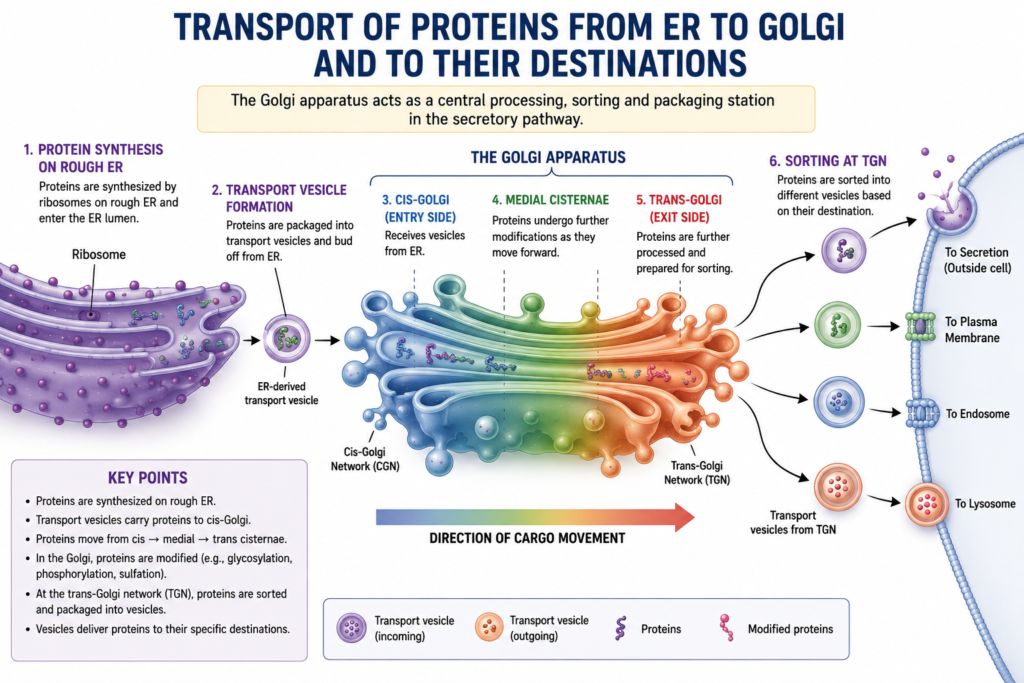
The Golgi body performs several closely related functions. Its importance comes from its ability to modify molecules and then direct them to the correct cellular destination.
1. Modification of Proteins
One of the most important functions of the Golgi is the post-translational modification of proteins.
Proteins arriving from the ER can undergo changes to their carbohydrate chains and other chemical groups as they pass through different Golgi compartments.
For example, the Golgi modifies N-linked oligosaccharides that were initially added to proteins in the ER and is also a major site of O-linked glycosylation.
These modifications can influence protein stability, activity, recognition, and destination.
2. Glycosylation
Glycosylation is the attachment or modification of carbohydrate groups on proteins and lipids.
The Golgi contains different glycosyltransferases and other enzymes arranged across its compartments.
Consequently, carbohydrate processing can occur in a particular sequence as cargo progresses from the cis side toward the trans side.
Glycosylation is important for the structure and function of many glycoproteins and glycolipids.
3. Protein Sorting
After processing, proteins must reach the correct destination.
The Golgi, especially the trans-Golgi network, helps sort cargo into different transport carriers.
Depending on the molecular signals associated with the cargo, proteins can be directed toward destinations such as the plasma membrane, endosomal-lysosomal system, or extracellular space.
4. Packaging of Proteins
The Golgi packages processed proteins into membrane-bound transport or secretory carriers.
These carriers then deliver their contents to appropriate destinations.
This packaging function is particularly important in cells that release large quantities of proteins, such as certain endocrine and exocrine cells.
5. Formation and Delivery of Lysosomal Enzymes
The Golgi participates in the processing and sorting of enzymes destined for lysosomes.
A key example is the generation of the mannose-6-phosphate (M6P) targeting signal on many lysosomal hydrolases.
This signal helps direct these enzymes toward the endosomal-lysosomal pathway.
6. Lipid Modification and Synthesis
The Golgi is also involved in lipid metabolism.
It participates in the synthesis and modification of certain glycolipids and sphingolipids, including sphingomyelin.
Therefore, the Golgi is not exclusively a protein-processing organelle.
7. Synthesis of Polysaccharides in Plant Cells
The Golgi has an additional major function in plant cells.
It synthesizes complex cell-wall polysaccharides, particularly pectins and hemicelluloses, which are subsequently transported to the cell surface.
Cellulose, in contrast, is synthesized at the plasma membrane rather than inside the Golgi.
8. Secretion
The Golgi contributes to the secretory pathway by processing and packaging molecules that are eventually released from the cell.
Secretory vesicles formed at the trans side can travel toward the plasma membrane and fuse with it, releasing their contents outside the cell.
Golgi Apparatus in Animal and Plant Cells
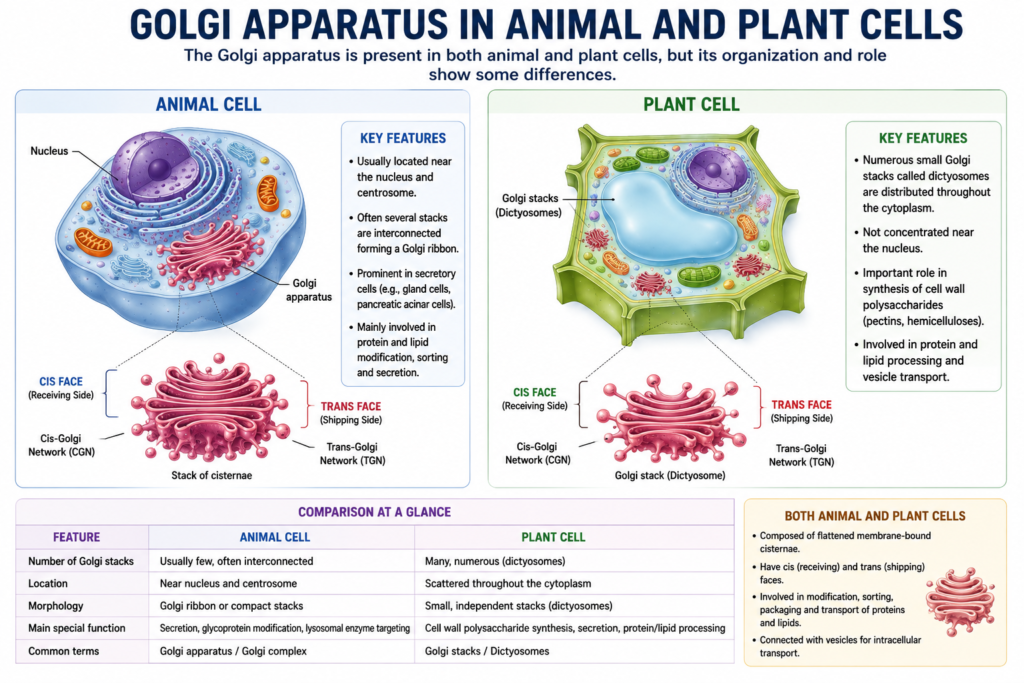
The Golgi apparatus is present in both animal and plant eukaryotic cells, but its organization can differ.
In many mammalian cells, Golgi stacks are commonly located near the nucleus and centrosome, and several stacks can be interconnected into a larger Golgi ribbon.
Plant cells commonly contain numerous Golgi stacks that are distributed throughout the cytoplasm.
Plant Golgi bodies are particularly important for producing and transporting cell-wall polysaccharides.
Why Is the Golgi Body Important?
The Golgi apparatus is essential because newly synthesized cellular molecules are not necessarily ready to function immediately after leaving the ER.
They may need to be:
modified → processed → sorted → packaged → transported
The Golgi coordinates these steps.
Without efficient Golgi processing and sorting, many proteins and lipids would not reach their correct destinations.
This would interfere with secretion, membrane composition, lysosomal function, cell signaling, and other fundamental cellular processes.
Modern cell biology therefore views the Golgi as a dynamic trafficking hub, rather than merely a passive stack of membrane sacs. Its structure is closely connected to the movement and processing of cellular cargo.
Golgi Body: Structure vs Functions at a Glance
| Structural part | Main role |
|---|---|
| Cisternae | Provide compartments for sequential processing |
| Cis-Golgi network | Receives and organizes incoming ER-derived cargo |
| Cis face | Entry/receiving side of the Golgi |
| Medial cisternae | Carry out many intermediate processing reactions |
| Trans cisternae | Complete late-stage processing and prepare cargo for sorting |
| Trans-Golgi network | Major sorting and distribution region |
| Transport vesicles | Carry selected cargo toward the plasma membrane |
| Secretory vesicles | Carry selected cargo toward the plasma membrane |
Quick Revision
The Golgi body is a polarized membrane-bound organelle composed mainly of stacked cisternae and associated membrane networks and vesicles.
It receives proteins and lipids from the ER at the cis side, modifies them as they pass through the Golgi, and sorts them at the trans side.
Its major functions are protein modification, glycosylation, lipid processing, sorting, packaging, secretion, lysosomal enzyme targeting, and polysaccharide synthesis in plants.
A useful way to remember its organization is:
Cis = Comes in
Medial = Modification
Trans = Takes out
Frequently Asked Questions
What is the Golgi body?
The Golgi body, or Golgi apparatus, is a membrane-bound organelle that modifies, sorts, packages, and distributes proteins and lipids within eukaryotic cells.
What is the basic structure of the Golgi apparatus?
The Golgi consists of stacks of flattened membrane sacs called cisternae, along with associated tubules and vesicles. It has distinct cis, medial, and trans regions.
What is the cis face of the Golgi?
The cis face is the receiving side of the Golgi, generally located toward the endoplasmic reticulum. It receives transport carriers containing proteins and lipids from the ER.
What is the trans face of the Golgi?
The trans face is the exit side of the Golgi. It is associated with the trans-Golgi network, where processed cargo is sorted and packaged for delivery.
What are the main functions of the Golgi body?
The major functions include protein modification, glycosylation, lipid processing, sorting, packaging, secretion, lysosomal enzyme targeting, and synthesis of certain polysaccharides in plant cells.
Does the Golgi apparatus make proteins?
No. Protein synthesis occurs primarily on ribosomes. The Golgi modifies, sorts, and packages proteins that are delivered to it, mainly from the ER.
What is a cisterna in the Golgi apparatus?
A cisterna is a flattened, membrane-bound compartment that forms part of the Golgi stack. Different cisternae contain different enzymes and perform different stages of molecular processing.
What is the trans-Golgi network?
The trans-Golgi network (TGN) is a tubular and interconnected region associated with the trans side of the Golgi. It plays an important role in sorting and dispatching processed cargo.
Is the Golgi apparatus present in plant cells?
Yes. Plant cells contain Golgi stacks, often called dictyosomes in some botanical contexts. Plant Golgi bodies are especially important for producing and transporting cell-wall polysaccharides.
What is the difference between the Golgi body and Golgi apparatus?
There is essentially no functional difference. Golgi body, Golgi apparatus, and Golgi complex are commonly used names for the same organelle.
Conclusion
The Golgi body is one of the most important organelles of the eukaryotic cell.
Its characteristic organization into cisternae creates specialized compartments where proteins and lipids can be processed in an orderly sequence.
The Golgi receives cargo from the ER at its cis face, modifies it through its cis, medial, and trans regions, and finally sorts and packages it through the trans-Golgi network.
Its functions extend far beyond simple packaging.
The Golgi participates in glycosylation, protein maturation, lipid processing, lysosomal enzyme targeting, secretion, and plant cell-wall polysaccharide synthesis.
Its ability to coordinate these processes makes it a central hub of intracellular transport and cellular organization.
References
- Hua, Z. & Graham, T. R. The Golgi Apparatus. NCBI Bookshelf, National Library of Medicine.
- Cooper, G. M. The Cell: A Molecular Approach — The Golgi Apparatus. NCBI Bookshelf.
- Alberts, B. et al. Molecular Biology of the Cell — Transport from the ER through the Golgi Apparatus. NCBI Bookshelf.
- Watson, E. T. et al. Mechanistic insights into cargo sorting and export from the Golgi apparatus. Nature Reviews Molecular Cell Biology, 2025.
- Essentials of Glycobiology — Subcellular trafficking pathways of glycoproteins and lysosomal enzymes.
- Glick, B. S. & Luini, A. Architecture of the Mammalian Golgi. Cold Spring Harbor Perspectives in Biology.
Discover more from Zoologyverse
Subscribe to get the latest posts sent to your email.