
1. Introduction
The Geological Time Scale is a chronological framework used by geologists and biologists to divide Earth’s history into successive intervals. These divisions are based on significant geological events, changes in climate and major developments in the history of life. The Geological Time Scale helps scientists understand when different groups of organisms originated, diversified and became extinct.
The history of life on Earth is a long and continuous process involving the origin, diversification, adaptation and extinction of different forms of organisms. Over billions of years, Earth has undergone remarkable geological, climatic and biological changes that have shaped the evolution of living organisms. Understanding these changes requires the systematic study of geological time, the fossil record and major extinction events.
Earth is approximately 4.54 billion years old. During this immense period, life evolved from simple microscopic organisms to highly complex forms, including plants, invertebrates and vertebrates. Major evolutionary developments, such as the appearance of eukaryotic cells, multicellular organisms, fishes, amphibians, reptiles, birds and mammals, occurred at different stages of geological history.
The fossil record provides important evidence of this evolutionary history. Fossils are preserved remains, impressions or traces of organisms that lived in the geological past. They provide information about ancient organisms, their structural characteristics, geographical distribution, environmental conditions and evolutionary relationships. By studying fossils preserved in different rock layers, scientists can reconstruct the sequence of biological changes that occurred throughout Earth’s history.
Another important aspect of Earth’s biological history is the occurrence of mass extinction events. These events involve the disappearance of a substantial proportion of Earth’s species within a relatively short geological interval. The five major mass extinction events have significantly influenced the course of evolution by eliminating many existing groups of organisms and creating ecological opportunities for surviving groups to diversify.
The study of the Geological Time Scale, fossil record and mass extinctions is therefore essential for understanding the origin, development and diversification of life on Earth. Together, these subjects provide a chronological and biological framework for interpreting evolutionary processes and reconstructing the history of biodiversity.
2. Concept and Importance of Geological Time Scale
2.1 Concept of Geological Time Scale
The Geological Time Scale is an internationally standardized chronological framework used to organize the history of Earth into successive intervals. These intervals represent major geological, climatic and biological changes that have occurred throughout Earth’s approximately 4.54-billion-year history.
The Geological Time Scale helps scientists understand the chronological sequence of important events, including the formation of continents, development of oceans, appearance of early life, evolution of major animal and plant groups, and extinction of ancient organisms.
Unlike ordinary calendar systems, the Geological Time Scale deals with extremely long periods, ranging from millions to billions of years. It provides a common reference framework for geologists, palaeontologists, evolutionary biologists and other researchers investigating Earth’s history.
Major Hierarchical Divisions
The major divisions of geological time are arranged hierarchically, from the largest to the smallest units:
- Eon: The largest formal division of geological time, representing an extensive interval of Earth’s history.
- Era: A subdivision of an eon, representing a major phase of geological and biological development.
- Period: A subdivision of an era, characterized by distinctive geological and biological developments.
- Epoch: A subdivision of a period, representing a more specific interval of geological history.
- Age: A smaller division of an epoch, used for more precise chronological classification.
These units form the principal geochronological hierarchy. Their corresponding rock-based units are called eonothem, erathem, system, series and stage, respectively. The International Commission on Stratigraphy (ICS) maintains the international framework and defines many geological boundaries using formally designated reference sections and points.
2.2 Importance of Geological Time Scale
The Geological Time Scale is essential for understanding the geological and biological history of Earth. It provides a chronological framework through which scientists can interpret evolutionary changes and correlate geological events occurring in different regions.
Understanding evolutionary history also requires a clear understanding of how species are defined and recognized. Read our article on the species concept for a detailed explanation.
Its major importance is discussed below.
1. Understanding Earth’s History
The Geological Time Scale provides a systematic framework for studying Earth’s development from its formation to the present. It helps identify major geological events, including the formation of continents, mountain-building processes, volcanic activity and changes in ocean levels.
2. Understanding the Evolution of Life
The Geological Time Scale helps reconstruct the evolutionary history of organisms. It indicates the approximate intervals during which different groups of organisms appeared, diversified and became extinct.
For example, fishes diversified extensively during the Paleozoic Era, dinosaurs dominated many terrestrial ecosystems during the Mesozoic Era, and mammals underwent extensive diversification during the Cenozoic Era.
3. Study of Fossil Records
The Geological Time Scale provides a chronological framework for studying fossils preserved in geological formations. By determining or estimating the ages of rock layers, palaeontologists can establish the relative sequence of appearance, diversification and extinction of different organisms.
4. Correlation of Geological Strata
Geologists use the Geological Time Scale to compare and correlate rock layers from different geographical regions. Fossils, particularly index fossils, are useful in identifying and matching rock formations of similar geological ages.
5. Understanding Mass Extinction Events
The Geological Time Scale helps identify major extinction events that caused widespread losses of biodiversity. It provides a framework for studying events such as the Permian–Triassic extinction and the Cretaceous–Paleogene extinction.
6. Reconstruction of Ancient Environments
The study of geological periods helps scientists reconstruct past environmental conditions, including ancient climates, ocean temperatures, atmospheric composition and the geographical distribution of continents.
7. Understanding Continental and Climatic Changes
The Geological Time Scale records major changes in continental positions, sea levels, glaciation and climatic conditions. These changes have influenced the distribution, adaptation and evolution of organisms throughout Earth’s history.
2.3 Geological Time and Evolutionary Biology
The Geological Time Scale has a particularly important role in evolutionary biology because evolutionary changes accumulate across generations, and major changes in biodiversity often become evident over geological periods.
By examining fossils from different geological intervals, scientists can identify evolutionary trends, transitional forms and the diversification of major taxonomic groups.
For example:
- The appearance and diversification of early vertebrates occurred during the Paleozoic Era.
- The transition of vertebrates from aquatic to terrestrial environments became prominent during the Devonian and Carboniferous periods.
- Reptiles diversified extensively during the Mesozoic Era.
- Birds and flowering plants became important components of terrestrial ecosystems during the Mesozoic Era.
- Mammals diversified significantly during the Cenozoic Era.
Thus, the Geological Time Scale connects geological history with biological evolution and provides an essential foundation for understanding the origin, diversification and extinction of organisms.
3. Basis of Geological Time Division
The division of Earth’s history into different geological intervals is based on significant geological, biological, climatic and environmental changes that have occurred over millions and billions of years. The Geological Time Scale provides a standardized framework for organizing these events in chronological order.
Scientists use several methods and types of evidence to establish the boundaries between geological intervals and determine the ages of rocks and geological events. These include the study of rock formations, fossil succession, radiometric dating, magnetic reversals and major changes in Earth’s environment.
3.1 Stratigraphy and Rock Layers
Stratigraphy is the branch of geology concerned with the study of rock layers (strata), their sequence, distribution, composition and chronological relationships.
Sedimentary rocks are particularly important in establishing geological chronology because they frequently contain fossils and preserve evidence of ancient environmental conditions.
The principle of superposition states that in an undisturbed sequence of sedimentary rock layers, the oldest layer generally occurs at the bottom, while progressively younger layers occur above it.
This principle helps scientists determine the relative ages of rock formations and reconstruct the sequence of geological events. However, geological disturbances such as folding, faulting and overturning can modify the original arrangement of rock layers, so their structural relationships must also be examined.
3.2 Fossil Succession
Fossil succession refers to the predictable appearance and disappearance of different organisms in successive geological rock layers.
Different groups of organisms existed during different intervals of Earth’s history. Therefore, fossils preserved in sedimentary rocks provide important evidence for determining the relative ages of geological strata and understanding changes in biodiversity.
Index fossils, also known as guide fossils, are particularly useful in geological correlation. They generally belong to organisms that were geographically widespread, relatively abundant and existed for comparatively short geological intervals.
Examples include:
- Trilobites: Important index fossils for identifying and correlating many Paleozoic rock formations.
- Ammonites: Widely used for identifying and correlating Mesozoic marine rock formations.
- Certain foraminifera: Commonly used in the dating and correlation of marine sedimentary deposits.
Fossil succession helps establish the relative chronological sequence of geological events and provides evidence of evolutionary changes throughout Earth’s history. However, fossil correlation must consider geographical distribution, environmental conditions and the possibility that organisms may appear or disappear at different times in different regions.
3.3 Radiometric Dating
Radiometric dating is a scientific method used to estimate the numerical age of rocks and minerals by measuring the radioactive decay of unstable isotopes into stable daughter products.
Radioactive isotopes decay at predictable rates, which are expressed through their half-lives. A half-life is the time required for half of the radioactive parent isotope in a sample to decay into its daughter product.
By measuring the proportions of parent and daughter isotopes in a suitable mineral, scientists can estimate the time elapsed since the mineral crystallized or the isotopic system was last reset.
Common radiometric dating methods include:
- Uranium–Lead Dating: Commonly used for determining the ages of ancient rocks and zircon minerals.
- Potassium–Argon Dating: Used to estimate the ages of volcanic rocks and minerals containing suitable potassium-bearing materials.
- Argon–Argon Dating: An advanced method used for determining the ages of volcanic materials and other suitable geological samples.
- Radiocarbon Dating: Used for dating relatively recent organic remains, generally up to approximately 50,000 years, depending on sample conditions and analytical methods.
Radiometric dating has played a major role in establishing the numerical age estimates associated with the Geological Time Scale. It is particularly useful when volcanic ash layers or igneous rocks occur within or near sedimentary sequences containing fossils.
3.4 Magnetic Reversals and Palaeomagnetism
Earth’s magnetic field has undergone several reversals throughout geological history, during which the magnetic north and south poles have exchanged their positions.
Certain magnetic minerals present in igneous and sedimentary rocks preserve information about the direction and polarity of Earth’s magnetic field at the time of their formation or deposition.
The study of this preserved magnetic information is known as palaeomagnetism.
The record of alternating normal and reversed magnetic polarity is called the geomagnetic polarity sequence. Scientists compare these magnetic patterns with the established geomagnetic polarity timescale to correlate rock sequences and improve geological age estimates.
Magnetic reversals are particularly useful in studying ocean-floor rocks, reconstructing the history of seafloor spreading and correlating geological deposits in which suitable fossils may be absent.
3.5 Major Geological Events
Major geological events also provide important evidence for understanding and dividing Earth’s history into different intervals.
These events include:
- Formation and breakup of supercontinents.
- Development of mountain ranges.
- Major volcanic eruptions.
- Changes in sea level.
- Formation and disappearance of large ocean basins.
- Periods of extensive glaciation.
- Major meteorite or asteroid impacts.
Such events have influenced Earth’s physical environment and sometimes produced significant changes in the distribution and evolution of living organisms.
For example, the breakup of the supercontinent Pangaea changed continental arrangements and influenced the geographical distribution of organisms. Similarly, major volcanic episodes have sometimes been associated with substantial climatic and environmental disturbances.
3.6 Biological and Climatic Changes
Major changes in biodiversity and global climate are important considerations in understanding geological boundaries and transitions.
The appearance of new groups of organisms, rapid diversification of existing groups and widespread extinction events have helped scientists identify important changes in Earth’s biological history.
For example, the transition from the Cretaceous Period to the Paleogene Period is associated with the Cretaceous–Paleogene extinction event approximately 66 million years ago. This event resulted in the extinction of non-avian dinosaurs and numerous other organisms.
Similarly, major climatic changes, including glaciation, global warming and changes in ocean circulation, have influenced the evolution and geographical distribution of organisms.
Biological and climatic evidence is therefore studied alongside rock sequences, fossils and numerical dating methods to understand major geological transitions.
3.7 Relative Dating and Numerical Age Dating
Two major approaches are used to establish the chronological relationships and ages of geological materials.
1. Relative Dating
Relative dating determines whether a rock, fossil or geological event is older or younger than another without assigning an exact numerical age.
It is based on geological principles such as superposition, cross-cutting relationships and fossil succession.
For example, in an undisturbed sequence of sedimentary rocks, a fossil found in a lower layer is generally older than a fossil found in an overlying layer.
2. Numerical Age Dating
Numerical age dating estimates the age of rocks, minerals or geological events in years. Radiometric dating is one of the most important methods used for obtaining these estimates.
The results are generally expressed in years, thousands of years or millions of years, depending on the age of the material and the dating method.
Both approaches complement each other. Relative dating establishes the sequence of geological events, while numerical age dating helps estimate when those events occurred. Together, they contribute to the development and refinement of the Geological Time Scale.
3.8 International Standardization of Geological Time
The international geological time framework is maintained by the International Commission on Stratigraphy (ICS), which operates under the International Union of Geological Sciences (IUGS).
The ICS develops and maintains the International Chronostratigraphic Chart, which provides the internationally recognized framework for geological divisions and their corresponding time units.
One important method used to define geological boundaries is the Global Boundary Stratotype Section and Point (GSSP), commonly known as a golden spike.
A GSSP identifies a specific physical point within a geological reference section that defines the lower boundary of a chronostratigraphic unit, particularly many geological stages. The boundary is identified using a combination of suitable geological, biological and other markers that allow correlation with rock sequences elsewhere.
For some older geological divisions, particularly within the Precambrian, boundaries have traditionally been established using numerical ages known as Global Standard Stratigraphic Ages (GSSAs).
This international system promotes consistency in geological terminology and allows scientists worldwide to compare geological and palaeontological findings. The numerical ages associated with geological boundaries may be revised as new evidence and improved dating techniques become available.
4. Major Divisions of Geological Time
The Geological Time Scale divides Earth’s approximately 4.54-billion-year history into a series of hierarchical chronological units. These divisions represent major changes in Earth’s physical structure, geological processes, climate and biological evolution.
The principal geochronological units are eons, eras, periods, epochs and ages. Each division represents a progressively smaller interval of geological history.
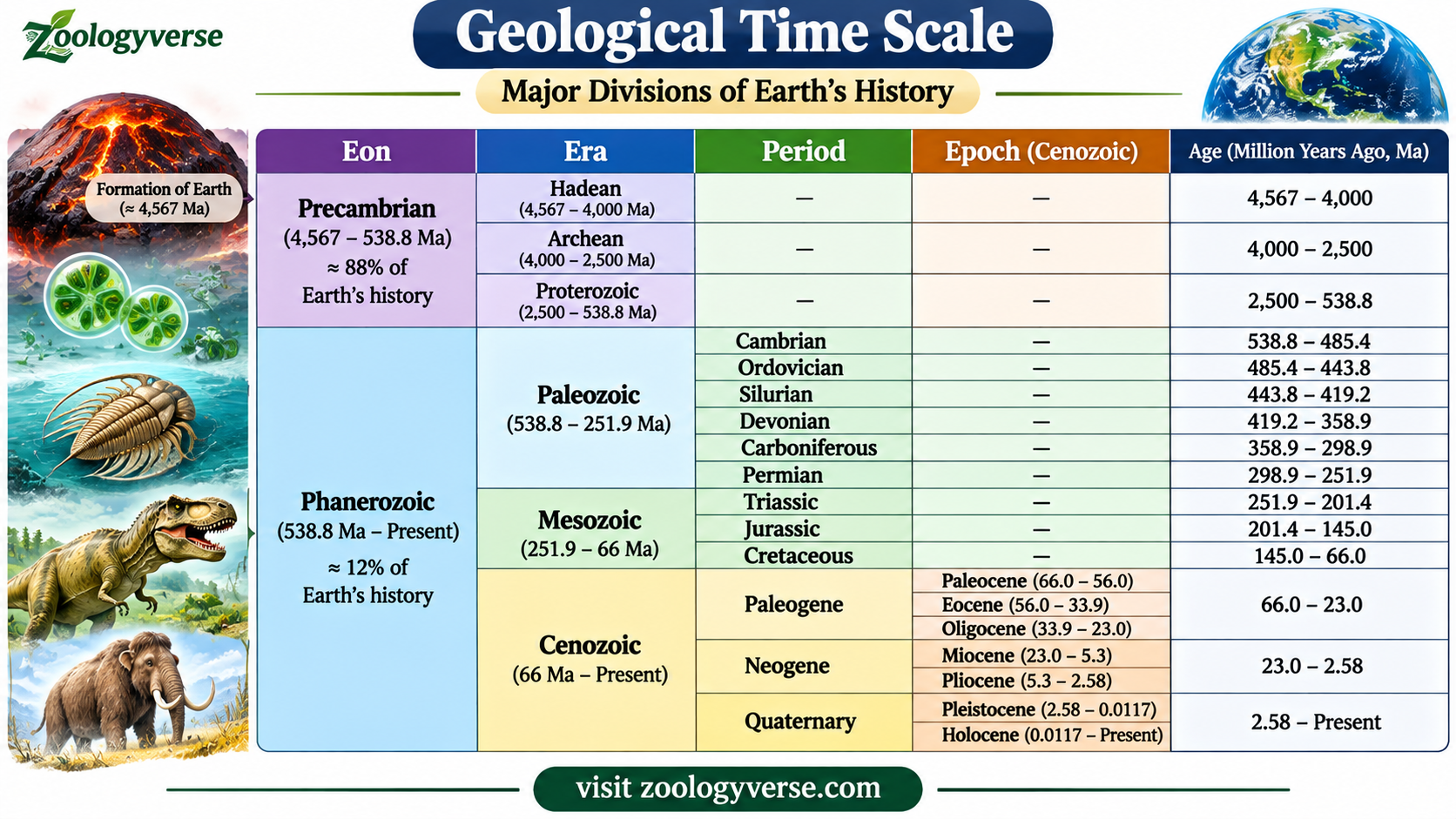
Earth’s history is broadly divided into four major eons: Hadean, Archean, Proterozoic and Phanerozoic. The Hadean, Archean and Proterozoic collectively form the Precambrian interval, which represents the earliest and longest part of Earth’s history. The Phanerozoic Eon represents the interval during which abundant and diverse fossil organisms became widespread.
4.1 Hierarchical Classification of Geological Time
The major divisions of the Geological Time Scale are arranged in the following order:
1. Eon
An eon is the largest formal unit of geological time. Earth’s history is divided into four major eons: Hadean, Archean, Proterozoic and Phanerozoic.
2. Era
An era is a subdivision of an eon. It represents a major interval characterized by significant geological and biological developments. For example, the Phanerozoic Eon is divided into the Paleozoic, Mesozoic and Cenozoic eras.
3. Period
A period is a subdivision of an era. It represents a distinct interval in geological history characterized by particular geological conditions and evolutionary developments. Examples include the Cambrian, Devonian, Jurassic and Cretaceous periods.
4. Epoch
An epoch is a subdivision of a period. It represents a relatively shorter interval characterized by specific geological, climatic and biological conditions. Examples include the Pleistocene and Holocene epochs.
5. Age
An age is a smaller formal division of an epoch. It is used to identify more specific intervals within geological history.
4.2 Major Eons of Geological Time
The four major eons provide the broadest chronological framework for understanding Earth’s development.
A. Hadean Eon (Approximately 4.567–4.031 Billion Years Ago)
The Hadean Eon represents the earliest stage of Earth’s history, beginning with the formation and early development of the planet approximately 4.567 billion years ago.
The name Hadean is derived from Hades, referring to the extremely hot and hostile conditions traditionally associated with early Earth.
Major characteristics include:
- Formation of Earth through the accumulation of planetary material.
- Extensive meteorite bombardment during the early stages of planetary development.
- Formation and differentiation of Earth’s internal layers, including the core, mantle and early crust.
- Development of the earliest atmosphere through volcanic outgassing.
- Cooling of the planetary surface and development of conditions suitable for liquid water.
No universally accepted fossil evidence of life is known from the Hadean Eon.
B. Archean Eon (Approximately 4.031–2.5 Billion Years Ago)
The Archean Eon witnessed the development of some of the earliest widely accepted evidence of life on Earth.
Major characteristics include:
- Formation of relatively stable continental crust.
- Development of early oceans.
- Appearance of ancient microbial life.
- Development of prokaryotic organisms.
- Formation of stromatolites associated with microbial communities.
- Development of early photosynthetic microorganisms.
Microbial organisms dominated the biological environment during this eon. Stromatolites and other ancient geological evidence provide important information about early microbial ecosystems.
C. Proterozoic Eon (Approximately 2.5 Billion–538.8 Million Years Ago)
The Proterozoic Eon was characterized by major atmospheric, geological and biological transformations.
Major characteristics include:
- Significant increase in atmospheric oxygen through photosynthetic activity.
- Occurrence of the Great Oxidation Event.
- Development and diversification of eukaryotic organisms.
- Appearance and diversification of multicellular organisms.
- Evolution of algae and early complex life forms.
- Development of the Ediacaran biota during the late Proterozoic.
The Proterozoic Eon represents an important stage in the transition from predominantly microbial life to more complex multicellular organisms.
D. Phanerozoic Eon (Approximately 538.8 Million Years Ago to Present)
The Phanerozoic Eon represents the interval during which abundant, diverse and readily recognizable fossil organisms became widespread.
It is divided into three major eras:
- Paleozoic Era.
- Mesozoic Era.
- Cenozoic Era.
The Phanerozoic Eon includes major evolutionary developments such as the diversification of marine invertebrates, appearance and diversification of fishes, colonization of land by plants and animals, diversification of reptiles, evolution of birds and extensive diversification of mammals.
4.3 Major Eras of the Phanerozoic Eon
The three eras of the Phanerozoic Eon represent important stages in the evolutionary history of life.
1. Paleozoic Era (Approximately 538.8–251.902 Million Years Ago)
The Paleozoic Era is commonly associated with the diversification of marine organisms and the gradual colonization of terrestrial environments by plants and animals.
Important evolutionary developments include:
- Cambrian diversification of marine animal groups.
- Abundance and diversification of trilobites.
- Evolution and diversification of fishes.
- Appearance and diversification of early land plants.
- Development of terrestrial arthropods.
- Evolution of amphibians and early reptiles.
- Formation of extensive coal deposits during the Carboniferous Period.
The Paleozoic Era ended with the Permian–Triassic mass extinction, the largest known mass extinction event in Earth’s history.
2. Mesozoic Era (Approximately 251.902–66 Million Years Ago)
The Mesozoic Era is popularly known as the Age of Reptiles because dinosaurs and other reptilian groups dominated many terrestrial and aquatic ecosystems.
Important evolutionary developments include:
- Diversification of dinosaurs.
- Evolution of the first mammals.
- Appearance of the earliest birds.
- Diversification of marine reptiles.
- Evolution and spread of flowering plants during the Cretaceous Period.
- Breakup of the supercontinent Pangaea.
The Mesozoic Era ended with the Cretaceous–Paleogene mass extinction approximately 66 million years ago.
3. Cenozoic Era (Approximately 66 Million Years Ago to Present)
The Cenozoic Era is commonly called the Age of Mammals because mammals underwent extensive diversification following the end-Cretaceous extinction.
Important evolutionary developments include:
- Diversification of mammals and birds.
- Evolution and expansion of modern flowering plants and grasslands.
- Development of modern ecosystems.
- Evolution and diversification of primates.
- Appearance and evolution of hominins.
- Evolution and geographical expansion of modern humans.
The Cenozoic Era continues today and is divided into the Paleogene, Neogene and Quaternary periods.
4.4 Major Periods of the Phanerozoic Eon
The Phanerozoic Eon is further divided into eleven major periods under its three eras.
Paleozoic Periods:
- Cambrian
- Ordovician
- Silurian
- Devonian
- Carboniferous
- Permian
Mesozoic Periods:
- Triassic
- Jurassic
- Cretaceous
Cenozoic Periods:
- Paleogene
- Neogene
- Quaternary
Each period represents a distinct interval in Earth’s history, characterized by particular geological conditions, fossil assemblages and evolutionary developments.
4.5 Summary of the Major Divisions
The following table summarizes the principal divisions of the Geological Time Scale and their important biological developments.
| Eon | Era | Major biological developments |
|---|---|---|
| Hadean | — | Formation and early development of Earth; no confirmed fossil evidence of life |
| Archean | — | Early microbial life, stromatolites and development of photosynthetic microorganisms |
| Proterozoic | — | Great Oxidation Event, eukaryotes and multicellular organisms |
| Phanerozoic | Paleozoic | Marine diversification, fishes and early terrestrial organisms |
| Phanerozoic | Mesozoic | Dinosaurs, early birds, mammals and flowering plants |
| Phanerozoic | Cenozoic | Mammalian diversification, modern ecosystems and human evolution |
The Geological Time Scale therefore provides a chronological framework for understanding the progressive development of Earth and its living organisms. Its divisions help scientists correlate geological formations, interpret fossil evidence and reconstruct the evolutionary history of biodiversity.
5. Precambrian Supereon
The Precambrian represents the earliest and longest interval in Earth’s geological history, extending from the formation of Earth approximately 4.567 billion years ago to the beginning of the Cambrian Period, approximately 538.8 million years ago. It accounts for nearly 88% of Earth’s total geological history.
The Precambrian is not a single geological era but a broad collective interval that includes three major eons: the Hadean, Archean and Proterozoic. These eons witnessed the formation of Earth’s crust, development of oceans, evolution of early microbial organisms, oxygenation of the atmosphere and emergence of complex multicellular life.
The Precambrian is particularly important in the Geological Time Scale because it records the earliest stages of planetary development and the origin and initial evolution of life.
5.1 Major Divisions of the Precambrian
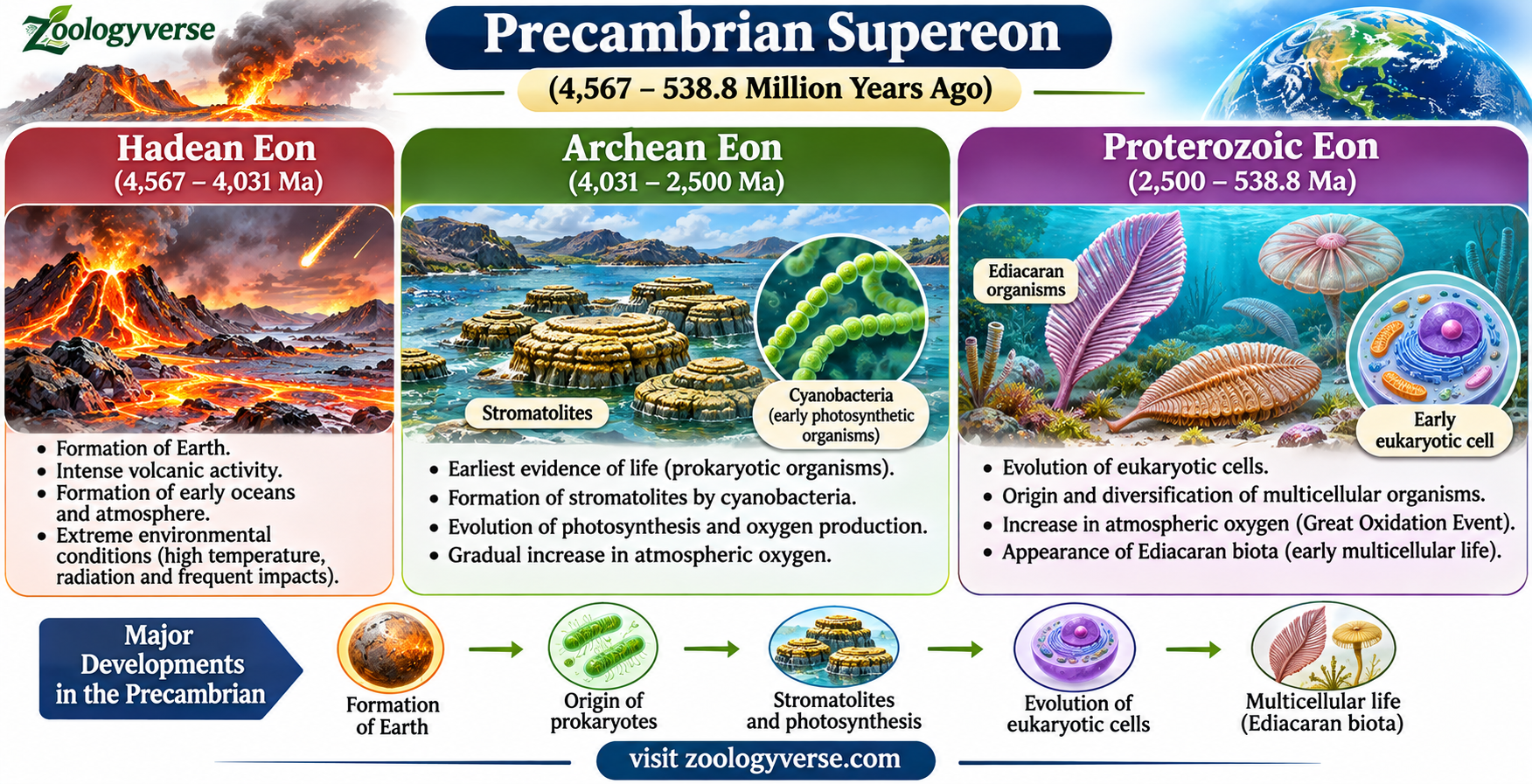
The Precambrian is broadly divided into three major eons:
- Hadean Eon: Approximately 4.567–4.031 billion years ago.
- Archean Eon: Approximately 4.031–2.5 billion years ago.
- Proterozoic Eon: Approximately 2.5 billion–538.8 million years ago.
Each eon represents a distinct stage in Earth’s geological and biological development.
5.2 Hadean Eon
The Hadean Eon represents the earliest interval of Earth’s history, beginning with the formation and early development of the planet approximately 4.567 billion years ago.
The name Hadean is derived from Hades, referring to the extremely hot and hostile conditions traditionally associated with early Earth.
Major Geological Characteristics
- Formation of Earth through the accumulation of dust, rocks and other planetary materials.
- Differentiation of Earth into the core, mantle and early crust.
- Extensive volcanic activity and meteorite bombardment.
- Development of the earliest atmosphere through volcanic outgassing.
- Cooling of the planetary surface and possible formation of early oceans.
Biological Significance
There is no universally accepted fossil evidence of life from the Hadean Eon. However, some ancient geological and geochemical evidence has been investigated for clues about the possible earliest conditions suitable for life.
The Hadean Eon established the physical and chemical conditions necessary for subsequent biological evolution.
5.3 Archean Eon
The Archean Eon extended from approximately 4.031 to 2.5 billion years ago. It represents an important stage in the history of life because some of the earliest widely accepted evidence of biological activity comes from this interval.
To understand the scientific explanations and hypotheses concerning the beginning of biological life, read our detailed article on the origin of life.
Major Geological Characteristics
- Development of relatively stable continental crust.
- Formation and expansion of ancient oceans.
- Extensive volcanic activity.
- Development of early continental nuclei.
- Formation of ancient sedimentary and volcanic rock sequences.
Biological Developments
The Archean Eon witnessed the development and diversification of early microbial organisms.
Important biological features include:
- Appearance of ancient microorganisms: Early microbial life forms developed in aquatic environments. Their exact evolutionary relationships remain difficult to establish from the limited ancient evidence.
- Development of microbial communities: Microorganisms formed communities in marine and other aquatic environments.
- Formation of stromatolites: Layered sedimentary structures developed through the activity of microbial mats.
- Evolution of early photosynthetic pathways: Microorganisms developed metabolic processes that used light as an energy source.
- Development of microbial ecosystems: Different microbial groups occupied ancient marine environments and contributed to early biogeochemical cycles.
Stromatolites are layered sedimentary structures produced through the activity of microorganisms, particularly microbial mats. Ancient stromatolites provide important evidence of early biological activity.
Photosynthetic microorganisms played a significant role in gradually modifying Earth’s chemical environment, although atmospheric oxygen remained relatively low during much of the Archean.
5.4 Proterozoic Eon
The Proterozoic Eon extended from approximately 2.5 billion years ago to 538.8 million years ago. It was characterized by major atmospheric, geological and biological transformations.
The Proterozoic represents a crucial stage in the Geological Time Scale because several important evolutionary developments occurred during this interval, including the rise of atmospheric oxygen, appearance and diversification of eukaryotic organisms, and emergence of multicellular life.
The evolutionary origin of multicellular animals is an important subject in zoology. Explore the different explanations in our article on the theories of origin of metazoans.
The differences between these two cellular organizations are explained in our article on prokaryotic and eukaryotic cells.
Major Geological Characteristics
- Development and stabilization of large continental landmasses.
- Formation and breakup of supercontinents.
- Occurrence of extensive glaciation.
- Significant changes in atmospheric oxygen concentration.
- Development of diverse sedimentary rock formations.
Biological Developments
The Proterozoic Eon witnessed important evolutionary innovations.
1. Great Oxidation Event
The Great Oxidation Event occurred approximately 2.4–2.1 billion years ago and involved a substantial increase in atmospheric oxygen.
Oxygen released through oxygenic photosynthesis, particularly by cyanobacteria, gradually accumulated in the atmosphere after interacting with various geological and chemical oxygen sinks. This transformation significantly altered Earth’s surface chemistry and influenced the evolution and ecological expansion of aerobic organisms.
2. Evolution of Eukaryotic Cells
Eukaryotic organisms appeared during the Proterozoic Eon. Their cells possessed a well-organized nucleus and membrane-bound organelles.
The evolution of eukaryotic cells represented a major biological innovation and provided the foundation for the subsequent diversification of complex organisms, including many algae, fungi, plants and animals.
3. Development of Multicellular Organisms
Multicellularity evolved in different groups of organisms during the Proterozoic. Multicellular algae became increasingly important in aquatic ecosystems, while evidence of more complex multicellular organisms appeared during the later part of this eon.
The evolution of multicellularity allowed cells to become specialized and function cooperatively within larger biological structures.
4. Ediacaran Biota
The Ediacaran Period, approximately 635–538.8 million years ago, represents the final geological period of the Proterozoic Eon.
It is particularly important because it contains evidence of diverse early macroscopic organisms collectively known as the Ediacaran biota.
These organisms included soft-bodied forms that lived in marine environments. Many displayed unusual body organizations and cannot be confidently assigned to modern animal groups.
Examples include:
- Dickinsonia
- Charnia
- Spriggina
- Kimberella
The Ediacaran biota provides important evidence about the early diversification of macroscopic life before the Cambrian diversification.
5.5 Biological Significance of the Precambrian
The Precambrian established the foundation for the evolution of complex life on Earth.
Its major biological contributions include:
- Origin and early diversification of microbial life.
- Development of photosynthetic microorganisms.
- Oxygenation of Earth’s atmosphere.
- Evolution and diversification of eukaryotic cells.
- Development of multicellular organisms.
- Emergence of early macroscopic organisms.
- Establishment of ecological conditions that preceded the Cambrian diversification.
The Precambrian therefore occupies a fundamental position in the Geological Time Scale. Although its fossil record is less abundant and often more difficult to interpret than that of later geological intervals, it provides essential evidence about the origin of life and the earliest stages of biological evolution.
6. Paleozoic Era
The Paleozoic Era represents an important interval in Earth’s biological history, extending from approximately 538.8 million to 251.9 million years ago. It is the first era of the Phanerozoic Eon and is commonly associated with the diversification of marine organisms and the gradual colonization of terrestrial environments by plants and animals.
The term Paleozoic is derived from the Greek words palaios, meaning ancient, and zoe, meaning life. Therefore, Paleozoic literally means ancient life.
During this era, life underwent remarkable evolutionary transformations. Marine invertebrates diversified extensively, fishes evolved into numerous groups, plants colonized terrestrial habitats, and vertebrates gradually adapted to life on land. The Paleozoic Era ended with the Permian–Triassic mass extinction, the largest known extinction event in Earth’s history.
6.1 Major Characteristics of the Paleozoic Era
The Paleozoic Era was characterized by significant geological, climatic and biological developments.
Its major characteristics include:
- Extensive diversification of marine invertebrates.
- Appearance and diversification of several major animal groups.
- Evolution and diversification of fishes.
- Development of jawed vertebrates.
- Colonization of land by plants and arthropods.
- Evolution of amphibians and early amniotes.
- Formation of extensive coal deposits.
- Development of large terrestrial forests.
- Assembly of the supercontinent Pangaea.
- Occurrence of several major extinction events.
6.2 Major Periods of the Paleozoic Era
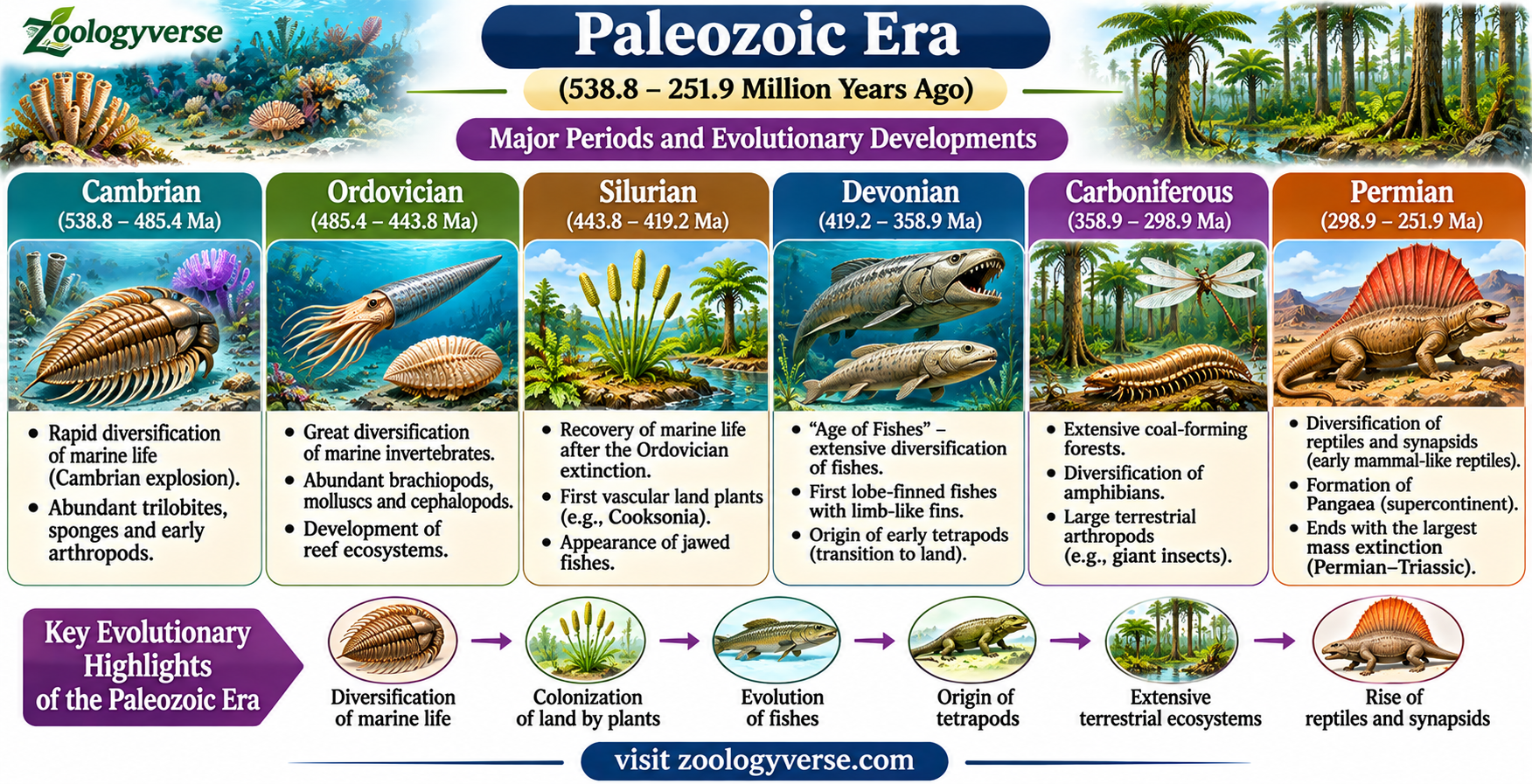
The Paleozoic Era is divided into six geological periods:
- Cambrian
- Ordovician
- Silurian
- Devonian
- Carboniferous
- Permian
Each period represents a distinct stage in the geological and evolutionary development of organisms.
6.3 Cambrian Period (Approximately 538.8–485.4 Million Years Ago)
The Cambrian Period marks the beginning of the Paleozoic Era and is particularly famous for the Cambrian diversification, historically known as the Cambrian Explosion.
During this interval, many major animal groups became abundant and more readily recognizable in the fossil record. Marine ecosystems became increasingly complex, with the development of diverse body forms, feeding strategies and ecological interactions.
Major Biological Developments
- Diversification of marine invertebrates.
- Abundance and diversification of trilobites.
- Appearance of numerous organisms with mineralized skeletons.
- Development of more complex marine food webs.
- Diversification of early arthropods.
- Appearance of early chordate representatives.
Important organisms included trilobites, brachiopods, sponges and early molluscs.
The Cambrian diversification represents a major transition in the history of animal life. However, the evolutionary origins of several animal lineages extend into the Precambrian, and the Cambrian diversification should not be interpreted as the sudden origin of all animal groups.
6.4 Ordovician Period (Approximately 485.4–443.1 Million Years Ago)
The Ordovician Period was characterized by extensive diversification of marine organisms. Marine environments supported a wide variety of invertebrates, and early vertebrates became increasingly evident in the fossil record.
Major Biological Developments
- Diversification of brachiopods and bryozoans.
- Abundance of trilobites and marine molluscs.
- Diversification of cephalopods.
- Development and expansion of coral communities.
- Appearance and diversification of early jawless vertebrates.
- Development of early land plants and their close relatives.
Marine ecosystems became increasingly complex, with diverse organisms occupying different ecological niches. The fossil record also provides evidence of early vertebrate groups, particularly jawless fishes.
The period ended with the Ordovician–Silurian mass extinction, which was associated with major climatic changes, widespread glaciation and subsequent changes in sea level and marine habitats.
6.5 Silurian Period (Approximately 443.1–419.6 Million Years Ago)
The Silurian Period followed the Ordovician–Silurian extinction and witnessed the recovery and diversification of marine ecosystems.
It was also an important interval for the development of terrestrial ecosystems.
Major Biological Developments
- Diversification of jawless fishes.
- Appearance and diversification of early jawed fishes.
- Development and diversification of vascular plants on land.
- Appearance and diversification of terrestrial arthropods.
- Expansion of coral reef ecosystems.
- Development of more complex terrestrial habitats.
The appearance and diversification of vascular plants were particularly important because specialized conducting tissues allowed plants to transport water and nutrients more efficiently.
These developments contributed to the gradual establishment of more complex terrestrial habitats and provided new ecological opportunities for other organisms.
6.6 Devonian Period (Approximately 419.6–358.9 Million Years Ago)
The Devonian Period is popularly known as the Age of Fishes because of the extensive diversification of fishes during this interval.
Several important evolutionary transitions occurred, including the development of early tetrapods from fish ancestors.
Major Biological Developments
- Diversification of jawless and jawed fishes.
- Development and diversification of placoderms and other early jawed vertebrates.
- Diversification of cartilaginous fishes.
- Evolution and diversification of lobe-finned fishes.
- Appearance of early tetrapods.
- Development of extensive terrestrial forests.
- Diversification of terrestrial arthropods.
The transition from aquatic vertebrates to early tetrapods represents one of the most important evolutionary developments of the Paleozoic Era.
Important fossil examples associated with this transition include Tiktaalik and Acanthostega. These fossils provide evidence of different anatomical features involved in the evolution of vertebrate adaptations for movement and support in shallow-water and terrestrial environments.
The Devonian Period ended with a series of extinction episodes, collectively known as the Late Devonian extinction events, which significantly affected marine biodiversity.
6.7 Carboniferous Period (Approximately 358.9–298.9 Million Years Ago)
The Carboniferous Period was characterized by extensive swamp forests, abundant vegetation and the evolution of important terrestrial animal groups.
Large quantities of plant material accumulated in swampy environments and eventually contributed to the formation of extensive coal deposits. These deposits are responsible for the name Carboniferous, which refers to coal-bearing rocks.
The period is traditionally divided into the Mississippian and Pennsylvanian subdivisions in North America, while other regional geological systems use different subdivisions.
Major Biological Developments
- Development of extensive forests containing lycophytes, horsetails and ferns.
- Abundance of giant terrestrial arthropods.
- Diversification of amphibians and other early tetrapods.
- Appearance and diversification of early amniotes.
- Development of early reptilian lineages.
- Evolution of increasingly complex terrestrial ecosystems.
The evolution of the amniotic egg was especially significant because it reduced the dependence of vertebrates on aquatic environments for reproduction.
The amniotic egg contains protective membranes that support embryonic development in a terrestrial environment. This reproductive adaptation contributed to the successful diversification of amniotes, including the evolutionary lineages that later gave rise to reptiles, birds and mammals.
6.8 Permian Period (Approximately 298.9–251.9 Million Years Ago)
The Permian Period represents the final interval of the Paleozoic Era.
During this period, the continents were united into the supercontinent Pangaea, resulting in major changes in climate, ocean circulation and terrestrial ecosystems. Extensive continental interiors experienced relatively dry conditions, while different climatic zones influenced the distribution of organisms.
Major Biological Developments
- Diversification of reptiles and synapsids.
- Development and diversification of therapsids.
- Abundance and diversification of gymnosperms.
- Diversification of terrestrial insects.
- Development of complex terrestrial food webs.
- Continued evolution and diversification of marine invertebrates.
Synapsids, an important group of amniotes, included several lineages that contributed to the evolutionary history of mammals. Therapsids were particularly important because they included forms displaying several features associated with the later evolution of mammals.
The Permian Period ended with the Permian–Triassic mass extinction approximately 251.9 million years ago. This event caused the disappearance of a very large proportion of marine species and numerous terrestrial organisms.
6.9 Major Evolutionary Developments During the Paleozoic Era
The Paleozoic Era witnessed several major evolutionary innovations that transformed life on Earth.
1. Diversification of Marine Invertebrates
Marine ecosystems became increasingly diverse, with the development and diversification of numerous invertebrate groups, including trilobites, brachiopods, molluscs, echinoderms and corals.
These organisms occupied different ecological niches and contributed to the development of increasingly complex marine food webs.
2. Evolution of Fishes
Early vertebrates diversified into different groups of fishes. The development of jaws, paired fins and improved locomotory structures contributed to the evolutionary success of several fish lineages.
The diversification of jawless and jawed fishes transformed aquatic ecosystems and provided the evolutionary background for the later emergence of tetrapods.
3. Colonization of Land by Plants
Early land plants evolved adaptations that enabled them to survive outside aquatic environments. Vascular tissues, supportive structures and specialized reproductive adaptations contributed to their diversification.
The development of increasingly complex plant communities transformed terrestrial habitats and provided new food and shelter resources for animals.
4. Colonization of Land by Animals
Arthropods were among the earliest animals to establish terrestrial populations. They evolved adaptations for movement, respiration and protection in terrestrial environments.
Later, vertebrates also began adapting to terrestrial environments, resulting in the development of early tetrapod lineages.
5. Evolution of Tetrapods
Early tetrapods evolved from lobe-finned fish ancestors. The development of limbs with digits and modifications of the respiratory and skeletal systems facilitated movement and support in shallow-water and terrestrial habitats.
Fossils such as Tiktaalik and Acanthostega provide important evidence about different stages in this evolutionary transition.
6. Evolution of Amniotes
The evolution of the amniotic egg represented a major reproductive innovation. It allowed vertebrates to reproduce more independently of aquatic environments and contributed to the diversification of amniotes.
This evolutionary group subsequently gave rise to several major lineages, including reptiles, birds and mammals.
6.10 End of the Paleozoic Era: Permian–Triassic Mass Extinction
The Paleozoic Era ended with the Permian–Triassic mass extinction approximately 251.9 million years ago.
It is considered the most severe mass extinction event in Earth’s history because of the enormous loss of marine and terrestrial biodiversity.
Major environmental factors associated with this event include:
- Extensive volcanic activity, particularly the Siberian Traps eruptions.
- Rapid global warming.
- Ocean acidification.
- Widespread marine oxygen depletion.
- Major disruptions of terrestrial and marine ecosystems.
The Siberian Traps volcanic activity released enormous quantities of volcanic gases, contributing to major environmental disturbances. These changes affected atmospheric conditions, ocean chemistry, temperature and the availability of suitable habitats.
The extinction event eliminated numerous marine and terrestrial organisms and profoundly altered the structure of global ecosystems.
Surviving groups subsequently recovered and diversified during the Mesozoic Era.
6.11 Significance of the Paleozoic Era in Evolution
The Paleozoic Era occupies a central position in evolutionary biology because it witnessed the establishment and diversification of several major animal and plant lineages.
Its major contributions include:
- Diversification of many marine animal groups.
- Evolution and diversification of vertebrate lineages.
- Development of terrestrial plant communities.
- Colonization of land by arthropods and vertebrates.
- Evolution of tetrapods and amniotes.
- Establishment of complex terrestrial ecosystems.
- Development of evolutionary lineages that contributed to later reptilian, avian and mammalian diversity.
Thus, the Paleozoic Era represents a major phase of biological diversification and terrestrial adaptation in Earth’s evolutionary history.tory.
7. Mesozoic Era
The Mesozoic Era was the middle era of the Phanerozoic Eon, extending from approximately 251.9 to 66 million years ago. It followed the Paleozoic Era and preceded the Cenozoic Era. The Mesozoic began after the Permian–Triassic mass extinction, the most severe known extinction event in Earth’s history, and ended with the Cretaceous–Paleogene (K–Pg) mass extinction.
The Mesozoic is commonly called the Age of Reptiles because dinosaurs and several other reptilian groups became prominent in terrestrial, marine and aerial ecosystems. However, this era was not characterized by reptiles alone. It also witnessed the origin of mammals, the evolution of birds, the diversification of flowering plants and major changes in continental geography and climate.
The term Mesozoic is derived from Greek words mesos, meaning middle, and zoe, meaning life. It therefore means “middle life.”
7.1 Major Characteristics of the Mesozoic Era
The major characteristics of the Mesozoic Era include:
- Diversification and ecological dominance of dinosaurs in terrestrial ecosystems.
- Evolution of the earliest mammals from mammaliaform ancestors.
- Origin of birds from theropod dinosaurs.
- Diversification of marine reptiles, including ichthyosaurs, plesiosaurs and mosasaurs.
- Widespread development and diversification of gymnosperms.
- Appearance and extensive diversification of flowering plants during the Cretaceous Period.
- Gradual breakup of the supercontinent Pangaea.
- Development of diverse marine and terrestrial ecosystems.
- Occurrence of the Triassic–Jurassic and Cretaceous–Paleogene extinction events.
7.2 Major Periods of the Mesozoic Era
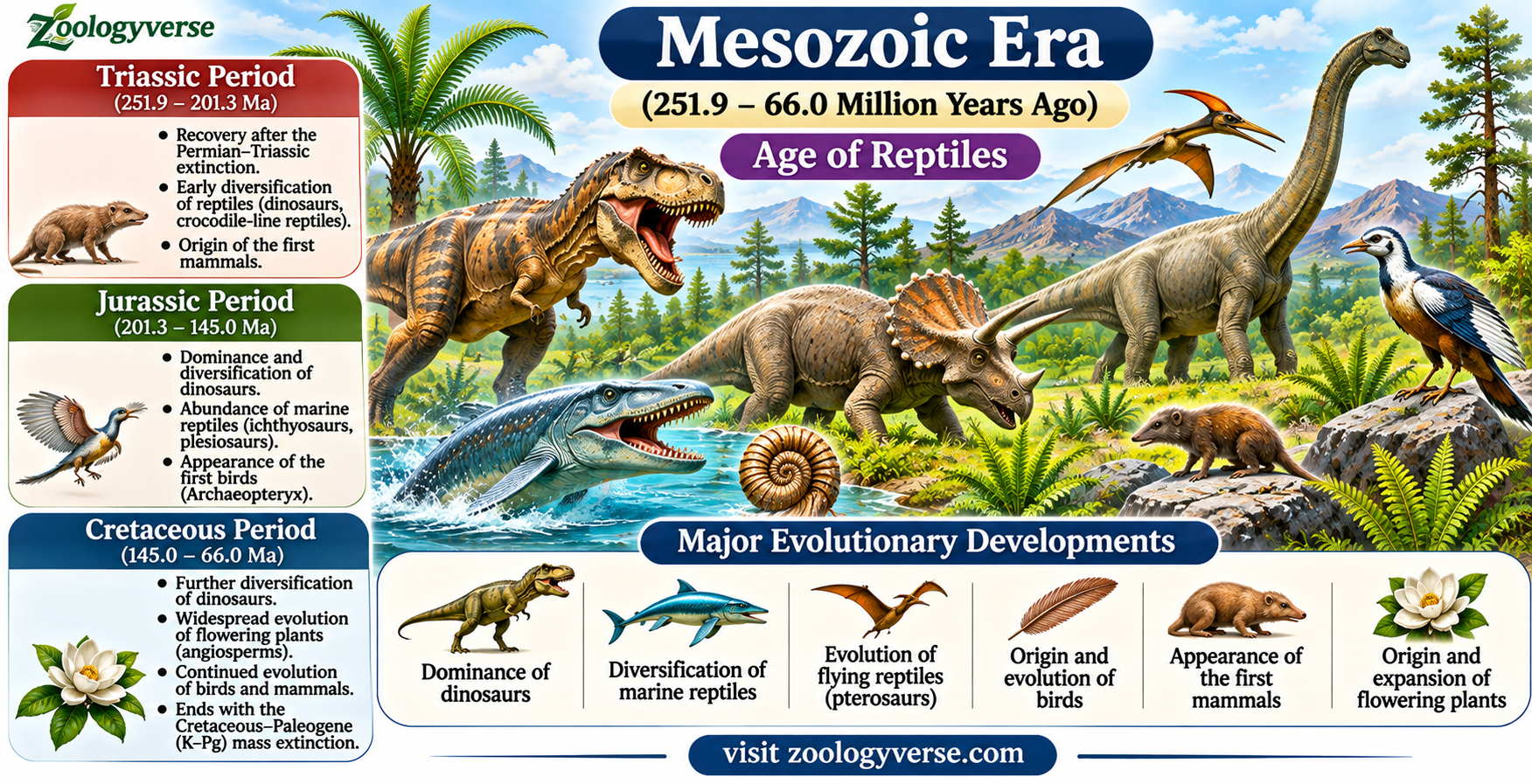
The Mesozoic Era is divided into three geological periods:
- Triassic Period – approximately 251.9–201.4 million years ago.
- Jurassic Period – approximately 201.4–145 million years ago.
- Cretaceous Period – approximately 145–66 million years ago.
These successive periods witnessed major changes in the evolution and diversification of reptiles, mammals, birds and plants.
7.3 Triassic Period (Approximately 251.9–201.4 Million Years Ago)
The Triassic Period represents the earliest period of the Mesozoic Era. It began immediately after the Permian–Triassic mass extinction, during which a very large proportion of marine and terrestrial biodiversity disappeared.
Following this extinction, surviving organisms gradually diversified and established new ecological communities. Several important vertebrate lineages appeared during this period.
Major Geological Characteristics
- Most continental landmasses remained united as the supercontinent Pangaea.
- Extensive dry and arid climatic conditions occurred in many regions.
- Geological processes gradually initiated the breakup of Pangaea.
- New marine and terrestrial environments developed.
Major Biological Developments
- Appearance and early diversification of dinosaurs.
- Evolution of the first mammals from mammaliaform ancestors.
- Diversification of marine reptiles, including ichthyosaurs and early plesiosaurs.
- Development and diversification of several groups of terrestrial reptiles.
- Widespread occurrence of conifers and other gymnosperms.
- Recovery and development of marine ecosystems following the Permian–Triassic extinction.
The first dinosaurs appeared during the Triassic Period, although they did not become the dominant terrestrial vertebrates until the Jurassic Period.
The earliest mammals also evolved during this interval from mammaliaform ancestors. These early mammals were generally small and occupied ecological niches alongside other terrestrial vertebrates.
The Triassic Period ended with the Triassic–Jurassic extinction event, approximately 201.4 million years ago. This event eliminated several groups of organisms and contributed to major ecological changes during the beginning of the Jurassic Period.
7.4 Jurassic Period (Approximately 201.4–145 Million Years Ago)
The Jurassic Period is widely recognized as the interval during which dinosaurs became the dominant large terrestrial vertebrates. It witnessed extensive diversification of dinosaurs and the development of several important vertebrate and plant lineages.
During this period, Pangaea continued to break apart, producing new continental arrangements and marine environments.
Major Geological Characteristics
- Continued breakup of Pangaea into the northern landmass Laurasia and the southern landmass Gondwana.
- Development and expansion of new ocean basins.
- Widespread marine sedimentation.
- Generally warm climatic conditions during much of the period.
- Changes in sea levels and continental environments.
Major Biological Developments
- Extensive diversification of dinosaurs.
- Evolution of large sauropods and theropods.
- Appearance of the earliest widely recognized birds.
- Diversification of marine reptiles.
- Abundance and diversification of ammonites.
- Diversification of gymnosperms, particularly conifers and cycads.
- Continued evolution and diversification of early mammals.
One of the most important evolutionary developments of the Jurassic Period was the appearance of Archaeopteryx, a fossil organism possessing both avian and non-avian theropod characteristics.
Its fossil remains provide important evidence for the evolutionary origin of birds from theropod dinosaurs. Features such as feathers and wings occur alongside skeletal characteristics associated with theropod dinosaurs.
The Jurassic Period therefore represents a significant stage in vertebrate evolution and the diversification of terrestrial ecosystems.
7.5 Cretaceous Period (Approximately 145–66 Million Years Ago)
The Cretaceous Period was the final period of the Mesozoic Era. It witnessed major changes in terrestrial vegetation, marine ecosystems and vertebrate diversity.
One of its most significant biological developments was the appearance and extensive diversification of flowering plants, also known as angiosperms. These plants gradually became important components of terrestrial ecosystems.
Major Geological Characteristics
- Continued separation of continental landmasses.
- Widespread development of shallow marine environments.
- High sea levels during several intervals.
- Formation of extensive chalk deposits in some marine basins.
- Significant climatic and environmental changes.
Major Biological Developments
- Appearance, diversification and ecological expansion of flowering plants.
- Diversification of insects, including groups associated with flowering plants.
- Continued diversification of dinosaurs.
- Evolution and diversification of several bird lineages.
- Diversification of mammals.
- Abundance of marine reptiles and ammonites.
- Development of increasingly complex terrestrial ecosystems.
Flowering plants underwent major diversification during the Cretaceous Period. Their reproductive structures and interactions with pollinating animals contributed to the development of complex ecological relationships in terrestrial environments.
Mammals also diversified into different ecological groups, although many remained relatively small compared with the large dinosaurs occupying terrestrial ecosystems.
The Cretaceous Period ended approximately 66 million years ago with the Cretaceous–Paleogene mass extinction event, which caused the extinction of non-avian dinosaurs and numerous other organisms.
7.6 Evolutionary Developments During the Mesozoic Era
The Mesozoic Era witnessed several important evolutionary developments that influenced the subsequent history of life.
1. Diversification of Dinosaurs
Dinosaurs diversified into numerous ecological forms, including herbivorous and carnivorous, bipedal and quadrupedal groups. They occupied a wide range of terrestrial habitats and became the dominant large terrestrial vertebrates during much of the Mesozoic.
2. Evolution of Mammals
The earliest mammals evolved from mammaliaform ancestors during the Triassic Period. Mammals gradually diversified into different ecological groups during the Mesozoic, although their major adaptive radiation occurred after the end-Mesozoic mass extinction.
3. Origin of Birds
Birds evolved from theropod dinosaurs. Fossil evidence, including Archaeopteryx, demonstrates important evolutionary similarities between birds and non-avian theropods. Modern birds represent the surviving lineage of avian dinosaurs.
4. Diversification of Marine Reptiles
Marine reptiles occupied important ecological positions in Mesozoic marine environments. Important groups included:
- Ichthyosaurs: Marine reptiles with streamlined bodies adapted for swimming.
- Plesiosaurs: Marine reptiles with paddle-like limbs; different forms had long or short necks.
- Mosasaurs: Large marine reptiles that became prominent predators, particularly during the Cretaceous Period.
These groups were not dinosaurs, although they lived during the same geological era.
5. Evolution of Flowering Plants
Angiosperms appeared in the fossil record during the Cretaceous Period and subsequently diversified. Their development transformed terrestrial vegetation and influenced the evolution of insects and other organisms.
6. Continental Fragmentation
The breakup of Pangaea produced new geographical barriers, coastlines and habitats. These changes influenced the geographical distribution, isolation and diversification of organisms.
7.7 End of the Mesozoic Era: Cretaceous–Paleogene Mass Extinction
The Mesozoic Era ended approximately 66 million years ago with the Cretaceous–Paleogene (K–Pg) mass extinction event. This event caused the disappearance of numerous marine and terrestrial organisms and marks one of the most important biological transitions in Earth’s history.
A major asteroid struck the region near the present-day Yucatán Peninsula in Mexico, producing the Chicxulub impact crater. The impact caused extensive environmental disturbances that affected ecosystems across the planet.
Important consequences included:
- Release of enormous quantities of dust, aerosols and other material into the atmosphere.
- Reduction in sunlight reaching Earth’s surface.
- Cooling and other major climatic disturbances.
- Disruption of photosynthesis and primary productivity.
- Collapse of several food chains.
- Widespread extinction of terrestrial and marine organisms.
The impact is considered the principal trigger of the K–Pg extinction. Environmental stress associated with large-scale volcanic activity, particularly the Deccan Traps eruptions in present-day India, may also have influenced climate and ecosystems around this interval.
Major Groups Affected
- Non-avian dinosaurs became extinct.
- Many ammonites disappeared.
- Several marine reptile groups became extinct.
- Numerous marine planktonic organisms experienced major losses.
- Several groups of terrestrial and marine organisms survived.
Birds, mammals, crocodilians, turtles and several other lineages survived the extinction. Birds are avian dinosaurs and represent the surviving dinosaur lineage.
The extinction created ecological opportunities that contributed to the subsequent diversification of surviving groups, particularly mammals and birds, during the Cenozoic Era.
7.8 Significance of the Mesozoic Era in Evolution
The Mesozoic Era occupies an important position in the Geological Time Scale because several major evolutionary lineages originated or underwent significant diversification during this interval.
Its major evolutionary contributions include:
- Evolution and diversification of dinosaurs.
- Origin and early diversification of mammals.
- Evolution of birds from theropod dinosaurs.
- Diversification of marine reptiles.
- Appearance and expansion of flowering plants.
- Development of diverse terrestrial and marine ecosystems.
- Continued fragmentation of continental landmasses and the development of new habitats.
- Establishment of evolutionary lineages that contributed to present-day biodiversity.
The Mesozoic Era represents a major phase in the evolutionary history of vertebrates and plants, connecting the biological diversification of the Paleozoic Era with the development of modern ecosystems during the Cenozoic Era.ary history of vertebrates and plants, bridging the biological diversification of the Paleozoic Era with the modern ecosystems of the Cenozoic Era.
8. Cenozoic Era
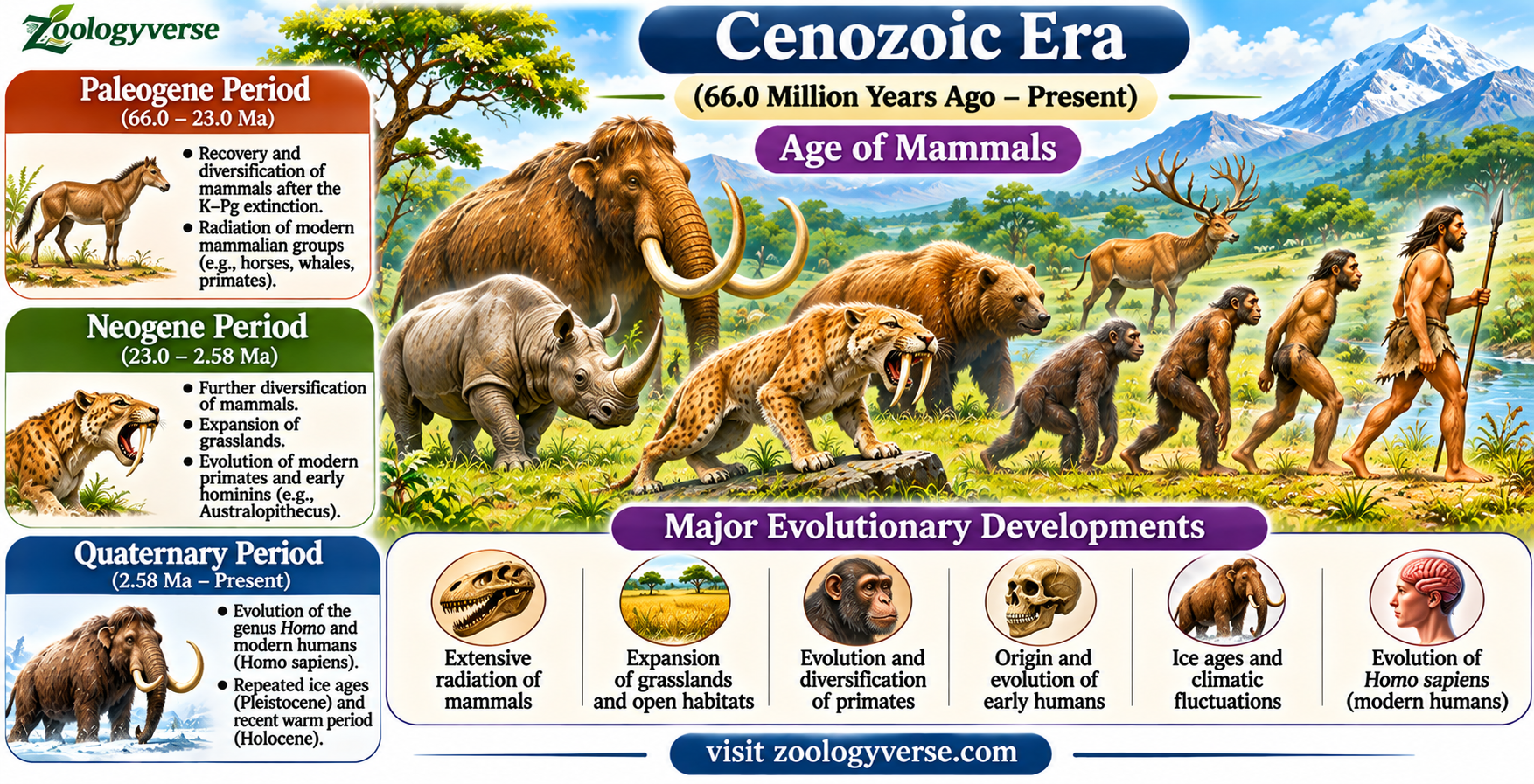
The Cenozoic Era is the most recent era of the Phanerozoic Eon, extending from approximately 66 million years ago to the present day. It began following the Cretaceous–Paleogene (K–Pg) mass extinction, which eliminated non-avian dinosaurs and several other major groups of organisms.
The extinction created new ecological opportunities for surviving organisms, particularly mammals and birds, to diversify and occupy different ecological niches.
The term Cenozoic is derived from the Greek words kainos, meaning new or recent, and zoe, meaning life. The Cenozoic is commonly known as the Age of Mammals because mammals underwent extensive adaptive radiation and occupied numerous ecological niches during this era.
In the Geological Time Scale, the Cenozoic represents an important interval in the development of modern biodiversity. It witnessed the evolution and diversification of modern mammalian groups, expansion of flowering plants and grasslands, development of modern ecosystems and the evolution of humans.
8.1 Major Characteristics of the Cenozoic Era
The Cenozoic Era is characterized by significant geological, climatic and biological developments.
Its major characteristics include:
- Extensive diversification of mammals following the end-Cretaceous extinction.
- Evolution and diversification of modern bird groups.
- Development and expansion of grassland ecosystems.
- Diversification of flowering plants.
- Evolution and diversification of primates and hominins.
- Development of modern terrestrial and marine ecosystems.
- Formation and uplift of major mountain ranges.
- Repeated glacial and interglacial periods.
- Evolution and geographical expansion of modern humans.
- Increasing influence of human activities on natural ecosystems.
These developments make the Cenozoic an essential interval for understanding the evolutionary history of present-day organisms.
8.2 Major Periods of the Cenozoic Era
The Cenozoic Era is divided into three major geological periods:
- Paleogene Period – approximately 66–23.03 million years ago.
- Neogene Period – approximately 23.03–2.58 million years ago.
- Quaternary Period – approximately 2.58 million years ago to the present.
Each period represents a distinct stage in the development of modern ecosystems and biodiversity.
8.3 Paleogene Period (Approximately 66–23.03 Million Years Ago)
The Paleogene Period represents the earliest period of the Cenozoic Era. It began immediately after the Cretaceous–Paleogene extinction event.
During this interval, mammals and birds underwent extensive diversification. Several modern mammalian lineages originated or became increasingly diverse, occupying ecological niches that had previously been occupied by non-avian dinosaurs and other organisms.
Major Geological Characteristics
- Continued movement and separation of continental landmasses.
- Development and uplift of major mountain-building systems.
- Generally warm climatic conditions during the early Paleogene.
- Significant long-term global cooling toward the end of the period.
- Development of new marine and terrestrial environments.
Major Biological Developments
- Adaptive radiation of mammals.
- Diversification of early primates.
- Evolution of early whales from terrestrial mammalian ancestors.
- Diversification of modern bird lineages.
- Expansion and diversification of flowering plants.
- Development of early grass-dominated habitats.
The evolution of whales represents an important example of evolutionary adaptation during the Cenozoic. Early whale ancestors gradually adapted to aquatic environments through changes in their limbs, body shape, sensory systems and respiratory adaptations.
The Paleogene Period is divided into three epochs:
- Paleocene Epoch.
- Eocene Epoch.
- Oligocene Epoch.
8.4 Neogene Period (Approximately 23.03–2.58 Million Years Ago)
The Neogene Period witnessed further diversification of mammals, expansion of grassland ecosystems and important evolutionary developments among primates.
During this period, global climates generally became cooler and drier, although climatic conditions varied considerably across different geographical regions.
Major Geological Characteristics
- Continued uplift of major mountain ranges.
- Expansion of grasslands and relatively open habitats.
- Development of modern ocean circulation patterns.
- Progressive long-term climatic cooling.
- Increasing development of seasonal environmental conditions.
Major Biological Developments
- Diversification of grazing mammals, including horses and bovids.
- Expansion of grassland ecosystems.
- Evolution and diversification of apes.
- Appearance and diversification of early hominins.
- Development of modern mammalian communities.
- Diversification of terrestrial birds.
The development and expansion of grasslands influenced the evolution of herbivorous mammals. Several groups evolved specialized teeth, digestive adaptations and locomotory modifications that facilitated feeding and movement in open habitats.
The Neogene Period is divided into two epochs:
- Miocene Epoch.
- Pliocene Epoch.
The Miocene was particularly important for the diversification of apes, while the Pliocene witnessed important developments in hominin evolution.
8.5 Quaternary Period (Approximately 2.58 Million Years Ago to Present)
The Quaternary Period is the most recent period of the Cenozoic Era. It is characterized by repeated climatic fluctuations, extensive glaciation in high-latitude regions and the evolution and geographical expansion of modern humans.
The Quaternary is divided into two epochs:
- Pleistocene Epoch – approximately 2.58 million to 11,700 years ago.
- Holocene Epoch – approximately 11,700 years ago to the present.
A. Pleistocene Epoch (Approximately 2.58 Million–11,700 Years Ago)
The Pleistocene Epoch is commonly associated with the Ice Age because it witnessed repeated glacial and interglacial cycles.
During glacial periods, large ice sheets expanded over extensive areas of North America, Europe and Asia. Interglacial periods were comparatively warmer and witnessed the retreat of glaciers.
Major biological developments included:
- Evolution and diversification of the genus Homo.
- Appearance and geographical expansion of Homo sapiens.
- Existence of large mammals known as megafauna.
- Development of complex human behavioural adaptations.
- Evolution and diversification of different human populations.
Examples of Pleistocene megafauna include mammoths, woolly rhinoceroses, giant ground sloths and saber-toothed cats.
B. Holocene Epoch (Approximately 11,700 Years Ago to Present)
The Holocene Epoch began following the end of the last major glacial period. It represents the interval during which modern human civilizations developed and expanded.
Major characteristics include:
- Relatively stable climatic conditions compared with the preceding glacial period.
- Development of agriculture and animal domestication.
- Expansion of human settlements.
- Development of cities and complex civilizations.
- Major modifications of natural ecosystems through human activities.
- Development of modern biodiversity conservation practices.
The Holocene continues today and represents the present epoch in the Geological Time Scale.
8.6 Major Evolutionary Developments During the Cenozoic Era
The Cenozoic Era witnessed several important evolutionary developments that contributed to the formation of modern biological diversity.
1. Adaptive Radiation of Mammals
Following the end-Cretaceous extinction, mammals diversified into numerous ecological groups. They evolved different body sizes, feeding habits and locomotory adaptations, allowing them to occupy terrestrial, aquatic and aerial environments.
Examples include the diversification of hoofed mammals, carnivores, bats, rodents, whales and primates.
2. Evolution of Modern Birds
Birds diversified extensively and developed different feeding strategies, flight adaptations and ecological relationships. Many modern bird lineages became established during the Cenozoic.
3. Evolution of Primates
Primates underwent significant diversification during the Paleogene and Neogene periods. Important evolutionary adaptations in different primate lineages included grasping hands and feet, forward-facing eyes and changes in brain development.
4. Evolution of Hominins
The Neogene and Quaternary periods witnessed the evolution of several hominin groups. Important developments included habitual bipedalism, changes in brain size, tool use and increasingly complex social behaviour.
5. Evolution of Modern Humans
Homo sapiens evolved in Africa approximately 300,000 years ago. Subsequently, modern humans expanded into different geographical regions and developed diverse cultural and technological adaptations.
6. Development of Grassland Ecosystems
Grasslands expanded considerably during parts of the Neogene. These environments influenced the evolution of grazing mammals, predators and other organisms adapted to open habitats.
8.7 Significance of the Cenozoic Era in Evolution
The Cenozoic Era occupies a particularly important position in evolutionary biology because it records the development of many modern organisms and ecosystems.
Its major contributions include:
- Extensive diversification of mammals and birds.
- Evolution and diversification of modern primates and humans.
- Development and expansion of grassland ecosystems.
- Diversification of flowering plants.
- Evolution of modern terrestrial and aquatic communities.
- Development of complex ecological relationships.
- Increasing influence of human activities on global biodiversity.
The Cenozoic Era represents the most recent major phase of biological evolution and provides an important framework for understanding the origin and development of modern biodiversity.
9. Fossil Record and Its Significance
The fossil record is one of the most important sources of evidence for understanding the history and evolution of life on Earth. It consists of preserved remains, impressions, traces and other evidence of organisms that existed during different geological periods.
Fossils are primarily preserved in sedimentary rocks and provide valuable information about the morphology, anatomy, behaviour, geographical distribution and evolutionary relationships of extinct organisms. By studying fossils from different geological layers, scientists can reconstruct the sequence of biological changes that occurred throughout Earth’s history.
The fossil record is closely associated with the Geological Time Scale because it provides evidence for identifying and correlating different geological intervals. Fossils also help scientists understand the appearance, diversification and extinction of organisms over millions of years.
9.1 Definition of Fossils
Fossils are the preserved remains, impressions or traces of ancient organisms that lived during earlier geological periods.
They may include bones, teeth, shells, leaves, wood, footprints, burrows, eggs and other biological structures preserved through natural geological processes.
Fossils provide direct or indirect evidence of ancient life and help establish evolutionary relationships between extinct and living organisms.
The scientific study of fossils is known as Palaeontology.
Palaeontology combines knowledge from biology, geology, ecology and evolutionary science to investigate ancient organisms, understand their evolutionary relationships and reconstruct past environments.
9.2 Concept of the Fossil Record
The fossil record refers to the total collection of fossil evidence preserved in Earth’s geological formations.
It represents an incomplete but valuable account of the biological history of our planet. Different geological layers contain fossils belonging to different intervals of Earth’s history, allowing scientists to reconstruct the chronological sequence of evolutionary developments.
The fossil record is particularly important in interpreting the Geological Time Scale because it provides evidence of major biological transitions and changes in biodiversity.
For example:
- Cambrian rocks contain abundant fossils of early marine animals, including trilobites.
- Devonian deposits preserve diverse remains of fishes and early tetrapods.
- Mesozoic rocks contain fossils of dinosaurs, marine reptiles and early birds.
- Cenozoic deposits contain abundant fossils of mammals and other modern animal groups.
The distribution of fossils across geological strata helps scientists understand how biodiversity changed through geological time.
However, the fossil record is not a complete representation of all organisms that have ever lived. Fossilization requires particular environmental conditions, and many organisms disappear without leaving recognizable fossil remains. Consequently, some organisms and evolutionary intervals are much better represented than others.
9.3 Process of Fossil Formation
Fossil formation is a natural process known as fossilization. It involves the preservation of biological remains or traces through different physical, chemical and geological processes.
The formation of fossils generally requires favourable environmental conditions because most organic remains undergo decomposition after the death of an organism.
The major stages involved in fossil formation are described below.
1. Death of an Organism
Fossilization begins when an organism dies. Its body or parts may become preserved if they are rapidly buried or protected from scavengers, decomposition and environmental destruction.
2. Burial by Sediments
The remains of the organism may become covered by sediments such as mud, sand, silt or volcanic ash.
Rapid burial reduces exposure to oxygen, scavengers and decomposing microorganisms, increasing the possibility of preservation.
3. Decomposition of Soft Tissues
After burial, soft tissues generally undergo decomposition through microbial activity and chemical processes.
Hard structures such as bones, teeth and shells are more likely to survive than soft tissues, although exceptional conditions can preserve soft-bodied organisms.
4. Mineralization
Mineral-rich groundwater may enter the remains and deposit minerals within their pores or replace their original components.
This process can transform biological structures into mineralized fossils. Depending on the conditions, mineralization may involve processes such as permineralization and replacement.
5. Compaction and Lithification
Over geological time, accumulated sediments undergo compaction and lithification, eventually forming sedimentary rocks.
The preserved remains become incorporated into these rock formations. Further chemical and physical changes may occur during burial.
6. Exposure and Discovery
Later geological processes, including erosion and weathering, may expose fossil-bearing rock layers at Earth’s surface.
Palaeontologists collect, document and study these fossils to reconstruct the history of ancient organisms and their environments.
9.4 Relationship Between Fossil Record and Geological Time Scale
The fossil record provides one of the major biological foundations for understanding the Geological Time Scale.
Different geological intervals contain characteristic fossil assemblages that help scientists identify and correlate rock formations.
The principle of faunal succession states that fossil organisms occur in a recognizable chronological sequence within geological strata. Fossil assemblages change through geological time because organisms appear, diversify and become extinct.
This principle allows scientists to establish the relative ages of sedimentary rock layers and reconstruct the evolutionary history of organisms.
For example:
- Trilobites are characteristic fossils of the Paleozoic Era.
- Ammonites are particularly important for identifying and correlating many Mesozoic marine deposits.
- Many mammalian fossils are characteristic of Cenozoic deposits.
The fossil record also provides evidence of major evolutionary transitions, including the diversification of early animals, the evolution of vertebrates and the development of terrestrial ecosystems.
Fossils are especially useful in biostratigraphy, the branch of stratigraphy that uses fossils to establish the relative ages and correlations of rock layers. Certain fossils, known as index fossils, are particularly useful because they have a relatively short geological range, broad geographical distribution and recognizable characteristics.
9.5 Significance of the Fossil Record
The fossil record has considerable importance in evolutionary biology, palaeontology and geology.
1. Evidence of Organic Evolution
Fossils provide direct evidence that organisms have changed throughout geological history. Differences between ancient and modern organisms demonstrate evolutionary modifications in body structure, organization and adaptation.
2. Reconstruction of Evolutionary History
The fossil record helps scientists reconstruct the evolutionary relationships and chronological development of different organism groups.
It provides evidence of ancestral forms, transitional organisms and the diversification of major evolutionary lineages.
3. Identification of Extinct Organisms
Fossils provide information about organisms that no longer exist. Examples include non-avian dinosaurs, trilobites, ammonites and woolly mammoths.
4. Evidence of Transitional Forms
Some fossils exhibit combinations of characteristics associated with different evolutionary groups. Such fossils help scientists understand major evolutionary transitions.
Examples include:
- Archaeopteryx, which exhibits both avian and non-avian theropod characteristics.
- Tiktaalik, which possesses features associated with both lobe-finned fishes and early tetrapods.
- Ambulocetus, an early whale relative showing adaptations associated with both aquatic and terrestrial movement.
Fossils represent one important line of evidence for evolution. Other evidence, including comparative anatomy, embryology and molecular biology, is discussed in our article on evidences of evolution.
5. Understanding Past Environments
Fossils provide information about ancient habitats, climates and ecological conditions.
For example, fossilized marine organisms found in present-day mountainous regions may indicate that these areas were once covered by ancient seas.
6. Determination of Geological Age
Index fossils help determine the relative ages of sedimentary rock formations. They are especially useful in correlating geological strata from different geographical regions.
7. Study of Mass Extinction Events
Changes in fossil abundance and diversity provide evidence of major extinction events. The disappearance of particular fossil groups from successive geological layers helps scientists identify important biological crises.
8. Understanding Biogeographical Distribution
The geographical distribution of fossils helps reconstruct the historical distribution of organisms and ancient continental arrangements.
For example, related fossil organisms found on continents that are now widely separated may provide evidence of past geographical connections and continental movements.
9. Understanding Adaptive Radiation
Fossil evidence helps scientists investigate how surviving organisms diversified into different ecological niches following major environmental changes and extinction events.
9.6 Limitations of the Fossil Record
Although the fossil record is extremely valuable, it does not provide a complete representation of all organisms that have ever existed.
Its major limitations include:
1. Incomplete Preservation: Most organisms do not become fossilized because their remains decompose before preservation. Fossilization is a relatively uncommon process.
2. Bias Towards Hard Parts: Bones, teeth and shells are more likely to fossilize than soft tissues. As a result, organisms with hard skeletal structures are generally better represented.
3. Environmental Limitations: Fossilization is more common in environments where rapid burial occurs, particularly sedimentary environments. Organisms living in environments with little sediment accumulation may have a lower chance of preservation.
4. Destruction of Fossils: Geological processes such as erosion, metamorphism and tectonic activity may destroy previously preserved fossils or make them difficult to discover.
5. Unequal Geological Sampling: Some geological intervals and geographical regions are better represented by fossils than others. This creates gaps in our knowledge of particular organisms and evolutionary events.
6. Difficulty in Interpretation: Incomplete or fragmented fossils may make it difficult to determine the exact morphology, lifestyle and evolutionary relationships of organisms.
7. Temporal Gaps: Many species have not been discovered in successive geological layers. These gaps may reflect incomplete preservation and sampling rather than an actual absence of organisms.
Therefore, the fossil record must be interpreted alongside geological, anatomical, molecular and other biological evidence.
Despite these limitations, fossils remain among the most important sources of evidence for understanding the origin, diversification and extinction of life throughout Earth’s history.
10. Types of Fossils
Fossils occur in different forms depending on the nature of the organism, environmental conditions and processes involved in their preservation. They may represent the actual remains of organisms, mineralized structures, impressions, moulds, casts or traces of biological activities.
The study of different fossil types is important in palaeontology because each type provides specific information about the structure, behaviour, ecology and evolutionary history of ancient organisms.
In relation to the Geological Time Scale, different fossil types help scientists identify ancient biological communities, correlate geological strata and reconstruct the history of life during successive geological intervals.
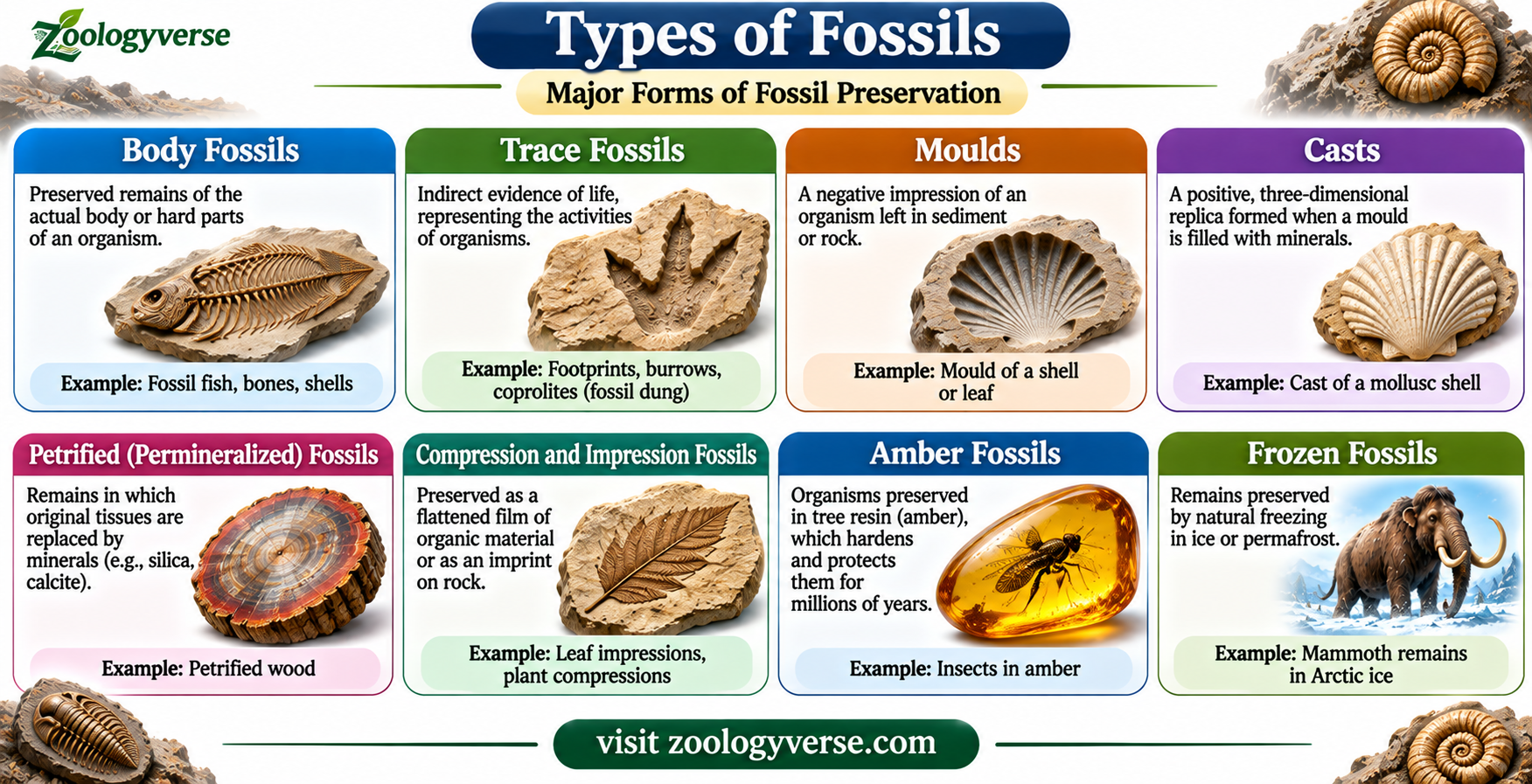
10.1 Body Fossils
Body fossils are the preserved physical remains of organisms or their body parts. They provide direct evidence of the morphology and anatomical organization of ancient organisms.
Body fossils commonly include bones, teeth, shells, leaves, wood and other biological structures.
Examples:
- Dinosaur bones and teeth.
- Fossilized shells of ammonites.
- Trilobite exoskeletons.
- Fossil leaves and plant stems.
- Mammalian teeth and skeletal remains.
Body fossils are particularly useful for studying the anatomical characteristics, structural organization and evolutionary modifications of extinct organisms.
10.2 Trace Fossils
Trace fossils, also known as ichnofossils, are preserved records of the activities of organisms rather than their actual body remains.
They provide information about the behaviour, locomotion, feeding habits and ecological interactions of ancient organisms.
Examples include:
- Footprints and trackways.
- Burrows and tunnels.
- Feeding marks.
- Nesting structures.
- Coprolites or fossilized faeces.
- Borings made by marine organisms.
Trace fossils are particularly valuable because they provide evidence of biological activities that may not be represented by body fossils.
For example, dinosaur footprints provide information about locomotion, movement patterns and possible social behaviour. Similarly, burrows may provide evidence of the activities and environmental preferences of ancient invertebrates.
10.3 Petrified Fossils
Petrified fossils are formed when biological remains undergo mineralization through processes such as mineral replacement and permineralization.
Mineral-rich groundwater enters the remains and deposits minerals within their pores or replaces their original components. Over time, these processes may preserve the external shape and internal structural details of the organism.
Two important processes associated with petrification are:
- Permineralization: Minerals are deposited within the pores and spaces of biological structures, preserving their internal details.
- Replacement: Original biological material is gradually replaced by minerals while the general structure is retained.
Examples:
- Petrified wood.
- Mineralized dinosaur bones.
- Fossilized plant stems.
Petrified fossils are important because they may preserve fine structural details of ancient organisms, including microscopic features of plant tissues and skeletal structures.
10.4 Moulds and Casts
Moulds and casts are fossils formed through the preservation of impressions left by organisms.
A. Mould Fossils
A mould is a hollow impression formed when an organism becomes buried in sediment and subsequently dissolves or decays, leaving behind an impression of its external or internal structure.
Moulds may be classified into two main types:
- External mould: Preserves the impression of the outer surface of an organism.
- Internal mould: Forms when sediment or minerals fill the internal cavity of a shell or other structure and preserve its internal shape.
B. Cast Fossils
A cast forms when a mould becomes filled with minerals or sediments that later harden.
The resulting structure represents a three-dimensional replica of the original organism or its body part.
Examples:
- Casts of marine shells.
- Casts of ammonites.
- Casts of gastropod shells.
Moulds and casts are particularly useful for understanding the external or internal morphology of organisms whose original organic material has disappeared.
10.5 Impression Fossils
Impression fossils are formed when the external surface of an organism leaves an imprint in soft sediment that later hardens into sedimentary rock.
They generally preserve surface features rather than the original organic material.
Examples:
- Leaf impressions.
- Impressions of feathers.
- Surface patterns of shells.
- Impressions of delicate plant structures.
Impression fossils are especially important in studying ancient vegetation and the external morphology of organisms. They can also provide information about the distribution of plants and the environments in which they lived.
10.6 Compression Fossils
Compression fossils are formed when an organism is buried under sediments and subjected to pressure during geological processes.
The organic remains become flattened, producing a compressed fossil that may preserve an outline or a thin carbon-rich film.
Compression fossils are particularly common among plants and some soft-bodied organisms.
Examples:
- Fossilized leaves.
- Fern impressions with carbon films.
- Ancient plant stems.
- Some soft-bodied marine organisms.
They provide important evidence about the morphology, distribution and diversity of ancient plants.
10.7 Amber Fossils
Amber fossils are formed when organisms become trapped in sticky tree resin, which subsequently hardens and undergoes chemical changes over geological time.
Amber may preserve small organisms with remarkable morphological details.
Examples:
- Insects.
- Spiders.
- Mites.
- Small plant fragments.
- Pollen grains.
Amber fossils are particularly valuable because they may preserve delicate structures, including legs, wings, antennae and other external features that are rarely preserved in ordinary sedimentary deposits.
They also provide information about ancient terrestrial ecosystems and interactions between organisms.
10.8 Frozen Fossils
Frozen fossils are preserved when organisms become trapped in extremely cold environments, where low temperatures slow down decomposition.
Under suitable conditions, even soft tissues, skin, hair and other delicate structures may remain preserved.
Examples:
- Woolly mammoth remains preserved in permafrost.
- Frozen remains of ancient mammals.
- Preserved plant material from frozen environments.
Frozen remains provide valuable information about the anatomy, diet and environmental adaptations of ancient organisms.
Unlike many fossils preserved through mineralization, frozen remains may retain substantial amounts of their original biological material.
10.9 Chemical Fossils
Chemical fossils, also known as molecular fossils or biomarkers, are organic chemical compounds preserved in ancient rocks and sediments.
These compounds may originate from biological molecules produced by ancient organisms or represent their chemically altered remains.
They provide indirect evidence of ancient biological activity, even when recognizable body fossils are absent.
Examples include:
- Steranes: Compounds derived from sterols, which are associated with biological membranes.
- Hopanes: Compounds derived from bacterial membrane lipids and useful in investigating ancient microbial activity.
- Other preserved organic biomarkers: Molecular compounds that can provide information about ancient organisms and their environments.
Carbon isotope patterns may also provide evidence of ancient biological processes, although these are geochemical signatures rather than chemical fossils in the strict sense.
Chemical fossils are particularly important for investigating early life forms, ancient microbial ecosystems and biological activity in rocks that contain few recognizable body fossils.
10.10 Microfossils
Microfossils are fossils that are generally too small to be studied effectively without magnification. They may represent entire microscopic organisms or small parts of larger organisms.
They are commonly studied using light or electron microscopy.
Examples:
- Foraminifera.
- Diatoms.
- Radiolarians.
- Coccolithophores.
- Pollen grains.
- Fossilized microbial structures.
Microfossils are particularly useful in biostratigraphy because certain species have widespread geographical distributions and relatively restricted geological ranges.
They also provide valuable information about ancient marine environments, climatic conditions, ocean productivity and evolutionary changes.
10.11 Classification of Fossils Based on Preservation
The different types of fossils can also be summarized according to their mode of preservation.
| Type of fossil | Mode of preservation | Example |
|---|---|---|
| Body fossil | Preserved body parts | Dinosaur bones |
| Trace fossil | Preserved biological activity | Footprints |
| Petrified fossil | Mineral replacement or impregnation | Petrified wood |
| Mould fossil | Impression left after removal of original material | Shell mould |
| Cast fossil | Hardened filling of a mould | Ammonite cast |
| Impression fossil | Surface imprint in sediment | Leaf impression |
| Compression fossil | Flattened organic remains | Fossil fern |
| Amber fossil | Organism preserved in hardened resin | Insect in amber |
| Frozen fossil | Preservation by low temperature | Woolly mammoth |
| Chemical fossil | Preserved organic biomarkers | Steranes |
| Microfossil | Microscopic biological remains | Foraminifera |
These categories describe different aspects of fossil preservation. Some fossils may belong to more than one category depending on their formation and preserved characteristics.
10.12 Significance of Different Types of Fossils
Different fossil types provide complementary information about the biological history of Earth.
Their major significance includes:
- Anatomical Reconstruction: Body fossils provide information about the morphology and internal or external structures of ancient organisms.
- Behavioural Studies: Trace fossils help reconstruct locomotion, feeding, nesting and other biological activities.
- Environmental Reconstruction: Fossils of plants and marine organisms provide evidence about ancient habitats and climatic conditions.
- Evolutionary Studies: Fossils help identify structural changes and transitional forms in evolutionary lineages.
- Biostratigraphic Correlation: Certain fossils, particularly microfossils and index fossils, help identify and correlate geological strata.
- Study of Ancient Biodiversity: Fossils provide evidence of organisms that existed during different geological intervals.
- Investigation of Early Life: Chemical fossils and microbial structures help scientists investigate the earliest stages of biological evolution.
Thus, the study of different types of fossils is essential for reconstructing the history of life and understanding the biological changes represented in the Geological Time Scale.
11. Process of Fossil Formation
Fossil formation, also known as fossilization, is a natural geological process through which the remains or traces of ancient organisms become preserved in rocks, sediments or other materials.
Fossilization generally occurs when biological remains are protected from rapid decomposition and undergo physical, chemical and geological changes over time. Although most organisms decompose after death, certain environmental conditions allow their remains or traces to become preserved.
The study of fossil formation is important for understanding how evidence of ancient organisms becomes incorporated into geological deposits. It also helps palaeontologists interpret the fossil record and reconstruct the evolutionary history represented in the Geological Time Scale.
11.1 General Conditions Required for Fossil Formation
Fossilization is a relatively uncommon process because most organic remains are destroyed through decomposition, scavenging, weathering and other environmental processes.
Several conditions increase the possibility of fossil preservation.
1. Rapid Burial
Rapid burial by sediments such as mud, sand, volcanic ash or silt protects biological remains from scavengers, weathering and physical destruction.
2. Low Oxygen Availability
Reduced oxygen conditions slow down the activities of many decomposing microorganisms and may increase the possibility of preservation.
3. Presence of Hard Body Parts
Organisms containing bones, teeth, shells and other resistant structures have a greater chance of becoming preserved than organisms consisting entirely of soft tissues.
4. Suitable Chemical Conditions
Mineral-rich groundwater and appropriate chemical conditions facilitate mineralization and preservation of biological structures.
5. Stable Geological Conditions
Fossils are more likely to survive when the surrounding sediments remain relatively undisturbed and are not subjected to excessive erosion, heating or metamorphism.
11.2 Major Stages of Fossil Formation
Although fossilization can occur through different processes, the general sequence of fossil formation includes the following stages.
Stage 1: Death of an Organism
The process begins when an organism dies in an environment where preservation is possible.
The organism may die in a marine, freshwater or terrestrial habitat. Its remains may include the entire body, skeletal structures, shells or other biological materials.
Stage 2: Burial of Remains
The remains become covered by sediments such as mud, sand or silt.
Rapid burial is particularly important because it protects the remains from scavengers, weathering and excessive exposure to oxygen.
Stage 3: Decomposition and Loss of Soft Tissues
After burial, soft tissues generally undergo decomposition through microbial activity and chemical reactions.
Hard structures such as bones, teeth and shells are more resistant and may remain preserved. However, under exceptional conditions, soft tissues can also become preserved.
Stage 4: Mineralization
Mineral-rich groundwater may enter the remains and deposit minerals within their pores and cavities.
In some cases, original biological material is gradually replaced by minerals.
Common minerals involved in fossil preservation include silica, calcite, iron compounds and calcium phosphate.
Stage 5: Compaction and Lithification
As additional sediment accumulates, the underlying layers become compressed under increasing pressure.
Compaction reduces the space between sediment particles, while lithification converts loose sediments into solid sedimentary rocks through compaction and cementation.
The preserved remains become incorporated into these rock formations.
Stage 6: Geological Exposure
Over millions of years, geological processes such as uplift, erosion and weathering may expose fossil-bearing rocks at Earth’s surface.
Palaeontologists can then discover, excavate and study the fossils.
11.3 Major Processes of Fossilization
Fossils can form through several different mechanisms depending on the organism and environmental conditions.
1. Permineralization
Permineralization occurs when mineral-rich water enters the pores and internal spaces of biological remains and deposits minerals within them.
The original structure of the organism may remain largely intact, while its internal spaces become filled with minerals.
Examples include petrified wood and many fossilized bones.
2. Replacement
Replacement occurs when the original mineral or organic components of an organism are gradually dissolved and replaced by other minerals.
This process may preserve the external shape and fine structural details of the original biological material.
Examples include fossil shells and mineralized skeletal structures.
3. Recrystallization
Recrystallization involves changes in the crystal structure of the original mineral components of biological remains.
The chemical composition may remain relatively similar, but the original crystal arrangement changes into a more stable form.
This process is commonly observed in fossil shells containing calcium carbonate.
4. Carbonization
Carbonization is a process in which volatile components of organic matter are lost, leaving behind a thin carbon-rich residue.
It commonly occurs during the preservation of plants and certain soft-bodied organisms.
Examples include fossil leaves, fern impressions and carbon films.
5. Mould and Cast Formation
Moulds form when the original organism or its hard parts disappear after leaving an impression in sediment.
When this impression becomes filled with sediment or minerals that subsequently harden, a cast is formed.
This process commonly preserves the external or internal shape of shells and other organisms.
6. Preservation in Amber
Small organisms may become trapped in sticky tree resin.
The resin gradually hardens and may undergo chemical transformation into amber, preserving the trapped organism.
Insects and other small arthropods are commonly found in amber deposits.
7. Freezing
Organisms may become preserved in ice or permanently frozen ground.
Low temperatures slow down decomposition and may preserve soft tissues, skin, hair and other delicate structures.
Frozen remains of woolly mammoths provide important examples of this type of preservation.
8. Desiccation or Mummification
Desiccation occurs when organisms lose moisture rapidly under dry environmental conditions.
The reduction in water availability slows microbial decomposition and may preserve soft tissues.
Natural mummification has occurred in extremely dry environments and certain caves.
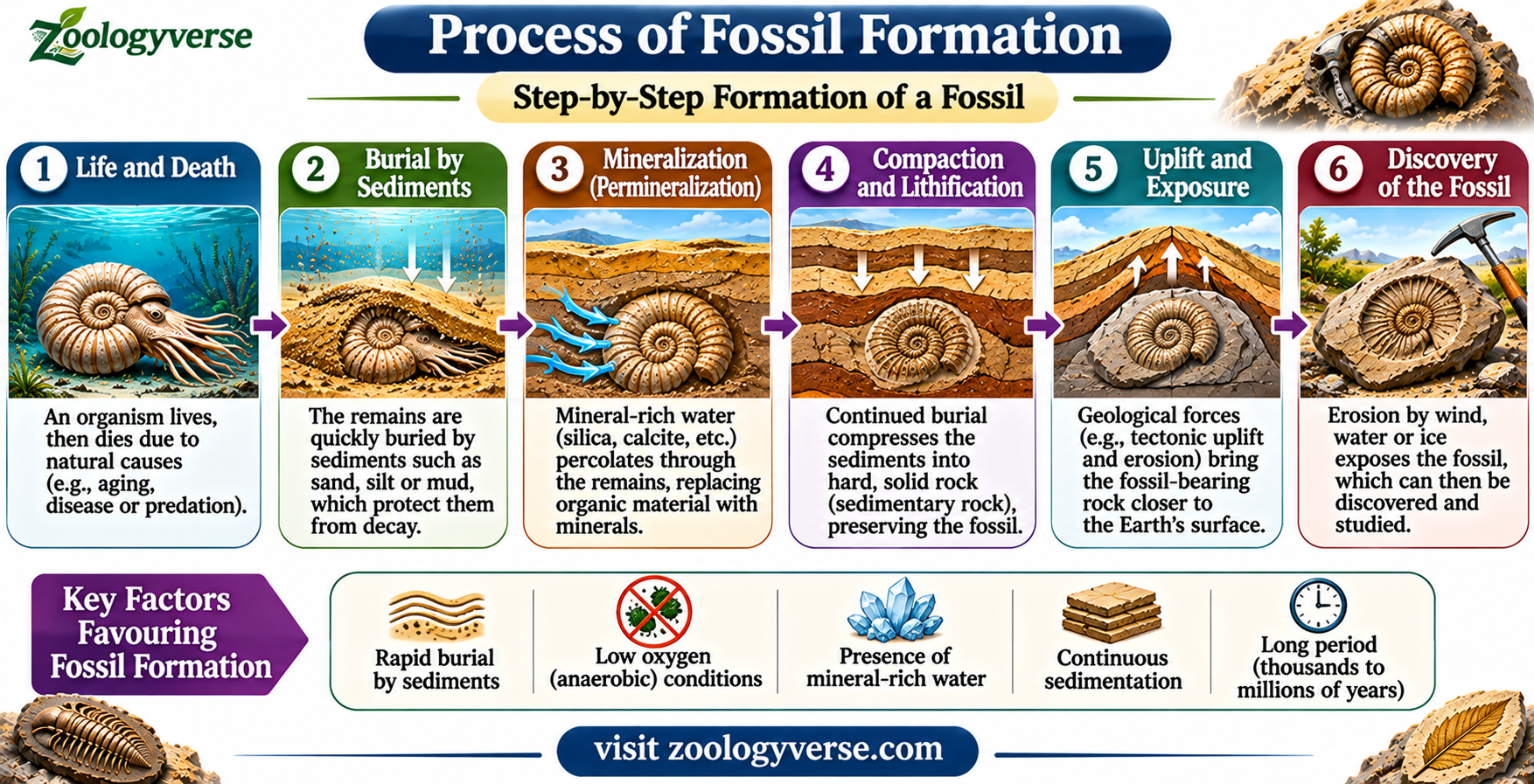
11.4 Different Environments of Fossil Formation
Fossilization occurs in several types of environments, depending on the conditions necessary for preservation.
A. Marine Environments
Marine environments are particularly favourable for fossil preservation because organisms may become rapidly buried by accumulating sediments.
Marine deposits commonly contain fossils of molluscs, brachiopods, corals, echinoderms and microscopic organisms.
B. Freshwater Environments
Lakes, rivers and wetlands may preserve remains of freshwater organisms and terrestrial organisms transported into aquatic environments.
Examples include fossil fishes, aquatic plants and remains of amphibians.
C. Terrestrial Environments
Terrestrial fossils may become preserved through burial in floodplain sediments, volcanic ash, caves and other sedimentary deposits.
Examples include dinosaur bones, fossilized wood, footprints and mammalian remains.
D. Frozen Environments
Extremely cold environments may preserve entire organisms or their soft tissues.
Permafrost deposits are particularly important for studying Pleistocene mammals, including woolly mammoths.
11.5 Importance of Fossil Formation in Evolutionary Studies
Understanding fossil formation is essential for correctly interpreting the fossil record and reconstructing evolutionary history.
Its importance includes:
- Explaining how biological remains become preserved over geological time.
- Understanding why certain organisms are more commonly represented in the fossil record.
- Identifying the environmental conditions associated with fossil preservation.
- Helping palaeontologists interpret anatomical structures and biological characteristics.
- Providing evidence for the chronological distribution of organisms.
- Supporting the identification and correlation of geological strata.
- Helping reconstruct ancient ecosystems and environmental conditions.
Fossilization is therefore an essential process through which biological evidence becomes preserved in geological formations. These preserved remains provide valuable information about the appearance, diversification and extinction of organisms throughout Earth’s history.
12. Major Mass Extinction Events
Mass extinction is a major biological event in which a substantial proportion of Earth’s species disappear within a relatively short interval of geological time. Such events cause widespread changes in biodiversity, ecological relationships and the evolutionary direction of surviving organisms.
Throughout Earth’s history, several extinction events have significantly altered the composition of biological communities. Among them, five major events are commonly recognized as the Big Five mass extinctions.
The study of these events is an important part of the Geological Time Scale because mass extinctions provide evidence of major biological crises and evolutionary transitions. They also help scientists understand how environmental disturbances influence biodiversity and the subsequent diversification of surviving groups.
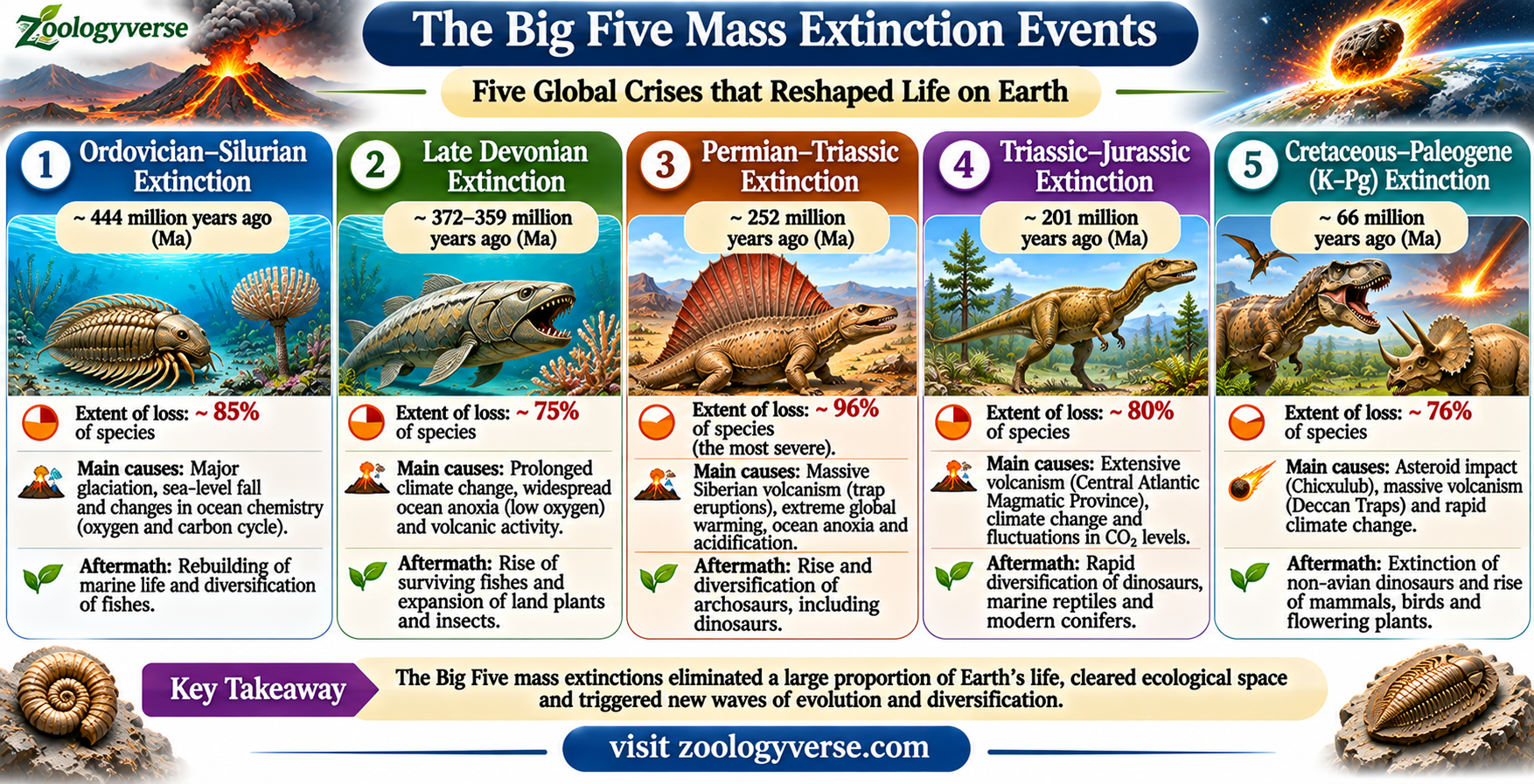
12.1 Concept of Mass Extinction
Mass extinction refers to an unusually rapid and widespread loss of biodiversity affecting numerous groups of organisms across different geographical regions.
In palaeontology, mass extinction is generally distinguished from background extinction, which represents the normal rate of species disappearance occurring throughout evolutionary history.
Mass extinction events are identified through major reductions in biodiversity preserved in successive geological deposits. They may affect:
- Marine invertebrates.
- Vertebrates.
- Terrestrial plants.
- Marine reptiles.
- Terrestrial reptiles.
- Microscopic organisms.
Although the causes of mass extinctions differ, major environmental disturbances frequently play an important role.
12.2 Causes of Mass Extinction
Mass extinction events may result from one or several interacting environmental and geological factors.
1. Asteroid and Meteorite Impacts
Large asteroid impacts can release enormous amounts of energy and eject dust, aerosols and other materials into the atmosphere.
These materials may reduce sunlight reaching Earth’s surface, disrupt photosynthesis and cause widespread ecological disturbances.
The Chicxulub impact is strongly associated with the Cretaceous–Paleogene extinction event.
2. Massive Volcanic Eruptions
Large-scale volcanic activity can release substantial quantities of carbon dioxide, sulphur dioxide and other gases into the atmosphere.
These emissions may cause global warming, atmospheric cooling, acid rain and ocean acidification, depending on the nature and duration of volcanic activity.
The Siberian Traps eruptions are strongly associated with the end-Permian extinction.
3. Rapid Climate Change
Rapid changes in global temperature can alter habitats, food availability, reproductive conditions and geographical distributions of organisms.
Both extreme warming and cooling may contribute to large-scale biodiversity losses.
4. Ocean Acidification
Increased atmospheric carbon dioxide can enter ocean water and form carbonic acid, reducing seawater pH.
Ocean acidification affects organisms that depend on calcium carbonate for constructing shells and skeletons, including corals and certain marine invertebrates.
5. Ocean Anoxia
Ocean anoxia refers to a condition in which dissolved oxygen becomes severely depleted or absent in aquatic environments.
It can cause widespread mortality among marine organisms and disrupt marine food webs.
6. Changes in Sea Level
Major fluctuations in sea level can destroy shallow marine habitats, alter coastal environments and affect the geographical distribution of marine organisms.
7. Changes in Continental Configuration
Continental movement and the formation or disappearance of ocean connections can influence ocean circulation, climate and biological distribution.
Such changes may contribute to long-term environmental instability.
12.3 The Five Major Mass Extinction Events
The five major mass extinction events are commonly known as the Big Five. They occurred during different intervals of the Phanerozoic Eon and caused substantial changes in global biodiversity.
12.3.1 Ordovician–Silurian Mass Extinction
Approximately 444 million years ago
The Ordovician–Silurian extinction was one of the earliest major mass extinction events in Earth’s history.
It occurred near the end of the Ordovician Period and significantly affected marine biodiversity. Since most known animal life at that time was aquatic, marine organisms experienced the greatest losses.
Major Causes
- Extensive global cooling.
- Development of large continental ice sheets over Gondwana.
- Major reduction in sea levels.
- Loss of shallow marine habitats.
- Subsequent environmental changes associated with deglaciation.
Major Groups Affected
- Trilobites.
- Brachiopods.
- Bryozoans.
- Graptolites.
- Several groups of marine invertebrates.
Biological Consequences
The extinction resulted in substantial losses of marine species and altered the composition of marine ecosystems. Surviving groups subsequently diversified during the Silurian Period.
12.3.2 Late Devonian Mass Extinction
Approximately 372–359 million years ago
The Late Devonian extinction represents a prolonged series of extinction pulses rather than a single sudden event.
It occurred during the later part of the Devonian Period, which is also known as the Age of Fishes.
Major Causes
- Widespread ocean anoxia.
- Changes in global climate.
- Fluctuations in sea level.
- Environmental disturbances associated with marine productivity.
- Possible interactions between terrestrial vegetation expansion and ocean chemistry.
Major Groups Affected
- Reef-building organisms.
- Brachiopods.
- Trilobites.
- Several groups of marine fishes.
- Certain marine invertebrates.
Biological Consequences
The extinction severely affected reef ecosystems and reduced the diversity of several marine groups.
It also influenced the subsequent evolutionary development of marine communities.
12.3.3 Permian–Triassic Mass Extinction
Approximately 251.9 million years ago
The Permian–Triassic extinction, also known as the Great Dying, was the most severe known mass extinction event in Earth’s history.
It occurred at the end of the Permian Period and marked the boundary between the Paleozoic and Mesozoic eras.
Approximately 81–90% of marine species and a substantial proportion of terrestrial species disappeared.
Major Causes
- Massive volcanic eruptions associated with the Siberian Traps.
- Extensive release of greenhouse gases.
- Rapid global warming.
- Ocean acidification.
- Widespread ocean anoxia.
- Disruption of terrestrial and marine ecosystems.
Major Groups Affected
- Trilobites, which became completely extinct.
- Several groups of brachiopods.
- Rugose and tabulate corals.
- Many marine molluscs.
- Numerous terrestrial vertebrate groups.
- Several insect lineages.
Biological Consequences
The extinction caused a profound reduction in biodiversity and disrupted major marine and terrestrial ecosystems.
However, surviving groups gradually diversified during the Triassic Period, contributing to the development of Mesozoic ecosystems.
12.3.4 Triassic–Jurassic Mass Extinction
Approximately 201.4 million years ago
The Triassic–Jurassic extinction occurred at the end of the Triassic Period and marked the transition into the Jurassic Period.
It significantly affected marine and terrestrial ecosystems and contributed to the ecological expansion of dinosaurs during the Jurassic.
Major Causes
- Extensive volcanic activity associated with the Central Atlantic Magmatic Province (CAMP).
- Increased atmospheric carbon dioxide.
- Rapid global warming.
- Ocean acidification.
- Changes in marine oxygen availability.
Major Groups Affected
- Several groups of large amphibians.
- Numerous non-dinosaurian reptiles.
- Conodonts, which became extinct.
- Several marine invertebrate groups.
Biological Consequences
The extinction eliminated many competing vertebrate groups and contributed to the subsequent dominance and diversification of dinosaurs in terrestrial ecosystems.
12.3.5 Cretaceous–Paleogene Mass Extinction
Approximately 66 million years ago
The Cretaceous–Paleogene extinction, commonly called the K–Pg extinction, occurred at the end of the Cretaceous Period.
It marked the boundary between the Mesozoic and Cenozoic eras.
A major asteroid impact near the present-day Yucatán Peninsula in Mexico is considered the primary cause of this extinction event. The impact produced the Chicxulub crater.
Major Causes
- Large asteroid impact.
- Release of dust and aerosols into the atmosphere.
- Reduction in sunlight reaching Earth’s surface.
- Disruption of photosynthesis.
- Collapse of terrestrial and marine food webs.
- Environmental disturbances associated with Deccan Traps volcanism.
Major Groups Affected
- Non-avian dinosaurs.
- Ammonites.
- Many marine reptiles.
- Several groups of marine plankton.
- Numerous marine and terrestrial organisms.
Biological Consequences
The extinction eliminated all non-avian dinosaurs, although birds survived as the only living dinosaur lineage.
Mammals, birds, crocodilians, turtles and several other groups survived and subsequently diversified.
The ecological opportunities created by the extinction contributed to the extensive diversification of mammals during the Cenozoic Era.
12.4 Comparative Table of the Five Major Mass Extinctions
| Mass extinction event | Approximate time | Major causes | Major biological effects |
|---|---|---|---|
| Ordovician–Silurian | 444 million years ago | Glaciation and sea-level fall | Major loss of marine invertebrates |
| Late Devonian | 372–359 million years ago | Ocean anoxia and climatic changes | Decline of reef ecosystems and marine biodiversity |
| Permian–Triassic | 251.9 million years ago | Siberian Traps volcanism and environmental disruption | Largest known mass extinction |
| Triassic–Jurassic | 201.4 million years ago | Volcanism and climate change | Decline of several competing reptilian groups |
| Cretaceous–Paleogene | 66 million years ago | Chicxulub asteroid impact and environmental disruption | Extinction of non-avian dinosaurs and many other groups |
12.5 Other Important Extinction Events
Apart from the Big Five, several other extinction episodes have influenced biodiversity throughout geological history.
1. End-Ediacaran Extinction or Biotic Turnover
Major changes in the composition of Ediacaran communities occurred near the transition to the Cambrian Period.
The disappearance of many characteristic Ediacaran organisms is associated with significant ecological and environmental changes. However, the extent to which this turnover represents a single mass extinction event remains debated, and it is not generally included among the Big Five.
2. Capitanian Extinction
The Capitanian extinction occurred during the Middle Permian, approximately 260 million years ago. It affected several marine organisms and has been associated with environmental disturbances and volcanic activity.
These events demonstrate that biological extinction and ecosystem turnover occurred repeatedly throughout Earth’s history, even outside the five traditionally recognized major mass extinctions.
12.6 Mass Extinctions and the Geological Time Scale
Mass extinction events are important reference points in the Geological Time Scale because they frequently coincide with major biological transitions and changes in fossil assemblages.
They help scientists identify boundaries between geological intervals and understand the chronological development of life.
For example:
- The Ordovician–Silurian extinction occurred near the Ordovician–Silurian boundary.
- The Permian–Triassic extinction marks the transition from the Paleozoic to the Mesozoic Era.
- The Cretaceous–Paleogene extinction marks the transition from the Mesozoic to the Cenozoic Era.
These events demonstrate how major environmental disturbances can transform biodiversity and influence the subsequent course of evolution.
The study of mass extinction events therefore provides essential evidence for understanding the relationship between geological processes, environmental changes and biological evolution.
13. Evolutionary Significance of Mass Extinctions
Mass extinction events have played a major role in shaping the evolutionary history of life on Earth. Although they cause extensive losses of biodiversity, they also create ecological opportunities for surviving organisms to diversify, adapt and occupy newly available habitats.
Throughout the Geological Time Scale, repeated extinction events have changed the composition of biological communities and influenced the evolutionary success of different groups. The disappearance of dominant organisms often allows previously less abundant groups to expand into ecological niches that have become available.
Mass extinctions are therefore not merely episodes of biological destruction; they are also important evolutionary events that have influenced the diversification, distribution and ecological relationships of organisms.
13.1 Elimination of Dominant Biological Groups
One of the major evolutionary consequences of mass extinction is the disappearance of dominant groups of organisms from particular ecosystems.
When environmental conditions change rapidly, organisms that are highly specialized or unable to tolerate new environmental conditions may experience severe population declines or become extinct. Their disappearance can fundamentally change the structure of biological communities.
For example, the Cretaceous–Paleogene extinction approximately 66 million years ago eliminated non-avian dinosaurs and several other major groups of organisms.
Similarly, the Permian–Triassic extinction caused the disappearance of numerous marine and terrestrial organisms, resulting in a major restructuring of global ecosystems.
The removal of dominant groups changes ecological relationships and influences the evolutionary opportunities available to surviving organisms. However, survival depends on several factors, including ecological flexibility, geographical distribution, population size and the ability to tolerate environmental disturbances.
13.2 Ecological Opportunity and Adaptive Radiation
Mass extinctions frequently create ecological opportunities by reducing competition and freeing previously occupied ecological niches.
Surviving organisms may subsequently undergo adaptive radiation, in which a single ancestral lineage diversifies into multiple species adapted to different ecological conditions.
These long-term patterns of diversification and evolutionary change can also be understood through the study of trends in evolution.
For example, following the Cretaceous–Paleogene extinction, mammals underwent extensive diversification during the Cenozoic Era. The disappearance of non-avian dinosaurs and several other animal groups changed terrestrial ecosystems and created opportunities for surviving mammalian lineages to expand into different habitats.
Different mammalian groups evolved adaptations for terrestrial, aquatic and aerial environments, eventually occupying numerous ecological niches.
Examples include:
- Whales and dolphins: Adapted to aquatic environments through modifications of their body shape and locomotory structures.
- Bats: Evolved powered flight and became highly successful aerial mammals.
- Primates: Diversified into arboreal and terrestrial forms with varied locomotory and feeding adaptations.
- Hoofed mammals: Diversified into different grazing and browsing groups.
- Carnivorous mammals: Developed specialized feeding adaptations for capturing and consuming animal prey.
This diversification demonstrates how ecological changes following extinction events can influence the evolutionary expansion of surviving lineages. However, adaptive radiation generally occurs over extended geological periods rather than immediately after an extinction.
13.3 Evolution of New Ecological Relationships
Mass extinction events can reorganize ecological communities and alter relationships among predators, prey, competitors and symbiotic organisms.
When particular species disappear, the structure of food webs changes. Surviving organisms may encounter new food resources, reduced competition and different environmental pressures.
These changes can influence natural selection and promote the evolution of new ecological adaptations.
For example, the diversification of mammals during the Cenozoic contributed to the development of varied predator–prey relationships and complex terrestrial food webs.
Changes in ecological relationships may involve:
- Predator–prey relationships: The disappearance or decline of particular predators can influence the abundance and distribution of prey populations.
- Competition: Reduced competition may allow surviving organisms to utilize resources that were previously occupied by other groups.
- Food availability: Changes in plant and animal communities can create new feeding opportunities.
- Symbiotic relationships: Changes in community composition may influence interactions between organisms that depend on one another.
- Habitat utilization: Surviving species may expand into habitats that become available after ecological disturbances.
These changes contribute to the gradual reorganization of ecosystems following major extinction events.
13.4 Changes in Biodiversity and Species Composition
Mass extinctions produce major changes in the number and composition of species within biological communities.
The fossil record demonstrates that biodiversity has not remained constant throughout Earth’s history. Instead, it has experienced repeated periods of decline followed by evolutionary recovery and diversification.
The Geological Time Scale provides a chronological framework for identifying these changes and comparing biodiversity before and after major extinction events.
For example, the Permian–Triassic extinction caused an enormous reduction in marine biodiversity. Many previously abundant marine organisms disappeared, and surviving groups gradually diversified during the Triassic Period.
Changes in biodiversity following mass extinctions may include:
- Reduction in the number of species.
- Disappearance of entire evolutionary lineages.
- Changes in the relative abundance of surviving groups.
- Development of new ecological communities.
- Gradual recovery of species diversity.
- Expansion of certain surviving lineages into newly available habitats.
The recovery of biodiversity does not necessarily restore the same species or ecological relationships that existed before the extinction. Instead, new communities develop through the diversification of surviving organisms.
13.5 Evolutionary Innovation and Natural Selection
Environmental disturbances associated with mass extinctions may impose strong selective pressures on surviving populations.
Organisms possessing characteristics that improve survival under changing environmental conditions may have greater reproductive success than less adaptable organisms.
Over successive generations, natural selection can increase the frequency of advantageous characteristics within populations.
Important adaptations may include:
- Changes in feeding strategies.
- Modifications in locomotory structures.
- Increased tolerance to environmental stress.
- Changes in reproductive strategies.
- Alterations in body size and physiological functions.
- Development of new habitat preferences.
For example, changes in temperature, food availability and habitat conditions may favour organisms capable of surviving under different environmental conditions.
It is important to understand that mass extinctions do not directly produce evolutionary innovations. Rather, they change environmental conditions and ecological opportunities under which natural selection and other evolutionary processes operate.
13.6 Evolutionary Recovery After Mass Extinction
Following a major extinction event, ecosystems generally undergo a period of recovery.
The duration of recovery varies depending on the severity of the extinction, environmental conditions and the biological characteristics of surviving organisms.
During recovery:
- Surviving species gradually increase in abundance.
- New ecological relationships develop.
- Vacant ecological niches become occupied.
- New species evolve through diversification and speciation.
- Ecosystem complexity gradually increases.
Recovery may take millions of years, particularly after severe extinction events that cause extensive environmental disruption.
For example, marine ecosystems underwent extensive recovery and diversification following the Permian–Triassic extinction. Surviving organisms gradually expanded and contributed to the development of new marine communities.
Similarly, mammals diversified extensively after the Cretaceous–Paleogene extinction, contributing to the development of many modern mammalian groups.
The recovery of ecosystems is therefore a gradual evolutionary process rather than an immediate return to their previous condition.
13.7 Influence on Vertebrate Evolution
Mass extinction events have had particularly important effects on vertebrate evolution. By changing ecological conditions and the composition of biological communities, they have influenced the diversification and distribution of several major vertebrate lineages.
Major evolutionary developments associated with post-extinction diversification include:
1. Diversification of Fishes
Changes in marine environments following extinction events influenced the composition and diversification of fish communities.
The Late Devonian extinction, for example, significantly affected several marine vertebrate groups and reef ecosystems. Subsequent evolutionary changes contributed to the continuing development of aquatic vertebrate communities.
2. Evolutionary Expansion of Reptiles
The extinction of several competing vertebrate groups at the end of the Permian contributed to the subsequent diversification of surviving reptilian lineages during the Mesozoic Era.
Archosaurs, which include the evolutionary lineages of crocodilians, dinosaurs and pterosaurs, became particularly important components of terrestrial ecosystems.
3. Diversification of Mammals
The extinction of non-avian dinosaurs at the end of the Cretaceous created ecological opportunities that contributed to the extensive diversification of mammals during the Cenozoic Era.
Mammals expanded into different ecological roles, including herbivorous, carnivorous, arboreal, aquatic and aerial forms.
4. Diversification of Birds
Birds survived the Cretaceous–Paleogene extinction and subsequently diversified into numerous ecological groups.
Their evolutionary diversification contributed to the development of modern bird communities occupying terrestrial, aquatic and aerial habitats.
These examples demonstrate how extinction events have influenced the evolutionary history of major vertebrate lineages by changing ecological conditions and opportunities for diversification.
13.8 Influence on Plant Evolution and Terrestrial Ecosystems
Mass extinction events have also influenced the evolutionary development of plants and terrestrial ecosystems.
Changes in climate, atmospheric composition and geographical conditions can affect plant distribution, abundance and community composition.
Following major extinction events, surviving plant groups may expand into newly available habitats and become important components of developing ecosystems.
Plant communities also influence the recovery of terrestrial environments because vegetation provides food, shelter and suitable habitats for numerous animal groups.
For example, the Permian–Triassic extinction caused major disturbances in terrestrial vegetation and ecosystem structure. Plant communities subsequently underwent changes in composition and distribution during the Triassic Period.
The diversification of flowering plants during the Cretaceous and Cenozoic intervals also contributed to the development of complex terrestrial ecosystems. This diversification began before the Cretaceous–Paleogene extinction and continued afterward.
The evolutionary history of plants therefore demonstrates that major changes in biodiversity involve interactions between vegetation, climate, environmental conditions and animal communities.
13.9 Mass Extinctions as Evolutionary Turning Points
Mass extinction events are considered major evolutionary turning points because they alter the direction and pattern of biological diversification.
They influence which organisms survive, which lineages disappear and which groups subsequently become ecologically dominant.
The relationship between major extinction events and evolutionary developments can be summarized as follows:
| Mass extinction event | Major evolutionary consequence |
|---|---|
| Ordovician–Silurian | Restructuring and subsequent recovery of marine communities |
| Late Devonian | Major changes in marine biodiversity and reef ecosystems |
| Permian–Triassic | Recovery and diversification of surviving marine and terrestrial groups |
| Triassic–Jurassic | Ecological expansion of dinosaurs during the Jurassic |
| Cretaceous–Paleogene | Extensive diversification of surviving mammals and birds |
The Geological Time Scale helps scientists understand these evolutionary turning points by connecting extinction events with major changes in the fossil record.
These events also demonstrate that evolutionary history is not a uniform process of gradual diversification. Periods of extensive biological diversification have been interrupted by episodes of rapid environmental change and widespread extinction.
13.10 Long-Term Impact on Modern Biodiversity
The evolutionary consequences of mass extinctions extend far beyond the periods in which they occurred.
Many modern biological groups owe part of their evolutionary history to the ecological changes produced by ancient extinction events.
For example, the extensive diversification of mammals and birds during the Cenozoic was influenced by ecological opportunities following the end-Cretaceous extinction.
Similarly, the evolutionary history of modern marine organisms has been shaped by repeated extinction and recovery events. Several present-day marine lineages are descendants of organisms that survived earlier environmental crises and diversified during subsequent geological intervals.
Mass extinctions have therefore contributed to the changing composition of biodiversity and the development of modern ecosystems.
The study of these events within the Geological Time Scale provides important insights into the relationship between environmental change, natural selection, extinction and evolutionary diversification.
14. Geological Time Scale and Evolutionary History
The Geological Time Scale provides a chronological framework for understanding the origin, evolution, diversification and extinction of organisms throughout Earth’s history. It connects major geological events with biological developments and helps scientists reconstruct the sequence of evolutionary changes that have occurred over billions of years.
Evolution is a continuous biological process influenced by genetic variation, natural selection, mutation, genetic drift, gene flow and environmental changes. However, the evolutionary history of organisms cannot be understood completely without considering the geological conditions under which these processes occurred.
The Geological Time Scale helps establish when major evolutionary developments took place and how changes in climate, continental configuration, ocean conditions and biodiversity influenced the evolution of different groups of organisms.
14.1 Origin and Early Evolution of Life
The earliest stages of Earth’s history provide important information about the origin and initial evolution of life.
During the Archean Eon, approximately 4.0–2.5 billion years ago, some of the earliest widely accepted evidence of microbial life appeared.
Important developments included:
- Appearance of early prokaryotic organisms.
- Development of microbial communities.
- Formation of stromatolites.
- Evolution of photosynthetic microorganisms.
- Development of early aquatic ecosystems.
Stromatolites are layered structures formed through the activities of microbial communities, particularly photosynthetic microorganisms. They provide important evidence of ancient microbial life and its interaction with the environment.
During the Proterozoic Eon, eukaryotic cells and multicellular organisms evolved and diversified. The development of more complex cellular organization and multicellularity represented important stages in the evolutionary history of life.
These developments established the biological foundation for the subsequent diversification of complex life during the Phanerozoic Eon.
14.2 Diversification of Marine Organisms
The beginning of the Phanerozoic Eon, approximately 538.8 million years ago, witnessed extensive diversification of marine organisms.
The Cambrian diversification represents one of the most important episodes in the evolutionary history of animals. During this interval, many animal groups became abundant in the fossil record, and marine ecosystems developed increasingly complex biological relationships.
Major developments included:
- Diversification of marine arthropods, particularly trilobites.
- Development of organisms with mineralized skeletons.
- Diversification of brachiopods and molluscs.
- Appearance of early representatives of several major animal lineages.
- Development of increasingly complex marine food webs.
The fossil record of this interval provides important evidence for understanding the early diversification of animal life.
Marine organisms continued to diversify during the Ordovician and Silurian periods. These intervals witnessed the expansion of marine invertebrates, reef communities and early vertebrates.
The increasing diversity of marine organisms contributed to the development of more complex aquatic ecosystems and food webs.
14.3 Evolution of Vertebrates
The Paleozoic Era witnessed major evolutionary developments among vertebrates.
Early vertebrates diversified in aquatic environments, followed by the evolution of jawed fishes and increasingly complex vertebrate groups.
Important evolutionary developments included:
- Diversification of jawless fishes.
- Evolution of jawed vertebrates.
- Development of paired fins.
- Diversification of cartilaginous and bony fishes.
- Evolution of lobe-finned fishes.
- Appearance of early tetrapods.
- Development of amphibians and early amniotes.
The Devonian Period is particularly important because of the extensive diversification of fishes and the evolutionary transition from aquatic vertebrates toward early tetrapods.
The evolution of tetrapods represents an important stage in vertebrate history because it involved the development of anatomical features that facilitated movement and support on land.
The appearance and diversification of early tetrapods during the late Paleozoic laid the foundation for the subsequent evolution of several major terrestrial vertebrate lineages.
14.4 Colonization of Terrestrial Environments
One of the most significant evolutionary developments recorded in the Geological Time Scale was the colonization of land by plants and animals.
Early land plants became established during the Paleozoic Era, followed by extensive diversification of vascular plants.
Terrestrial arthropods also diversified, and vertebrates gradually developed adaptations that facilitated movement and survival outside aquatic environments.
The transition from aquatic to terrestrial habitats required several structural, physiological and reproductive modifications.
Important adaptations associated with terrestrial life included:
- Development of supportive skeletal structures: Stronger skeletal elements helped support the body against gravity on land.
- Modification of locomotory organs: Limbs and associated skeletal structures facilitated movement on terrestrial surfaces.
- Evolution of lungs and other respiratory adaptations: These structures enabled efficient gas exchange in air.
- Development of water-resistant body coverings: Such coverings helped reduce water loss in terrestrial environments.
- Evolution of internal fertilization in several lineages: Internal fertilization reduced dependence on external aquatic conditions for reproduction.
- Development of the amniotic egg: The amniotic egg provided protective membranes and a suitable environment for embryonic development on land.
These adaptations contributed to the successful establishment and diversification of terrestrial ecosystems.
14.5 Evolutionary Diversification During the Mesozoic Era
The Mesozoic Era witnessed extensive diversification of reptiles and the origin of several important modern vertebrate lineages.
Dinosaurs became dominant terrestrial vertebrates, while marine reptiles occupied important aquatic ecological niches.
Important evolutionary developments included:
- Diversification of dinosaurs.
- Evolution of the first mammals.
- Appearance of early birds.
- Diversification of marine reptiles.
- Evolution and expansion of flowering plants.
- Development of complex terrestrial food webs.
Mammals evolved from earlier mammaliaform ancestors during the Mesozoic Era. Although many early mammals were relatively small, they represented an important stage in the evolutionary history of modern mammals.
The evolutionary origin of birds from theropod dinosaurs represents an important example of major vertebrate transformation documented by fossil evidence.
Flowering plants also originated and diversified during the Cretaceous Period, gradually becoming increasingly important components of terrestrial ecosystems.
The Mesozoic Era therefore represents a major interval of evolutionary diversification involving reptiles, mammals, birds and plants.
14.6 Diversification of Mammals and Modern Birds
The Cretaceous–Paleogene extinction approximately 66 million years ago profoundly changed the composition of terrestrial ecosystems.
Following this event, surviving mammalian and avian lineages underwent extensive diversification.
Mammals evolved into numerous ecological forms, including terrestrial herbivores, carnivores, aquatic mammals and flying mammals.
Birds also diversified into different ecological groups with specialized feeding, locomotory and reproductive adaptations.
The diversification of these groups contributed to the development of complex modern terrestrial and aquatic ecosystems.
The Cenozoic Era therefore represents an important interval in the development of modern vertebrate biodiversity.
14.7 Evolution of Primates and Humans
The Geological Time Scale also provides a chronological framework for studying primate evolution and human origins.
Primates diversified during the Cenozoic Era, particularly during the Paleogene and Neogene periods.
Important evolutionary developments included:
- Development of grasping hands and feet.
- Forward-facing eyes and stereoscopic vision.
- Changes in dental structure.
- Increasing brain complexity in several lineages.
- Diversification of apes.
- Evolution of early hominins.
- Development of habitual bipedalism in hominin lineages.
- Evolution of the genus Homo and modern humans.
The development of grasping hands and feet contributed to movement and manipulation in arboreal environments, while forward-facing eyes provided stereoscopic vision and improved depth perception.
Habitual bipedalism became an important characteristic in the evolutionary history of hominins. Later evolutionary developments included changes in brain size, body proportions, locomotion and behaviour.
Homo sapiens evolved in Africa approximately 300,000 years ago and subsequently expanded into different geographical regions.
The study of geological chronology and fossil evidence helps scientists reconstruct the evolutionary history of primates and understand the emergence and diversification of the human lineage.
14.8 Relationship Between Geological Events and Evolution
Geological events have influenced evolutionary processes by modifying habitats, climate, geographical barriers and ecological conditions.
The Geological Time Scale helps scientists understand the relationship between these environmental changes and biological evolution.
Important examples include:
1. Continental Drift
Movement of continents has influenced geographical isolation, migration and the distribution of organisms.
As continents move, populations may become separated by geographical barriers. Such isolation can reduce gene flow and contribute to evolutionary divergence and speciation.
2. Climate Change
Long-term climatic changes have altered habitats and imposed new selective pressures on populations.
Changes in temperature, rainfall and vegetation influence food availability, reproductive conditions and the geographical distribution of organisms.
3. Volcanic Activity
Large volcanic eruptions have caused environmental disturbances and contributed to some major extinction events.
Volcanic emissions can influence atmospheric composition, temperature and ocean chemistry, producing conditions that affect the survival and distribution of organisms.
4. Sea-Level Changes
Fluctuations in sea level have modified marine habitats and influenced the geographical distribution of aquatic organisms.
Changes in sea level may expand or reduce shallow marine environments and alter the availability of suitable habitats for marine species.
5. Mass Extinctions
Major extinction events have altered ecological communities and created opportunities for surviving organisms to diversify.
The disappearance of particular groups changes ecological relationships and may allow surviving lineages to occupy previously utilized ecological niches.
These examples demonstrate that geological processes and environmental changes have played an important role in shaping evolutionary history.
14.9 Importance in Understanding Evolutionary Patterns
The Geological Time Scale helps identify major evolutionary patterns and connects biological changes with their chronological occurrence.
Its importance includes:
- Establishing the chronological sequence of evolutionary developments: It helps determine the approximate geological intervals during which major biological changes occurred.
- Identifying the appearance and extinction of major biological groups: It provides a framework for studying the origin, diversification and disappearance of different lineages.
- Understanding transitional forms and evolutionary relationships: Fossils from different geological intervals provide evidence of evolutionary modifications and transitional characteristics.
- Reconstructing ancient ecosystems and geographical distributions: Geological and fossil evidence helps scientists understand the habitats and distribution of ancient organisms.
- Studying adaptive radiation following mass extinction events: It helps identify periods during which surviving lineages diversified into different ecological roles.
- Understanding the influence of environmental changes on biodiversity: It connects changes in climate, sea level and continental configuration with biological developments.
- Comparing fossil evidence from different geological intervals: It allows scientists to examine changes in organism diversity and anatomical characteristics through time.
Thus, the Geological Time Scale provides an essential foundation for interpreting evolutionary history. By combining fossil evidence, geological chronology and biological information, scientists can reconstruct the long-term development of life and understand how modern biodiversity evolved from ancient organisms.
15. Conclusion
The Geological Time Scale provides a fundamental framework for understanding the geological and biological history of Earth. By dividing Earth’s approximately 4.54-billion-year history into successive eons, eras, periods, epochs and ages, it enables scientists to study the chronological development of life and major environmental changes.
The study of the Geological Time Scale reveals how life evolved from early microbial organisms to complex multicellular forms, including plants, invertebrates and vertebrates. The Precambrian Supereon witnessed the origin of early life, development of eukaryotic cells and emergence of multicellular organisms. The Paleozoic Era was characterized by extensive diversification of marine organisms, evolution of fishes and colonization of terrestrial environments. The Mesozoic Era witnessed the dominance of dinosaurs and the origin of birds and mammals, whereas the Cenozoic Era was marked by extensive diversification of mammals, development of modern ecosystems and evolution of humans.
The fossil record provides essential evidence for reconstructing this evolutionary history. Preserved remains, impressions and traces of ancient organisms help scientists understand their anatomical structures, ecological relationships, geographical distribution and evolutionary modifications. Different processes of fossilization have preserved valuable evidence of organisms that lived millions of years ago.
Mass extinction events have also played a significant role in shaping biodiversity. The five major mass extinctions transformed biological communities by eliminating numerous species and creating ecological opportunities for surviving organisms to diversify. These events demonstrate the close relationship between geological processes, environmental changes and evolutionary patterns.
The combined study of the Geological Time Scale, fossil record and mass extinctions provides a comprehensive understanding of the origin, diversification and extinction of organisms throughout Earth’s history. It also establishes an important foundation for evolutionary biology, palaeontology, stratigraphy and modern biodiversity studies.
16. References
- 16. References
- International Commission on Stratigraphy (ICS). (2026). International Chronostratigraphic Chart. Available at: https://stratigraphy.org/chart/
- Cohen, K. M., Finney, S. C., Gibbard, P. L., & Fan, J.-X. (2013). The ICS International Chronostratigraphic Chart. Episodes, 36(3), 199–204. https://doi.org/10.18814/epiiugs/2013/v36i3/002
- U.S. Geological Survey (USGS). (2012; revised 2024). Divisions of Geologic Time (Version 3.0). General Information Product 141. https://doi.org/10.3133/gip141
- Gradstein, F. M., Ogg, J. G., Schmitz, M. D., & Ogg, G. M. (Eds.). (2020). Geologic Time Scale 2020. Elsevier. https://doi.org/10.1016/C2020-1-02369-3
- International Commission on Stratigraphy (ICS). Subcommission on Quaternary Stratigraphy. Available at: https://quaternary.stratigraphy.org/
- Benton, M. J. (2015). Vertebrate Palaeontology (4th ed.). Wiley-Blackwell.
- Prothero, D. R. (2013). Bringing Fossils to Life: An Introduction to Paleobiology (3rd ed.). Columbia University Press. https://cup.columbia.edu/book/bringing-fossils-to-life/9780231158923/
- Raup, D. M., & Sepkoski, J. J. (1982). Mass extinctions in the marine fossil record. Science, 215(4539), 1501–1503. https://doi.org/10.1126/science.215.4539.1501
- Sepkoski, J. J. (1996). Patterns of Phanerozoic extinction: A perspective from global data bases. In D. Jablonski & D. H. Erwin (Eds.), Evolutionary Paleobiology. University of Chicago Press.
- Knoll, A. H. (2003). Life on a Young Planet: The First Three Billion Years of Evolution on Earth. Princeton University Press.
Discover more from Zoologyverse
Subscribe to get the latest posts sent to your email.