
Classification of Spirorbis
The genus Spirorbis contains tiny polychaete worms (2–5 mm; 0.079–0.197 in) that often have a white, coiled shell. The genus’s members inhabit stony shorelines’ lower littoral and sublittoral zones. Although some species of spirorbis worms dwell directly on rocks, shells, or other hard substrates, most species are linked to seaweeds. Although all pre-Bathonian (Middle Jurassic) spirorbins are now recognized to be microconchids, it was previously believed that Spirorbis had a fossil record dating back to the Early Paleozoic. The genus’s first members first appeared in the Miocene, however Oligocene discoveries are possibly conceivable.
Kingdom :- Animalia (Multicellular eukaryotic organisms)
Phylum :- Annelida (Segmented worms with true coelom and metamerism)
Class :- Polychaeta (Marine bristle worms with parapodia)
Order :- Sabellida (Tubicolous, sedentary and proboscis not-protrusible, without jaws or teeth)
Genus :- Spirorbis
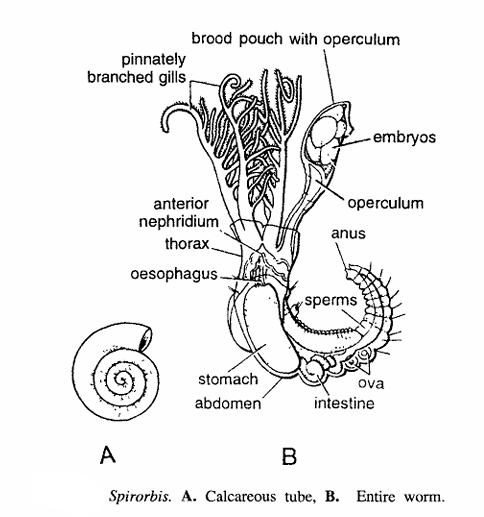
Habit and habitat of Spirorbis
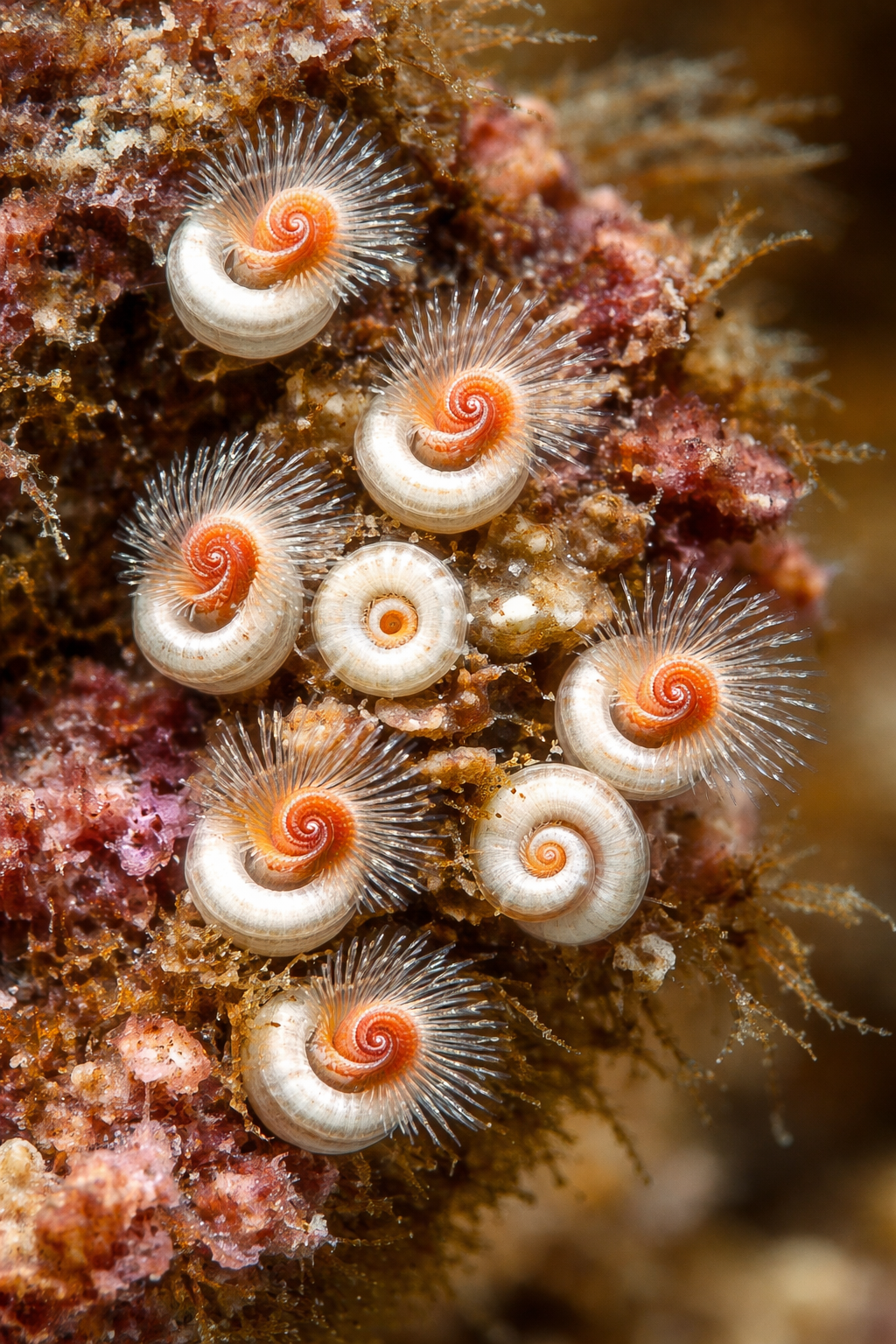
Spirorbis is minute, tubicolous, sedentary polychaete living in a small calcareous tube, coiled in a flat spiral manner which is incrusted on seaweeds, stones, shells and any hard calcareous object of the sea
Distribution
Commonly found in U.S.A., Long Island to Bay of Fundy and northwards.
Comments of Spirorbis
- Animal measures about 3 mm in length and tube diameter is also nearly 3 mm.
- Body is divided into anterior and posterior regions.
- Anterior end is constituted by prostomium and peristomium.
- Prostomium contains pinnately branched gills.
- One of the gill filaments is enlarged to form stopper or operculum.
- There are 9 greenish gill filaments.
- Operculum is grooved on one side to serve as brood punch for the developing eggs.
- Peristome is similar to other segments of the thorax, but it forms a collar which secretes the tube.
- Abdominal segments are hermaphroditic.
- The anterior abdominal segments produce eggs while posterior segments sperms.
Special features
It has long fossil history. It was abundantly found in Silurian Paleozoic and strata.
Identification
Since the specimen contains pinnately branched tentacles and all above characters and hence it is Spirorbis.
See other posts also
- Larval Forms in Echinodermata
- HYDROSTATIC MOVEMENT
- LOCOMOTION IN PROTOZOA
- ORGANIZATION OF COELOM
- Species Concept
Discover more from Zoologyverse
Subscribe to get the latest posts sent to your email.