
Sycon or Scypha
Sycon is a genus of small marine sponges that belongs to the class Calcarea, whose members possess calcium carbonate spicules forming their skeletal framework. These sponges are commonly found in shallow coastal waters attached to hard surfaces such as rocks or shells. Sycon has a cylindrical body with a system of pores and canals that allows water to circulate through the sponge for filter feeding on microscopic food particles. By filtering suspended matter from seawater, Sycon helps maintain water quality and plays a supportive role in coastal marine ecosystems.
| Feature | Description |
|---|---|
| Common Name | Sycon or Scypha |
| Phylum | Porifera |
| Class | Calcarea |
| Order | Heterocoela |
| Habitat | Marine |
| Canal System | Syconoid |
| Skeleton | Calcareous spicules |
| Reproduction | Sexual and Asexual |
| Larva | Amphiblastula |
Classification of Sycon or Scypha
- Phylum :- Porifera (Pore bearing, cellular grade, asymmetrical or radially symmetrical)
- Class :- Calcarea (Calcareous spicules present)
- Order :- Heterocoela (Syconoid sponges with internal folds)
- Genus :- Sycon
Habit and habitat
Sycon or Scypha is a small, solitary or colonial marine sponge found in shallow to approximately 60 fathoms deep in well oxygenated water.
Distribution
Common in Europe. Distributed from Rhode Island to Greenland.
General Characterstics of Sycon or Scypha
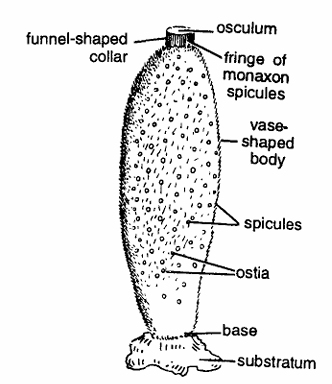
- Complex vase-shaped body, measuring 20 to 25 mm in length and 5 to 6 mm in diameter.
- Each cylinder bulges in the middle and opens to the exterior by osculum.
- Body surface is covered by a ostia bearing membrane.
- At the distal free end there is a large osculum, encircled by a fringe of large giant monaxon spicules forming funnel-shaped collar or oscular fringe.
- Proximal and or base attached to substratum.
- Body wall is thick through which monaxon, triaxon and tetraxon spicules project.
- Body wall is composed of outer dermal epithelium, middle mesenchyma and inner flattened epithelium lining spongocoel which opens through the osculum.
- Canal system is syconoid. Choanocytes are restricted to radial canals.
- Course of water current is ostia – prosopyles – radial – canals -apopyles -spongocoel -osculum – exterior.
- Nutrition, respiration and excretion by canal system.
- Hermaphroditic.
- Reproduction by sexual or asexual methods. Asexual reproduction by budding and regeneration, while sexual by ova and sperms.
- Larva is amphiblastula.
Identification
Since the animal has radial tubes, oscular fringe, ostia and all above features, hence it is Sycon.
Key Takeaways
- Sycon (Scypha) is a small marine sponge belonging to Phylum Porifera and Class Calcarea.
- It possesses a syconoid canal system, which is more advanced than the asconoid type.
- The body is vase-shaped and attached to rocks or shells in shallow marine waters.
- Its skeleton is made of calcareous spicules of monoaxon, triaxon, and tetraxon types.
- Sycon reproduces both sexually and asexually, and its larva is called amphiblastula.
- It plays an important ecological role by filtering suspended particles from seawater.
Frequently Asked Questions (FAQs)
What is Sycon (Scypha)?
Sycon, also known as Scypha, is a small marine sponge belonging to Phylum Porifera and Class Calcarea. It is commonly used as a zoological specimen for studying sponge anatomy.
Where is Sycon found?
Sycon is found attached to rocks, shells, and other hard surfaces in shallow marine waters around the world.
What type of canal system is present in Sycon?
Sycon has a syconoid canal system, which increases the surface area for choanocytes and improves filter feeding.
What is the skeleton of Sycon made of?
The skeleton consists of calcareous spicules, including monoaxon, triaxon, and tetraxon spicules.
How does Sycon reproduce?
Sycon reproduces sexually by producing gametes and asexually through budding and regeneration.
What is the larva of Sycon called?
The larval stage of Sycon is known as the amphiblastula larva.
Why is Sycon important in zoology?
Sycon is an important laboratory specimen because it demonstrates the syconoid canal system and the structural organization of calcareous sponges.
What are the main characteristics of Sycon?
The main characteristics include a vase-shaped body, marine habitat, calcareous spicules, syconoid canal system, filter-feeding habit, and both sexual and asexual reproduction.
Also read other articles
- Spongilla: Classification, Habitat, Characteristics
- Euspongia (Bath Sponge)
- Leucosolenia
- The Canal System
Discover more from Zoologyverse
Subscribe to get the latest posts sent to your email.