
You’re at the edge of a pond, and something small and green just leapt into the water. Frog, right? Now picture a squat, warty little guy sitting motionless in your garden after a rainstorm. Also a frog… or is it? Here’s the twist: every toad is technically a frog, but not every frog is a toad — and once you know what’s actually going on under the skin, you’ll never mix them up again.
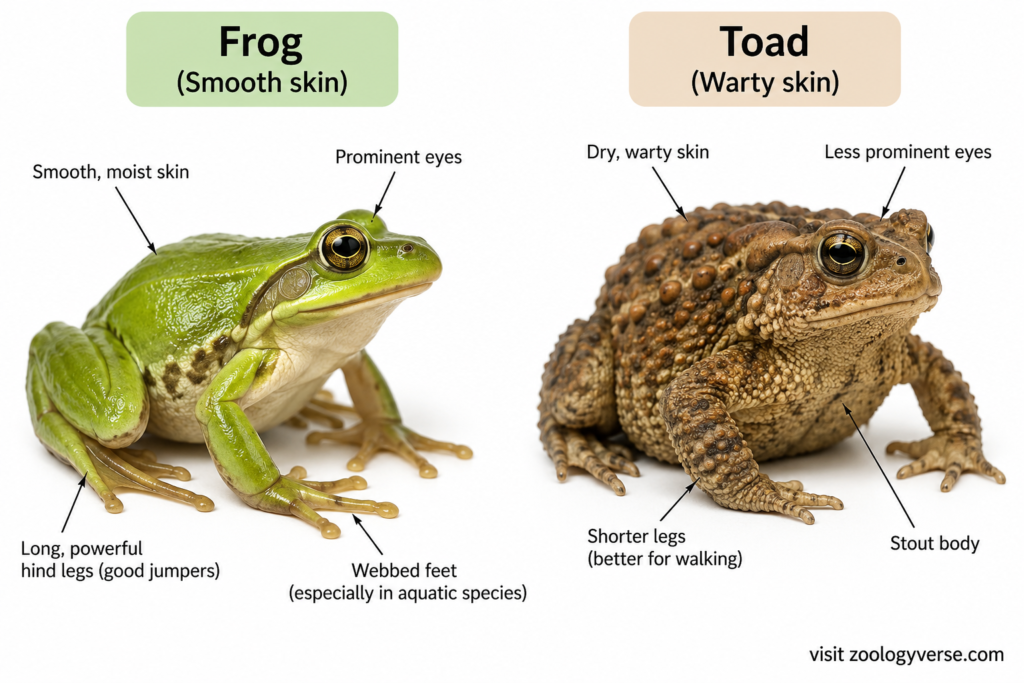
The 5-Second Test
Forget biology class for a second. Here’s the shortcut people actually use in the field:
- Wet, smooth, shiny skin + long jumping legs = frog. It just leapt three feet like it’s auditioning for the Olympics.
- Dry, bumpy, warty skin + short stubby legs = toad. It’s just… sitting there. Vibing. Not going anywhere fast.
That covers most casual identification. For everything else — including what’s happening anatomically — here’s the full breakdown.
Wait, So a Toad IS a Frog?
Yes, and this trips up almost everyone. Both belong to the order Anura (“without a tail”) within class Amphibia. “Toad” isn’t an official taxonomic rank — it’s the common name for family Bufonidae (“true toads“), one branch of the frog family tree adapted for dry land instead of water. So when someone insists “that’s not a frog, it’s a toad,” the correct reply is: “Congratulations, you’ve just described a specific kind of frog.”
Frog vs Toad
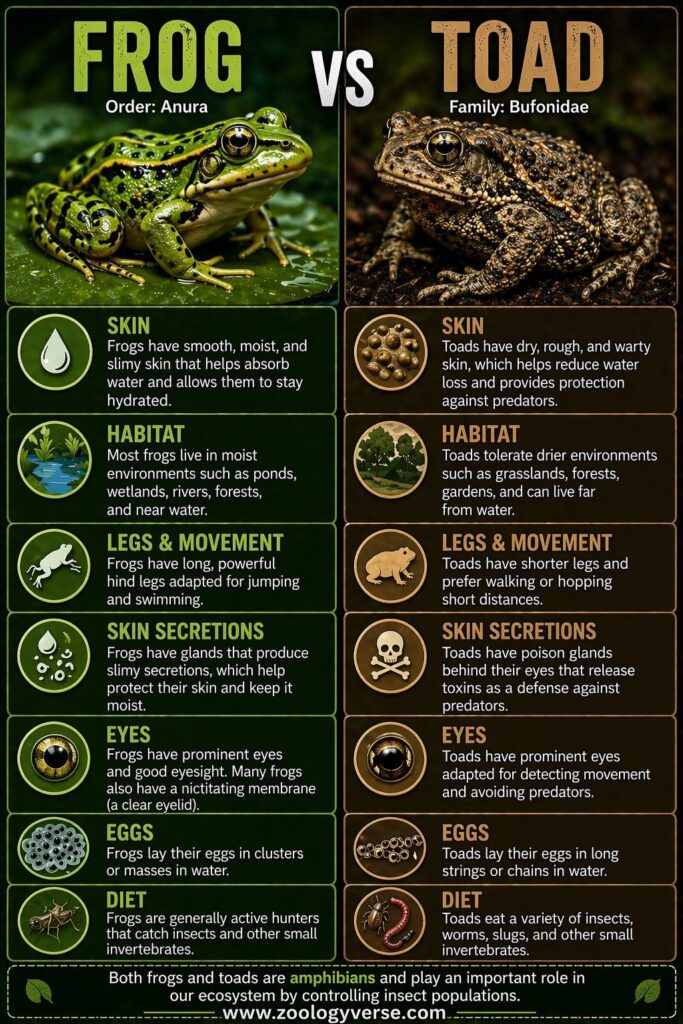
| Feature | Frog | Toad |
|---|---|---|
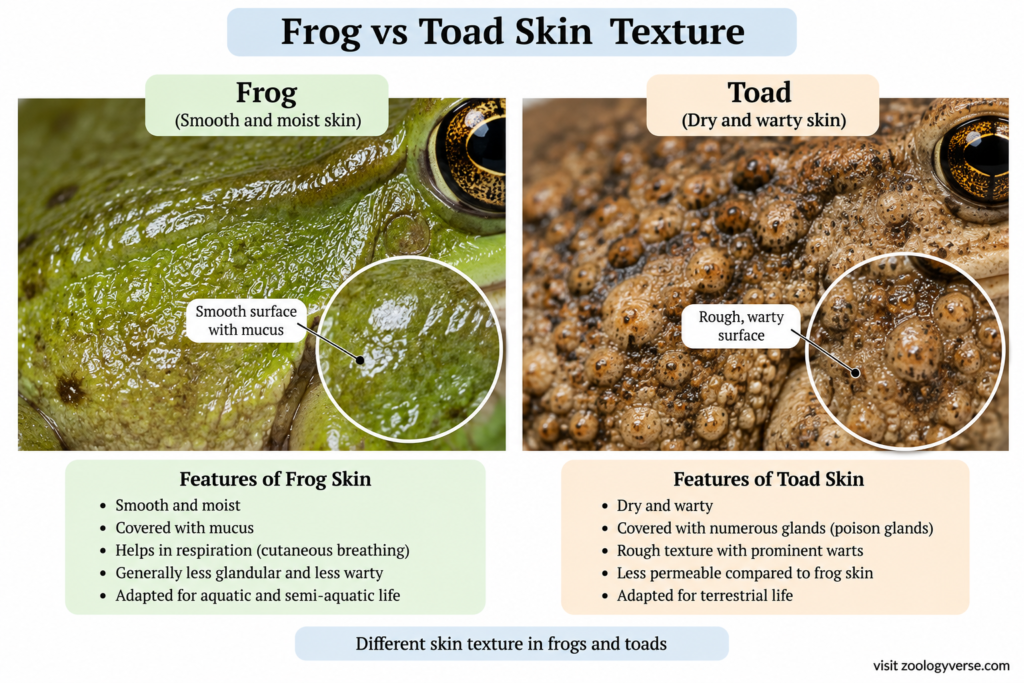
| Skin | Smooth, moist, often shiny | Dry, thick, warty (granular glands) |
| Body shape | Slender, streamlined | Squat, rounded |
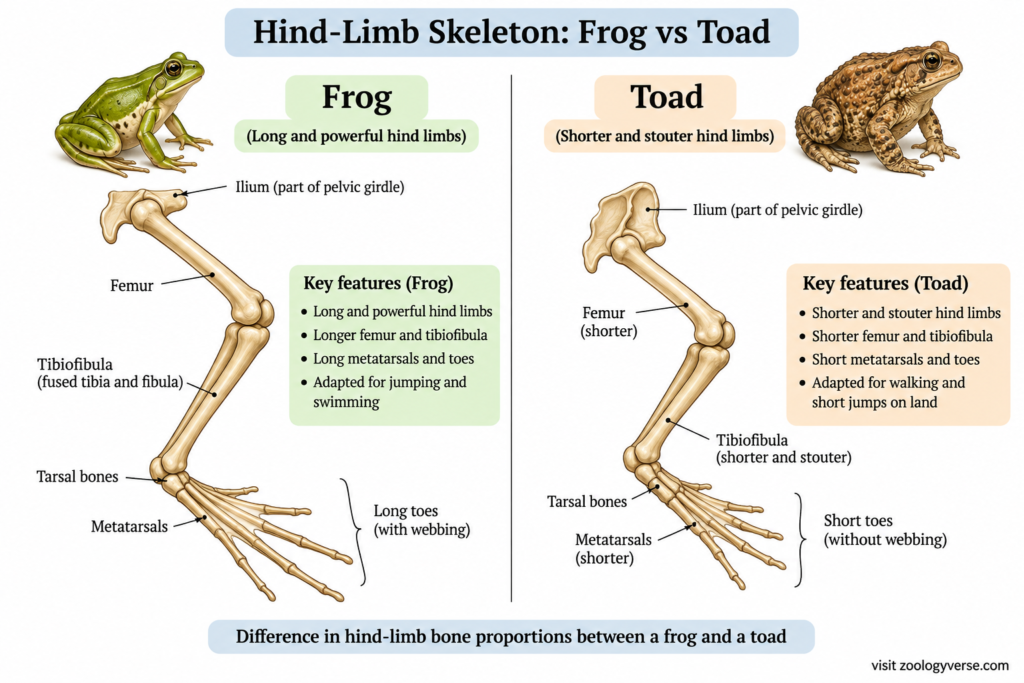
| Hind limb bones | Elongated ilium, longer tibiofibula for powerful leaps | Proportionally shorter — built for walking/hopping |
| Feet | Webbed, built for swimming | Little to no webbing |
| Respiration | Heavy reliance on cutaneous (skin) respiration | Thicker skin means more reliance on lungs |
| Eyes | Pupil shape varies by species | Often horizontal, football-shaped pupils; bony cranial crest above the eye |
| Habitat | Aquatic or near-water, most of its life | Terrestrial; returns to water mainly to breed |
| Eggs | Laid in loose floating clusters | Laid in long chains/strings |
| Tadpoles | Larger, more dispersed | Smaller, darker, often school in tight groups |
| Defense | Speed, camouflage, some species toxic | Parotoid glands secrete bufotoxin |
The Skeleton Tells the Real Story
A frog’s skeleton is built as a jumping machine: an elongated ilium and fused ankle bones (the tibiofibula and tarsals) work like a spring-loaded lever, while a short, rigid spine transfers that force into one explosive leap. Toads share the same basic blueprint but with proportionally shorter hind-limb bones — the anatomical trade-off for a body built to walk rather than launch itself across a pond. Both frogs and toads also lack ribs, almost uniquely among vertebrates, which lets the whole body compress and stretch during a jump or a big gulp of prey.
The Warts Aren’t Actually Warts
Toad “warts” are aggregations of glandular tissue — not human-style warts, and not contagious. Their job is moisture retention, since toad skin is built to survive on dry land where a frog’s thinner, more permeable skin would dehydrate fast. The two largest glands, the parotoid glands behind a toad’s eyes, secrete a toxic compound called bufotoxin when threatened. It’s mostly harmless on human skin but a real deterrent to predators — and why pets sometimes end up unwell after mouthing one.
Skin as a Second Set of Lungs
Frogs and toads both breathe partly through their skin, a process called cutaneous respiration — oxygen dissolves into skin moisture and diffuses directly into the bloodstream. Frogs depend on this far more heavily, which is exactly why their skin has to stay thin and wet. Toads, with thick, dry, keratinized skin, rely more on their lungs — another reason they can live comfortably away from water while frogs generally can’t stray far from it.
Eggs and Tadpoles
Frog eggs are laid in a loose, floating clump — like a blob of caviar in the water. Toad eggs come in a long string, like a strand of black pearls wrapped around underwater plants — one of the most reliable ways to tell the two apart even without an adult in sight. Even before metamorphosis, toad tadpoles tend to be smaller, darker, and cluster in tighter schools than frog tadpoles, a likely defense strategy since toad tadpoles carry mild toxins too.
Why It Actually Matters
Because frog skin absorbs so much directly from its environment, frogs are extremely sensitive to water pollution, pesticides, and UV changes — scientists use frog populations as an early warning indicator for environmental damage, sometimes called an “indicator species.” Toads, with thicker, more protective skin, tend to tolerate degraded environments a bit longer, which is part of why toads sometimes persist in areas where frogs have already vanished.
Key Takeaways
- Frogs and toads both belong to order Anura — every toad is a frog, but not every frog is a toad.
- Frog skin is smooth and moist; toad skin is dry, thick, and warty.
- Frog hind limbs are longer and built for jumping; toad limbs are shorter and built for walking.
- Frogs rely more on skin (cutaneous) respiration; toads rely more on lungs.
- Frog eggs are laid in clusters; toad eggs are laid in long chains.
- Toads defend themselves with bufotoxin from their parotoid glands; frogs rely more on speed and camouflage.
Frequently Asked Questions
Can toads live in water like frogs?
Toads can swim if needed but don’t live in water the way frogs do — most only return to ponds or streams briefly to breed.
Are toads poisonous to touch?
Handling a toad won’t poison a person, but their parotoid gland secretions (bufotoxin) can irritate eyes or mouth if you touch your face afterward. Always wash your hands after handling any amphibian.
Do frogs and toads make the same sound?
No. Frog calls tend to be higher-pitched croaks or chirps; toad calls are often longer, trilling, or musical — species vary widely, but the difference in call pattern is a common field-identification clue.
Which came first, frogs or toads?
Frogs and toads share a common ancestor within Anura. “Toad” (family Bufonidae) is one branch of that family tree that evolved traits suited to drier habitats, rather than a separate, older lineage
Recommended Study Resource
Frogs & Toads of the World
by Chris Mattison (Author)
Frogs and Toads (Complete Herp Care)
by Devin Edmonds (Author)
As an Amazon Associate I earn from qualifying purchases.
Discover more from Zoologyverse
Subscribe to get the latest posts sent to your email.