
Amino acid biosynthesis is the process by which organisms synthesize amino acids from metabolic precursors such as α-ketoglutarate, oxaloacetate, pyruvate, and 3-phosphoglycerate.
Amino acids are the fundamental building blocks of proteins, but their importance extends far beyond protein synthesis. They also participate in nitrogen metabolism, formation of nucleotides and other biomolecules, energy metabolism, and numerous cellular regulatory processes.
In living organisms, amino acids can be produced from intermediates of central metabolic pathways. The major carbon skeletons used for amino acid biosynthesis come from glycolysis, the citric acid cycle, and the pentose phosphate pathway. Nitrogen is incorporated into these carbon skeletons through reactions involving compounds such as glutamate and glutamine.
The ability to synthesize amino acids differs among organisms. Plants and many microorganisms can synthesize all 20 standard proteinogenic amino acids, whereas humans cannot synthesize nine essential amino acids in sufficient amounts and therefore must obtain them from the diet.
A useful way to understand amino acid biosynthesis is to group the pathways according to their metabolic precursors.
What Is Amino Acid Biosynthesis?
Amino acid biosynthesis is the process by which organisms produce amino acids from metabolic intermediates and inorganic or organic nitrogen sources.
The carbon skeletons required for these pathways are largely derived from central metabolic pathways.
The major precursor molecules include:
- α-Ketoglutarate
- 3-Phosphoglycerate
- Oxaloacetate
- Pyruvate
- Phosphoenolpyruvate
- Erythrose-4-phosphate
- Ribose-5-phosphate
These intermediates are converted through a series of enzyme-catalyzed reactions into the different amino acids.
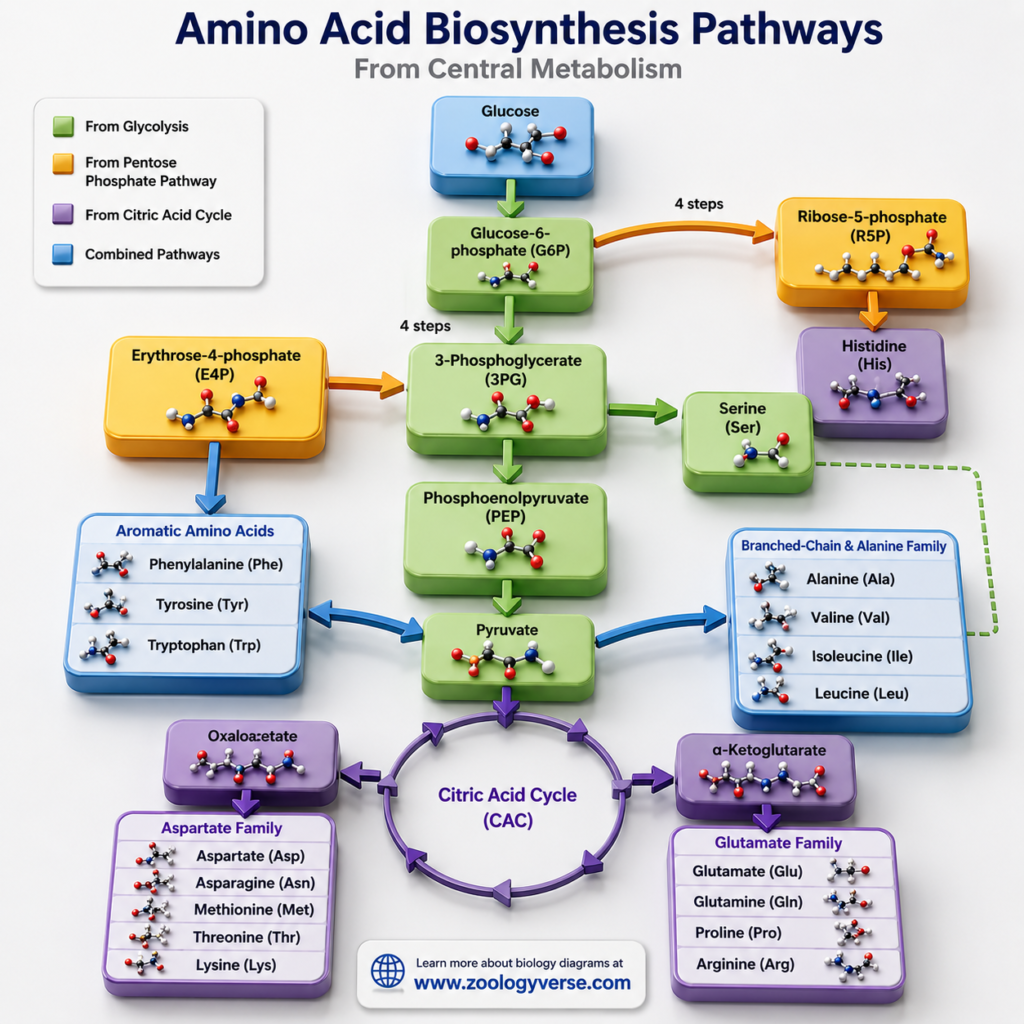
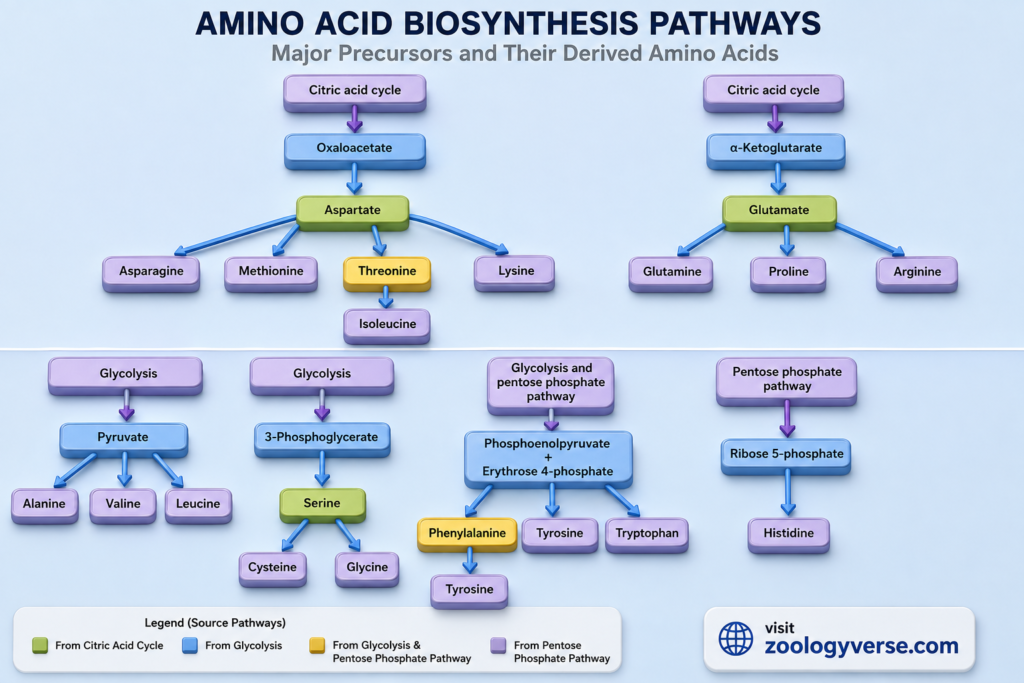
Major Precursors of Amino Acids
Amino acid biosynthesis is closely connected with central metabolism. The carbon skeleton of an amino acid can often be traced back to a glycolytic, TCA-cycle, or pentose-phosphate-pathway intermediate.
| Metabolic precursor | Major amino acids derived from it |
| α-Ketoglutarate | Glutamate, glutamine, proline, arginine |
| 3-Phosphoglycerate | Serine, glycine, cysteine |
| Oxaloacetate | Aspartate, asparagine, methionine, threonine, lysine |
| Pyruvate | Alanine, valine, leucine, isoleucine |
| PEP + erythrose-4-phosphate | Phenylalanine, tyrosine, tryptophan |
| Ribose-5-phosphate | Histidine |
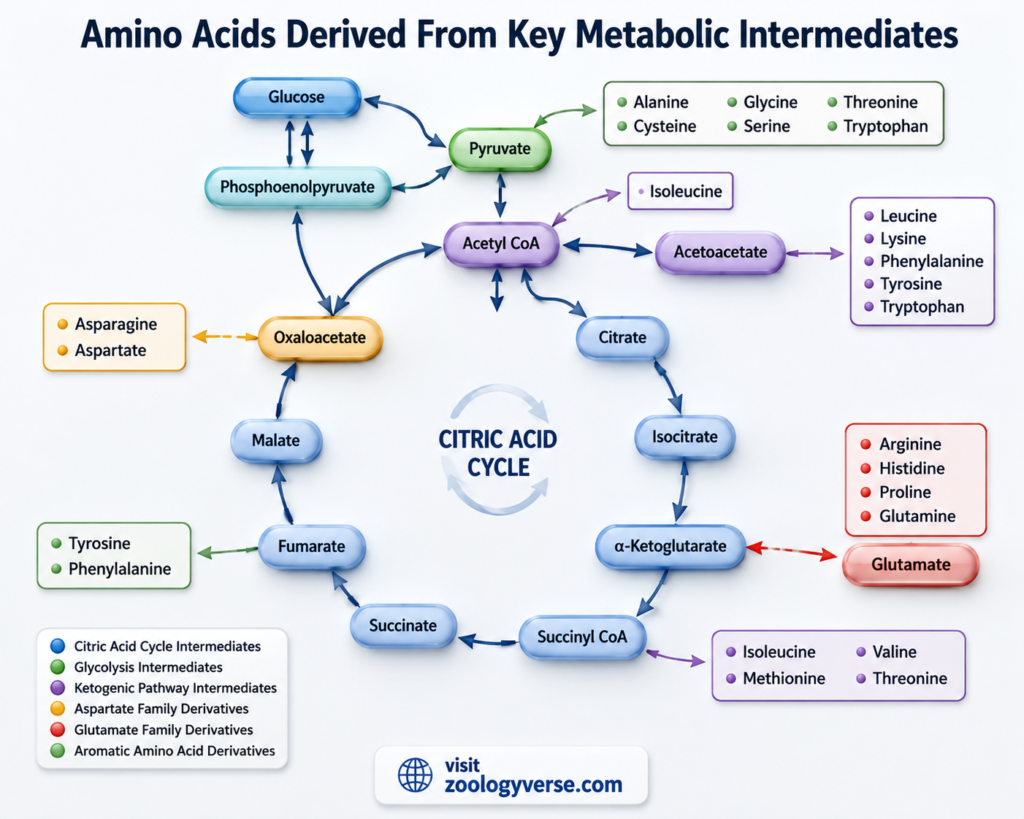
This organization reflects the major biosynthetic families used to describe amino acid metabolism.
Nitrogen Assimilation and the Role of Glutamate
Carbon skeletons alone are not enough to produce amino acids. A nitrogen source must also be incorporated.
Two amino acids are particularly important in nitrogen metabolism:
Glutamate and glutamine
Glutamate acts as a major amino-group donor in many transamination reactions, while glutamine serves as an important nitrogen donor in several biosynthetic pathways.
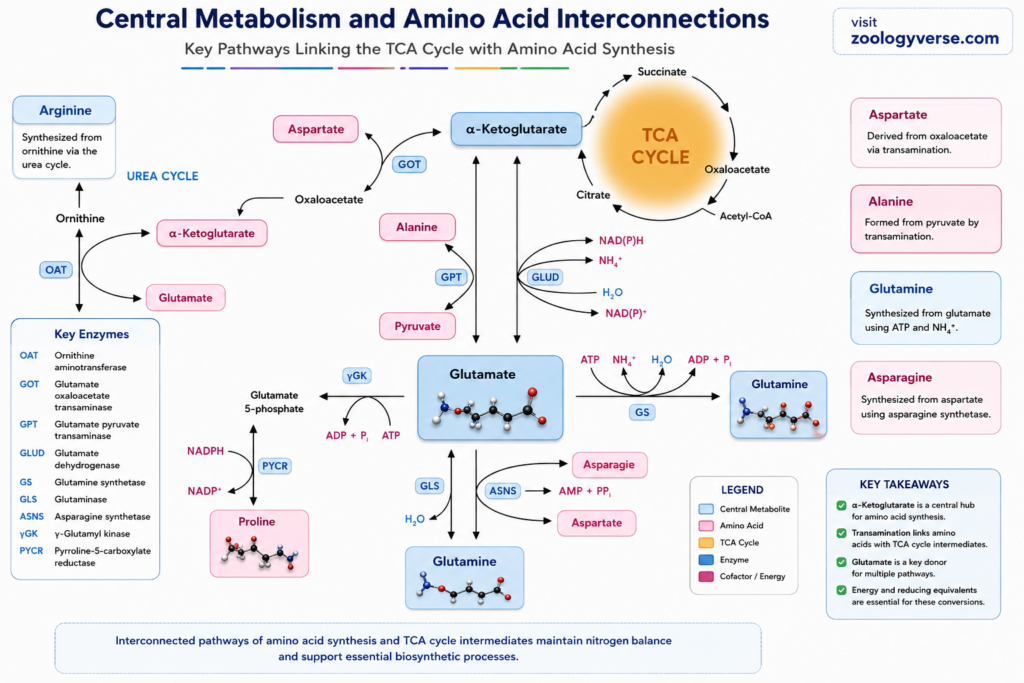
One major route for incorporating ammonium involves glutamine synthetase, which converts glutamate and ammonium into glutamine using ATP.
Overall reaction
Glutamate + NH₄⁺ + ATP → Glutamine + ADP + Pi
Glutamate can also be produced by the reductive amination of α-ketoglutarate through glutamate dehydrogenase.
Reaction
α-Ketoglutarate + NH₄⁺ + NADPH → Glutamate + NADP⁺ + H₂O
These reactions connect nitrogen assimilation with central carbon metabolism.
Biosynthesis from α-Ketoglutarate
α-Ketoglutarate, an intermediate of the citric acid cycle, provides the carbon skeleton for an important family of amino acids.
The major members are:
- Glutamate
- Glutamine
- Proline
- Arginine
The pathway can be summarized as:
α-Ketoglutarate → Glutamate → Glutamine / Proline / Arginine
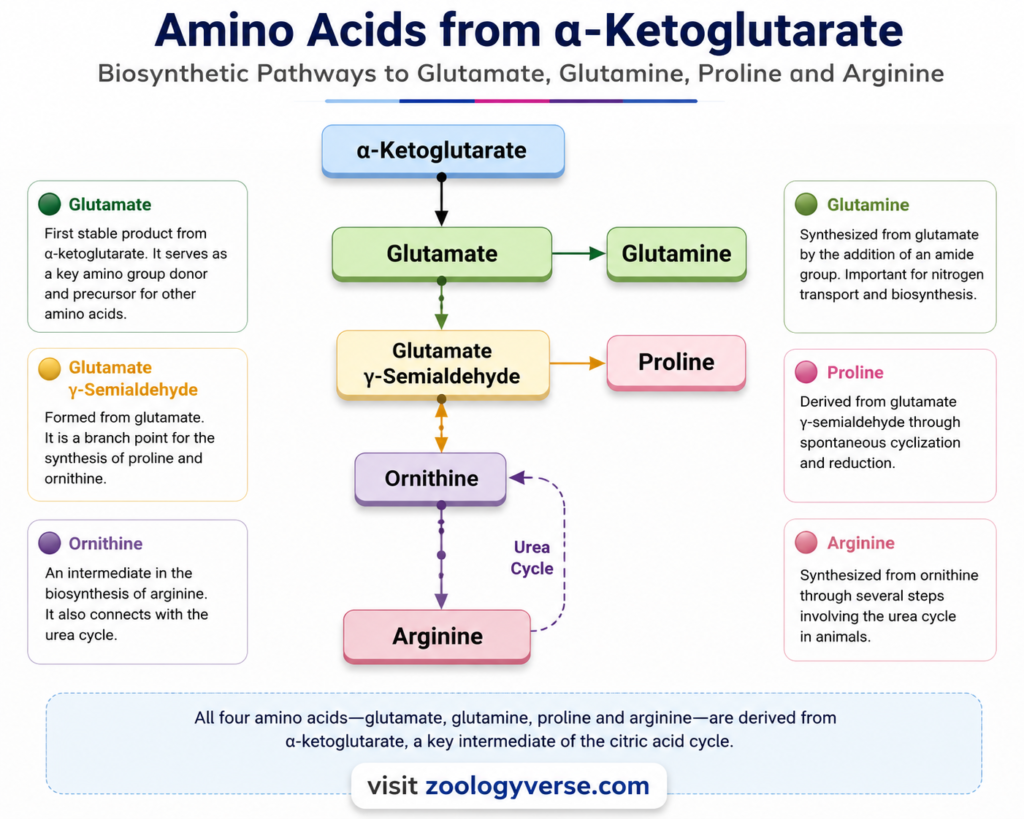
Glutamate Biosynthesis
Glutamate can be produced by incorporating ammonium into α-ketoglutarate.
The reaction is catalyzed by glutamate dehydrogenase and uses NADPH or NADH as reducing power, depending on the organism and physiological conditions.
α-Ketoglutarate + NH₄⁺ + NADPH → Glutamate + NADP⁺ + H₂O
Glutamate is especially important because it serves as a central amino-group donor for many transamination reactions.
Glutamine Biosynthesis
Glutamine is synthesized from glutamate by glutamine synthetase.
The reaction proceeds through a phosphorylated intermediate and requires ATP.
Overall reaction
Glutamate + NH₄⁺ + ATP → Glutamine + ADP + Pi
Glutamine is more than simply another amino acid. It is an important nitrogen donor in the biosynthesis of several metabolites, including nucleotides and certain amino acids.
In animals, glutamine also provides a relatively safe form for transporting nitrogen between tissues.
Proline Biosynthesis
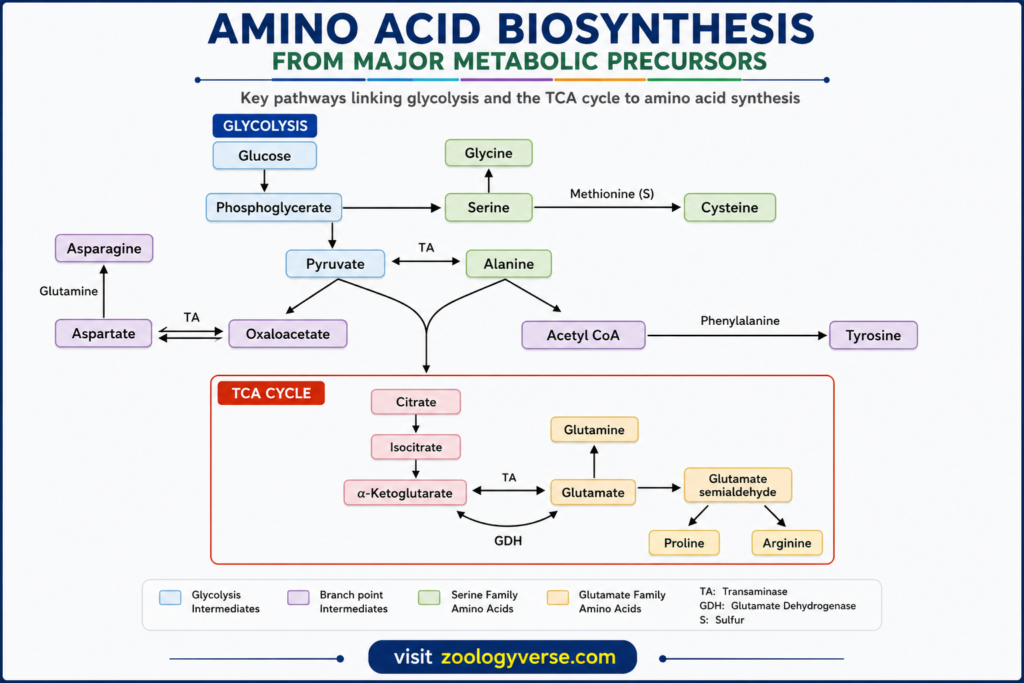
Proline is synthesized from glutamate through several enzymatic steps.
The pathway begins with activation of the γ-carboxyl group of glutamate using ATP. The resulting intermediate is reduced to glutamate-γ-semialdehyde.
This intermediate undergoes spontaneous cyclization to form pyrroline-5-carboxylate, which is subsequently reduced to proline.
Simplified pathway
Glutamate → Glutamate-γ-semialdehyde → Pyrroline-5-carboxylate → Proline
The pathway illustrates how a common metabolic intermediate can be transformed into an amino acid with a distinct cyclic structure.
Arginine Biosynthesis
Arginine biosynthesis is closely connected with glutamate metabolism.
In bacteria and plants, arginine can be synthesized through pathways involving ornithine and several intermediates of nitrogen metabolism.
In animals, arginine metabolism is closely associated with the urea cycle. The nutritional requirement for arginine can vary with developmental and physiological conditions.
Biosynthesis from 3-Phosphoglycerate
3-Phosphoglycerate, an intermediate of glycolysis, is the precursor of:
- Serine
- Glycine
- Cysteine
The pathway can be summarized as:
3-Phosphoglycerate → Serine → Glycine / Cysteine
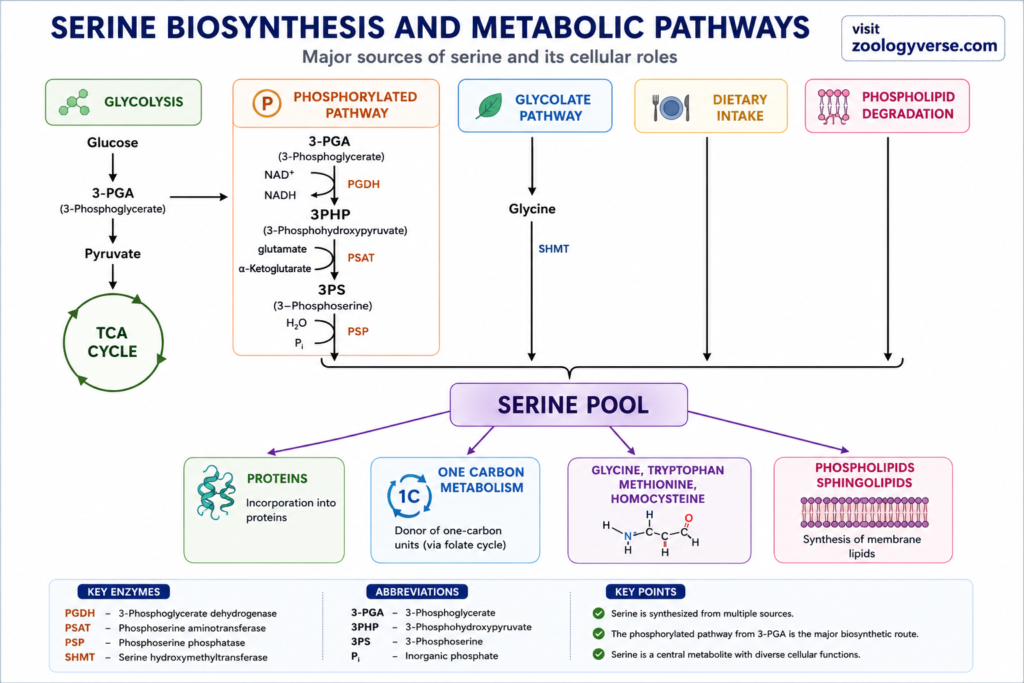
Serine Biosynthesis
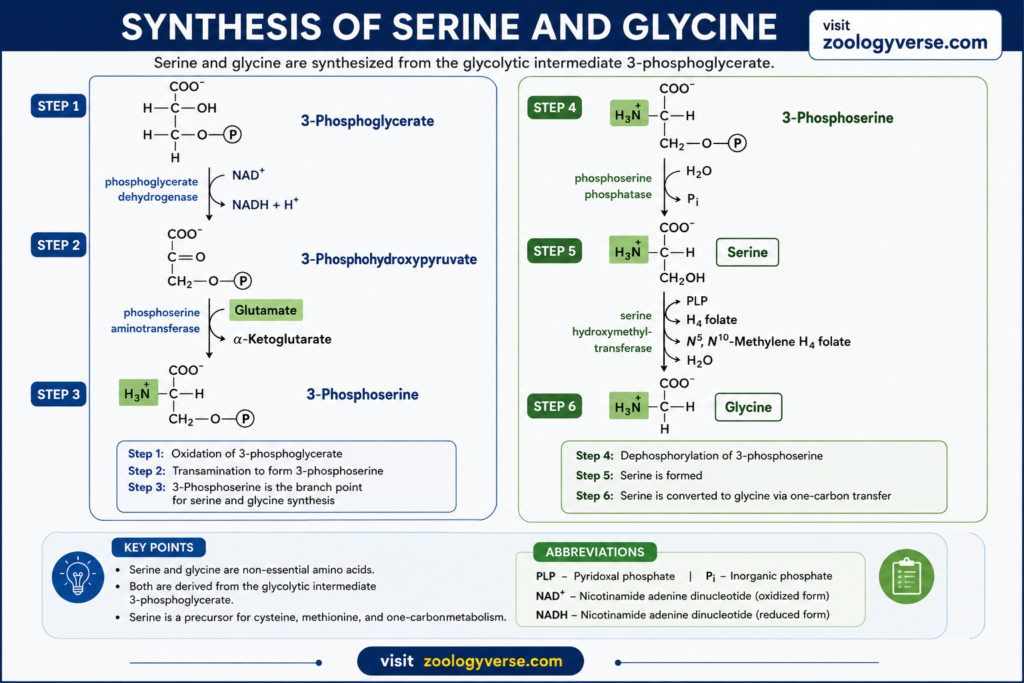
Serine is synthesized from 3-phosphoglycerate through three principal steps.
Step 1: Oxidation
3-Phosphoglycerate is oxidized to 3-phosphohydroxypyruvate by phosphoglycerate dehydrogenase.
NAD⁺ acts as the electron acceptor.
Step 2: Transamination
3-Phosphohydroxypyruvate undergoes transamination, producing 3-phosphoserine.
Glutamate commonly provides the amino group.
Step 3: Dephosphorylation
3-Phosphoserine is hydrolyzed by phosphoserine phosphatase, producing free serine.
Overall pathway
3-Phosphoglycerate → 3-Phosphohydroxypyruvate → 3-Phosphoserine → Serine
Glycine Biosynthesis
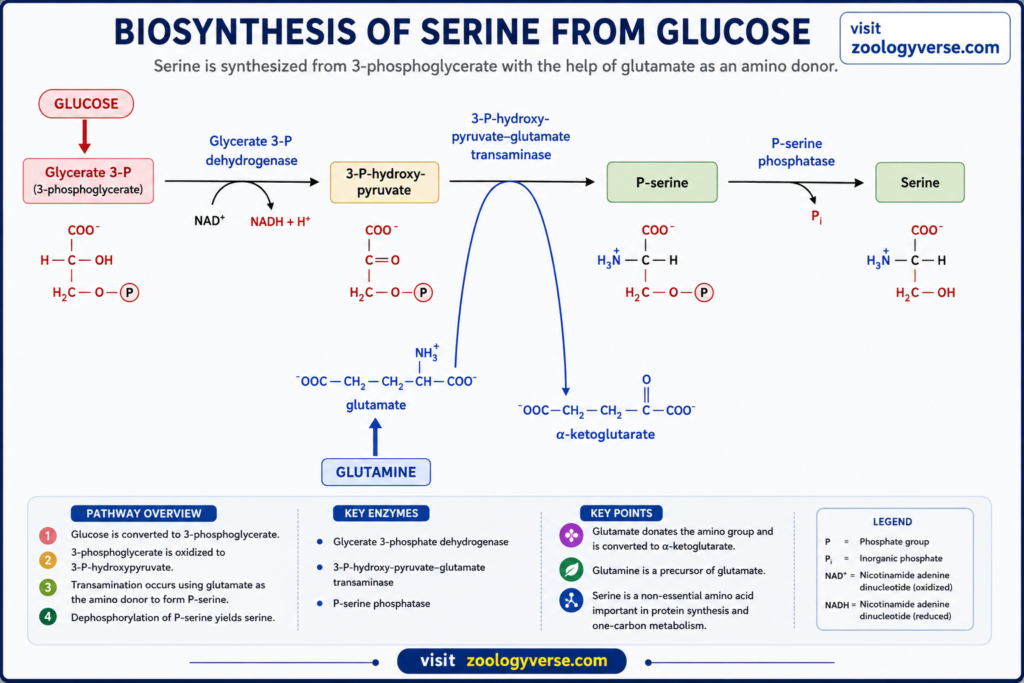
Serine is an important precursor of glycine.
The conversion is catalyzed by serine hydroxymethyltransferase and involves tetrahydrofolate.
During the reaction, the β-carbon of serine is transferred to tetrahydrofolate, producing 5,10-methylene-tetrahydrofolate.
Simplified reaction
Serine + THF ⇌ Glycine + 5,10-Methylene-THF
This reaction connects amino acid metabolism with one-carbon metabolism.
Cysteine Biosynthesis
Cysteine biosynthesis differs considerably between organisms.
In plants and many microorganisms, sulfur obtained from sulfate can ultimately be incorporated into cysteine.
In mammals, cysteine can be synthesized from methionine and serine through the transsulfuration pathway.
Methionine is first converted through S-adenosylmethionine (SAM) and subsequent reactions to homocysteine. Homocysteine then reacts with serine to form cystathionine, which is cleaved to produce cysteine.
Simplified mammalian pathway
Methionine → Homocysteine → Cystathionine → Cysteine
Biosynthesis from Oxaloacetate
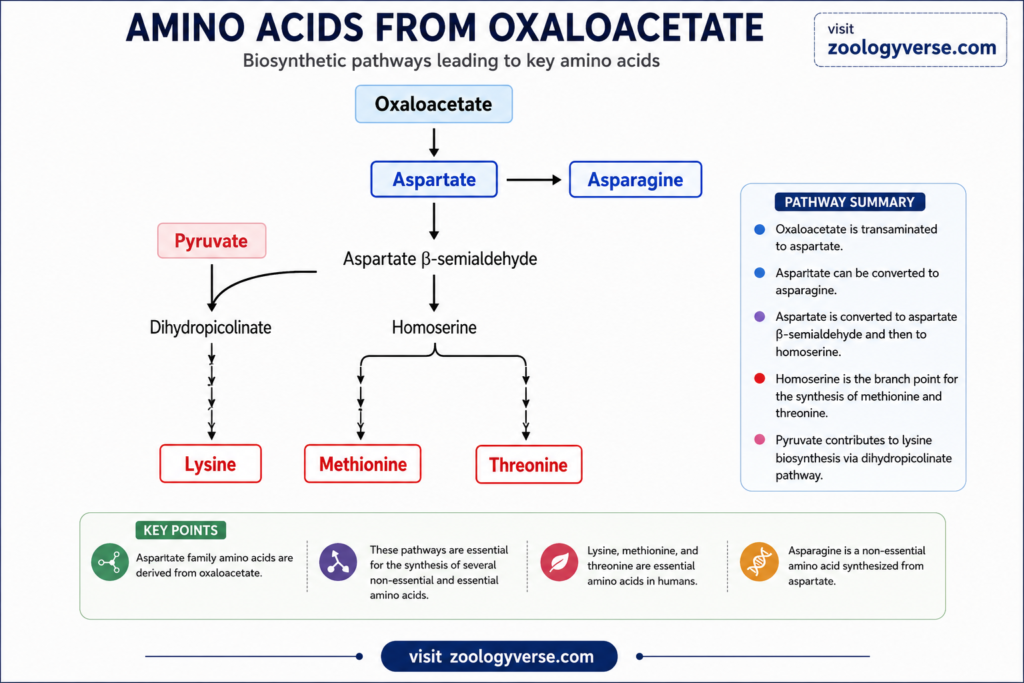
Oxaloacetate, an intermediate of the citric acid cycle, gives rise to the aspartate family of amino acids.
These include:
- Aspartate
- Asparagine
- Lysine
- Methionine
- Threonine
The pathway can be represented as:
Oxaloacetate → Aspartate → Asparagine / Lysine / Methionine / Threonine
Aspartate Family Amino Acids
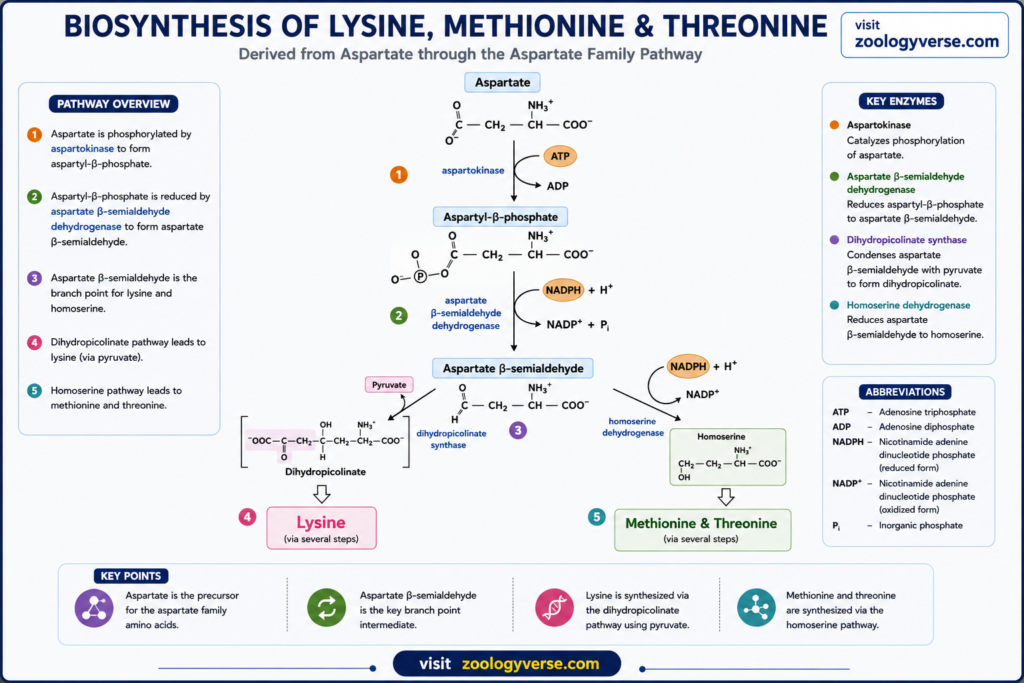
Oxaloacetate is converted to aspartate through transamination.
Aspartate then serves as a precursor for several amino acids.
Aspartate → Asparagine
Asparagine is synthesized from aspartate by an ATP-dependent reaction in which glutamine commonly serves as the nitrogen donor.
Aspartate → Lysine
In bacteria and plants, lysine biosynthesis follows a multi-step pathway beginning with aspartate-derived intermediates.
Aspartate → Threonine and Methionine
Both threonine and methionine arise through pathways involving aspartate-semialdehyde and homoserine as important intermediates.
Methionine and Threonine Biosynthesis
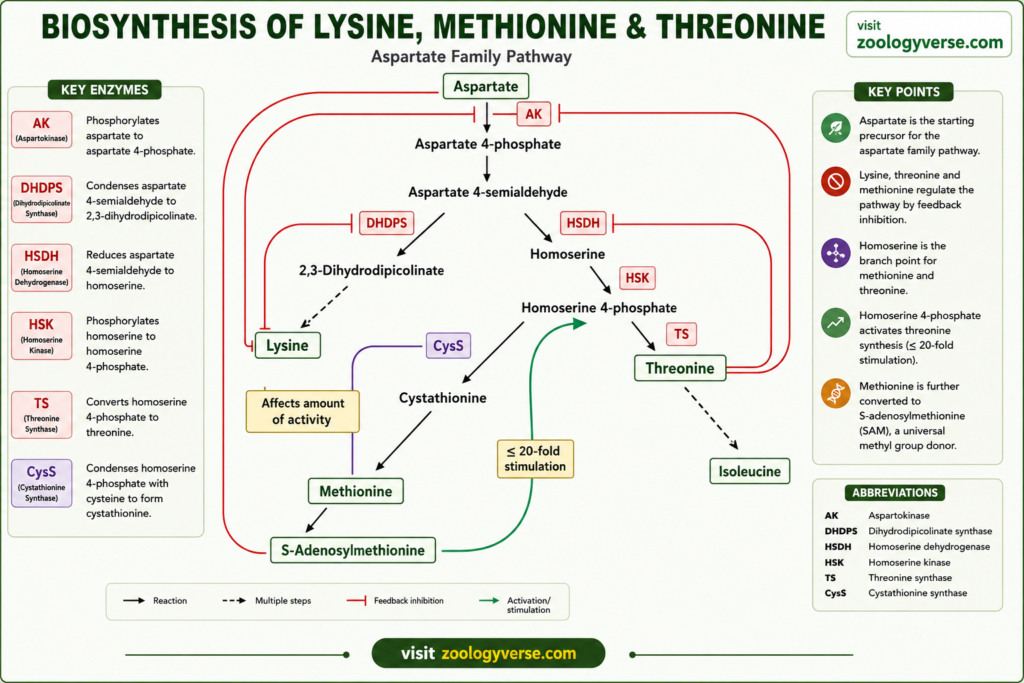
The pathways to methionine and threonine branch from the aspartate family.
A simplified arrangement is:
Aspartate → Aspartate-semialdehyde → Homoserine
From homoserine, separate pathways lead toward:
Homoserine → Threonine
and
Homoserine → Methionine
Threonine can also serve as a precursor for isoleucine in microorganisms and plants.
Lysine Biosynthesis
Lysine is another member of the aspartate family.
Several organisms synthesize lysine through the diaminopimelate pathway, while some microorganisms use alternative pathways such as the α-aminoadipate route.
Because these pathways differ among organisms, it is useful to avoid presenting one bacterial pathway as universal.
Biosynthesis from Pyruvate
Pyruvate, the end product of glycolysis, provides the carbon skeleton for several amino acids, particularly the branched-chain amino acids.
Major products include:
- Alanine
- Valine
- Leucine
- Isoleucine
Alanine Biosynthesis
Alanine can be synthesized directly from pyruvate by transamination.
Reaction
Pyruvate + Glutamate ⇌ Alanine + α-Ketoglutarate
The enzyme alanine aminotransferase catalyzes this reversible reaction.
This pathway is a good example of how amino-group transfer connects amino acid metabolism with central carbohydrate metabolism.
Valine and Isoleucine Biosynthesis
Valine and isoleucine belong to the branched-chain amino acid (BCAA) family.
Their biosynthesis involves several shared enzymes.
Valine is synthesized primarily from pyruvate.
Isoleucine biosynthesis begins with threonine, which is converted to α-ketobutyrate. This intermediate then enters a pathway that shares several enzymes with valine biosynthesis.
Leucine Biosynthesis
Leucine biosynthesis is closely related to valine biosynthesis.
Both pathways begin with pyruvate-derived intermediates and share several enzymatic reactions before branching toward their respective products.
These pathways are found primarily in microorganisms and plants because animals cannot synthesize the branched-chain essential amino acids.
Aromatic Amino Acid Biosynthesis
The aromatic amino acids:
- Phenylalanine
- Tyrosine
- Tryptophan
are synthesized in plants, fungi and many microorganisms through pathways involving phosphoenolpyruvate (PEP) and erythrose-4-phosphate (E4P).
These precursors enter the shikimate pathway, which produces chorismate, the major branch point for aromatic amino acid biosynthesis.
Simplified pathway
PEP + E4P → Shikimate → Chorismate
Then:
Chorismate → Tryptophan
or
Chorismate → Phenylalanine / Tyrosine
Tryptophan Biosynthesis
Tryptophan biosynthesis begins with chorismate.
The pathway proceeds through several intermediates, including anthranilate and indole-3-glycerol phosphate.
Glutamine provides nitrogen during the pathway, while PRPP contributes carbon atoms to the developing indole-containing structure.
The final step is catalyzed by tryptophan synthase.
Tryptophan synthase is composed of two functional components:
- α subunit
- β subunit
The α subunit produces indole, which is transferred internally to the β-subunit active site, where it reacts with a serine-derived intermediate to form tryptophan.
This type of internal transfer is known as substrate channeling.
Phenylalanine and Tyrosine Biosynthesis
Phenylalanine and tyrosine are also derived from chorismate.
A major branch proceeds through prephenate.
Simplified pathway
Chorismate → Prephenate → Phenylalanine
and
Chorismate → Prephenate → Tyrosine
In humans, tyrosine can also be synthesized from phenylalanine by hydroxylation catalyzed by phenylalanine hydroxylase.
Therefore, tyrosine is generally classified as a nonessential amino acid, although its synthesis depends on an adequate supply of phenylalanine.
Histidine Biosynthesis
Histidine has a distinctive biosynthetic pathway.
In microorganisms and plants, histidine biosynthesis uses precursors from both purine metabolism and the pentose phosphate pathway.
A major precursor is 5-phosphoribosyl-1-pyrophosphate (PRPP).
ATP contributes atoms to the developing histidine ring, while glutamine provides nitrogen.
Simplified pathway
Ribose-5-phosphate → PRPP → Histidine
The pathway is unusual because of its close metabolic connection with purine nucleotide metabolism.
Role of PRPP in Amino Acid Biosynthesis
5-Phosphoribosyl-1-pyrophosphate (PRPP) is an important activated ribose compound.
It is produced from ribose-5-phosphate, which is derived from the pentose phosphate pathway.
PRPP participates in the biosynthesis of several important compounds, including histidine, tryptophan and nucleotides.
Because PRPP is used in multiple biosynthetic pathways, its production and availability are tightly regulated.
Essential and Nonessential Amino Acids
The ability to synthesize amino acids varies between organisms.
In humans, the nine amino acids generally classified as nutritionally essential are:
- Histidine
- Isoleucine
- Leucine
- Lysine
- Methionine
- Phenylalanine
- Threonine
- Tryptophan
- Valine
They must normally be supplied through the diet.
Other amino acids can be synthesized by the human body, although some—such as arginine and cysteine—can become conditionally essential under particular developmental or physiological conditions.
This classification is organism-dependent. An amino acid that is essential for humans may be synthesized efficiently by bacteria or plants.
Amino Acid Biosynthetic Families at a Glance
| Precursor | Amino acid family |
| α-Ketoglutarate | Glutamate, glutamine, proline, arginine |
| 3-Phosphoglycerate | Serine, glycine, cysteine |
| Oxaloacetate | Aspartate, asparagine, lysine, methionine, threonine |
| Pyruvate | Alanine, valine, leucine, isoleucine |
| PEP + E4P | Phenylalanine, tyrosine, tryptophan |
| Ribose-5-phosphate / PRPP | Histidine |
This precursor-based organization is also reflected in biochemical pathway references and metabolic studies.
Why Is Amino Acid Biosynthesis Important?
Amino acid biosynthesis is important because it:
- supplies amino acids for protein synthesis
- connects amino acid metabolism with glycolysis and the citric acid cycle
- provides nitrogen-containing compounds for other biosynthetic pathways
- supports cellular growth and reproduction
- contributes to synthesis of nucleotides, hormones and other metabolites
- allows plants and microorganisms to produce amino acids that animals must obtain through food
The pathways are also important in biotechnology and medicine because many metabolic disorders and antimicrobial strategies involve amino acid metabolism.
Key Takeaways
- Amino acid biosynthesis converts metabolic intermediates into amino acids.
- The major precursor families arise from glycolysis, the citric acid cycle and the pentose phosphate pathway.
- α-Ketoglutarate gives rise to glutamate, glutamine, proline and arginine.
- 3-Phosphoglycerate gives rise to serine, glycine and cysteine.
- Oxaloacetate forms the starting point for the aspartate family.
- Pyruvate is the major precursor for alanine and branched-chain amino acid biosynthesis.
- PEP and erythrose-4-phosphate enter the shikimate pathway to produce aromatic amino acids.
- PRPP is an important precursor in histidine biosynthesis.
- Glutamate and glutamine are central to nitrogen assimilation.
- Plants and many microorganisms can synthesize all 20 standard amino acids.
- Humans require dietary sources of nine essential amino acids.
Frequently Asked Questions
What is amino acid biosynthesis?
Amino acid biosynthesis is the production of amino acids from metabolic intermediates and nitrogen sources through enzyme-catalyzed pathways.
What are the main precursors of amino acids?
The major precursors are α-ketoglutarate, 3-phosphoglycerate, oxaloacetate, pyruvate, phosphoenolpyruvate, erythrose-4-phosphate and ribose-5-phosphate.
Which amino acids are derived from α-ketoglutarate?
Glutamate, glutamine, proline and arginine belong to the α-ketoglutarate-derived family.
Which amino acids are synthesized from 3-phosphoglycerate?
Serine is directly derived from 3-phosphoglycerate, while glycine and cysteine are part of the same biosynthetic family.
Which amino acids come from oxaloacetate?
Oxaloacetate gives rise to aspartate, which serves as a precursor for asparagine, lysine, methionine and threonine.
What is the role of glutamate in amino acid synthesis?
Glutamate is a major amino-group donor in transamination reactions and plays a central role in nitrogen metabolism.
What is PRPP?
PRPP, or 5-phosphoribosyl-1-pyrophosphate, is an activated ribose intermediate involved in the biosynthesis of histidine, tryptophan and nucleotides.
Which pathway produces aromatic amino acids?
The shikimate pathway produces the aromatic amino acids phenylalanine, tyrosine and tryptophan in organisms that possess this pathway.
Can humans synthesize all 20 amino acids?
No. Humans cannot synthesize nine amino acids in sufficient amounts and therefore must obtain them from dietary sources.
Why are some amino acids called essential?
An amino acid is nutritionally essential when the body cannot synthesize enough of it to meet physiological requirements, so it must be obtained from the diet.
Conclusion
Amino acid biosynthesis demonstrates how closely interconnected cellular metabolism really is. Pathways beginning with intermediates of glycolysis, the citric acid cycle and the pentose phosphate pathway supply the carbon skeletons required for amino acid production.
α-Ketoglutarate, 3-phosphoglycerate, oxaloacetate, pyruvate, PEP, erythrose-4-phosphate and ribose-5-phosphate serve as major metabolic starting points for different amino acid families.
Among these pathways, glutamate and glutamine occupy a particularly important position because they connect carbon metabolism with nitrogen assimilation. Other pathways, such as the shikimate pathway for aromatic amino acids and the PRPP-dependent pathway for histidine, demonstrate the remarkable biochemical diversity of amino acid synthesis.
Understanding these pathways is therefore essential for studying biochemistry, molecular biology, metabolism, nutrition and microbial physiology.
REFERENCES
- NCBI Bookshelf — Amino Acid Synthesis and Degradation
- NCBI Bookshelf — The Biosynthesis of Cell Constituents
- OpenStax — Structures of Amino Acids
- NCBI Bookshelf — Essential Amino Acids
- NCBI/PMC — Biosynthesis of Aromatic Amino Acids
Discover more from Zoologyverse
Subscribe to get the latest posts sent to your email.