
What is Branchiostoma lanceolatum?
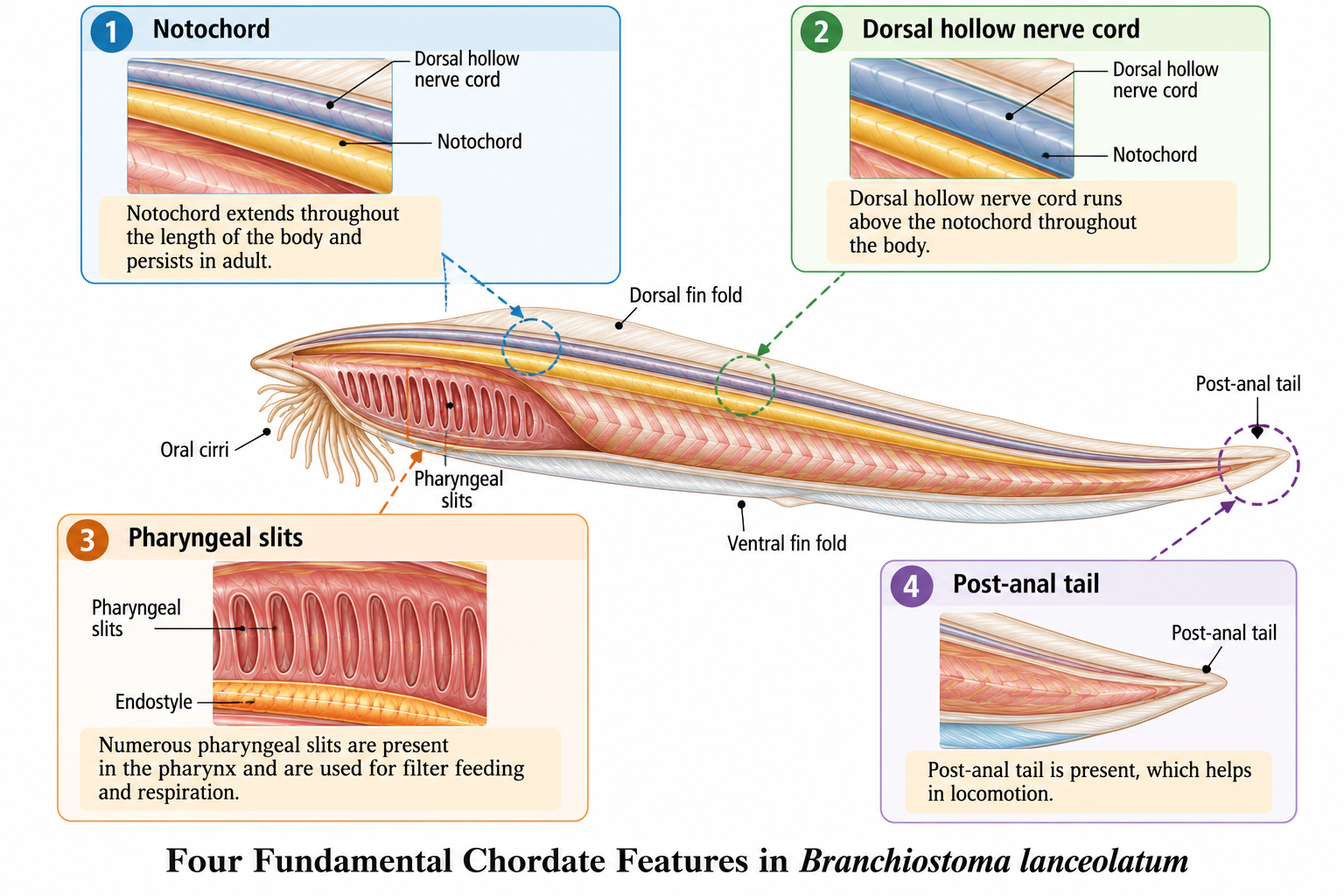
Branchiostoma lanceolatum is a small, marine, fish-like cephalochordate commonly known as the European lancelet or amphioxus. It belongs to the phylum Chordata and subphylum Cephalochordata. It is an important organism in zoology because it retains the fundamental chordate features throughout its adult life, including a notochord, dorsal hollow nerve cord, pharyngeal slits, and post-anal tail.
The body of Branchiostoma lanceolatum is elongated, laterally compressed, and pointed at both ends, giving it a lance-like appearance. It generally lives partially buried in sandy or shallow marine sediments, with its anterior end exposed for filter feeding.
Unlike vertebrates, Branchiostoma lanceolatum does not possess a vertebral column or a cranium. Its simple body organization provides important insights into the basic structural features of chordates and helps students understand the evolutionary relationships between non-vertebrate chordates and vertebrates.
Because of its characteristic chordate features, Branchiostoma lanceolatum is frequently studied in zoology, chordate classification, comparative anatomy, and practical examinations.
Structure of Branchiostoma lanceolatum
Branchiostoma lanceolatum has a small, elongated, laterally compressed body that is pointed at both ends. Its simple organization clearly shows the fundamental structural plan of a chordate.
External Structure
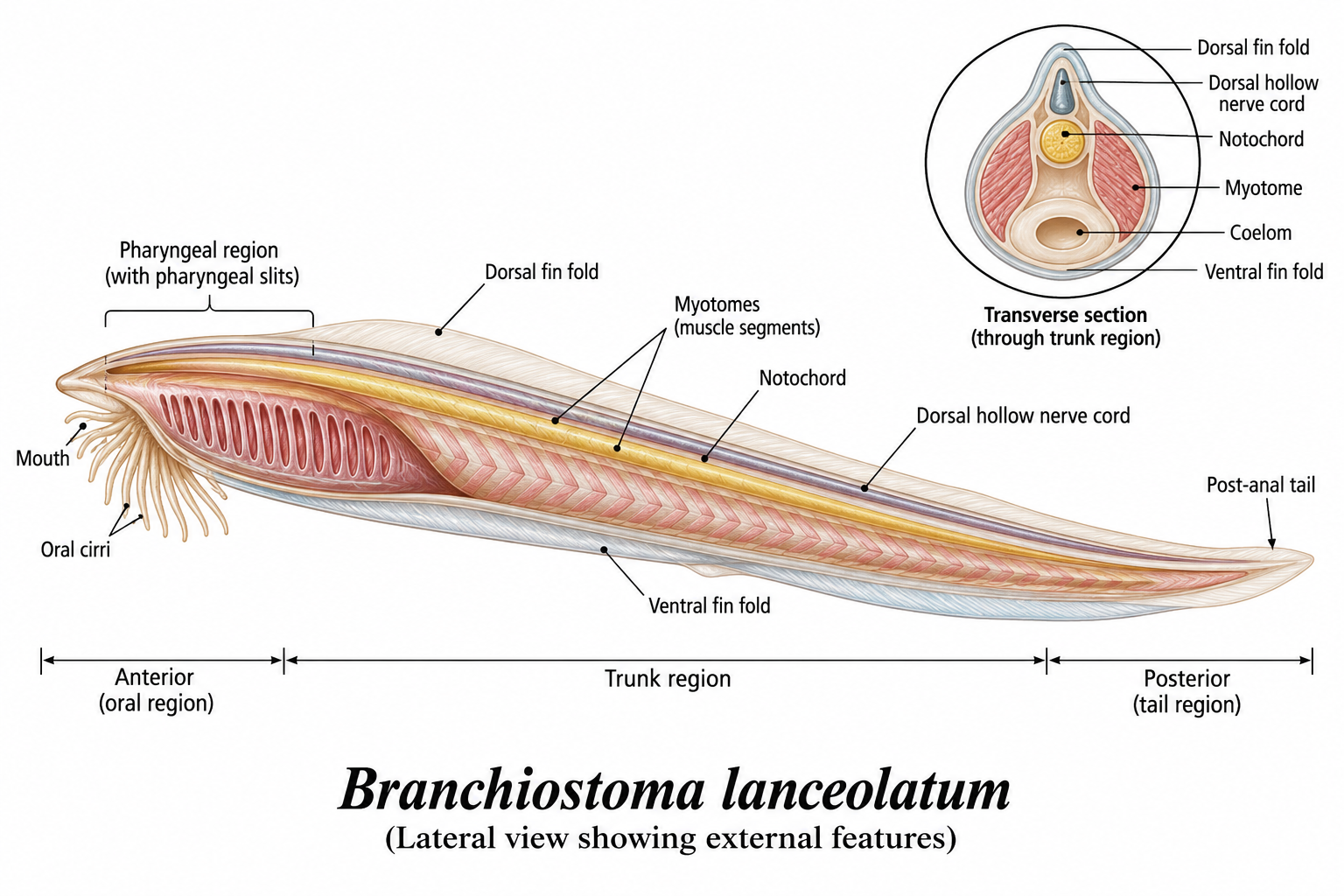
The body is divided broadly into an anterior oral region, trunk, and posterior tail region. The mouth is located at the anterior end and is surrounded by numerous oral cirri that help prevent large particles from entering the mouth during filter feeding.
A prominent notochord extends almost the entire length of the body, from the anterior end to the tip of the tail. Above the notochord lies the dorsal hollow nerve cord, another characteristic chordate feature.
The body bears a series of myotomes, or V-shaped muscle segments, which are arranged along both sides of the body. These muscles produce the lateral movements required for swimming and movement through the sediment.
The pharyngeal region contains numerous pharyngeal slits. Water entering through the mouth passes through this region and exits through the atriopore after participating in filter feeding and gas exchange.
Body Wall and Fins
The body wall consists mainly of an outer epidermis and underlying connective tissues and muscles. Thin median fin folds are present along the dorsal, ventral, and caudal regions.
Unlike vertebrates, Branchiostoma lanceolatum lacks paired fins and does not possess a vertebral column. The absence of a cranium and vertebrae is an important distinction between cephalochordates and vertebrates.
Coelom and Major Body Regions
The coelom is well developed in the trunk and is associated with the arrangement of the digestive and other visceral structures. The body organization remains relatively simple compared with that of vertebrates, making Branchiostoma an important organism for studying the basic chordate body plan.
Key chordate features visible in its structure include the notochord, dorsal hollow nerve cord, pharyngeal slits, and post-anal tail.
Digestive, Respiratory and Circulatory Systems
Digestive System
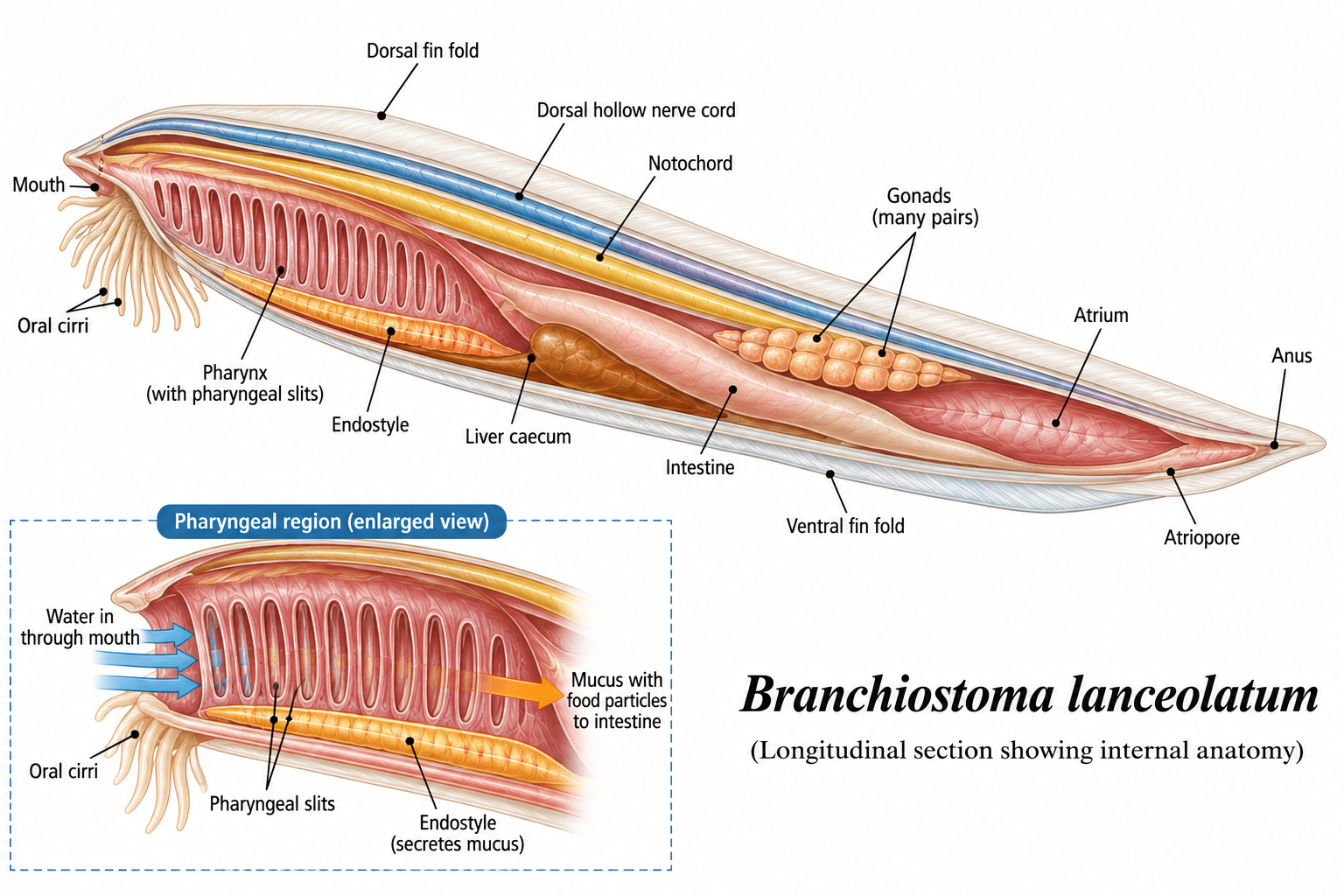
Branchiostoma lanceolatum is a filter feeder. Food particles suspended in seawater are trapped by mucus in the pharyngeal region and transported toward the digestive tract.
Water enters through the mouth and passes into the large pharynx, which contains numerous pharyngeal slits. Cilia and mucus help separate food particles from the water. The collected food is carried into the intestine, where digestion and absorption take place.
The digestive tract consists mainly of the mouth, buccal cavity, pharynx, intestine, and anus. A distinctive endostyle in the pharynx produces mucus that helps in food collection.
Respiratory System
Respiration occurs primarily through the pharyngeal wall and body surface. Water flowing through the pharyngeal region allows oxygen to diffuse into the surrounding tissues while carbon dioxide diffuses outward.
The numerous pharyngeal slits greatly increase the respiratory surface and facilitate continuous water flow through the pharynx.
Circulatory System
Branchiostoma lanceolatum has a closed circulatory system, but it does not possess a true heart. Blood is propelled by the rhythmic contractions of several contractile blood vessels.
The main longitudinal vessels include the ventral aorta, dorsal aorta, and cardinal veins. Blood passes through the pharyngeal region and other tissues, allowing oxygen and nutrients to be distributed throughout the body.
The absence of a distinct heart despite having a closed circulatory system is an important feature of Branchiostoma and distinguishes its circulation from that of vertebrates.
Nervous and Excretory Systems
Nervous System
The nervous system of Branchiostoma lanceolatum is relatively simple and retains the basic chordate arrangement. A dorsal hollow nerve cord extends longitudinally along the body, positioned above the notochord.
The anterior end of the nerve cord is slightly enlarged to form a simple cerebral vesicle. Unlike vertebrates, Branchiostoma does not have a highly developed brain enclosed within a cranium.
Sensory structures include sensory cells, photoreceptors, and mechanoreceptors, which help the animal detect changes in light, water movement, and its surroundings.
Excretory System
Excretion is carried out mainly by numerous specialized structures called protonephridia. These are associated with the pharyngeal region and contain specialized solenocytes.
The solenocytes bear flagella that help move fluid through the excretory tubules. Nitrogenous wastes are ultimately released into the surrounding water.
The excretory system of Branchiostoma is therefore quite different from the kidneys of vertebrates, reflecting its simpler cephalochordate organization.
Reproduction and Development
Branchiostoma lanceolatum is dioecious, meaning that male and female reproductive organs occur in separate individuals. The gonads are arranged in a series along the sides of the trunk.
The gonads do not have separate ducts. When the gametes mature, they are released into the surrounding atrial cavity and eventually pass out through the atriopore.
Fertilization
Fertilization is external. Eggs and sperm are released into seawater, where fusion of the gametes takes place.
Development
Development is indirect and includes a free-swimming larval stage. The fertilized egg undergoes cleavage and develops into a ciliated larva. During development, the larva undergoes substantial changes in body organization before reaching the adult form.
The development of Branchiostoma lanceolatum is particularly important in zoology because it demonstrates the basic developmental pattern of a cephalochordate and the formation of characteristic chordate structures.
For Practical Study
The following notes are arranged in a practical examination format for easy study and identification.
Classification of Branchiostoma lanceolatum
| Rank | Classification | Characteristic |
|---|---|---|
| Kingdom | Animalia | Multicellular, heterotrophic animals |
| Phylum | Chordata | Notochord and dorsal hollow nerve cord present |
| Subphylum | Cephalochordata | Notochord extends from head to tail |
| Class | Leptocardii | Small, fish-like marine chordates without a cranium |
| Order | Amphioxiformes | Elongated body with numerous pharyngeal slits |
| Family | Branchiostomidae | Lancelet-like cephalochordates with oral cirri |
| Genus | Branchiostoma | Body elongated and pointed at both ends |
| Species | Branchiostoma lanceolatum | European lancelet with a characteristic lance-shaped body |
Geographical Distribution
- Branchiostoma lanceolatum occurs in coastal marine waters, particularly in parts of the eastern Atlantic and Mediterranean region, where it is commonly associated with shallow sandy sediments.
Habit and Habitat
It is a marine, sedentary or weakly swimming, filter-feeding animal. It commonly lives partially buried in clean, shallow sandy or coarse sediments, with the anterior end exposed for feeding. It can rapidly withdraw into the sediment when disturbed.

Comments or characteristics of Branchiostoma lanceolatum
- Body small, elongated, laterally compressed, and pointed at both ends.
- Notochord extends throughout the length of the body and persists throughout life.
- Dorsal hollow nerve cord is present above the notochord.
- Numerous pharyngeal slits are present in the pharynx.
- Mouth is surrounded by oral cirri.
- Body muscles are arranged into segmented myotomes.
- A post-anal tail is present.
- No cranium or vertebral column is present.
- Animal is marine and primarily a filter feeder.
Special Features
- The notochord extends from the anterior end to the posterior end and persists throughout life.
- The dorsal hollow nerve cord remains a prominent longitudinal structure.
- Numerous pharyngeal slits are associated with filter feeding and respiration.
- The body contains numerous V-shaped myotomes arranged segmentally.
- A distinct atriopore is present for the discharge of water from the atrial cavity.
- It has a closed circulatory system but no distinct heart.
- The organism represents a basic non-vertebrate chordate body plan.
Identification
The specimen can be identified as Branchiostoma lanceolatum by its small, elongated lance-shaped body, persistent notochord, dorsal nerve cord, numerous pharyngeal slits, oral cirri, segmented myotomes, and absence of a cranium and vertebral column.
Branchiostoma lanceolatum vs Vertebrates
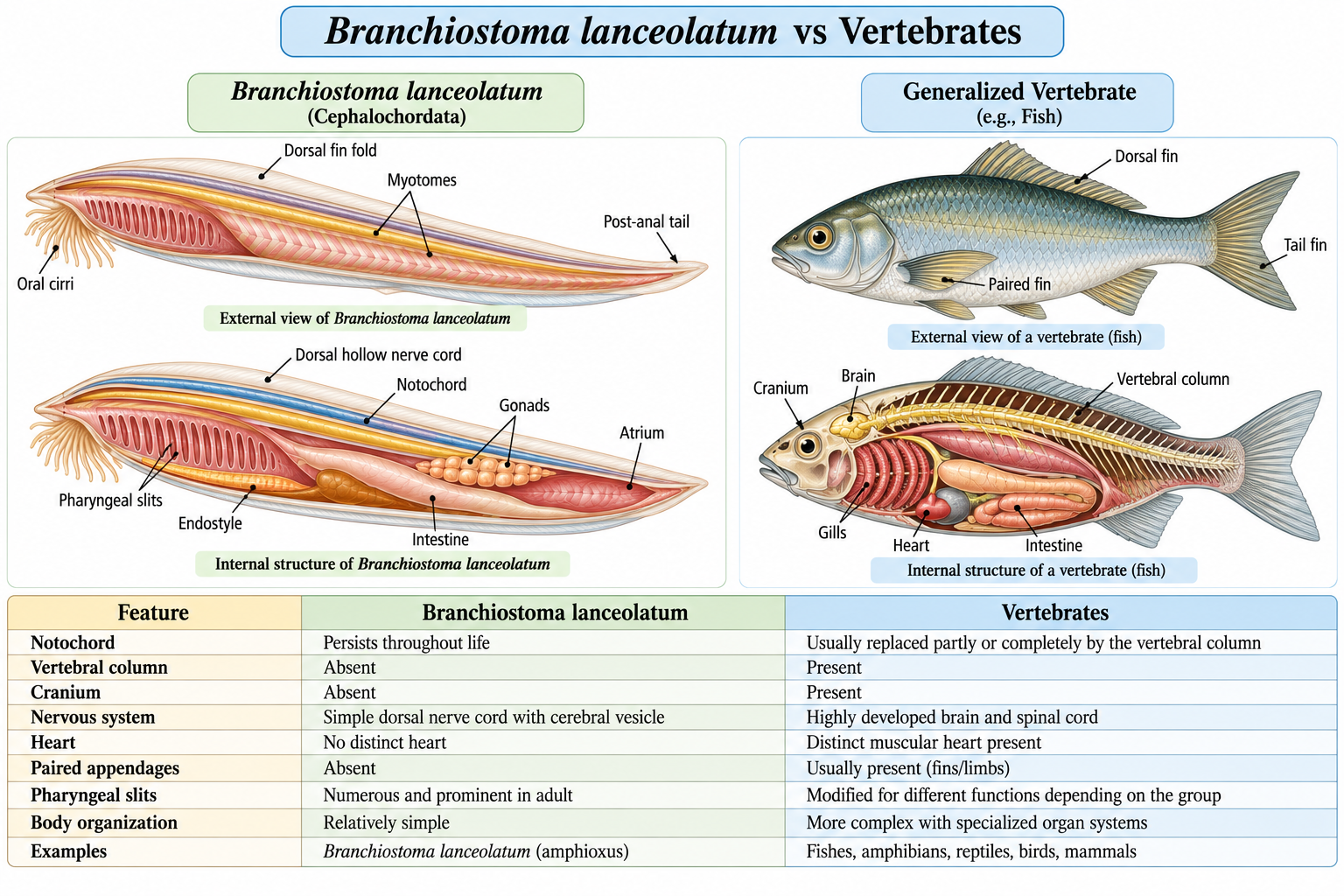
Branchiostoma lanceolatum shares the fundamental chordate features with vertebrates, but it lacks several advanced features characteristic of vertebrates.
| Rank | Branchiostoma lanceolatum | Vertebrates |
|---|---|---|
| Notochord | Persists throughout life | Usually replaced partly or completely by the vertebral column |
| Vertebral column | Absent | Present |
| Cranium | Absent | Present |
| Nervous system | Simple dorsal nerve cord with cerebral vesicle | Highly developed brain and spinal cord |
| Heart | No distinct heart | Distinct muscular heart present |
| Paired appendages | Absent | Usually present |
| Pharyngeal slits | Numerous and prominent in adults | Modified for different functions depending on the group |
| Body organization | Relatively simple | More complex |
| Examples | Branchiostoma | Fishes, amphibians, reptiles, birds, mammals |
This comparison shows why Branchiostoma lanceolatum is useful for understanding the basic chordate organization while also highlighting the structural differences between cephalochordates and vertebrates.
Branchiostoma represents Cephalochordata, while organisms such as tunicates belong to Urochordata.
Frequently Asked Questions
What is Branchiostoma lanceolatum?
Branchiostoma lanceolatum is a small marine cephalochordate commonly known as the European lancelet or amphioxus. It retains the basic chordate features throughout its adult life.
Why is Branchiostoma lanceolatum important?
It is important for studying the basic organization of chordates because it possesses a persistent notochord, dorsal hollow nerve cord, pharyngeal slits, and post-anal tail but lacks a cranium and vertebral column.
Where does Branchiostoma lanceolatum live?
It is a marine animal that commonly lives partially buried in sandy or coarse sediments in shallow coastal waters.
Is Branchiostoma lanceolatum a vertebrate?
No. It is a non-vertebrate chordate belonging to the subphylum Cephalochordata.
What is the common name of Branchiostoma lanceolatum?
It is commonly called the European lancelet or amphioxus.
How does Branchiostoma lanceolatum feed?
It is primarily a filter feeder. Water enters through the mouth, passes through the pharynx, and food particles are trapped in mucus before being transported into the digestive tract.
Does Branchiostoma lanceolatum have a heart?
It does not have a distinct chambered heart. Circulation occurs through a closed vascular system in which contractile blood vessels propel the blood.
How does Branchiostoma lanceolatum reproduce?
It is dioecious and reproduces sexually. Eggs and sperm are released into seawater, where external fertilization takes place.
References and Further Reading
- World Register of Marine Species (WoRMS). Branchiostoma lanceolatum (Pallas, 1774).
- NCBI Taxonomy. Branchiostoma lanceolatum, Taxonomy ID 7740. National Center for Biotechnology Information.
- University of Hawaiʻi at Mānoa. Phylum Chordata – Exploring Our Fluid Earth.
- Marine Biological Association. Barnes, M.K.S. Lancelet (Branchiostoma lanceolatum). Marine Life Information Network (MarLIN).
- Caccavale, F., Osca, D., et al. (2021). Molecular taxonomy confirms that the northeastern Atlantic and Mediterranean Sea harbor a single lancelet, Branchiostoma lanceolatum. PLOS ONE, 16(5), e0251358.
- Idaho State University. Deuterostomes – Cephalochordates teaching collection
Discover more from Zoologyverse
Subscribe to get the latest posts sent to your email.
Pingback: AMPHIOXUS SLIDES | Zoologyverse