
Sphyrna is a genus of cartilaginous fishes belonging to the family Sphyrnidae and order Carcharhiniformes. The members of this genus are commonly known as hammerhead sharks, bonnetheads, or related hammerhead-type sharks. The name Sphyrna is derived from the Greek word sphyra, meaning “hammer,” referring to the characteristic laterally expanded head or cephalofoil.
The most distinctive feature of Sphyrna is its broad, horizontally expanded head, with the eyes and nasal openings positioned widely apart compared with most other sharks. This unusual head structure is associated with enhanced sensory capabilities and gives hammerhead sharks their characteristic appearance. Members of the genus are marine and primarily occur in warm waters, with several species inhabiting coastal and oceanic environments.
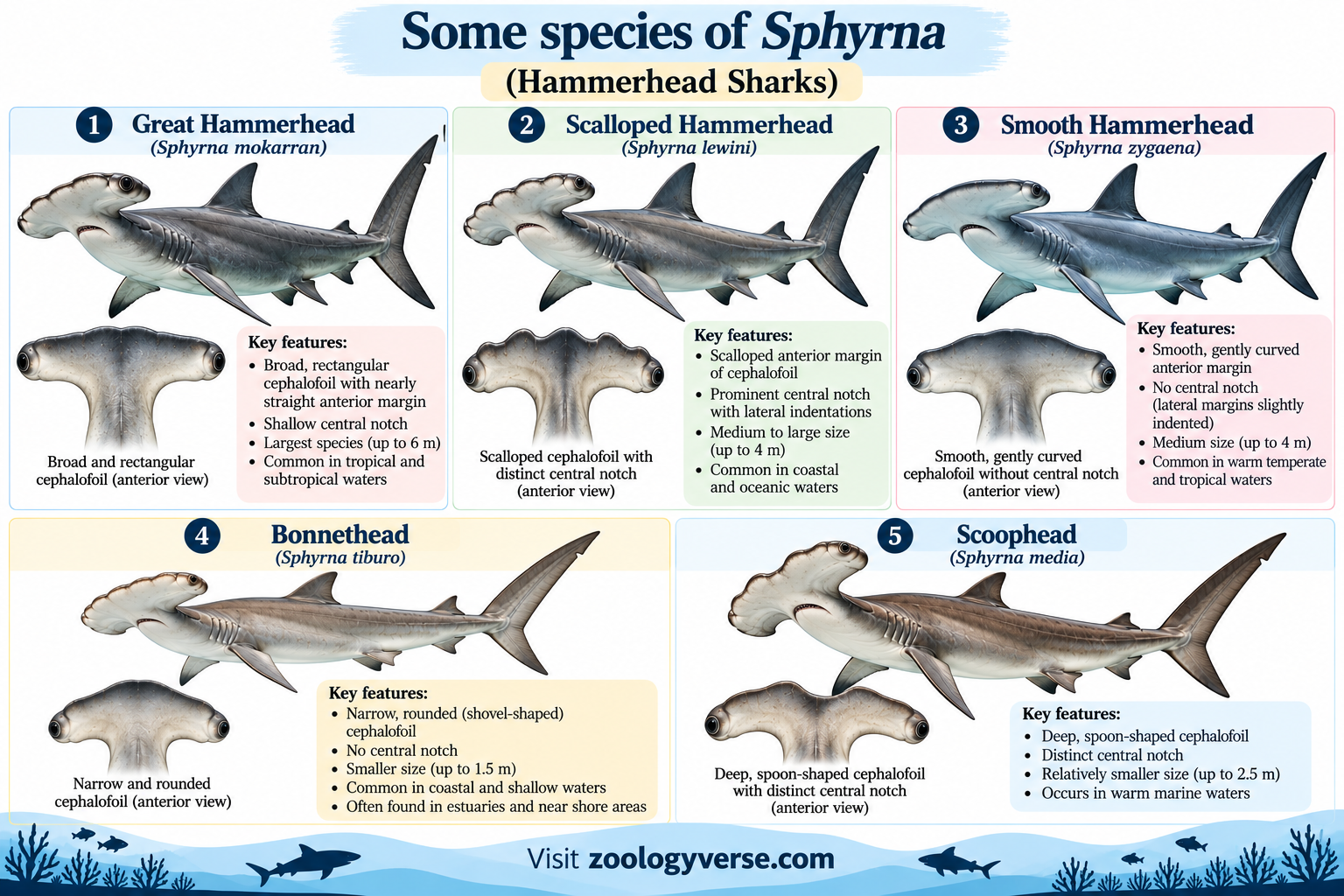
The genus Sphyrna includes several species, such as the Great Hammerhead (Sphyrna mokarran), Scalloped Hammerhead (Sphyrna lewini), Smooth Hammerhead (Sphyrna zygaena), Bonnethead (Sphyrna tiburo), and Scoophead (Sphyrna media). FishBase currently lists 11 species within Sphyrna.
Like other elasmobranchs, Sphyrna has a cartilaginous endoskeleton and five pairs of gill openings. It lacks a spiracle, a useful distinguishing feature when comparing it with some other shark groups. Members of the family feed on a variety of prey, including fishes, other elasmobranchs, cephalopods, crustaceans, and other marine animals.
Sphyrna is an important genus for zoology practical studies because its hammer-shaped cephalofoil, widely separated eyes, ventral mouth, five pairs of gill slits, fins, and characteristic body form provide useful features for identification and comparative study of cartilaginous fishes.
Sphyrna Species and Common Name
The genus Sphyrna belongs to the family Sphyrnidae and includes several species commonly known as hammerhead sharks. The name Sphyrna refers to the characteristic hammer-shaped, laterally expanded head or cephalofoil found in its members.
Unlike a species-level article, this article deals with Sphyrna as a genus. FishBase currently recognizes several species within the genus, including the Great Hammerhead (Sphyrna mokarran), Scalloped Hammerhead (S. lewini), Smooth Hammerhead (S. zygaena), Bonnethead (S. tiburo), Scoophead (S. media), and other hammerhead species.
Common Name
Members of Sphyrna are generally referred to as Hammerhead Sharks because of their distinctive head shape. The laterally expanded head separates the eyes and nasal openings widely and is the most recognizable feature of the group.
The common name may vary according to the species. For example:
| Scientific Name | Common Name |
|---|---|
| Sphyrna mokarran | Great Hammerhead |
| Sphyrna lewini | Scalloped Hammerhead |
| Sphyrna zygaena | Smooth Hammerhead |
| Sphyrna tiburo | Bonnethead |
| Sphyrna media | Scoophead |
| Sphyrna tudes | Smalleye Hammerhead |
| Species | Istiophorus platypterus (Indo-Pacific sailfish) and Istiophorus albicans (Atlantic sailfish) |
Thus, Sphyrna is the genus name, while names such as Great Hammerhead, Scalloped Hammerhead, Smooth Hammerhead, Bonnethead, and Scoophead refer to particular species within the genus.
Taxonomic Note
Older practical-zoology manuals may simply list “Sphyrna: Hammer-headed Shark” as a specimen name. This terminology is still useful for practical examinations, but modern classification recognizes Sphyrna as a genus containing multiple species.
For zoology practical study, the specimen can therefore be written as:
Sphyrna — Hammerhead Shark
The most important identification feature is the laterally expanded hammer-shaped head (cephalofoil).
For Practical Study
The following notes are arranged in a practical examination format for easy study and identification.
Classification of Sphyrna (Hammerhead Shark)
| Rank | Classification | Characteristic |
|---|---|---|
| Kingdom | Animalia | Multicellular, heterotrophic organisms without a cell wall. |
| Phylum | Chordata | Dorsal nerve cord and other chordate features are present during development. |
| Subphylum | Vertebrata | Cranium and vertebral column are present. |
| Division | Gnathostomata* | Jaws and paired appendages are present. |
| Superclass | Pisces* | Traditional zoological grouping of aquatic vertebrates with fins and gills. |
| Class | Chondrichthyes | Endoskeleton is predominantly cartilaginous |
| Subclass | Elasmobranchii | Five pairs of gill openings |
| Order | Carcharhiniformes | Carpet sharks |
| Family | Sphyrnidae | Hammerhead sharks |
| Genus | Sphyrna | Laterally expanded head |
Note: Gnathostomata and Pisces are traditional practical-zoology ranks that may still be used in examination-oriented classification. Modern classifications generally emphasize Chondrichthyes, Elasmobranchii, Carcharhiniformes, Sphyrnidae, and Sphyrna. FishBase places Sphyrna in Sphyrnidae and Carcharhiniformes.
Geographical Distribution
Sphyrna occurs mainly in warm marine waters of tropical and subtropical regions. Different species have different geographic ranges, with members occurring in coastal and oceanic environments. Some species may also enter brackish waters.
Habit and Habitat
Members of Sphyrna are active marine sharks and occur in coastal waters, continental shelves, reefs, bays, and open-ocean environments depending on the species. They are generally strong swimmers and are predatory in habit.
They feed on fishes, cephalopods, crustaceans, other elasmobranchs, and various other marine animals.
Characteristics Of Sphyrna (Hammerhead Shark)
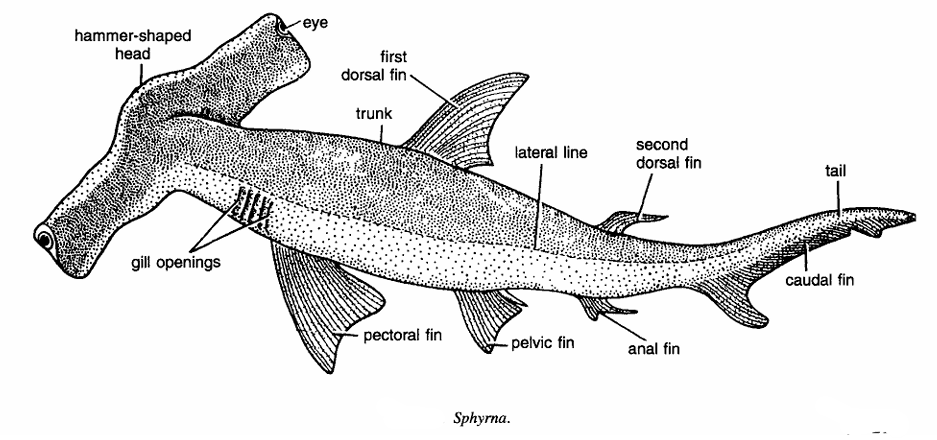
- Head greatly expanded laterally into a hammer-shaped cephalofoil.
- Eyes are widely separated and situated toward the lateral ends of the head.
- Nasal openings are also widely separated.
- Body is elongated and streamlined.
- Mouth is ventral and crescent-shaped.
- Five pairs of gill slits are present.
- Spiracle is absent.
- Pectoral fins are well developed.
- Two dorsal fins and a caudal fin are present.
- Members are active marine predators.
- The exact head shape varies among different Sphyrna species.
Special Features
Sphyrna is characterized by a distinctive hammer-shaped, laterally expanded head called the cephalofoil. The eyes and nasal openings are positioned widely apart on the expanded head. The body is elongated and streamlined, while the mouth is situated on the ventral side of the head.
Identification of Sphyrna (Hammerhead Shark)
The specimen can be identified by its strongly expanded hammer-shaped head, widely separated eyes, ventral mouth, five pairs of gill slits, elongated body, and absence of a spiracle.
The exceptionally broad cephalofoil is the most characteristic feature and readily distinguishes Sphyrna from many other sharks encountered in practical zoology.
External Morphology of Sphyrna
The body of Sphyrna is elongated and streamlined, as expected in an actively swimming shark. Its most remarkable external feature is the greatly expanded head, or cephalofoil, which gives hammerhead sharks their characteristic appearance. The exact shape and width of the cephalofoil vary among species.
1. Body
The body is elongated and relatively streamlined, with the trunk gradually narrowing toward the tail. The dorsal surface is generally darker than the ventral surface, providing countershading that is common among marine fishes.
The body is covered with placoid scales (dermal denticles), which give the skin a rough texture and help reduce resistance during swimming.
2. Head and Cephalofoil
The head is expanded laterally into a broad, flattened structure called the cephalofoil. This is the most distinctive feature of Sphyrna.
The shape of the cephalofoil differs among species. In some species it is very broad and nearly hammer-shaped, whereas in others it is narrower or more rounded.
The expanded head provides a large surface for sensory structures and gives the eyes and nasal openings their characteristic widely separated positions.
3. Eyes
A pair of eyes is present on the lateral portions of the expanded head. Their widely separated position is one of the characteristic features of hammerhead sharks.
The lateral placement of the eyes provides a broad field of vision and is closely associated with the unusual shape of the cephalofoil.
4. Nasal Openings
The paired nasal openings are situated on the anterior region of the cephalofoil and are widely separated from one another.
Their position, together with the widely separated eyes, contributes to the distinctive sensory arrangement of the hammerhead head.
5. Mouth
The mouth is situated on the ventral surface of the head. It is broad and generally crescent-shaped.
The jaws bear numerous teeth adapted for grasping and cutting prey. The precise shape and arrangement of the teeth vary among species according to their feeding habits.
6. Gill Slits
There are five pairs of gill slits on the sides of the head. They provide external openings through which water leaves the pharyngeal cavity after passing over the gills.
The five pairs of gill openings are an important characteristic of Sphyrna and other elasmobranchs.
7. Spiracle
A spiracle is absent in Sphyrna. This is a useful distinguishing feature when comparing hammerhead sharks with shark groups that possess prominent spiracles.
8. Fins
The fins provide stability, steering, and propulsion during swimming.
- Pectoral fins: Broad and well developed; they extend laterally from the body and help control movement and lift.
- Pelvic fins: Present on the posterior ventral region of the body.
- First dorsal fin: Large and prominent, providing stability during swimming.
- Second dorsal fin: Smaller than the first dorsal fin.
- Anal fin: Present behind the pelvic region.
- Caudal fin: Large and powerful, providing the main propulsive force during swimming.
The relative position and proportions of the fins can vary between Sphyrna species.
9. Tail
The tail is elongated and terminates in a well-developed caudal fin. The caudal fin is heterocercal, with the vertebral column extending into the upper lobe.
The powerful tail provides forward propulsion and enables Sphyrna to maintain active swimming.
10. Colouration
Colouration varies among species, but the dorsal surface is generally darker than the ventral surface. This countershading helps reduce visibility when viewed from above or below in the marine environment.
The exact shades and patterns should not be used as the primary genus-level identification characters because they vary among species.
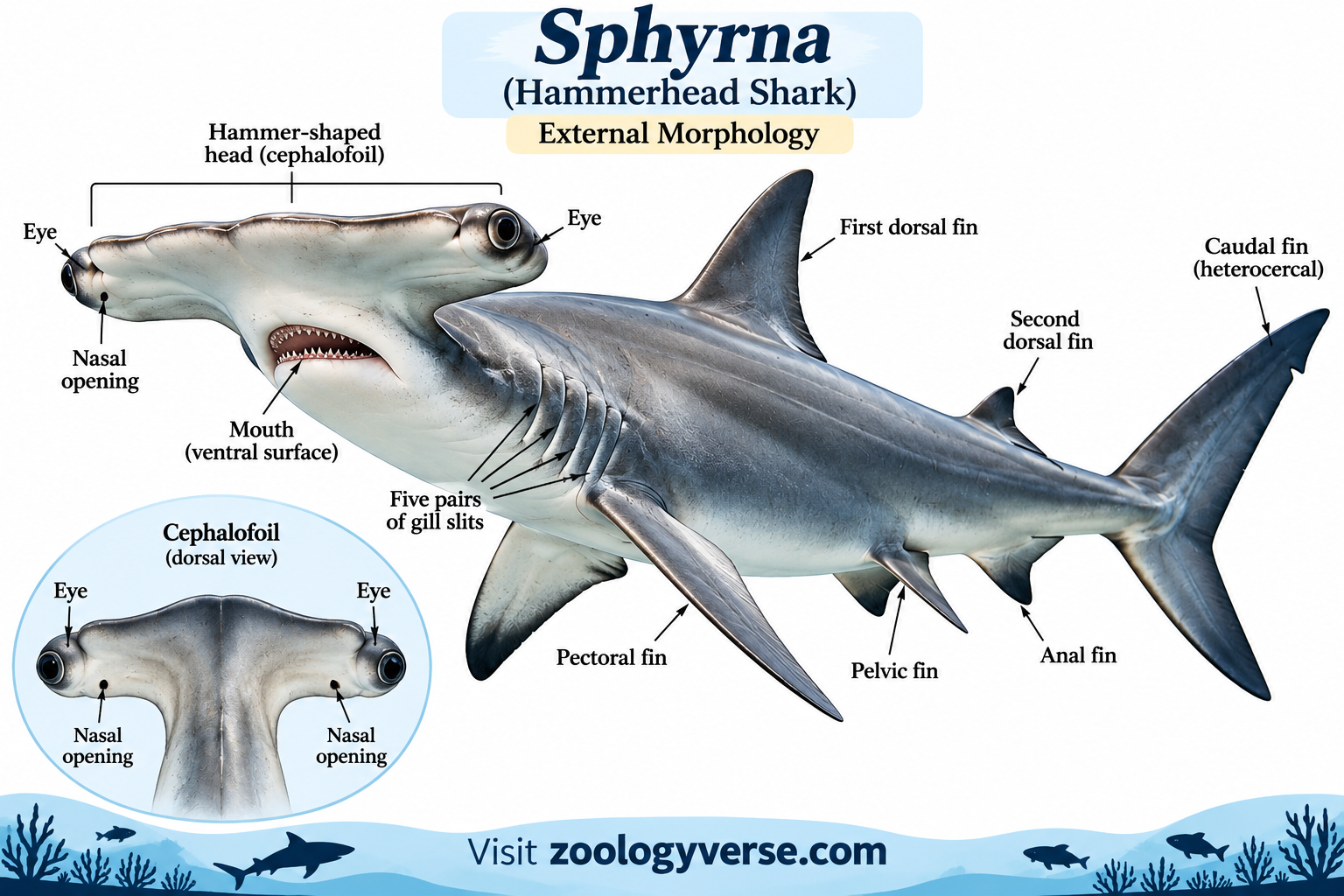
External Identification Features: For practical identification, the most useful external characters of Sphyrna are:
- Broad, laterally expanded cephalofoil
- Widely separated eyes
- Widely separated nasal openings
- Ventral crescent-shaped mouth
- Five pairs of gill slits
- Absence of a spiracle
- Elongated, streamlined body
- Well-developed pectoral and dorsal fins
- Powerful caudal fin
- Placoid scales covering the body
Together, these features give Sphyrna its characteristic hammerhead appearance and distinguish it from many other shark genera.
Digestive System of Sphyrna
The digestive system of Sphyrna is adapted for a carnivorous predatory diet. It consists of the alimentary canal and associated digestive glands. The main parts of the alimentary canal are the mouth, buccal cavity, pharynx, oesophagus, stomach, intestine, rectum, and cloaca. The principal digestive glands are the liver and pancreas.
1. Mouth and Buccal Cavity
The mouth is situated on the ventral surface of the head. It opens into a spacious buccal cavity.
The jaws bear numerous teeth that help seize, hold, and cut prey. Food enters the buccal cavity before passing into the pharynx.
2. Pharynx
The pharynx is a muscular region situated behind the buccal cavity. It is associated with both feeding and respiration.
During feeding, swallowed food passes from the pharynx into the oesophagus. The pharyngeal region is also associated with the internal openings of the gill slits.
3. Oesophagus
The oesophagus is a short, muscular tube connecting the pharynx with the stomach. Its muscular walls help transport swallowed food toward the stomach.
4. Stomach
The stomach is a muscular sac where food is temporarily stored and subjected to gastric digestion.
Gastric secretions contain acids and enzymes that begin the chemical breakdown of food, particularly proteins.
5. Intestine
The intestine receives partially digested food from the stomach and is the principal region for further digestion and absorption of nutrients.
A characteristic feature of the elasmobranch intestine is the spiral valve. The spiral folds increase the internal absorptive surface and slow the movement of food through the intestine, allowing more time for digestion and nutrient absorption.
The spiral valve is therefore an important feature for practical identification and comparative anatomy of sharks.
6. Rectum
The posterior part of the intestine forms the rectal region. It receives the remaining undigested material and conducts it toward the cloaca.
7. Cloaca
The alimentary canal opens posteriorly into the cloaca, a common chamber associated with the terminal digestive and urogenital passages.
Undigested material eventually passes out through the cloacal opening.
8. Liver
The liver is a large and important digestive gland. It produces bile, which assists in the digestion and absorption of fats.
The liver also contains a considerable amount of oil, which contributes to buoyancy and helps reduce the need for a gas-filled swim bladder.
9. Pancreas
The pancreas produces digestive enzymes that contribute to the breakdown of carbohydrates, proteins, and fats. It therefore plays an important role in chemical digestion.
Digestive Tract in Sequence
Mouth → Buccal cavity → Pharynx → Oesophagus → Stomach → Intestine with spiral valve → Rectum → Cloaca
The spiral valve is one of the most significant internal adaptations of Sphyrna and other elasmobranchs because it increases absorptive efficiency without requiring an extremely long intestine.
Feeding and Food
Sphyrna species are carnivorous marine predators. Their diet varies among species and according to habitat, body size, and prey availability. Members of the family Sphyrnidae feed on fishes, other elasmobranchs, cephalopods, crustaceans, and other marine animals.
Feeding Habit
Hammerhead sharks are active predators that search for prey in coastal and oceanic environments. Depending on the species, they may forage near the sea floor, in the water column, or around reef and continental-shelf habitats.
The broad cephalofoil is associated with the sensory capabilities of hammerhead sharks and provides a distinctive structure for detecting and locating prey.
Food: The food of Sphyrna may include:
- Fishes — an important component of the diet of many species.
- Other elasmobranchs — smaller sharks, rays, and related cartilaginous fishes may be consumed.
- Cephalopods — squid and other cephalopods form part of the diet of some species.
- Crustaceans — crabs, shrimps, and other crustaceans may be eaten, particularly by species that forage near the bottom.
- Other marine animals — the diet can vary with species, habitat, and prey availability.
Feeding Adaptations
| Adaptation | Feeding significance |
|---|---|
| Broad cephalofoil | Provides a large surface associated with sensory detection |
| Widely separated sensory structures | Helps sample environmental information across a broad head region |
| Ventral mouth | Suitable for taking prey below the head |
| Numerous teeth | Help grasp, hold, and cut prey |
| Powerful jaws | Assist in capturing and processing prey |
| Streamlined body | Supports active swimming during prey pursuit |
| Powerful caudal fin | Provides propulsion during swimming |
The importance of individual adaptations differs among species, so these features should be considered as general adaptations of hammerhead sharks rather than identical feeding mechanisms in every Sphyrna species.
Feeding Mechanism
A hammerhead shark detects potential prey using its highly developed sensory systems and approaches the prey using its powerful swimming muscles and caudal fin. The prey is seized with the jaws and teeth and then swallowed.
Species that forage near the bottom can also use the broad head while searching over the substrate. The widely distributed sensory structures on the cephalofoil are particularly notable in hammerhead sharks.
Practical Significance
For practical zoology, Sphyrna can be described as a carnivorous, active marine predator. Its well-developed jaws and teeth, streamlined body, powerful tail, and distinctive cephalofoil are important features associated with its predatory mode of life.
Thus, the feeding adaptations of Sphyrna combine sensory detection, active swimming, prey capture, and efficient processing of animal food.
Respiratory System of Sphyrna
The respiratory system of Sphyrna is adapted for obtaining oxygen from water. Like other elasmobranchs, it breathes through gills located in the pharyngeal region. Water passes over the gill surfaces, where oxygen is absorbed into the blood and carbon dioxide is released into the surrounding water.
1. Gill Slits
Sphyrna possesses five pairs of gill slits on either side of the head. These are external openings through which water leaves the pharyngeal cavity after passing over the gills.
The five pairs of gill openings are an important external characteristic of hammerhead sharks and other members of Elasmobranchii.
2. Absence of Spiracle
Unlike some other shark groups, Sphyrna does not possess a spiracle. Water therefore enters primarily through the mouth and passes into the pharyngeal region before flowing across the gills.
3. Gills
The gills are situated on the sides of the pharyngeal region and are supported by gill arches.
Each gill bears numerous delicate gill filaments, which provide a large respiratory surface. The filaments contain numerous secondary lamellae supplied with blood vessels.
The thin walls of the lamellae allow efficient exchange of respiratory gases between the blood and surrounding water.
4. Water Flow and Gas Exchange
During respiration, water enters through the mouth and reaches the pharyngeal cavity.
The general pathway is:
Mouth → Buccal cavity → Pharyngeal cavity → Gills → Five pairs of gill slits → Outside
As water passes over the gill filaments and secondary lamellae:
- Oxygen diffuses from the water into the blood.
- Carbon dioxide diffuses from the blood into the water.
- The oxygenated blood is distributed to the tissues of the body.
The respiratory and digestive pathways share the pharyngeal region, but water used for respiration passes over the gills rather than through the digestive tract.
5. Gill Structure
The major structural components of the gills include:
| Structure | Function |
|---|---|
| Gill arches | Support the gills |
| Gill filaments | Provide respiratory surface |
| Secondary lamellae | Main site of gaseous exchange |
| Blood vessels | Transport respiratory gases |
| Gill slits | Allow water to leave the body |
6. Importance of the Gill System
The extensive surface area of the gill filaments and secondary lamellae allows Sphyrna to obtain sufficient oxygen for its active lifestyle.
The respiratory system is therefore closely related to its active swimming and predatory habit, which require a continuous supply of oxygen to the muscles and other tissues.
Significance
The following respiratory features are important for practical identification and examination:
- Five pairs of gill slits
- Gills situated in the pharyngeal region
- Well-developed gill filaments and secondary lamellae
- Gill arches supporting the respiratory structures
- Absence of a spiracle
- Water entering through the mouth and leaving through the gill slits
Thus, the respiratory system of Sphyrna is a highly efficient branchial respiratory system adapted to life in marine environments.
Reproduction in Sphyrna
Members of the genus Sphyrna are dioecious, meaning that males and females are separate individuals. Reproduction occurs by sexual reproduction with internal fertilization. Hammerhead sharks are viviparous, with embryos developing inside the female and young being born as free-swimming juveniles.
1. Sexes
Male and female Sphyrna are separate.
The sexes can be distinguished externally by the presence of claspers in males. Claspers are elongated structures associated with the pelvic fins and are used to transfer sperm to the female during mating.
Females lack claspers.
2. Internal Fertilization
Fertilization takes place inside the female reproductive tract. During mating, the male uses one of its claspers to transfer sperm into the female.
Internal fertilization is an important reproductive characteristic of elasmobranchs.
3. Viviparity
Unlike sharks that lay eggs externally, Sphyrna species give birth to live young. The developing embryos remain inside the female until they are sufficiently developed for birth.
In hammerhead sharks, the developing embryos are nourished through the reproductive system of the mother. In species such as the Great Hammerhead (Sphyrna mokarran), development is described as viviparous with a yolk-sac placenta.
4. Embryonic Development
The general sequence of reproduction is:
Mating → Internal fertilization → Embryonic development inside female → Development of young → Birth of free-swimming juvenile
During early development, the embryo receives nourishment from its yolk reserve. In species exhibiting placental development, the yolk-sac placenta provides additional nourishment during later development.
5. Birth and Young
The young are born as relatively well-developed juveniles and are capable of independent swimming and feeding after birth.
For example, FishBase records newborn Great Hammerheads at approximately 50–70 cm in length, although reproductive measurements vary among species.
Reproductive Features
| Structure | Description |
|---|---|
| Sexes | Male and female separate |
| Fertilization | Internal |
| Male reproductive structure | Claspers |
| Reproductive mode | Viviparous |
| Young | Born as free-swimming juveniles |
| Parental care after birth | No prolonged parental care |
The most important reproductive features of Sphyrna for practical zoology are:
- Sexes are separate.
- Fertilization is internal.
- Male possesses claspers.
- Embryonic development occurs inside the female.
- Young are born alive.
- Reproductive details such as litter size and gestation vary among species.
Thus, Sphyrna demonstrates the advanced reproductive adaptations characteristic of many elasmobranchs, combining internal fertilization with internal development and live birth.
Economic and Ecological Importance of Sphyrna
Members of the genus Sphyrna are important components of marine ecosystems. As predatory sharks, they occupy higher trophic levels and interact with populations of fishes, cephalopods, crustaceans, and other marine animals. Their ecological importance is therefore closely connected with marine food-web structure.
1. Ecological Importance
Sphyrna species are predators in marine food webs. By feeding on a variety of marine organisms, they participate in the regulation of prey populations and contribute to the natural structure of marine communities.
Their presence can also indicate the ecological importance of productive coastal and oceanic habitats where different prey species occur.
2. Role in Marine Food Webs
Hammerhead sharks occupy relatively high trophic positions. They consume fishes and other marine animals and, depending on the species, may also prey upon rays, cephalopods, and crustaceans.
Thus, Sphyrna forms an important link between populations of marine prey and larger marine predators.
3. Fisheries Importance
Some Sphyrna species have historically been caught in commercial and artisanal fisheries, either intentionally or as bycatch. Their meat and other body parts may enter fisheries markets in some regions.
However, fishing pressure is an important conservation concern for several hammerhead species, and responsible fisheries management is necessary to reduce unsustainable exploitation.
4. Ecotourism
Hammerhead sharks are also of interest to marine ecotourism and recreational diving. Their distinctive head shape makes them one of the most recognizable groups of sharks for underwater observation.
Responsible shark tourism can contribute to public awareness of marine biodiversity when conducted without disturbing the animals or their habitats.
5. Educational and Scientific Importance
Sphyrna is particularly valuable for zoological and biological studies because it demonstrates several important features of cartilaginous fishes, including:
- Cartilaginous endoskeleton
- Placoid scales
- Five pairs of gill slits
- Absence of a spiracle
- Internal fertilization
- Male claspers
- Viviparous reproduction
- Spiral-valve intestine
- Specialized hammer-shaped cephalofoil
Conservation Status
The conservation status of Sphyrna should be considered species by species, because the genus contains several hammerhead shark species with different population trends and Red List assessments. Therefore, a single IUCN category should not be assigned to the entire genus.
Major Threats: Hammerhead sharks are affected by several human-related pressures, including:
- Overfishing and targeted shark fisheries
- Bycatch in commercial and artisanal fisheries
- International trade in shark products
- Habitat degradation in important coastal areas
- Coastal development and pollution
- Reduction of prey populations and degradation of marine habitats
Fishing pressure is particularly important because some hammerhead species have experienced substantial population declines.
Species-Specific Conservation Status
Three well-known Sphyrna species have been included in CITES Appendix II:
| Species | Common Name | Conservation Information |
|---|---|---|
| Sphyrna lewini | Scalloped Hammerhead | CITES Appendix II; IUCN assessment has classified it as Critically Endangered |
| Sphyrna mokarran | Great Hammerhead | CITES Appendix II; IUCN assessment has classified it as Critically Endangered |
| Sphyrna zygaena | Smooth Hammerhead | CITES Appendix II; IUCN assessment has classified it as Vulnerable |
CITES Appendix II regulates international trade rather than imposing a complete international trade ban. The CITES listing of these three hammerhead species entered into effect in 2014.
The conservation status of other Sphyrna species can differ, so their individual IUCN assessments should be checked separately rather than applying the status of one species to the whole genus.
Conservation Measures: Important conservation measures include:
- Reducing unsustainable fishing pressure
- Minimizing accidental capture and bycatch
- Protecting important coastal and marine habitats
- Monitoring hammerhead populations and fisheries
- Improving species-level identification in shark catches and trade
- Regulating international trade under CITES requirements
- Promoting responsible shark fisheries and marine conservation
- Increasing public awareness about the ecological importance of sharks
Species-level identification is particularly important because hammerhead species and their fins can be difficult to distinguish in trade. CITES documentation highlights the need for improved species-level monitoring and identification.
Note: IUCN Red List assessments are periodically updated. The current IUCN Red List version is 2026-1, released in July 2026, so species-level statuses should be checked against the latest assessment when the article is updated.
Key Takeaways
- Sphyrna is a genus of hammerhead sharks belonging to the family Sphyrnidae and order Carcharhiniformes.
- The name Sphyrna refers to the characteristic hammer-shaped, laterally expanded head or cephalofoil.
- The genus includes several species, including the Great Hammerhead (Sphyrna mokarran), Scalloped Hammerhead (Sphyrna lewini), Smooth Hammerhead (Sphyrna zygaena), Bonnethead (Sphyrna tiburo), and Scoophead (Sphyrna media). FishBase currently lists 11 species in the genus.
- The head is greatly expanded laterally, with the eyes and nasal openings widely separated.
- The body is elongated and streamlined and is covered with placoid scales.
- There are five pairs of gill slits.
- A spiracle is absent, which is an important identification feature.
- The mouth is situated on the ventral surface and bears numerous teeth adapted for capturing prey.
- Sphyrna species are carnivorous marine predators, feeding on fishes, cephalopods, crustaceans, other elasmobranchs, and other marine animals.
- The digestive system includes an intestine with a spiral valve, which increases absorptive efficiency.
- Reproduction involves internal fertilization, with males using claspers to transfer sperm.
- Hammerhead sharks are viviparous, producing fully developed young; reproductive details such as litter size vary among species.
- Members of the genus occur mainly in warm marine waters, although distribution and habitat differ among species.
- Several Sphyrna species face significant conservation pressures, particularly from fishing and trade.
- Conservation status should always be considered species-specific, rather than assigning one category to the entire genus.
- The laterally expanded hammer-shaped head, widely separated eyes, five pairs of gill slits, and absence of a spiracle are the most useful practical identification characters.
Frequently Asked Questions
What is Sphyrna?
Sphyrna is a genus of cartilaginous fishes in the family Sphyrnidae and order Carcharhiniformes. Its members are commonly known as hammerhead sharks because of their laterally expanded, hammer-shaped heads.
What is the common name of Sphyrna?
The general common name is Hammerhead Shark or hammerhead sharks. Different species have specific common names, such as Great Hammerhead, Scalloped Hammerhead, Smooth Hammerhead, Bonnethead, and Scoophead.
What is the characteristic feature of Sphyrna?
The most characteristic feature is the laterally expanded hammer-shaped head, called the cephalofoil. The eyes and nasal openings are widely separated on the expanded head.
How many gill slits are present in Sphyrna?
Sphyrna has five pairs of gill slits, or five gill openings on each side of the head.
Does Sphyrna have a spiracle?
No. A spiracle is absent in Sphyrna. This is a useful feature for distinguishing hammerhead sharks from some other shark groups.
What does Sphyrna eat?
Sphyrna species are carnivorous predators. Their food may include fishes, rays and other elasmobranchs, cephalopods, crustaceans, and other marine animals. The exact diet varies among species.
How does Sphyrna reproduce?
Members of Sphyrna reproduce sexually and have internal fertilization. Males possess claspers for transferring sperm, and hammerhead sharks are viviparous, giving birth to live young.
What is the function of the cephalofoil in Sphyrna?
The cephalofoil is the characteristic expanded head structure of hammerhead sharks. It provides a broad region containing sensory structures and is associated with their ability to detect environmental stimuli and prey.
Is Sphyrna a bony fish?
No. Sphyrna is a cartilaginous fish belonging to Chondrichthyes. Its endoskeleton is primarily composed of cartilage rather than true bone.
What is the digestive adaptation of Sphyrna?
The intestine contains a spiral valve, which increases the effective absorptive surface and slows the passage of food, allowing more efficient digestion and absorption.
Recommended Study Resource
Sharks of the World
by Rodney Steel (Author)
Practical Zoology: Vertebrate
by S. S. Lal (Author)
As an Amazon Associate I earn from qualifying purchases.
References
- Sphyrna zygaena, Smooth hammerhead : fisheries, gamefish
- Sphyrna mokarran, Great hammerhead : fisheries, gamefish
- Hammerhead shark-wikipedia
- Sphyrna zygaena (Linnaeus, 1758)
- IUCN Red List of Threatened Species. Species-level conservation assessments for hammerhead sharks.
- Sharks and rays – CITES
Discover more from Zoologyverse
Subscribe to get the latest posts sent to your email.