
Leucosolenia
Leucosolenia is a genus of simple calcareous sponges belonging to the class Calcarea. These small, tube-shaped sponges are usually found in shallow marine waters attached to rocks, shells, or other submerged surfaces. Their bodies contain calcium carbonate spicules and a basic canal system that allows water to flow through for filter feeding on microscopic particles and organic matter. Despite their simple structure, Leucosolenia contributes to maintaining water quality and supports biodiversity in coastal marine ecosystems.
| Feature | Description |
|---|---|
| Common Name | Leucosolenia |
| Phylum | Porifera |
| Class | Calcarea |
| Order | Homocoela |
| Habitat | Marine |
| Canal System | Asconoid |
| Skeleton | Calcareous spicules |
| Reproduction | Sexual and Asexual |
| Symmetry | Radial or Asymmetrical |
| Larva | Parenchymula |
Classification of Leucosolenia
- Phylum :- Porifera (Pore bearing, cellular grade, asymmetrical or radially symmetrical)
- Class :- Calcarea (Calcareous spicules present)
- Order :- Homocoela (Canal system of ascon type)
- Genus :- Leucosolenia
Habit and habitat of Leucosolenia
Marine colonial sponge found in shallow waters below tidemark on seashore rocks, having intense wave action of the water.
Distribution
Distributed from Matha’s vineyard to Gulf of St. Lawrence. From Casco bay to Arctic ocean and common in Europe.
General Characteristics of Leucosolenia
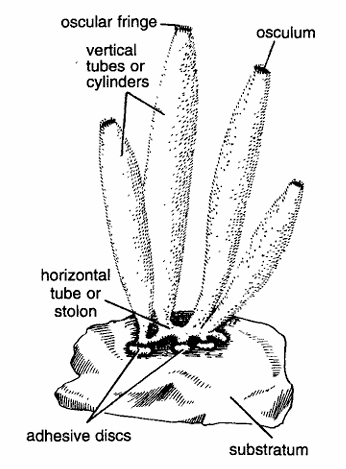
- Colony is composed of bunches of whitish vertical cylinders and tubes about 25 mm long.
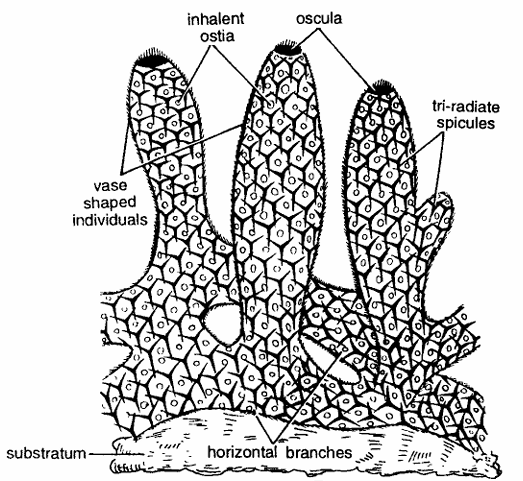
- Vertical tubes of the colony contain osculum distally. They are joined together by horizontal tubes at the base. The surface of the body is perforated by numerous pores or ostia or incurrent pores.
- Magnified portion of the colony shows vase-shaped individuals, inhalent ostia, tri-radiate spicules and horizontal branches attached to substratum.
- Simplest sponge with ostia ~ spongocoel ~ osculum arrangement of water current.
- Canal system is simplest of ascon type. Osculum is surrounded by oscular fringe.
- Body wall is composed of dermal epithelium forming outer layer, and Choanocyte layer forming inner layer, separated by middle mesenchyme layer. Calcareous spicules are monaxon or Triaxon. Asexual reproduction by budding, branching and regeneration.
- Sexual reproduction by ova and spermatozoa.
- Larva is parenchymula.
- It has phylogenetic significance because complex sycon and leucon sponges pass through ascon stage during their development.
Identification
Since the above specimen contains oscula, ostia, anastomosing colony and all above characters and hence it is Leucosolenia.
Key Takeaways
- Leucosolenia is a simple marine sponge belonging to Phylum Porifera and Class Calcarea.
- It possesses the simplest asconoid canal system among all sponges.
- The body consists of slender, tube-like individuals joined together to form a colony.
- Its skeleton is composed of calcareous spicules that provide structural support.
- Leucosolenia reproduces both sexually and asexually, and its larva is called the parenchymula.
- It is considered an important specimen for understanding the evolution of more complex sponges.
Frequently Asked Questions (FAQs)
What is Leucosolenia?
Leucosolenia is a simple marine sponge belonging to Phylum Porifera and Class Calcarea. It is one of the simplest multicellular animals and is commonly studied in zoology.
Where is Leucosolenia found?
Leucosolenia is found in shallow marine waters attached to rocks, shells, and other submerged surfaces.
What type of canal system is present in Leucosolenia?
Leucosolenia has an asconoid canal system, which is the simplest canal system found in sponges.
What is the skeleton of Leucosolenia made of?
The skeleton consists of calcareous spicules, which provide support and protection.
How does Leucosolenia reproduce?
Leucosolenia reproduces sexually by producing gametes and asexually through budding, branching, and regeneration.
What is the larva of Leucosolenia called?
The larval stage of Leucosolenia is known as the parenchymula larva.
Why is Leucosolenia important in zoology?
Leucosolenia is an important laboratory specimen because it demonstrates the simplest body organization and the asconoid canal system of sponges.
What are the main characteristics of Leucosolenia?
The main characteristics include a marine habitat, colonial tube-like body, asconoid canal system, calcareous spicules, filter-feeding habit, and both sexual and asexual reproduction.
Also read other articles
- Spongilla: Classification, Habitat, Characteristics
- Sycon or Scypha
- Phylum Porifera Explained: Classification, Structure & Examples
- The Canal System
Discover more from Zoologyverse
Subscribe to get the latest posts sent to your email.