
Clathrina or Olynthus
Clathrina and Olynthus are simple marine sponges belonging to the class Calcarea, characterized by skeletons made of calcium carbonate spicules.
Clathrina typically forms delicate, branching or tube-like colonies attached to hard surfaces in shallow coastal waters. It has a very simple body organization in which water flows through small openings directly into internal chambers for filter feeding.
Olynthus represents a basic structural form of calcareous sponges with a thin, cylindrical body and a central cavity through which water circulates. Like other sponges, it feeds on microscopic particles suspended in seawater and contributes to maintaining water clarity and nutrient balance in marine ecosystems.
Classification of Clathrina or Olynthus
- Phylum :- Porifera (Pore bearing, cellular grade, asymmetrical or radially symmetrical)
- Class :- Calcarea (Calcareous spicules present)
- Order :- Homocoela (Canal system of ascon type)
- Genus :- Clathrina
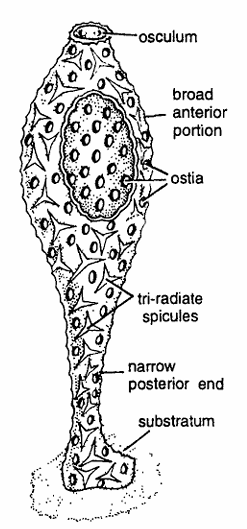
Habit and habitat
Clathrina is a simple, marine sponge attached to rocks or substratum.
Distribution
Distributed from Matha’s vineyard to Gulf of St. Lawrence. From Casco bay to Arctic ocean and common in Europe.
General Characterstics
- Originally it was presumed as adult and was called as Olynthus, but now it is known to represent the late developmental stage of some sponge.
- Sedentary sponge with a free end containing osculum. Spongocoel opens through the osculum.
- Body is cylindrical and perforated by various ostia.
- Triradiate calcareous spicules form the skeleton.
- Development is complicated.
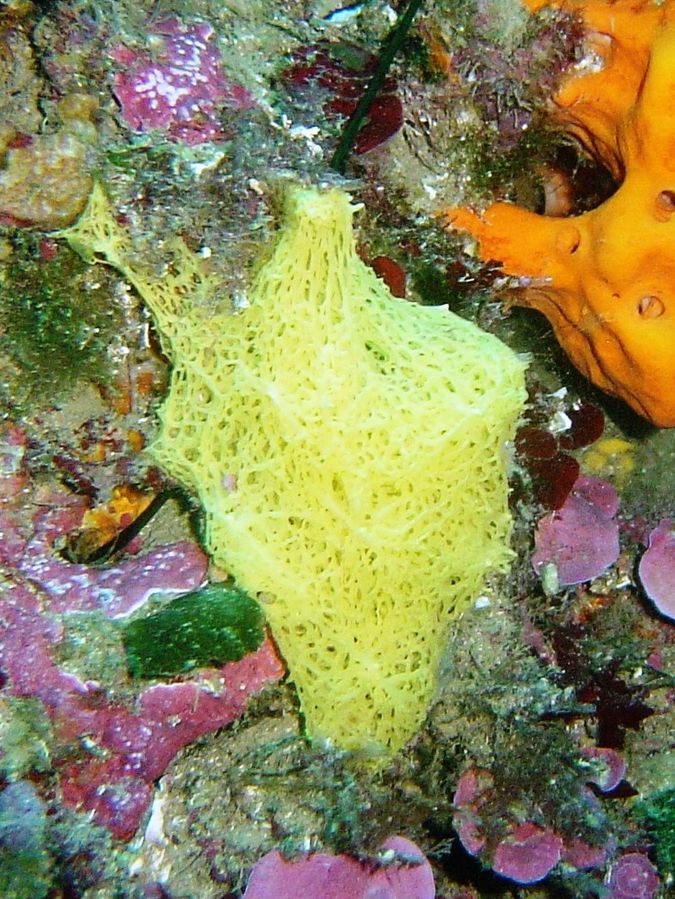
Identification
Since the animal has broad anterior, portion with osculum, ostia and narrow posterior portion attached to substratum and all above characters, hence it is Clathrina.
Discover more from Zoologyverse
Subscribe to get the latest posts sent to your email.