
What Is Phylum Hemichordata?
Hemichordates have a soft, elongated body divided into three main regions: proboscis, collar, and trunk. They possess pharyngeal gill slits and a dorsal tubular structure called the stomochord, but they do not have a true notochord.
Phylum Hemichordata is a small group of marine, worm-like animals that are mainly found in shallow coastal waters and ocean sediments. The name Hemichordata means “half chord”, because these animals were once thought to have a structure similar to the notochord of chordates.
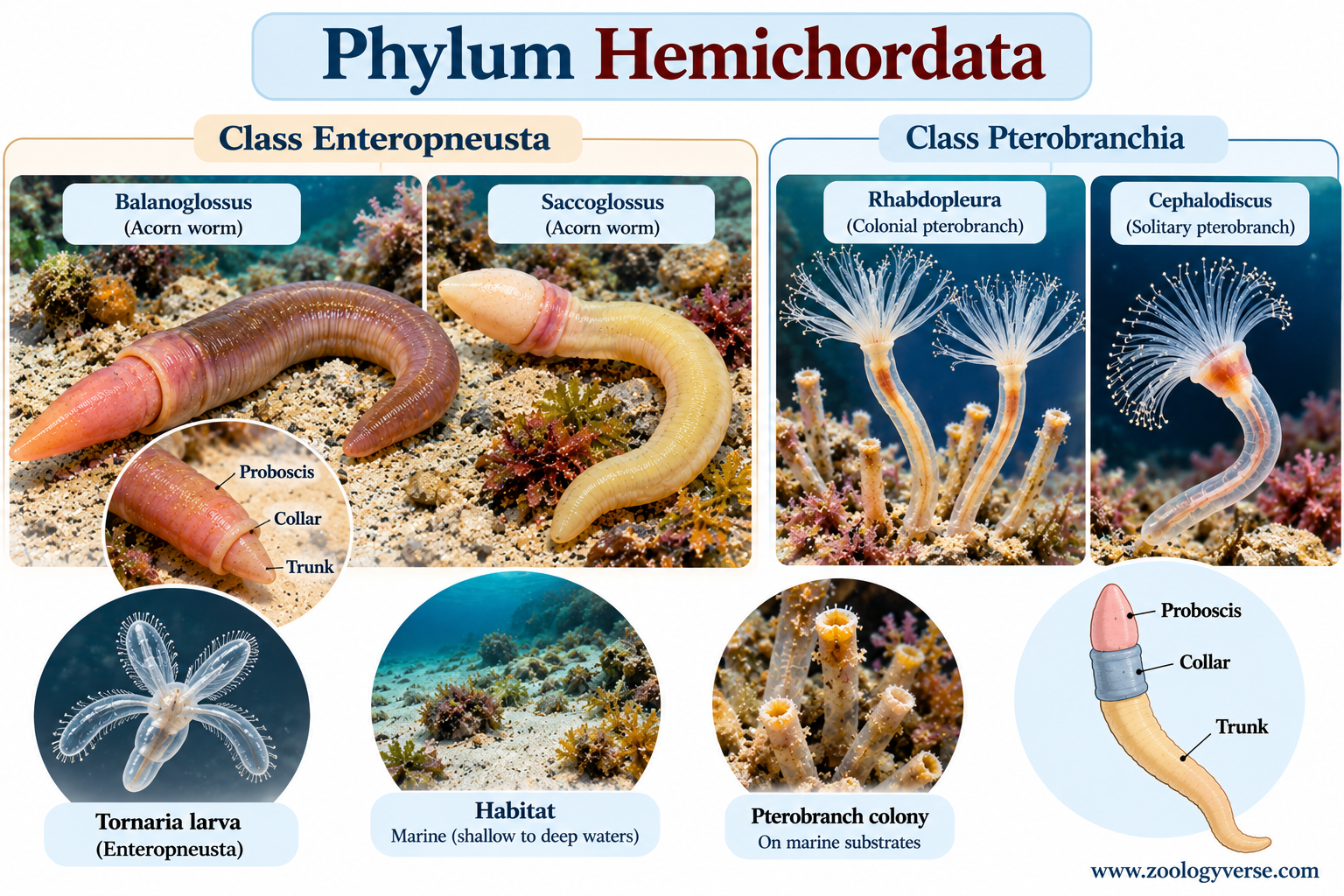
Most hemichordates are marine and live either by burrowing into sediments or attached to the sea floor. Well-known examples include Balanoglossus (acorn worm) and Saccoglossus.
Hemichordata is an important phylum in zoology because its members show some characteristics that help in understanding the evolutionary relationship between invertebrates and chordates.
General Characteristics of Hemichordata
The important characteristics of Phylum Hemichordata are:
- Hemichordates are exclusively marine animals.
- Their body is generally soft, elongated, and worm-like.
- The body is divided into proboscis, collar, and trunk.
- They are mostly bilaterally symmetrical and triploblastic.
- They are coelomate animals, with the coelom divided into compartments.
- The digestive system is complete, with a separate mouth and anus.
- Pharyngeal gill slits are present and help in respiration and filter feeding.
- A structure called the stomochord is present in the proboscis. It is not a true notochord.
- The circulatory system is generally open, with a dorsal heart-like structure.
- Respiration mainly occurs through the pharyngeal gill slits.
- Excretion is carried out mainly by the proboscis gland or glomerulus.
- Most hemichordates are dioecious, although reproductive conditions vary among groups.
- Development may be direct or indirect, and some species have a tornaria larva.
- Important examples include Balanoglossus, Saccoglossus, and Rhabdopleura.
Classification of Phylum Hemichordata
Phylum Hemichordata is traditionally divided into two main classes based on body form and mode of life:
1. Class Enteropneusta
Members of Enteropneusta are commonly known as acorn worms. They are generally solitary, worm-like animals that live in marine sediments or burrows.
Important features:
- Body is divided into proboscis, collar, and trunk.
- Pharyngeal gill slits are well developed.
- Most species are deposit feeders or filter feeders.
- Development may include a characteristic tornaria larva.
Examples: Balanoglossus, Saccoglossus
2. Class Pterobranchia
Pterobranchs are small, mostly colonial marine animals that generally live attached to the substrate.
Important features:
- Body is small and specialized for a sessile lifestyle.
- They may live in secreted tubes.
- Tentacle-like structures help in feeding and water movement.
- Their body organization differs considerably from that of acorn worms.
Examples: Rhabdopleura, Cephalodiscus
Body Structure of Hemichordates
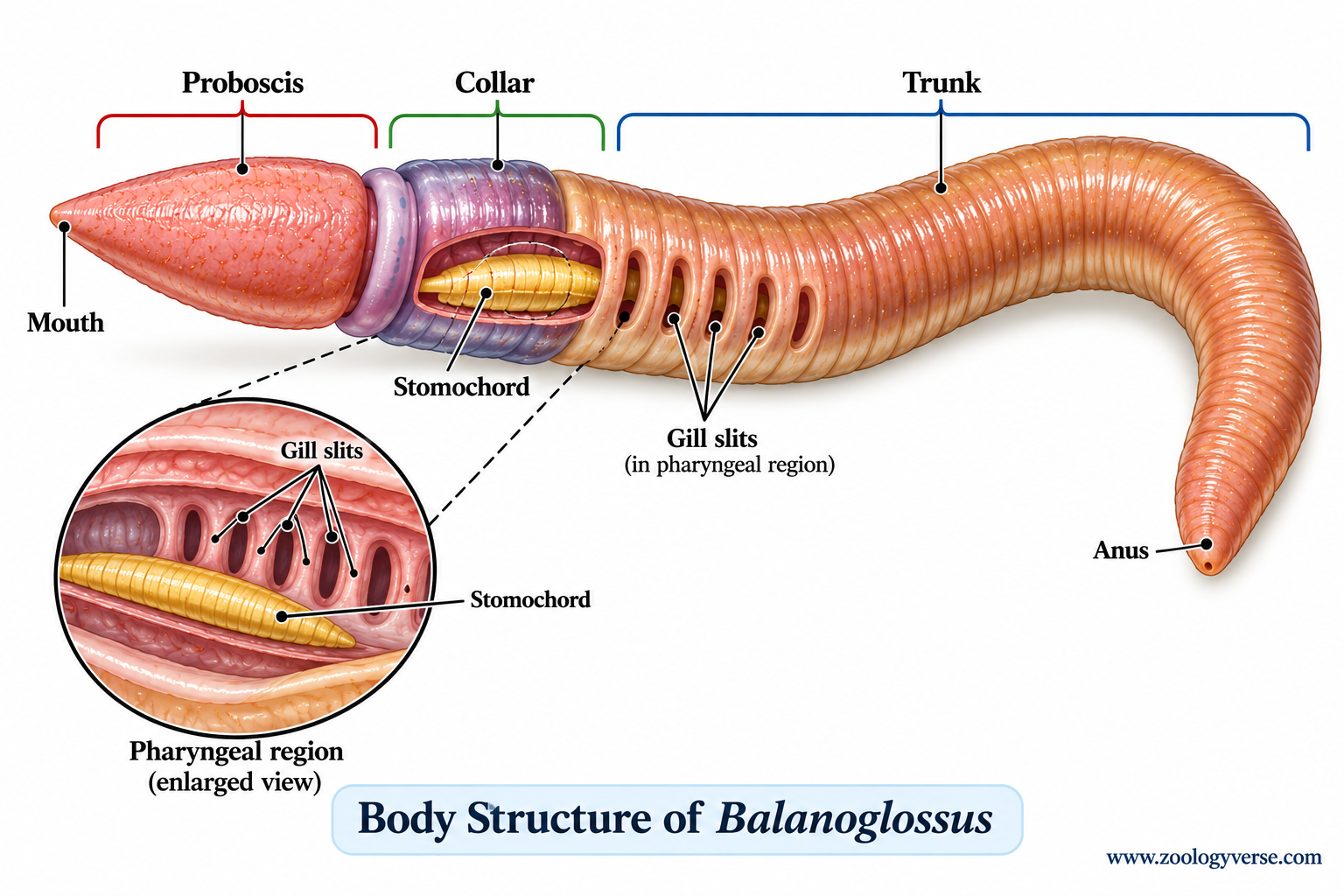
The body of a typical hemichordate, such as Balanoglossus, is soft, elongated, and divided into three distinct regions:
1. Proboscis
The proboscis is the anterior region of the body. It is muscular and helps the animal in burrowing, locomotion, and feeding.
2. Collar
The collar is the short region located behind the proboscis. The mouth is situated at the junction between the proboscis and collar.
3. Trunk
The trunk is the longest part of the body and contains most of the internal organs. It includes the digestive tract, pharyngeal gill slits, and reproductive organs. A characteristic structure called the stomochord extends into the proboscis. Despite its name and historical importance, the stomochord is not homologous to the true notochord of chordates.
Digestive System of Hemichordates
The digestive system of hemichordates is complete, with a distinct mouth and anus. In animals such as Balanoglossus, it is mainly adapted for deposit feeding and filter feeding.
Food enters through the mouth, which is located between the proboscis and collar. From the mouth, it passes into the buccal cavity and then into the pharynx.
The pharynx is an important part of the digestive system because it contains numerous pharyngeal gill slits. These slits allow water to pass out of the pharynx and also play an important role in feeding and respiration.
Behind the pharynx is the oesophagus, which connects the pharynx to the intestine. The intestine extends through the trunk and is responsible for the digestion and absorption of nutrients.
The undigested material passes through the posterior part of the intestine and is finally expelled through the anus, which is located at the posterior end of the body.
Hemichordates therefore have a straight and relatively simple alimentary canal, consisting of the mouth, buccal cavity, pharynx, oesophagus, intestine, and anus.
Respiratory System of Hemichordates
Respiration in hemichordates mainly occurs through the pharyngeal gill slits present in the pharynx. These structures allow the exchange of gases between the surrounding seawater and the animal’s internal tissues.
Water enters through the mouth and passes into the pharynx. It then flows through the pharyngeal region and leaves through the gill slits. Oxygen dissolved in the water diffuses into the blood, while carbon dioxide passes out into the surrounding water.
The walls of the pharyngeal region are thin and richly supplied with blood vessels, making them suitable for gas exchange. In addition to the pharyngeal gill slits, the general body surface can also contribute to respiration, particularly in smaller or exposed body regions.
The respiratory system of hemichordates is therefore closely associated with the pharynx and its gill slits, which are among the most characteristic features of the phylum.
Circulatory System of Hemichordates
The circulatory system of hemichordates is relatively simple and consists mainly of blood vessels, sinuses, and a contractile heart-like structure. It helps transport nutrients, gases, and other substances throughout the body.
A dorsal blood vessel runs along the body and is connected with blood vessels associated with different organs. Blood is circulated through a system of vessels and body spaces.
An important structure is the heart vesicle, located in the anterior region near the proboscis. It works with the surrounding vascular structures to help maintain the circulation of blood.
The circulatory system is generally described as open, because blood is not confined entirely to a closed network of blood vessels and can pass through spaces associated with the tissues.
The blood circulation also supports the pharyngeal region, where oxygen is absorbed through the gill slits. Thus, the circulatory system plays an important role in transporting oxygen and nutrients throughout the body.
Excretory System of Hemichordates
Excretion in hemichordates is mainly carried out by a specialized structure called the proboscis gland, also known as the glomerulus. It is located in the anterior part of the body, within the proboscis.
The glomerulus is closely associated with the heart vesicle and blood vessels. It helps remove metabolic waste products from the blood and releases them to the outside through the proboscis pores.
The proboscis gland is therefore considered the principal excretory organ of hemichordates. It also has an important role in maintaining the internal fluid balance of the animal.
The excretory system is relatively simple compared with that of many other invertebrates and is well adapted to the marine environment in which hemichordates live.
Nervous System of Hemichordates
The nervous system of hemichordates is relatively simple and is mainly responsible for coordinating movement, feeding, and responses to environmental stimuli.
A diffuse nerve plexus is present in the body wall. In addition, a dorsal nerve cord and a ventral nerve cord are present, particularly in the trunk region.
The dorsal nerve cord becomes more specialized in the collar region, where it forms a collar nerve cord. It extends along the body and is associated with the longitudinal nerve system.
Hemichordates do not possess a highly developed brain like vertebrates. Their nervous system is therefore considered less centralized, with coordination occurring through the nerve cords and associated nerve networks.
Sensory structures help hemichordates detect changes in their surroundings and respond to stimuli such as touch, water movement, and changes in the environment.
Reproduction and Development in Hemichordates
Most hemichordates reproduce sexually, and the sexes are generally separate. The reproductive organs are located mainly in the trunk region.
In species such as Balanoglossus, fertilization is usually external. The eggs and sperm are released into seawater, where fertilization takes place.
Development may be direct or indirect, depending on the species. In many enteropneusts, development involves a free-swimming tornaria larva. The larva has a ciliated body and feeds on small particles present in the water.
The tornaria larva eventually undergoes metamorphosis and develops into the adult form. In some hemichordates, however, the young animal develops more directly without a distinct free-swimming larval stage.
Reproduction and development in hemichordates are important in zoology because their larval and adult characteristics provide useful information for understanding the evolutionary relationships of deuterostome animals.
Examples of Hemichordata
Phylum Hemichordata includes several marine animals, with members of Enteropneusta and Pterobranchia being the most commonly studied.
Balanoglossus :- Balanoglossus is commonly called the acorn worm. It is a solitary, marine animal that usually lives in burrows in sandy or muddy sediments. It is one of the most important examples of Hemichordata in zoology.
Saccoglossus :- Saccoglossus is another genus of acorn worms. It is generally found in shallow marine environments and has the typical hemichordate body division into proboscis, collar, and trunk.
Rhabdopleura :- Rhabdopleura belongs to Class Pterobranchia. It is a small colonial animal that lives in tubes attached to the marine substrate.
Cephalodiscus :- Cephalodiscus is also a pterobranch hemichordate. It is a small marine animal that commonly lives in a colony and differs in body form and lifestyle from the larger acorn worms.
Importance of Hemichordata in Zoology
Hemichordates are important in zoology because they show a combination of features that are useful for understanding animal evolution and relationships among deuterostomes.
Their pharyngeal gill slits, body organization, and developmental features provide important information for comparative zoology. The presence of a stomochord was historically considered significant in discussions about their relationship with chordates, although it is not a true notochord.
Hemichordates are also important for studying deuterostome development because their embryological development and larval forms share certain characteristics with other deuterostome groups.
The tornaria larva of many enteropneusts is particularly useful in comparative studies because of its similarities to the larval forms of some other marine deuterostomes.
Hemichordata vs Chordata
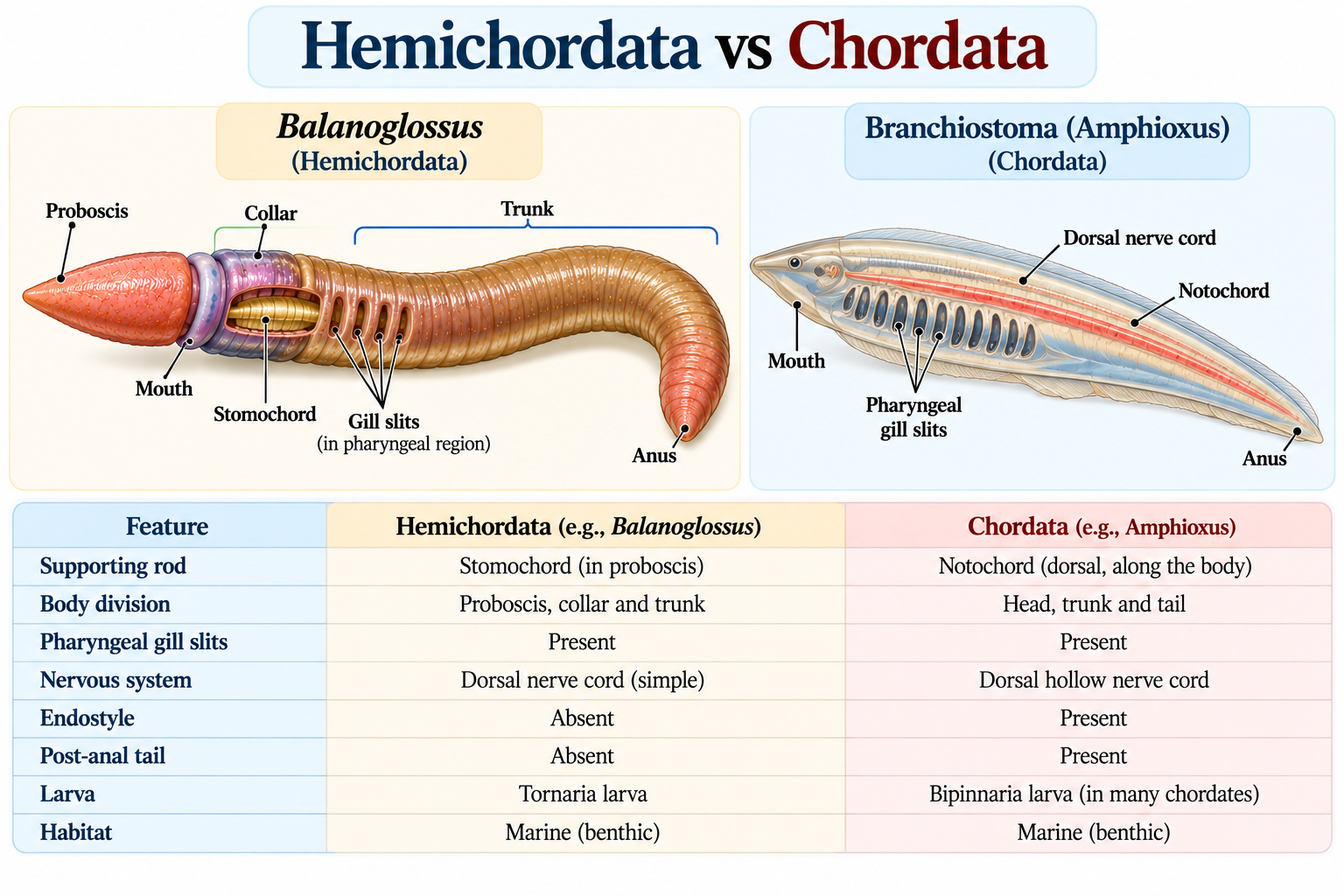
Hemichordates and chordates share some important features, particularly the presence of pharyngeal gill slits, but they are distinct animal groups. The most important differences are given below.
| Feature | Hemichordata | Chordata |
|---|---|---|
| Body division | Proboscis, collar, and trunk | Usually head, trunk, and tail regions |
| Notochord | Absent; stomochord is present | True notochord is present at least during some stage of development |
| Pharyngeal gill slits | Present | Present in at least some stage of development |
| Nervous system | Mainly dorsal and ventral nerve cords with a nerve plexus | Dorsal hollow nerve cord |
| Post-anal tail | Absent | Usually present during development |
| Habitat | Exclusively marine | Marine, freshwater, and terrestrial |
| Examples | Balanoglossus, Saccoglossus, Rhabdopleura | Fish, frogs, birds, reptiles, mammals |
The similarities between these groups are important in evolutionary studies, but Hemichordata is not a subphylum of Chordata. Modern classification places hemichordates within the deuterostomes, alongside chordates and echinoderms.
Key Takeaways
- Hemichordata is a small phylum of exclusively marine animals.
- Their body is divided into proboscis, collar, and trunk.
- The phylum includes two major groups: Enteropneusta and Pterobranchia.
- Balanoglossus is the most commonly studied example of a hemichordate.
- Pharyngeal gill slits are important for respiration and feeding.
- The stomochord is not a true notochord.
- Most hemichordates reproduce sexually, and many enteropneusts have a tornaria larva.
- Hemichordates are important for studying comparative anatomy, embryology, evolution, and deuterostome relationships.
Frequently Asked Questions
What is Phylum Hemichordata?
Phylum Hemichordata is a group of exclusively marine, worm-like animals characterized by a body divided into proboscis, collar, and trunk.
What are the main classes of Hemichordata?
The two commonly recognized classes are Enteropneusta and Pterobranchia.
What is the most common example of Hemichordata?
Balanoglossus, commonly known as the acorn worm, is one of the best-known examples of Hemichordata.
Do hemichordates have a notochord?
No. Hemichordates do not possess a true notochord. They have a structure called the stomochord, which is different from the notochord of chordates.
What is a tornaria larva?
A tornaria larva is a free-swimming, ciliated larval stage found in the development of many enteropneust hemichordates.
Are hemichordates marine?
Yes. All known hemichordates are marine animals, living in environments ranging from shallow coastal waters to deeper marine habitats.
Recommended Study Resource
Biology of Invertebrates
by Jan A. Pechenik (Author)
INVERTEBRATE ZOOLOGY: A FUNCTIONAL EVOLUTIONARY APPROACH, 7TH EDN
by Robert D. Barnes (Author)
As an Amazon Associate I earn from qualifying purchases.
References
- Hemichordata World Database – World Register of Marine Species (WoRMS)
- Integrated Taxonomic Information System (ITIS) – Hemichordata
- Tassia, M. G. et al. (2016). The Global Diversity of Hemichordata. PLOS ONE, 11(10), e0162564.
- OpenStax – Superphylum Deuterostomia
- WInvertebrates – Phylum Hemichordata, University of Wisconsin–Stevens Point
Discover more from Zoologyverse
Subscribe to get the latest posts sent to your email.