
Doris: Classification, Habitat, Anatomy, Identification, and More
Doris is a prominent genus within the dorid nudibranchs, a group of shell-less marine gastropod mollusks renowned for their striking coloration and distinctive external features. As spongivorous sea slugs, Species play essential roles in marine ecosystems, primarily as specialist predators on sponges and as indicators of ecosystem health. With species distributed worldwide, from temperate Atlantic and Pacific coasts to subtropical reefs, this genus continues to intrigue marine biologists and naturalists due to its fascinating adaptations and ecological significance.
Classification of Doris
| Rank | Taxon | Distinctive Character |
|---|---|---|
| Domain | Eukaryota | Cells with nucleus |
| Kingdom | Animalia | Multicellular animals |
| Phylum | Mollusca | Soft, unsegmented body, often with external or reduced shell |
| Class | Gastropoda | Muscular foot, radula present |
| Order | Nudibranchia | Shell absent in adult, “naked gills” |
| Family | Dorididae | Dorid nudibranchs with dorsal, circlet-shaped gills |
| Genus | Doris | Oval, soft-bodied, tuberculate notum |
Habit and Habitat
Doris species are predominantly benthic, crawling slowly across hard substrates in intertidal and subtidal marine zones. Their habitats range from rocky coastlines and tide pools to deeper offshore reefs and sponge beds. These nudibranchs show a strong preference for regions abundant in sponges, which form both their primary food source and chemical defense reservoir. Rare in the open intertidal, Doris species typically shelter in crevices or beneath rocks during daylight, emerging at dusk or night to feed.
Geographical Distribution
The genus Doris possesses a cosmopolitan distribution across temperate and subtropical seas. Many well-known species, such as Doris verrucosa and Doris pseudoargus, span the North Atlantic from Norway to the Mediterranean and British Isles, reaching as far as West Africa. Others, like Doris odhneri, are distributed along the Pacific Coast of North America, from Alaska to California, and have been found in Korea. The diversity within this genus reflects the widespread availability of their sponge prey and their adaptability to different marine environments.
Characteristics of Doris
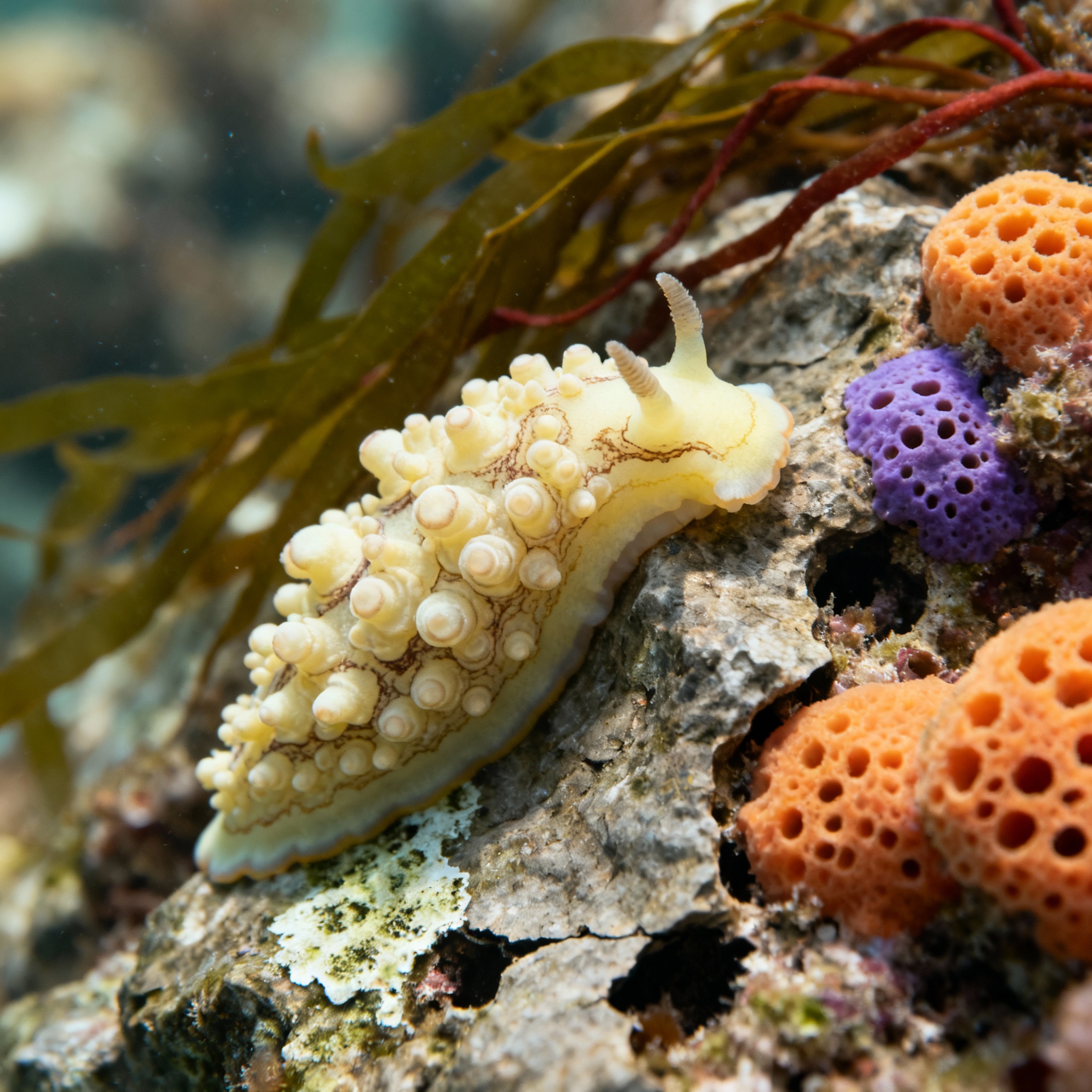
- Commonly known as sea lemon.
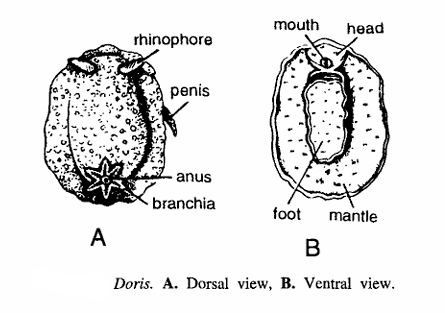
- Body consists of more or less ovoid mass with a convex warm dorsal side.
- Colour is purplish brown. Head bears a pair of short retractile tentacles or rhinophores beset with calcareous spicules.
- Mantle is usually pigmented and contains calcareous spicules or dorsal tubercles.
- The anus lies mid-posteriorly and is surrounded by a circlet of feathered retractile secondary branchiae.
- Ventral surface has mouth, head, tentacle and mantles. Anus is surrounded by branchia or gills.
- Foot has a large creeping sole. Dorsal surface has protruding penis.
- Digestive gland unbranched compact mass and nervous system of euthyneurous type.
- Sexes are united and the gonopore is asymmetrically placed on the right side of the body.
- Body Form: Oval, broad, and dorsoventrally flattened. The dorsal surface (notum) is covered with tubercles or papillae, sometimes giving a velvety appearance.
- Size: Typically ranges from less than 2 cm to over 20 cm in large species.
- Coloration: Highly variable; often matches local sponges—white, yellow, brown, black, or occasionally orange—providing camouflage or aposematism.
- Rhinophores: Prominent, perfoliate (ringed) organs on the head, highly sensitive to chemical cues.
- Gills: A circlet or plume of feathery gills arrayed around the anus on the dorsal trunk end, distinctive of dorid nudibranchs.
- Foot: Wide and muscular, well-adapted for adhering to rocks and crawling across different marine surfaces.
- Radula: Specialized for scraping sponge tissue, lined with numerous hook-shaped teeth.
Special Features
- Chemical Defenses: Doris nudibranchs are known for their potent chemical sequestration, storing toxins or unpleasant compounds from their sponge diet in their own tissues. This adaptation deters fish and invertebrate predators.
- Camouflage & Mimicry: Pigmentation and surface textures frequently mimic the sponges they inhabit, making them masters of camouflage in their environments.
- Hermaphroditism: All Doris species are simultaneous hermaphrodites, capable of functioning as both male and female during mating. Fertilized eggs are laid as coiled, ribbon-like masses on rocks or shells.
Identification
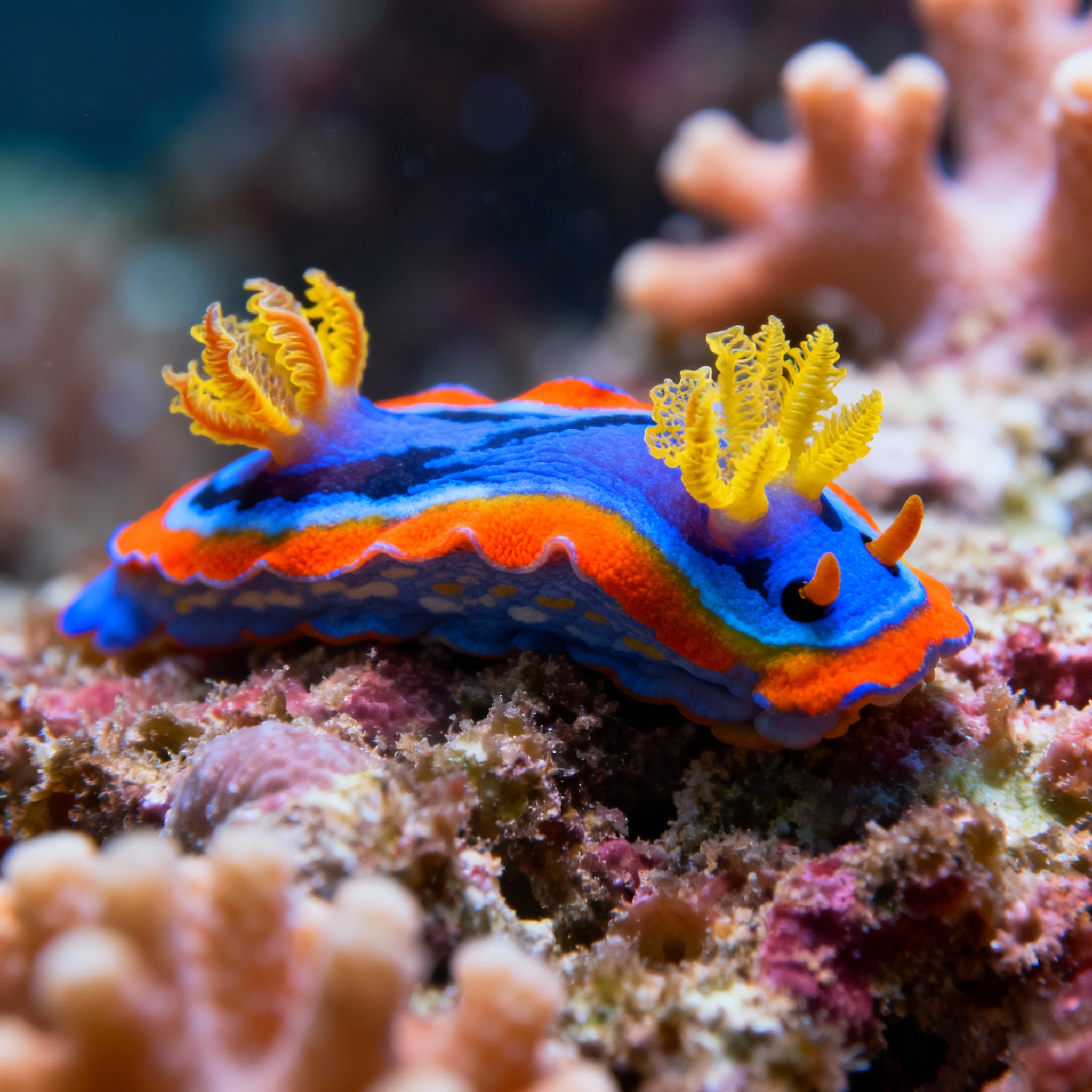
Key factors for identifying Doris species include:
- Dorsal Tubercles: Surface features (tubercles or papillae) help distinguish genus Doris from other nudibranchs.
- Rhinophore Structure: Lamellate rhinophores with multiple rings are typical of Doris.
- Gill Arrangement: The dorsal, centralized circlet of gills, with each branch being feather-like, is a reliable genus indicator.
- Color Patterns: Matching local sponges or warning (aposematic) coloration.
- Size and Proportion: Some species, like Doris odhneri, may reach 20 cm in length and are bright white, further aiding in field identification.
References
- https://www.zoologyverse.com/classification-of-aplysia
- https://www.biologydiscussion.com/structures/structure-of-sea-slug-aplysia-with-diagram-zoology/60658
- https://en.wikipedia.org/wiki/Aplysia_punctata
- https://animaldiversity.org/accounts/Aplysia_californica/
- https://opistobranquis.info/en/guia/aplysiida/aplysia-dactylomela/
- https://academic.oup.com/zoolinnean/article/202/4/zlae043/7664331
- https://en.wikipedia.org/wiki/Doris_odhneri
- https://ejabf.journals.ekb.eg/article_98019_2ef5147b346c6c36dc39603740a06859.pdf
- https://www.scribd.com/document/414982497/Animal-Kingdom-Examples-Dr-1
- https://en.wikipedia.org/wiki/Doris_(gastropod)
- http://www.seaslugforum.net/showall/aplybras
- http://ndl.ethernet.edu.et/bitstream/123456789/79511/1/VERTEBRATE_ZOOLOGY_-_MODULE.pdf
- https://www2.habitas.org.uk/marbiop-ni/speciesaccounts.php?item=W13970
- https://www.scribd.com/document/895240479/fbf45a6d-4c9f-401b-a30a-7b181f24f1ab
- https://www.acsedu.co.uk/uploads/Animals/Lesson%201%20and%20Assignment%201%20Sample%20Vertebrate%20Zoology.pdf
- https://www.vedantu.com/animal/gastropod
- https://www.zoologyverse.com/phylum-mollusca-characters-classification
- https://www.zoologyverse.com/category/specimens
- http://www.marinespecies.org/aphia.php?p=taxdetails&id=139623
- https://www.moderncollegegk.org/Zoology-specimen.pdf
Discover more from Zoologyverse
Subscribe to get the latest posts sent to your email.