
Corvus splendens, commonly known as the House Crow, is one of the most familiar urban birds across South Asia.
Highly intelligent and adaptable, this species thrives in human-dominated environments such as towns, villages, coastal areas, and agricultural landscapes.
Recognized by its glossy black plumage, grey neck, and harsh cawing calls, the House Crow is an opportunistic omnivore that feeds on grains, insects, fruits, refuse, and small animals.
Its strong social behavior, problem-solving ability, and close association with human settlements have enabled it to expand its range to parts of East Africa, the Middle East, and Southeast Asia.
Corvus splendens plays a significant ecological role in waste removal but can also act as a pest or invasive species in some regions.
For Practical Study 🧪
Classification of Corvus splendens
| Rank | Classification | Characteristic |
|---|---|---|
| Kingdom | Animalia | Multicellular, heterotrophic animals |
| Phylum | Chordata | Dorsal tubular nerve cord, notochord and gill-slits present. |
| Group | Craniata | Definite head, Cranium with brain present. |
| Sub-phylum | Vertebrata | Vertebral column present. |
| Division | Gnathostomata | Jaws and paired appendages present |
| Super Class | Tetrapoda | Paired limbs, lungs, cornified skin and bony skeleton. |
| Class | Aves | Biped and feathered vertebrates. |
| Sub-Class | Neornithes | True birds. Metacarpals fused. |
| Super-Order | Neognathae | Modern birds. no teeth. sternum keeled. |
| Order | Passeriformes | Perching bird. Toes 3 in front and behind. |
| Family | Corvidae | Crows, ravens, rooks, jays and related birds |
| Genus | Corvus | Crows and ravens with strong bills and highly developed behaviour |
| Species | Corvus splendens | House Crow |
Geographical Distribution
Corvus splendens is found everywhere in India.
Habit and Habitat
It is the most common, most familiar, most intelligent and boldest bird, living on trees in towns, villages and gardens.
It feeds on any thing from dead meat to any eatable left on the table, i.e., bread, butter, fruits and other preparations. Always around human habitat.
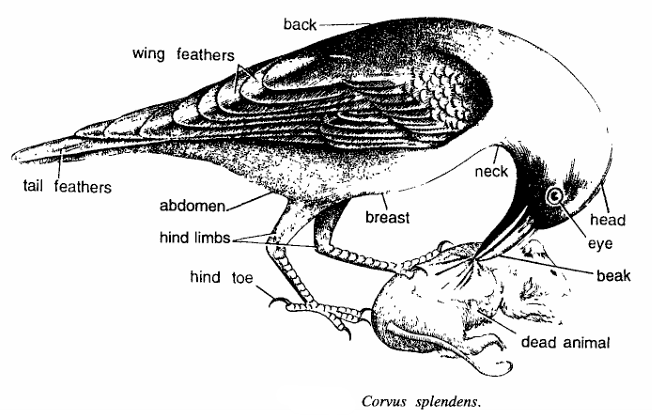
Comments
- Commonly called as House Crow
- Adult crow 32 to 42 cm in length.
- Body divisible into head, neck, back, breast and abdomen.
- Head contains eyes and beak. Beak adapted for tearing and cutting.
- Neck and breast are grey, but back and plumage are glossy black.
- Eyes are large and beak stout and elongated. Tail feathers are elongated. Wing feathers folded dorsolaterally.
- Feet adapted for perching, 3 toes in front and 1 behind.
- Young naked and blind at hatching, require feeding and parental care eating rats and dead animals before becoming independent.
Special Features
- The house crow acts as efficient municipal scavenger. It destroys locusts and other injurious insects but it also destroys the crop and fruits in orchards.
- The house crow builds nests of sticks. They roost communally in large flocks.
- They are also a menace to the eggs and infants of other birds.
- Whenever any fellow crow dies, several crows assemble. It is very intelligent and danger avoiding bird.
Identification
Since the above bird has raised head and above features, hence it is Corvus splendens.
Quick Identification of Corvus splendens
| Feature | Description |
|---|---|
| Common name | House Crow |
| Scientific name | Corvus splendens |
| Class | Aves |
| Order | Passeriformes |
| Family | Corvidae |
| Body | Medium-sized crow, about 40–42 cm long |
| Plumage | Glossy black body with a distinctive greyish neck and upper breast |
| Bill | Strong, slightly curved black bill |
| Wings | Broad, rounded wings adapted for strong, sustained flight |
| Tail | Medium to long, slightly rounded tail |
| Feet | Strong feet with three toes forward and one backward |
| Key identifying feature | Grey neck contrasting with the otherwise dark glossy plumage |
| Typical habitat | Towns, cities, villages, agricultural areas and other human-associated environments |
Physical Characteristics of Corvus splendens
The House Crow is a medium-sized crow with a slender body and characteristic contrasting plumage.
Its most distinctive feature is the greyish neck and upper breast, which contrasts with the glossy black head, wings and other dark body regions.
- Head: The head is black, with a strong, slightly curved black bill.
- Neck and breast: The neck and upper breast are grey to greyish-brown, forming a clear contrast with the black head.
- Body: The back, wings and tail are predominantly glossy black.
- Wings: The wings are broad and well developed, allowing strong and sustained flight.
- Tail: The tail is relatively long and helps provide stability and control during flight.
- Legs and feet: The legs are dark and the feet are adapted for perching and walking. Like other passerine birds, the toes include three directed forward and one backward.
- Eyes: The eyes are relatively small compared with the large head and are adapted for good daytime vision.
- Plumage: Adult plumage is predominantly black with a noticeable grey neck and upper breast.
Body Form and Adaptation
The House Crow’s strong bill, grasping feet, mobile neck and well-developed wings reflect its adaptable lifestyle.
These features allow it to forage on the ground, handle a wide variety of foods and move efficiently through both natural and human-dominated environments.
Feeding and Dietary Adaptations of Corvus splendens
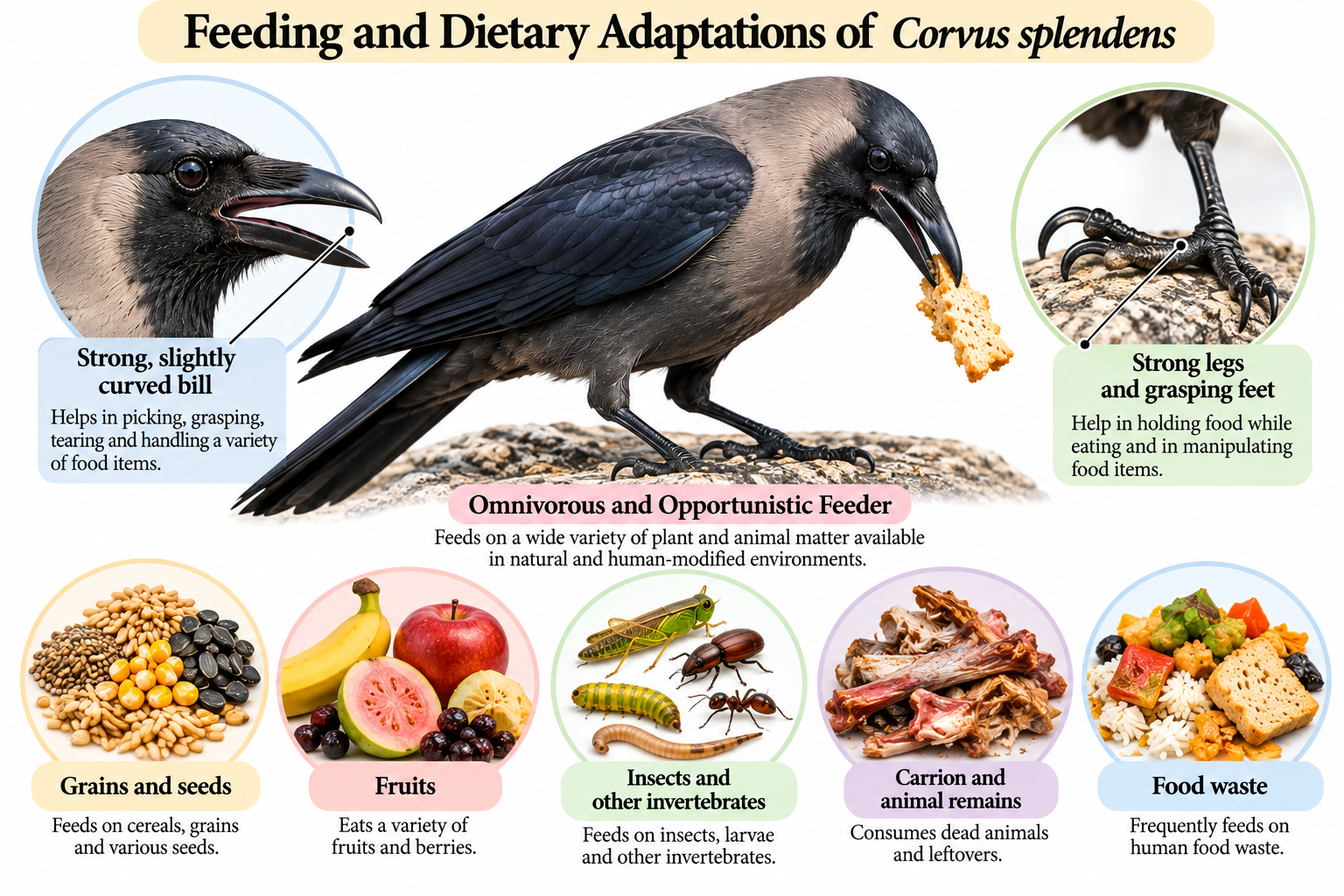
The House Crow is an omnivorous and opportunistic feeder. Its flexible diet allows it to exploit food resources in both natural environments and human-dominated areas.
- Plant foods: grains, seeds, fruits and other plant material.
- Animal foods: insects, small invertebrates, eggs, young animals and other available animal matter.
- Carrion: It may feed on dead animals and discarded animal remains.
- Human-associated food: food scraps, refuse and other edible waste can form an important part of its diet in towns and cities.
- Strong bill: The sturdy bill helps the crow pick, tear and manipulate different types of food.
- Grasping feet: Strong feet help it hold and manipulate food while feeding.
- Opportunistic feeding: Rather than depending on a single food source, it can switch between different resources according to availability.
Why Its Diet Is Important
This dietary flexibility is one reason the House Crow can live successfully around human settlements. Its ability to exploit refuse and a wide variety of natural foods allows it to occupy environments where food resources change throughout the year.
Behaviour and Social Life of Corvus splendens
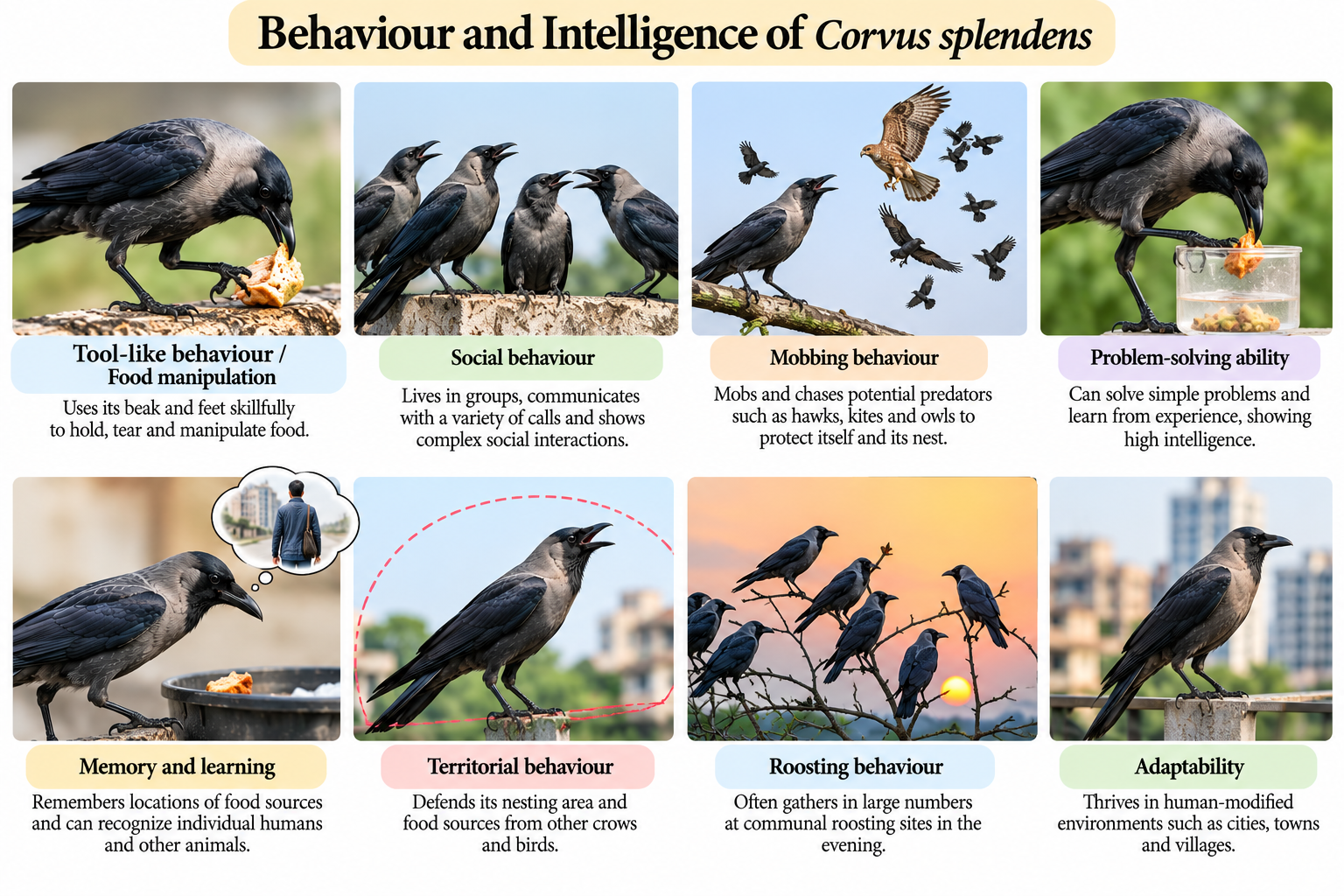
The House Crow is a highly social and adaptable bird. It commonly occurs in groups and remains closely associated with human settlements.
Individuals may travel considerable distances between feeding areas and roosting sites.
- Social behaviour: House Crows commonly live and forage in groups and may gather in large numbers at communal roosts.
- Daily activity: They are mainly active during the daytime, spending much of the day searching for food.
- Roosting: Groups may gather at established trees or other suitable locations to roost.
- Foraging behaviour: Individuals actively search different food sources and can travel between feeding and roosting areas.
- Adaptability: Their close association with human settlements allows them to exploit food and nesting opportunities created by urban environments.
- Threat response: House Crows can alter their behaviour when disturbed, including changing roosting locations.
- Communication: A variety of harsh calls, caws and other vocalizations are used during social interactions and in response to potential threats.
Intelligence and Problem-Solving
As a member of the family Corvidae, the House Crow exhibits behavioural flexibility and the ability to adjust its activities according to changing environmental conditions.
Its ability to exploit new food sources and human-dominated environments is an important part of its ecological adaptability.
Nesting and Reproduction in Corvus splendens
House Crows form breeding pairs and construct relatively conspicuous stick nests, usually in trees. Their ability to nest close to people is another feature that helps them thrive in towns, villages and cities.
- Nest: A platform or cup-like structure mainly constructed from twigs and sticks.
- Nesting sites: Nests are commonly built in trees, including trees in gardens, roadsides and other human-dominated environments.
- Eggs: The female lays a small clutch of eggs, which are typically pale bluish-green or greenish with darker markings.
- Incubation: The eggs are incubated until hatching, with parental investment continuing after the chicks emerge.
- Chicks: Newly hatched chicks are altricial—poorly developed, largely helpless and dependent on their parents.
- Parental care: Adults feed and protect the nestlings until they develop sufficiently to leave the nest.
- Nest defence: Breeding adults can actively defend the nest and young from potential threats.
Brood Parasitism
An especially interesting aspect of House Crow reproduction is its relationship with the Asian Koel (Eudynamys scolopaceus), a brood parasite that may lay its eggs in House Crow nests.
The crow can consequently incubate the koel’s egg and provide care to the resulting chick.
Ecological Role and Human Association
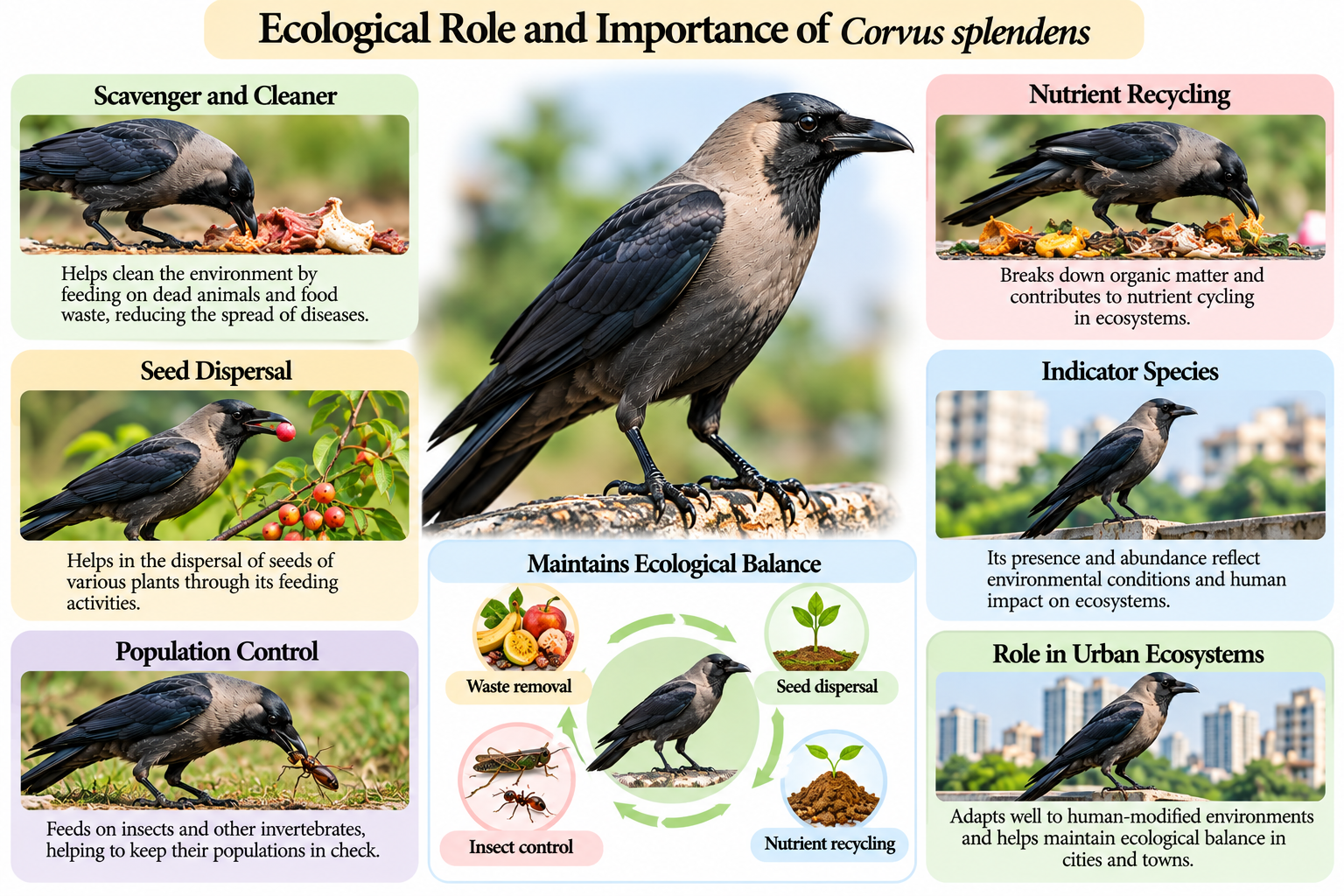
The House Crow has a close association with human settlements and has adapted to environments where food waste and other human-generated resources are available.
It can function as a scavenger and opportunistic predator, while also interacting with other bird species.
- Scavenging: It consumes discarded food and animal remains, helping remove some organic waste.
- Predation: It may take eggs, nestlings and small animals, influencing populations of other species.
- Food-web role: As both predator and prey, it participates in urban and rural food webs.
- Human association: Cities, villages, markets, parks and other disturbed habitats provide feeding and nesting opportunities.
- Introduced populations: Outside its native range, established House Crow populations can affect native wildlife through predation and competition. The documented impacts vary by location.
House Crow as an Adaptable Urban Bird
Its flexible diet, social behaviour and ability to use human-modified habitats have contributed to its successful expansion into many areas.
In some introduced regions, however, its population growth has created management concerns because of interactions with native wildlife and agriculture.
Conservation Status of Corvus splendens
The House Crow is currently classified as Least Concern (LC) by the IUCN Red List, reflecting its extremely large range and stable population trend.
However, its conservation situation should be considered differently in its native range versus areas where it has been introduced, where it is sometimes managed as a pest or invasive species.
Management of Introduced Populations
In some regions outside its native range, House Crow populations have become established and are treated as an introduced or invasive species because of their interactions with native wildlife, agriculture and human environments.
Documented concerns include predation on eggs and young birds, competition for resources and consumption of crops or food waste. The effects vary between locations.
Frequently Asked Questions
What is the scientific name of the House Crow?
The scientific name of the House Crow is Corvus splendens.
Why is the House Crow called a House Crow?
It is closely associated with human settlements and is commonly found around houses, towns, cities, villages and other human-modified environments.
What does the House Crow eat?
It is an omnivorous and opportunistic feeder that consumes grains, seeds, fruits, insects, small animals, carrion and food waste.
What is the main identifying feature of the House Crow?
It commonly builds stick nests in trees, including trees in urban and suburban environments.
Is the House Crow a social bird?
Yes. House Crows commonly forage and roost in groups and show strong social behaviour.
Which bird is associated with brood parasitism in House Crow nests?
The Asian Koel (Eudynamys scolopaceus) is a brood parasite that may lay its eggs in House Crow nests.
What is a group of crows called?
A group of crows is commonly called a murder of crows. Other collective terms, such as flock or gathering, may also be used, especially in ordinary scientific or descriptive writing.
Recommended Study Resource
Practical Zoology Vertebrate 12/Ed
by Ss Lal (Author)
Rastogi Publications MODERN TEXT BOOK OF ZOOLOGY: VERTEBRATES (Z-3)
by Prof. R. L. Kotpal (Author)
As an Amazon Associate I earn from qualifying purchases.
References
- NCBI Taxonomy Browser — Corvus splendens
- U.S. Fish & Wildlife Service — House Crow Taxonomy
- Atlas of Living Australia — Corvus splendens
- IUCN Global Invasive Species Database — House Crow
- Corvus splendens Vieillot, 1817 | Species
Discover more from Zoologyverse
Subscribe to get the latest posts sent to your email.