
RNA Synthesis: How Cells Transcribe DNA into RNA
Every protein in your body starts life as a stretch of DNA — but DNA never leaves the nucleus (or, in bacteria, the nucleoid) to do the actual work of building anything. Instead, the cell makes a disposable working copy of the gene in the form of RNA. That copying process is called transcription, or RNA synthesis, and it’s the first and most tightly controlled step in gene expression.
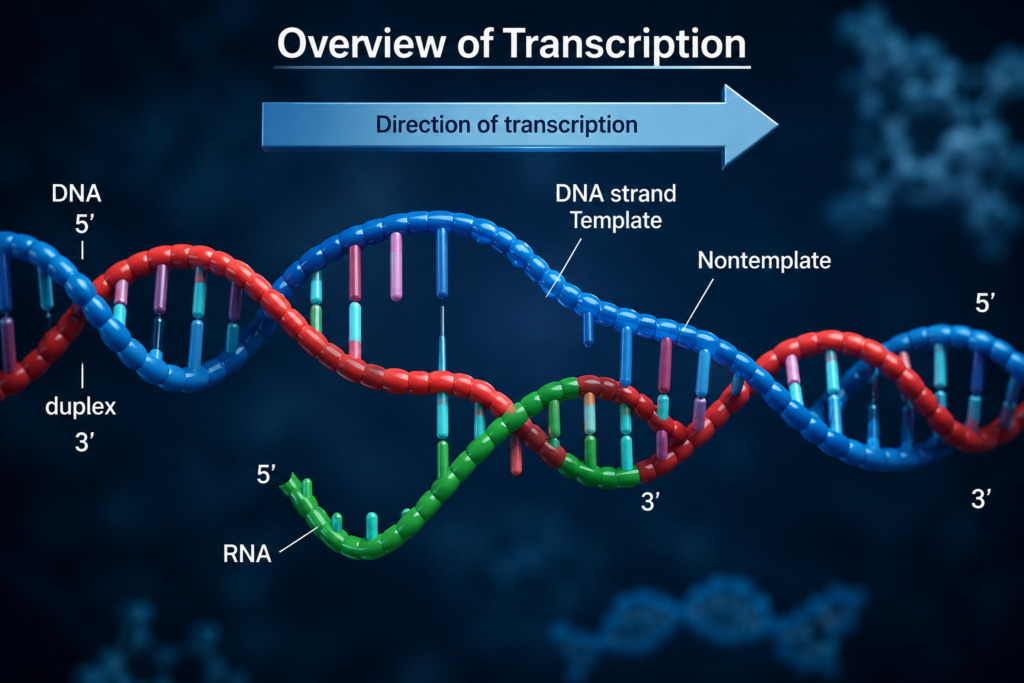
This guide breaks down exactly how RNA synthesis happens — from the moment RNA polymerase locks onto a promoter to the moment it lets go of a finished transcript — using the bacterial (E. coli) system as the model, since it’s the best-understood version of the process.
What Is RNA Synthesis?
RNA synthesis is the enzyme-driven process of building a strand of RNA using one strand of DNA as a template. The enzyme responsible, RNA polymerase, reads the DNA template strand and links together ribonucleotides in a complementary, antiparallel sequence — swapping in uracil (U) wherever the template calls for an adenine-pairing base, in place of the thymine (T) that DNA replication would use.
Chemically, transcription looks a lot like DNA replication: both processes copy a nucleic acid template using a polymerase enzyme. But the two processes serve very different purposes, and several mechanical details set them apart.
How Transcription Differs from DNA Replication
| Feature | DNA Replication | Transcription (RNA Synthesis) |
| Product | New DNA strand | New RNA strand |
| Building blocks | Deoxyribonucleotides | Ribonucleotides |
| Needs a primer? | Yes | No — RNA polymerase starts fresh |
| Portion of genome copied | The entire chromosome | Only selected genes, when needed |
| Error rate | About 1 in 10 million bases | About 1 in 10,000 bases |
| Frequency | Once per cell division | Many times, on demand |
That higher error rate might sound alarming, but it’s not a design flaw — a faulty RNA copy is short-lived and simply gets degraded and replaced, whereas a mistake in DNA would be permanent and heritable. Still, RNA polymerase isn’t reckless: it has two built-in proofreading mechanisms, covered below. Because only certain genes are transcribed at any given moment, the cell can turn specific genes on or off depending on what proteins it needs. This selectivity is what allows two genetically identical cells — say, a muscle cell and a neuron — to look and behave completely differently.
The Three Phases of Transcription
Regardless of which gene is being copied, RNA polymerase always works through the same three stages:
- Initiation — the enzyme finds and binds the start of a gene
- Elongation — the enzyme builds the RNA strand base by base
- Termination — the enzyme reaches a stop signal and releases the finished transcript
Phase 1: Initiation
What Are Promoters?
If RNA polymerase bound DNA at random, transcription would be hopelessly wasteful and uncontrolled. Instead, the enzyme is directed to specific start points called promoters — DNA sequences that sit just upstream of a gene and tell the polymerase exactly where to begin.
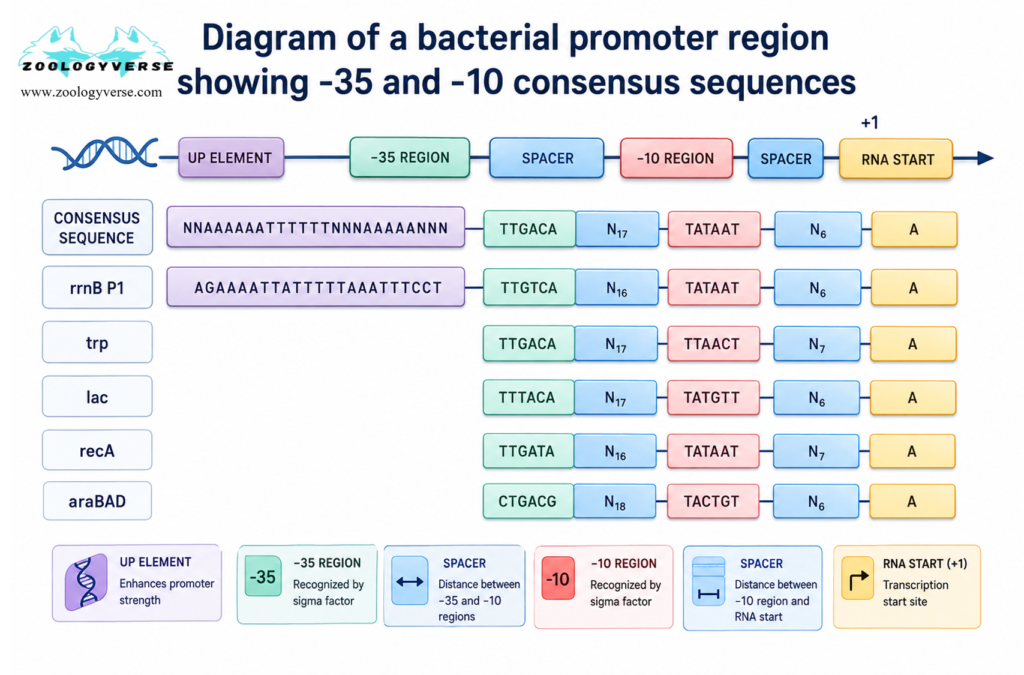
In E. coli, the promoter region spans roughly 70 base pairs before the transcription start site to about 30 base pairs after it. Positions are numbered relative to the start site: everything downstream (where RNA synthesis begins) gets a positive number, and everything upstream gets a negative one.
Comparing thousands of bacterial promoters recognized by the most common RNA polymerase form (the one containing the σ70 subunit) reveals two short, highly conserved sequences:
- The −10 element (also called the Pribnow box): consensus sequence TATAAT
- The −35 element: consensus sequence TTGACA
A third element, the UP element, sits further upstream (roughly −40 to −60) in highly active genes and is recognized by the α subunit of RNA polymerase rather than σ70. How closely a real promoter matches these consensus sequences — and how well-spaced the elements are — largely determines how efficiently RNA polymerase binds and fires up transcription there.
Structure of RNA Polymerase
Bacterial RNA polymerase only works efficiently when bound to double-stranded DNA. Its core enzyme is built from multiple subunits that together form a shape often compared to a crab’s claw, with the large β and β′ subunits forming the two pincers. A separate σ (sigma) factor — most commonly σ70 in E. coli — joins the core enzyme to form the holoenzyme, and it’s the sigma factor that gives the enzyme its ability to recognize promoter sequences in the first place.
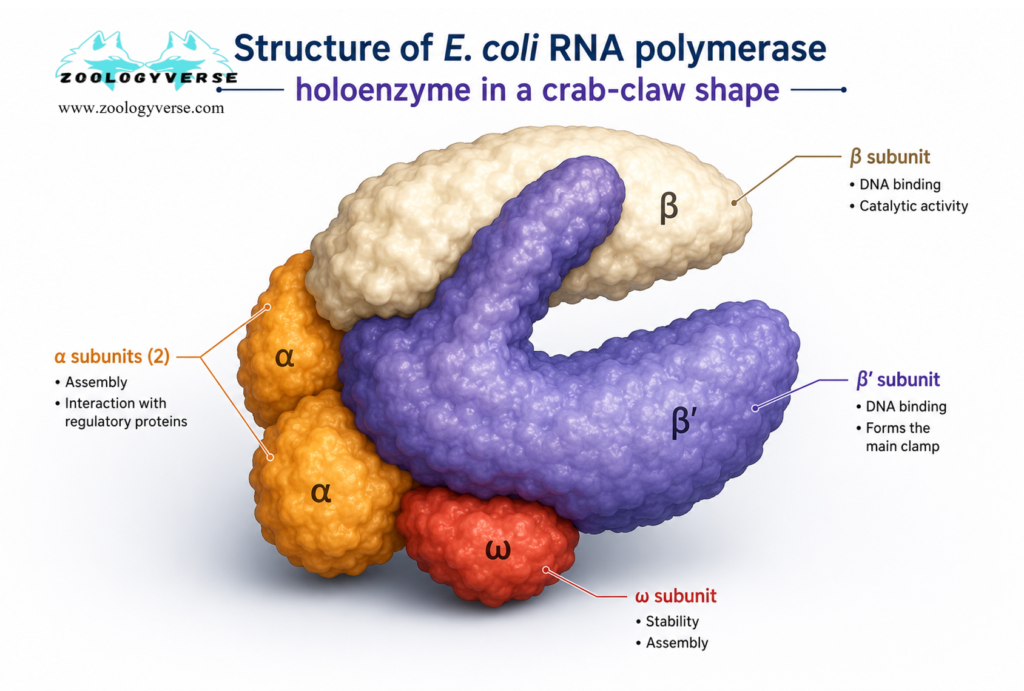
Inside the pincers sits the active center cleft, where the actual chemistry of RNA synthesis happens. Several channels run through the enzyme: one lets new ribonucleotides (NTPs) enter the active site, one lets the growing RNA strand exit, and others manage DNA entering and leaving the enzyme as it works.
Step-by-Step: How Initiation Happens
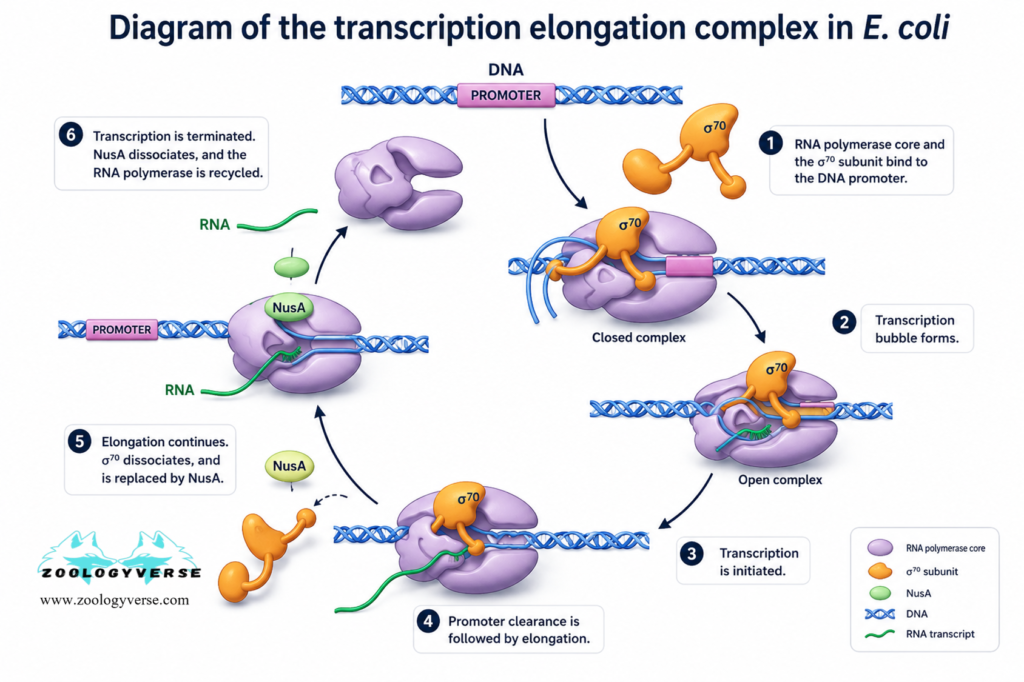
- Closed complex formation — RNA polymerase binds the promoter while the DNA is still fully double-stranded (duplex). This binding is easily reversible; the enzyme can just as easily let go here as move forward.
- Open complex formation — The sigma factor reshapes the enzyme’s DNA-binding behavior, causing about 12–14 base pairs of DNA (roughly positions −11 to +2) to unwind, or “melt.” This unwound region is called the transcription bubble.
- First bond formation — RNA polymerase catalyzes the first phosphodiester bond between two ribonucleotides, officially starting the RNA chain.
- Ternary complex — Once RNA, DNA, and the enzyme are all engaged together, the complex is called a ternary complex.
- Promoter escape — Only after synthesizing a short transcript of roughly 10 or more nucleotides does the enzyme break free of the promoter and its regulatory contacts, threading the growing RNA into the RNA-exit channel and formally entering elongation.
Phase 2: Elongation
Once RNA polymerase escapes the promoter, it moves along the DNA like a tiny molecular motor, advancing exactly one base pair for every nucleotide it adds to the RNA chain. Remarkably, the size of the transcription bubble stays constant the entire time: for every base pair that unwinds ahead of the enzyme, one base pair re-forms (reanneals) behind it.
Built-in Proofreading During RNA Synthesis
Transcription isn’t as accurate as DNA replication, but it isn’t sloppy either — RNA polymerase corrects itself using two distinct mechanisms:
- Pyrophosphorolytic editing — the enzyme runs its normal reaction in reverse at the active site, plucking out a wrongly inserted ribonucleotide by re-adding pyrophosphate (PPi), then inserts the correct base in its place. The enzyme lingers longer over mismatched bases than correctly paired ones, so it removes errors more often than correct nucleotides — but it can technically remove either.
- Hydrolytic editing — the enzyme backtracks a few nucleotides, cleaves off the region containing the error, and resumes synthesis from the corrected point.
Phase 3: Termination
RNA synthesis is highly processive — once started, the enzyme adds a long stretch of nucleotides before letting go, because a prematurely released transcript can’t simply be resumed; the whole process would have to restart from the promoter. Termination, then, isn’t the enzyme running out of steam — it’s a response to specific DNA signals. E. coli uses two distinct termination strategies.
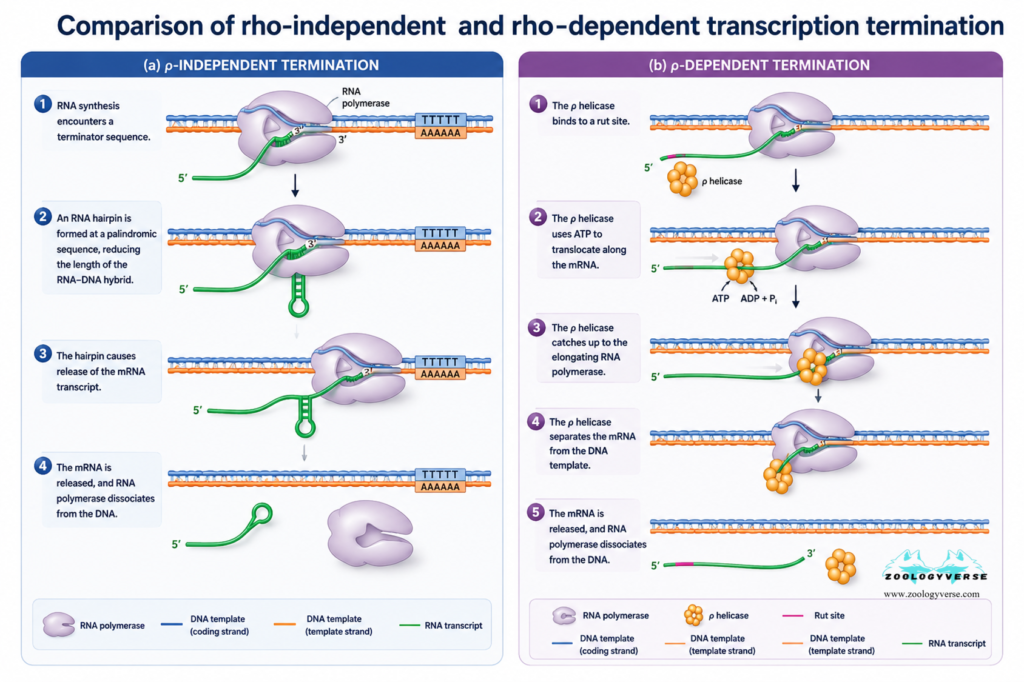
Rho-Independent (Intrinsic) Termination
This method needs no extra protein factors. It relies on two features encoded directly in the DNA sequence:
- A self-complementary region in the new RNA that folds back on itself to form a hairpin structure, forming roughly 15–20 nucleotides before the end of the transcript.
- A run of A residues in the template strand immediately after the hairpin, which get transcribed into a stretch of U residues at the RNA’s 3′ end.
When RNA polymerase reaches this structure, it pauses. The hairpin destabilizes the RNA–DNA hybrid within the enzyme (partly because A–U base pairs are weaker than G–C pairs) and disrupts contacts between the RNA and the polymerase, allowing the transcript to dissociate.
Rho-Dependent Termination
The second class of terminators lacks the poly-A template signal but instead contains a CA-rich sequence called a rut (rho utilization) site. A separate protein, the ρ (Rho) factor, binds the nascent RNA at this site and travels along it in the 5′→3′ direction, powered by its own ATP-dependent RNA-DNA helicase activity, until it catches up to a polymerase that has paused at a termination site — at which point it helps release the finished RNA transcript. The precise molecular choreography of that final release is still an active area of research.
Why RNA Synthesis Matters
Transcription is the hinge on which gene expression turns. It converts the static, archival information stored in DNA into a working RNA copy the cell can actually use — whether that’s a messenger RNA destined to be translated into protein, or a regulatory or structural RNA in its own right.
Because transcription is selective — copying only the genes a cell needs, in the amounts it needs, at the time it needs them — it gives cells the flexibility to specialize (a muscle cell vs. a neuron), respond to their environment (a bacterium switching food sources), and shut down genes that shouldn’t be active. DNA replication, by contrast, must copy the entire genome, exactly once, every time a cell divides — no room for selectivity there. That distinction is what makes transcriptional control one of the most important regulatory layers in all of biology.
Frequently Asked Questions
What is the main enzyme responsible for RNA synthesis? RNA polymerase carries out RNA synthesis. In bacteria, the core enzyme joins with a sigma factor (commonly σ70) to form the holoenzyme, which is what actually recognizes promoters and initiates transcription.
Does RNA polymerase need a primer to start transcription? No. Unlike DNA polymerase, RNA polymerase can initiate synthesis de novo, without a pre-existing primer strand — though in living cells it can only start at specific promoter sequences.
What are the three stages of transcription? Initiation (binding the promoter and unwinding the DNA), elongation (building the RNA chain), and termination (releasing the finished transcript at a stop signal).
What is the difference between rho-dependent and rho-independent termination? Rho-independent termination relies purely on a self-contained hairpin structure and a run of U residues in the RNA. Rho-dependent termination requires a separate protein, the Rho factor, which binds the RNA and chases down the paused polymerase to trigger release.
Why is transcription less accurate than DNA replication? Transcription lacks the extensive proofreading machinery built into DNA replication. It still has two correction mechanisms of its own — pyrophosphorolytic and hydrolytic editing — but because RNA transcripts are short-lived and not inherited, a higher error rate is far less costly than it would be in DNA.
References
- Chan, B., Spassky, A., & Busby, S. (1990). The organization of open complexes between Escherichia coli RNA polymerase and DNA fragments carrying promoters either with or without consensus −35 region sequences. Biochemical Journal, 270(1), 141–148.
- Kobayashi, M., Nagata, K., & Ishihama, A. (1990). Promoter selectivity of Escherichia coli RNA polymerase: effect of base substitutions in the promoter −35 region on promoter strength. Nucleic Acids Research, 18(24), 7367–7372.
- Uptain, S. M., & Chamberlin, M. J. (1997). Escherichia coli RNA polymerase terminates transcription efficiently at rho-independent terminators on single-stranded DNA templates. PNAS, 94(25), 13548–13553.
- Hao, Z., Svetlov, V., & Nudler, E. (2021). Rho-dependent transcription termination: a revisionist view. Transcription, 12(4), 171–181.
- Song, E., et al. (2022). Rho-dependent transcription termination proceeds via three routes. Nature Communications, 13, 1663.
- Farnham, P. J., & Platt, T. (1981). Rho-independent termination: dyad symmetry in DNA causes RNA polymerase to pause during transcription in vitro. Nucleic Acids Research, 9(3), 563–577.
- Nelson, D. L., & Cox, M. M. Lehninger Principles of Biochemistry (7th ed.).
- Watson, J. D., Baker, T. A., Bell, S. P., Gann, A., Levine, M., & Losick, R. Molecular Biology of the Gene (7th ed.).
Discover more from Zoologyverse
Subscribe to get the latest posts sent to your email.