
What Is Fatty Acid Catabolism?
Fat is the body’s densest energy reserve, and breaking it down for fuel is one of the most important jobs mitochondria perform.
In heart and liver tissue especially, fatty acid breakdown can supply the large majority of the cell’s energy needs — even when other fuel sources are scarce.
The process works by clipping two-carbon fragments off the end of a fatty acid chain, one pair at a time, and converting each fragment into acetyl-CoA.
That acetyl-CoA can then be burned in the citric acid cycle for more energy, or in the liver, redirected into making ketone bodies — compact, water-soluble fuel molecules the brain and other tissues can use when glucose is in short supply.
This repeating four-step breakdown cycle is called beta-oxidation, and despite fatty acids varying widely in length and shape, the core mechanism stays essentially the same across nearly every organism that uses it.
Where Fat Comes From, and How It Gets Into Cells
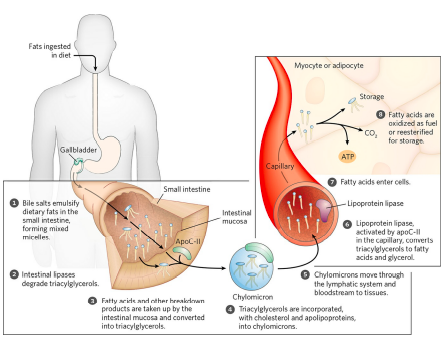
Before a cell can burn fat for energy, that fat has to get there — and dietary fat starts the journey looking nothing like the microscopic fuel packets your mitochondria eventually use.
Fat arrives in the body from four places: what’s eaten, what’s stored in fat droplets inside cells, what’s shipped from one organ to another, and what’s recycled from a cell’s own worn-out components through autophagy.
Dietary fat has a head start problem: it’s not water-soluble, and the gut is a watery environment. Bile salts solve this by acting as natural detergents, breaking large fat globules into much smaller droplets called micelles.
That dramatically increases the surface area exposed to digestive enzymes, which then break the fat down into fatty acids, glycerol, and partial fat molecules.
These get absorbed by intestinal cells, reassembled, and packaged — along with dietary cholesterol — into transport particles called chylomicrons.
Chylomicrons travel through the lymph system and into the bloodstream, delivering their fat cargo to muscle and fat tissue.
Once there, an enzyme called lipoprotein lipase breaks the fat back down into free fatty acids, which cells absorb and either burn immediately (in muscle) or store for later (in fat tissue).
Beta-Oxidation of Saturated Fatty Acids
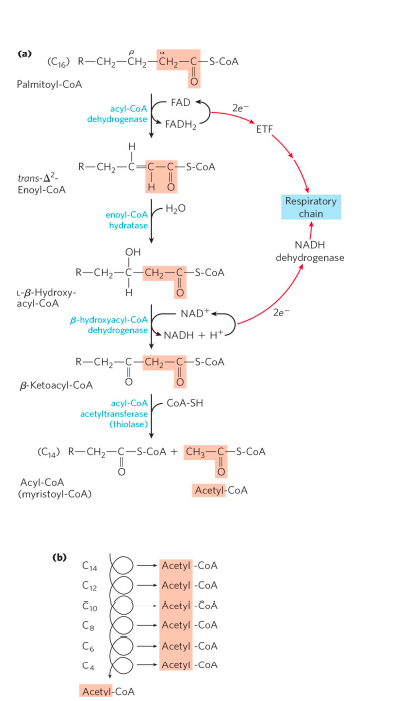
Once inside the mitochondria, a fatty acid chain goes through the same four-step cycle repeatedly, losing a two-carbon acetyl-CoA fragment every time around.
Step 1: Initial Oxidation
An enzyme family called acyl-CoA dehydrogenase removes a pair of electrons from the fatty acid chain, creating a double bond. Different versions of this enzyme specialize in different chain lengths — some handle very long chains, others work on medium or short ones — but all of them hand their captured electrons off to the respiratory chain, contributing to ATP production almost immediately.
Step 2: Adding Water
Water is added across the new double bond, producing a hydroxyl group partway down the chain.
Step 3: Second Oxidation
That hydroxyl group is oxidized again, this time handing electrons to NAD+ instead of the flavin-based carrier used in step one — another direct contribution to ATP production.
Step 4: Cleavage
An enzyme called thiolase splits off the terminal two-carbon fragment as acetyl-CoA, leaving behind a fatty acid chain that’s two carbons shorter — ready to go through the same four steps again.
For long fatty acid chains, these steps are handled by a large membrane-anchored enzyme complex; once the chain gets short enough, a separate set of free-floating enzymes in the mitochondrial matrix takes over. Either way, the chain keeps shrinking two carbons at a time until the whole thing has been converted to acetyl-CoA.
information source :- Biochemistry, Fatty Acid Oxidation — StatPearls, NCBI Bookshelf
ATP Yield From Beta-Oxidation
Each trip through the four-step cycle produces one molecule of acetyl-CoA and hands off two separate pairs of electrons to the respiratory chain — one pair via the flavin-linked carrier from step 1, and one pair via NADH from step 3.
Altogether, this generates roughly four ATP molecules per cycle, plus water as a byproduct, before the acetyl-CoA itself is even sent on to the citric acid cycle for further energy extraction.
A single 16-carbon fatty acid needs to go through this cycle seven times to be fully broken down — which is part of why fat is such an energy-dense fuel source compared to carbohydrate.
Oxidizing Unsaturated Fatty Acids
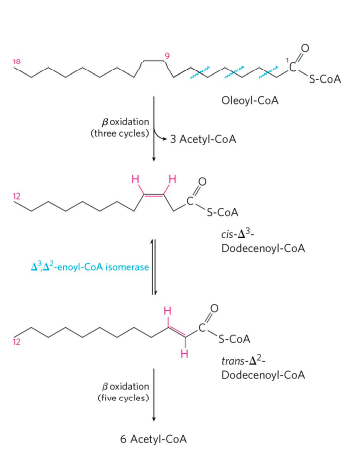
Not every fatty acid is a simple straight chain — many contain one or more built-in double bonds, and those double bonds create a mechanical problem for the standard beta-oxidation machinery, which is only built to handle a specific bond geometry.
For fatty acids with a single double bond, an extra “helper” enzyme repositions and reshapes the existing double bond so it matches the geometry the standard pathway expects. Once that adjustment is made, beta-oxidation proceeds as normal.
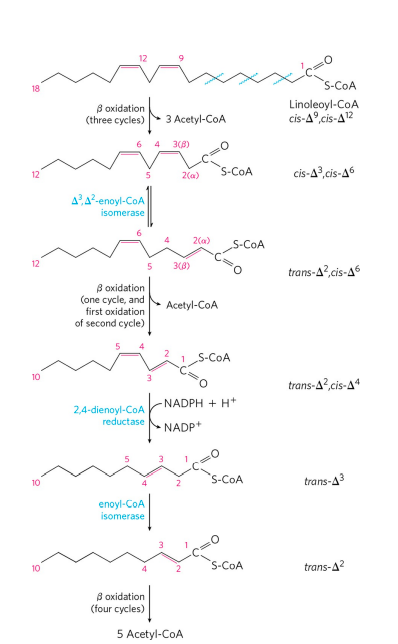
Fatty acids with multiple double bonds need a second helper enzyme in addition to the first, since the standard pathway can’t process the extra bond configuration on its own. Once both helpers have done their job, the modified chain re-enters the normal four-step cycle and is broken down the same way as any other fatty acid.
Fatty acids with multiple double bonds need a second helper enzyme in addition to the first, since the standard pathway can’t process the extra bond configuration on its own. Once both helpers have done their job, the modified chain re-enters the normal four-step cycle and is broken down the same way as any other fatty acid.
Oxidizing Odd-Chain Fatty Acids
Most naturally occurring fatty acids have an even number of carbons, but some — particularly in plants and certain marine organisms — have an odd number instead. Ruminant animals like cattle also generate a specific three-carbon compound as a byproduct of gut fermentation, which gets absorbed and processed the same way.
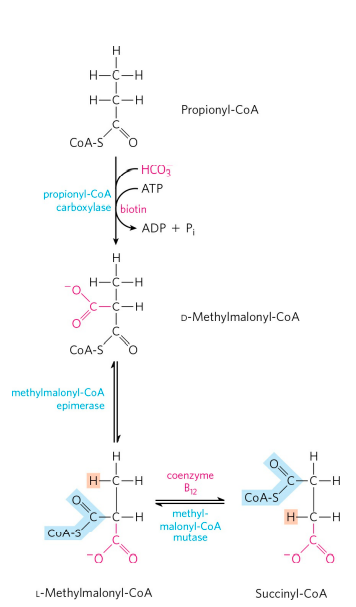
Odd-chain fatty acids go through the exact same beta-oxidation cycle as even-chain ones, right up until the final round. At that point, instead of producing two acetyl-CoA fragments, the last cycle produces one acetyl-CoA and one three-carbon leftover fragment that can’t enter the citric acid cycle directly.
That leftover fragment goes through a short three-enzyme detour: it’s first attached to a carbon dioxide molecule (a reaction that requires biotin and a bit of ATP), then rearranged into a different molecular shape, and finally converted — with the help of a vitamin B12-derived cofactor — into succinyl-CoA, which can enter the citric acid cycle directly.
Key Takeaways
- Fatty acid catabolism breaks fat chains down two carbons at a time via a repeating four-step process called beta-oxidation.
- Each cycle produces one acetyl-CoA and contributes roughly four ATP equivalents to the cell’s energy budget.
- Unsaturated fatty acids need one or two extra helper enzymes to reshape their double bonds before standard beta-oxidation can proceed.
- Odd-chain fatty acids follow the same pathway but end with a three-carbon fragment that takes a short detour — involving biotin and vitamin B12 — before joining the citric acid cycle.
- Roughly 95% of the usable energy in dietary fat comes from its fatty acid chains rather than the glycerol backbone.
Frequently Asked Questions
What is fatty acid catabolism in simple terms? It’s the process cells use to break fatty acids down for energy, chopping the chain into two-carbon pieces that get converted into acetyl-CoA and fed into the citric acid cycle.
What is the difference between beta-oxidation and lipolysis? Lipolysis is the earlier step — breaking a stored triglyceride apart into free fatty acids and glycerol. Beta-oxidation happens after that, inside the mitochondria, and breaks the released fatty acids down further for energy.
How much ATP does beta-oxidation produce? Roughly four ATP-equivalents per cycle from the electron pairs generated, on top of the additional ATP that comes later when the resulting acetyl-CoA is oxidized in the citric acid cycle. A full-length fatty acid can yield well over 100 ATP molecules by the time it’s completely broken down.
Why do unsaturated fatty acids need extra enzymes to be oxidized? Their existing double bonds are in positions or configurations that the standard beta-oxidation enzymes can’t process directly. Helper enzymes reposition or reduce those bonds first, after which the normal pathway can take over.
What happens to odd-chain fatty acids during oxidation? They follow the same pathway as even-chain fatty acids until the final cycle, which leaves behind a three-carbon fragment (propionyl-CoA) instead of a clean two-carbon one. That fragment is converted through a separate three-step pathway into succinyl-CoA before it can enter the citric acid cycle.
What happens when fatty acid oxidation doesn’t work properly? Genetic conditions that impair specific enzymes in this pathway — such as deficiencies affecting the enzymes that act on medium- or very-long-chain fatty acids — can cause serious energy shortfalls, especially during fasting or illness, since the body can’t fall back on fat as a fuel source.
Information Source :- Medium-Chain Acyl-CoA Dehydrogenase Deficiency — StatPearls, NCBI Bookshelf
Biochemistry, Ketogenesis — StatPearls, NCBI Bookshelf.
See Other Posts Also
- Oxidative Phosphorylation: How Mitochondria Make ATP
- STORAGE LIPIDS (TRIACYLGYCEROL)
- MEMBRANE LIPIDS
- Citric Acid Cycle: 8 Steps, Diagram & Energy Yield Explained
Discover more from Zoologyverse
Subscribe to get the latest posts sent to your email.