
Acorn worms in the genus Saccoglossus are members of the class Enteropneusta within the phylum Hemichordata. These worms feed on organic particles while burrowing through muddy or sandy soils in shallow sea environments. They are crucial to the recycling of nutrients and the turnover of sediment. Saccoglossus offers important information on early deuterostome evolution and the origins of chordate anatomical features since it displays important hemichordate traits, such as the tripartite body plan of proboscis, collar, and trunk.
Classification of Saccoglossus
- Phylum :- Hemichordata (Marine, enterocoelous coelomate. Notochord confined to head region)
- Class :- Enteropneusta (Several gill-slits, intestine straight, solitary.)
- Family :- Harrimaniidae
- Genus :- Saccoglossus

Geographical distribution of Saccoglossus
It occurs in New Zealand, Australia, the Indo-Pacific region, the Atlantic coasts, and North America.
Habit and Habitat
It is marine, burrowing and tubicolous animal. These burrow in sand flats near low tide, line, living in semipermanent tunnels lined with mucous secretions. The mouth, which apparently cannot be closed, lies ventrally between the proboscis and collar. As the worm burrows much of the sand is swallowed.
Characteristics of Saccoglossus
- It is vermiform hemichordate.
- Body regionated into proboscis (prosoma) collar (mesosoma) and trunk. (metasoma).
- Proboscis is exceptionally longer than any other enteropneust.
- Collar slightly overhangs the beginning of trunk, covering three of four gill-slits. Trunk is differentiated into three regions. In the anterior part numerous pairs of gill-slits open externally near the mid-dorsal line.
- Middle part has gonads which are grey in female and yellow in male.
- Posterior region has only posterior part of intestine and tapers gradually to anus.
- Hepatic sacculations and genital ridges.
- So well developed in Balanoglossus, are absent.
- Synapticulae are absent in pharynx and such tongue bars hang freely in gill-slits. Its affinities etc., are similar to those of Balanoglossus.
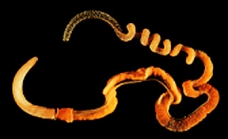
Identification
Since the specimen has long proboscis and all above features, hence it is Saccoglossus.
See Other Posts Also
- PRIMITIVE NERVOUS SYSTEM OF COELeNTERATES AND ECHINODERMS
- OSMOREGULATION OF FRESHWATER AND MARINE INVERTEBRATES
- ORGANS AND MECHANISM OF RESPIRATION IN LOWER INVERTEBRATES
- ECTOPROCTA – STRUCTURE, LIFE HISTORY, AFFINITIES
- HYDROSTATIC MOVEMENT
Discover more from Zoologyverse
Subscribe to get the latest posts sent to your email.