
What Is Phylum Urochordata (Tunicata)?
Phylum Urochordata, commonly called Tunicata, is a group of exclusively marine chordates found in oceans around the world.
They are commonly known as tunicates because their body is covered by a protective outer covering called the tunic.
Urochordates have a sac-like or barrel-shaped body with two openings called incurrent and excurrent siphons.
Water enters through the incurrent siphon, passes through the pharynx, and leaves through the excurrent siphon.
A distinctive feature of Urochordata is that the notochord and dorsal nerve cord are well developed mainly in the larval stage.
In most adults, these chordate features are reduced or lost. The notochord is present mainly in the tail of the larva, which gives the group its name—uro meaning tail and chord referring to the notochord.
Examples of urochordates include Herdmania, Ascidia, Salpa, and Oikopleura.
Their unusual life cycle makes them particularly important for understanding chordate evolution and development.
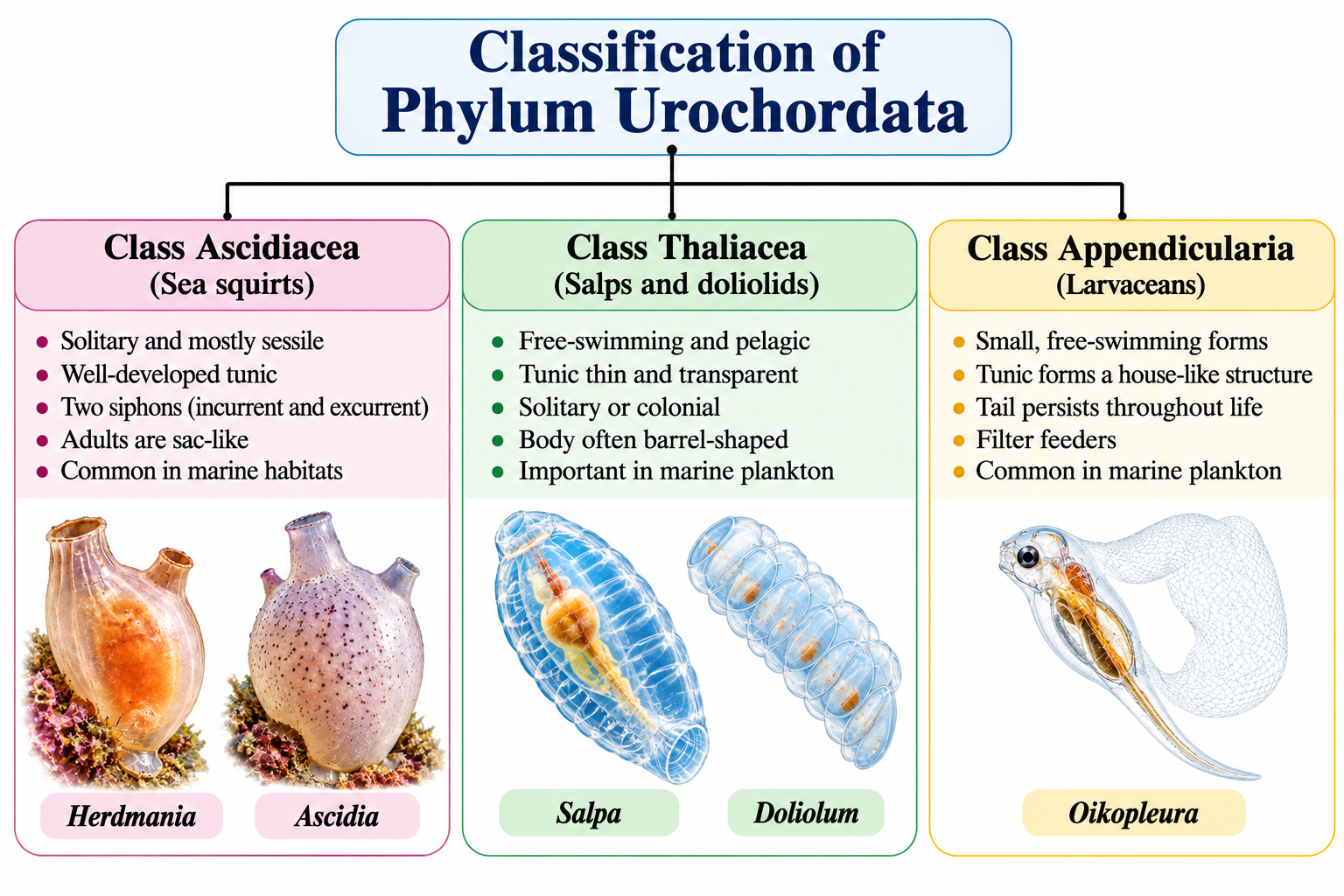
The classification of Urochordata recognises three classes: Ascidiacea, Thaliacea and Appendicularia.
General Characteristics of Urochordata
The important characteristics of Phylum Urochordata are:
- Urochordates are exclusively marine animals.
- They are chordates, although the main chordate features are most prominent in the larval stage.
- The adult body of most urochordates is sac-like, barrel-shaped, or cylindrical.
- “Most have a protective tunic or test and two siphons (incurrent and excurrent).
- The body has two openings: an incurrent (oral) siphon and an excurrent (atrial) siphon.
- The pharynx is large and perforated by numerous gill slits, which are important for filter feeding and respiration.
- The notochord is confined to the larval tail in most, but is retained in adult appendicularians.
- A dorsal hollow nerve cord is also prominent in the larval stage but becomes greatly reduced in the adult.
- Most adult urochordates are sessile, while some forms such as salps are free-swimming.
- They are mainly filter feeders, obtaining food from particles suspended in seawater.
- Many species are hermaphroditic, although reproductive patterns vary among groups.
- Development commonly includes a free-swimming tadpole-like larva.
- Important examples include Herdmania, Ascidia, Salpa, and Oikopleura.
Classification of Urochordata
Phylum Urochordata is commonly divided into three main classes based on their body form, habitat, and mode of life.
Molecular studies place tunicates, rather than Cephalochordata, as the closest living relatives of vertebrates. Ascidiacea is also now considered paraphyletic, though the three-class scheme remains standard in textbooks.
1. Class Ascidiacea
Ascidiaceans are commonly known as sea squirts. Most are sessile as adults and remain attached to rocks, shells, or other underwater surfaces.
Important features:
- Adult body is generally sac-like.
- The tunic is usually well developed.
- Adults are mainly sessile.
- They are efficient filter feeders.
Examples: Herdmania, Ascidia, Ciona
2. Class Thaliacea
Thaliaceans are free-swimming, barrel-shaped urochordates. Unlike most ascidiaceans, they remain pelagic throughout their adult life.
Important features:
- Body is usually transparent and barrel-shaped.
- They are free-swimming marine animals.
- Muscular bands around the body help in movement.
- Some species show alternation of generations.
Examples: Salpa, Doliolum, Pyrosoma
3. Class Appendicularia
Appendicularians are very small, free-swimming urochordates. They retain a prominent tail throughout their adult life.
Important features:
- Body is small and tadpole-like.
- The tail is retained in the adult.
- They produce a mucus feeding structure called a house.
- They are important planktonic filter feeders.
Example: Oikopleura
Body Structure of Urochordates
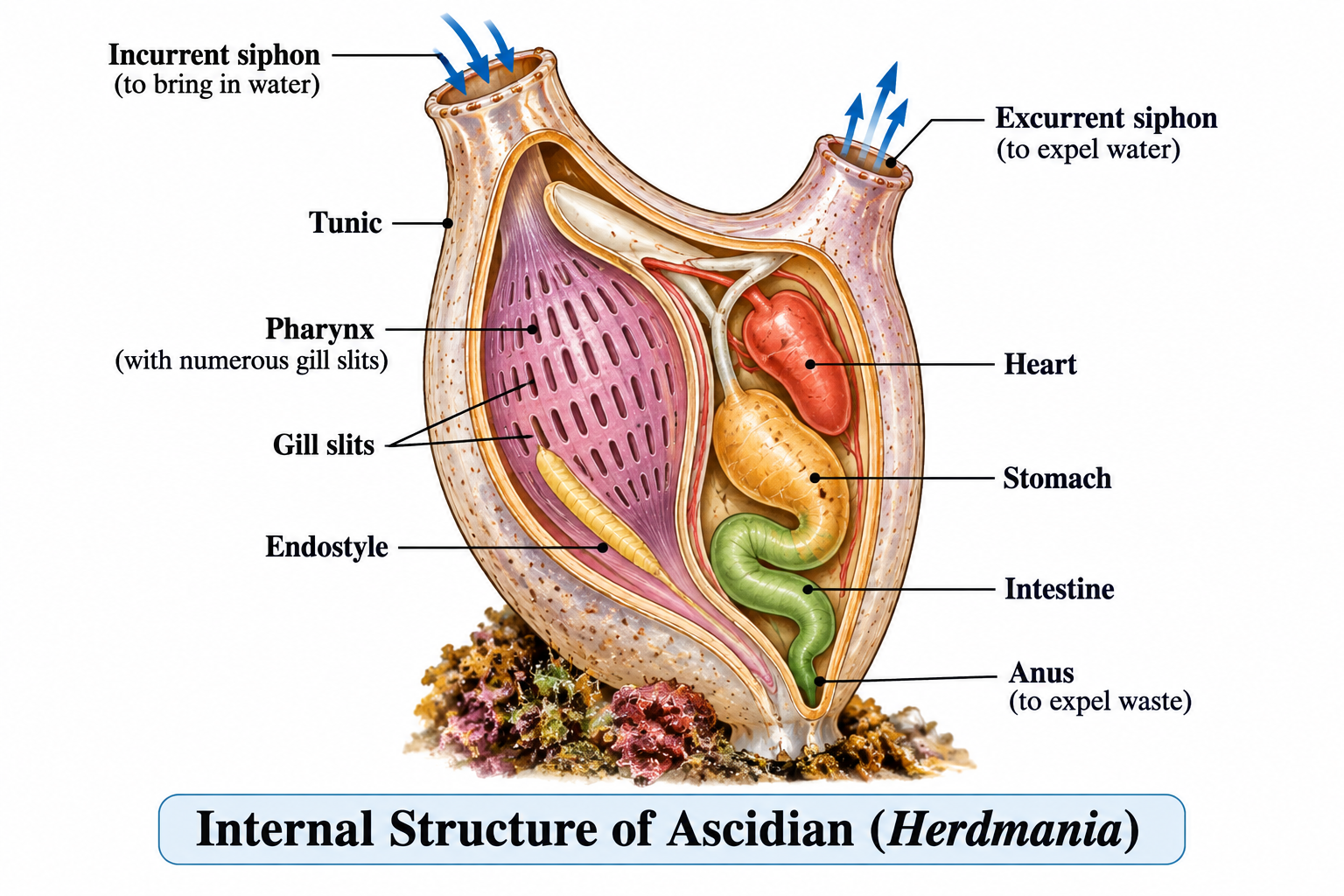
The body of an adult urochordate is generally sac-like or barrel-shaped and is enclosed by a protective covering called the tunic. The tunic contains a substance called tunicin, which gives it strength and flexibility.
The body has two prominent openings called siphons. The incurrent or oral siphon allows seawater to enter the body, while the excurrent or atrial siphon allows water and waste material to leave.
The pharynx is the largest internal structure and contains numerous pharyngeal gill slits. These slits allow water to pass through the pharynx and are important for both filter feeding and respiration.
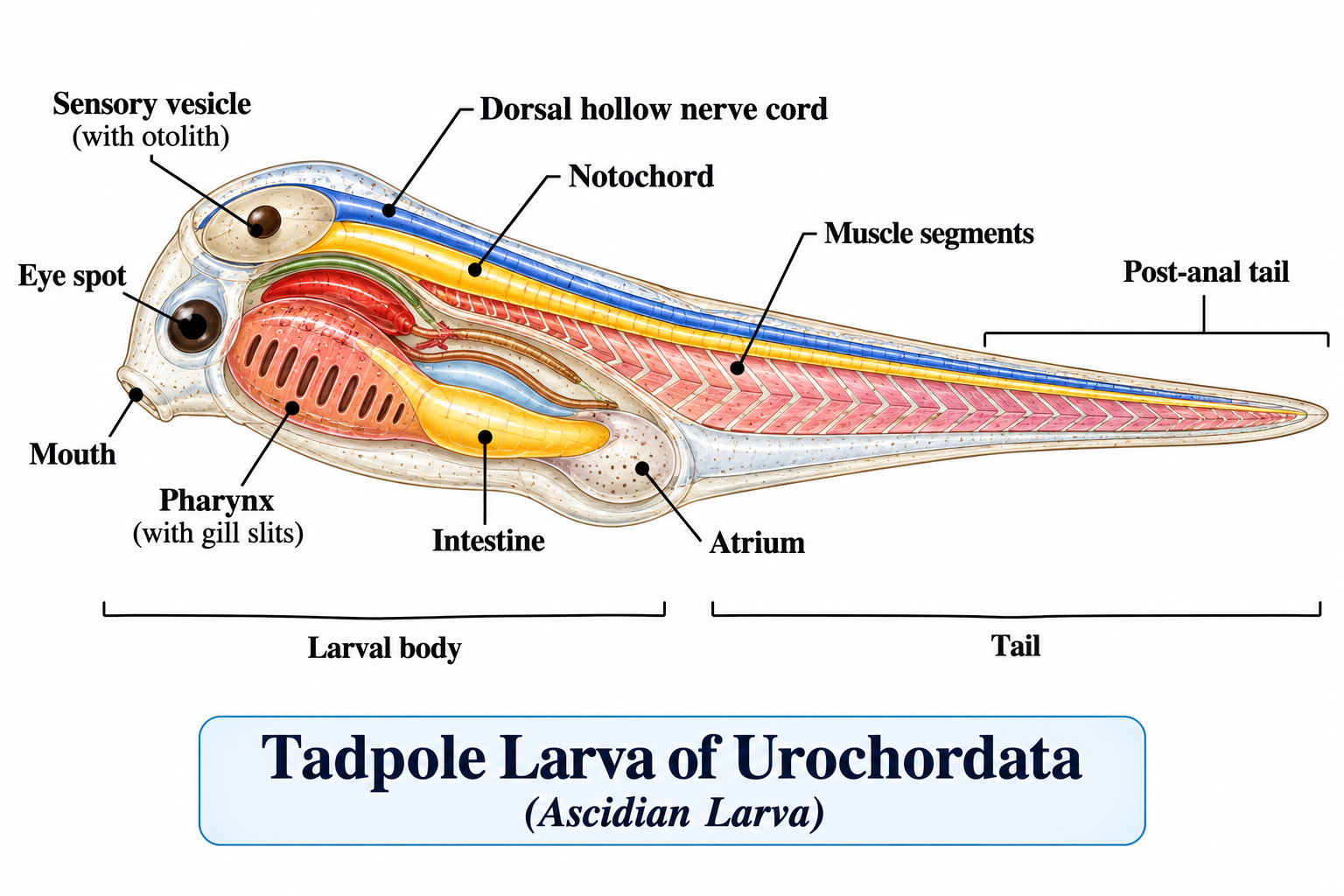
In the typical urochordate larva, the body is divided into a trunk and tail. The tail contains the notochord and dorsal hollow nerve cord, along with muscles that help the larva swim.
During metamorphosis, the larva attaches to a suitable surface in most ascidiaceans. The tail and several larval chordate structures are then reduced or lost, producing the characteristic adult form.
Digestive System of Urochordates
Urochordates have a complete digestive system that is closely associated with their filter-feeding habit. The digestive tract begins with the mouth and ends at the anus.
Water containing food particles enters through the incurrent siphon and passes into the large pharynx. The pharynx contains numerous gill slits and is lined by mucus-producing cells.
A structure called the endostyle produces mucus that traps tiny food particles from the incoming water. Cilia then move the mucus and trapped food toward the digestive tract.
From the pharynx, food passes into the oesophagus and then into the stomach, where digestion takes place. The digested nutrients are absorbed mainly through the intestine.
The undigested material passes through the intestine and is expelled through the anus, which opens into the atrial cavity. The waste is then carried out of the body through the excurrent siphon.
Thus, the digestive system of urochordates is highly adapted for filter feeding on microscopic organisms and organic particles suspended in seawater.
Respiratory System of Urochordates
Respiration in urochordates mainly occurs through the pharyngeal gill slits. The large pharynx acts as an important respiratory surface because it is continuously supplied with seawater.
Water enters through the incurrent siphon and passes into the pharynx. As water moves through the numerous pharyngeal gill slits, oxygen diffuses into the blood, while carbon dioxide passes from the blood into the water.
The walls of the pharyngeal region are thin and richly supplied with blood vessels, making them suitable for gas exchange. The continuous flow of water also helps maintain an adequate supply of oxygen.
In addition to respiration, the pharynx is involved in filter feeding, making it an important multifunctional structure in urochordates.
In the larval stage, respiration can also occur through the body surface, while the adult mainly depends on the pharyngeal region for gaseous exchange.
Circulatory System of Urochordates
The circulatory system of urochordates is relatively simple and consists of a heart, blood vessels, and blood-filled spaces. It transports oxygen, nutrients, hormones, and waste products throughout the body.
The circulatory system is open, with blood flowing through sinuses rather than a closed network of vessels.
The heart is a tubular, muscular structure located near the digestive organs. A distinctive feature of urochordates is that the heart can reverse the direction of its pumping action periodically. This helps maintain circulation through different parts of the body.
Blood is distributed through vessels and sinuses to various tissues. It also reaches the pharyngeal region, where oxygen is absorbed from the seawater passing through the gill slits.
The blood of many urochordates contains specialized blood cells and pigments involved in transporting and storing substances. The circulatory system therefore supports both the animal’s filter-feeding lifestyle and metabolic activities.
Excretory System of Urochordates
Most urochordates lack a kidney-like excretory organ. Excretion takes place mainly through the blood, body tissues, and pharyngeal region.
Nephrocytes are important in nitrogenous waste storage in many adult urochordates. These cells accumulate waste, particularly uric acid, as crystals
The accumulated waste may remain stored within these cells rather than being immediately eliminated. This type of waste storage is particularly useful in the relatively simple body organization of adult tunicates.
Some metabolic wastes can also be removed by diffusion through the body surface and pharyngeal region into the surrounding water. Thus, the excretory system of Urochordata is relatively simple and is closely adapted to their marine habitat.
Nervous System of Urochordates
The nervous system of urochordates differs considerably between the larval and adult stages.
In the tadpole-like larva, a dorsal hollow nerve cord is present along the tail. It develops from the dorsal neural tube and is associated with a sensory structure called the sensory vesicle. The larval nervous system helps the animal swim and locate a suitable surface for attachment.
During metamorphosis, particularly in ascidiaceans, the tail is lost and the larval nerve cord undergoes major reduction. The adult nervous system is represented mainly by a cerebral ganglion located between the two siphons.
The adult cerebral ganglion coordinates basic activities such as feeding, siphon movements, and responses to environmental stimuli.
The marked difference between the larval and adult nervous systems is an important feature of urochordates and demonstrates the remarkable changes that occur during their metamorphosis.
Reproduction and Development of Urochordates
Urochordates reproduce mainly by sexual reproduction. Many species are hermaphroditic, meaning the same individual produces both eggs and sperm. However, self-fertilization is generally avoided through differences in the timing of gamete release.
In many ascidiaceans, fertilization is external. Eggs and sperm are released into the surrounding seawater, where fertilization takes place. Some species have variations in their reproductive process.
The fertilized egg develops into a free-swimming tadpole-like larva. The larva possesses the main chordate features, including a notochord, dorsal hollow nerve cord, post-anal tail, and pharyngeal region.
The larva swims for a short period and eventually attaches to a suitable surface using its anterior end. It then undergoes metamorphosis. During this process, the tail and several larval chordate structures are reduced or lost, while the body develops into the characteristic adult form.
In some groups such as Thaliacea, reproduction can be more complex and may involve alternation between sexual and asexual generations.
The development of urochordates is particularly important in zoology because the larva clearly displays several fundamental chordate characteristics that become reduced in the adult.
Examples of Urochordata
Phylum Urochordata includes several marine animals that differ in their body form, habitat, and mode of life. Some important examples are:
Herdmania :- Herdmania is a common solitary sea squirt and an important example studied in zoology. The adult is sessile and has a sac-like body covered by a tough tunic.
Ascidia :- Ascidia is another typical ascidian or sea squirt. It remains attached to underwater surfaces and obtains food by filtering seawater through its pharynx.
Ciona :- Ciona is a solitary ascidian with a relatively transparent body. It is commonly used in developmental and evolutionary studies because of its chordate characteristics.
Salpa :- Salpa belongs to Class Thaliacea. It is a transparent, barrel-shaped, free-swimming tunicate that occurs in marine plankton.
Doliolum :- Doliolum is a small, free-swimming thaliacean. It has a barrel-shaped body with muscular bands that help it move through seawater.
Oikopleura :- Oikopleura belongs to Class Appendicularia. Unlike adult ascidians, it retains its tail throughout life and remains free-swimming. It also produces a mucus-based feeding structure called a house.
Importance of Urochordata in Zoology
Urochordates are important in zoology because they provide useful information about chordate structure, development, and evolution.
Their tadpole-like larvae clearly show the major chordate features, including the notochord, dorsal hollow nerve cord, pharyngeal gill slits, and post-anal tail. These features become reduced or lost during metamorphosis in many adult urochordates.
Urochordates are also important for studying developmental biology. Species such as Ciona are used as research organisms for understanding embryonic development, gene expression, and the evolution of chordate characteristics.
Their unusual transformation from a free-swimming larva to a sessile adult is another important example of metamorphosis in animals.
Urochordates also contribute to marine ecosystems as filter feeders, removing suspended organic particles and microorganisms from seawater.
For zoology students, Urochordata is therefore particularly useful for understanding chordate evolution, embryology, metamorphosis, and marine ecology.
Urochordata vs Vertebrata
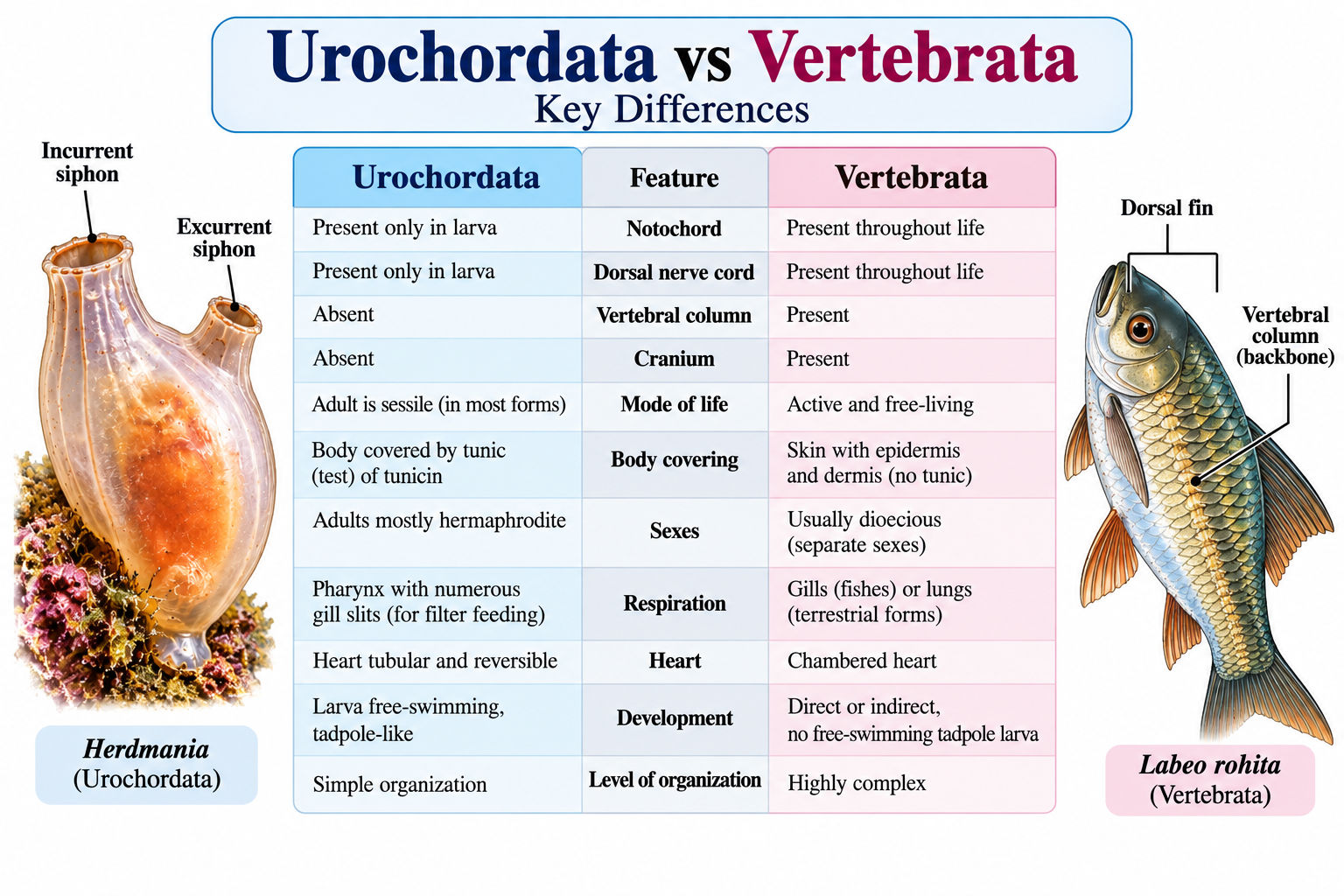
Urochordates and vertebrates both belong to Phylum Chordata, but they differ considerably in their body organization, development, and adult characteristics.
| Feature | Urochordata | Vertebrata |
|---|---|---|
| Notochord | Present mainly in the larval tail | Present during early development and replaced partly or completely by the vertebral column in most adults |
| Nervous system | Dorsal nerve cord is prominent mainly in the larva | Well-developed dorsal hollow nerve cord forms the brain and spinal cord |
| Body covering | Usually covered by a tunic | Usually covered by skin, scales, feathers, hair, or other specialized structures |
| Adult lifestyle | Many adults are sessile; some are free-swimming | Mostly actively mobile |
| Body organization | Generally simple and sac-like | Complex and highly organized |
| Endoskeleton | Vertebral column absent | Vertebral column and internal skeleton present |
| Pharyngeal slits | Prominent in adults and important in filter feeding | Present during development in many groups; function varies among vertebrates |
| Examples | Herdmania, Ascidia, Salpa, Oikopleura | Fish, amphibians, reptiles, birds, and mammals |
The main difference is that urochordates retain the major chordate features most clearly during their larval stage, whereas vertebrates develop a highly specialized internal skeleton and nervous system.
Key Takeaways
- Urochordata, also called Tunicata, is a group of exclusively marine chordates.
- Their body is covered by a protective tunic or test.
- The adult body usually has two siphons: an incurrent siphon and an excurrent siphon.
- The pharynx contains numerous gill slits and plays an important role in filter feeding and respiration.
- The notochord and dorsal hollow nerve cord are prominent mainly in the larval stage.
- Most ascidiacean adults are sessile, while thaliaceans and appendicularians are free-swimming.
- Many urochordates develop through a tadpole-like larval stage followed by metamorphosis.
- Important examples include Herdmania, Ascidia, Ciona, Salpa, Doliolum, and Oikopleura.
- Urochordates are important for studying chordate evolution, embryology, development, and metamorphosis.
Frequently Asked Questions
What is Phylum Urochordata?
Phylum Urochordata is a group of marine chordates commonly known as tunicates. Their body is covered by a protective tunic.
Why are urochordates called Tunicata?
They are called Tunicata because their body is surrounded by an outer covering called the tunic or test.
What are the main classes of Urochordata?
The three commonly recognized classes are Ascidiacea, Thaliacea, and Appendicularia.
What is the most common example of Urochordata?
Herdmania is one of the most commonly studied examples of Urochordata in zoology.
Do adult urochordates have a notochord?
In most urochordates, the notochord is present mainly in the larval tail and is lost during metamorphosis.
What is a tadpole larva in Urochordata?
It is a free-swimming larval stage that possesses important chordate features such as the notochord, dorsal hollow nerve cord, and post-anal tail.
Are urochordates vertebrates?
No. Urochordates are invertebrate chordates and do not develop a vertebral column.
Where do urochordates live?
Urochordates are exclusively marine and are found in oceans and coastal waters. Some live attached to substrates, while others are free-swimming.
Recommended Study Resource
Chordate Zoology
by P S Verma (Author)
Rastogi Publications PRACTICAL ZOOLOGY INVERTEBRATE (Z-20)
by Dr. S.S. Lal (Author)
As an Amazon Associate I earn from qualifying purchases.
References
- General information on tunicates, body structure, life cycle, and classification-Britannica – Tunicate
- World Register of Marine Species – Tunicata
- Useful for morphology, behavior, reproduction, and natural history :- Animal Diversity Web – Tunicata
- 29.1 Chordates – Biology 2e
- Useful for developmental biology and the evolutionary significance of tunicates :- NCBI Bookshelf
Discover more from Zoologyverse
Subscribe to get the latest posts sent to your email.