
Energy flow in an ecosystem is the transfer of energy from an external source, usually the Sun, to producers and then to consumers. It follows a unidirectional flow of energy, and energy transfer between trophic levels is limited by the 10% law of energy transfer. Most energy is used for life activities or lost as heat, so only a fraction reaches the next level.
Every ecosystem requires a continuous supply of energy to support the survival, growth, reproduction and daily activities of living organisms. Plants capture solar energy and convert it into chemical energy, herbivores obtain energy by feeding on plants, and carnivores acquire it by consuming other animals. This transfer connects organisms through feeding relationships and supports the functioning of ecosystems.
Understanding energy flow in an ecosystem explains why food chains are limited in length. It also shows why energy generally decreases at higher trophic levels and why producers form the foundation of most ecosystems. It provides the basis for studying food chains, food webs, ecological pyramids and the 10% law of energy transfer.
Unlike nutrients such as carbon and nitrogen, which can cycle between organisms and the environment, energy flow in an ecosystem is one-way, and energy is eventually dissipated as heat. Therefore, ecosystems require a continuing energy input to maintain their biological processes.
Definition of Energy Flow in an Ecosystem
Energy flow in an ecosystem is the transfer of energy from an external source to producers and then through consumers and other feeding pathways. It describes how energy is captured, transformed, transferred and eventually dissipated as heat during biological processes.
In most ecosystems, sunlight is the primary energy source. Green plants, algae and phytoplankton capture solar energy through photosynthesis and store it in organic compounds. Herbivores obtain this energy by consuming producers, while carnivores obtain it by eating other animals. Each transfer makes some energy available to another organism, while a substantial proportion is used in metabolism or dissipated as heat.
In ecosystems where sunlight is unavailable, such as deep-sea hydrothermal vents, certain bacteria use chemical energy to produce organic compounds. These organisms support food webs that do not depend directly on sunlight.
Energy flow can be understood through three main processes:
- Energy capture: Producers convert sunlight or chemical energy into chemical energy stored in organic compounds.
- Energy transfer: Organisms obtain energy by consuming producers or other organisms, connecting different trophic levels.
- Energy dissipation: Organisms use energy for respiration, movement, growth and other activities, and much of it ultimately leaves the ecosystem as heat.
For example, in the food chain Grass → Grasshopper → Frog → Snake, energy stored in grass passes to the grasshopper, then to the frog and finally to the snake. The amount available generally decreases at successive trophic levels.
This process is closely related to food chains and food webs, which illustrate the pathways through which energy moves between organisms. Energy flow also provides the foundation for understanding ecological pyramids, particularly pyramids of energy.
A key feature of energy flow in an ecosystem is that energy moves through ecosystems rather than being continuously recycled. Unlike nutrients such as carbon and nitrogen, energy is gradually dissipated as heat and must be replenished by an external source. This continuous transfer supports ecosystem productivity and helps determine how many trophic levels an ecosystem can sustain.
Sources of Energy in an Ecosystem
Energy is essential for all biological activities, including growth, movement, reproduction and cellular maintenance. To understand energy flow in an ecosystem, it is important to identify where energy originates and how it becomes available to living organisms.
The two major sources supporting energy flow in an ecosystem are sunlight and chemical energy. Sunlight supports most ecosystems, while chemical energy sustains certain communities in environments where sunlight is absent or insufficient.
1. Solar Energy
The Sun is the primary energy source for most ecosystems. Plants, algae and photosynthetic bacteria capture sunlight and use it to convert carbon dioxide and water into organic compounds through photosynthesis.
These organic compounds store chemical energy that can be transferred to consumers through feeding relationships.
For example:
Sunlight → Grass → Grasshopper → Frog → Snake
In this sequence, grass captures solar energy, the grasshopper obtains energy by eating grass, and the frog and snake acquire energy by consuming other organisms.
Not all sunlight reaching an ecosystem is captured by producers. Some is reflected, transmitted through leaves or absorbed without being used in photosynthesis. Consequently, only a portion of incoming solar energy becomes chemical energy in organic matter.
2. Chemical Energy
Some ecosystems depend on chemical energy rather than directly on sunlight. In these environments, certain microorganisms use energy released by chemical reactions to produce organic compounds. This process is called chemosynthesis.
A well-known example occurs around deep-sea hydrothermal vents, where bacteria use chemical substances such as hydrogen sulfide as an energy source. These microorganisms support communities containing organisms such as specialized worms, molluscs and crustaceans.
Chemosynthetic ecosystems demonstrate that biological energy input does not always require sunlight. Nevertheless, they follow the same general principle of energy flow in an ecosystem: energy is captured, transferred between organisms and eventually dissipated as heat.
3. Producers: The Entry Point of Energy
Producers are organisms that convert an external energy source into chemical energy stored in organic compounds. They form the foundation of most food chains and food webs.
Examples include:
- Terrestrial plants: Grasses, shrubs and trees capture solar energy through photosynthesis.
- Aquatic producers: Phytoplankton, algae and aquatic plants supply energy to many aquatic food webs.
- Chemosynthetic microorganisms: Certain bacteria and archaea use chemical energy to produce organic matter.
The rate at which producers store energy as organic matter is related to primary productivity. Gross primary productivity is the total rate of energy capture through photosynthesis, while net primary productivity is the energy stored as new plant or algal biomass after subtracting the energy used in producers’ own respiration.
Net primary productivity represents the energy available for producer growth and, ultimately, for consumers and decomposers.
4. Organic Matter as an Energy Source for Consumers
Consumers cannot generally produce all their organic food from inorganic substances. Instead, they obtain energy by consuming plants, animals or other organic material.
Herbivores feed on producers, carnivores consume other animals, and omnivores obtain energy from both plant and animal sources. Detritivores and decomposers obtain energy from dead organisms and organic waste.
These feeding relationships connect producers to consumers and detrital pathways. Although nutrients can be released and reused, energy is progressively dissipated as heat during metabolism. This is a defining feature of energy flow in an ecosystem.
In this way, sunlight or chemical energy enters an ecosystem, becomes stored in organic matter, passes through feeding relationships and eventually leaves as heat. This continuous transfer is the basis of energy flow in an ecosystem.
Steps of Energy Flow in an Ecosystem
Energy flow in an ecosystem occurs in a series of connected stages, beginning with energy capture and continuing through feeding relationships, decomposition and the eventual dissipation of energy as heat. These stages explain how energy becomes available to organisms and why less energy is generally available at higher trophic levels.
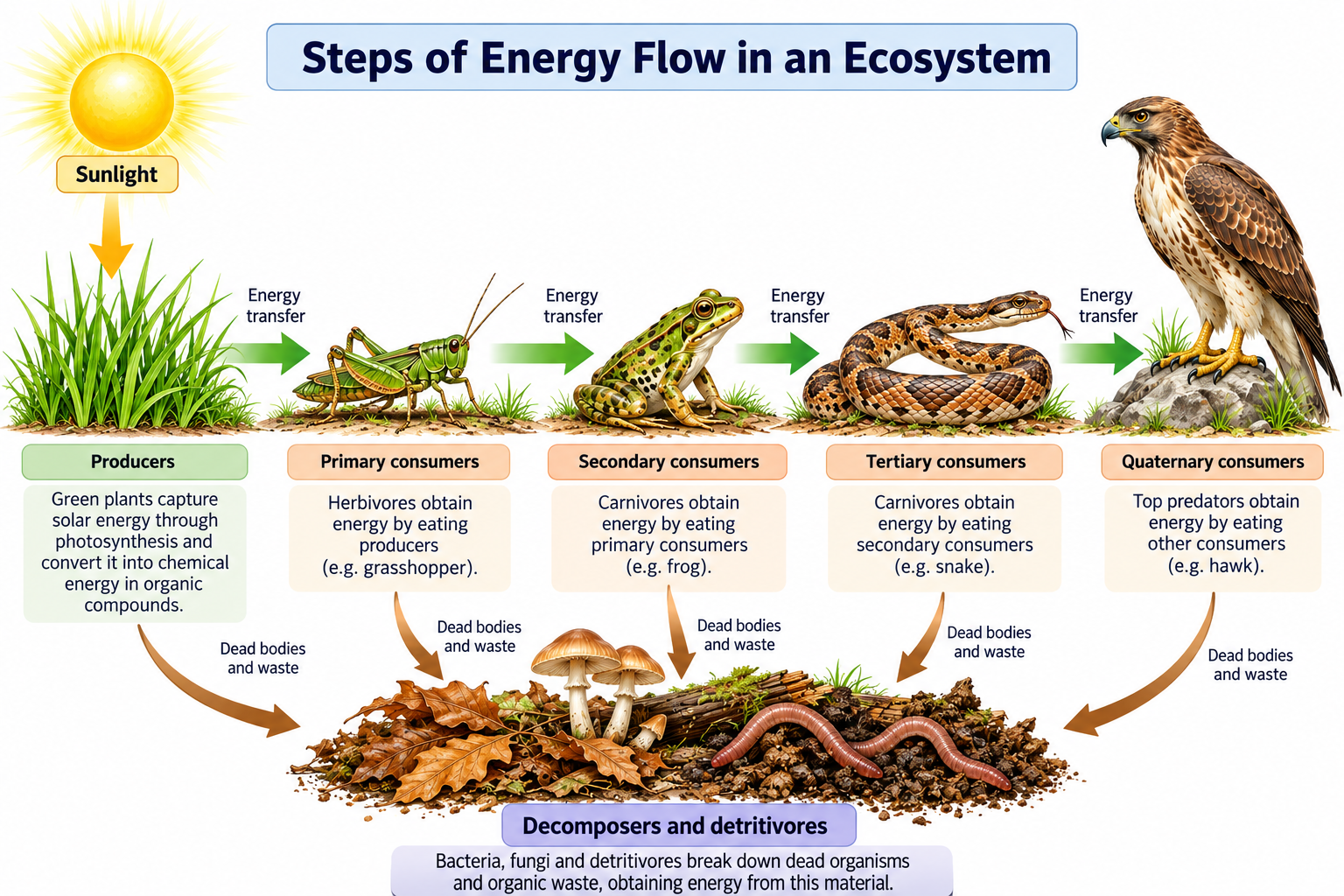
The following steps describe energy flow in an ecosystem using a typical terrestrial ecosystem as an example.
Step 1: Capture of Energy by Producers
In most ecosystems, the process begins when green plants, algae and other photosynthetic organisms capture sunlight. Through photosynthesis, they convert light energy into chemical energy stored in organic compounds such as glucose.
For example, grass captures sunlight and uses it to manufacture food. This stored chemical energy supports the growth of the plant and becomes available to herbivores that consume it.
In ecosystems such as deep-sea hydrothermal vents, chemosynthetic microorganisms capture energy from chemical reactions instead of sunlight.
Step 2: Transfer of Energy to Primary Consumers
Primary consumers obtain energy by feeding directly on producers. They are commonly herbivores, including grasshoppers, rabbits, deer and plant-eating zooplankton.
When a grasshopper eats grass, it obtains some of the chemical energy stored in plant tissues. However, not all the energy consumed becomes part of the grasshopper’s biomass. Some material remains undigested, while some assimilated energy is used for respiration, movement and other biological processes.
Only the portion incorporated into new consumer biomass can potentially be transferred to predators when the consumer is eaten.
Step 3: Transfer of Energy to Secondary Consumers
Secondary consumers obtain energy by feeding on primary consumers. Many are carnivores, such as frogs that eat insects, spiders that capture herbivorous insects and small predatory fish that consume zooplankton.
For example, a frog obtains energy by eating a grasshopper. Some of that energy supports the frog’s metabolism and activity, while another portion may become part of its body tissues.
The energy available for transfer to the next consumer is therefore generally lower than the energy originally captured by the producers.
Step 4: Transfer to Tertiary and Higher-Level Consumers
Tertiary consumers feed on secondary consumers, while higher-level predators may feed on organisms occupying several trophic positions.
Consider this food chain:
Grass → Grasshopper → Frog → Snake → Hawk
Grass is the producer, the grasshopper is the primary consumer, the frog is the secondary consumer, the snake is the tertiary consumer, and the hawk occupies the next trophic level in this simplified pathway.
At each transfer, energy is used in biological processes and dissipated as heat. As a result, the amount available to support biomass at higher trophic levels generally decreases.
Step 5: Transfer of Energy Through Detrital Pathways
Not all organic matter produced by plants is consumed by herbivores, and not all consumed material is assimilated. Dead leaves, fallen branches, animal remains and organic waste provide energy to detritivores and decomposers.
Earthworms and certain other detritivores consume dead organic material, while bacteria and fungi break down complex organic compounds. These organisms obtain energy from the material they process.
Detrital pathways connect with grazing food chains because dead organic matter originates from producers and consumers throughout the ecosystem. They are particularly important in forests, soils, wetlands and aquatic sediments.
Step 6: Dissipation of Energy as Heat
Organisms use energy for cellular respiration, movement, growth, reproduction and maintaining internal conditions. During these processes, much of the energy is ultimately transformed into heat and dissipated into the surroundings.
This is why energy does not circulate through an ecosystem in the same way as nutrients. Nutrients can be reused, but energy that has dissipated as heat is not returned to producers as usable biological energy through ordinary ecosystem processes. As a result, energy flow in an ecosystem is one-way, while nutrient cycling is circular.
A continuous input of energy is therefore required to sustain ecosystem functioning.
Summary of Energy Flow
The main stages can be summarized as follows:
Sunlight → Producers → Primary Consumers → Secondary Consumers → Higher-Level Consumers
Dead organisms and organic waste also enter detrital pathways, where decomposers and detritivores obtain energy from organic matter.
The diagrammatic sequence is a simplified model. Real ecosystems contain multiple connected feeding pathways, as explained in our article on food chains and food webs.
Understanding these steps helps explain energy transfer between trophic levels, the reduction in available energy at higher levels and the importance of producers in supporting ecosystem life.
Energy Transfer Between Trophic Levels: Food Chains and Food Webs
Food chains and food webs explain how energy moves between organisms through feeding relationships. They connect producers, consumers and decomposers and help ecologists understand how energy supports life at different trophic levels.
A food chain represents one feeding pathway, while a food web shows several interconnected pathways. Both are useful for understanding energy flow in an ecosystem, but a food web more closely represents the complexity of feeding relationships in nature.
Energy Transfer Through a Food Chain
A food chain shows the movement of energy through a sequence of organisms, beginning with a producer or another food source.
For example:
Grass → Grasshopper → Frog → Snake → Hawk
In this sequence:
- Grass captures solar energy and stores it as chemical energy.
- The grasshopper obtains energy by eating grass.
- The frog obtains energy by eating the grasshopper.
- The snake obtains energy by eating the frog.
- The hawk may obtain energy by preying on the snake.
At each transfer, organisms use energy for respiration, movement, growth and other biological activities. Some energy is also present in material that is not consumed or assimilated. Consequently, only a portion of the energy available at one level becomes incorporated into biomass that can support the next level.
Energy Transfer Through a Food Web
In natural ecosystems, most organisms participate in multiple feeding relationships. A single producer may support several herbivores, and those herbivores may be consumed by different predators.
For example, grass in a grassland may provide food for grasshoppers, rabbits and mice. Grasshoppers may be eaten by frogs and birds, while rabbits and mice may be prey for foxes, snakes and hawks.
These interconnected pathways form a food web. Energy can move through several routes, and some consumers may obtain energy from organisms occupying different trophic levels.
If one food source becomes scarce, certain consumers may switch to alternative prey. However, this flexibility depends on the species, its feeding behaviour and the availability of suitable alternatives. A food web does not guarantee that every organism can survive the loss of its preferred food source.
Role of Decomposers in Energy Transfer
Decomposers and detritivores obtain energy from dead organisms, fallen leaves and organic waste. Bacteria and fungi break down organic material, while detritivores such as earthworms consume and fragment it.
These organisms connect the detrital pathway with the rest of the food web because dead material originates from producers and consumers at many trophic levels.
Decomposition also releases nutrients into the environment. Producers can absorb these nutrients and use them to manufacture new organic matter. However, the energy used by decomposers is ultimately dissipated as heat rather than recycled indefinitely.
Difference Between Energy Transfer and Nutrient Cycling
Energy transfer and nutrient cycling are related but distinct ecological processes.
| Feature | Energy Transfer | Nutrient Cycling |
|---|---|---|
| Movement | Through organisms and feeding relationships | Between organisms and the environment |
| General pattern | One-way flow through the ecosystem | Repeated circulation and reuse |
| What happens during biological activity? | Much energy is eventually dissipated as heat | Nutrients are incorporated into organic matter and released again |
| Requirement | A continuing external energy input | Ongoing exchanges among organisms and environmental reservoirs |
| Example | Sunlight → Grass → Grasshopper → Frog | Carbon moves between the atmosphere, organisms, soil and water |
This distinction is fundamental to understanding energy flow in an ecosystem and overall ecosystem functioning. Energy enters the system, passes through feeding relationships and eventually leaves as heat, whereas nutrients can be reused through biological, geological and chemical processes.
For more detail about the structure of feeding relationships, see our article on food chains and food webs. The distribution of energy across trophic levels is also represented by ecological pyramids.
The 10% Law of Energy Transfer
The 10% law of energy transfer states that, on average, about 10% of the energy at one trophic level passes to the next. The rest is used in biological activities, lost as heat, or remains in material that is not consumed or assimilated.
This principle is commonly associated with ecologist Raymond Lindeman, whose 1942 work on trophic dynamics helped establish the importance of energy transfer in ecosystem studies. The 10% value is a simplified approximation, not a fixed percentage that applies to every ecosystem or feeding relationship.
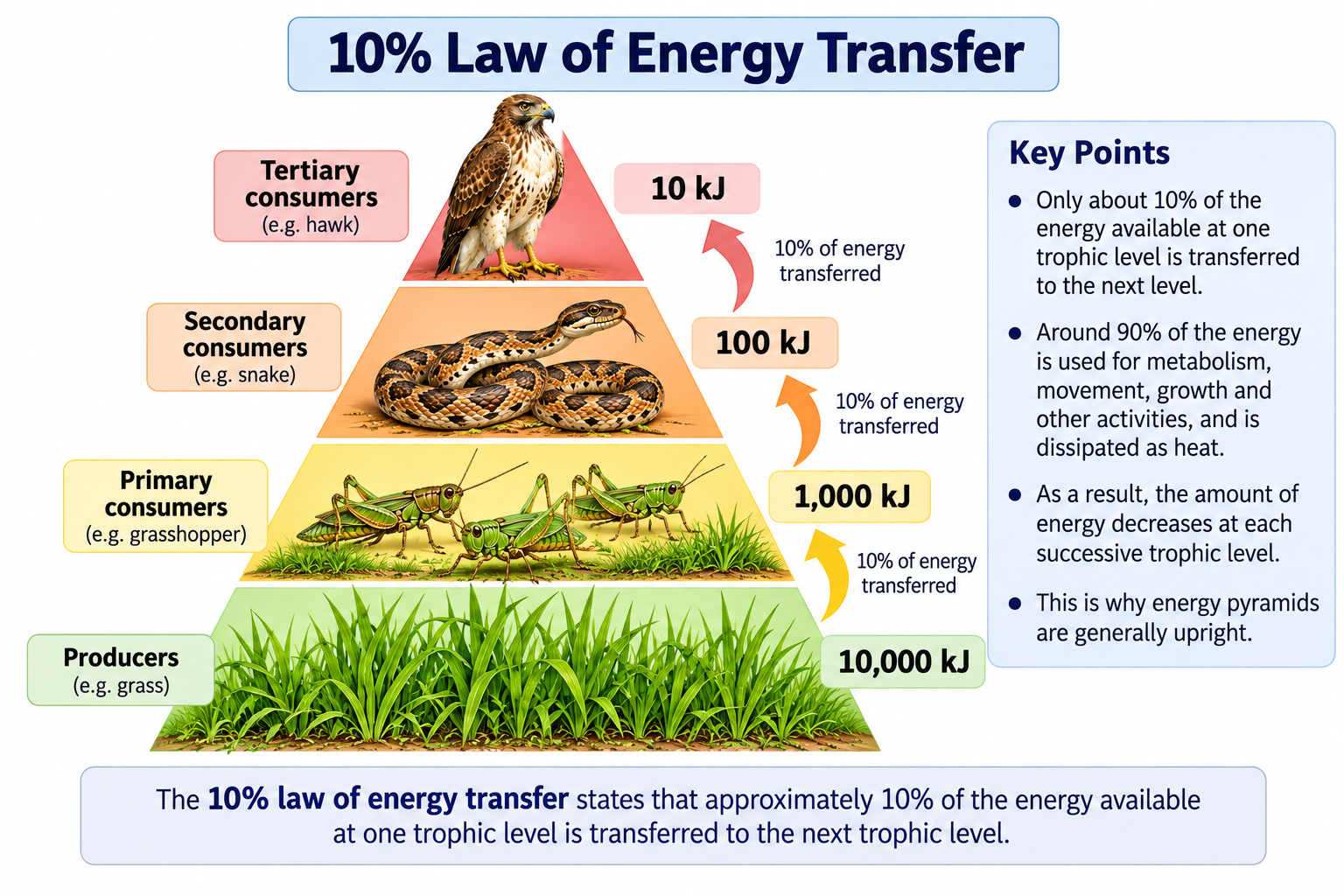
Explanation of the 10% Law
When a herbivore eats a plant, it does not convert all the energy in the plant material into new body tissue. Some of the food may remain undigested, and some of the assimilated energy is used for respiration, movement, growth and other biological processes.
Only a portion of the energy consumed becomes new biomass that can be transferred to a predator when the herbivore is eaten. Similar losses occur at subsequent trophic levels.
For example, consider a simplified grassland food chain:
Grass → Grasshopper → Frog → Snake
If producers contain 10,000 kJ of energy available in biomass, a hypothetical transfer efficiency of 10% would give the following values:
| Trophic level | Illustrative energy available |
|---|---|
| Producers (grass) | 10,000 kJ |
| Primary consumers (grasshoppers) | 1,000 kJ |
| Secondary consumers (frogs) | 100 kJ |
| Tertiary consumers (snakes) | 10 kJ |
These figures demonstrate the principle mathematically. They are illustrative values rather than measurements from a particular ecosystem.
Formula for the 10% Law
The approximate transfer of energy can be calculated using:
Energy transferred = Energy available at the previous trophic level × Transfer efficiency
When the assumed transfer efficiency is 10%:
Energy transferred = Previous trophic-level energy × 0.10
For example, if 5,000 kJ is available at one trophic level, a 10% transfer would provide approximately 500 kJ at the next level.
Transfer efficiency can also be calculated as:
Transfer efficiency (%) = (Energy transferred to the next trophic level ÷ Energy available at the previous trophic level) × 100
These calculations are useful for understanding energy transfer, but actual efficiencies vary with organism type, food quality, digestibility, metabolism and ecosystem conditions.
Why Is Only a Small Portion of Energy Transferred?
Several processes limit the transfer of energy between trophic levels.
1. Respiration and metabolism
Organisms use energy to maintain cellular functions, move, grow and reproduce. Much of this energy is ultimately released as heat.
2. Undigested material
Not all the food consumed by an organism can be digested and assimilated. Some energy remains in faeces and other waste material.
3. Uneaten biomass
Some parts of plants or animals may not be eaten by consumers. This material can enter detrital pathways and become available to decomposers and detritivores.
4. Incomplete assimilation
Even when food is consumed, not all its energy is incorporated into the consumer’s body. Some is used in metabolism or lost in waste.
These processes explain why the energy incorporated into the biomass of a consumer is generally less than the energy available in its food.
Importance of the 10% Law
The 10% law is useful for understanding several ecological patterns.
- Declining energy availability: Less energy is generally available to support biomass at successive trophic levels.
- Limits on trophic levels: Energy losses help explain why food chains commonly contain only a limited number of trophic transfers.
- Ecological pyramids: Energy pyramids represent the reduction in energy available across trophic levels.
- Population support: The energy available from prey and producers constrains how many organisms can be supported at higher trophic levels.
- Ecosystem comparisons: Transfer efficiencies help ecologists investigate differences in energy use among ecosystems.
The principle is closely connected to energy flow in an ecosystem because it describes the approximate efficiency of transfer between trophic levels.
Limitations of the 10% Law
The 10% law of energy transfer should not be interpreted as a universal biological rule. Actual transfer efficiency may be higher or lower than 10%, depending on the organisms and the ecosystem.
For example, transfer efficiency can differ between herbivores that eat relatively digestible animal material and herbivores that consume plant tissues containing substantial amounts of cellulose. Temperature, metabolic demands, food quality and the proportion of consumed material that becomes new biomass can also affect energy transfer.
Furthermore, energy transfer between trophic levels depends on how the ecosystem boundary and the energy budget are defined. Therefore, the 10% law is best used as a teaching model for explaining energy loss rather than as a precise prediction for every food chain.
In summary, the 10% law of energy transfer illustrates why only a fraction of energy is passed from one trophic level to the next. Together with food chains, food webs and energy pyramids, it helps explain energy flow in an ecosystem and the availability of energy at each level.
Unidirectional Flow of Energy in an Ecosystem
Energy flow in an ecosystem shows a unidirectional flow of energy. Energy moves from an external source through producers and consumers and is eventually dissipated as heat. Unlike nutrients, which are recycled through biogeochemical cycles, energy is not returned to producers in a reusable form.
In most ecosystems, sunlight provides the initial energy input for energy flow in an ecosystem. Producers capture some of this energy and store it in organic compounds. Consumers obtain energy by feeding on producers or other organisms, while decomposers obtain energy from dead organic matter and waste. Throughout these processes, organisms use energy for metabolism and release heat into their surroundings.
Why Is Energy Flow Unidirectional?
1. Energy enters the ecosystem from an external source
Most ecosystems receive energy from the Sun. Photosynthetic organisms capture a portion of this energy and convert it into chemical energy. In some ecosystems, chemosynthetic microorganisms use chemical energy instead.
2. Energy passes through trophic levels
Energy stored in organic matter moves from producers to primary consumers and then to higher-level consumers through feeding relationships. Decomposers also obtain energy from dead organisms and organic waste originating at different trophic levels.
3. Energy is dissipated as heat
During cellular respiration and other metabolic processes, organisms transform chemical energy to support biological activities. Much of this energy is ultimately dissipated as heat and becomes unavailable for reuse by organisms through ordinary food-chain processes.
4. Continuous energy input is required
Because usable energy is progressively dissipated, ecosystems need a continuing source of energy to sustain biological activity. Most ecosystems depend on sunlight, while some specialized communities rely on chemical energy. Without this input, energy flow in an ecosystem would stop.
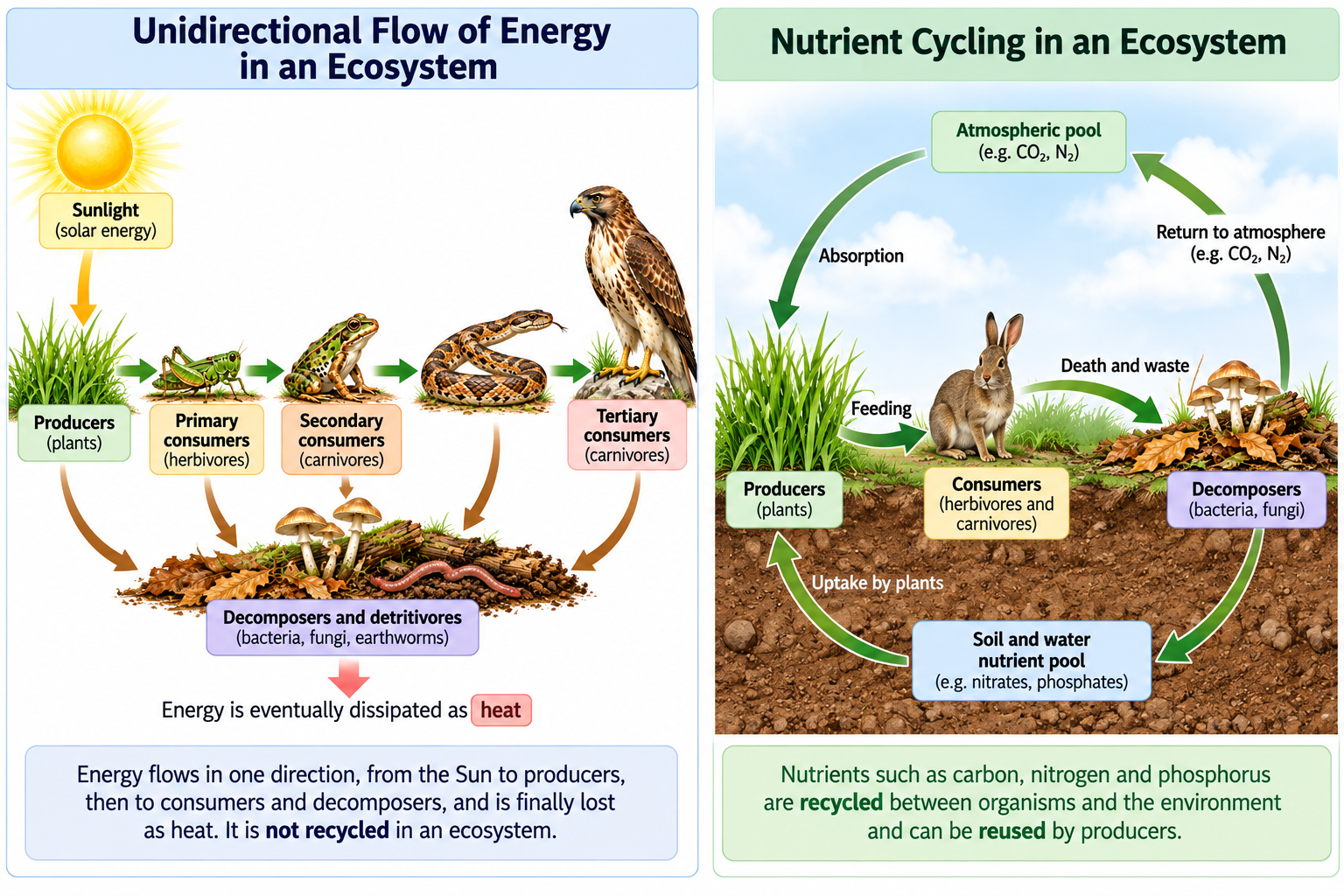
Energy Flow Compared with Nutrient Cycling
| Feature | Energy Flow | Nutrient Cycling |
|---|---|---|
| General pattern | One-way transfer through an ecosystem | Repeated circulation between organisms and the environment |
| Main source or reservoir | Usually sunlight; chemical energy in some ecosystems | Soil, water, atmosphere, rocks and living organisms |
| What happens during metabolism? | Energy is ultimately dissipated as heat | Nutrients remain in matter and can be released and reused |
| Can the same energy be continuously recycled by organisms? | No, not through ordinary ecosystem processes | Nutrients can be reused through biological and environmental processes |
| Example | Sunlight → Grass → Grasshopper → Frog | Carbon moves between the atmosphere, plants, animals, soil and water |
Importance of Unidirectional Energy Flow
The unidirectional flow of energy explains why energy flow in an ecosystem requires an ongoing energy supply and why energy availability generally decreases at higher trophic levels. It also helps explain the structure of energy pyramids and the limited number of trophic transfers commonly supported by food chains.
For example, grass captures solar energy and stores it as organic matter. A grasshopper obtains some of this energy by eating grass, and a frog obtains some by eating the grasshopper. At each stage, energy is used for biological activities and dissipated as heat, so only a portion remains available for transfer to another consumer.
Understanding this principle is fundamental to energy flow in an ecosystem and provides a basis for studying food chains, food webs, ecological pyramids and the 10% law of energy transfer.
Energy Flow Through Different Ecosystems
Energy flow in an ecosystem follows the same basic principles across habitats: energy enters through producers or other energy-capturing organisms, passes through feeding relationships and is eventually dissipated as heat. However, the organisms involved and the pathways of energy transfer differ according to environmental conditions, available resources and community structure.
1. Energy Flow in a Terrestrial Ecosystem
Terrestrial ecosystems include forests, grasslands, deserts and other land-based habitats. In most of these ecosystems, green plants capture sunlight through photosynthesis and provide the organic matter that supports consumers.
For example, in a grassland ecosystem:
Sunlight → Grass → Grasshopper → Frog → Snake
Grass captures solar energy and stores it in organic compounds. Grasshoppers feed on grass, frogs consume insects, and snakes may prey on frogs. At each trophic transfer, some energy is used for biological processes and dissipated as heat.
Forest ecosystems also receive energy through photosynthesis, but their producers include trees, shrubs and other vegetation. Fallen leaves, dead wood and animal remains support detrital pathways, which are especially important in forest soils.
2. Energy Flow in an Aquatic Ecosystem
Aquatic ecosystems include ponds, lakes, rivers, wetlands and marine environments. In many of these habitats, phytoplankton and algae are major primary producers.
A simplified aquatic food chain is:
Sunlight → Phytoplankton → Zooplankton → Small Fish → Large Fish
Phytoplankton capture solar energy through photosynthesis. Zooplankton consume phytoplankton, and fish obtain energy by feeding on zooplankton or other fish.
The amount of energy captured by aquatic producers depends on factors such as light availability, nutrient supply, water temperature and the depth at which photosynthesis can occur. In deep or turbid water, limited light can restrict photosynthesis.
3. Energy Flow in a Marine Ecosystem
Marine ecosystems contain diverse feeding relationships involving phytoplankton, zooplankton, crustaceans, fish, seabirds and marine mammals.
One simplified pathway is:
Phytoplankton → Zooplankton → Small Fish → Tuna
Another example involves krill, which consume phytoplankton and may be eaten by certain whales, seabirds and fish.
Marine food webs often contain many interconnected pathways. The availability of energy at higher trophic levels depends on primary productivity, feeding relationships and the efficiency with which energy is transferred between organisms.
Some deep-sea ecosystems, particularly those around hydrothermal vents, are supported by chemosynthetic microorganisms rather than direct sunlight. These organisms use chemical energy to produce organic matter that supports other species.
4. Energy Flow in a Desert Ecosystem
Deserts receive relatively little precipitation, and extreme temperatures or limited water availability can restrict plant growth. Nevertheless, desert ecosystems support producers such as shrubs, grasses and cacti, which provide energy for herbivores and other consumers.
A simplified desert food chain is:
Desert plants → Grasshopper → Lizard → Snake
Desert plants capture solar energy and store it in organic matter. Insects feed on vegetation, lizards may consume insects, and snakes may prey on lizards or other animals.
Energy flow in an ecosystem such as a desert is influenced by water availability, seasonal productivity and the activity patterns of organisms. Some animals are nocturnal, reducing their exposure to daytime heat, while many plants grow rapidly during periods when water becomes available.
5. Energy Flow in a Forest Ecosystem
Forests contain producers such as trees, shrubs, herbs and mosses. These organisms capture solar energy and support herbivores, omnivores and predators.
For example:
Leaves → Caterpillar → Insect-Eating Bird → Hawk
Energy also enters detrital pathways when leaves fall or organisms die. Fungi, bacteria and detritivores obtain energy from this organic material and contribute to decomposition.
Forest ecosystems can produce substantial quantities of organic matter, but the amount of energy available to consumers depends on plant productivity, the proportion of plant material consumed and the efficiency of energy transfer.
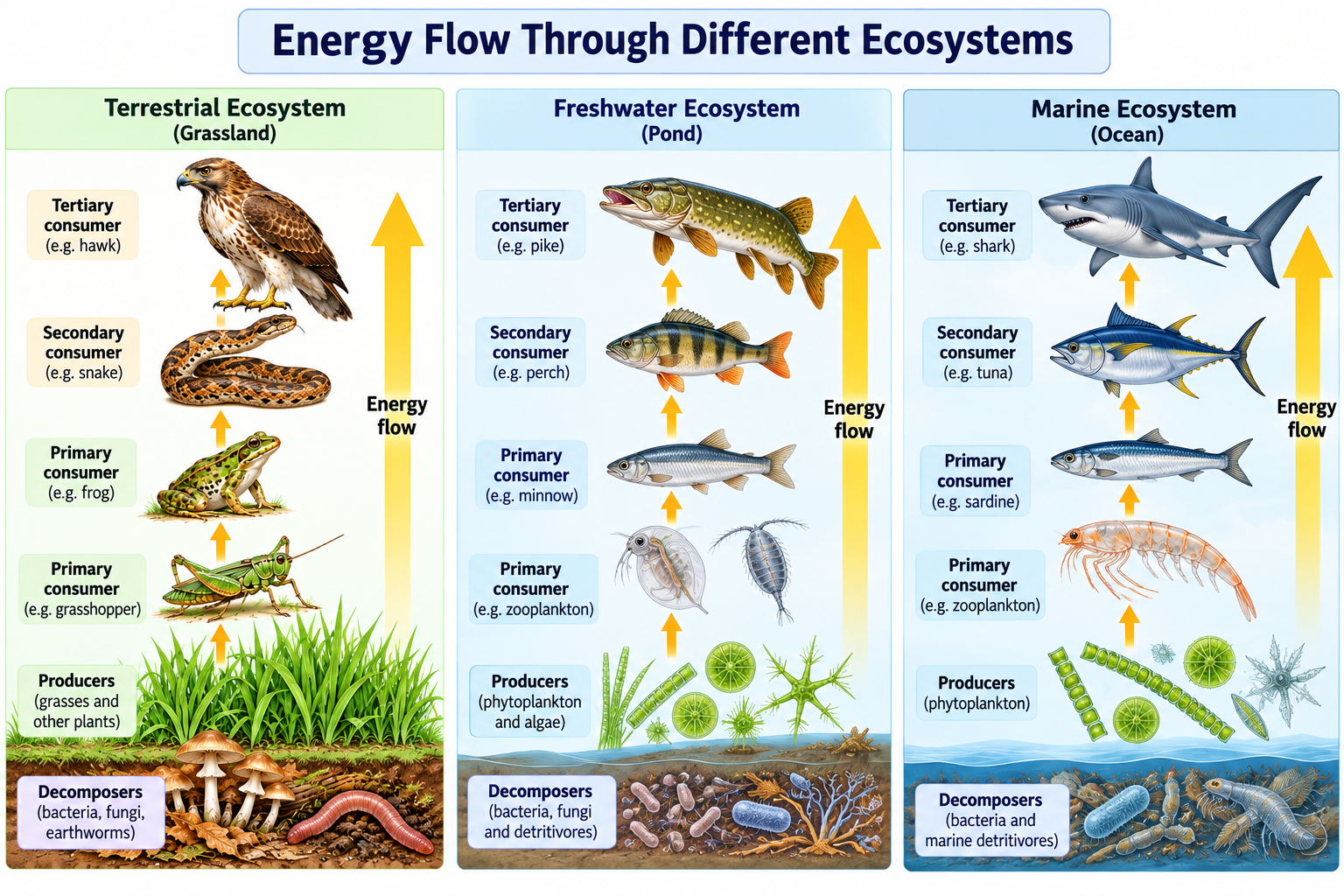
Comparison of Energy Flow in Different Ecosystems
| Ecosystem | Major producers | Example of a food chain | Important influences |
|---|---|---|---|
| Grassland | Grasses and herbs | Grass → Grasshopper → Frog → Snake | Rainfall, soil nutrients and grazing |
| Forest | Trees, shrubs and herbs | Leaves → Caterpillar → Bird → Hawk | Light, moisture and vegetation structure |
| Pond | Phytoplankton, algae and aquatic plants | Phytoplankton → Zooplankton → Fish | Light penetration, nutrients and water temperature |
| Marine | Phytoplankton and algae | Phytoplankton → Zooplankton → Small Fish | Nutrient availability, light and ocean conditions |
| Desert | Drought-adapted plants | Desert plants → Grasshopper → Lizard | Water scarcity and temperature |
These examples illustrate that the organisms and feeding pathways vary among habitats, but the basic principles of energy flow in an ecosystem remain the same. Studying these differences helps ecologists compare ecosystem productivity, understand food-web structure and investigate how environmental changes influence energy availability.
Ecological Significance of Energy Flow
Energy flow is one of the fundamental processes that maintains ecosystem functioning. It determines how energy becomes available to organisms, supports biological activities and influences the structure of food chains and food webs. Studying energy flow in an ecosystem helps ecologists understand productivity, population relationships and the effects of environmental changes.
1. Supports the Survival of Organisms
All living organisms require energy for essential activities such as growth, movement, reproduction, cellular maintenance and repair. Producers capture energy from sunlight or chemical sources, while consumers obtain energy by feeding on other organisms.
Without a continuing energy supply, organisms could not maintain their biological activities, and ecosystem processes would eventually cease.
2. Determines Ecosystem Productivity
Ecosystem productivity depends on the rate at which producers capture energy and convert it into organic matter. Primary productivity is especially important because it determines how much energy-rich biomass becomes available to consumers and decomposers.
Factors such as light intensity, temperature, water availability, nutrient supply and the type of producer influence productivity. For example, a productive grassland may support substantial herbivore populations, whereas a desert’s limited water supply often restricts plant growth and the energy available to consumers.
3. Influences the Structure of Food Chains and Food Webs
Energy availability helps determine which feeding relationships can be supported within an ecosystem. Producers provide the organic matter used by herbivores, while predators depend directly or indirectly on energy originally captured by producers.
Food chains illustrate individual pathways of energy transfer, while food webs show interconnected pathways. See our article on food chains and food webs for a detailed comparison.
4. Explains the Decline in Energy at Higher Trophic Levels
Organisms use much of the energy they obtain for metabolism and other biological processes. Consequently, only a fraction of the energy available at one trophic level becomes incorporated into biomass that can be transferred to the next.
This pattern helps explain why energy pyramids are generally upright and why ecosystems typically support less biomass at higher trophic levels than at lower ones. The exact transfer efficiency varies among organisms and ecosystems.
5. Helps Explain the Length of Food Chains
Energy losses during energy transfer between trophic levels limit the amount of energy available to higher-level consumers. As a result, food chains generally contain a limited number of trophic transfers, although their length varies with ecosystem conditions and feeding relationships.
The 10% law of energy transfer is a simplified model commonly used to illustrate this pattern. It suggests that approximately 10% of the energy available at one trophic level may be transferred to the next, but actual efficiencies can differ considerably.
6. Supports Understanding of Ecological Pyramids
Ecological pyramids represent the number of organisms, biomass or energy at successive trophic levels. An energy pyramid is particularly useful because it shows the amount of energy available at each level over a specified period and area.
Understanding energy transfer helps explain why less energy is generally available to support higher-level consumers. For more detail, see our article on ecological pyramids.
7. Helps Explain Ecosystem Responses to Disturbances
Changes in environmental conditions can affect producers and, consequently, the consumers that depend on them. Drought, pollution, habitat destruction, invasive species and climate change may alter productivity or disrupt feeding relationships.
For example, a decline in phytoplankton productivity may reduce food availability for zooplankton and affect fish populations that depend on them. The severity of the effects depends on the ecosystem, alternative food sources and the organisms involved.
8. Supports Conservation and Ecosystem Management
Knowledge of energy flow can help ecologists evaluate habitat quality, assess food availability and understand the potential consequences of changes in species populations. This information can support wildlife conservation, fisheries management, habitat restoration and the protection of biodiversity.
Maintaining healthy producer communities and the feeding relationships they support is important for sustaining ecosystem productivity and the organisms that depend on it.
Energy flow in an ecosystem connects the major biological processes within it. It helps explain how organisms obtain energy, how trophic relationships are maintained and why continuous energy input is essential for ecosystem functioning.
Frequently Asked Questions (FAQs)
What is energy flow in an ecosystem?
Why is energy flow unidirectional?
What is the main source of energy in most ecosystems?
What are the main steps of energy flow?
What is the 10% law of energy transfer?
Why does energy decrease at successive trophic levels?
What is the difference between energy flow and nutrient cycling?
What role do producers play in energy flow?
How do food chains and food webs explain energy transfer?
What is an energy pyramid?
Can energy be recycled in an ecosystem?
What factors affect energy flow in an ecosystem?
Conclusion
Energy flow in an ecosystem is a fundamental ecological process that explains how energy enters the environment, passes through organisms and is eventually dissipated as heat. In most ecosystems, producers capture solar energy through photosynthesis and store it in organic compounds. Consumers obtain this energy through feeding relationships, while decomposers and detritivores obtain energy from dead organic matter and waste.
Energy transfer occurs through trophic levels, but only a fraction of the energy available at one level becomes incorporated into biomass that can support the next. The 10% law provides a simplified illustration of this process, although actual transfer efficiencies vary among organisms and ecosystems.
The unidirectional flow of energy distinguishes energy flow in an ecosystem from nutrient cycling. While nutrients can be reused through biological and environmental processes, energy must be continually supplied from an external source to sustain ecosystem functioning.
Understanding energy flow in an ecosystem helps explain food chains, food webs, ecological pyramids, ecosystem productivity and the effects of environmental disturbances. It also provides a scientific foundation for biodiversity conservation and ecosystem management.
References
- OpenStax. (2018). Biology 2e: 46.2 Energy Flow through Ecosystems. OpenStax, Rice University. https://openstax.org/books/biology-2e/pages/46-2-energy-flow-through-ecosystems
- OpenStax. (2013). Concepts of Biology: 20.1 Energy Flow through Ecosystems. OpenStax, Rice University. https://openstax.org/books/concepts-biology/pages/20-1-energy-flow-through-ecosystems
- Lindeman, R. L. (1942). The trophic-dynamic aspect of ecology. Ecology, 23(4), 399–417. https://doi.org/10.2307/1930126
- OpenStax. (2018). Biology 2e: 46.1 Ecology of Ecosystems. OpenStax, Rice University. https://openstax.org/books/biology-2e/pages/46-1-ecology-of-ecosystems
Discover more from Zoologyverse
Subscribe to get the latest posts sent to your email.