
Introduction
Herdmania is a genus of marine tunicates commonly known as sea squirts. It belongs to Phylum Chordata, Subphylum Tunicata, Class Ascidiacea, Order Stolidobranchia and Family Pyuridae. Species of Herdmania are sessile marine animals that usually remain attached to hard substrates and obtain food by filter feeding.
The Classification of Herdmania is important in zoology because tunicates are chordates whose adults have a highly modified body form, while their free-swimming larvae retain characteristic chordate features. The Characteristics of Herdmania include a thick tunic, two siphons, a large pharyngeal basket with numerous openings, an endostyle and a specialized filter-feeding system.
The Life cycle of Herdmania includes a free-swimming tadpole larva followed by settlement and metamorphosis into a sessile adult. During the larval stage, structures such as the notochord, dorsal hollow nerve cord and post-anal tail demonstrate its chordate affinity.
This article covers the Classification of Herdmania, Characteristics of Herdmania, body organization, feeding adaptations, respiration, reproduction, Life cycle of Herdmania and its evolutionary and ecological importance.
For Practical Study
The following notes are arranged in a practical examination format for easy study and identification.
Classification of Herdmania
| Rank | Classification | Characteristic |
|---|---|---|
| Kingdom | Animalia | Multicellular animals |
| Phylum | Chordata | Animals showing fundamental chordate features during development |
| Subphylum | Tunicata | Marine chordates enclosed by a protective tunic |
| Class | Ascidiacea | Adult tunicates commonly known as sea squirts |
| Order | Stolidobranchia | Ascidians with a relatively complex branchial sac |
| Family | Pyuridae | Family of predominantly solitary ascidians |
| Genus | Herdmania | Marine tunicates with a sac-like body and two siphons |
Geographical Distribution
Herdmania occurs in marine environments, particularly in coastal and shallow-water regions. Its exact distribution varies among species.
Habit and Habitat
The Genus is a sessile marine animal that remains attached to rocks, shells, reef surfaces and other firm substrates.
It obtains food by filtering suspended particles from seawater.

Comments
- commonly called Monascidian or sea squirt. Das S.M. (1936) wrote a memoir on this animal.
- It is more or less like a purse or large oval potato, measuring 6.5 to 11.8 cm in length and 5.2 to 6.9 cm in breadth.
- Body dark brown, reddish brown or yellowish brown in colour and regionated into soft body proper and foot.
- Foot large, dirty, rough, leathery and with a number of foreign objects. It forms one-third of the body.
- Body enclosed in a thick, tough and supporting transparent test or tunic in the form of a thick translucent protective investment meant for respiration and reception of stimuli.
- It is composed of polysaccharide, called as tunicin, and protein.
- Without cutting the animal open at the free end, body is drawn to form 1.0 cm long branchial or incurrent siphon and 1.5 cm long atrial or excurrent siphon.
- The incurrent opening of mouth is somewhat laterally placed, while the excurrent opening is directed upwards.
- Branchial and atrial apertures are found on branchial and atrial siphons respectively.
- Body proper lies within test.
- Herdmania is hermaphrodite and protogynous.
- Fertilization external. Development includes a fully formed larva, called ascidian tadpole larva.
- It contains all the chordate characters i.e., notochord and nerve cord, etc.
- Metamorphosis is retrogressive in which notochord, nerve cord, tail and tail fins are degenerated. By the time adult is formed, all chordate characters disappear.
Special Features
- Herdmania in adult form is devoid of any chordate characters which are exhibited only by its tadpole larva. Animal has also a peculiar symmetry; branchial aperture marks the anterior end and opposite end is the posterior end.
- The atrial aperture indicates dorsal side and the area diagonally opposed to it represents ventral side. Such abnormal symmetry is brought about by metamorphosing larva into sedentary adult.
- Chordate Larval Stage: Possess notochord, dorsal nerve cord, and a tail, making them an evolutionary link between invertebrates and vertebrates.
- Tunic Composition: Unique tunic material (tunicin) provides protection and structural support.
- Regenerative Abilities: Capable of regenerating damaged tissues, highlighting their resilience.
- Filter Feeding Efficiency: Process significant volumes of water daily, aiding in plankton control and water clarity.
- Metamorphosis: Undergo rapid transformation from a motile larva to a sessile adult, an evolutionary hallmark.
Identification
A marine, sac-like, sessile tunicate attached to a hard substrate, with a thick tunic, two siphons and a large pharyngeal basket, can be identified as Herdmania.
Quick Identification of Herdmania
Herdmania is a marine tunicate or sea squirt with a sessile, sac-like body enclosed by a thick tunic. The adult remains attached to a firm substrate and obtains food by filter feeding.
- Common name: Sea squirt
- Scientific name: Herdmania
- Phylum: Chordata
- Subphylum: Tunicata
- Class: Ascidiacea
- Order: Stolidobranchia
- Family: Pyuridae
- Body: Sac-like and sessile
- Covering: Thick tunic or test
- Siphons: Oral and atrial siphons
- Feeding: Suspension or filter feeding
- Respiration: Mainly through the pharyngeal basket
- Special feature: Tadpole larva possesses a notochord, dorsal hollow nerve cord and post-anal tail
- Key identifying feature: A thickly tunicated, sessile marine body with two siphons and a large pharyngeal basket.
Physical Characteristics of Herdmania
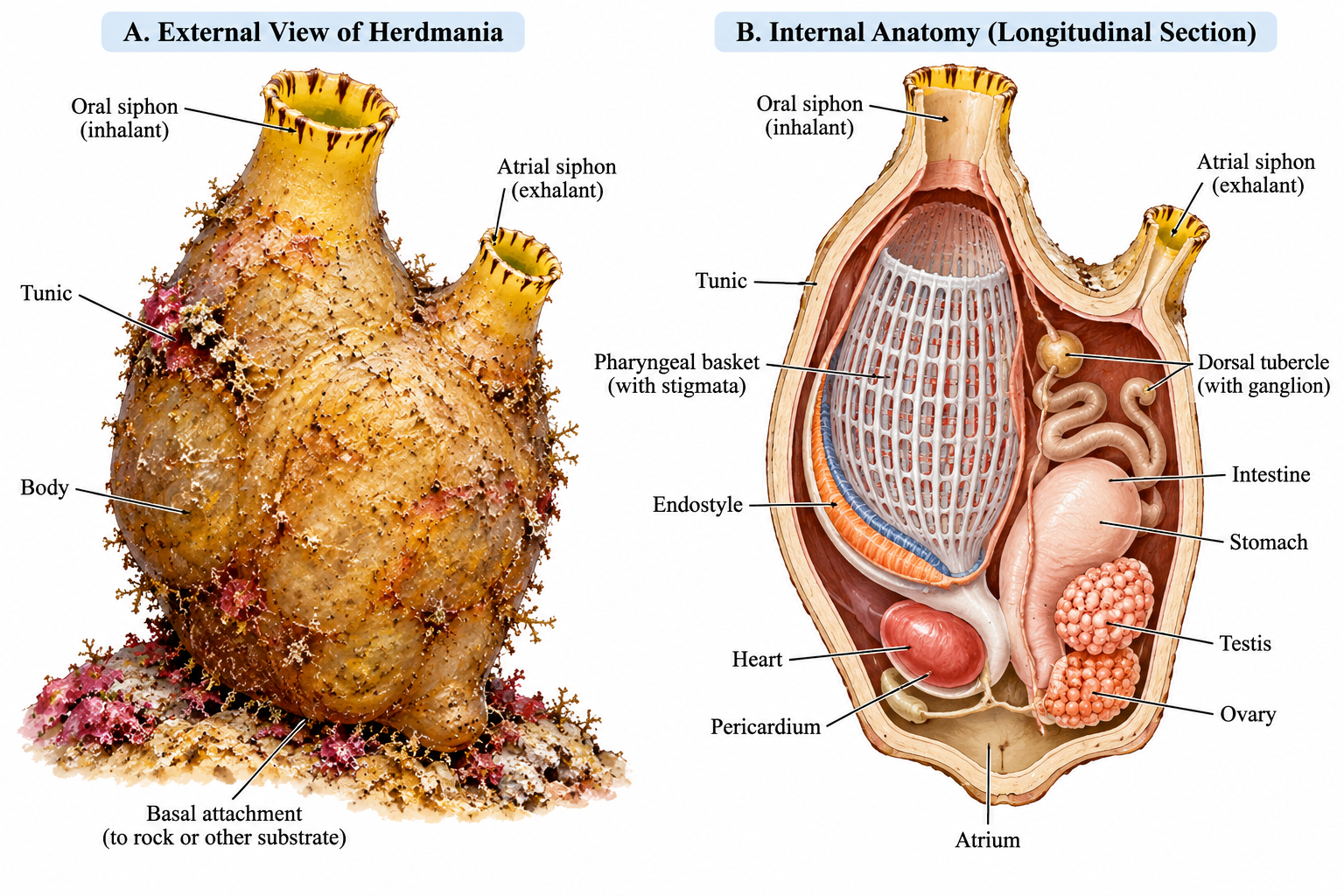
- Body shape: The adult body is generally sac-like, cylindrical or somewhat elongated.
- Tunic: A thick outer tunic or test surrounds and protects the body.
- Siphons: Two openings are present—the oral siphon through which water enters and the atrial siphon through which filtered water leaves.
- Pharyngeal basket: A large perforated pharynx forms the major internal feeding and respiratory structure.
- Stigmata: Numerous small openings in the pharyngeal wall allow water to pass into the surrounding atrial cavity.
- Endostyle: A specialized structure in the pharynx that produces mucus used to trap suspended food particles.
- Digestive system: Food passes from the pharyngeal region into the digestive tract, where digestion and absorption occur.
- Heart: A tubular heart is associated with the circulatory system and can periodically reverse the direction of blood flow.
- Adult nervous system: A compact cerebral ganglion is located between the two siphons.
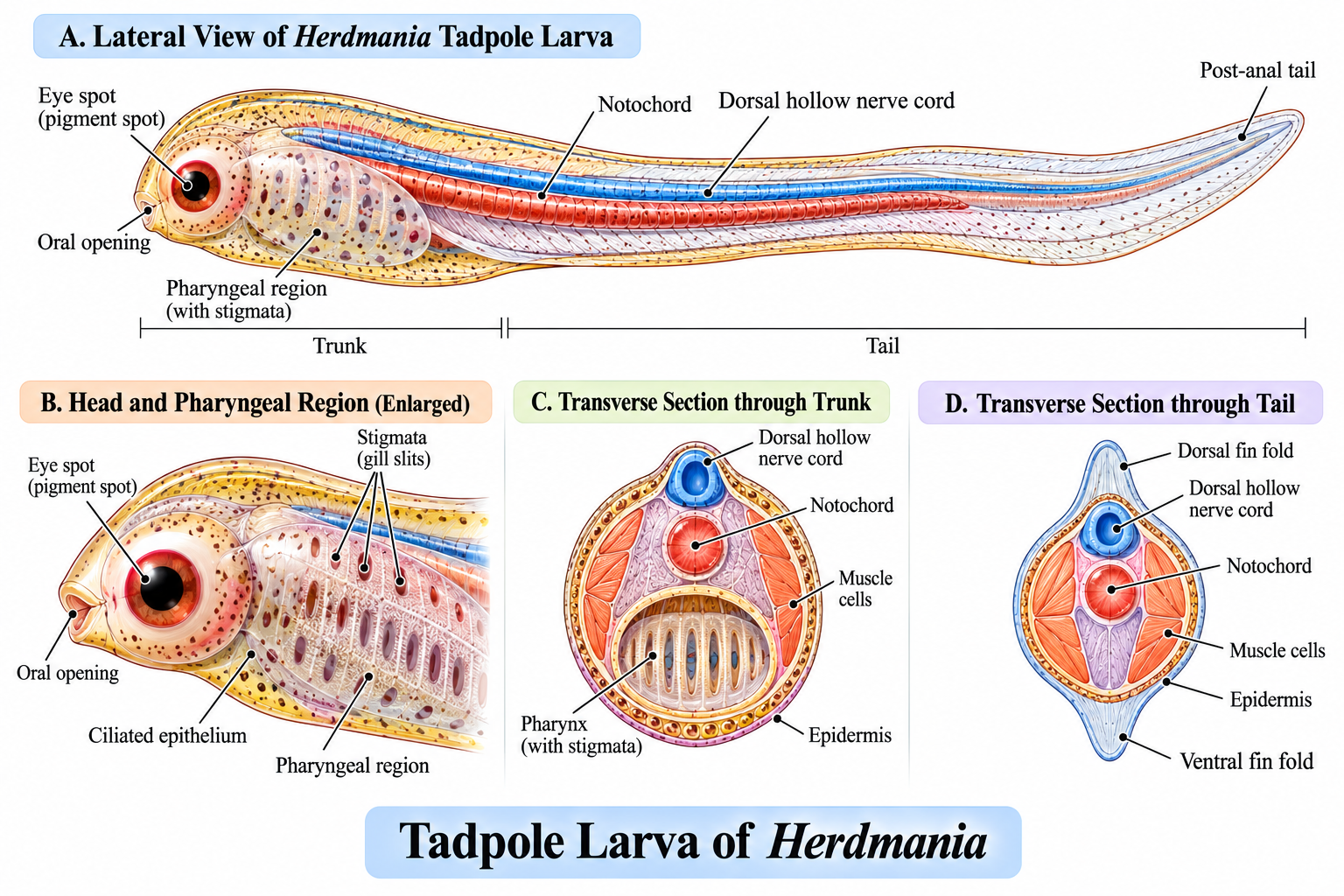
- Larval chordate features: The tadpole larva possesses a notochord, dorsal hollow nerve cord and post-anal tail, which are important evidence of its chordate affinity.
Feeding and Filter-Feeding Adaptations in Herdmania
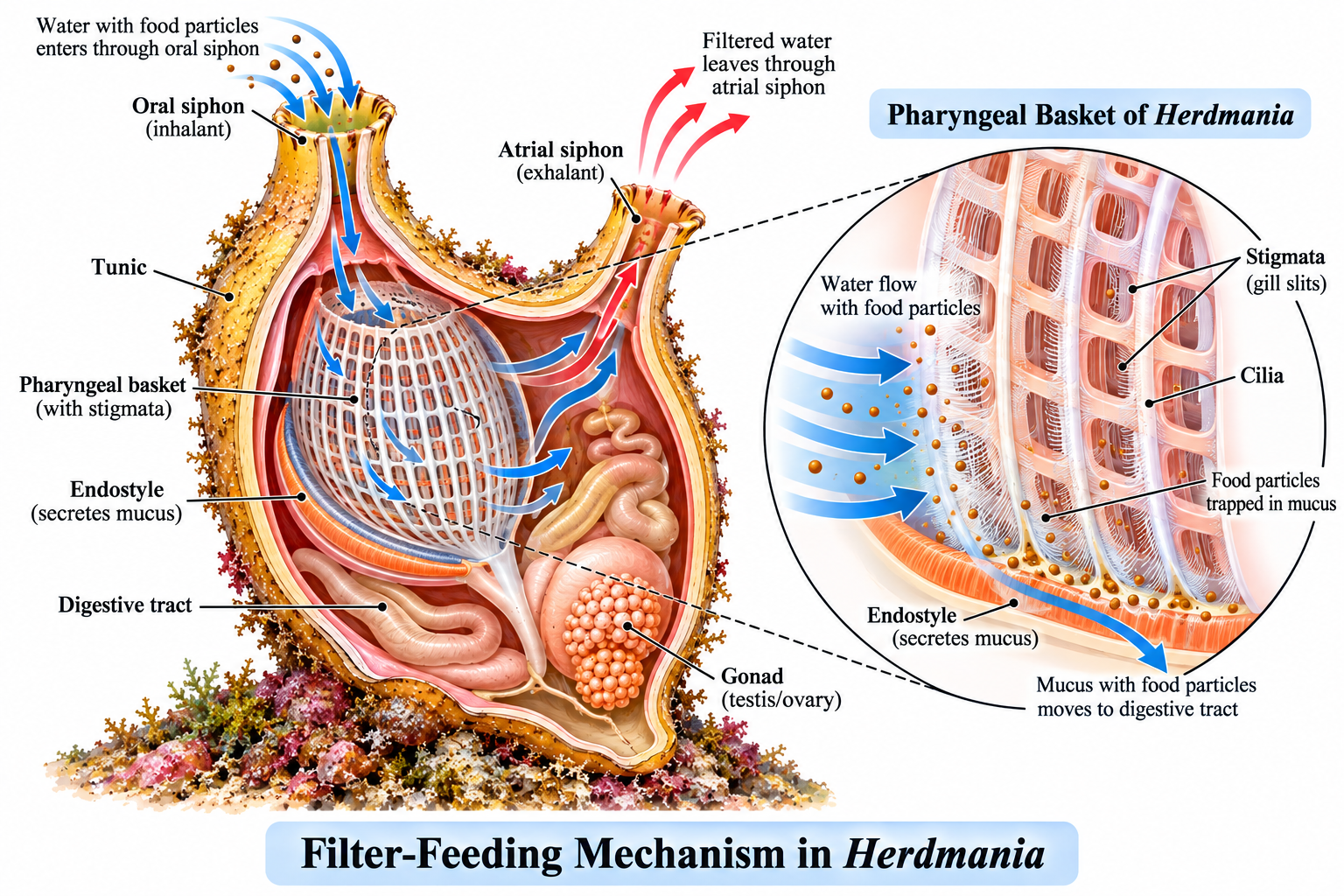
Herdmania is a suspension feeder that obtains microscopic food particles from seawater. Its large pharyngeal basket and mucus-based feeding mechanism are highly specialized for continuous filter feeding.
Filter-Feeding Process
- Water enters through the oral siphon.
- Ciliary activity creates a continuous water current through the pharyngeal basket.
- Suspended particles such as plankton and fine organic matter are trapped in mucus produced by the endostyle.
- Cilia transport the mucus and captured food particles toward the digestive region.
- Filtered water passes through the stigmata into the atrial cavity.
- Water is finally expelled through the atrial siphon.
- Food is transported to the digestive tract for digestion and absorption.
Feeding Adaptations
- Oral siphon allows seawater to enter the body.
- Pharyngeal basket provides a large filtering surface.
- Endostyle produces mucus for trapping food particles.
- Cilia maintain water currents and transport food-laden mucus.
- Stigmata allow filtered water to pass out of the pharyngeal basket.
- Atrial siphon expels filtered water and other materials.
- The large pharyngeal surface enables efficient suspension feeding.
Respiration and Circulation in Herdmania
Respiration
Respiration in Herdmania mainly occurs through the pharyngeal basket. Water entering through the oral siphon passes through the numerous openings of the pharyngeal wall. Oxygen diffuses into the blood, while carbon dioxide diffuses out.
The extensive surface area of the pharyngeal basket makes it well suited for respiratory gas exchange.
Circulation
Herdmania has an open circulatory system with a tubular heart and blood vessels. The heart pumps blood through the vascular system and shows a characteristic periodic reversal of the direction of contraction, allowing circulation to be maintained in different regions of the body.
The blood also transports nutrients, respiratory gases and metabolic wastes between tissues.
Nervous System and Sensory Features in Herdmania
The nervous system of adult Herdmania is relatively simple because the adult is sessile and has limited locomotory requirements. A cerebral ganglion is located between the oral and atrial siphons and acts as the main nervous centre.
Main Features
- A compact cerebral ganglion forms the principal nervous centre.
- Nerve fibres extend from the ganglion to different parts of the body.
- Sensory structures around the siphons help detect changes in the surrounding environment.
- The siphons can respond to mechanical and chemical stimuli.
- The adult nervous system is much simpler than that of the free-swimming larva.
- During the larval stage, a dorsal hollow nerve cord is present, representing an important chordate feature.
- After settlement and metamorphosis, the larval nervous structures undergo major changes as the animal develops into a sessile adult.
Reproduction and Life Cycle of Herdmania
Herdmania is generally hermaphroditic, with male and female reproductive organs occurring in the same individual. Fertilization usually takes place in seawater, followed by the development of a free-swimming tadpole larva.
Reproduction
- Male and female gametes are produced by the same adult.
- Gametes are released into the surrounding seawater.
- Fertilization generally occurs externally.
- The fertilized egg undergoes embryonic development.
- A characteristic tadpole larva develops from the embryo.
Life Cycle
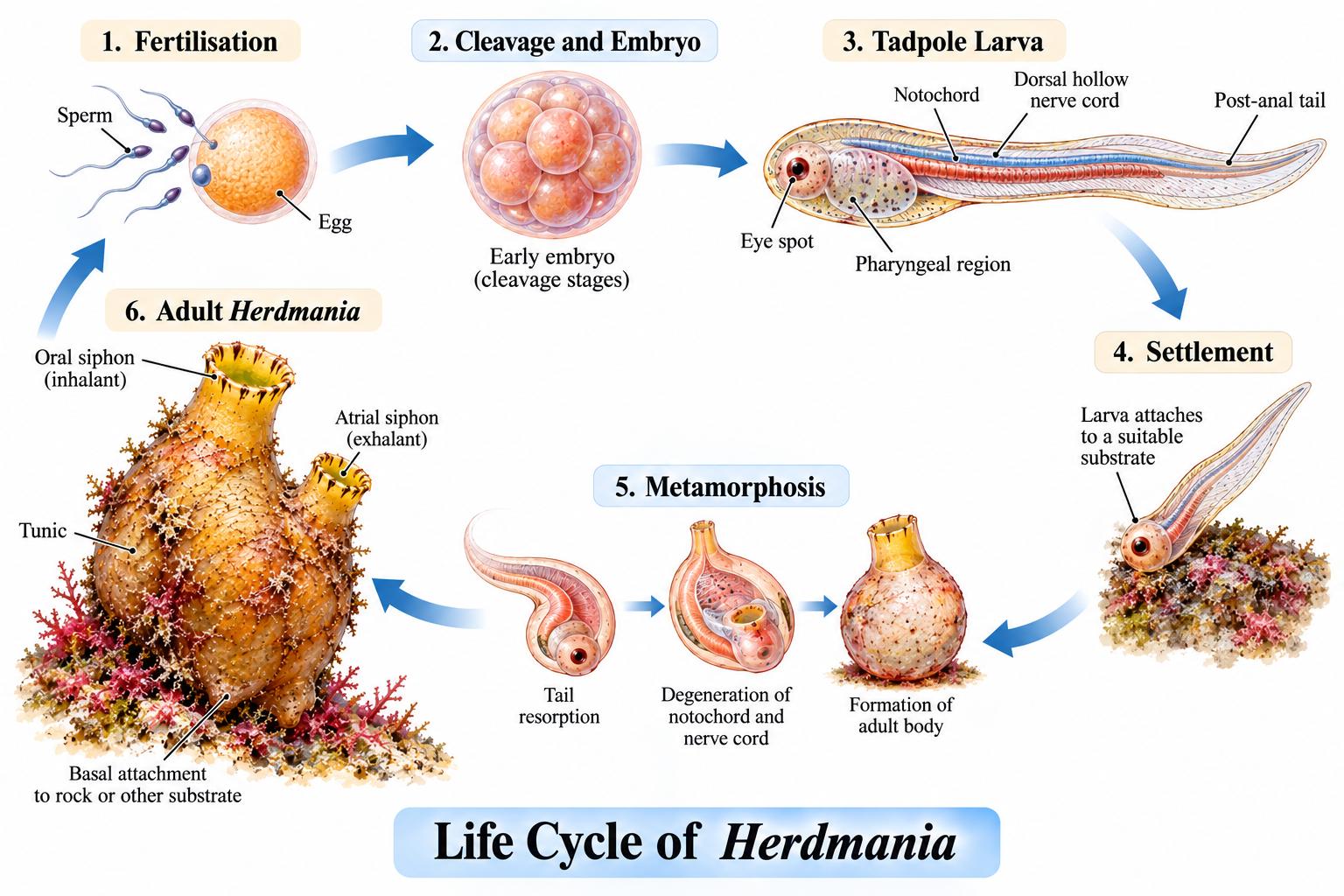
The life cycle of Herdmania includes the following major stages:
Adult → Gametes → Fertilization → Embryo → Tadpole larva → Settlement → Metamorphosis → Juvenile → Adult
The tadpole larva is an important stage because it possesses characteristic chordate structures, including a notochord, dorsal hollow nerve cord and post-anal tail. It swims freely for a period before attaching to a suitable substrate.
After settlement, the larva undergoes metamorphosis. The tail and several larval structures are lost or reorganized, while the body develops into the sessile adult form with functional siphons and a large pharyngeal basket.
Tunic and Siphons in Herdmania
The tunic and siphons are important features of the adult body of Herdmania. They provide protection, regulate water flow and support the animal’s filter-feeding lifestyle.
Tunic
The body is enclosed by a thick tunic or test, which forms an external protective covering. The tunic helps protect the soft internal organs from physical damage and environmental conditions. In some species, the outer surface may accumulate particles or other materials from the surrounding environment.
Siphons
Two prominent siphons are associated with the body:
- Oral siphon: Allows seawater to enter the pharyngeal basket.
- Atrial siphon: Allows filtered water and other materials to leave the body.
The coordinated action of the siphons and cilia maintains a continuous water current through the pharyngeal basket. This water flow is essential for both filter feeding and respiration.
Evolutionary Significance of Herdmania
Herdmania is important in zoology because tunicates are chordates, even though the adult animal has a highly modified sessile body.
The evolutionary significance of Herdmania is mainly evident during its larval stage:
- The tadpole larva possesses a notochord along the tail.
- A dorsal hollow nerve cord is present.
- The larva has a post-anal tail.
- Pharyngeal structures are present as part of the chordate body plan.
- After settlement, the larva undergoes metamorphosis and loses or reorganizes many of these larval features.
- The contrast between the free-swimming larva and sessile adult demonstrates the remarkable modification of the tunicate body plan during evolution.
- Tunicates therefore provide important material for studying chordate development, evolution and relationships among deuterostome animals.
Ecological Importance of Herdmania
Herdmania contributes to marine ecosystems mainly through its filter-feeding activity and interactions with benthic communities.
- Filter feeding: It removes suspended food particles and microorganisms from seawater.
- Nutrient cycling: Processing organic particles contributes to the movement and recycling of nutrients in marine environments.
- Food-web role: Herdmania can serve as a food resource for other marine organisms.
- Benthic communities: Its attachment to rocks, shells and other hard surfaces contributes to the diversity of organisms living on submerged substrates.
- Water-particle processing: Continuous filtration transfers suspended organic material into the benthic food web through digestion and waste production.
- Ecological interactions: The tunicate may compete with other sessile suspension feeders for space and suspended food resources.
Key Takeaways About Herdmania
- Herdmania is a marine tunicate belonging to Phylum Chordata.
- It is classified under Class Ascidiacea, Order Stolidobranchia and Family Pyuridae.
- The adult is a sessile, sac-like sea squirt enclosed by a thick tunic.
- Two siphons, the oral siphon and atrial siphon, maintain water flow through the body.
- The large pharyngeal basket is specialized for filter feeding and respiration.
- The endostyle produces mucus that helps capture suspended food particles.
- The adult has a relatively simple nervous system with a cerebral ganglion.
- Herdmania is generally hermaphroditic, with a free-swimming tadpole larva.
- The larva possesses important chordate features, including a notochord, dorsal hollow nerve cord and post-anal tail.
- Metamorphosis transforms the swimming larva into a sessile adult.
- Herdmania is useful for studying chordate development, tunicate biology and evolutionary relationships.
Frequently Asked Questions
What is Herdmania?
Herdmania is a genus of marine tunicates commonly known as sea squirts. The adult is a sessile, filter-feeding animal.
What is the classification of Herdmania?
Herdmania belongs to Phylum Chordata, Subphylum Tunicata, Class Ascidiacea, Order Stolidobranchia and Family Pyuridae.
Where does Herdmania live?
It is a marine animal that generally remains attached to firm underwater substrates such as rocks, shells and other hard surfaces.
What are the main characteristics of Herdmania?
Important characteristics include a thick tunic, sac-like body, two siphons, a large pharyngeal basket, endostyle and a sessile adult stage.
What is the function of the endostyle?
The endostyle produces mucus that helps trap suspended food particles during filter feeding.
Does Herdmania have a notochord?
The adult does not retain a functional notochord, but the tadpole larva possesses a notochord as one of its important chordate features.
What is the larval stage of Herdmania?
It develops into a free-swimming tadpole larva that possesses a notochord, dorsal hollow nerve cord and post-anal tail.
How does the life cycle of Herdmania occur?
The life cycle includes fertilization, embryonic development, tadpole larva, settlement, metamorphosis and development into a sessile adult.
Why is Herdmania important in zoology?
It is important for studying tunicate biology, chordate development, larval adaptations and the evolution of the chordate body plan.
Recommended Study Resource
A Manual of Practical Zoology – Chordates
by P S Verma (Author)
A Manual of Practical Zoology Chordates : For Undergraduate, Postgraduate Students | 12th Edition | Basic Lab Methods Book | Experimental Biochemistry, Physiology, Osteology, Embryology
by Dr. P S Verma (Author)
As an Amazon Associate I earn from qualifying purchases.
References
- NCBI Taxonomy – Herdmania
- WoRMS – Herdmania
- Ascidiacea World Database
- Ruppert, E. E., Fox, R. S., & Barnes, R. D. Invertebrate Zoology: A Functional Evolutionary Approach. Brooks/Cole.
- Brusca, R. C., Moore, W., & Shuster, S. M. Invertebrates. Sinauer Associates.
Discover more from Zoologyverse
Subscribe to get the latest posts sent to your email.
Pingback: HERDMANIA SLIDES | Zoologyverse