
Introduction
The genus Ascidia includes sea squirts, which are sessile marine invertebrates that are members of the phylum Chordata’s subphylum Tunicata (Urochordata). Because of their chordate characteristics, like a notochord and a dorsal nerve cord in their larval stage, these fascinating animals are frequently thought of as a link between invertebrates and vertebrates. Ascidia, which is frequently found in shallow coastal waters, is distinguished by its sac-like body structure that is covered in a tunic composed of a substance that resembles cellulose.
Ascidians are essential to marine ecosystems because they act as filter feeders, eliminating organic matter and plankton from the water. By giving microorganisms a place to live and acting as food for other marine creatures, they also support the ecological equilibrium. They have also been the focus of extensive scientific study because to their capacity to produce bioactive chemicals and regenerate tissue.
Classification of Ascidia
- Phylum :- Chordata (Dorsal tubular nerve cord, notochord and gill-slits present.)
- Group :- Acraniata (No head, cranium or brain)
- Sub phylum :- Urochordata (Marine. Body covered by a thick test. Notochord present only in larval tail.)
- Class :- Ascidiacea (Test with scattered muscles. Many pharyngeal gill-slits. Bottom-dwelling.)
- Order :- Phlebobranchia (Neural gland ventral to nerve ganglion. Gonad one.)
- Family :- Ascidiidae
- Genus :- Ascidia
Geographical distribution
- Ascidia is commonly found in cold temperate regions.
Habit and habitat
- Ascidia is solitary, marine and sedentary urochordate inhabiting shallow water but some occur deep upto 5500 metres.
General Characteristics of Ascidia
- Commonly called as sea squirts.
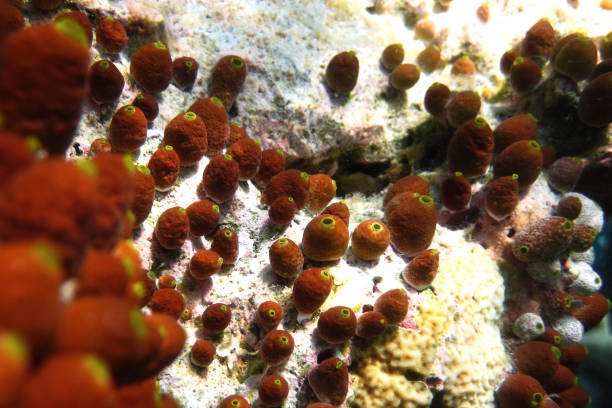
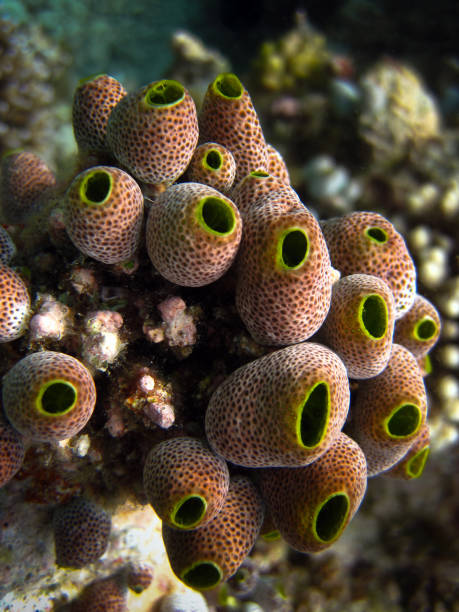
- Shape of body short and cylindrical with a broad base attached to rocky substratum.
- Test translucent, wrinkled and brownish in colour. Below test is mantle.
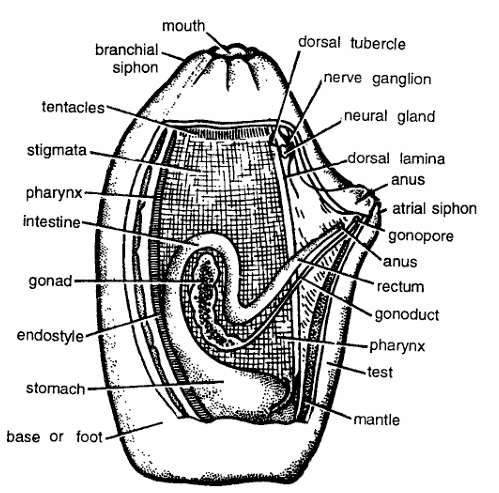
- Anteriorly body contains eight-lobed terminal branchial siphon and six-lobed sub-terminal atrial siphon having mouth and anus, respectively. Mouth is surrounded by 50-100 tentacles.
- Branchial siphon leads into pharynx which is perforated by stigmata. Pharynx contains endostyle.
- Dorsal tubercle separated from the nerve ganglion neural gland and membranous dorsal lamina.
- Alimentary canal consists of mouth pharynx, stomach, intestine, rectum and anus.
- Gonads, gonoduct and gonopore distinct.
- Monoecious. Ovary, testes in the same animal. Reproduction sexual. Oviparous. Metamorphosis retrogressive.
Special features
There are some compound ascidians in which individuals are buried in a common test. The development includes tailed larva exhibiting typical chordate characters having notochord, nerve cord, etc. Kowalewsky (1886) carefully studied the development of larval ascidians and brilliantly demonstrated true position of the group among chordates. The tunicates are best understood by studying first free-living larva of an ascidian, than the adult. The larva shows chordate characters but same are absent in adult and others are modified to sessile mode of life. Compound ascidians reproduce asexually by gemmation and also produce eggs and sperms for sexual reproduction.
Identification
- Since the animal contains lobed siphons and all above features, hence it is Ascidia.
References
- Marine Biodiversity Wiki – Ascidians
- National Center for Biotechnology Information (NCBI)
- World Register of Marine Species (WoRMS)
- Encyclopedia of Life – Ascidia
- ResearchGate – Bioactive Compounds in Ascidians
- Zoology Practical Vertebrate
Discover more from Zoologyverse
Subscribe to get the latest posts sent to your email.