
Doliolum is a genus of small, free-swimming marine tunicates belonging to Phylum Chordata, Subphylum Tunicata and Class Thaliacea. It is placed in Order Doliolida and Family Doliolidae. Unlike the sessile adults of many ascidians, Doliolum has a pelagic lifestyle and is adapted for active movement through seawater.
The Classification of Doliolum is important in zoology because it represents a specialized group of thaliacean tunicates with a transparent, barrel-shaped body, prominent circular muscle bands and a highly developed filter-feeding system.
The Characteristics of Doliolum include a barrel-shaped body enclosed by a transparent tunic, inhalant and exhalant openings, a pharyngeal basket, endostyle and muscular bands that help generate water currents and movement.
The Life cycle of Doliolum is particularly interesting because it involves different forms within the life history. Asexual reproduction produces specialized individuals called trophozooids, phorozooids and gonozooids, allowing colonies or reproductive chains to develop.
This article covers the Classification of Doliolum, Characteristics of Doliolum, body organization, feeding adaptations, locomotion, polymorphism, reproduction, Life cycle of Doliolum and its ecological importance.
For Practical Study
The following notes are arranged in a practical examination format for easy study and identification.
Classification of Doliolum
| Rank | Classification | Characteristic |
|---|---|---|
| Kingdom | Animalia | Multicellular animals |
| Phylum | Chordata | Animals showing fundamental chordate features during development |
| Subphylum | Tunicata | Marine chordates enclosed by a protective tunic |
| Class | Thaliacea | Pelagic tunicates adapted for free-swimming life |
| Order | Doliolida | Small, barrel-shaped pelagic tunicates |
| Family | Doliolidae | Includes doliolids with complex life cycles and polymorphic forms |
| Genus | Doliolum | Small free-swimming tunicates with a transparent, barrel-shaped body |
Geographical Distribution
Doliolum occurs in marine waters, particularly in planktonic communities of open-ocean and coastal environments. Its exact distribution varies among species.
Habit and Habitat
Doliolum is a free-swimming pelagic tunicate that remains suspended in the water column. It feeds on suspended microscopic particles and forms an important component of marine plankton communities.
Comments
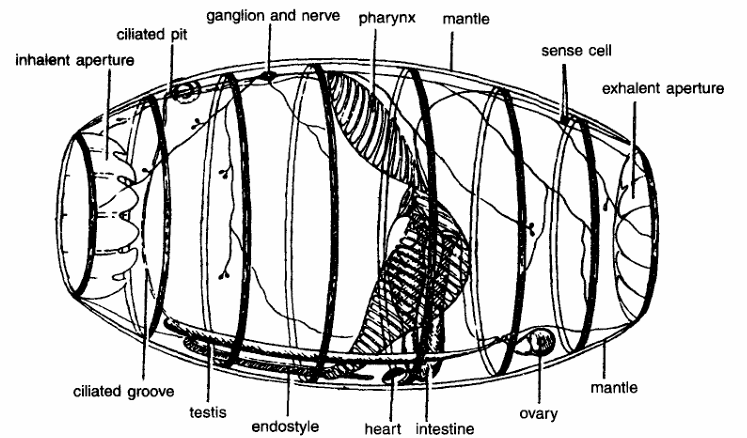
- Doliolum is commonly called as chain tunicate. It measures 1 to 1.5 cm.
- It shows polymorphism and exists in two phases:
- gonozooid or solitary phase
- oozooid or gregaria phase.
- Fully grown oozooid has a barrel-shaped transparent body, a large mouth, branchial and atrial apertures at opposite ends and 8 complete muscle bands.
- Body covered by test and below test is mantle
- Edges of above lobes contain sensory lobes, 10 on branchial and 12 on atrial side,
- Mouth leads into pharynx with a few stigmata.
- It has ventral endostyle, and peripharyngeal bands.
- Viscera consists of oesophagus, stomach, intestine, digestive gland, heart and neural complex,
- Oozooids reproduce asexually by stolon budding.
- Life-cycle is peculiar consisting of
- Sexual form
- Tailed larva developed sexually
- First asexual form
- Second asexual forms (Phorozooid) developed on cadophore and buds developed on stolon.
- The animal moves through water by jet propulsion. The contraction of the muscle bands drives water backwards out of atrial sac and so propels the animal.
- Gonozooid can be differentiated from oozooid in having 12 and 10 sensory lobes in branchial and atrial openings, 8 muscle bands, cadaphore and otocyst absent and with testis and ovary.
Special Features
- Doliolum is a favourite tunicate. The fertilized egg develops into a free-swimming tailed larva somewhat like that of an ascidian. The larva metamorphoses into a barrel-shaped adult ‘nurse’ stage that by asexual reproduction gives rise to several individuals. Some even produce sperm and ova
- Alternation of Generations: Exhibits a complex life cycle with sexual and asexual phases, allowing for rapid population expansion.
- Efficient Locomotion: Uses muscular contractions to propel itself through the water, a unique feature among planktonic organisms.
- Filter Feeding Efficiency: Capable of processing large volumes of water, helping to maintain water clarity.
- Adaptability: Rapidly adjusts to changes in environmental conditions, enabling survival in diverse oceanic regions.
- Transparent Body: Almost entirely transparent, aiding in camouflage and reducing predation.
Identification
A small, transparent, barrel-shaped marine tunicate with prominent circular muscle bands and a free-swimming pelagic habit can be identified as Doliolum.
Quick Identification of Doliolum
Doliolum is a small, transparent, free-swimming tunicate with a distinctive barrel-shaped body and strong circular muscle bands adapted for pelagic locomotion and filter feeding.
- Common name: Doliolid
- Scientific name: Doliolum
- Phylum: Chordata
- Subphylum: Tunicata
- Class: Thaliacea
- Order: Doliolida
- Family: Doliolidae
- Body: Small, transparent and barrel-shaped
- Lifestyle: Free-swimming and pelagic
- Feeding: Suspension or filter feeding
- Locomotion: Muscular contractions generate jet-like water currents
- Special feature: Polymorphic life cycle with specialized individuals
- Key identifying feature: Transparent barrel-shaped body with prominent circular muscle bands.
Physical Characteristics of Doliolum
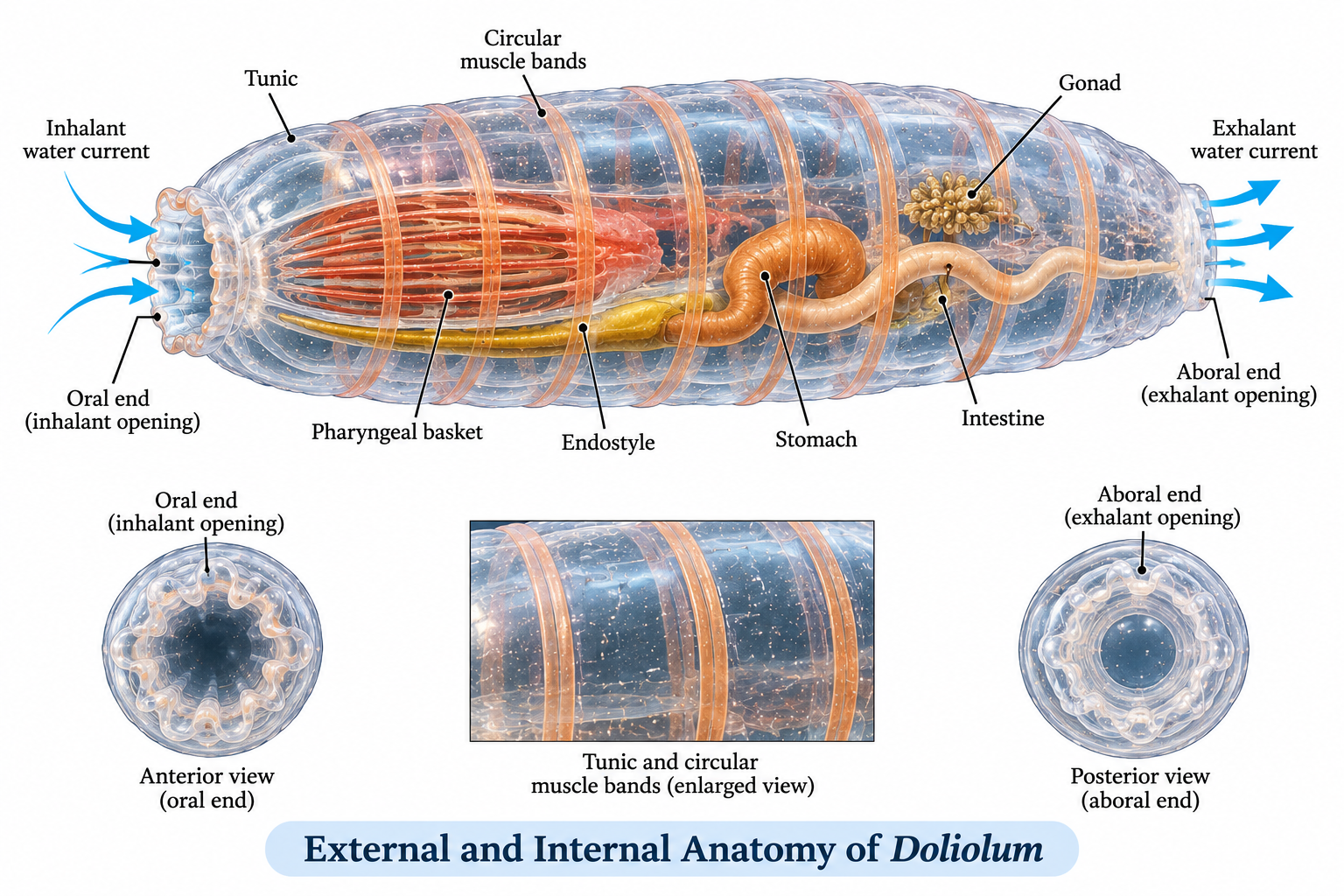
Doliolum has a small, transparent and barrel-shaped body that is well adapted for a free-swimming pelagic lifestyle. Its body is enclosed by a delicate tunic and contains prominent muscular bands that help generate water currents.
Main Physical Features
- Body shape: Short, cylindrical or barrel-shaped body.
- Tunic: A transparent tunic surrounds and protects the body.
- Openings: Inhalant and exhalant openings allow continuous water flow through the animal.
- Muscle bands: Several circular muscle bands surround the body and contract rhythmically.
- Pharyngeal basket: A large pharyngeal region is specialized for filter feeding.
- Endostyle: Produces mucus that helps trap suspended food particles.
- Digestive system: A compact digestive tract processes the captured food.
- Pelagic adaptation: The transparent body and efficient water-current system are suited to life in the plankton.
- Locomotion: Alternating contraction and relaxation of the body muscles expels water and produces forward movement.
- Polymorphism: Different forms occur during the life cycle, with specialized individuals performing feeding, asexual reproductive and sexual reproductive functions.
Feeding and Filter-Feeding Adaptations in Doliolum
Doliolum is a suspension feeder that obtains microscopic food particles from seawater. Its barrel-shaped body and powerful ciliary currents allow continuous movement of water through the pharyngeal basket.
Filter-Feeding Process
- Seawater enters through the incurrent opening.
- Ciliary activity maintains a continuous water current through the pharyngeal basket.
- Suspended food particles are trapped in mucus produced by the endostyle.
- Cilia transport the food-containing mucus toward the digestive tract.
- Filtered water passes through the pharyngeal openings and is expelled through the excurrent opening.
- Captured food is digested and absorbed in the digestive system.
Feeding Adaptations
- Pharyngeal basket: Provides a large filtering surface.
- Endostyle: Produces mucus for trapping food particles.
- Cilia: Maintain water currents and transport captured food.
- Incurrent opening: Allows seawater and suspended particles to enter.
- Excurrent opening: Removes filtered water.
- Muscular bands: Help maintain water movement through the body while also contributing to locomotion.
Respiration and Circulation in Doliolum
Respiration
Respiration in Doliolum mainly occurs across the pharyngeal basket. As seawater passes through the pharyngeal region, oxygen diffuses into the blood while carbon dioxide diffuses out.
The continuous water current generated by ciliary activity also supports efficient respiratory exchange.
Circulation
Doliolum has a simple circulatory system associated with the body tissues and digestive organs. A tubular heart drives circulation and helps distribute nutrients and respiratory gases.
The circulatory system supports the high metabolic demands of the actively swimming pelagic animal.
Nervous System and Sensory Features in Doliolum
The nervous system of Doliolum is relatively simple and is suited to its free-swimming pelagic lifestyle. A cerebral ganglion acts as the main nervous centre and coordinates movement, feeding and responses to environmental stimuli.
- A cerebral ganglion is located near the anterior region of the body.
- Nerve fibres extend from the ganglion to different parts of the body.
- Sensory structures detect mechanical and chemical changes in the surrounding seawater.
- Muscular contractions are coordinated by the nervous system to produce swimming movements.
- Sensory responses help regulate feeding currents and movement through the water column.
- The nervous system also coordinates activities associated with the different stages of the polymorphic life cycle.
Reproduction and Life Cycle of Doliolum
The life cycle of Doliolum is characterized by alternation between sexual and asexual phases and the formation of specialized individuals. This polymorphic life cycle allows rapid production of new individuals and efficient colony development.
Reproduction
- Sexual reproduction occurs in the gonozooid, which produces male and female gametes.
- Fertilization produces a zygote that develops into a larval stage.
- The larva develops into an oozooid, which represents the early developmental form.
- The oozooid produces specialized individuals through asexual budding.
- These individuals include trophozooids, which are mainly associated with feeding, and phorozooids, which help carry developing reproductive individuals.
- Gonozooids develop from the reproductive chain and produce gametes.
- The cycle therefore alternates between asexual multiplication and sexual reproduction.
Life Cycle
Gonozooid → Gametes → Fertilization → Embryo → Tadpole larva → Oozooid → Budding → Trophozooids/Phorozooids → Gonozooids → New generation
This alternation of generations and specialized zooid forms is one of the most distinctive features of Doliolum.
Polymorphism in Doliolum
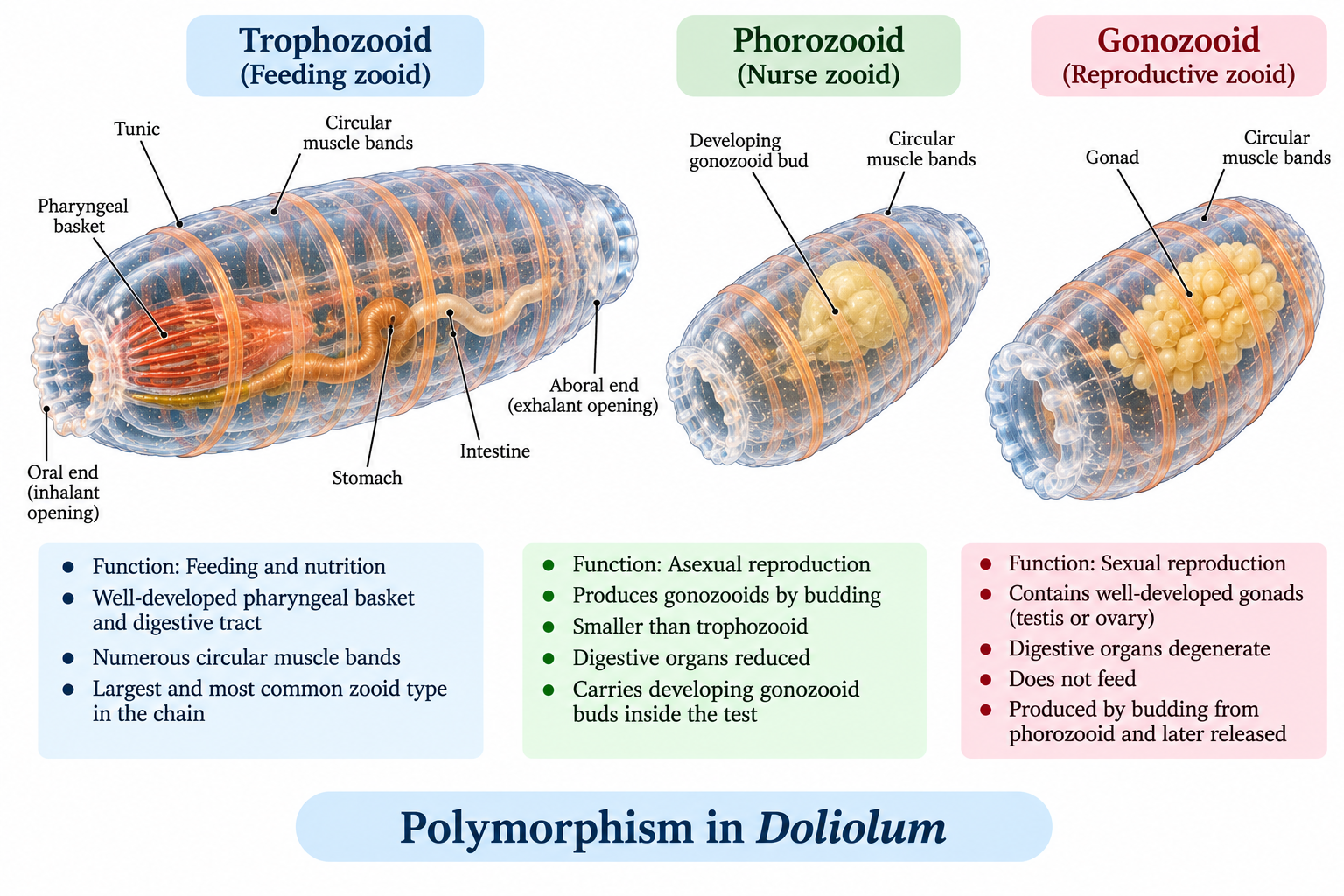
One of the most remarkable Characteristics of Doliolum is its polymorphism, in which different forms occur during the life cycle and perform different functions. These specialized individuals are produced through a combination of sexual reproduction and asexual budding.
1. Oozooid
The oozooid is the primary individual that develops from the sexually produced embryo. It is generally a larger, feeding form and serves as the starting point for asexual reproduction.
- Develops from the larval stage.
- Possesses the main feeding and locomotory structures.
- Produces new individuals by budding.
- Initiates the formation of the polymorphic series.
2. Trophozooid
The trophozooid is primarily concerned with feeding and nutrition.
- Possesses a well-developed pharyngeal basket.
- Efficiently filters suspended food particles from seawater.
- Has prominent muscular bands for water movement and locomotion.
- Supports the nutritional requirements of the developing life-cycle stages.
3. Phorozooid
The phorozooid is a specialized form associated with the asexual phase and development of reproductive individuals.
- Develops through budding.
- Carries developing gonozooids.
- Provides a temporary structure in which reproductive individuals develop.
- Eventually releases the gonozooids, which become sexually reproductive forms.
4. Gonozooid
The gonozooid is the sexually reproductive form.
- Develops from the phorozooid.
- Contains well-developed reproductive organs.
- Produces sperm and eggs.
- Sexual reproduction ultimately gives rise to the next generation.
Polymorphic Sequence
The major sequence can be summarized as:
Oozooid → Asexual budding → Trophozooids and phorozooids → Gonozooids → Gametes → Fertilization → Embryo → Larva → Oozooid
This division of functions among different forms allows Doliolum to combine feeding, asexual multiplication and sexual reproduction within a highly specialized life cycle.
Locomotory Mechanism
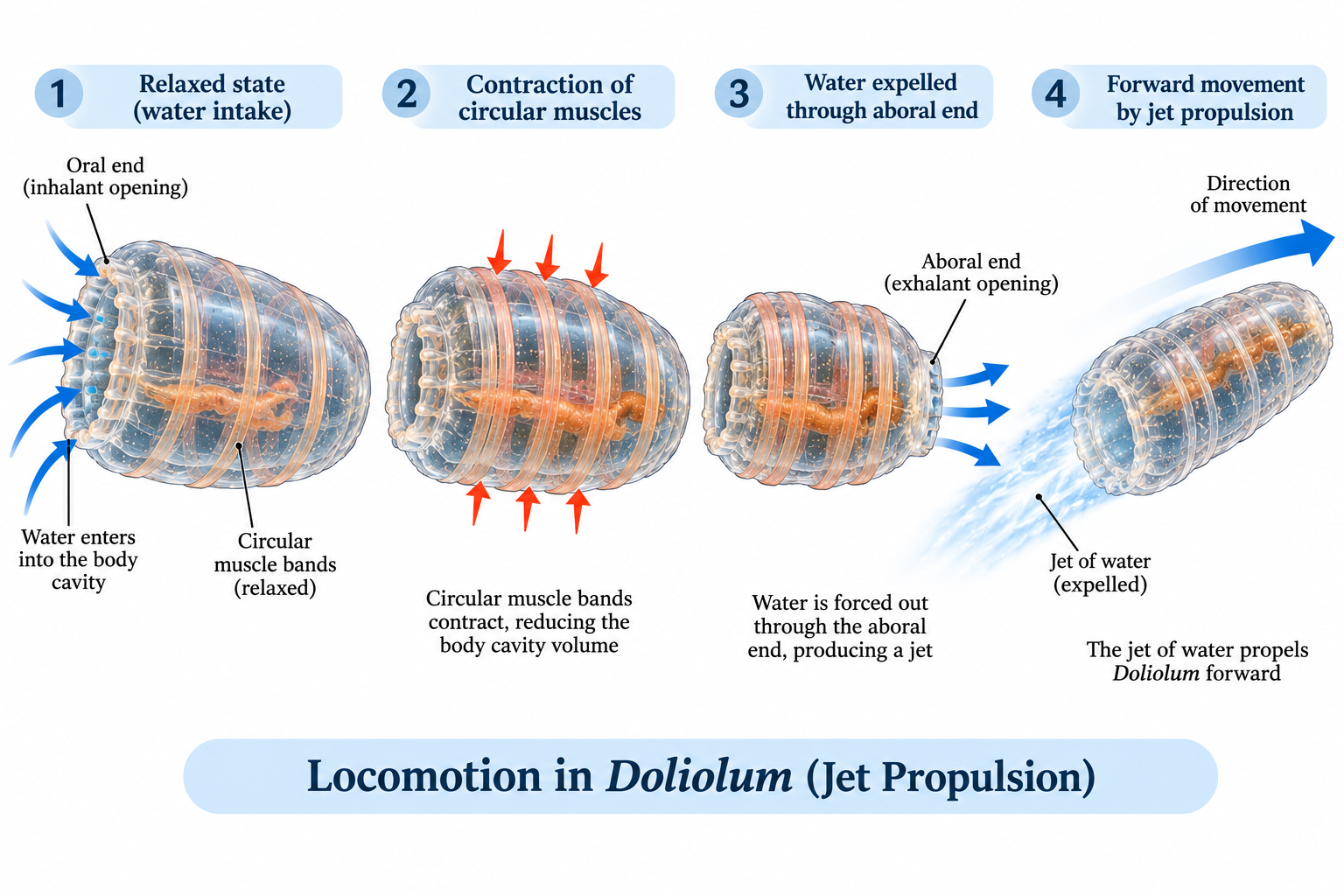
- Several circular muscle bands surround the barrel-shaped body.
- Rhythmic contraction of these muscles reduces the volume of the body cavity.
- Water is expelled through the exhalant opening, producing a jet-like thrust.
- Relaxation of the muscles allows the body to return to its original shape.
- Repeated muscular contractions produce forward movement through the water.
- The same water-current mechanism also assists filter feeding and respiration.
The combination of a transparent body, streamlined shape and powerful circular muscles makes Doliolum well adapted to its pelagic lifestyle.
Ecological Importance of Doliolum
Doliolum is an important component of marine planktonic communities and contributes to the transfer of organic matter through pelagic food webs.
- Filter feeding: It removes suspended microscopic particles and planktonic food from seawater.
- Nutrient cycling: Digestion and waste production contribute to the recycling of nutrients in the water column.
- Food-web role: Doliolum serves as prey for various marine organisms.
- Organic matter transfer: By consuming suspended particles and producing fecal material, it helps transfer organic matter through different levels of the pelagic ecosystem.
- Planktonic communities: Periods of high doliolid abundance can influence the composition and flow of material within marine plankton communities.
- Pelagic adaptation: Its free-swimming lifestyle and efficient filter-feeding system allow it to occupy an important ecological niche in the open ocean.
Key Takeaways
- Doliolum is a small pelagic tunicate belonging to Phylum Chordata.
- It is classified under Class Thaliacea, Order Doliolida and Family Doliolidae.
- The body is typically transparent, cylindrical or barrel-shaped.
- Circular muscle bands help produce water currents and locomotion.
- It is a filter-feeding animal that captures suspended microscopic food particles.
- The pharyngeal basket and endostyle are important feeding structures.
- Its life cycle shows alternation between sexual and asexual phases.
- Specialized forms such as trophozooids, phorozooids and gonozooids occur during the life cycle.
- The free-swimming habit makes Doliolum an important member of marine planktonic communities.
- Doliolum is useful for studying tunicate polymorphism, reproduction, pelagic adaptations and marine ecology.
Frequently Asked Questions
What is Doliolum?
Doliolum is a genus of small, free-swimming marine tunicates belonging to Class Thaliacea.
Where does Doliolum live?
It is a pelagic marine organism that lives in the water column and forms part of marine plankton communities.
What are the main characteristics of Doliolum?
Important characteristics include a transparent barrel-shaped body, circular muscle bands, a pharyngeal basket, filter-feeding adaptations and a polymorphic life cycle.
How does Doliolum move?
Rhythmic contraction of its circular muscle bands expels water through the body openings and produces jet-like propulsion.
How does Doliolum feed?
It is a filter feeder. Ciliary currents move seawater through the pharyngeal basket, where suspended food particles are captured in mucus.
What is the life cycle of Doliolum?
Its life cycle includes sexual and asexual phases, with an oozooid producing specialized forms through budding before the development of reproductive gonozooids.
What are trophozooids and phorozooids?
They are specialized individuals that occur during the polymorphic life cycle. Trophozooids are primarily associated with feeding, while phorozooids function in carrying developing reproductive individuals.
What is a gonozooid?
A gonozooid is the sexually reproductive form that produces male and female gametes.
Why is Doliolum important in zoology?
It is important for studying tunicate polymorphism, alternation between reproductive phases, pelagic adaptations, filter feeding and marine plankton ecology.
Recommended Study Resource
A Manual of Practical Zoology – Chordates
by P S Verma (Author)
A Manual of Practical Zoology Chordates : For Undergraduate, Postgraduate Students | 12th Edition | Basic Lab Methods Book | Experimental Biochemistry, Physiology, Osteology, Embryology
by Dr. P S Verma (Author)
As an Amazon Associate I earn from qualifying purchases.
References
- NCBI Taxonomy – Doliolum
- WoRMS – Doliolum
- Ascidiacea World Database
- Ruppert, E. E., Fox, R. S., & Barnes, R. D. Invertebrate Zoology: A Functional Evolutionary Approach. Brooks/Cole.
- Brusca, R. C., Moore, W., & Shuster, S. M. Invertebrates. Sinauer Associates.
Discover more from Zoologyverse
Subscribe to get the latest posts sent to your email.