
Pyrosoma is a genus of marine colonial tunicates commonly known as fire bodies.
It belongs to Phylum Chordata, Subphylum Tunicata, Class Thaliacea, Order Pyrosomata and Family Pyrosomatidae. Unlike solitary ascidians such as Herdmania and Ascidia, Pyrosoma forms a large free-floating colony composed of numerous individual zooids.
The Classification of Pyrosoma is important in zoology because it represents a highly specialized group of pelagic tunicates. Each zooid is embedded in a common gelatinous test and contributes to the feeding and movement of the colony.
The Characteristics of Pyrosoma include a tubular or cylindrical colony, numerous zooids arranged around a common central cavity, efficient filter feeding and the ability to produce bioluminescent light, which gives these animals their distinctive appearance in the ocean.
The Life cycle of Pyrosoma involves the formation and growth of colonies through the development of individual zooids.
Reproduction and budding contribute to colony growth, while the free-floating colony can increase considerably in size as new zooids are added.
The genus Pyrosoma includes species such as P. atlanticum and P. godeauxi.
This article covers the Classification of Pyrosoma, Characteristics of Pyrosoma, colony structure, feeding adaptations, bioluminescence, reproduction, Life cycle of Pyrosoma and its ecological importance.
For Practical Study
The following notes are arranged in a practical examination format for easy study and identification.
Classification of Pyrosoma
| Rank | Classification | Characteristic |
|---|---|---|
| Kingdom | Animalia | Multicellular animals |
| Phylum | Chordata | Animals showing fundamental chordate features during development |
| Subphylum | Tunicata | Marine chordates enclosed by a protective tunic |
| Class | Thaliacea | Pelagic tunicates adapted for free-swimming life |
| Order | Pyrosomata | Colonial tunicates with zooids arranged in a tubular colony |
| Family | Pyrosomatidae | Family of colonial pyrosomes |
| Genus | Pyrosoma | Bioluminescent colonial tunicates |
Geographical Distribution
Pyrosoma occurs in marine waters of tropical, temperate and other oceanic regions, with individual species having their own geographical ranges.
Habit and Habitat
Pyrosoma is a free-floating colonial tunicate that occurs mainly in the open ocean. Numerous zooids are embedded in a common gelatinous test and arranged to form a characteristic tubular colony.

Comments
- It is a thimble-shaped hypopleustonic colony, 25 cm to 1 meter in length and consists of several individuals, called blastozooids, embedded in a common test having test processes and terminal opening.
- Colony floats horizontally and is like a balloon cylinder.
- Zooids are arranged in the wall of the cylinder.
- Branchial and atrial apertures are at opposite ends.
- Branchial openings or mouths of individuals or zooids open to the outside, while atria open into a common cloaca with a terminal outlet, from which a continuous jet emerges.
- Colony moves by a jet propulsion. Rhythmic contractions of muscular bands in the body wall cause ejection of water through pharynx and atrium with sufficient force to propel the organism.
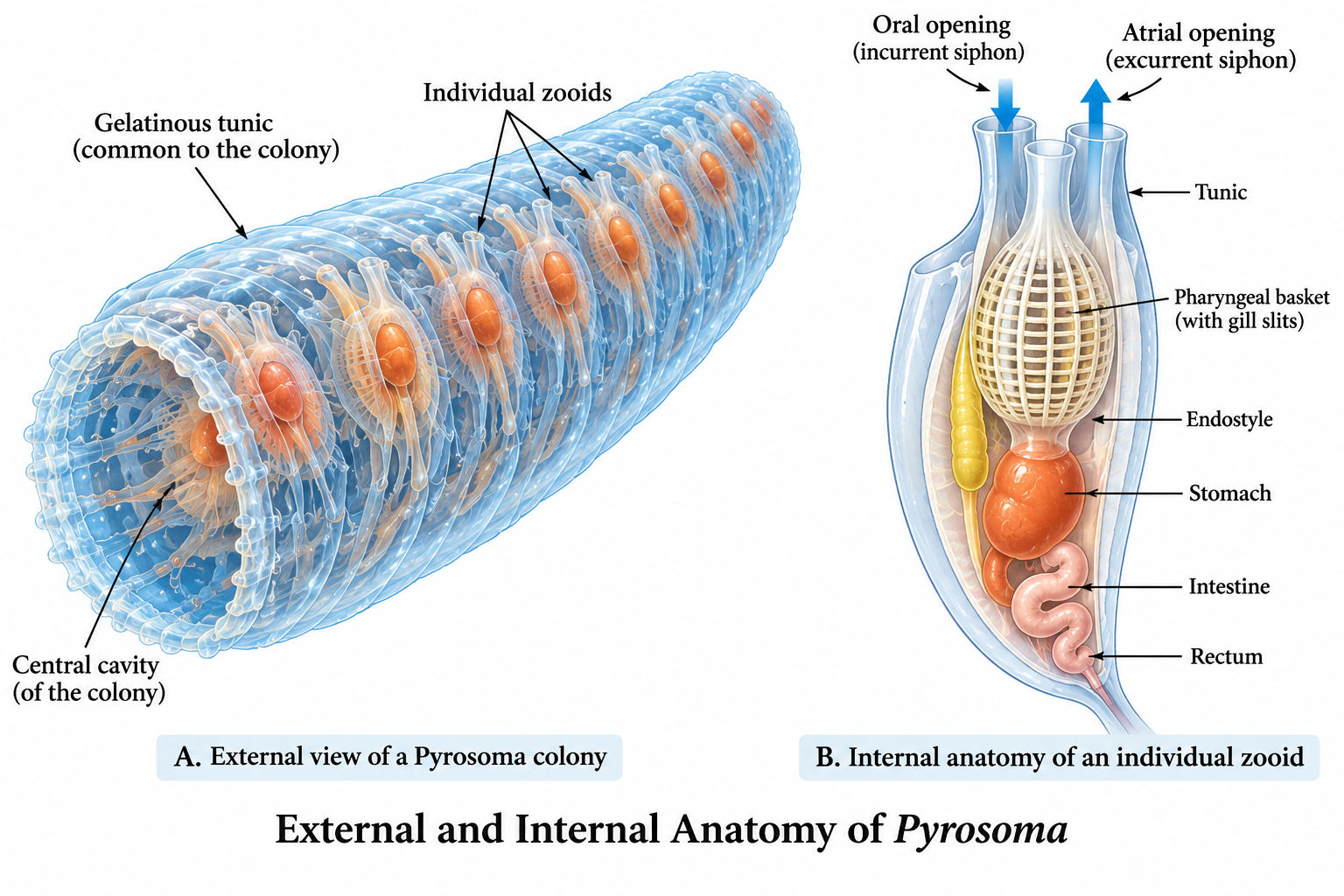
- Each zooid consists of a large branchial sac with endostyle and dorsal lamina, neural complex, heart and atrium.
- Branchial sac contains 50 gill-slits divided by internal longitudinal bars. Endostyle communicates with peripharyngeal band, retropharyngeal band and dorsal lamina. Intestine makes a loop around stomach and ends into atrium. Heart is ventral. Lobed testis is found behind ovary.
- Close to the mouth of each zooid arises a tongue-like process of the test, called as buccal appendage.
- Other structures seen are testes, anus, stomach, oesophagus intestine, atrial muscles, stigmata, mass of mesodermal cells, dorsal tubericle, muscle fibers, luminous organs and tentacles.
- Hermaphroditic. Reproduction sexual and asexual.
- A single fertilized egg develops within blastozooid and gives rise to asexual oozooid. It gives stolon that forms 4 ascidiozooids or tetrazooid which degenerates and gives rise to cyathozooid. It is enclosed in a test and by repeated budding forms a colony.
- Asexually colony multiplies the number of zooids by direct stolon budding, producing blastozooids.
Special Features
- Bioluminescence : Animal produces light on stimulation and when all colonies produce light, the entire area is illuminated as much as one can read the book. Light is produced by bioluminescent cells, which contain curved inclusions.
- Colonial Structure: Tubular colonies can reach several meters in length, with coordinated movement and feeding mechanisms.
- Efficient Filter Feeding: Remove significant amounts of plankton from the water, enhancing water clarity.
- Rapid Growth: Colonies can grow quickly in favorable conditions, responding dynamically to nutrient availability.
- Unique Reproduction: Exhibit both sexual and asexual reproduction, contributing to their rapid population growth.
Identification
A free-floating, tubular marine colony composed of numerous small tunicate zooids embedded in a common gelatinous test, often capable of producing blue-green bioluminescence, is characteristic of Pyrosoma.
Quick Identification of Pyrosoma
Pyrosoma is a free-floating colonial tunicate characterized by a hollow tubular colony composed of numerous individual zooids embedded in a common gelatinous test.
- Common name: Fire body or pyrosome
- Scientific name: Pyrosoma
- Phylum: Chordata
- Subphylum: Tunicata
- Class: Thaliacea
- Order: Pyrosomata
- Family: Pyrosomatidae
- Body organization: Colonial
- Lifestyle: Free-floating and pelagic
- Feeding: Suspension or filter feeding
- Colony: Tubular or cylindrical, with a central cavity
- Special feature: Bioluminescence is characteristic of pyrosomes
- Key identifying feature: A large tubular colony formed by numerous zooids arranged around a common central cavity.
Physical Characteristics of Pyrosoma
Pyrosoma has a distinctive colonial body organization unlike the solitary adult form seen in many ascidians. The colony is generally tubular or cylindrical and consists of numerous small zooids embedded in a common gelatinous test.
Main Physical Features
- Colony shape: The colony is typically cylindrical or tubular and may vary greatly in size among species.
- Zooids: Numerous individual zooids are arranged closely together along the wall of the colony.
- Common test: The zooids are embedded in a transparent or gelatinous common tunic.
- Central cavity: The colony surrounds a large central cavity through which seawater can pass.
- Zooid body: Each zooid has a tunicate body plan with an oral opening, pharyngeal region and atrial opening.
- Feeding structures: The pharyngeal basket is adapted for filtering suspended food particles from seawater.
- Pelagic adaptation: The colony remains suspended in the water column rather than being permanently attached to the seafloor.
- Bioluminescence: Many pyrosomes produce visible blue-green light through specialized bioluminescent organs associated with the zooids.
- Colony growth: New zooids are added during colony development, allowing the colony to increase in size.
Feeding and Filter-Feeding Adaptations in Pyrosoma
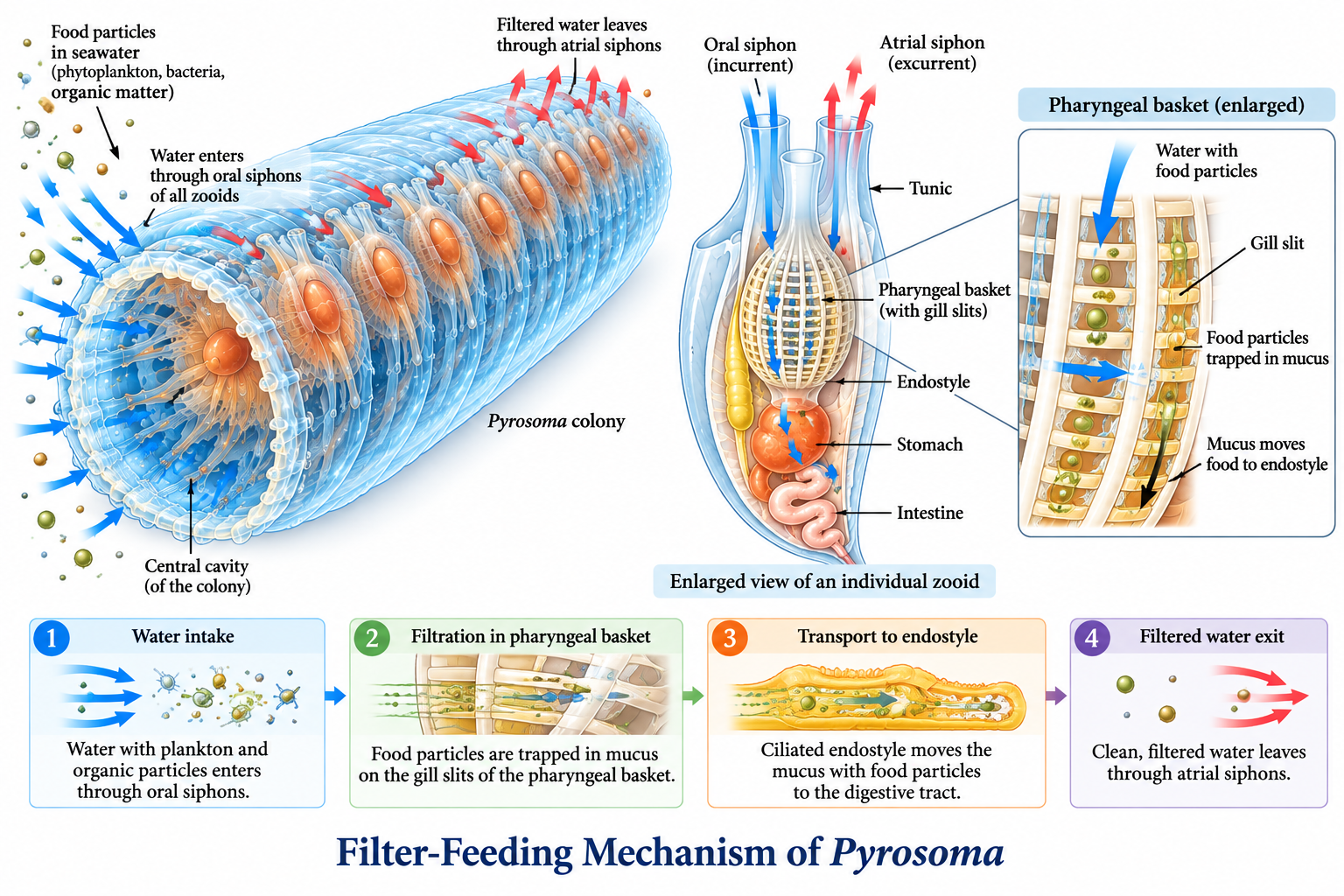
Pyrosoma is a suspension feeder that obtains microscopic food particles from seawater. The coordinated feeding activity of numerous zooids allows the colony to process a continuous flow of water.
Filter-Feeding Process
- Seawater enters each zooid through its oral opening.
- Ciliary activity produces a water current through the pharyngeal basket.
- Suspended food particles are trapped in mucus within the pharyngeal filtering system.
- Cilia transport the captured food toward the digestive tract.
- Filtered water passes out through the atrial opening.
- The processed food enters the digestive system for digestion and absorption.
Feeding Adaptations
- Pharyngeal basket: Provides a large filtering surface.
- Cilia: Maintain water currents and transport food-containing mucus.
- Endostyle: Produces mucus that helps capture suspended particles.
- Oral opening: Provides the main route for incoming seawater.
- Atrial opening: Allows filtered water to leave the zooid.
- Colonial organization: Numerous zooids feed simultaneously, making the colony an effective suspension-feeding unit.
Respiration and Circulation in Pyrosoma
Respiration
Respiration in Pyrosoma is mainly associated with the pharyngeal basket of each zooid. As seawater passes through the pharyngeal region, oxygen diffuses into the blood while carbon dioxide diffuses out.
The continuous movement of water through the feeding apparatus also supports efficient respiratory gas exchange.
Circulation
Each zooid has its own circulatory system that transports nutrients and respiratory gases to different tissues. The heart and blood vessels distribute materials within the zooid.
Because a pyrosome is a colony, the individual zooids remain physiologically organized units while living together within the common tunic.
Bioluminescence in Pyrosoma
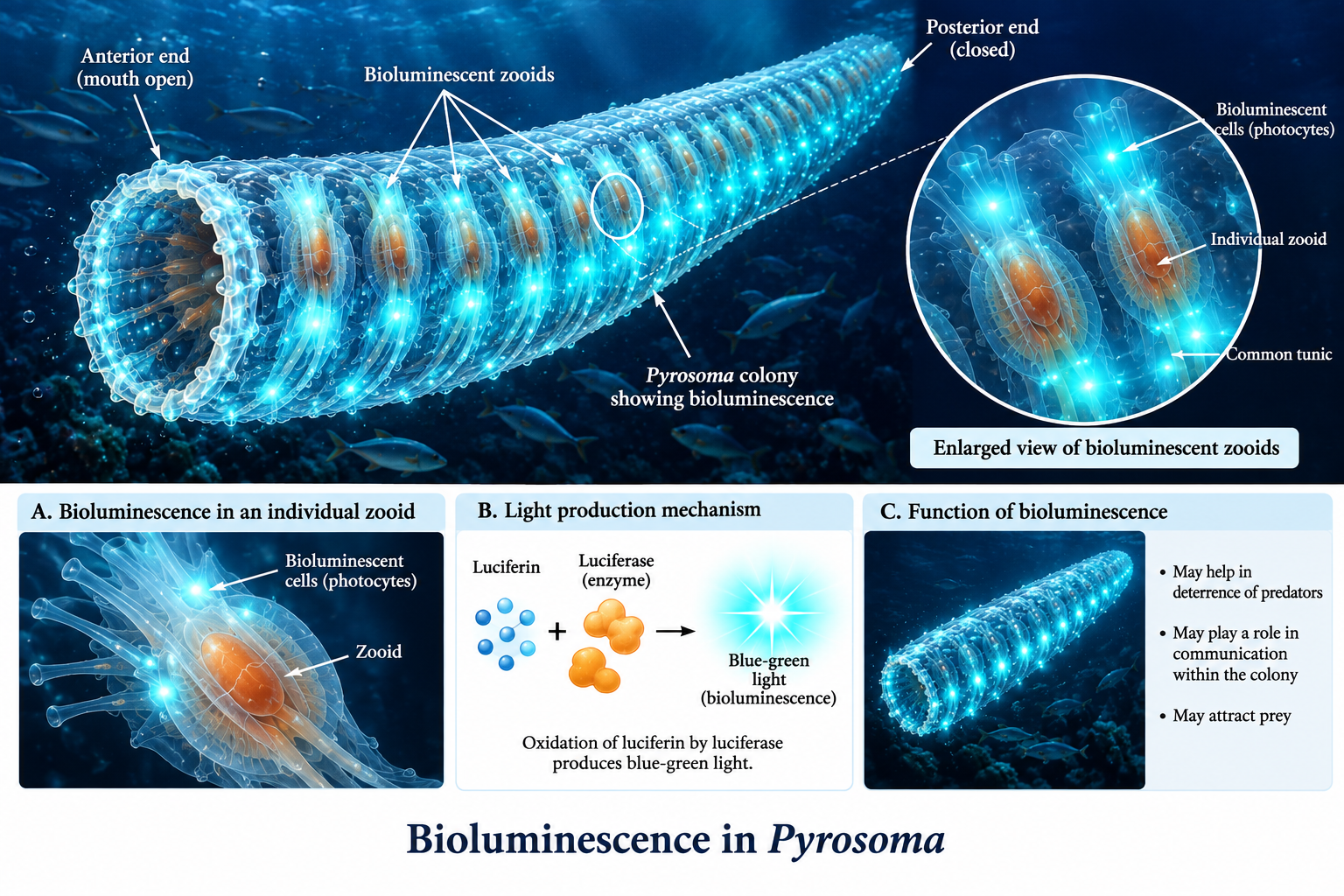
One of the most distinctive features of Pyrosoma is its ability to produce bioluminescent light. The colony can emit a striking blue-green glow, particularly when stimulated or disturbed.
How Bioluminescence Works
- Bioluminescent organs are associated with the individual zooids of the colony.
- Light is produced through a biochemical reaction involving luciferin and luciferase.
- Stimulation of one part of the colony can trigger light production in nearby zooids, producing a coordinated luminous response.
- The emitted light can make the entire colony appear to glow in the surrounding seawater.
- Bioluminescence is an important biological feature of pyrosomes and contributes to their distinctive appearance in the open ocean.
The name Pyrosoma is derived from Greek words associated with fire and body, reflecting this remarkable luminous characteristic.
Colony Formation and Zooid Organization in Pyrosoma
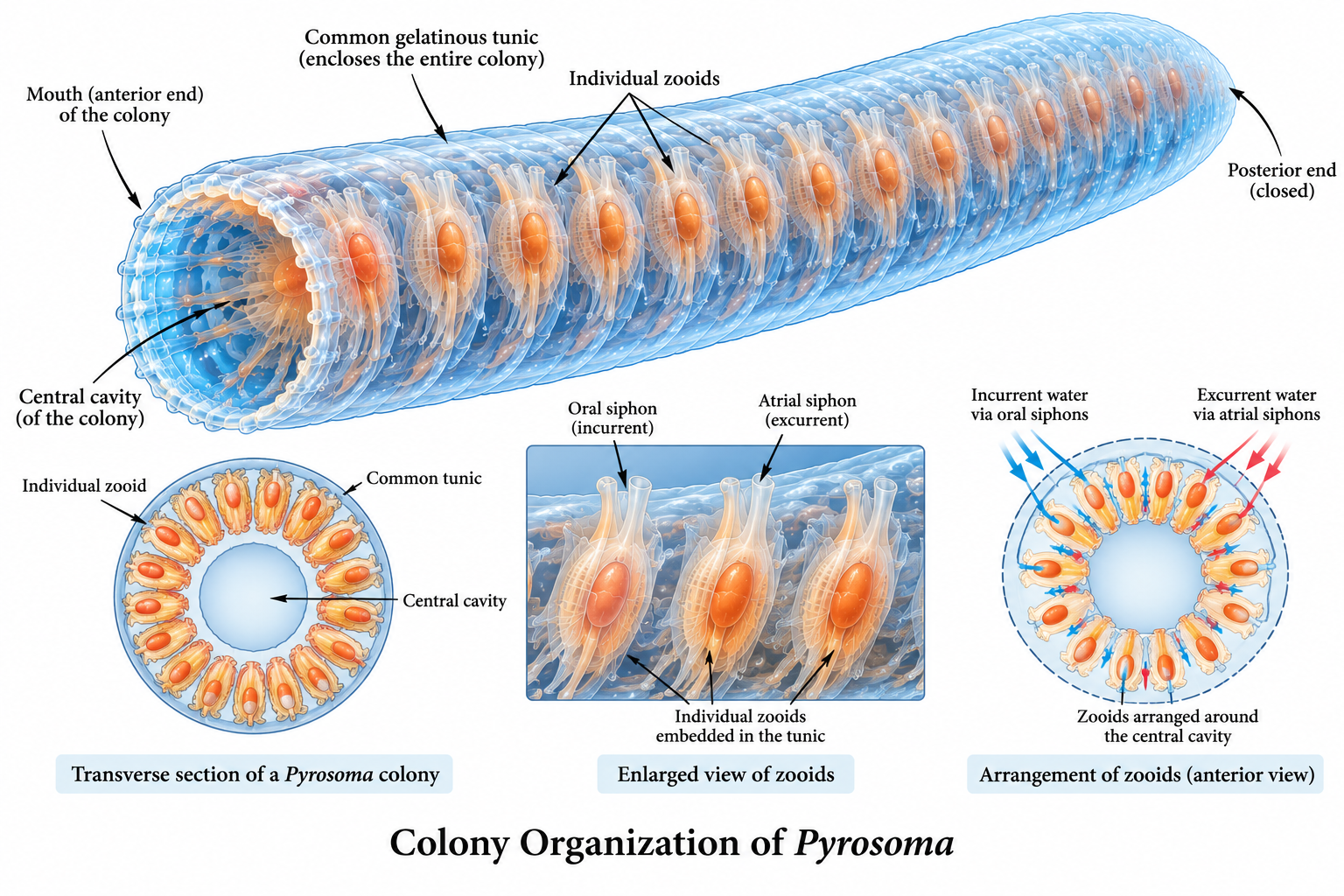
The colony of Pyrosoma is formed by numerous individual zooids embedded in a common gelatinous test. The zooids are arranged closely together, producing the characteristic tubular or cylindrical colony.
Colony Organization
- Numerous zooids are arranged around a central cavity.
- Each zooid maintains its own feeding and digestive structures.
- The zooids are embedded in a shared common tunic.
- Their coordinated feeding produces water currents through the colony.
- The open end of the colony allows seawater to move through the central cavity.
- New zooids are added during colony growth, increasing the length and overall size of the colony.
- The colony can function as an integrated pelagic unit while each zooid retains its basic tunicate organization.
This colonial organization is one of the most important Characteristics of Pyrosoma and distinguishes it from solitary ascidians such as Herdmania and Ciona.
Nervous System and Sensory Features in Pyrosoma
The nervous system of each Pyrosoma zooid is relatively simple and is adapted to its pelagic filter-feeding lifestyle.
- Each zooid possesses a cerebral ganglion that acts as the main nervous centre.
- Nerve fibres extend from the ganglion to different regions of the body.
- Sensory structures help the zooids respond to changes in the surrounding seawater.
- Mechanical or chemical stimulation can influence the activity of individual zooids.
- Coordinated responses among zooids contribute to the integrated functioning of the colony.
- The nervous system is much simpler than that of vertebrates but retains the basic organization characteristic of tunicates.
Reproduction and Life Cycle of Pyrosoma
Pyrosoma has a distinctive life cycle associated with its colonial organization. A newly developing pyrosome begins from a nurse or oozooid, which gives rise to additional zooids through budding. These zooids remain associated and gradually form the characteristic tubular colony.
Life Cycle
The major stages can be represented as:
Fertilization → Embryonic development → Larval stage → Metamorphosis → Oozooid → Budding → Colony formation
- Sexual reproduction produces a developing embryo.
- The larval stage develops chordate features characteristic of tunicates.
- After metamorphosis, the developing individual becomes an oozooid.
- The oozooid produces additional zooids by asexual budding.
- Newly formed zooids remain attached to the developing colony.
- Continued budding results in the formation of a larger tubular colony.
- The mature colony contains numerous specialized zooids that function together as a pelagic unit.
Thus, the life cycle of Pyrosoma combines sexual reproduction with extensive asexual budding during colony formation.
Evolutionary Significance of Pyrosoma
Pyrosoma is important in zoology because it represents a highly specialized colonial tunicate within Phylum Chordata. Its life history illustrates how the tunicate body plan can become adapted to a pelagic lifestyle.
- Pyrosoma belongs to Subphylum Tunicata, showing its evolutionary relationship with other chordates.
- Individual zooids retain the basic tunicate organization despite being integrated into a colony.
- The larval stage exhibits characteristic chordate features that are important for understanding tunicate development.
- The transformation from a developing individual into a colony demonstrates the importance of asexual budding and colonial organization in tunicate evolution.
- Its free-floating lifestyle differs markedly from the sessile adult condition of many ascidians.
- The combination of filter feeding, colonial organization and bioluminescence represents specialized adaptations to life in the open ocean.
Ecological Importance of Pyrosoma
Pyrosoma plays an important role in marine pelagic ecosystems through its filter-feeding activity and contribution to oceanic food webs.
- Filter feeding: Colonies remove suspended particles, including planktonic food organisms and organic matter, from seawater.
- Nutrient cycling: Feeding and waste production contribute to the movement of organic nutrients within the marine ecosystem.
- Food-web role: Pyrosome colonies can serve as food for various marine predators.
- Pelagic particle processing: Large colonies can process substantial volumes of seawater, influencing the distribution of suspended organic material.
- Carbon transfer: By consuming particulate organic matter and producing waste particles, pyrosomes can contribute to the transfer of organic material through the pelagic food web.
- Marine biodiversity: Their colonies provide a distinctive component of open-ocean planktonic communities.
Key Takeaways
- Pyrosoma is a colonial marine tunicate belonging to Phylum Chordata.
- It is classified under Class Thaliacea, Order Pyrosomata and Family Pyrosomatidae.
- The colony is generally tubular or cylindrical and consists of numerous zooids.
- Individual zooids are embedded in a common gelatinous tunic.
- The colony is free-floating and pelagic, unlike the sessile adults of many ascidians.
- Zooids are specialized for suspension or filter feeding.
- The pharyngeal basket and endostyle help capture suspended food particles.
- Bioluminescence is one of the most distinctive features of pyrosomes.
- Colony growth involves the addition of zooids through asexual budding.
- The combination of colonial organization, filter feeding and bioluminescence makes Pyrosoma an important organism for studying tunicate biology and pelagic marine ecosystems.
Frequently Asked Questions
What is Pyrosoma?
Pyrosoma is a genus of marine colonial tunicates commonly known as pyrosomes or fire bodies.
Where does Pyrosoma live?
It is a pelagic marine organism that lives freely in the open ocean rather than remaining attached to the seafloor.
Why is Pyrosoma called a fire body?
The name refers to its remarkable ability to produce blue-green bioluminescent light.
Is Pyrosoma solitary or colonial?
Pyrosoma is colonial. Its colony consists of numerous individual zooids embedded in a common gelatinous tunic.
What is the characteristic shape of a Pyrosoma colony?
The colony is generally tubular or cylindrical, with zooids arranged around a central cavity.
How does Pyrosoma obtain food?
It is a filter feeder. Individual zooids filter suspended particles from seawater using their pharyngeal feeding apparatus.
How does the Pyrosoma colony grow?
Colony growth occurs largely through asexual budding, which produces additional zooids that remain integrated into the colony.
What is the importance of bioluminescence in Pyrosoma?
Bioluminescence allows the colony to produce visible light when stimulated and is one of its most distinctive biological features.
Why is Pyrosoma important in zoology?
It is useful for studying colonial organization, tunicate biology, pelagic adaptations, filter feeding and bioluminescence.
Recommended Study Resource
A Manual of Practical Zoology – Chordates
by P S Verma (Author)
A Manual of Practical Zoology Chordates : For Undergraduate, Postgraduate Students | 12th Edition | Basic Lab Methods Book | Experimental Biochemistry, Physiology, Osteology, Embryology
by Dr. P S Verma (Author)
As an Amazon Associate I earn from qualifying purchases.
References
- NCBI Taxonomy – Pyrosoma
- WoRMS – Pyrosoma
- Ascidiacea World Database
- Ruppert, E. E., Fox, R. S., & Barnes, R. D. Invertebrate Zoology: A Functional Evolutionary Approach. Brooks/Cole.
- Brusca, R. C., Moore, W., & Shuster, S. M. Invertebrates. Sinauer Associates.
Discover more from Zoologyverse
Subscribe to get the latest posts sent to your email.