
Mitosis is a type of cell division in which one parent cell undergoes a single nuclear division to produce two daughter cells that generally have the same chromosome number and essentially the same genetic information as the parent cell.
It is an essential process in multicellular organisms because it allows cells to increase in number during growth, replace old or damaged cells, and maintain tissues. Mitosis also plays an important role in asexual reproduction in many organisms.
Mitosis should not be viewed as an isolated event. It forms part of the cell cycle, following DNA replication during the S phase of interphase. Once DNA has been replicated, the duplicated chromosomes must be accurately separated so that each daughter cell receives one complete chromosome set.
What Is Mitosis?
Mitosis is the process by which the duplicated chromosomes of a eukaryotic cell are separated into two daughter nuclei.
It is usually followed by cytokinesis, the division of the cytoplasm, resulting in two daughter cells.
A simplified sequence is:
DNA replication → Chromosome condensation → Chromosome alignment → Sister chromatid separation → Nuclear reformation → Cytokinesis
The major stages of mitosis are:
- Prophase
- Metaphase
- Anaphase
- Telophase
Prometaphase is also recognized as a distinct stage between prophase and metaphase in modern cell biology descriptions.
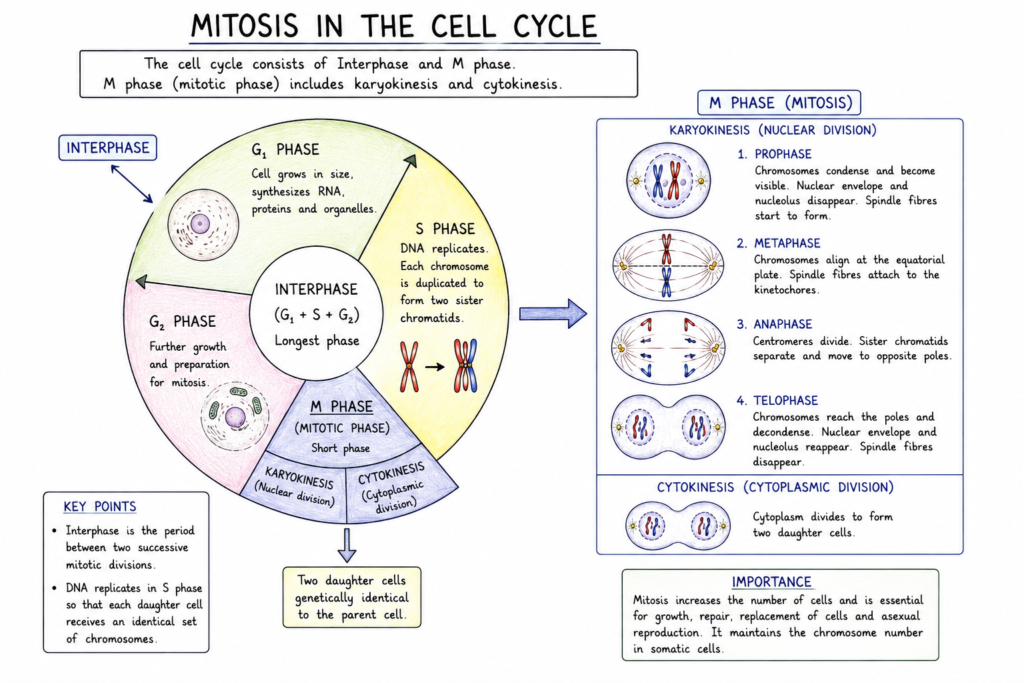
Mitosis and the Cell Cycle
Mitosis occurs during the M phase of the cell cycle.
Before entering mitosis, the cell passes through interphase:
- G₁ phase: Cell growth and normal cellular activities
- S phase: DNA replication
- G₂ phase: Further growth and preparation for division
- M phase: Mitosis and cytokinesis
DNA replication does not occur during mitosis. It takes place earlier, during the S phase.
After replication, each chromosome consists of two sister chromatids joined at a centromere.
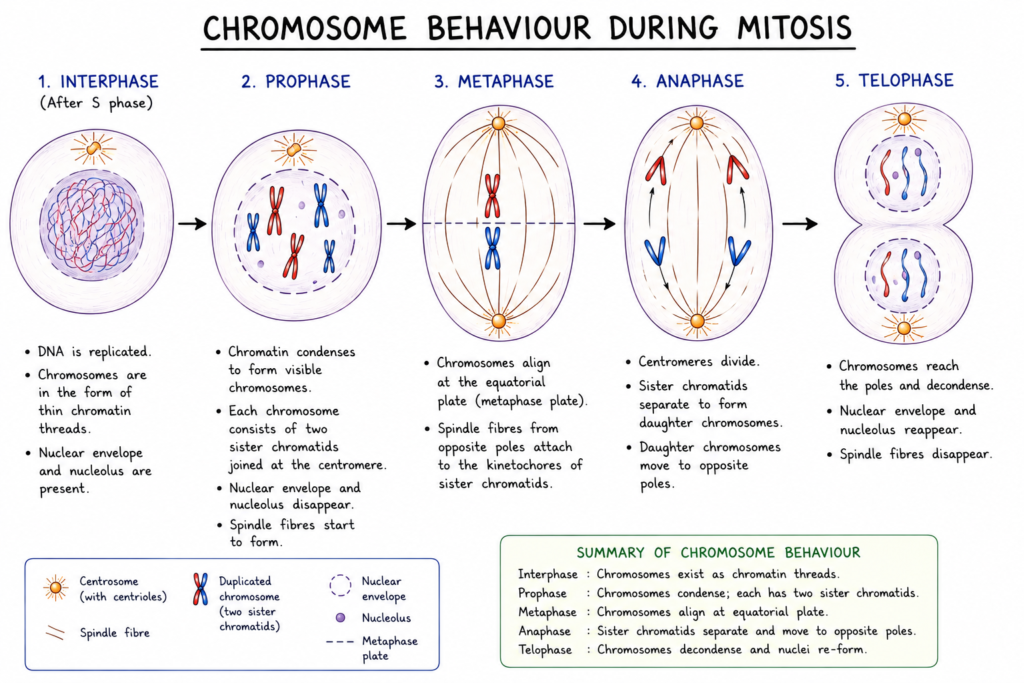
Stages of Mitosis
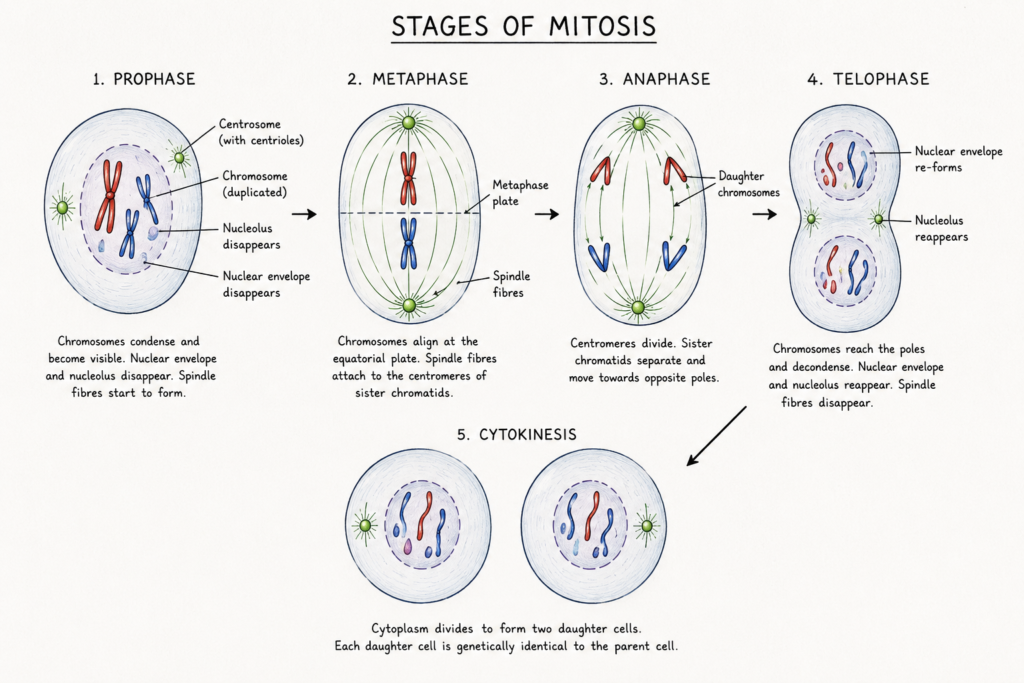
Mitosis is traditionally divided into four main stages: prophase, metaphase, anaphase and telophase. Prometaphase is often described separately between prophase and metaphase. Cytokinesis generally follows mitosis and divides the cytoplasm.
Prophase
During prophase:
- The chromatin condenses and becomes visible as distinct chromosomes.
- Each chromosome consists of two sister chromatids joined at the centromere.
- The nucleolus gradually disappears.
- The nuclear envelope begins to break down toward the end of prophase.
- Centrosomes move toward opposite poles in animal cells.
- Mitotic spindle fibres begin to form between the two poles.
- Chromosomes become progressively shorter and thicker, making them suitable for accurate segregation.
Prometaphase
Prometaphase connects prophase with metaphase.
- The nuclear envelope breaks down completely.
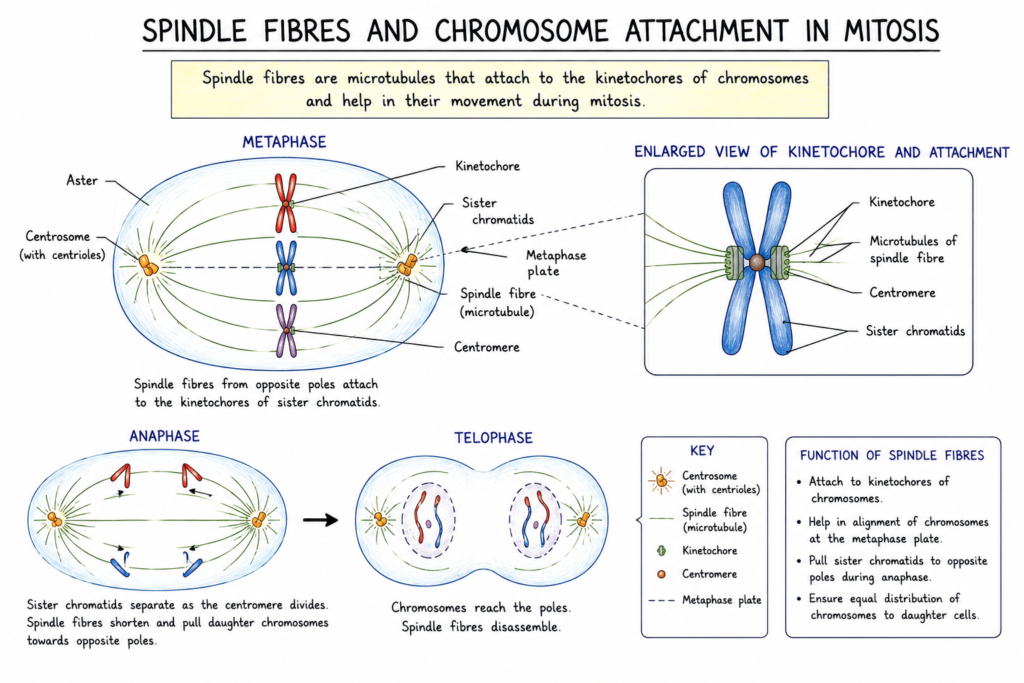
- Spindle microtubules enter the region previously occupied by the nucleus.
- Kinetochores form at the centromeres of chromosomes.
- Spindle microtubules attach to the kinetochores.
- Sister chromatids become connected to microtubules associated with opposite spindle poles.
- Chromosomes begin active movement toward the cell’s equatorial region.
- Proper chromosome–spindle attachment prepares the cell for metaphase.
Metaphase
During metaphase:
- Chromosomes become highly condensed and clearly visible.
- Chromosomes align along the equatorial plane, called the metaphase plate.
- Spindle microtubules remain attached to the kinetochores.
- Sister chromatids are oriented toward opposite spindle poles.
- Each chromosome is positioned so that its sister chromatids can be separated accurately.
- The spindle assembly checkpoint monitors whether chromosomes are properly attached.
- The cell proceeds to anaphase only after the necessary chromosome attachments are established.
Anaphase
Anaphase is characterized by the separation of sister chromatids.
- Sister chromatids separate from one another.
- Once separated, each chromatid is considered an individual daughter chromosome.
- The daughter chromosomes move toward opposite poles.
- Spindle microtubules attached to kinetochores shorten and contribute to chromosome movement.
- The two chromosome sets become progressively farther apart.
- The cell elongates as spindle-associated forces separate the chromosome groups.
- Accurate chromosome movement ensures that each future daughter cell receives one complete chromosome set.
Telophase
During telophase:
- The chromosomes reach the opposite poles of the cell.
- Chromosomes begin to decondense and return toward a less compact chromatin state.
- A new nuclear envelope forms around each chromosome set.
- The nucleoli reappear.
- The mitotic spindle is progressively disassembled.
- Two daughter nuclei are established within the same cell.
- Cytokinesis begins or continues, depending on the organism and cell type.
Cytokinesis
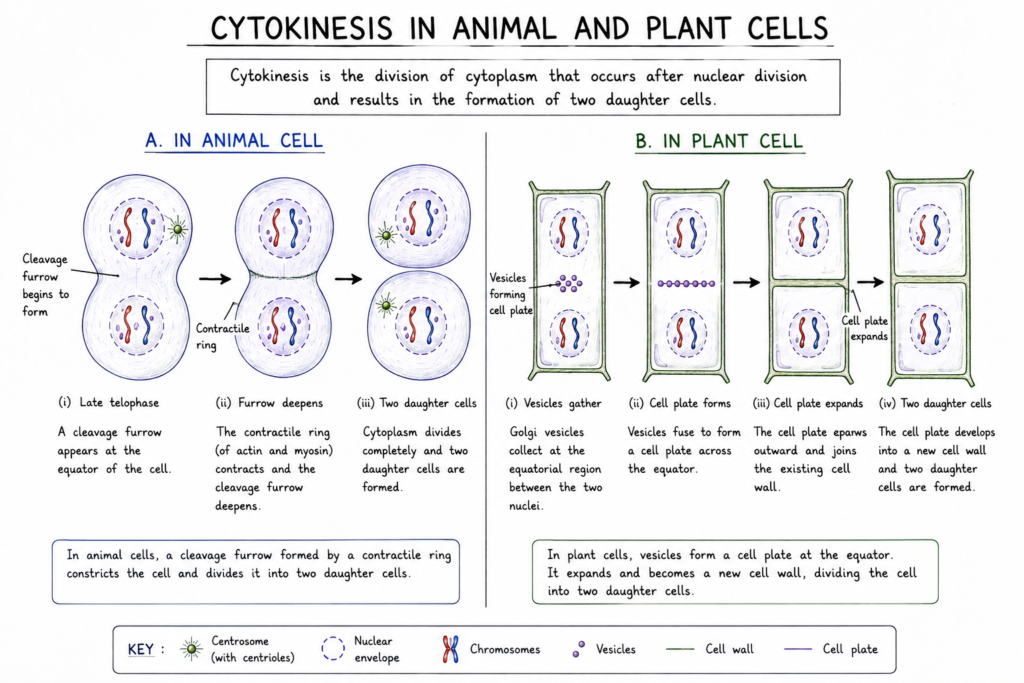
Cytokinesis is technically cytoplasmic division rather than a stage of mitosis itself, but it usually completes the cell-division process.
- The cytoplasm is divided between the two daughter cells.
- In animal cells, a contractile ring containing actin and myosin forms.
- The plasma membrane develops an inward cleavage furrow.
- The cleavage furrow deepens until the cell separates.
- In plant cells, vesicles accumulate at the equator and form a cell plate.
- The cell plate expands outward and develops into a new partition between daughter cells.
- The result is two daughter cells, generally containing the same chromosome number as the parent cell.
What Happens to Chromosomes During Mitosis?
The behavior of chromosomes is central to understanding mitosis.
Before mitosis, DNA replication produces two sister chromatids for each chromosome.
During mitosis:
Duplicated chromosome → Sister chromatids separate → Daughter chromosomes → Two daughter nuclei
Importantly, the chromosome number is maintained through mitosis.
For example, if a diploid cell has 2n = 46 chromosomes, mitosis produces daughter cells that also have 46 chromosomes.
The DNA content changes during the cycle, but the chromosome number is maintained because sister chromatids are separated equally during mitosis.
Significance of Mitosis
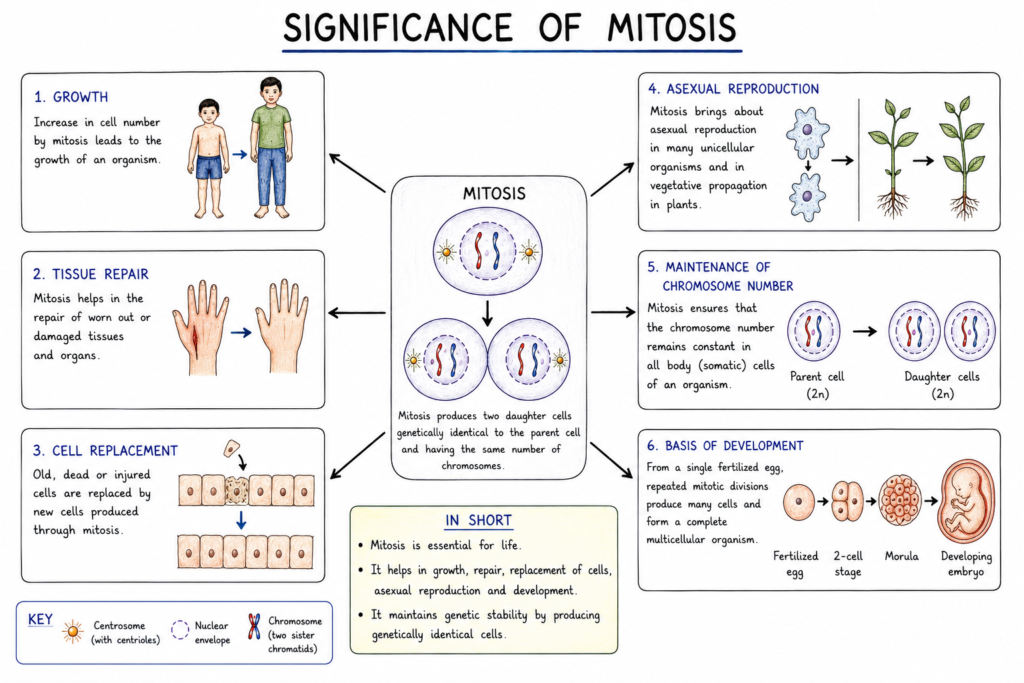
Mitosis is essential for several biological processes.
1. Growth
In multicellular organisms, growth requires an increase in cell number.
Mitosis produces new cells that contribute to the growth of tissues and organs.
2. Tissue Repair
When tissues are damaged, mitotic cell division helps replace injured or lost cells.
For example, cells in the skin undergo continuous division to replace cells that are naturally lost.
3. Cell Replacement
Many tissues continuously produce new cells to replace old or damaged cells.
Mitosis therefore contributes to the maintenance of tissues throughout an organism’s life.
4. Asexual Reproduction
Mitosis contributes to asexual reproduction in many organisms.
Because mitosis generally produces genetically similar daughter cells, offspring produced through mitotic mechanisms can be genetically similar to the parent.
Examples include cell division in unicellular eukaryotes and vegetative propagation in plants.
5. Maintenance of Chromosome Number
Mitosis helps maintain the chromosome number across successive somatic cell divisions.
This is particularly important during the development of multicellular organisms from a single fertilized egg.
6. Genetic Stability
Accurate chromosome segregation allows daughter cells to inherit essentially equivalent genetic information.
However, mutations can arise independently of the normal mechanics of mitosis, so daughter cells are not necessarily perfectly identical in every molecular respect.
Regulation of Mitosis
Mitosis must be carefully regulated to prevent chromosome-segregation errors.
Cell-cycle regulation involves proteins such as cyclins and cyclin-dependent kinases (CDKs).
Several control mechanisms ensure that:
- DNA has been replicated before division.
- Damaged DNA is not passed unchecked to daughter cells.
- Chromosomes attach correctly to spindle microtubules.
- Sister chromatids separate at the appropriate time.
The spindle assembly checkpoint is particularly important during mitosis because it delays chromosome separation until chromosomes are correctly attached to the spindle.
Errors in Mitosis
Although mitosis is highly regulated, errors can occur.
One possible error is the unequal distribution of chromosomes between daughter cells.
Such chromosome-segregation errors can result in aneuploidy, meaning an abnormal chromosome number.
Persistent defects in cell-cycle regulation and chromosome segregation can contribute to genomic instability, which is a characteristic associated with many cancers.
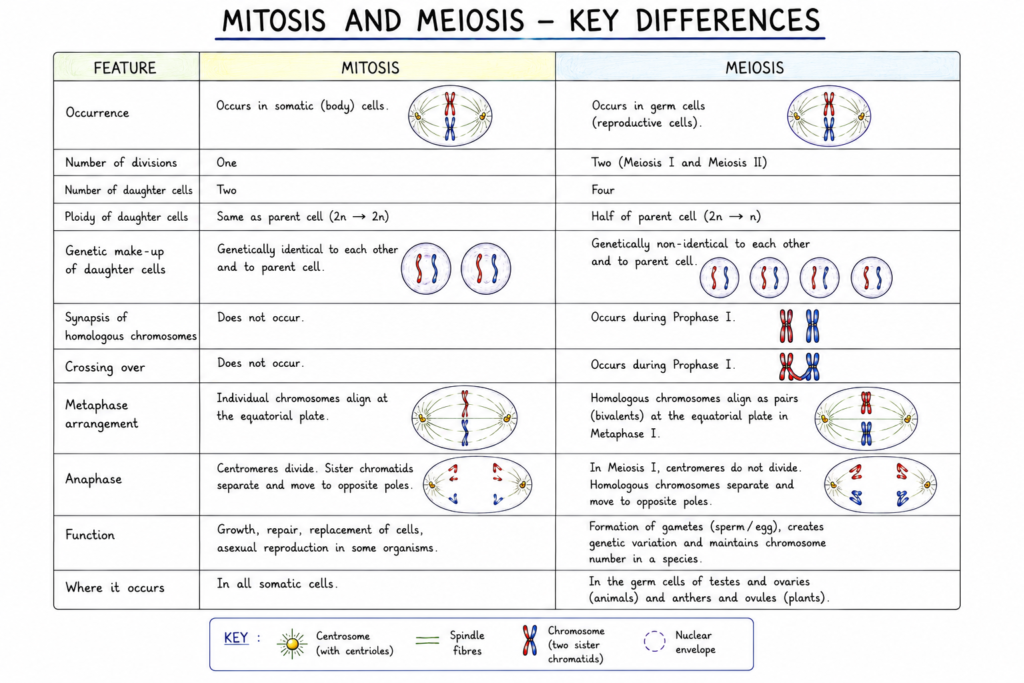
Mitosis vs Meiosis
Mitosis and meiosis are both forms of eukaryotic chromosome segregation, but they serve different biological purposes.
| Feature | Mitosis | Meiosis |
|---|---|---|
| Number of divisions | One | Two |
| DNA replication | Once before division | Once before Meiosis I |
| Daughter cells | Usually two | Usually four |
| Chromosome number | Maintained | Reduced by half |
| Homologous pairing | Absent | Present in Prophase I |
| Crossing over | Normally absent | Occurs during Prophase I |
| Genetic variation | Usually limited | High |
| Sister chromatids | Separate during anaphase | Separate during Meiosis II |
| Main function | Growth, repair and replacement | Sexual reproduction |
| Typical products | Somatic cell lineages | Gametes or meiotic products |
Mitosis in Animals and Plants
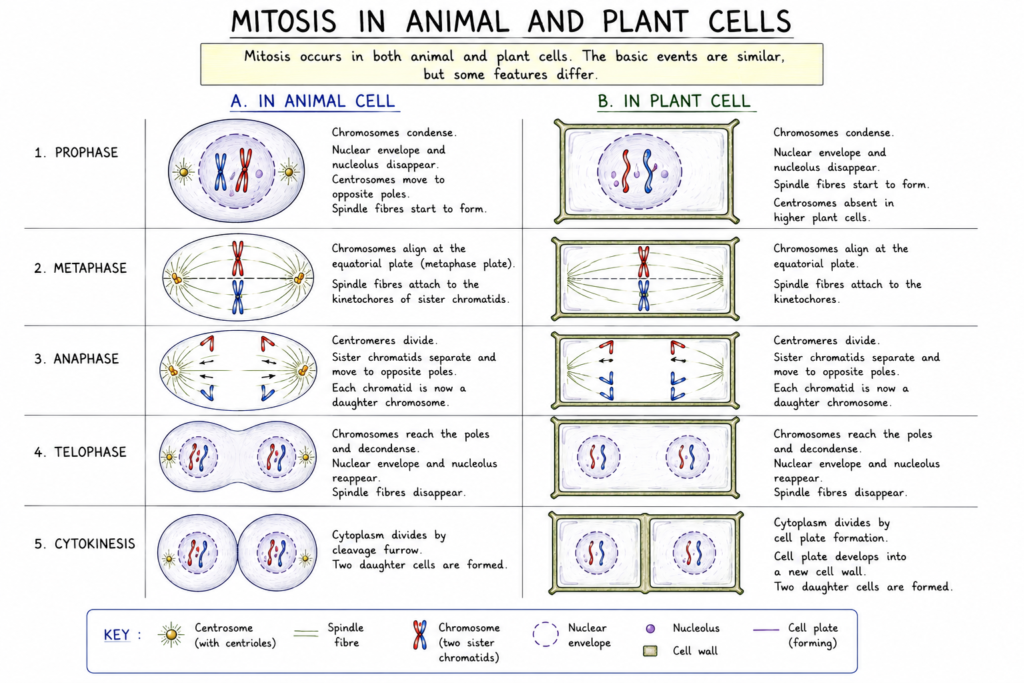
Mitosis occurs in both animals and plants, but some details differ.
In Animal Cells
- Centrosomes organize the spindle.
- Cytokinesis occurs through a cleavage furrow.
- The cell membrane constricts inward.
In Plant Cells
- The rigid cell wall prevents a typical cleavage furrow.
- The cell plate forms between the daughter nuclei.
- The cell plate develops into a new cell wall.
Despite these differences, the fundamental process of chromosome segregation is conserved.
Mitosis in Unicellular and Multicellular Organisms
In unicellular eukaryotes, cell division can directly produce new individuals.
In multicellular organisms, mitosis primarily increases cell number and maintains tissues.
Therefore, the biological significance of mitosis depends partly on the organism and the type of cell undergoing division.
Mitosis in Embryonic Development
Mitosis begins to play a major role immediately after fertilization.
A fertilized egg undergoes repeated rounds of cell division, increasing the number of cells during early development.
As development continues, cells become specialized through processes of cell differentiation, while mitosis continues to generate new cells.
Thus, mitosis is fundamental to the transformation of a single-celled zygote into a multicellular organism.
Key Takeaways
- Mitosis is a nuclear division process that separates duplicated chromosomes into two daughter nuclei.
- It occurs during the M phase of the cell cycle.
- DNA replication takes place earlier, during the S phase.
- The major stages are prophase, metaphase, anaphase and telophase.
- Prometaphase is commonly recognized between prophase and metaphase.
- Sister chromatids separate during anaphase.
- Cytokinesis divides the cytoplasm after nuclear division.
- Mitosis generally maintains the chromosome number.
- It is essential for growth, repair, cell replacement and asexual reproduction.
- Accurate regulation of mitosis helps maintain genetic and chromosomal stability..
Frequently Asked Questions
What is mitosis?
Mitosis is a type of nuclear division in which duplicated chromosomes are separated into two daughter nuclei, generally producing two daughter cells with the same chromosome number as the parent cell.
What are the four main stages of mitosis?
The four traditionally recognized stages are prophase, metaphase, anaphase and telophase. Prometaphase is often treated as a distinct stage between prophase and metaphase.
During which phase do chromosomes align?
Chromosomes align at the metaphase plate during metaphase.
During which stage do sister chromatids separate?
Sister chromatids separate during anaphase.
Does DNA replication occur during mitosis?
No. DNA replication occurs during the S phase of interphase, before mitosis begins.
What is the significance of mitosis?
Mitosis is important for growth, development, tissue repair, cell replacement, maintenance of chromosome number, and asexual reproduction in many organisms.
What is cytokinesis?
Cytokinesis is the division of the cytoplasm that produces separate daughter cells following nuclear division.
What is the difference between mitosis and meiosis?
Mitosis involves one division and generally produces two genetically similar cells while maintaining chromosome number. Meiosis involves two divisions and produces haploid cells with genetically varied chromosome combinations.
References
- Alberts B, Johnson A, Lewis J, et al. Molecular Biology of the Cell. Garland Science.
- Lodish H, Berk A, Kaiser CA, et al. Molecular Cell Biology. W.H. Freeman.
- OpenStax. Biology 2e. Rice University.
- Cooper GM, Hausman RE. The Cell: A Molecular Approach. Sinauer Associates.
- Urry LA, Cain ML, Wasserman SA, et al. Campbell Biology. Pearson.
Discover more from Zoologyverse
Subscribe to get the latest posts sent to your email.