
1. Concept and Meaning of Speciation
Speciation is the evolutionary process through which an ancestral population gives rise to two or more distinct species. It is a central event in biological evolution because it increases biodiversity and explains how the diversity of living organisms has originated. During speciation, populations become sufficiently different genetically and reproductively that they follow separate evolutionary paths.
A species is commonly described under the biological species concept as a group of natural populations whose members can interbreed and produce fertile offspring, while being reproductively isolated from other such groups. This definition is especially useful for sexually reproducing organisms, although it does not apply equally well to fossils, asexual organisms or some cases of hybridisation. Therefore, the recognition of species may also require morphological, ecological, genetic and phylogenetic evidence.
Speciation is closely associated with evolutionary processes such as natural selection, mutation and genetic drift. To understand these processes in greater detail, read our article on Theories of Evolution.
1.1 Speciation and the Origin of New Species
The process usually begins when populations of the same species experience reduced gene exchange. This separation may arise because of a geographical barrier, differences in habitat, changes in mating behaviour, or other factors. Once gene flow is restricted, mutation, natural selection and genetic drift can cause the populations to diverge. Over many generations, these differences may lead to reproductive isolation.
Reproductive isolation is important because it prevents populations from merging into a single gene pool. Barriers may act before fertilisation, such as differences in courtship behaviour or breeding seasons, or after fertilisation, such as reduced hybrid viability or fertility. The development and accumulation of such barriers are major components of many speciation pathways.
1.2 Speciation as a Branching Evolutionary Process
Speciation is not simply the appearance of a new variation within a population. It involves the formation of independently evolving lineages. The process may occur gradually over many generations, and its pace can differ among organisms and environmental conditions. In some cases, divergence occurs while populations are geographically separated; in others, it develops within the same geographical area.
The study of speciation helps explain patterns of biodiversity, adaptation, endemism and the evolutionary relationships among organisms. It also provides a framework for understanding how barriers to reproduction arise and how a single ancestral lineage can give rise to multiple descendant species.
2. Geographical Isolation and the Origin of Species
Geographical isolation occurs when a physical barrier separates members of a population and restricts their opportunities to interbreed. Mountains, rivers, oceans, deserts, glaciers and long distances may divide a formerly connected population into smaller groups. This separation can initiate allopatric speciation, one of the most widely recognised pathways through which new species arise. This form of speciation begins with spatial separation rather than with the immediate development of reproductive barriers.
2.1 How Geographical Barriers Separate Populations
A geographical barrier reduces or prevents the movement of individuals and the exchange of reproductive material between populations. Before separation, individuals may belong to the same gene pool and regularly exchange alleles through reproduction. After isolation, each group may experience different mutations, environmental pressures and random changes in allele frequencies. Over generations, these differences can accumulate and promote speciation. The rate of speciation varies, and some isolated populations may remain distinct without becoming separate species.
The effects of isolation depend on the nature and duration of the barrier. A newly formed river may divide a population, while the formation of an island may isolate a small number of colonising individuals from the mainland population. In either situation, reduced gene flow allows the separated groups to follow partly independent evolutionary trajectories. Geographical separation therefore provides an opportunity for speciation by reducing the homogenising effect of gene flow. It is an important starting condition for allopatric speciation.
2.2 Divergence of Geographically Isolated Populations
Once populations become separated, they may encounter different climatic conditions, food resources, predators, competitors and habitats. Natural selection can favour different inherited characteristics in each environment. Genetic drift may also produce divergence, particularly when one or both isolated populations have small effective population sizes. Mutation introduces new genetic variants, while recombination generates new combinations of existing alleles.
These processes do not necessarily produce new species immediately. At first, the separated populations may still be capable of interbreeding if brought together. With continued divergence, however, genetic, behavioural, physiological or ecological differences may lead to reproductive barriers. The development of such barriers is a critical stage in speciation because it reduces the possibility that the populations will merge again. In this way, geographical isolation may be followed by biological divergence and, eventually, completed speciation.
2.3 Examples of Geographical Isolation
Island populations provide useful examples of how geographical separation can promote evolutionary divergence. The different species of Darwin’s finches in the Galápagos Islands are a well-known example of diversification associated with island environments, ecological differences and adaptation. Their beak forms and feeding specialisations differ in relation to available food resources.
Geographical isolation is also important in the diversification of freshwater fishes separated by river systems, and in organisms distributed across mountain ranges or oceanic islands. These examples show that physical separation can create conditions for speciation, although isolation alone does not guarantee that new species will form. Successful speciation depends on the evolutionary history of the populations and the establishment of sufficient reproductive isolation. Thus, geographical isolation is a major pathway to speciation, but it is not by itself proof that speciation has occurred.
3. Allopatric Speciation: Definition, Process and Examples
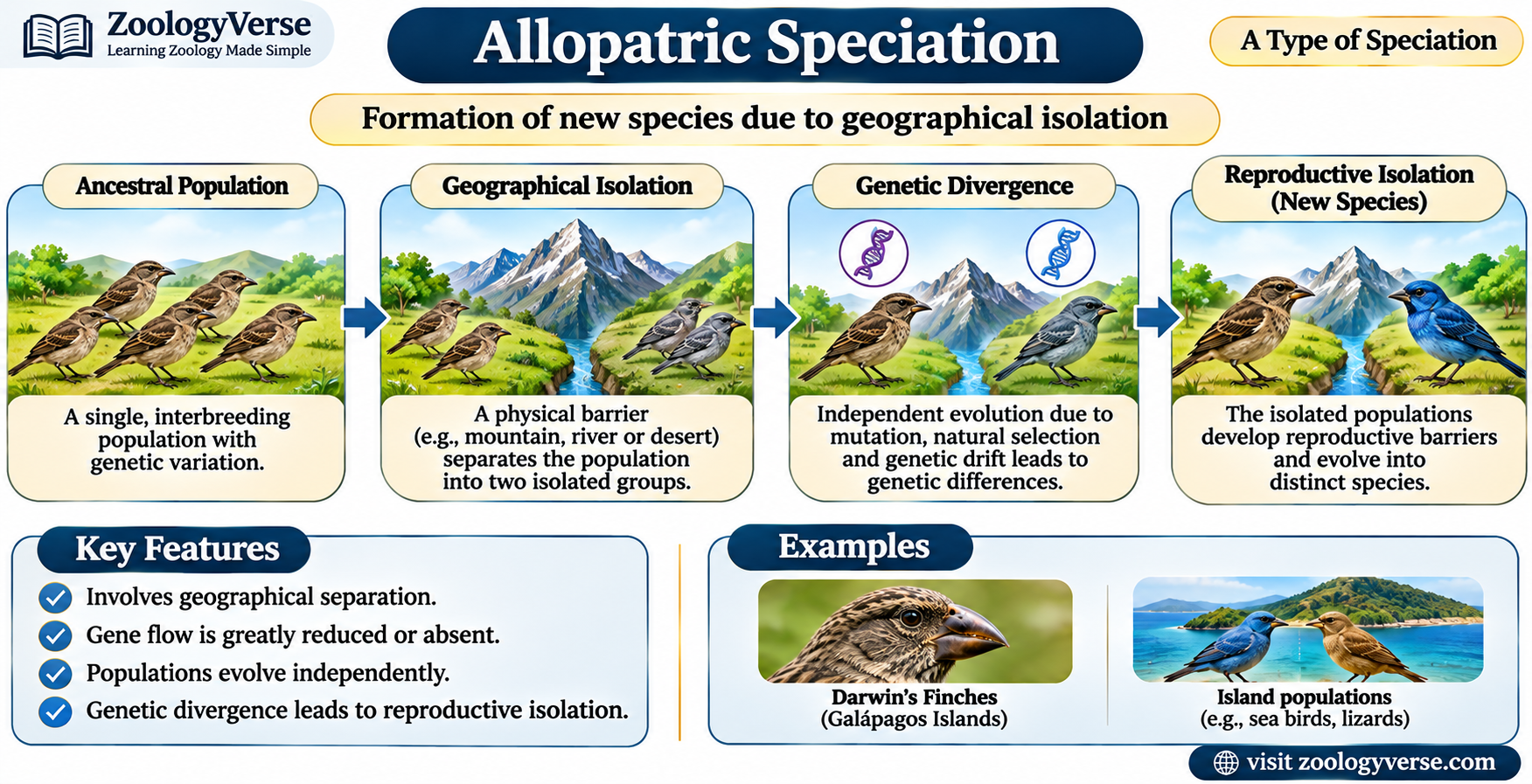
Allopatric speciation is a mode of speciation in which populations of the same ancestral species become geographically separated and gradually evolve into distinct species. The term allopatric means occurring in different geographical regions. Physical barriers such as mountains, rivers, oceans, deserts and glaciers may restrict gene flow between populations, allowing them to undergo independent evolutionary changes.
Allopatric speciation is one of the most widely studied mechanisms of speciation. It demonstrates how geographical separation, combined with mutation, natural selection and genetic drift, can produce reproductive isolation and contribute to the formation of new species.
3.1 Process of Allopatric Speciation
Allopatric speciation generally involves the following stages:
1. Formation of a geographical barrier: An ancestral population becomes divided by a physical barrier, such as a mountain range, river or ocean. The barrier restricts movement and reduces gene exchange between the separated groups.
2. Isolation of populations: The separated populations develop independently because individuals can no longer regularly interbreed. Their gene pools gradually become different as gene flow is restricted.
3. Genetic divergence: Mutation introduces new genetic variations, while natural selection favours characteristics suited to local environmental conditions. Genetic drift may also cause random changes in allele frequencies, particularly in small populations.
4. Development of reproductive isolation: Over many generations, genetic and biological differences may accumulate. These differences can produce reproductive barriers, including changes in mating behaviour, breeding seasons, reproductive structures or genetic compatibility.
5. Formation of distinct species: If the populations become sufficiently reproductively isolated, they may be recognised as separate species. Even if the geographical barrier later disappears, they may no longer be able to interbreed successfully.
3.2 Types of Allopatric Speciation
Allopatric speciation is commonly discussed in two forms based on how geographical separation occurs.
3.2.1 Vicariance
Vicariance occurs when a previously continuous population is divided by the formation of a new geographical barrier. Geological events, changes in river courses, mountain formation and the appearance of other physical barriers may divide the original population into isolated groups.
For example, the formation of a mountain range may separate populations living on opposite sides. Differences in climate, food availability and environmental conditions may then promote evolutionary divergence. If reproductive isolation develops, the separated populations may eventually undergo speciation.
3.2.2 Dispersal
Dispersal occurs when some individuals move from their original population and establish a new population in a geographically separated region. This may happen when organisms colonise islands, cross water bodies or enter previously unoccupied habitats.
The colonising population may contain only a small sample of the genetic variation present in the original population. Consequently, founder effects and genetic drift may influence its genetic composition. Different environmental conditions may also promote adaptation and divergence. Over time, reproductive isolation may develop between the original and colonising populations.
3.3 Examples of Allopatric Speciation
Darwin’s finches: The finches of the Galápagos Islands are a well-known example of evolutionary diversification involving geographical separation and ecological adaptation. Different island populations experienced distinct environmental conditions and food resources. Natural selection contributed to differences in beak shape and feeding adaptations. Their evolutionary history illustrates how isolation and ecological divergence can contribute to the formation of distinct species.
Island populations: Oceanic islands frequently contain endemic species that are found nowhere else. When a small number of individuals colonise an island, geographical isolation may restrict gene flow with the original population. Differences in habitat, resources and selection pressures may then promote evolutionary divergence.
Populations separated by mountain ranges: Mountain formation can divide populations into separate geographical groups. If the barrier persists for a long period, independent evolutionary changes may lead to reproductive isolation and speciation.
3.4 Evolutionary Significance of Allopatric Speciation
Allopatric speciation explains how geographical separation can initiate independent evolutionary histories. It is particularly important in understanding island biodiversity, endemic species and the distribution of closely related organisms across different geographical regions.
However, geographical isolation does not automatically result in speciation. Some separated populations may remain genetically compatible, while others may diverge sufficiently to become distinct species. The outcome depends on factors such as population size, duration of isolation, environmental conditions, natural selection, genetic drift and the development of reproductive barriers.
4. Peripatric Speciation: Definition, Process and Examples
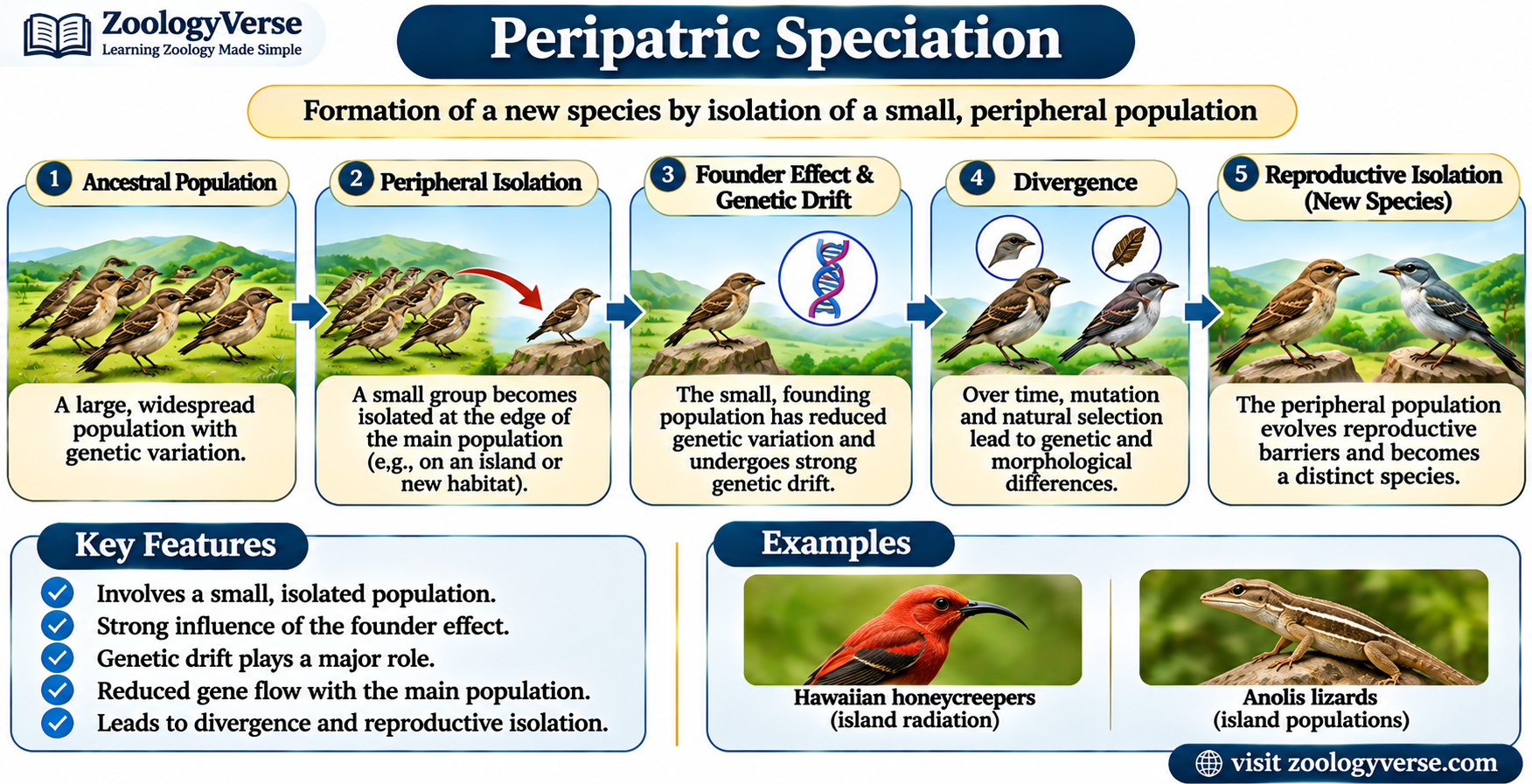
Peripatric speciation is a mode of speciation in which a small population becomes geographically isolated at the edge of the distribution of a larger ancestral population and gradually evolves into a distinct species. It is closely related to allopatric speciation, but the major distinguishing feature is the small size and peripheral location of the isolated population.
The term peripatric refers to populations occurring around the geographical margins of a larger population’s distribution. Since the isolated group often contains relatively few individuals, genetic drift and founder effects may have a particularly strong influence on its genetic composition. Over generations, natural selection, mutation and other evolutionary processes may contribute to divergence and reproductive isolation.
4.1 Process of Peripatric Speciation
Peripatric speciation generally involves the following stages:
1. Dispersal to a peripheral region: A small number of individuals move away from the main population and establish themselves in a geographically isolated area near the edge of the species’ distribution.
2. Establishment of a small population: The newly established group consists of relatively few individuals. Its genetic composition may differ from that of the original population because only a limited sample of the ancestral gene pool is represented.
3. Founder effect and genetic drift: The small population may experience a founder effect, in which the alleles carried by the colonising individuals influence the genetic composition of subsequent generations. Genetic drift can cause further random changes in allele frequencies, particularly when the effective population size remains small.
4. Adaptation to local conditions: The peripheral population may experience environmental conditions different from those of the ancestral population. Natural selection can favour traits that improve survival and reproduction in the new habitat.
5. Development of reproductive isolation: As genetic and ecological differences accumulate, reproductive barriers may develop. If the population becomes sufficiently isolated reproductively, it may eventually form a distinct species.
4.2 Role of the Founder Effect in Peripatric Speciation
The founder effect is an important evolutionary factor in many cases of peripatric speciation. It occurs when a new population is established by a small number of individuals carrying only a fraction of the genetic variation present in the original population.
As a result, some alleles may become more common, while others may be absent entirely from the newly established population. These differences arise through sampling rather than necessarily through natural selection. Subsequent genetic drift can further alter allele frequencies.
The founder effect does not automatically produce a new species. However, it can create genetic differences that, together with natural selection, mutation and restricted gene flow, contribute to evolutionary divergence and eventual reproductive isolation.
4.3 Examples and Illustrations of Peripatric Speciation
Peripatric speciation is often discussed in relation to island colonisation. A small group of individuals may reach an isolated island at the edge of the ancestral species’ range. Because the colonising group is small and separated from the original population, founder effects and genetic drift may influence its evolutionary history.
The Hawaiian Drosophila flies are frequently discussed in evolutionary biology as an example of extensive diversification associated with island colonisation and isolation. Their evolutionary history involves geographical separation, ecological differences and the development of reproductive barriers. However, the entire Hawaiian radiation should not be treated as proof that every species originated through a single peripatric event.
4.4 Evolutionary Significance of Peripatric Speciation
Peripatric speciation demonstrates how small, isolated populations can undergo rapid genetic changes under particular conditions. The influence of founder effects and genetic drift may be especially strong when the effective population size is small.
This mode of speciation also helps explain the origin of endemic species, particularly in island environments and peripheral habitats. It highlights the importance of population size, geographical distribution, genetic variation and reproductive isolation in the formation of new species.
5. Parapatric Speciation: Definition, Process and Examples
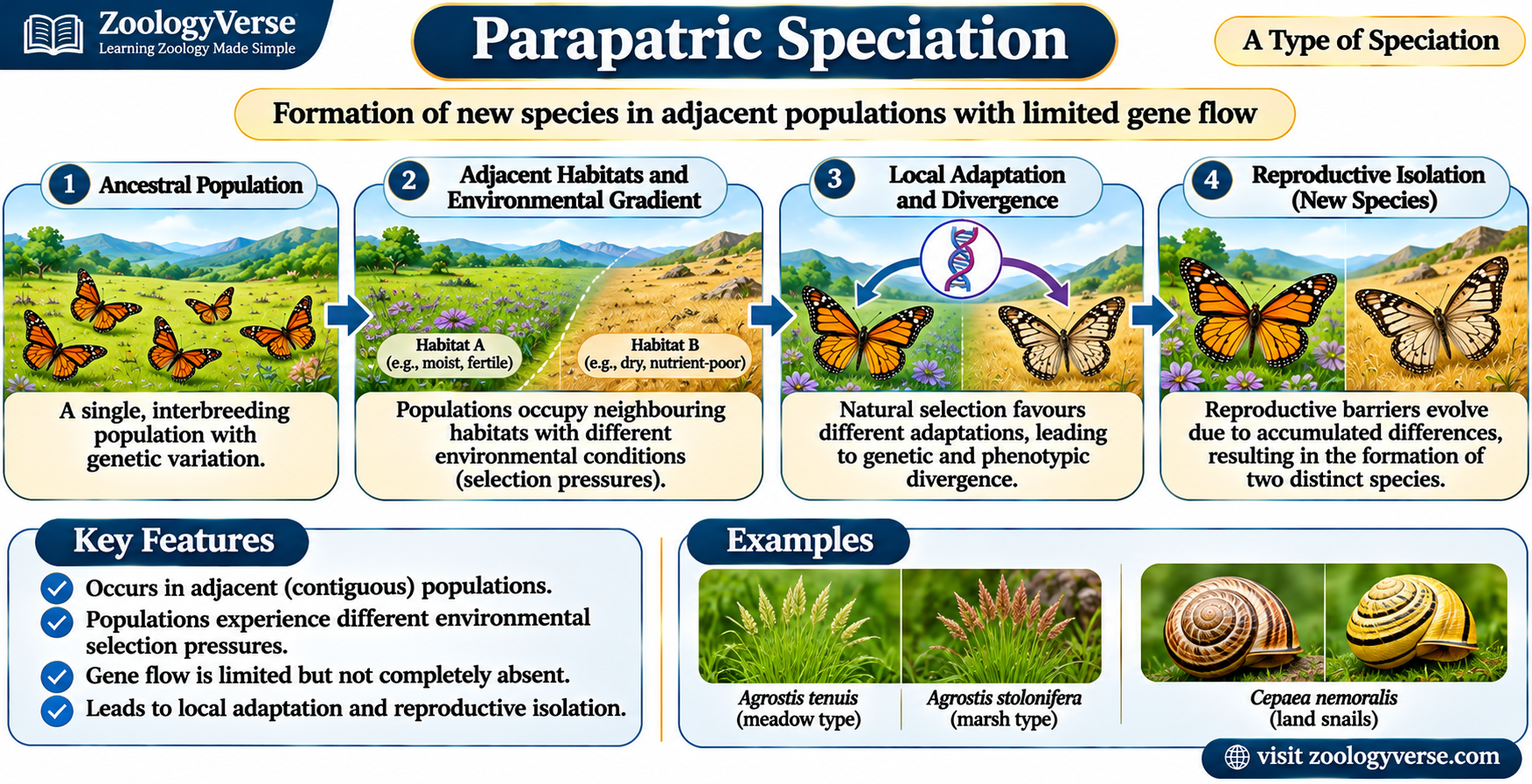
Parapatric speciation is a mode of speciation in which neighbouring populations of the same species occupy adjacent geographical regions and gradually evolve into distinct species despite having limited contact along their distributional boundaries. Unlike allopatric speciation, it does not require a complete physical barrier separating the populations. Instead, differences in environmental conditions, ecological pressures and patterns of reproduction contribute to evolutionary divergence.
The term parapatric refers to populations occurring in neighbouring geographical areas. Gene flow may continue between them in a narrow contact zone, but it is often insufficient to prevent genetic divergence. Over generations, natural selection and other evolutionary processes may promote reproductive isolation and eventually lead to speciation.
5.1 Process of Parapatric Speciation
Parapatric speciation generally involves the following stages:
1. Occupation of adjacent habitats: A species occupies a continuous or neighbouring geographical range containing different environmental conditions. Populations may occur in areas with different soil types, temperatures, food resources or ecological conditions.
2. Development of environmental differences: Individuals living in different parts of the range experience different selection pressures. Natural selection may favour different inherited characteristics in each habitat, resulting in local adaptation.
3. Restricted gene flow: Although neighbouring populations may come into contact, mating and genetic exchange may be limited. Individuals may preferentially reproduce within their own habitat, or hybrids may have reduced survival or reproductive success in either environment.
4. Genetic divergence: Natural selection, mutation and genetic drift contribute to differences between the populations. Local adaptation may become increasingly pronounced, while restricted gene flow reduces the exchange of alleles between them.
5. Development of reproductive isolation: Differences in flowering or breeding periods, mating behaviour, habitat preference or hybrid fitness may produce reproductive barriers. If these barriers become sufficiently strong, the neighbouring populations may evolve into distinct species.
5.2 Role of Natural Selection and Hybrid Zones
Natural selection is particularly important in parapatric speciation because neighbouring populations may experience contrasting environmental conditions. A characteristic that improves survival in one habitat may be less beneficial in another. Consequently, different traits may become common in adjacent populations.
A hybrid zone may develop where the neighbouring populations meet and reproduce. Individuals in this region may show intermediate characteristics or combinations of traits from both populations. The fitness of hybrids influences the extent of gene exchange across the boundary.
If hybrids have lower fitness than individuals adapted to either parental habitat, selection may favour reproductive barriers that reduce interbreeding. In contrast, extensive hybridisation and successful reproduction may maintain genetic connections between the populations and slow their divergence.
5.3 Examples of Parapatric Speciation
Heavy metal-tolerant grasses: Certain plant populations growing on soils contaminated with heavy metals near mining sites provide a commonly discussed example of parapatric divergence. Metal-tolerant plants may become adapted to contaminated soil, while neighbouring populations remain adapted to uncontaminated soil. Differences in flowering time and local adaptation can reduce gene exchange between the populations.
Grass species growing in contrasting soil conditions: Plants occupying adjacent habitats with different soil chemistry may develop distinct physiological adaptations. When these differences are accompanied by restricted gene flow and reproductive barriers, they may contribute to parapatric speciation.
These examples illustrate how neighbouring populations can diverge without complete geographical separation. However, local adaptation alone does not establish that speciation has occurred; evidence of reproductive isolation and independent evolutionary development is also important.
5.4 Evolutionary Significance of Parapatric Speciation
Parapatric speciation demonstrates that new species can originate even when populations occupy neighbouring geographical areas. It highlights the role of environmental gradients, local adaptation, restricted gene flow and hybrid fitness in evolutionary divergence.
This mode of speciation is particularly useful for understanding how ecological differences can promote reproductive isolation. It also shows that geographical separation is not always necessary for speciation, provided that evolutionary differences become sufficiently strong to maintain distinct populations.
6. Sympatric Speciation: Definition, Process and Examples
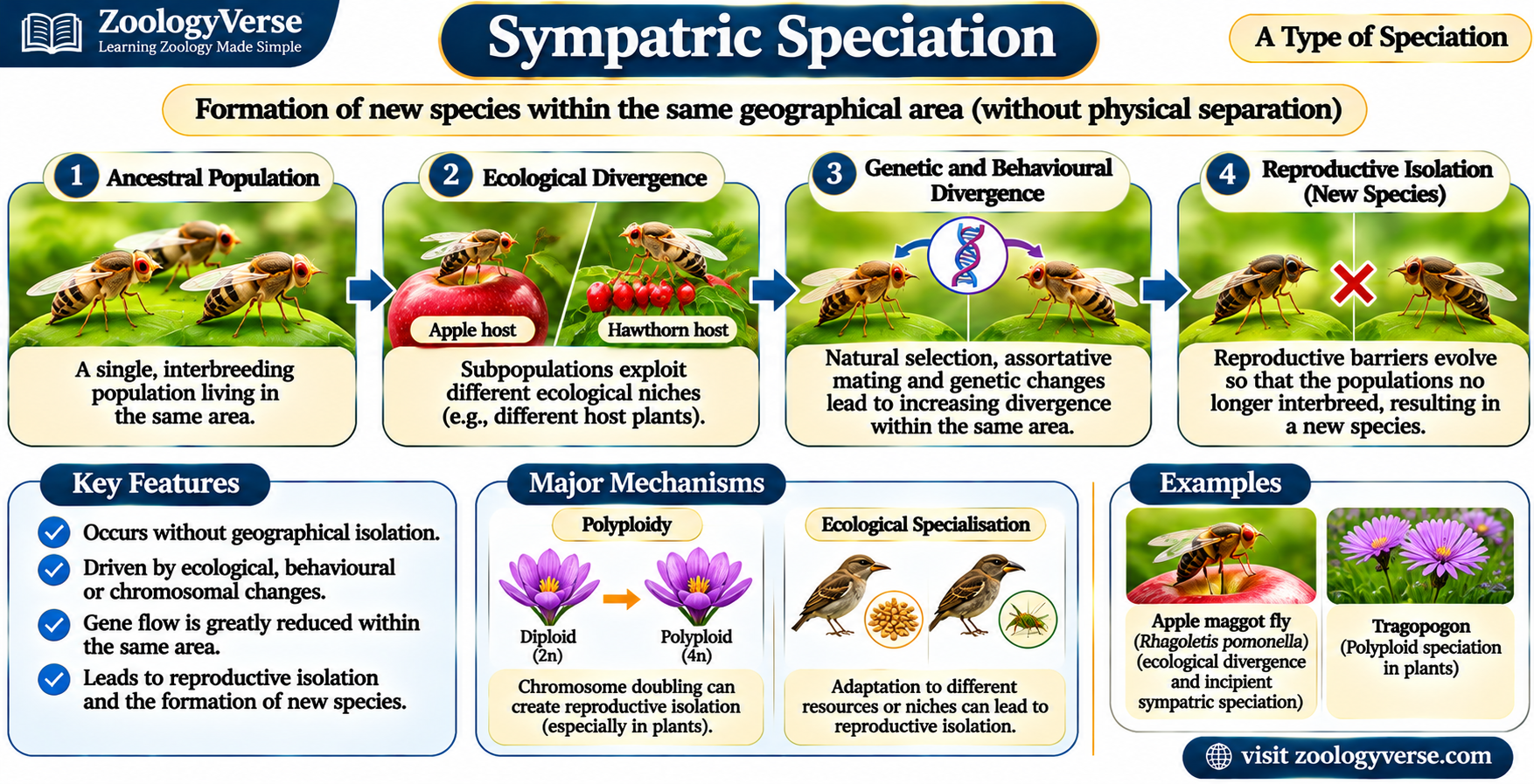
Sympatric speciation is a mode of speciation in which new species originate from an ancestral population within the same geographical area, without the initial separation of populations by a physical barrier. The term sympatric means occurring in the same geographical region. In this process, reproductive isolation develops despite the absence of complete geographical separation.
Unlike allopatric speciation, sympatric speciation does not depend on mountains, rivers, oceans or other physical barriers to restrict contact between populations. Instead, reproductive isolation may develop through ecological specialisation, differences in mating preferences, changes in chromosome number or other genetic and behavioural factors. These processes reduce interbreeding and allow distinct evolutionary lineages to develop within the same geographical region.
6.1 Process of Sympatric Speciation
Sympatric speciation generally involves the following stages:
1. Occupation of the same geographical area: Individuals of an ancestral species live within the same geographical region. There is no initial physical barrier dividing the population into separate groups.
2. Development of ecological or genetic differences: Some individuals begin using different food resources, habitats or reproductive strategies. Genetic changes may also produce differences in chromosome number or mating characteristics.
3. Reduction in interbreeding: Individuals may preferentially mate with others sharing similar ecological preferences, physical characteristics or courtship behaviours. This reduces gene exchange between emerging groups.
4. Development of reproductive isolation: Genetic, behavioural, ecological or chromosomal differences may become sufficiently strong to prevent successful interbreeding. Reproductive isolation can develop through prezygotic or postzygotic barriers.
5. Formation of distinct species: When the diverging groups become independently evolving and sufficiently reproductively isolated, they may be recognised as separate species even though they occupy overlapping geographical ranges.
6.2 Mechanisms of Sympatric Speciation
Several mechanisms can contribute to sympatric speciation.
6.2.1 Polyploidy
Polyploidy is a condition in which an organism possesses more than two complete sets of chromosomes. It is particularly important in plant evolution and can produce reproductive isolation rapidly.
Polyploidy may arise through errors in cell division that produce unreduced gametes. When these gametes participate in fertilisation, offspring with additional chromosome sets may be produced. Such individuals may be unable to reproduce successfully with the original diploid population because of differences in chromosome pairing during meiosis.
Two major forms are recognised:
- Autopolyploidy: The additional chromosome sets originate from the same species.
- Allopolyploidy: The chromosome sets originate from different species, usually following hybridisation and chromosome doubling.
Polyploidy is one of the clearest mechanisms through which new plant species can originate without geographical separation.
6.2.2 Ecological Specialisation
Ecological specialisation occurs when individuals within a population begin exploiting different ecological resources or habitats. These differences may influence feeding behaviour, habitat preference and reproductive activities.
For example, insects feeding on different host plants may increasingly mate and reproduce on their preferred host plants. If individuals show strong host preference, gene exchange between the groups may decline. Over generations, genetic and behavioural differences may contribute to reproductive isolation.
6.2.3 Sexual Selection and Assortative Mating
Sexual selection may contribute to sympatric speciation when individuals develop different mating preferences. If individuals consistently select mates with particular colours, courtship displays, body sizes or other characteristics, reproductive groups may become separated even within the same geographical area.
Positive assortative mating, in which individuals preferentially mate with similar individuals, can reduce interbreeding between emerging groups. If genetic differences accumulate alongside these mating preferences, reproductive isolation may develop.
6.3 Examples of Sympatric Speciation
Polyploid plant species: Polyploidy has contributed to the origin of many plant species. Chromosome doubling can produce individuals that are reproductively isolated from the original diploid population. This process provides a well-supported example of rapid sympatric species formation.
Apple maggot fly (Rhagoletis pomonella): This insect is a commonly discussed example of ecological divergence associated with host-plant preference. Ancestral flies associated with hawthorn began using cultivated apples as an alternative host. Since mating and egg-laying occur on or near host plants, differences in host preference and breeding time can reduce gene exchange between the populations. This example is often used to illustrate the early stages of sympatric divergence, although the extent of reproductive isolation and its interpretation remain subjects of scientific study.
African cichlid fishes: Some cichlid fish populations in African lakes show diversification associated with differences in feeding ecology, habitat use and mate preferences. These patterns demonstrate how ecological and sexual selection may contribute to reproductive divergence. However, not every cichlid radiation is a confirmed example of strictly sympatric speciation.
6.4 Evolutionary Significance of Sympatric Speciation
Sympatric speciation demonstrates that geographical separation is not essential for the origin of new species. It explains how ecological differences, chromosome changes, mating preferences and reproductive barriers can produce distinct evolutionary lineages within the same geographical region.
This process is particularly important in plants because polyploidy can establish reproductive isolation in a relatively short evolutionary period. In animals, ecological specialisation and sexual selection may contribute to reproductive divergence, although distinguishing true sympatric speciation from divergence involving earlier geographical isolation can be challenging.
Overall, sympatric speciation broadens our understanding of the mechanisms responsible for biodiversity and demonstrates that reproductive isolation can develop even when populations remain geographically close.
7. Reproductive Isolation: Mechanisms and Types
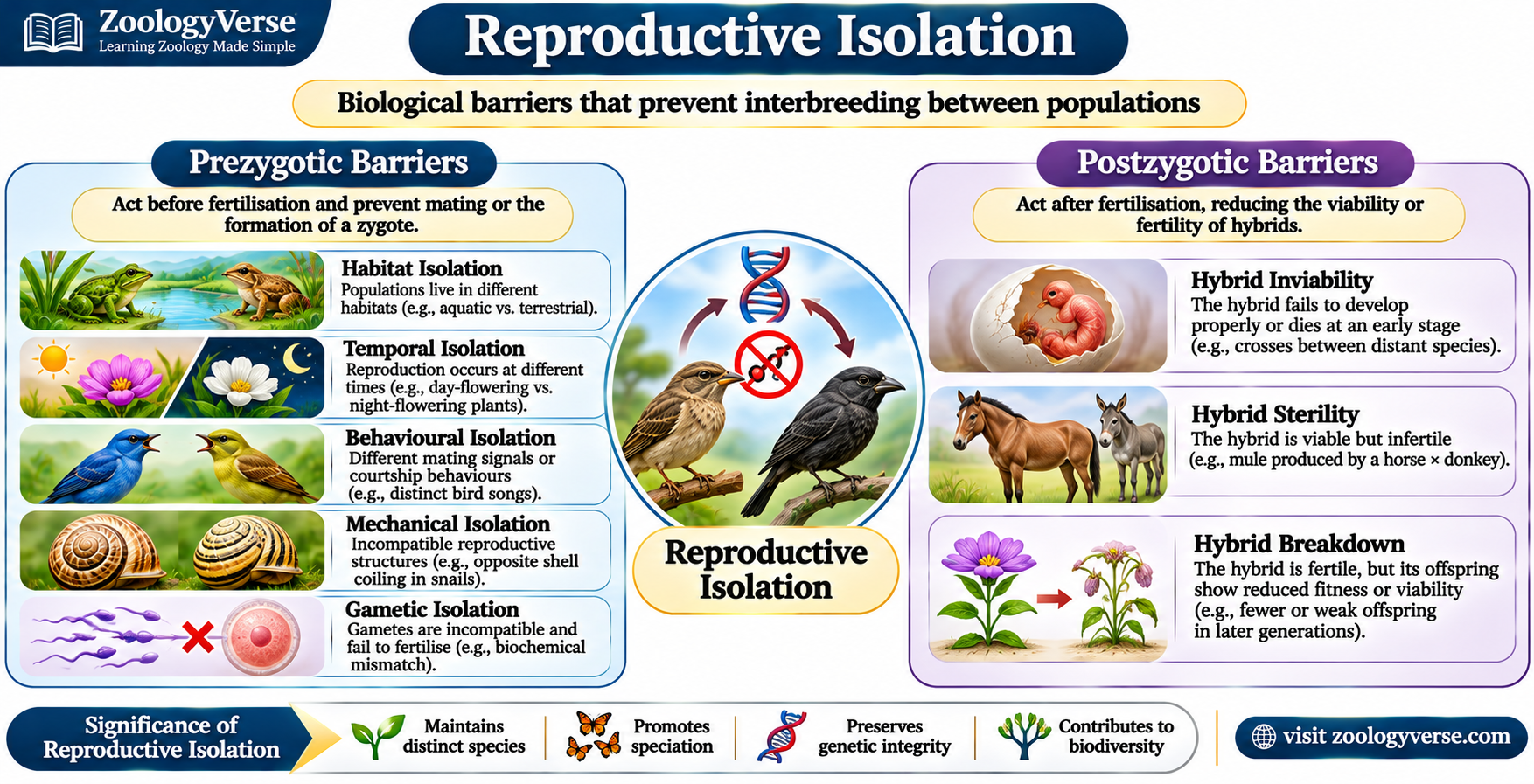
Reproductive isolation refers to the biological mechanisms that prevent individuals belonging to different populations or species from producing offspring together or from producing viable and fertile offspring. It is a fundamental component of speciation because it restricts gene exchange between diverging populations and allows them to follow independent evolutionary pathways.
Reproductive isolation may develop through differences in mating behaviour, reproductive structures, breeding seasons, gamete compatibility, embryonic development or chromosome organisation. These barriers are broadly classified into prezygotic and postzygotic mechanisms according to the stage at which they act.
7.1 Prezygotic Isolation
Prezygotic isolation consists of reproductive barriers that operate before the formation of a zygote. These mechanisms prevent mating, fertilisation or the successful union of gametes. They reduce gene exchange between populations and can contribute to the early stages of speciation.
The major types of prezygotic isolation are:
7.1.1 Habitat Isolation
Habitat isolation occurs when two populations occupy different habitats within the same geographical region and rarely encounter one another for reproduction.
For example, two closely related insect species may live on different host plants. Although their geographical ranges overlap, their habitat preferences reduce opportunities for mating. This separation may gradually contribute to reproductive isolation.
7.1.2 Temporal Isolation
Temporal isolation occurs when populations reproduce at different times. Differences may involve breeding seasons, flowering periods or daily reproductive activity.
For example, two closely related frog species may breed during different seasons. Similarly, plant species may release pollen at different times. Such differences reduce the possibility of successful reproduction between populations.
7.1.3 Behavioural Isolation
Behavioural isolation results from differences in courtship behaviour, mating calls, visual signals, pheromones or other reproductive activities.
For example, closely related bird species may possess different courtship displays or songs. Individuals generally recognise and respond to the mating signals of their own species, reducing interbreeding with other species.
7.1.4 Mechanical Isolation
Mechanical isolation occurs when differences in reproductive structures prevent successful mating or the transfer of gametes.
In animals, differences in the shape or arrangement of reproductive organs may prevent effective copulation. In flowering plants, differences in floral structure may restrict pollen transfer between certain species.
7.1.5 Gametic Isolation
Gametic isolation occurs when sperm and egg cells or other reproductive gametes fail to recognise, interact with or fuse successfully with one another.
This mechanism is particularly important in externally fertilising aquatic organisms, where gametes may be released into the surrounding water. Species-specific biochemical interactions help ensure that fertilisation occurs between compatible gametes.
7.2 Postzygotic Isolation
Postzygotic isolation refers to reproductive barriers that act after fertilisation has occurred. In these cases, mating and zygote formation may be possible, but the resulting hybrid offspring experience reduced survival, development or reproductive success.
The major types of postzygotic isolation are:
7.2.1 Hybrid Inviability
Hybrid inviability occurs when hybrid embryos or offspring fail to develop normally or die before reaching reproductive maturity.
Genetic incompatibilities between the parental species may interfere with normal development. As a result, hybrids may have reduced survival compared with individuals of either parental species.
7.2.2 Hybrid Sterility
Hybrid sterility occurs when hybrid offspring survive and develop normally but are unable to produce functional gametes.
A familiar example is the mule, which is generally produced by crossing a male donkey with a female horse. Mules usually possess 63 chromosomes, resulting from the combination of 62 chromosomes from the horse and 64 from the donkey. Differences in chromosome number and organisation interfere with normal meiosis, making most mules infertile.
7.2.3 Hybrid Breakdown
Hybrid breakdown occurs when the first-generation hybrids are viable and fertile, but their offspring in later generations show reduced survival or fertility.
This may happen because genetic combinations that function adequately in the first generation become disrupted during subsequent generations. Consequently, reproductive success declines in later hybrid generations.
7.3 Comparison Between Prezygotic and Postzygotic Isolation
| Feature | Prezygotic Isolation | Postzygotic Isolation |
|---|---|---|
| Stage of action | Before fertilisation | After fertilisation |
| Main effect | Prevents mating or fertilisation | Reduces hybrid survival or fertility |
| Zygote formation | Usually prevented | Occurs |
| Major types | Habitat, temporal, behavioural, mechanical and gametic isolation | Hybrid inviability, hybrid sterility and hybrid breakdown |
| Example | Different breeding seasons | Mule sterility |
7.4 Role of Reproductive Isolation in Speciation
Reproductive isolation is essential for maintaining the distinct identity of independently evolving species. When reproductive barriers reduce gene flow, genetic differences can accumulate through mutation, natural selection and genetic drift.
In the early stages of speciation, reproductive barriers may be incomplete. Some individuals may still interbreed, producing hybrids. However, as barriers become stronger, gene exchange may decline further and populations may become increasingly independent.
The development of reproductive isolation does not always occur in a single step. Different prezygotic and postzygotic mechanisms may accumulate over many generations. Their combined effects can eventually prevent successful reproduction between diverging populations, completing an important stage in the process of speciation.
8. Genetic and Ecological Factors Responsible for Speciation
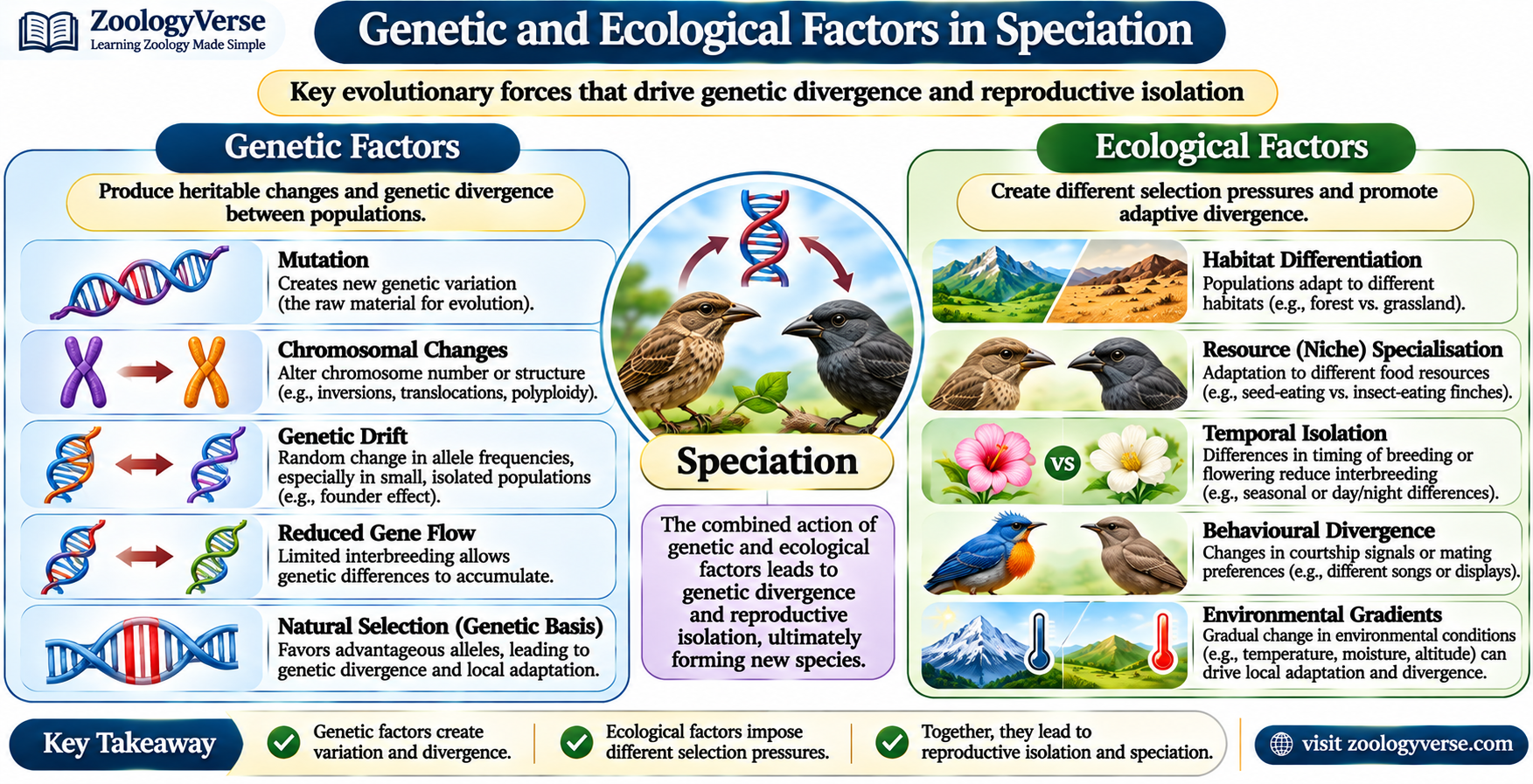
Speciation is influenced by several genetic, ecological and evolutionary factors that promote divergence between populations and contribute to reproductive isolation. These factors may operate independently or interact with one another over many generations. Their combined effects determine whether populations remain connected through gene flow or develop into distinct evolutionary lineages.
Genetic changes provide the raw material for evolutionary divergence, while ecological conditions influence which inherited characteristics become more common. Understanding these factors is essential for explaining how new species originate and how reproductive barriers develop.
8.1 Mutation and Genetic Variation
Mutation is a permanent change in the genetic material of an organism. It introduces new alleles into populations and provides an important source of genetic variation. Mutations may affect individual genes, chromosome structure or chromosome number.
When populations become isolated or experience restricted gene flow, different mutations may accumulate independently. Some mutations may have neutral effects, while others may influence survival, reproduction or adaptation to particular environmental conditions.
Over generations, the accumulation of genetic differences may contribute to reproductive incompatibility between populations. Mutation therefore provides new genetic variants that can participate in the evolutionary processes leading to speciation.
8.2 Natural Selection and Local Adaptation
Natural selection occurs when individuals possessing certain heritable characteristics achieve greater reproductive success under particular environmental conditions. It can promote evolutionary divergence when different populations experience different selection pressures.
For example, populations occupying contrasting habitats may develop differences in body size, feeding structures, camouflage, temperature tolerance or reproductive behaviour. These adaptations may gradually become genetically established.
When local adaptation is associated with differences in mating behaviour, breeding seasons or habitat preference, reproductive isolation may develop. Natural selection can therefore contribute to speciation by promoting divergence between populations.
8.3 Genetic Drift and Founder Effects
Genetic drift refers to random changes in allele frequencies between generations. Its influence is particularly strong in populations with small effective population sizes.
When a small number of individuals establish a new population, the founder effect may cause its genetic composition to differ from that of the original population. Certain alleles may become common, while others may be absent simply because they were not represented among the founders.
If the isolated population remains small, genetic drift may continue to produce random genetic differences. These changes, together with mutation and natural selection, may contribute to reproductive isolation and speciation.
8.4 Gene Flow and Its Restriction
Gene flow is the transfer of alleles between populations through the movement and reproduction of individuals or the exchange of reproductive material. It tends to reduce genetic differences between populations by introducing alleles from one population into another.
Continuous gene flow can therefore slow evolutionary divergence. However, when migration and interbreeding become restricted, populations may accumulate genetic differences independently.
The reduction of gene flow is particularly important in allopatric speciation. In other modes of speciation, ecological preferences, mating behaviour or reproductive barriers may reduce gene exchange even when populations remain geographically close.
8.5 Ecological Differences and Environmental Heterogeneity
Environmental heterogeneity refers to the variation in ecological conditions across a geographical region. Different habitats may provide different food resources, climatic conditions, predators, competitors and breeding sites.
Populations exposed to different environmental conditions may undergo local adaptation. For example, organisms living in different water depths may experience different light levels, temperatures and food availability. Such ecological differences may influence their morphology, physiology and behaviour.
If individuals become specialised for particular habitats and preferentially reproduce within those habitats, gene flow may decline. Ecological divergence can then contribute to the development of reproductive isolation and speciation.
8.6 Sexual Selection and Mating Preferences
Sexual selection occurs when certain inherited characteristics increase an individual’s success in obtaining mates. Differences in mate preferences may promote reproductive divergence between populations.
Individuals may prefer particular body colours, courtship displays, mating calls, body sizes or other characteristics. When different mating preferences become established within a population, individuals may increasingly reproduce with others sharing similar traits.
This pattern of assortative mating can reduce interbreeding between emerging groups. If the differences become sufficiently strong and persistent, they may contribute to reproductive isolation and speciation.
8.7 Chromosomal Changes and Polyploidy
Changes in chromosome number and structure can influence reproductive compatibility between populations. Chromosomal rearrangements, including inversions, translocations and changes in chromosome number, may affect meiosis and the production of functional gametes.
Polyploidy is especially important in plant speciation. It involves the presence of more than two complete sets of chromosomes and may arise through errors in cell division or chromosome doubling following hybridisation.
Individuals with different chromosome numbers may experience difficulties in producing fertile offspring when crossed with the ancestral population. Consequently, polyploidy can establish reproductive isolation rapidly and contribute to the origin of new species.
8.8 Interaction of Genetic and Ecological Factors
The factors responsible for speciation rarely operate in complete isolation. Mutation produces genetic variation, natural selection favours traits suited to particular environments, and genetic drift can cause random divergence. Restricted gene flow allows these differences to accumulate, while ecological specialisation and sexual selection may strengthen reproductive barriers.
The relative importance of each factor differs among organisms and evolutionary situations. In some plants, polyploidy may produce rapid reproductive isolation. In other organisms, geographical separation and gradual ecological divergence may be more important.
Thus, speciation is best understood as a complex evolutionary process resulting from interactions among genetic variation, environmental conditions, population structure and reproductive isolation.
9. Types of Speciation: A Comparative Study
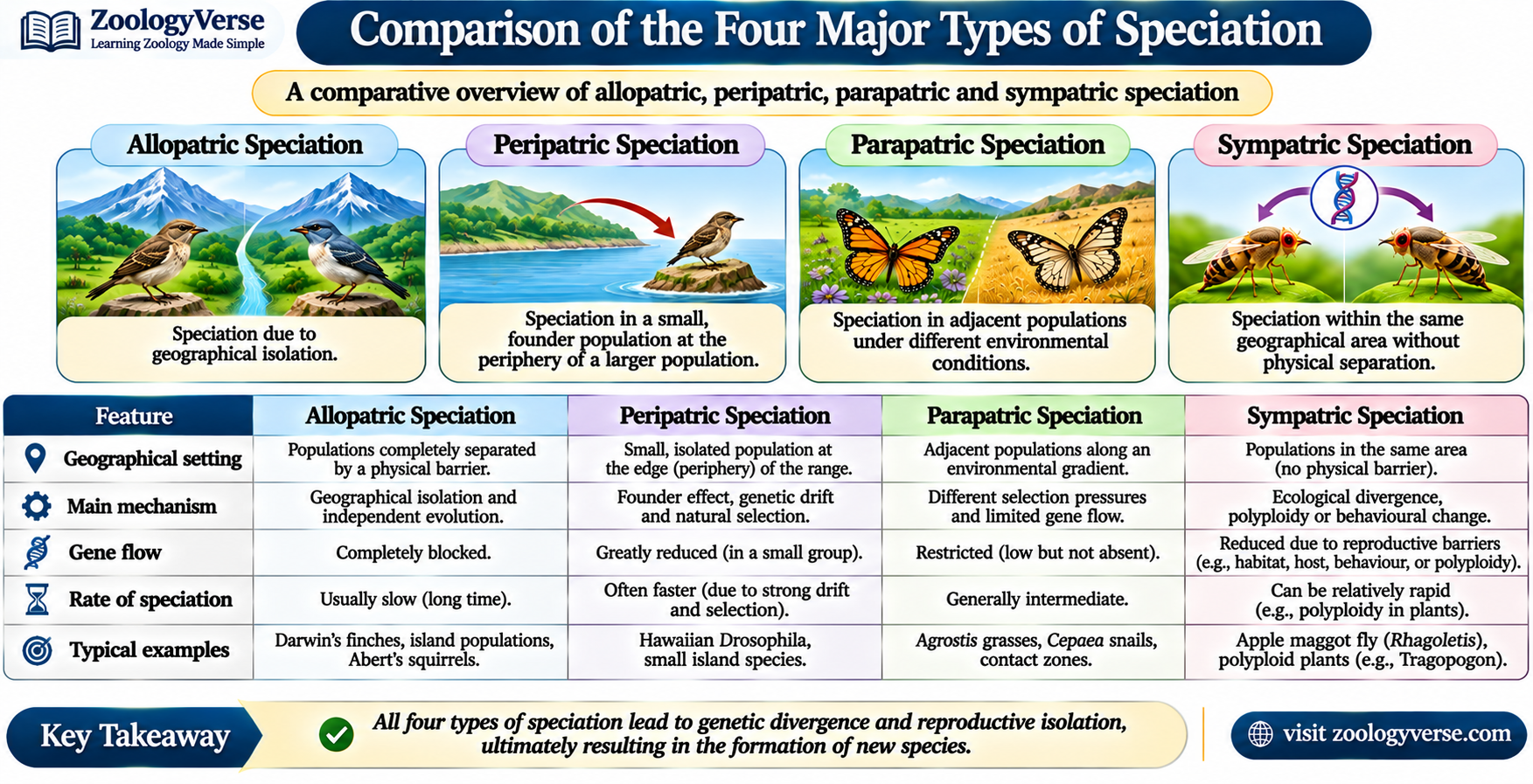
Speciation can occur through different evolutionary pathways depending on the geographical distribution of populations, patterns of gene flow, environmental conditions and the development of reproductive isolation. The major types of speciation include allopatric, peripatric, parapatric and sympatric speciation.
Although all these pathways result in the formation of distinct species, they differ in the way populations become separated and the evolutionary factors responsible for their divergence. Understanding these differences helps explain the diverse processes through which biodiversity originates.
9.1 Allopatric Speciation
Allopatric speciation occurs when populations become geographically separated by physical barriers. These barriers restrict gene flow and allow the isolated populations to evolve independently.
Mutation, natural selection and genetic drift contribute to genetic divergence. Over time, reproductive barriers may develop, resulting in the formation of distinct species.
Characteristic features:
- Involves geographical separation of populations.
- Gene flow is greatly reduced or prevented.
- Physical barriers may include mountains, rivers, oceans and deserts.
- Genetic divergence occurs through independent evolutionary changes.
- Reproductive isolation may develop gradually.
9.2 Peripatric Speciation
Peripatric speciation occurs when a small population becomes isolated at the geographical margin of a larger ancestral population. The small size of the isolated group makes founder effects and genetic drift particularly important.
The peripheral population may experience different environmental conditions and undergo genetic divergence. Over time, reproductive isolation may develop.
Characteristic features:
- Involves a small, geographically peripheral population.
- Often begins through dispersal and colonisation.
- Founder effects may strongly influence genetic composition.
- Genetic drift can be particularly influential.
- Local adaptation may contribute to divergence.
9.3 Parapatric Speciation
Parapatric speciation occurs when neighbouring populations occupy adjacent geographical regions and experience different environmental conditions. Complete geographical separation is absent, but restricted gene flow and local adaptation may promote evolutionary divergence.
Natural selection may favour different characteristics in each habitat. Hybrid zones may occur where the populations meet, and differences in hybrid fitness can influence the development of reproductive barriers.
Characteristic features:
- Populations occupy adjacent geographical regions.
- Complete physical separation is not necessary.
- Different environmental conditions promote local adaptation.
- Limited gene flow may continue between populations.
- Reproductive isolation may develop through ecological and genetic divergence.
9.4 Sympatric Speciation
Sympatric speciation occurs when new species originate within the same geographical area without an initial physical barrier separating the populations.
Ecological specialisation, sexual selection, assortative mating and chromosomal changes may reduce interbreeding. Polyploidy is particularly important in the origin of new plant species through sympatric speciation.
Characteristic features:
- Occurs within the same geographical region.
- Does not require initial geographical separation.
- Ecological and reproductive differences promote divergence.
- Polyploidy may establish rapid reproductive isolation in plants.
- Mating preferences and ecological specialisation may reduce gene flow.
9.5 Comparison of Major Types of Speciation
| Feature | Allopatric | Peripatric | Parapatric | Sympatric |
|---|---|---|---|---|
| Geographical distribution | Separate regions | Small peripheral population | Adjacent regions | Same geographical area |
| Initial physical barrier | Usually present | Geographical isolation of peripheral group | Not required | Absent |
| Population size | May involve large populations | Usually small isolated population | Neighbouring populations | Diverging groups within a shared area |
| Gene flow | Greatly reduced or absent | Greatly reduced | Limited gene flow may continue | Reduced by reproductive or ecological differences |
| Important evolutionary factors | Selection, drift and mutation | Founder effect, drift and selection | Local adaptation and selection | Polyploidy, ecological specialisation and sexual selection |
| Commonly discussed example | Island populations | Peripheral island colonisation | Metal-tolerant grasses | Polyploid plants |
9.6 Evolutionary Relationship Among the Different Types
The four major types of speciation represent different pathways through which populations become reproductively isolated. Allopatric and peripatric speciation involve geographical separation, although peripatric speciation specifically involves a small population at the margin of the ancestral distribution.
Parapatric speciation occurs between neighbouring populations experiencing different environmental conditions, while sympatric speciation develops within the same geographical area. These categories are useful for understanding evolutionary processes, but natural speciation events do not always fit perfectly into a single category.
In every pathway, the development of reproductive isolation is essential for maintaining independently evolving lineages. The relative contributions of natural selection, genetic drift, mutation, ecological adaptation and chromosomal changes vary according to the organism and its evolutionary history.
10.1 Darwin’s Finches: Adaptive Radiation and Speciation
Darwin’s finches of the Galápagos Islands provide a classic example of evolutionary diversification. These birds are believed to have descended from a common ancestral population that colonised the islands. As populations spread across different islands and habitats, they encountered different food resources and environmental conditions.
Natural selection favoured variations in beak shape and size that improved feeding efficiency under particular ecological conditions. Some species developed strong, broad beaks suitable for cracking seeds, while others evolved narrower beaks suited to feeding on insects or other food sources.
Geographical separation, ecological adaptation and differences in reproductive behaviour contributed to diversification among the finch populations. Their evolutionary history illustrates how populations descended from a common ancestor can diversify into distinct species.
10.2 African Cichlid Fishes: Rapid Diversification
African cichlid fishes, particularly those found in Lakes Victoria, Malawi and Tanganyika, represent an important example of extensive evolutionary diversification.
Different cichlid species show considerable variation in body shape, feeding structures, colouration, habitat preference and reproductive behaviour. These differences are associated with adaptation to diverse ecological niches, including different food resources and water depths.
Sexual selection also plays an important role in some cichlid populations. Female mate preferences based on male colouration can contribute to reproductive isolation. Ecological specialisation and reproductive differences together help explain the remarkable diversity of cichlid fishes.
10.3 Hawaiian Drosophila: Island Diversification
The Hawaiian islands contain an extraordinary diversity of Drosophila species. These flies are considered an important example of adaptive radiation and evolutionary diversification.
Their ancestral populations are thought to have colonised different islands, where geographical separation, ecological specialisation and genetic divergence contributed to the formation of distinct lineages.
Different species occupy different habitats and may show variations in feeding behaviour, courtship patterns and reproductive characteristics. Their evolutionary history demonstrates how island colonisation and restricted gene flow can contribute to speciation over evolutionary time.
10.4 Apple Maggot Fly: Ecological Divergence
The apple maggot fly, Rhagoletis pomonella, is a widely studied example of ecological divergence that may contribute to sympatric speciation.
Historically, these flies used hawthorn fruits as their principal host resource. Some populations began using cultivated apples as an alternative host. Since adult flies tend to mate and lay eggs on or near their preferred host plants, host preference can influence mating patterns.
Apple and hawthorn populations also differ in their seasonal timing because the fruits mature at different times. These differences reduce opportunities for interbreeding and may promote reproductive isolation.
This example is particularly important because it demonstrates how host-plant specialisation and differences in reproductive timing can contribute to divergence even when populations occupy overlapping geographical regions. The extent of reproductive isolation remains an important subject of evolutionary research.
10.5 Polyploid Plants: Rapid Origin of New Species
Polyploidy provides one of the clearest mechanisms of rapid speciation, particularly in flowering plants. It occurs when an organism possesses more than two complete sets of chromosomes.
Errors during cell division may produce unreduced gametes containing the full chromosome complement. Fusion of such gametes can result in polyploid offspring. Chromosome doubling may also occur in hybrids between different species, producing allopolyploid organisms.
Polyploid individuals may become reproductively isolated from their diploid ancestors because differences in chromosome number interfere with normal chromosome pairing and meiosis.
Examples of polyploid plant evolution include bread wheat (Triticum aestivum), which is a hexaploid species formed through hybridisation and chromosome doubling involving ancestral wheat lineages. It illustrates the important contribution of hybridisation and polyploidy to plant evolution.
10.6 Mule: Hybrid Sterility as a Reproductive Barrier
The mule is a hybrid produced by crossing a male donkey (Equus asinus) with a female horse (Equus caballus). It usually possesses 63 chromosomes, an odd number resulting from the combination of 31 chromosomes from the donkey and 32 from the horse.
The chromosomes inherited from the two parental species do not pair normally during meiosis. Consequently, mules are generally sterile.
Although mule formation is not itself an example of completed speciation, it demonstrates postzygotic reproductive isolation through hybrid sterility. It also illustrates how chromosome differences can restrict successful reproduction between related species.
10.7 Importance of Natural Examples in Understanding Speciation
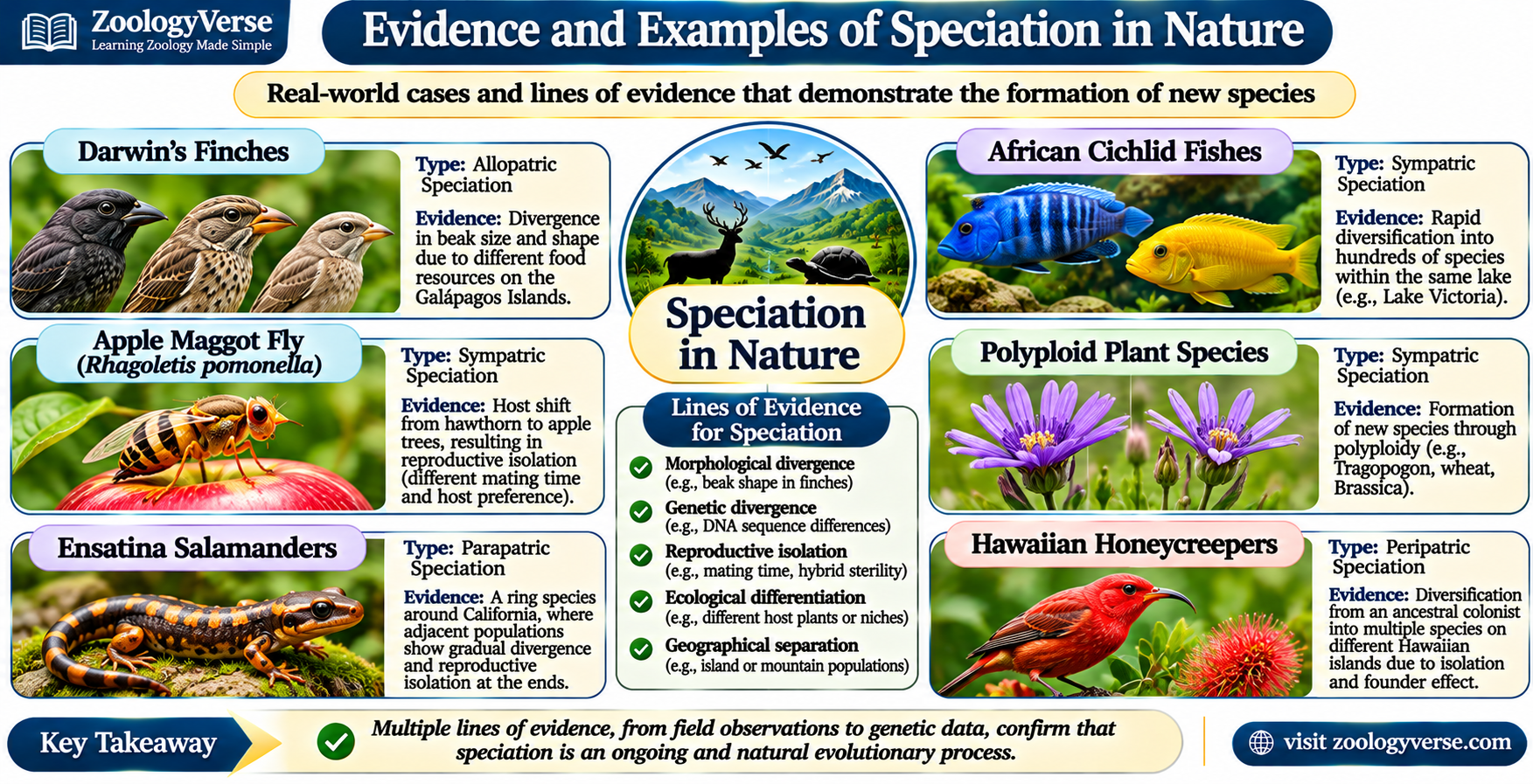
Natural examples demonstrate that speciation can occur through several evolutionary pathways. Darwin’s finches and Hawaiian Drosophila illustrate diversification associated with island colonisation and geographical isolation. African cichlid fishes demonstrate the importance of ecological specialisation and sexual selection. Apple maggot flies illustrate how host-plant preference and reproductive timing may contribute to divergence, while polyploid plants demonstrate the role of chromosome changes in rapid species formation.
These examples also show that evolutionary divergence occurs over different timescales. Some populations may develop reproductive barriers gradually over many generations, whereas chromosome doubling can establish reproductive isolation in plants within a comparatively short period.
The study of such organisms provides important evidence for understanding the origin of biodiversity and the evolutionary processes responsible for the formation of new species.
11. Evolutionary Significance and Importance of Speciation
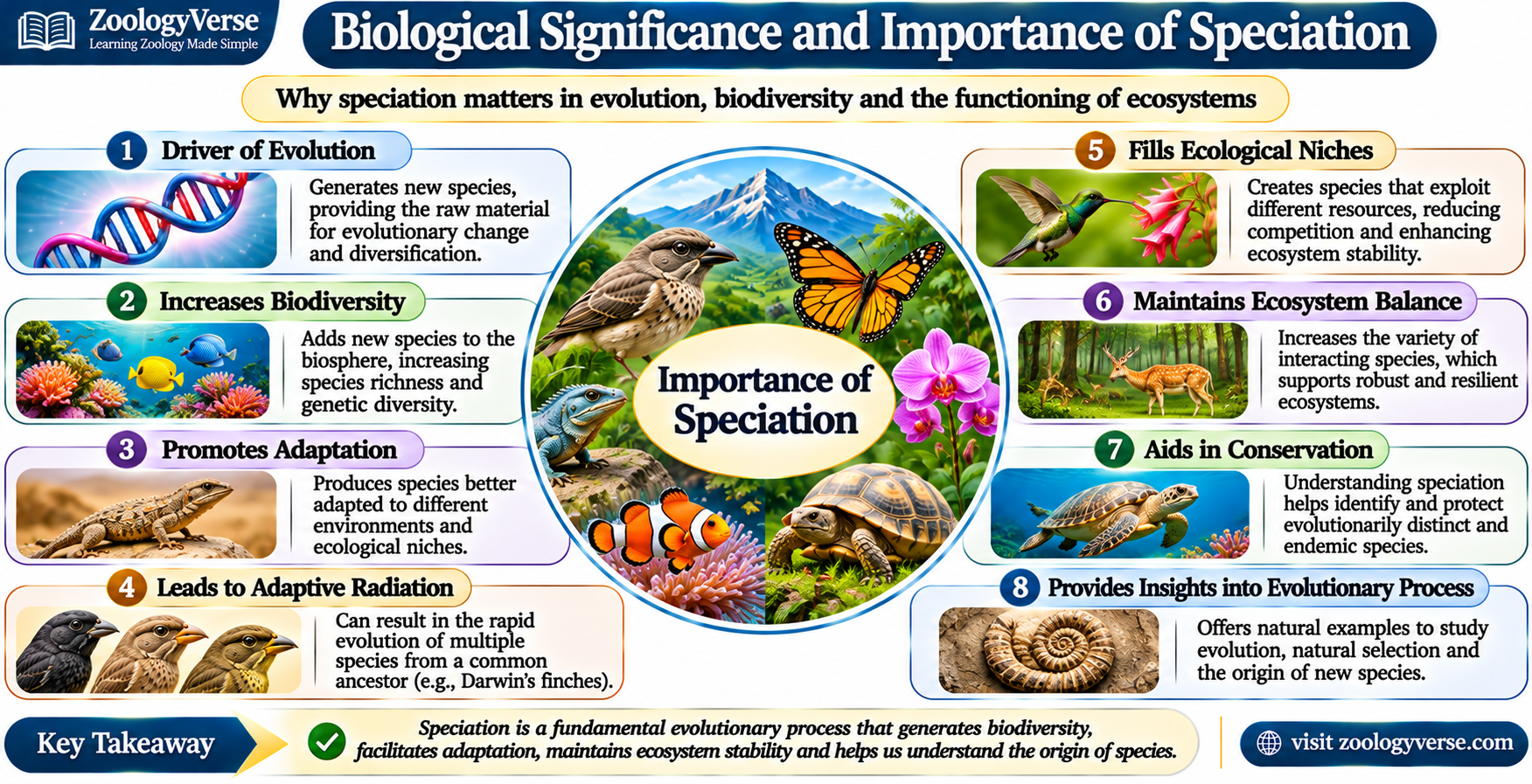
Speciation is one of the most important processes in biological evolution because it generates new species and contributes to the diversification of life. Through the development of reproductive isolation, populations become independently evolving lineages with distinct genetic, morphological, physiological and ecological characteristics.
The importance of speciation extends beyond the formation of new species. It influences biodiversity, adaptation, ecological interactions, biogeographical distribution and the evolutionary history of organisms.
The origin of new species is part of the broader patterns of evolutionary change observed across geological ages. Explore our article on Trends in Evolution to understand these long-term evolutionary patterns and their biological significance.
11.1 Origin and Diversification of Biodiversity
Speciation is a major source of biodiversity because it increases the number of distinct species within ecosystems. When ancestral populations diverge and become reproductively isolated, they may give rise to multiple descendant species.
Over long evolutionary periods, repeated speciation events contribute to the enormous diversity of plants, animals, fungi and microorganisms found on Earth. Adaptive radiation, in which a common ancestral lineage diversifies into several species adapted to different ecological niches, is an important example of this process.
11.2 Development of New Adaptations
Speciation is frequently associated with the development of adaptations to different environmental conditions. Populations occupying different habitats may experience different selection pressures, resulting in the evolution of distinct characteristics.
For example, the different beak shapes of Darwin’s finches reflect adaptations to different feeding resources. Similarly, aquatic organisms may develop specialised feeding structures, body forms or physiological characteristics suited to particular ecological conditions.
These adaptations contribute to ecological diversification and may accompany the formation of new species.
11.3 Evolution of Reproductive Isolation
The development of reproductive isolation is a central component of speciation. Reproductive barriers prevent or reduce gene exchange between populations and allow them to maintain distinct genetic identities.
Differences in courtship behaviour, breeding seasons, reproductive structures, gamete compatibility and hybrid fertility can contribute to the establishment of these barriers.
The evolution of reproductive isolation is important because it maintains the separation of species even when their geographical ranges overlap or come into contact.
11.4 Formation of New Ecological Niches
Speciation can contribute to the occupation of new ecological niches. As populations diversify, different species may evolve specialised feeding habits, habitat preferences, reproductive strategies and patterns of resource utilisation.
For example, the diversification of African cichlid fishes has produced species with different feeding adaptations and habitat preferences. This ecological specialisation allows related species to utilise different resources within the same aquatic ecosystem.
The formation of new species can therefore increase ecological complexity and influence interactions among organisms.
11.5 Evolution of Endemic Species
Endemic species are organisms naturally restricted to a particular geographical region. Geographical isolation and restricted gene flow can contribute to the evolution of endemic species, especially on islands, in mountain ranges and in isolated freshwater habitats.
For example, many species of Hawaiian plants and animals have restricted geographical distributions. Their evolutionary histories are associated with island isolation, ecological diversification and independent evolutionary development.
Speciation is therefore important in understanding the origin and distribution of endemic biodiversity.
11.6 Contribution to Adaptive Radiation
Adaptive radiation is the evolutionary diversification of an ancestral lineage into multiple species, each adapted to different ecological opportunities.
It commonly occurs when organisms enter new habitats containing available resources and relatively unoccupied ecological niches. Different populations may become specialised for particular food sources, habitats or environmental conditions.
Darwin’s finches and African cichlid fishes are widely studied examples of adaptive radiation. These evolutionary patterns demonstrate how speciation contributes to the diversification of organisms and the occupation of different ecological niches.
11.7 Importance in Conservation Biology
Understanding speciation is important for biodiversity conservation because it helps explain the origin, distribution and evolutionary distinctiveness of species.
Isolated populations may contain unique genetic variations and adaptations. If their habitats are destroyed or their populations decline, these evolutionary lineages may be lost permanently.
Conservation programmes therefore consider genetic diversity, population connectivity, geographical distribution and evolutionary relationships when developing strategies for protecting species.
The study of speciation also helps identify populations that may represent distinct evolutionary lineages and deserve particular conservation attention.
11.8 Understanding Evolutionary Relationships
Speciation provides the basis for understanding the branching pattern of evolutionary history. When an ancestral population divides into independently evolving lineages, the resulting species may retain shared inherited characteristics while developing new adaptations.
Comparative anatomy, embryology, molecular biology and fossil evidence help scientists reconstruct these relationships. Phylogenetic trees represent the evolutionary connections among organisms and show how different lineages may have originated from common ancestors.
Thus, the study of speciation is essential for understanding the evolutionary history and relationships of living organisms.
12. Conclusion
Speciation is a fundamental evolutionary process responsible for the origin of new species and the diversification of life on Earth. It occurs when populations of an ancestral species diverge genetically and develop reproductive isolation, allowing them to follow independent evolutionary pathways.
The major modes of speciation include allopatric, peripatric, parapatric and sympatric speciation. These pathways differ in their geographical conditions and patterns of gene flow, but all involve the development of reproductive barriers that maintain distinct evolutionary lineages.
Several factors contribute to speciation, including mutation, natural selection, genetic drift, ecological specialisation, sexual selection and chromosomal changes. Reproductive isolation may develop through prezygotic or postzygotic mechanisms, preventing successful interbreeding between diverging populations.
Examples such as Darwin’s finches, African cichlid fishes, Hawaiian Drosophila, apple maggot flies and polyploid plants demonstrate the different evolutionary pathways through which species may originate.
The study of speciation is essential for understanding biodiversity, adaptive radiation, evolutionary relationships and the distribution of organisms. It also provides an important scientific foundation for conservation biology by helping explain how unique evolutionary lineages originate and why their protection matters.
Frequently Asked Questions (FAQs) About Speciation
What is speciation?
What are the four major types of speciation?
Allopatric speciation
Peripatric speciation
Parapatric speciation
Sympatric speciation
What is allopatric speciation?
What is sympatric speciation?
What is the difference between allopatric and sympatric speciation?
What is peripatric speciation?
What is parapatric speciation?
What is reproductive isolation?
What are prezygotic and postzygotic barriers?
What is the role of natural selection in speciation?
What is the role of genetic drift in speciation?
What is the founder effect?
How does polyploidy contribute to speciation?
What is the difference between speciation and adaptive radiation?
Why is speciation important in evolution?
14. References and Further Reading
- OpenStax. Biology 2e – 18.2 Formation of New Species. Rice University.
https://openstax.org/books/biology-2e/pages/18-2-formation-of-new-species - OpenStax. Concepts of Biology – 11.4 Speciation. Rice University.
https://openstax.org/books/concepts-biology/pages/11-4-speciation - Farrington, H. L., Lawson, L. P., Clark, C. M., & Petren, K. (2014). The evolutionary history of Darwin’s finches: speciation, gene flow, and introgression in a fragmented landscape. Evolution, 68(10), 2932–2944.
https://doi.org/10.1111/evo.12484 - Grant, B. R. (2003). Evolution in Darwin’s finches: a review of a study on Isla Daphne Major in the Galápagos archipelago. Zoology, 106(4), 255–259.
https://doi.org/10.1078/0944-2006-00123 - Lamichhaney, S., Han, F., Webster, M. T., Andersson, L., Grant, B. R., & Grant, P. R. (2018). Rapid hybrid speciation in Darwin’s finches. Science, 359(6372), 224–227.
https://doi.org/10.1126/science.aao4593 - Grant, P. R., & Grant, B. R. (2024). From microcosm to macrocosm: adaptive radiation of Darwin’s finches. Evolutionary Journal of the Linnean Society, 3(1).
https://doi.org/10.1093/evolinnean/kzae006 - OpenStax. Biology 2e – 18. Chapter Summary. Rice University.
https://openstax.org/books/biology-2e/pages/18-chapter-summary - Losos, J. B., & Ricklefs, R. E. (2009). Adaptation and diversification on islands. Nature, 457, 830–836.
https://doi.org/10.1038/nature07893
Discover more from Zoologyverse
Subscribe to get the latest posts sent to your email.