
Balanoglossus
Acorn worms in the genus Balanoglossus are members of the class Enteropneusta and phylum Hemichordata. These marine worms inhabit shallow coastal habitats, where they burrow into muddy or sandy soils and consume organic debris. Balanoglossus aids in understanding the evolutionary relationship between hemichordates and the earliest chordates since they exhibit a distinct segmentation of the body into the proboscis, collar, and trunk. The worm’s collar and trunk house vital organs for feeding, digestion, and reproduction, while the proboscis facilitates effective digging. Additionally, Balanoglossus is crucial to the preservation of nutrient cycling and sediment structure in maritime environments. It is a crucial organism in the study of deuterostome evolution because of its biological characteristics, which include a stomochord and pharyngeal gill slits.
| Feature | Description |
|---|---|
| Common Name | Acorn Worm |
| Phylum | Hemichordata |
| Class | Enteropneusta |
| Habitat | Marine |
| Body Regions | Proboscis, Collar and Trunk |
| Coelom | Enterocoelous |
| Reproduction | Sexual |
| Larva | Tornaria |
| Symmetry | Bilateral |
| Importance | Connecting link in deuterostome evolution |
Classification of Balanoglossus
Phylum :- Hemichordata (Marine, enterocoelous coelomate. Notochord confined to head region)
Class :- Enteropneusta (Several gill-slits, intestine straight, solitary.)
Genus :- Balanoglossus (Tongue worm), Glossobalanus (Acorn worm)

Geographical distribution
World-wide or cosmopolitan.
Habit and habitat
It is a marine animal, adapted for burrowing life in the sandy bottom. The animal lives inside the V-tubes (tubicolous). Most of them live in shallow water but a few go deeper upto approximately 15,000 feet. They burrow slowly by soft proboscis.
Characteristics of Balanoglossus
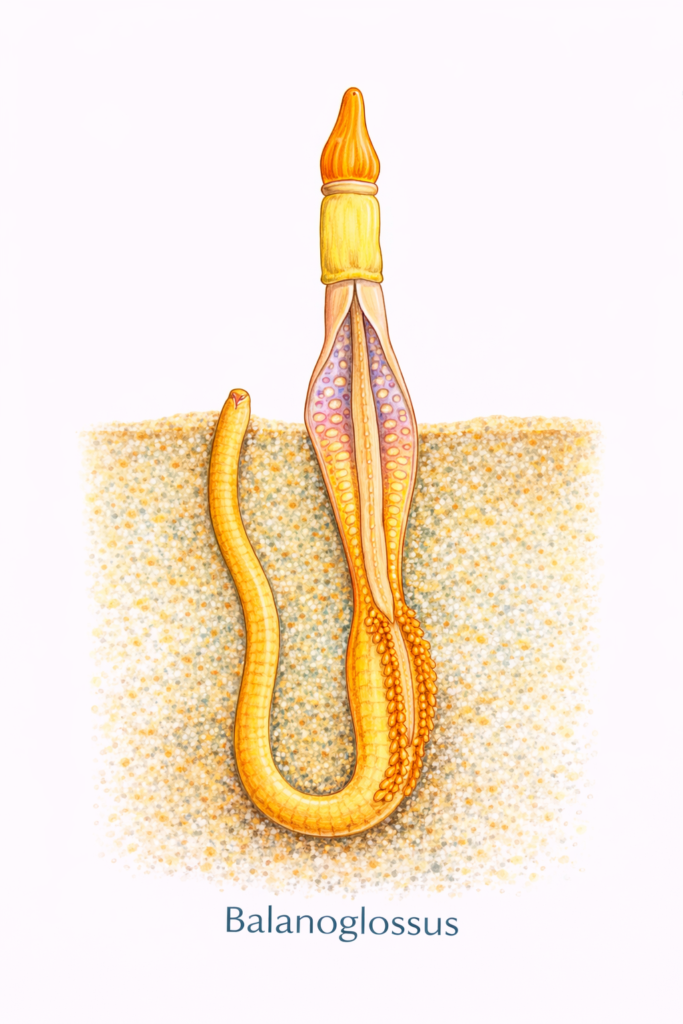
- Balanoglossus is commonly called as ‘Acorn worm.’ It lives in a U-shaped burrow and at one opening of burrow fecal castings may be seen. V-tube burrow at other end has opening for anterior end and also another additional opening.
- It measures 10 cm to 2.5 meters, depending on the species.
- It is bilaterally symmetrical, triploblastic deuterostome with worm-shaped body divisible into three regions-anterior proboscis or prosoma, middle collar or mesosoma and posterior trunk or metasoma.
- Proboscis is conical, collar is funnel like, while trunk is cylindrical.
- Proboscis contains heart vesicle, central sinus and buccal diverticulum. It has thick muscular body wall and its cavity or coelom opens to the exterior by the proboscis pore.
- Collar contains the mouth and collar coelom which opens by a pair of collar pores on dorsal surface.
- Trunk region contains most of the internal organs, such as pharynx, gonads or hepatic region.
- Pharynx and gonads constitute branchiogenital region. Posteriormost part is abdomen.
- Branchio-genital region is composed off
- genital wing having gonad
- branchial region containing paired gills and
- hepatic region having hepatic caecae.
- Sexual dimorphism. Fertilization external and development includes tornaria larva. It possesses power of regeneration.
- Alimentation is complete and circulatory system usually contains contractile sac of heart.
Special features of Balanoglossus
Balanoglossus and allied forms have phylogenetic importance. Certain tissue in the form of anterior projection from the mouth cavity was formerly interpreted as a notochord and thus placing this group within the phylum Chordata. Recent studies show such structure mainly as buccal pouch and now the hemichordates are not included with the chordates but as separate phylum Hemichordata.
It shows affinities with (i) Chordates (Bateson, 1885), (ii) Echinoderms (Metshinkoff, 1869), and (iii) Annelida (Spangel, 1893).
Gill-slits, nerve cord and the so-called notochord are identical with chordates. Hyman (1959) objected its so-called notochord. Blastopore, ciliated bands and enterocoelus coelom are common features both in Hemichordates and Echinoderms. It resembles with Annelids also in having segmented body. It may be concluded that invertebrate features out weigh the chordate features and hence hemichordates are included in invertebrates but under separate Phylum Hemichordata.
Identification
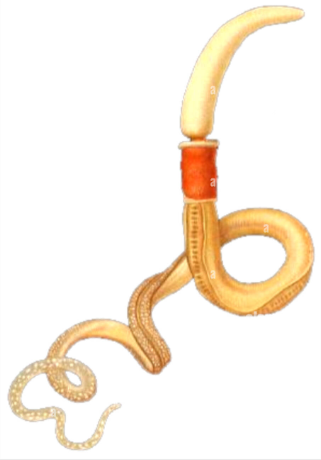
Since the specimen contains short proboscis and all above features hence, it is Balanoglossus.
Key Takeaways
- Balanoglossus, commonly known as the acorn worm, belongs to Phylum Hemichordata and Class Enteropneusta.
- It is a marine, burrowing animal found in sandy and muddy coastal habitats.
- Its body is divided into three distinct regions: proboscis, collar, and trunk.
- Balanoglossus possesses pharyngeal gill slits and a stomochord, making it important in the study of deuterostome evolution.
- Development includes a free-swimming tornaria larva, which resembles echinoderm larvae.
- It serves as an important connecting link in understanding the evolutionary relationship between invertebrates and chordates.
Frequently Asked Questions (FAQs)
What is Balanoglossus?
Balanoglossus is a marine hemichordate commonly known as the acorn worm. It belongs to Class Enteropneusta and is an important zoological specimen.
Where is Balanoglossus found?
Balanoglossus is found in shallow marine waters where it lives in U-shaped burrows in sandy or muddy bottoms.
Why is Balanoglossus called an acorn worm?
It is called an acorn worm because its anterior proboscis resembles the shape of an acorn.
What are the body regions of Balanoglossus?
The body is divided into three regions: proboscis, collar, and trunk.
What is the larva of Balanoglossus called?
The larval stage of Balanoglossus is known as the tornaria larva.
Why is Balanoglossus important in zoology?
Balanoglossus is important because it shows characteristics shared with both echinoderms and chordates, making it valuable for studying animal evolution.
How does Balanoglossus reproduce?
Balanoglossus reproduces sexually with external fertilization, and its life cycle includes a tornaria larval stage.
What are the main characteristics of Balanoglossus?
Its main characteristics include a marine burrowing habit, body divided into proboscis, collar and trunk, pharyngeal gill slits, stomochord, enterocoelous coelom, and bilateral symmetry.
See other posts also
- CEPHALODISCUS
- RHABDOPLEURA
- SACCOGLOSSUS
- Environmental Limiting Factors
- Holocephali – General organization and affinities
Discover more from Zoologyverse
Subscribe to get the latest posts sent to your email.
Pingback: SACCOGLOSSUS | Zoologyverse
Your article helped me a lot, is there any more related content? Thanks!