
Imagine a female crocodile laying a clutch of eggs even though she has never lived with a male. At first, there seems to be nothing unusual about it. Reptiles can lay eggs that never develop, so such a clutch might easily be ignored.
But in 2018, something very unusual happened at a reptile facility in Costa Rica. An adult female American crocodile produced a clutch of eggs after spending her entire known life without contact with a male crocodile. When the eggs were examined, one contained a fully formed crocodile fetus.
There was no father.
Genetic analysis later provided strong evidence that the fetus had developed through facultative parthenogenesis, a reproductive process in which an animal that normally reproduces sexually can produce offspring without genetic contribution from a male.
The discovery, published in Biology Letters in 2023, was the first documented evidence of parthenogenesis in a crocodilian.
This discovery is important because it expands our understanding of reproduction in reptiles and raises interesting questions about how ancient reptiles and other archosaurs may have reproduced.
What Is Parthenogenesis?
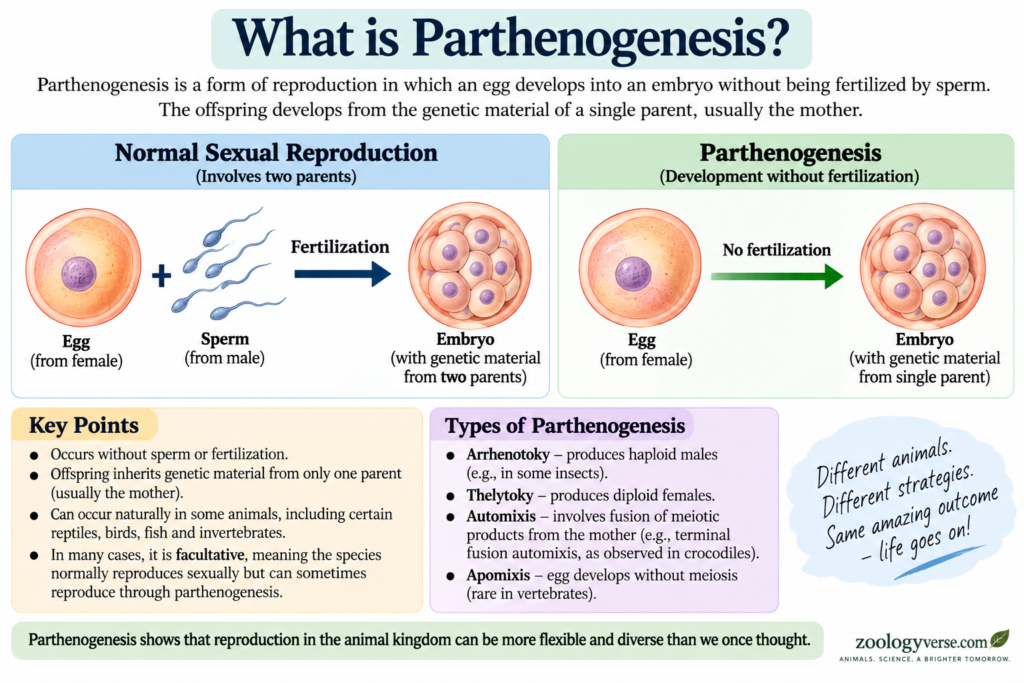
Parthenogenesis is a form of reproduction in which an egg develops into an embryo without being fertilized by sperm.
In ordinary sexual reproduction, an offspring receives genetic material from two parents. The mother’s egg contributes one set of chromosomes, while the father’s sperm contributes another set.
Parthenogenesis is different. The embryo develops without a paternal genetic contribution.
However, parthenogenesis does not necessarily mean that the offspring is an exact genetic copy of its mother. Different mechanisms can produce different amounts of genetic similarity between the mother and offspring.
In many vertebrates, the type of parthenogenesis documented is called automictic parthenogenesis. During this process, meiosis still occurs, but genetic material from the mother’s meiotic products is combined in a way that restores the chromosome number needed for development.
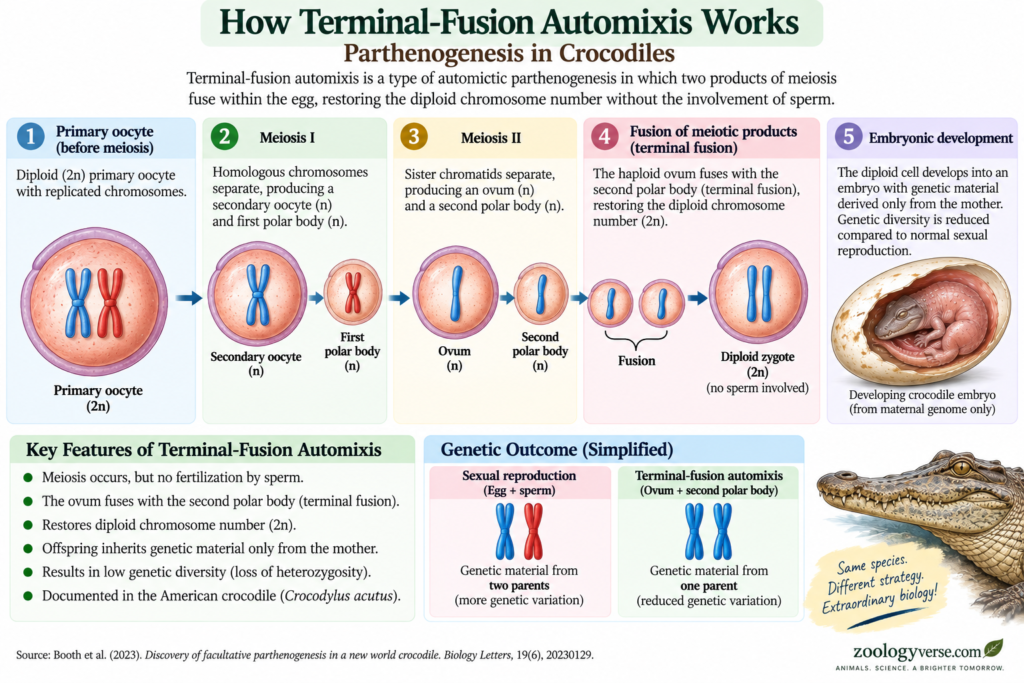
The crocodile case was particularly interesting because researchers found evidence for a specific form known as terminal-fusion automixis.
The Real Example: A Crocodile That Produced an Embryo Without a Male
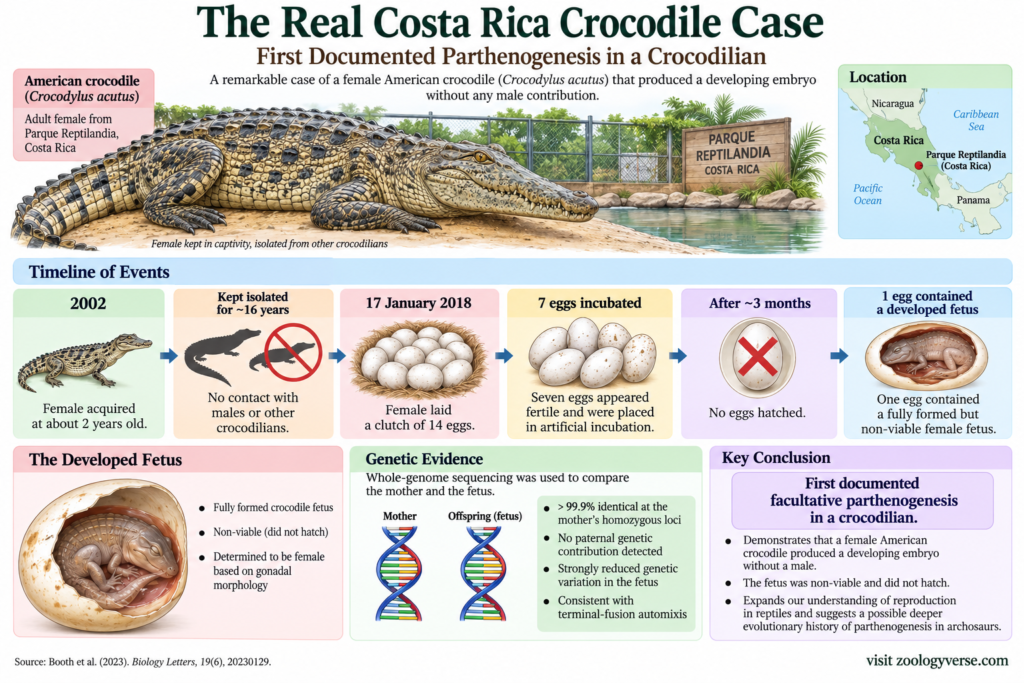
The famous case involved an American crocodile (Crocodylus acutus) living at Parque Reptilandia in Costa Rica.
The female was approximately 18 years old when the unusual clutch was discovered in January 2018.
According to the scientific report, she had been acquired at about two years of age and had been kept isolated from other crocodilians throughout her life. This made ordinary mating an extremely unlikely explanation for the developing embryo.
The crocodile laid 14 eggs. Seven of the eggs appeared to be fertile and were placed in artificial incubation. After approximately three months, none of the eggs hatched.
When the eggs were examined, researchers found that six did not contain clearly identifiable developing embryos. However, one egg contained something extraordinary: a fully formed but non-viable crocodile fetus.
The fetus was determined to be female based on its gross gonadal morphology. At this point, researchers had an important question:
How could an embryo develop when the female had never had access to a male? Genetic testing provided the answer.
How Did Scientists Know It Was Parthenogenesis?
Simply finding an embryo in an isolated female is not enough to prove parthenogenesis. Scientists also have to rule out other possibilities. One important alternative is long-term sperm storage. Some female reptiles can retain sperm from previous mating events for remarkably long periods.
Therefore, if a female produces offspring after being separated from males, researchers must determine whether sperm from an earlier mating could have fertilized the eggs.
In this crocodile case, the female had been isolated from other crocodilians for many years. Researchers therefore examined the genetic relationship between the mother and fetus.
They used whole-genome sequencing and analyzed hundreds of thousands of genetic variants.
The results were striking. The fetus had genetic characteristics showing that it did not possess paternal genetic contributions. At more than 99.9% of the mother’s homozygous genetic positions, the offspring had the same genotype as the mother.
The researchers also found a major reduction in genetic variation in the fetus compared with its mother. Together, these results supported parthenogenesis rather than reproduction involving a male.
What Is Terminal-Fusion Automixis?
This is perhaps the most fascinating part of the discovery. The crocodile did not simply produce an egg that developed unchanged into a fetus.
The process involved meiosis. During meiosis, reproductive cells undergo chromosome separation and produce haploid cells. In normal sexual reproduction, a sperm later combines with an egg to restore the diploid chromosome number.
During terminal-fusion automixis, two products produced during the later stages of meiosis can fuse with each other.
In simplified terms: Mother’s reproductive cell → meiosis → egg + meiotic product → fusion → embryo
There is still no sperm from a male. Because the two genetic products come from the same mother, the resulting offspring has a strongly reduced level of genetic diversity compared with the mother.
This is consistent with what researchers observed in the crocodile fetus. The fetus retained only about 3% of the mother’s heterozygosity, supporting terminal-fusion automixis as the mechanism.
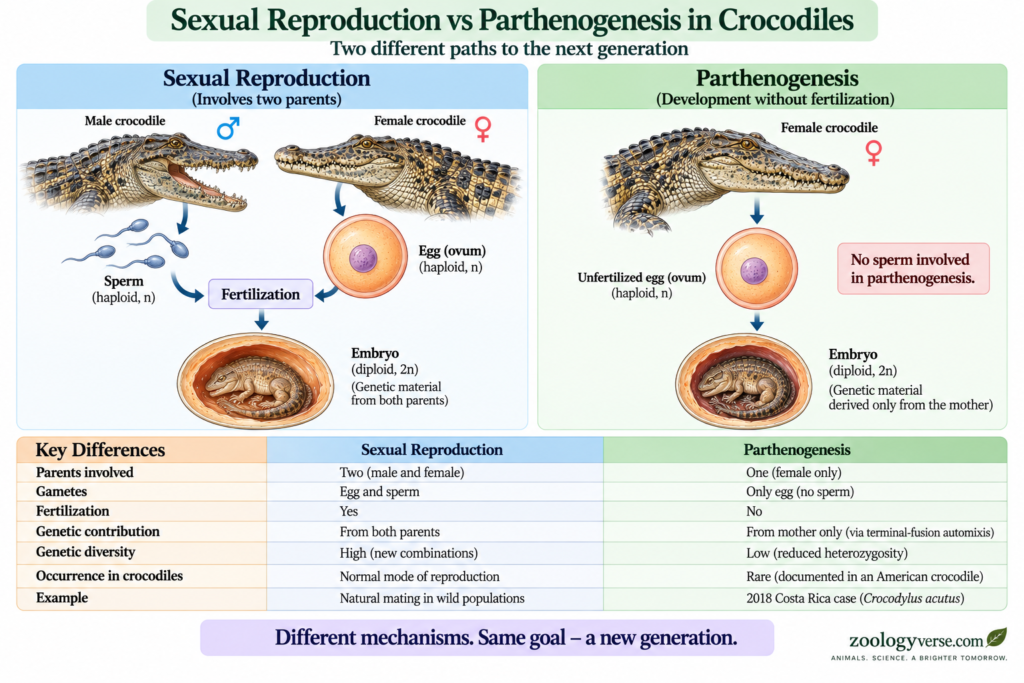
Simple comparison
| Sexual reproduction | Parthenogenesis |
|---|---|
| Egg comes from female | Egg comes from female |
| Sperm comes from male | No sperm contribution |
| Two parents contribute genetic material | Genetic material comes from one parent |
| Fertilization occurs | Fertilization does not occur |
| Greater genetic mixing | Reduced genetic variation is common |
Why Didn’t the Baby Crocodile Hatch?
One of the most interesting details of this case is that the crocodile fetus did not survive to hatching. It is important not to interpret this as proof that parthenogenesis cannot produce viable crocodiles.
The 2023 study specifically noted that non-viable embryos and developmental problems have been observed in parthenogenetic offspring of other vertebrate species. At the same time, viable parthenogenetic individuals have been documented in several animals, including turkeys, California condors, boa constrictors and sharks.
So the Costa Rican crocodile case demonstrates that parthenogenesis can produce a developing crocodile embryo, but it does not demonstrate that crocodile parthenogens are incapable of surviving.
More research would be needed to determine whether crocodilian parthenogens can hatch and reach adulthood.
Parthenogenesis Is Not the Same as Cloning
The phrase “virgin birth” makes the discovery sound almost like natural cloning. But that description can be misleading.
The crocodile fetus was genetically related to its mother, but it was not simply a perfect copy of her genome. Because terminal-fusion automixis involves meiosis and chromosome recombination, genetic variation can be lost or rearranged.
Therefore: Parthenogenesis ≠ ordinary cloning
A clone is generally produced with essentially the same nuclear genetic information as its source organism. Parthenogenesis, on the other hand, involves reproductive cells and meiotic processes.
This distinction is important when explaining the crocodile discovery scientifically.
Why Is This Discovery So Important?
The discovery was significant because crocodilians had not previously been documented as exhibiting facultative parthenogenesis. Before this study, facultative parthenogenesis had been reported in several groups of vertebrates, including snakes, lizards, birds and cartilaginous fishes such as sharks and rays.
The discovery therefore expanded the known distribution of this unusual reproductive ability. But there was another reason researchers were particularly interested in crocodilians.
Crocodilians are part of Archosauria, the major evolutionary group that also includes birds and extinct groups such as dinosaurs and pterosaurs. Modern birds are living archosaurs, while crocodilians represent the other surviving major branch of the group.
Finding facultative parthenogenesis in both crocodilians and birds therefore provides an intriguing evolutionary connection.
The researchers suggested that the ability might have a much older evolutionary history than previously recognized, although this does not prove that dinosaurs reproduced through parthenogenesis.
Could Dinosaurs Have Reproduced by Parthenogenesis?
This is where the discovery becomes especially interesting. Crocodilians and birds are both archosaurs. Dinosaurs also belonged to this evolutionary group.
Because facultative parthenogenesis has now been documented in both modern crocodilians and birds, researchers have suggested that the reproductive mechanism may have a deep evolutionary history within archosaurs.
However, there is an important scientific limitation.
We cannot directly prove that dinosaurs used parthenogenesis from this crocodile discovery alone.
There is no living dinosaur population from which scientists can collect DNA and test for parthenogenetic reproduction.
Therefore, the correct scientific statement is that the discovery raises the possibility that some extinct archosaurs may have possessed similar reproductive capabilities. It does not prove that dinosaurs regularly reproduced without males.
Crocodile Sex Determination Makes the Discovery Even More Interesting
There is another unusual feature of crocodilian reproduction.
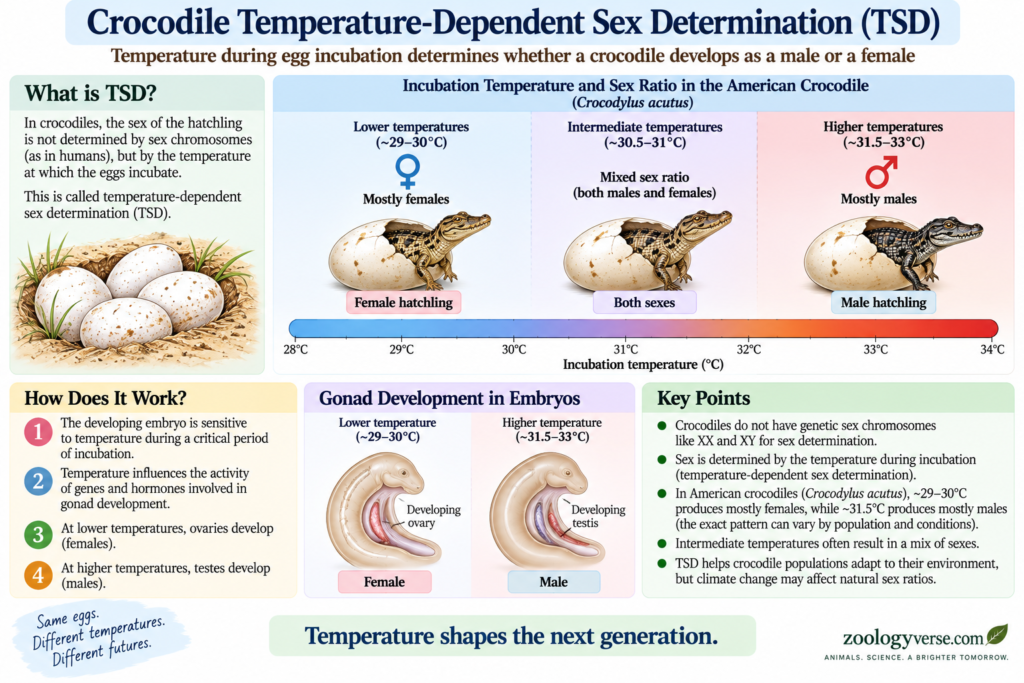
Unlike humans and many other animals, crocodilians do not use ordinary sex chromosomes such as XX and XY to determine sex.
Instead, sex is strongly influenced by the temperature at which the eggs develop.
This phenomenon is called temperature-dependent sex determination (TSD).
The American crocodile studied in Costa Rica also follows temperature-dependent sex determination.
The research paper reports that eggs of Crocodylus acutus incubated at approximately 29–30°C produce females, while temperatures around 31.5°C produce mostly males, with the precise pattern depending on incubation conditions.
The parthenogenetic fetus in this study was female, consistent with the incubation conditions.
This makes the case particularly valuable for researchers because it brings together two unusual biological phenomena:
Parthenogenesis + temperature-dependent sex determination
Can Crocodiles Reproduce Without Males in the Wild?
The discovery does not mean that female crocodiles commonly reproduce without males.
In fact, the frequency of facultative parthenogenesis in wild crocodilian populations is still uncertain.
One reason is that it can be very difficult to recognize.
Suppose a female crocodile living in the wild lays eggs.
If no males are seen nearby, that does not automatically mean the eggs developed through parthenogenesis. The female could have mated earlier and stored sperm.
Alternatively, a parthenogenetic offspring might look perfectly normal and provide no obvious clue that it was produced without a male.
Modern genomic testing is therefore extremely useful for identifying cases that would otherwise remain hidden.
Why Might an Animal Use Parthenogenesis?
Scientists are still investigating why facultative parthenogenesis occurs.
One possible advantage is obvious: a female does not necessarily need a male to produce offspring.
This could potentially be useful when population density is extremely low or when females have difficulty finding mates.
Imagine a small population in which only a few individuals remain.
If a female has the ability to reproduce without a male, she may still be able to produce offspring.
However, parthenogenesis also has important disadvantages.
Sexual reproduction combines genetic material from two parents and therefore generates new genetic combinations.
Parthenogenesis generally produces offspring with much less genetic diversity.
Reduced genetic variation can become a problem when populations face diseases, environmental changes or other challenges.
Therefore, facultative parthenogenesis should not be viewed simply as a superior alternative to sexual reproduction.
It is better understood as an unusual reproductive strategy that may be useful under particular circumstances.
Is Parthenogenesis Common in Reptiles?
Parthenogenesis is not restricted to crocodiles.
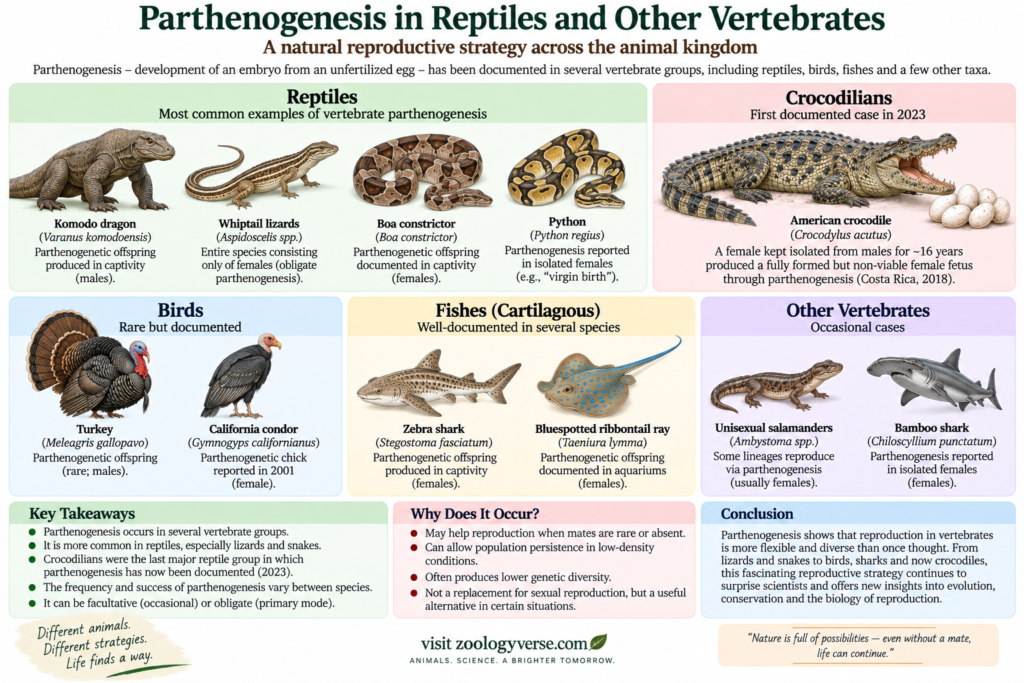
It has been documented in several reptile groups, particularly among snakes and lizards.
Examples of vertebrates in which facultative parthenogenesis has been documented include:
- Boa constrictors
- Certain pythons
- Komodo dragons
- Some sharks and rays
- Turkeys
- California condors
- Other reptiles
The 2023 crocodile study placed crocodilians alongside these previously documented vertebrate examples.
However, the occurrence of parthenogenesis differs greatly between species.
Finding it in one species does not mean that all related animals are capable of reproducing this way.
The Difference Between Facultative and Obligate Parthenogenesis
There are two useful terms to understand.
Facultative parthenogenesis
An animal normally reproduces sexually but can sometimes reproduce through parthenogenesis.
This is the category relevant to the crocodile discovery.
The female crocodile was not a species that depended exclusively on parthenogenesis. Instead, researchers documented a reproductive event that occurred without paternal genetic contribution.
Obligate parthenogenesis
In obligate parthenogenesis, reproduction occurs through parthenogenesis as the normal or exclusive reproductive strategy of a lineage.
The Costa Rican crocodile case is not an example of obligate parthenogenesis.
It is an example of facultative parthenogenesis.
What Happened to the Other Eggs?
The crocodile laid 14 eggs.
Seven appeared fertile and were artificially incubated.
After approximately three months, they failed to hatch.
Six eggs did not contain an identifiable fetus when examined.
The seventh contained the fully formed female fetus that became the focus of the genetic investigation.
This detail is important because the discovery was not based on a healthy baby crocodile emerging from an egg.
Instead, researchers found a developed but non-viable fetus and then used genomic evidence to determine how it had originated.
What Does This Teach Us About Animal Reproduction?
The crocodile case demonstrates why animal reproduction is often more flexible and complicated than the simple textbook division between “sexual” and “asexual” reproduction suggests.
A species can normally depend on sexual reproduction while retaining the biological machinery that allows an occasional parthenogenetic event.
It also shows the importance of modern genetics.
Without DNA analysis, researchers might have suspected unusual reproduction, but they could not have confidently demonstrated the absence of paternal genetic contribution.
Whole-genome sequencing transformed an unusual observation into strong scientific evidence.
Why the Discovery Matters for Conservation
The conservation implications are still being investigated.
The American crocodile has experienced conservation concerns across parts of its range, and understanding every possible reproductive strategy can help researchers better understand population biology.
If facultative parthenogenesis occurs in wild crocodilians more often than currently recognized, it could be relevant in small or isolated populations.
However, parthenogenesis should not be regarded as a substitute for maintaining healthy breeding populations.
Sexual reproduction remains important because genetic diversity is essential for long-term population resilience.
The discovery mainly tells researchers that crocodilian reproduction may be more flexible than previously thought.
Key Facts About the Crocodile Virgin Birth
| Rank | Details |
|---|---|
| Animal | American crocodile |
| Scientific name | Crocodylus acutus |
| Location | Parque Reptilandia, Costa Rica |
| Female’s age | About 18 years |
| Male present? | No |
| Eggs laid | 14 |
| Eggs incubated | 7 |
| Developing fetus found | 1 |
| Fetus | Fully formed but non-viable |
| Sex of fetus | Female |
| Reproductive mechanism | Facultative parthenogenesis |
| Mechanism identified | Terminal-fusion automixis |
| Genetic evidence | No paternal genetic contribution detected |
| Scientific report | Published in Biology Letters, 2023 |
The details above come from the original scientific study rather than from the popular-media description of the event.
Frequently Asked Questions
Can a crocodile become pregnant without a male?
A female crocodile can produce a developing embryo without genetic contribution from a male through facultative parthenogenesis. The 2023 study provided the first documented evidence of this phenomenon in a crocodilian.
Was the crocodile baby a clone of its mother?
No. The embryo was genetically related to the mother, but parthenogenesis through terminal-fusion automixis is not the same as artificial cloning. Meiosis occurs, and genetic diversity is reduced.
Was the crocodile fetus alive?
The fetus was fully formed but non-viable and did not hatch.
Can crocodiles reproduce without mating?
Under unusual circumstances, facultative parthenogenesis can allow reproduction without paternal genetic contribution. However, this should not be interpreted as meaning that crocodiles normally reproduce without mating.
What crocodile species showed parthenogenesis?
The documented case involved the American crocodile (Crocodylus acutus).
Is parthenogenesis the same as asexual reproduction?
Parthenogenesis is generally considered a form of reproduction without fertilization, but the biological mechanism can still involve meiosis. It is therefore more complex than simply producing an identical copy of the parent.
Could dinosaurs reproduce through parthenogenesis?
The crocodile discovery raises an evolutionary possibility because crocodilians and birds are both living archosaurs. However, there is currently no direct evidence demonstrating that dinosaurs reproduced through parthenogenesis.
Why is the discovery called a “virgin birth”?
“Virgin birth” is a popular description for reproduction without fertilization. In zoology, the more precise term is parthenogenesis.
Conclusion
The discovery of parthenogenesis in an American crocodile changed what scientists knew about crocodilian reproduction.
An 18-year-old female crocodile in Costa Rica produced an unusual clutch of eggs despite having lived without a male. One egg contained a fully formed female fetus. Genetic analysis showed that the fetus had no paternal genetic contribution and supported terminal-fusion automixis, a form of facultative parthenogenesis.
The fetus did not survive to hatch, so the discovery does not mean that crocodiles can routinely reproduce without males. Instead, it provides evidence that crocodilians possess a previously undocumented reproductive capability.
Perhaps the most fascinating part is the evolutionary question it creates.
Crocodilians and birds are the two major living branches of archosaurs, while dinosaurs and pterosaurs were also archosaurs. Because facultative parthenogenesis has now been documented in crocodilians as well as birds, scientists can investigate whether this reproductive ability has a much older evolutionary history.
For now, one conclusion is clear: crocodilian reproduction is more biologically flexible than scientists once realized.
And the story of the Costa Rican crocodile shows that sometimes, an apparently ordinary clutch of eggs can reveal something genuinely extraordinary about animal evolution.
References
- Booth, W., Levine, B. A., Corush, J. B., Davis, M. A., Dwyer, Q., De Plecker, R., & Schuett, G. W. (2023). Discovery of facultative parthenogenesis in a new world crocodile. Biology Letters, 19(6), 20230129.
Read the original scientific paper - Booth, W., et al. (2023). Discovery of facultative parthenogenesis in a new world crocodile. Full text available through PubMed Central.
Read the full-text article on PubMed Central - Correia, A. M., et al. (2019). The sex-determination pattern in crocodilians: A systematic review of three decades of research. Biological Reviews.
View the PubMed record - Rainwater, T. R., et al. Regional warming and the thermal regimes of American crocodile nests in the Tempisque Basin, Costa Rica.
View the PubMed record - Population assessment of the American crocodile (Crocodylus acutus) on the Pacific coast of Costa Rica.
View the PubMed record
Recommended Study Resource
Virgin Birth: Parthenogenesis in the Animal Kingdom
by Jeff Ambrose Mitchell (Author)
Parthenogenesis
German Edition by Siebold (Author), C Th E (Author) Format: Paperback
As an Amazon Associate I earn from qualifying purchases.
Discover more from Zoologyverse
Subscribe to get the latest posts sent to your email.