
1. Concept and Meaning of the Hardy–Weinberg Principle
The Hardy–Weinberg Principle is a fundamental concept in population genetics and evolutionary biology. It explains the relationship between allele frequency and genotype frequency in a population and establishes the mathematical conditions under which genetic equilibrium is maintained. A population that meets these conditions is said to be in Hardy-Weinberg Equilibrium.
The Hardy–Weinberg Principle demonstrates that allele frequencies remain constant across successive generations when specific evolutionary conditions are satisfied.
The Hardy–Weinberg Principle provides a theoretical model for understanding how genetic variation is distributed within a population. It also helps researchers identify changes in the gene pool that may result from evolutionary forces. In this way, the principle connects Mendelian inheritance with population-level evolutionary processes.
The Hardy–Weinberg Principle is an essential mathematical foundation of Population Genetics, providing a framework for understanding allele frequencies, genotype frequencies and genetic equilibrium within populations.
1.1 Definition of the Hardy–Weinberg Principle
The Hardy–Weinberg Principle states that allele and genotype frequencies remain constant from generation to generation in a sufficiently large, randomly mating population, provided that mutation, migration, natural selection and genetic drift do not significantly influence the population.
According to the Hardy–Weinberg Principle, genetic equilibrium, or Hardy-Weinberg Equilibrium, is maintained when these conditions are satisfied. The frequency of an allele is represented by p or q, while the expected genotype frequency is calculated from the relationship between these allele frequencies.
1.2 Meaning of Genetic Equilibrium
Genetic equilibrium refers to a condition in which allele frequencies and expected genotype frequencies remain stable across generations.
The Hardy–Weinberg Principle explains this condition mathematically. For a gene with two alternative alleles, A and a:
- p = frequency of allele A.
- q = frequency of allele a.
Their combined frequency is:
[
p+q=1
]
The expected genotype frequencies are:
- AA = (p^2)
- Aa = (2pq)
- aa = (q^2)
Therefore:
[
p^2+2pq+q^2=1
]
These equations form the mathematical foundation of the Hardy–Weinberg Principle and describe the expected distribution of genotypes under equilibrium conditions.
1.3 Importance in Evolutionary Biology
The Hardy–Weinberg Principle is important because it provides a reference model for studying evolutionary changes in populations.
Its major contributions include:
- Understanding genetic equilibrium: Explains the conditions required for stable allele frequency and genotype frequency.
- Studying genetic variation: Helps examine the distribution of genetic variants within a population.
- Detecting evolutionary changes: Allows comparison between observed and expected genotype frequencies.
- Understanding inheritance: Demonstrates that dominant alleles do not automatically increase in frequency.
- Studying evolution: Provides a foundation for investigating mutation, migration, selection and genetic drift.
The Hardy–Weinberg Principle is therefore an essential framework for understanding population genetics, genetic equilibrium and the evolutionary significance of changes in allele frequency.
2. Historical Background and Contributions of Hardy and Weinberg
The Hardy-Weinberg Principle was independently developed in 1908 by two scientists, G. H. Hardy, an English mathematician, and Wilhelm Weinberg, a German physician. Their work established a mathematical relationship between allele frequency and genotype frequency in populations. The Hardy-Weinberg Principle became a foundation of modern population genetics because it explained how Mendelian inheritance operates without necessarily producing evolutionary changes in allele frequencies.
Before the development of the Hardy-Weinberg Principle, some biologists believed that dominant alleles would automatically become more frequent in populations, whereas recessive alleles would gradually disappear. This misunderstanding resulted from confusing the expression of dominant characteristics with the actual frequency of alleles in a gene pool.
2.1 Contribution of G. H. Hardy
G. H. Hardy (1877–1947) was a British mathematician who published a paper titled Mendelian Proportions in a Mixed Population in the journal Science in 1908.
Hardy demonstrated mathematically that allele frequencies remain constant under random mating when the required population conditions are satisfied. His explanation established that dominant alleles do not automatically increase in frequency simply because they are dominant.
His mathematical contribution became one of the foundations of the Hardy-Weinberg Principle and provided a theoretical explanation of genetic equilibrium.
2.2 Contribution of Wilhelm Weinberg
Wilhelm Weinberg (1862–1937) was a German physician who independently developed the same mathematical relationship in 1908.
Weinberg applied the principle to human populations and explained how genotype frequencies could be calculated from allele frequencies. His work contributed significantly to the understanding of inheritance patterns and genetic variation in human populations.
The independent contributions of Hardy and Weinberg established the mathematical basis of the Hardy-Weinberg Principle.
2.3 Historical Significance in Population Genetics
The Hardy-Weinberg Principle helped connect Mendelian genetics with evolutionary biology. It demonstrated that inheritance alone does not necessarily change allele frequency and established genetic equilibrium as a mathematical reference condition.
Later scientists, including R. A. Fisher, J. B. S. Haldane and Sewall Wright, developed mathematical population genetics further. Their contributions explained how natural selection, mutation, migration and genetic drift influence genetic equilibrium and population evolution.
The Hardy-Weinberg Principle consequently became an essential foundation for studying allele frequency, genotype frequency and evolutionary changes in populations.
3. Basic Genetic Concepts Required to Understand the Hardy–Weinberg Principle
Understanding the Hardy–Weinberg Principle requires familiarity with certain fundamental concepts of genetics and population biology. These concepts explain how genes, alleles and genotypes are distributed within a population and how their frequencies can be calculated. The Hardy–Weinberg Principle uses these genetic concepts to establish the expected genetic composition of an ideal population.
3.1 Population
A population is a group of individuals belonging to the same species that occupy a particular geographical area and have the potential to interbreed.
In the Hardy–Weinberg Principle, the population is the basic unit of genetic analysis. Allele and genotype frequencies are calculated for the population as a whole rather than for isolated individuals.
For example, all individuals of a particular fish species inhabiting a lake may be considered a population if they form an interbreeding group.
3.2 Gene and Allele
A gene is a segment of DNA that contains information influencing a particular biological characteristic. Different forms of the same gene are called alleles.
For a gene with two alternative alleles, the alleles may be represented by A and a. These alleles can occur in different combinations within individuals.
The Hardy–Weinberg Principle examines the frequency of these alternative alleles in a population to predict the distribution of genotypes.
3.3 Genotype and Phenotype
Genotype refers to the genetic constitution of an individual for a particular gene, whereas phenotype refers to the observable characteristics produced through interactions between genetic factors and the environment.
For a gene with two alleles, A and a, three possible genotypes occur:
- AA: Homozygous dominant.
- Aa: Heterozygous.
- aa: Homozygous recessive.
The Hardy–Weinberg Principle uses these three genotype categories to calculate expected genotype frequencies from the frequencies of the two alleles.
3.4 Allele Frequency
Allele frequency refers to the proportion of a particular allele among all copies of that gene in a population.
In a diploid population, each individual normally carries two copies of an autosomal gene. Therefore, the total number of allele copies is twice the number of individuals.
For two alleles, A and a:
- Frequency of allele A = p.
- Frequency of allele a = q.
The Hardy–Weinberg Principle expresses their relationship as:
[
p+q=1
]
For example, if allele A has a frequency of 0.6 and allele a has a frequency of 0.4, their combined frequency is 1.0.
3.5 Genotype Frequency
Genotype frequency is the proportion of individuals in a population possessing a particular genotype.
Under the Hardy–Weinberg Principle, the expected genotype frequencies are:
- AA = p²
- Aa = 2pq
- aa = q²
The sum of these frequencies is:
[
p^2+2pq+q^2=1
]
This relationship allows researchers to predict the expected proportions of homozygous and heterozygous individuals.
3.6 Gene Pool
The gene pool represents the total collection of alleles present in an interbreeding population at a particular time.
It includes all genetic variations carried by the reproductive members of that population. The Hardy–Weinberg Principle assumes that allele frequencies within this gene pool remain stable when its ideal conditions are maintained.
Changes in the gene pool may occur through mutation, migration, natural selection and genetic drift. These processes can alter allele frequencies and disturb Hardy–Weinberg equilibrium.
3.7 Homozygous and Heterozygous Individuals
A homozygous individual possesses two identical alleles for a particular gene, such as AA or aa. A heterozygous individual possesses two different alleles, such as Aa.
The Hardy–Weinberg Principle is particularly useful for estimating the proportion of homozygous and heterozygous individuals in a population.
The frequency of heterozygous individuals is represented by 2pq, while the combined frequency of homozygous individuals is represented by p² + q².
These concepts provide the genetic foundation necessary for understanding the mathematical equations, assumptions and applications of the Hardy–Weinberg Principle.
4. Mathematical Expression and Derivation of the Hardy–Weinberg Principle
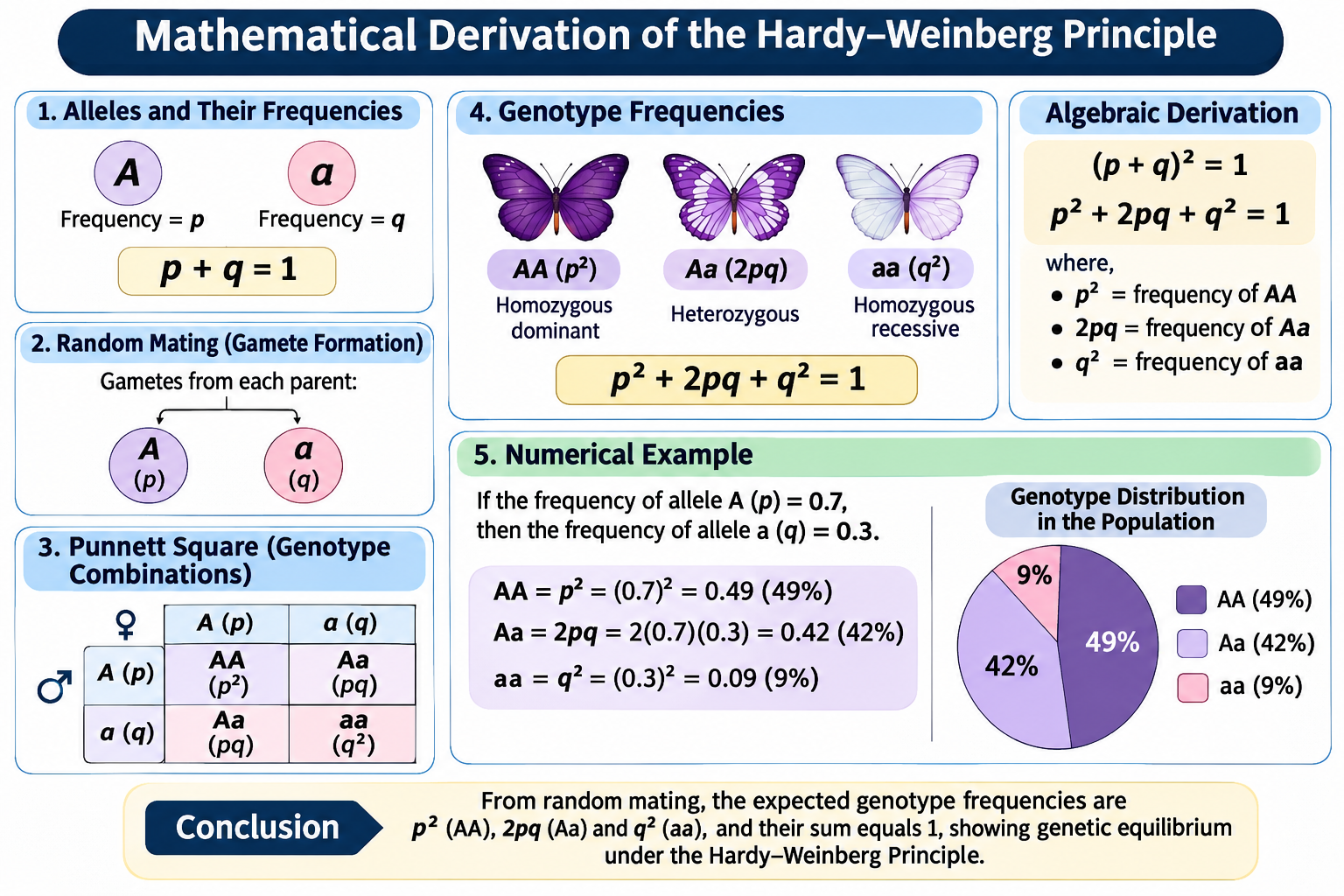
The Hardy–Weinberg Principle is based on a mathematical relationship between allele frequency and genotype frequency in a population. The Hardy–Weinberg Principle demonstrates how the frequencies of different genotypes can be predicted from the frequencies of alleles. This mathematical relationship forms the foundation for understanding genetic equilibrium and calculating genetic variation in populations.
4.1 Basic Mathematical Expression
Consider a diploid population in which a particular gene has two alternative alleles, A and a.
Let:
- p = frequency of allele A.
- q = frequency of allele a.
Since these are the only two alleles considered, their combined allele frequency must equal one.
[
p+q=1
]
The Hardy–Weinberg Principle predicts three possible genotypes: AA, Aa and aa.
Their expected genotype frequencies are:
| Genotype | Expected frequency | Genetic constitution |
|---|---|---|
| AA | (p^2) | Homozygous dominant |
| Aa | (2pq) | Heterozygous |
| aa | (q^2) | Homozygous recessive |
The sum of these genotype frequencies is:
[
p^2+2pq+q^2=1
]
This equation represents the expected genotype frequency distribution under Hardy–Weinberg equilibrium.
4.2 Derivation of the Hardy–Weinberg Equation
The derivation is based on the random union of gametes during fertilization.
In the population:
- A gametes occur with frequency p.
- a gametes occur with frequency q.
During random fertilization, male and female gametes combine independently. The possible combinations are:
| Male gamete | Female gamete | Resulting genotype | Frequency |
|---|---|---|---|
| A | A | AA | (p \times p=p^2) |
| A | a | Aa | (p \times q=pq) |
| a | A | Aa | (q \times p=pq) |
| a | a | aa | (q \times q=q^2) |
The two heterozygous combinations together produce a frequency of 2pq.
Therefore:
[
p^2+pq+pq+q^2=1
]
Simplifying:
[
p^2+2pq+q^2=1
]
Thus, the Hardy–Weinberg Principle establishes that the expected genotype frequencies can be calculated from the allele frequencies in a randomly mating population.
4.3 Relationship Between Allele Frequency and Genotype Frequency
The Hardy–Weinberg Principle also demonstrates how allele frequencies can be obtained from genotype frequencies.
The frequency of allele A is calculated as:
[
p=f(AA)+\frac{1}{2}f(Aa)
]
Similarly, the frequency of allele a is:
[
q=f(aa)+\frac{1}{2}f(Aa)
]
These relationships are useful when researchers know the genotype frequency but need to calculate the corresponding allele frequency.
4.4 Numerical Example
Suppose a population has an allele A frequency of 0.7 and an allele a frequency of 0.3.
Therefore:
[
p=0.7,\quad q=0.3
]
According to the Hardy–Weinberg Principle:
[
AA=p^2=0.7^2=0.49
]
[
Aa=2pq=2(0.7)(0.3)=0.42
]
[
aa=q^2=0.3^2=0.09
]
The expected genotype distribution is:
| Genotype | Frequency | Percentage |
|---|---|---|
| AA | 0.49 | 49% |
| Aa | 0.42 | 42% |
| aa | 0.09 | 9% |
| Total | 1.00 | 100% |
This example illustrates how allele frequency determines the expected genotype frequency distribution. When the assumptions of the Hardy–Weinberg Principle are maintained, these frequencies remain stable across generations.
5. Assumptions of Hardy-Weinberg Equilibrium
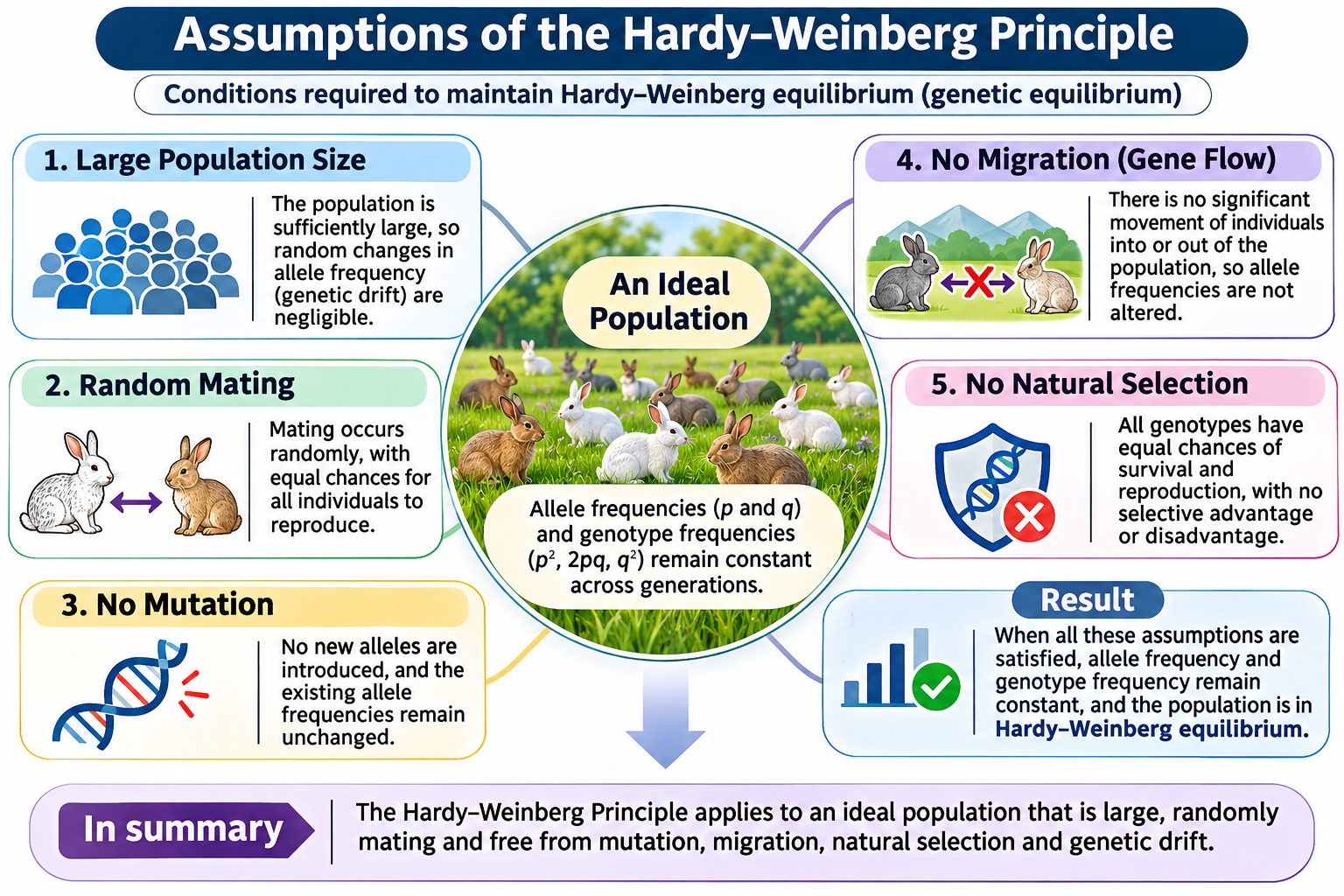
The Hardy–Weinberg Principle describes genetic equilibrium under a specific set of ideal conditions. These conditions ensure that allele frequencies and genotype frequencies remain constant from one generation to the next. When all these conditions are satisfied, a population is expected to maintain Hardy-Weinberg Equilibrium.
The Hardy–Weinberg Principle is based on the idea that genetic equilibrium is maintained when evolutionary forces do not disturb the gene pool. Therefore, the assumptions of Hardy-Weinberg Equilibrium are essential for understanding changes in allele frequency, genotype frequency and genetic equilibrium in natural populations.
The assumptions of genetic equilibrium help explain how evolutionary processes influence populations. These changes are discussed further in our article on Trends in Evolution.
5.1 Large Population Size
The first assumption of the Hardy–Weinberg Principle is that the population must be sufficiently large.
In a small population, random fluctuations in the transmission of alleles from parents to offspring may produce considerable changes in allele frequency. This phenomenon is known as genetic drift.
A large population reduces the influence of random sampling effects and helps maintain stable allele frequencies across generations.
For example, if a population contains only a few individuals, the accidental loss of an allele may considerably change its genetic composition. In a large population, the same event is less likely to produce a major change in allele frequency.
5.2 Random Mating
The Hardy–Weinberg Principle assumes that individuals mate randomly with respect to the gene being studied.
Random mating means that the probability of mating does not depend on the particular genotype or allele carried by an individual.
Under this condition, the union of gametes follows the expected probability of allele combinations. Consequently, genotype frequencies can be predicted using the relationship between allele frequency and genotype frequency.
Non-random mating, such as inbreeding or assortative mating, can alter genotype frequencies. Inbreeding generally increases homozygosity and decreases heterozygosity, although it does not necessarily change allele frequencies by itself.
5.3 Absence of Mutation
Mutation is a permanent change in the nucleotide sequence of genetic material. It can introduce new alleles into a population or convert one allele into another.
The Hardy–Weinberg Principle assumes that mutation does not occur at a rate sufficient to alter the allele frequencies being studied.
If mutation occurs, the genetic composition of the gene pool may gradually change. Therefore, the absence of significant mutation is necessary for maintaining ideal genetic equilibrium.
5.4 Absence of Migration or Gene Flow
Migration refers to the movement of individuals between populations. When migrating individuals reproduce in a new population, they may introduce new alleles or change the frequencies of existing alleles. This exchange of genetic material is called gene flow.
The Hardy–Weinberg Principle assumes that there is no significant migration or gene flow between the population under study and other populations.
For example, if individuals carrying a relatively uncommon allele enter a population and reproduce, the frequency of that allele may increase. Such a change can disturb Hardy–Weinberg equilibrium.
5.5 Absence of Natural Selection
Natural selection occurs when individuals possessing certain inherited characteristics have different reproductive success.
The Hardy–Weinberg Principle assumes that all genotypes have equal survival and reproductive success with respect to the gene being examined.
If a particular genotype provides a survival or reproductive advantage, its frequency may increase over generations. Conversely, genotypes associated with lower reproductive success may become less common.
Natural selection therefore acts as an evolutionary force that can change allele frequencies and disturb genetic equilibrium.
5.6 Absence of Genetic Drift
Genetic drift refers to random changes in allele frequencies caused by chance events, particularly in small populations.
The Hardy–Weinberg Principle assumes that the population is sufficiently large for random sampling effects to be negligible.
Genetic drift may cause certain alleles to become more common, less common or completely lost from a population, irrespective of whether they provide an adaptive advantage.
Two important examples of genetic drift are the founder effect and the bottleneck effect.
5.7 No Significant Disturbance of the Gene Pool
The combined assumptions of the Hardy–Weinberg Principle ensure that the gene pool remains genetically stable.
When large population size, random mating, absence of significant mutation, migration, natural selection and genetic drift are maintained, allele frequencies remain constant. The expected genotype frequencies also remain stable under these conditions.
The following table summarizes the major assumptions:
| Assumption | Meaning | Possible disturbance when violated |
|---|---|---|
| Large population | Population is sufficiently large | Genetic drift |
| Random mating | Mating occurs without genotype-based preference | Changes in genotype frequencies |
| No mutation | No significant introduction or conversion of alleles | Mutation-driven allele-frequency changes |
| No migration | No significant gene flow between populations | Introduction or removal of alleles |
| No natural selection | Genotypes have equal reproductive success | Differential survival and reproduction |
| No significant genetic drift | Random sampling effects are negligible | Random changes in allele frequency |
These assumptions establish the theoretical conditions required for Hardy–Weinberg Equilibrium. Natural populations may not satisfy all these conditions perfectly, but the Hardy–Weinberg Principle remains valuable as a reference model for identifying and investigating genetic changes.
6. Calculation of Allele and Genotype Frequencies
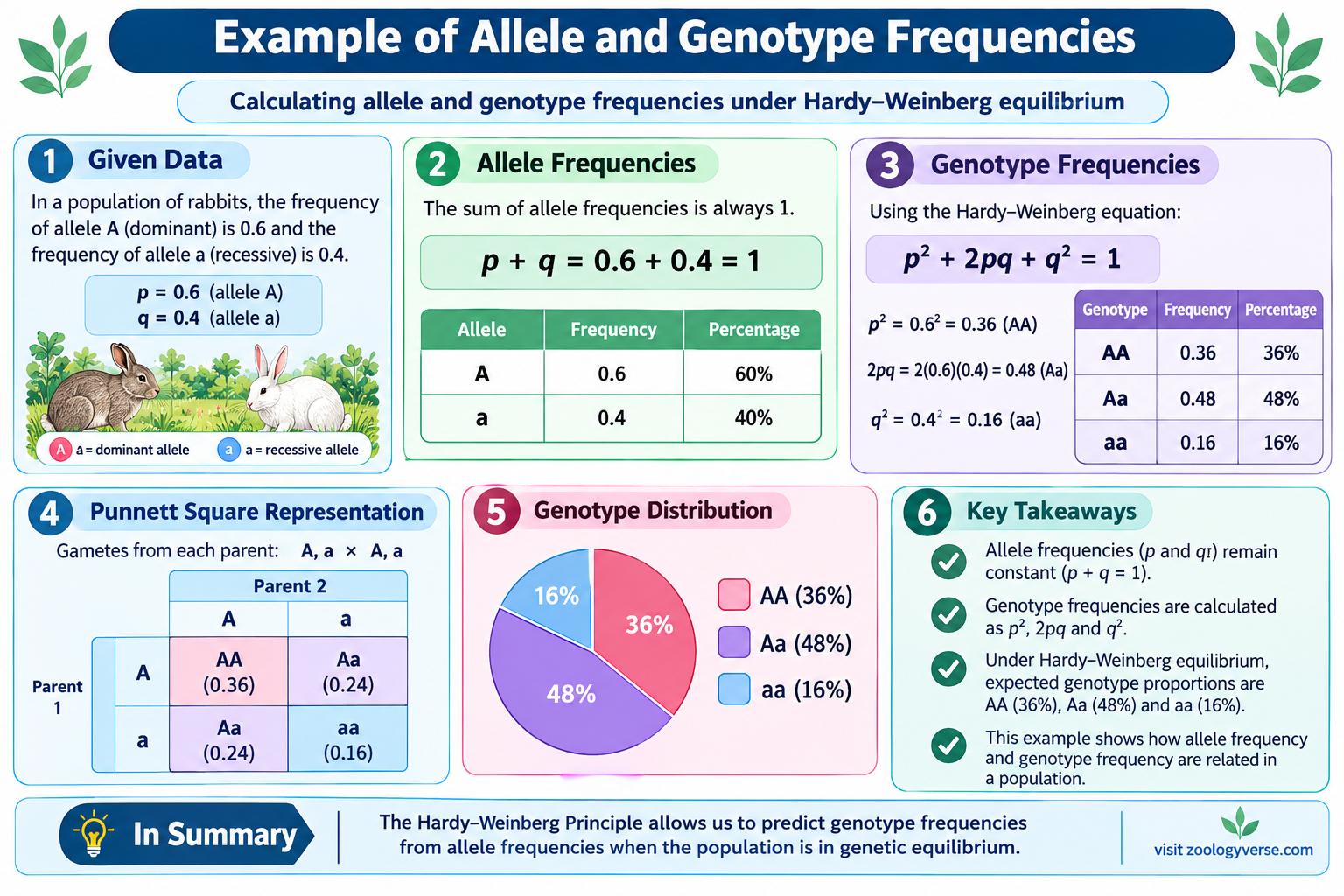
The Hardy–Weinberg Principle provides a mathematical method for calculating allele frequency and genotype frequency in a population. These calculations help researchers understand the genetic composition of populations and determine whether their observed genetic structure is consistent with Hardy–Weinberg Equilibrium.
The Hardy–Weinberg Principle uses allele frequencies to predict genotype frequencies and also allows allele frequencies to be calculated from observed genotype data. Understanding these calculations is essential in population genetics, particularly when investigating genetic variation and genetic equilibrium.
6.1 Calculation of Allele Frequency from Genotype Data
In a diploid population, each individual possesses two copies of an autosomal gene. Therefore, the total number of alleles at a particular locus is twice the total number of individuals.
Consider a population containing three genotypes:
- AA = Homozygous dominant
- Aa = Heterozygous
- aa = Homozygous recessive
The frequency of allele A is calculated by counting all A alleles contributed by AA and Aa individuals.
[
p=\frac{2N_{AA}+N_{Aa}}{2N}
]
Similarly, the frequency of allele a is:
[
q=\frac{2N_{aa}+N_{Aa}}{2N}
]
Where:
- (N_{AA}) = Number of individuals with genotype AA.
- (N_{Aa}) = Number of individuals with genotype Aa.
- (N_{aa}) = Number of individuals with genotype aa.
- (N) = Total number of individuals.
According to the Hardy–Weinberg Principle, the sum of the two allele frequencies must equal one.
[
p+q=1
]
6.2 Numerical Example: Calculation of Allele Frequency
Suppose a population contains 100 individuals with the following genotype distribution:
| Genotype | Number of individuals |
|---|---|
| AA | 40 |
| Aa | 40 |
| aa | 20 |
| Total | 100 |
Step 1: Calculate the total number of alleles.
Since every individual is diploid:
[
2N=2\times100=200
]
Step 2: Calculate the frequency of allele A.
[
p=\frac{2(40)+40}{200}
]
[
p=\frac{120}{200}=0.6
]
Step 3: Calculate the frequency of allele a.
[
q=\frac{2(20)+40}{200}
]
[
q=\frac{80}{200}=0.4
]
Therefore:
- Frequency of allele A = 0.6 or 60%.
- Frequency of allele a = 0.4 or 40%.
This calculation demonstrates how allele frequency can be obtained from observed genotype data.
6.3 Calculation of Expected Genotype Frequency
Once allele frequencies are known, the Hardy–Weinberg Principle can be used to calculate the expected genotype frequency.
The mathematical relationship is:
[
p^2+2pq+q^2=1
]
Using the previous example:
[
p=0.6,\quad q=0.4
]
Frequency of AA:
[
p^2=(0.6)^2=0.36
]
Frequency of Aa:
[
2pq=2(0.6)(0.4)=0.48
]
Frequency of aa:
[
q^2=(0.4)^2=0.16
]
The expected genotype distribution is:
| Genotype | Expected frequency | Expected percentage |
|---|---|---|
| AA | 0.36 | 36% |
| Aa | 0.48 | 48% |
| aa | 0.16 | 16% |
| Total | 1.00 | 100% |
6.4 Comparison Between Observed and Expected Genotype Frequencies
The Hardy–Weinberg Principle allows researchers to compare observed genotype frequencies with expected genotype frequencies.
In the numerical example, the observed and expected distributions are:
| Genotype | Observed number | Observed frequency | Expected frequency | Expected number |
|---|---|---|---|---|
| AA | 40 | 0.40 | 0.36 | 36 |
| Aa | 40 | 0.40 | 0.48 | 48 |
| aa | 20 | 0.20 | 0.16 | 16 |
| Total | 100 | 1.00 | 1.00 | 100 |
The observed genotype frequencies differ from the expected frequencies. This difference may indicate that the population is not in Hardy–Weinberg equilibrium.
However, a difference alone does not establish that a population is evolving. Sampling variation and other statistical or biological factors must also be considered.
6.5 Estimation of Recessive Allele Frequency
The Hardy–Weinberg Principle is particularly useful when studying recessive genetic traits or disorders.
If a recessive phenotype is expressed only in individuals with genotype aa, its frequency corresponds to (q^2), provided the population satisfies Hardy–Weinberg equilibrium and the phenotype is correctly identified.
For example, if the frequency of a recessive phenotype is 0.04:
[
q^2=0.04
]
Taking the square root:
[
q=\sqrt{0.04}=0.2
]
Therefore:
[
p=1-q=1-0.2=0.8
]
The expected genotype frequencies are:
- AA = (p^2=0.64) or 64%.
- Aa = (2pq=0.32) or 32%.
- aa = (q^2=0.04) or 4%.
Thus, the expected frequency of heterozygous carriers is 32%.
This method is widely used in population genetics to estimate carrier frequencies for certain recessive genetic conditions. Such estimates require appropriate assumptions, including a clearly defined population and reliable identification of the recessive phenotype.
7. Factors That Disturb Hardy-Weinberg Equilibrium
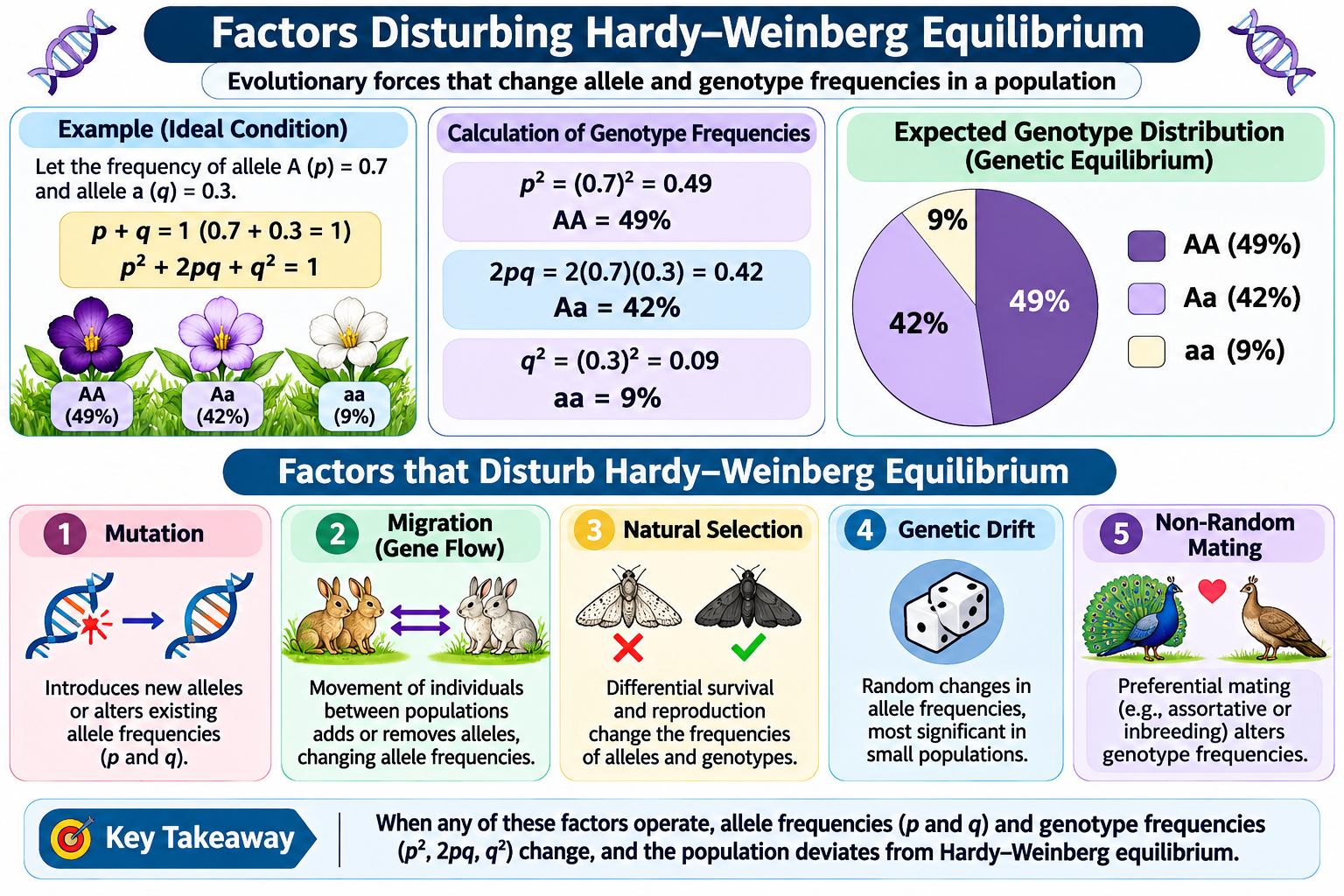
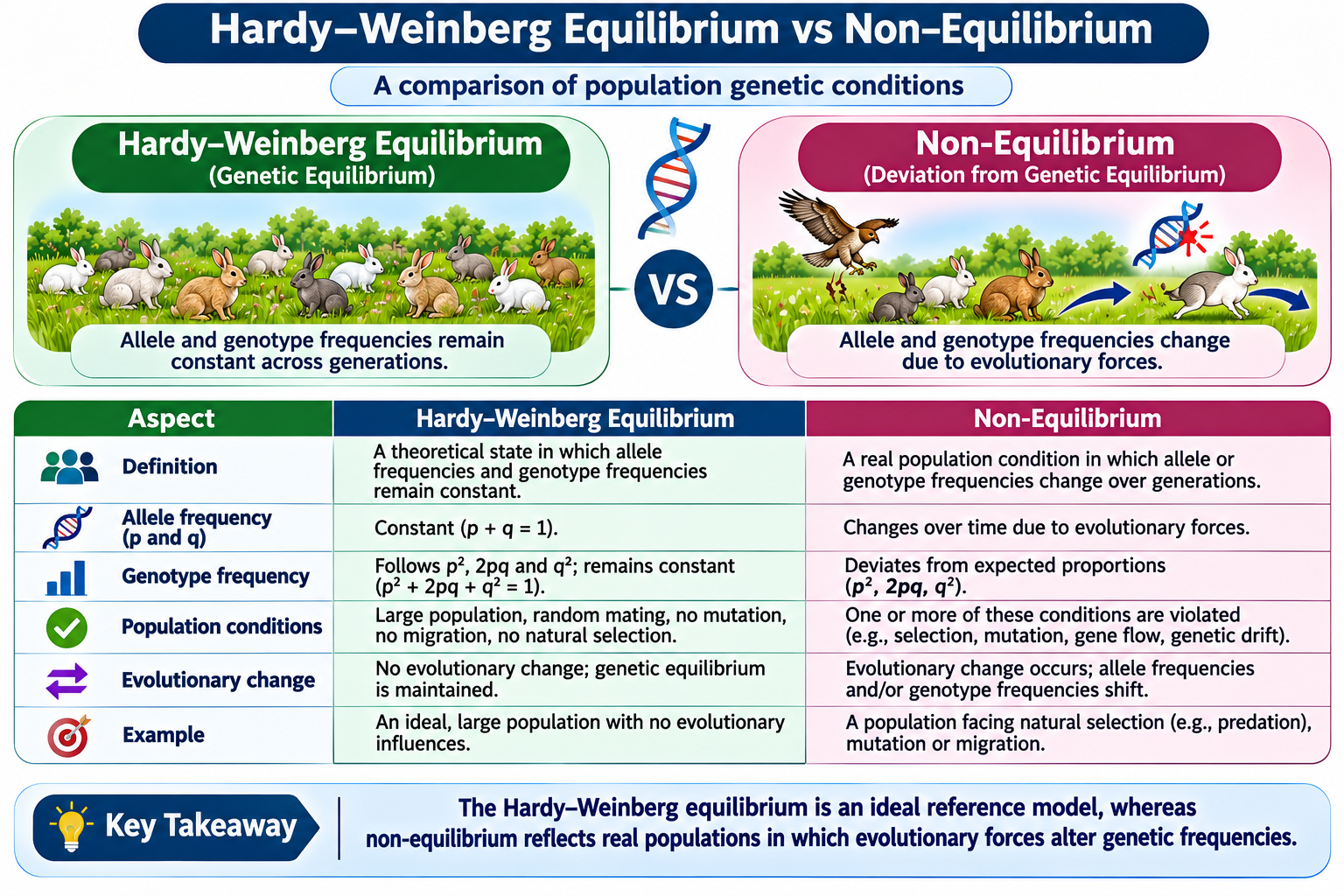
The Hardy–Weinberg Principle describes the conditions under which allele and genotype frequencies remain constant across generations. However, natural populations are influenced by several evolutionary forces that can disturb this genetic stability. When these forces act on a population, its genetic composition may change, resulting in a deviation from Hardy-Weinberg Equilibrium.
The major factors affecting the Hardy–Weinberg Principle include mutation, gene flow, genetic drift, natural selection and non-random mating. These evolutionary mechanisms influence the gene pool and may produce changes in allele frequency, genotype frequency and overall genetic variation.
The effects of mutation, migration, natural selection and genetic drift are central to the Modern Synthetic Theory of Evolution, which explains how evolutionary mechanisms produce changes in populations over generations.
7.1 Mutation
Mutation is a heritable change in the DNA sequence that can introduce new alleles into a population or modify existing alleles.
According to the Hardy–Weinberg Principle, allele frequencies remain stable when mutation does not significantly alter the genetic composition of a population. However, when mutation occurs repeatedly over generations, it may change allele frequencies and disturb genetic equilibrium.
For example, a mutation may convert allele A into allele a. If this change occurs frequently enough, the frequency of allele a may gradually increase in the gene pool.
Mutation is an important ultimate source of new genetic variation and provides the raw material upon which natural selection and other evolutionary processes act.
7.2 Gene Flow or Migration
Gene flow refers to the transfer of alleles between populations through the movement and reproduction of individuals or, in some organisms, through the movement of gametes.
The Hardy–Weinberg Principle assumes that there is no significant migration affecting the population under study. When individuals enter or leave a population and reproduce, they may introduce or remove alleles, changing allele frequency and disturbing genetic equilibrium.
For example, if individuals carrying a relatively rare allele migrate into another population, the frequency of that allele may increase in the recipient population.
Gene flow can increase genetic variation within a population while reducing genetic differences between populations.
7.3 Genetic Drift
Genetic drift refers to random changes in allele frequencies caused by chance events. It has a particularly strong influence on small populations.
The Hardy–Weinberg Principle assumes a sufficiently large population so that random sampling effects do not substantially alter allele frequencies.
Genetic drift may cause an allele to become more common, decrease in frequency or disappear completely, irrespective of its adaptive value.
Two important examples are:
- Founder effect: Occurs when a small group of individuals establishes a new population with allele frequencies that may differ from those of the original population.
- Bottleneck effect: Occurs when a population undergoes a sudden and substantial reduction in size, resulting in the random loss of genetic variation.
Both processes can alter the gene pool and disturb Hardy–Weinberg equilibrium.
7.4 Natural Selection
Natural selection occurs when individuals with particular inherited characteristics differ in their survival and reproductive success.
The Hardy–Weinberg Principle assumes that different genotypes have equal reproductive success with respect to the gene being examined. When this condition is violated, certain alleles may increase or decrease in frequency over generations.
For example, in environments where malaria is prevalent, individuals heterozygous for the sickle-cell allele may have a survival advantage against severe malaria. This can help maintain the allele in certain populations.
Natural selection is therefore an important mechanism of evolution because it changes allele frequencies through differences in reproductive success.
7.5 Non-Random Mating
Non-random mating occurs when individuals do not choose mates independently of their genetic characteristics or relatedness.
The Hardy–Weinberg Principle assumes random mating with respect to the gene being studied. Inbreeding, assortative mating and sexual selection can disturb the expected genotype frequency distribution.
Inbreeding involves mating between related individuals and generally increases homozygosity while reducing heterozygosity. Positive assortative mating occurs when individuals with similar characteristics preferentially mate, whereas negative assortative mating involves preference for dissimilar characteristics.
Non-random mating can change genotype frequencies even when allele frequencies remain unchanged. Therefore, a deviation from expected genotype frequency does not necessarily indicate a change in allele frequency.
7.6 Combined Effects of Evolutionary Forces
In natural populations, evolutionary forces rarely act independently. Mutation may introduce new alleles, migration may transfer them between populations, genetic drift may alter their frequencies randomly, and natural selection may favour particular genetic variants.
These processes can operate simultaneously and influence the genetic composition of populations.
The following table summarizes the major factors that disturb the Hardy–Weinberg Principle:
| Evolutionary factor | Major effect on genetic composition |
|---|---|
| Mutation | Introduces or modifies alleles |
| Gene flow | Transfers alleles between populations |
| Genetic drift | Produces random changes in allele frequency |
| Natural selection | Changes allele frequency through differential reproductive success |
| Non-random mating | Alters genotype frequencies, often affecting homozygosity and heterozygosity |
These mechanisms explain why natural populations frequently deviate from ideal genetic equilibrium and demonstrate how evolutionary processes contribute to changes in population genetics.
8. Applications and Importance of the Hardy–Weinberg Principle
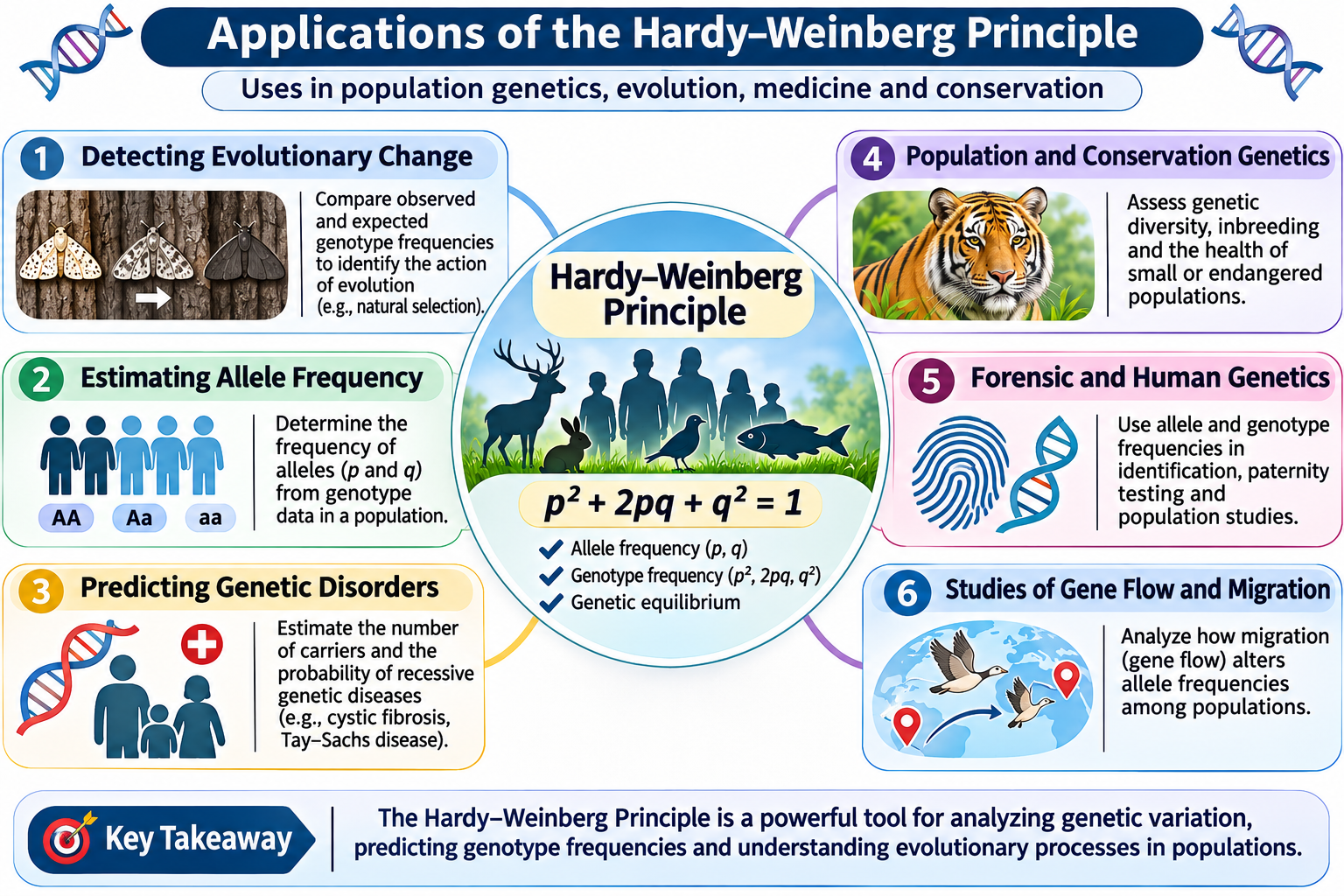
The Hardy–Weinberg Principle has several important applications in genetics, evolutionary biology, medicine and conservation biology. It provides a mathematical reference for studying the genetic composition of populations and identifying deviations from expected genetic equilibrium. By examining allele frequency and genotype frequency, the Hardy–Weinberg Principle helps researchers understand the distribution of inherited characteristics within populations.
The Hardy–Weinberg Principle is particularly useful because it connects Mendelian inheritance with population-level genetic patterns. It allows scientists to estimate the expected frequency of different genotypes and compare these values with observations from natural populations.
Genetic changes within populations provide important evidence for evolutionary processes, which are discussed in detail in our article on Evidences of Evolution: Types, Examples and Importance.
8.1 Estimation of Allele and Genotype Frequencies
One of the most important applications of the Hardy–Weinberg Principle is the estimation of allele frequency and genotype frequency.
When the frequency of one allele is known, the frequency of the alternative allele can be calculated. The expected proportions of homozygous and heterozygous individuals can then be estimated.
For example, if the frequency of allele A is 0.7 and allele a is 0.3, the expected genotype frequencies are:
- AA = 49%.
- Aa = 42%.
- aa = 9%.
Thus, the Hardy–Weinberg Principle provides a useful method for predicting the genetic composition of a population under equilibrium conditions.
8.2 Study of Inherited Genetic Disorders
The Hardy–Weinberg Principle is widely used in medical genetics to estimate the frequency of recessive alleles and potential carriers of inherited disorders.
For a recessive genetic condition, affected individuals generally possess two copies of the relevant recessive allele. Under appropriate Hardy–Weinberg assumptions, the frequency of affected individuals corresponds to q².
By calculating q from the square root of q², researchers can estimate the frequency of the recessive allele and the expected frequency of heterozygous carriers.
This approach is useful in population-level studies of inherited conditions such as cystic fibrosis and phenylketonuria. However, accurate estimates require reliable population data and consideration of factors such as population structure, selection and non-random mating.
8.3 Detection of Genetic Changes in Populations
The Hardy–Weinberg Principle provides a reference model for identifying possible evolutionary changes.
Researchers compare observed genotype frequencies with the frequencies predicted under genetic equilibrium. Significant deviations may indicate the influence of natural selection, genetic drift, migration, mutation or non-random mating.
Statistical methods, particularly the chi-square test, can be used to evaluate whether the difference between observed and expected genotype frequencies is greater than would be expected from sampling variation alone.
Therefore, the Hardy–Weinberg Principle is an important starting point for investigating evolutionary processes in natural populations.
8.4 Applications in Conservation Biology
The Hardy–Weinberg Principle is useful in conservation genetics for examining genetic variation in threatened and endangered populations.
Small and isolated populations may experience genetic drift, inbreeding and reduced gene flow. These processes can affect allele frequency, genotype frequency and overall genetic diversity.
Researchers use population-genetic data to investigate these changes and assess possible risks to population persistence.
However, deviation from Hardy–Weinberg equilibrium alone does not prove that a population is losing genetic diversity. It must be interpreted alongside information about population size, relatedness, migration and demographic history.
8.5 Study of Evolutionary Processes
The Hardy–Weinberg Principle helps researchers understand microevolution by providing a theoretical condition against which changes in allele frequencies can be evaluated.
When allele frequencies change across generations, researchers can investigate the evolutionary mechanisms responsible for those changes.
For example, natural selection may increase the frequency of beneficial alleles, while genetic drift may produce random changes in small populations. Gene flow may introduce new alleles, and mutation may generate new genetic variants.
The principle therefore provides an essential foundation for studying the mechanisms of evolution.
8.6 Applications in Human Population Genetics
The Hardy–Weinberg Principle is also applied in human population genetics to investigate the distribution of genetic variants among different populations.
Researchers may use genotype-frequency information to study inherited characteristics, genetic disease susceptibility and population differences.
Such studies require careful interpretation because human populations may contain subpopulations with different allele frequencies. Population subdivision and ancestry differences can produce deviations from expected genotype frequencies even when mating is random within individual subpopulations.
8.7 Importance in Genetic Research
The Hardy–Weinberg Principle remains an important theoretical and practical tool in modern genetics. Its major applications can be summarized as follows:
| Field | Application |
|---|---|
| Population genetics | Estimation of allele and genotype frequencies |
| Medical genetics | Estimation of recessive allele and carrier frequencies |
| Evolutionary biology | Investigation of evolutionary changes |
| Conservation biology | Assessment of genetic variation in populations |
| Human genetics | Study of inherited genetic variants |
| Genetic research | Comparison of observed and expected genotype frequencies |
Overall, the Hardy–Weinberg Principle provides a fundamental framework for studying genetic equilibrium and understanding the genetic structure of populations. Its applications extend from theoretical evolutionary biology to medical research and wildlife conservation.
9. Biological and Evolutionary Significance of the Hardy–Weinberg Principle
The Hardy–Weinberg Principle has considerable biological and evolutionary significance because it explains the genetic stability of populations and provides a foundation for understanding evolutionary changes. It connects Mendelian inheritance with population-level genetic processes and helps explain how allele frequency and genotype frequency behave across generations.
The Hardy–Weinberg Principle establishes genetic equilibrium as a theoretical reference condition. By comparing the genetic composition of natural populations with this reference, scientists can investigate the mechanisms responsible for evolutionary change.
Changes in genetic composition and reproductive isolation contribute to population differentiation and speciation, concepts closely connected with the Species Concept.
9.1 Establishes the Concept of Genetic Equilibrium
One of the major contributions of the Hardy–Weinberg Principle is the establishment of genetic equilibrium as a measurable population-level condition.
Genetic equilibrium occurs when allele frequencies and the expected genotype frequencies remain constant across generations under the assumptions of the principle.
This concept demonstrates that Mendelian inheritance alone does not necessarily produce evolutionary change. In the absence of evolutionary forces, genetic variation can be maintained within a population without continuous changes in allele frequency.
9.2 Explains the Relationship Between Inheritance and Evolution
The Hardy–Weinberg Principle explains that inheritance and evolution are related but distinct processes.
Inheritance transfers alleles from parents to offspring, while evolution involves changes in allele frequencies within populations over generations.
The principle demonstrates that the transmission of dominant and recessive alleles does not automatically change their frequencies. Therefore, the dominance of an allele does not determine whether its frequency will increase or decrease.
This distinction is essential for understanding population genetics and the genetic basis of evolution.
9.3 Provides a Foundation for Understanding Microevolution
Microevolution refers to changes in allele frequencies within a population across generations.
The Hardy–Weinberg Principle provides a baseline for identifying such changes. When the observed allele frequency differs from the expected stable condition, researchers can investigate the evolutionary forces responsible.
Mutation, migration, natural selection and genetic drift can alter the gene pool and produce evolutionary changes.
Thus, the principle provides a mathematical starting point for studying microevolution and its underlying mechanisms.
9.4 Helps Explain the Maintenance of Genetic Variation
Genetic variation refers to differences in genetic composition among individuals within a population.
The Hardy–Weinberg Principle demonstrates that genetic variation can persist across generations even when allele frequencies remain stable.
For example, a population containing two alleles may maintain homozygous and heterozygous individuals in predictable proportions under equilibrium conditions.
The frequency of heterozygous individuals is represented by 2pq. This relationship helps researchers understand the distribution of genetic variation within populations.
9.5 Helps Identify the Effects of Natural Selection
The Hardy–Weinberg Principle provides a reference against which the possible effects of natural selection can be investigated.
If certain genotypes have higher survival or reproductive success, their frequencies may change over successive generations.
For example, the sickle-cell allele can be maintained at relatively high frequencies in some malaria-endemic regions because heterozygous individuals may have increased protection against severe malaria.
This example illustrates how natural selection can influence allele frequency and produce deviations from expected genetic equilibrium.
9.6 Supports the Study of Population Differentiation
Populations of the same species may develop different genetic compositions because of geographical isolation, restricted migration, genetic drift and local adaptation.
The Hardy–Weinberg Principle helps researchers examine genotype frequencies within these populations and investigate possible deviations from equilibrium.
Comparisons between populations can provide information about gene flow, genetic differentiation and evolutionary history.
9.7 Connects Population Genetics with Modern Evolutionary Theory
The Hardy–Weinberg Principle is an important foundation of modern evolutionary biology because it provides a mathematical framework for studying changes in population gene pools.
It helps explain how evolutionary forces influence allele frequency and genotype frequency and how these changes contribute to microevolution.
The principle also supports broader investigations into adaptation, population differentiation and speciation. However, speciation and large-scale evolutionary patterns involve additional biological processes that cannot be explained by the equilibrium equations alone.
Consequently, the Hardy–Weinberg Principle remains an essential conceptual and mathematical tool for understanding the genetic basis of evolution.
10. Limitations of the Hardy–Weinberg Principle
The Hardy–Weinberg Principle is a fundamental mathematical model in population genetics, but its application to natural populations has certain limitations. The Hardy–Weinberg Principle is based on idealized assumptions, including a sufficiently large population, random mating and the absence of significant mutation, migration, natural selection and genetic drift.
In nature, populations are influenced by several biological and environmental factors that may prevent the maintenance of perfect genetic equilibrium. Therefore, the Hardy–Weinberg Principle should be understood as a theoretical reference model rather than a description of every natural population.
10.1 Idealized Population Conditions
One major limitation of the Hardy–Weinberg Principle is that it assumes ideal population conditions that are rarely found completely in nature.
Natural populations may experience changes in population size, geographical distribution, reproductive behaviour and environmental conditions. These factors can influence allele frequency and genotype frequency.
Consequently, the expected genetic equilibrium may not be maintained over successive generations.
10.2 Assumption of Random Mating
The Hardy–Weinberg Principle assumes random mating with respect to the gene being studied. However, mating in natural populations may be influenced by behavioural, ecological and genetic factors.
Inbreeding, assortative mating and sexual selection can alter genotype frequencies. Inbreeding generally increases homozygosity and decreases heterozygosity without necessarily changing allele frequencies.
Therefore, deviations in genotype frequency may occur even when allele frequencies remain stable.
10.3 Influence of Small Population Size
The Hardy–Weinberg Principle assumes a sufficiently large population in which random sampling effects are negligible.
Small populations are more strongly affected by genetic drift. Chance events may cause certain alleles to increase in frequency or disappear completely.
The founder effect and bottleneck effect are important examples of genetic drift that can substantially change the genetic composition of small populations.
10.4 Effects of Mutation and Migration
Mutation and migration can introduce new genetic variants or change the frequencies of existing alleles.
The Hardy–Weinberg Principle assumes that these processes do not significantly disturb the gene pool. However, natural populations may receive migrants from neighbouring populations or experience recurring mutations.
These processes can produce changes in allele frequency and disturb genetic equilibrium.
10.5 Influence of Natural Selection
The Hardy–Weinberg Principle assumes equal survival and reproductive success among the genotypes being studied.
In reality, environmental conditions may favour particular genetic variants. Individuals with advantageous genotypes may produce more offspring, causing their associated alleles to increase in frequency.
Therefore, natural selection can produce deviations from expected genotype frequencies and alter the genetic composition of populations.
10.6 Population Subdivision
Another limitation of the Hardy–Weinberg Principle is that it assumes the population under study is an appropriate single interbreeding unit.
Sometimes, a population sample contains individuals from several genetically distinct subpopulations. These subpopulations may have different allele frequencies.
Combining such groups can produce an apparent excess of homozygotes compared with Hardy–Weinberg expectations. This phenomenon is known as the Wahlund effect.
Therefore, population structure must be considered before interpreting deviations from genetic equilibrium.
10.7 Difficulty in Applying the Model to Complex Genetic Systems
The simplest form of the Hardy–Weinberg Principle considers a single gene with two alleles in a diploid population.
However, many biological characteristics involve multiple alleles, several interacting genes, sex-linked inheritance or complex patterns of inheritance.
Although the Hardy–Weinberg framework can be extended to more complicated genetic systems, additional calculations and assumptions may be required.
10.8 Interpretation of Deviations from Equilibrium
A deviation from Hardy–Weinberg equilibrium does not automatically identify the evolutionary mechanism responsible.
Differences between observed and expected genotype frequencies may result from selection, inbreeding, population subdivision, migration, genetic drift or sampling errors.
Researchers must therefore use additional biological information and appropriate statistical tests before drawing conclusions about evolutionary changes.
These limitations do not reduce the importance of the Hardy–Weinberg Principle. Instead, they demonstrate why its assumptions must be carefully considered when studying genetic equilibrium, allele frequency and genotype frequency in natural populations.
11. Conclusion
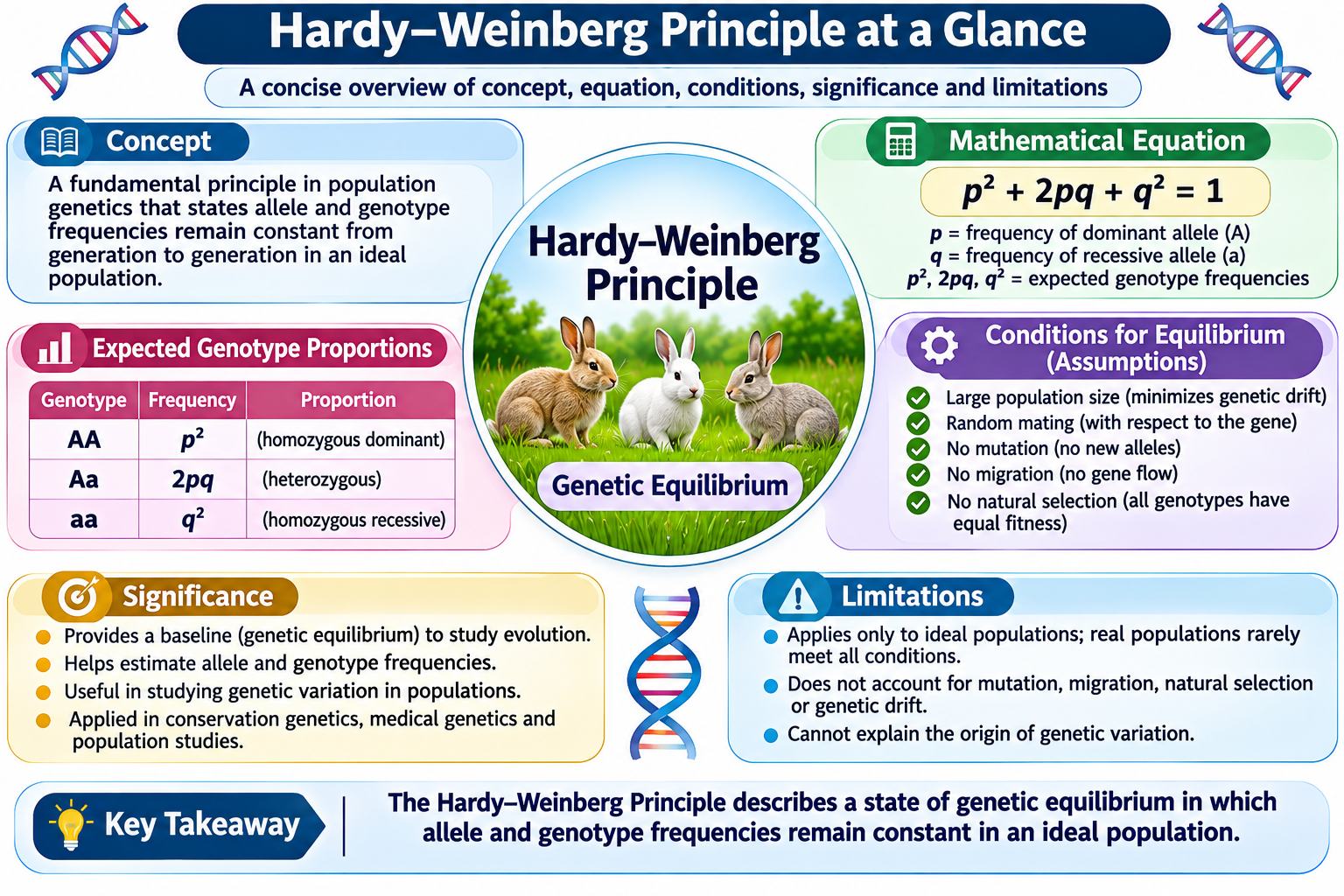
The Hardy–Weinberg Principle is a fundamental concept in population genetics that explains the relationship between allele frequency and genotype frequency in an ideal population. It establishes the mathematical conditions under which genetic equilibrium can be maintained across successive generations.
The Hardy–Weinberg Principle demonstrates that allele frequencies remain constant when a population is sufficiently large, mating is random, and significant mutation, migration, natural selection and genetic drift are absent. Its mathematical expressions, (p+q=1) and (p^2+2pq+q^2=1), provide a foundation for calculating expected genotype frequencies and understanding the genetic composition of populations.
The principle is particularly important because it provides a reference model for investigating evolutionary changes. Deviations from Hardy-Weinberg Equilibrium may indicate the influence of evolutionary forces, population subdivision or non-random mating. By examining these deviations, researchers can investigate changes in the gene pool and understand the mechanisms responsible for genetic variation.
The Hardy–Weinberg Principle also has practical applications in medical genetics, conservation biology, human population studies and evolutionary research. It helps estimate recessive allele frequencies, predict carrier frequencies and investigate genetic patterns within populations.
Although natural populations rarely satisfy all its assumptions perfectly, the Hardy–Weinberg Principle remains an essential theoretical and mathematical foundation for understanding genetic equilibrium, population genetics and the evolutionary process.
12. References
- Hardy, G. H. (1908). Mendelian proportions in a mixed population. Science, 28(706), 49–50. https://doi.org/10.1126/science.28.706.49
- Weinberg, W. (1908). Über den Nachweis der Vererbung beim Menschen. Jahreshefte des Vereins für vaterländische Naturkunde in Württemberg, 64, 369–382.
- Fisher, R. A. (1930). The Genetical Theory of Natural Selection. Oxford University Press.
- Wright, S. (1931). Evolution in Mendelian populations. Genetics, 16(2), 97–159. https://doi.org/10.1093/genetics/16.2.97
- Hartl, D. L., & Clark, A. G. (2007). Principles of Population Genetics (4th ed.). Sinauer Associates.
- Hedrick, P. W. (2011). Genetics of Populations (4th ed.). Jones & Bartlett Learning.
- Edwards, A. W. F. (2008). G. H. Hardy (1908) and Hardy–Weinberg equilibrium. Genetics, 179, 1143–1150. https://pmc.ncbi.nlm.nih.gov/articles/PMC2475721/
- Hastings, A. (2001). Hardy–Weinberg theorem. Encyclopedia of Life Sciences. Wiley. https://doi.org/10.1038/npg.els.0001741
- OpenStax. (2018). Population evolution. In Biology 2e. https://openstax.org/books/biology-2e/pages/19-1-population-evolution
- Nature Education. (2009). The Hardy–Weinberg principle. Scitable. https://www.nature.com/scitable/knowledge/library/the-hardy-weinberg-principle-13235724/
- Graffelman, J. (2020). Statistical tests for the Hardy–Weinberg equilibrium. Wiley StatsRef. https://doi.org/10.1002/9781118445112.stat08274
- OpenStax. (2018). Population genetics. In Biology 2e. https://openstax.org/books/biology-2e/pages/19-2-population-genetics
Frequently Asked Questions (FAQs)
What is the Hardy–Weinberg Principle?
What is the Hardy–Weinberg equilibrium equation?
p + q = 1, representing the sum of the frequencies of two alleles.
p² + 2pq + q² = 1, representing the expected genotype frequencies.
Here, p represents the frequency of the dominant allele, q represents the frequency of the recessive allele, p² represents the homozygous dominant genotype, 2pq represents the heterozygous genotype, and q² represents the homozygous recessive genotype.
What are the five main assumptions of the Hardy–Weinberg Principle?
A very large population size.
Random mating.
Absence of mutation.
No migration or gene flow.
Absence of natural selection.
These conditions help maintain genetic equilibrium across generations.
What is the difference between allele frequency and genotype frequency?
What is the significance of the Hardy–Weinberg Principle in evolution?
Which factors disturb Hardy–Weinberg equilibrium?
Can Hardy–Weinberg equilibrium occur in natural populations?
Why is the Hardy–Weinberg Principle important in medical genetics?
Does deviation from Hardy–Weinberg equilibrium always indicate evolution?
Who independently proposed the Hardy–Weinberg Principle?
Discover more from Zoologyverse
Subscribe to get the latest posts sent to your email.