
Enzymes are often described as the biological catalysts that make life possible. They accelerate thousands of chemical reactions inside cells, but simply having an enzyme present is not enough. Cells must also control when an enzyme works, where it works, and how strongly it works.
If metabolic enzymes remained active all the time, cells could waste valuable energy and materials or produce metabolites in excessive amounts. For this reason, enzyme activity is carefully regulated according to the changing needs of the cell.
The major mechanisms involved in the regulation of enzyme action include allosteric regulation, regulation by multiple enzyme forms (isozymes), reversible covalent modification, and proteolytic activation. These mechanisms allow metabolic pathways to respond rapidly and efficiently to cellular conditions.
This article explains each mechanism with important examples, including aspartate transcarbamoylase (ATCase), lactate dehydrogenase, glycogen phosphorylase, and the blood-clotting cascade.
What Is Regulation of Enzyme Action?
Regulation of enzyme action refers to the processes through which cells control the activity of enzymes so that biochemical reactions occur at the appropriate rate, location, and time.
The regulation of enzymes is particularly important in metabolic pathways. Rather than allowing every reaction to proceed continuously, cells adjust key enzymes according to factors such as:
- Substrate concentration
- Product concentration
- Cellular energy status
- Hormonal signals
- Metabolic requirements
- Tissue-specific needs
In many pathways, one or more enzymes act as important control points. Regulating these enzymes helps coordinate the entire pathway instead of independently controlling every reaction.
The major mechanisms discussed here are:
- Allosteric regulation
- Multiple forms of enzymes or isozymes
- Reversible covalent modification
- Proteolytic activation
Allosteric Regulation of Enzymes
Allosteric regulation is one of the most important mechanisms for controlling enzyme activity.
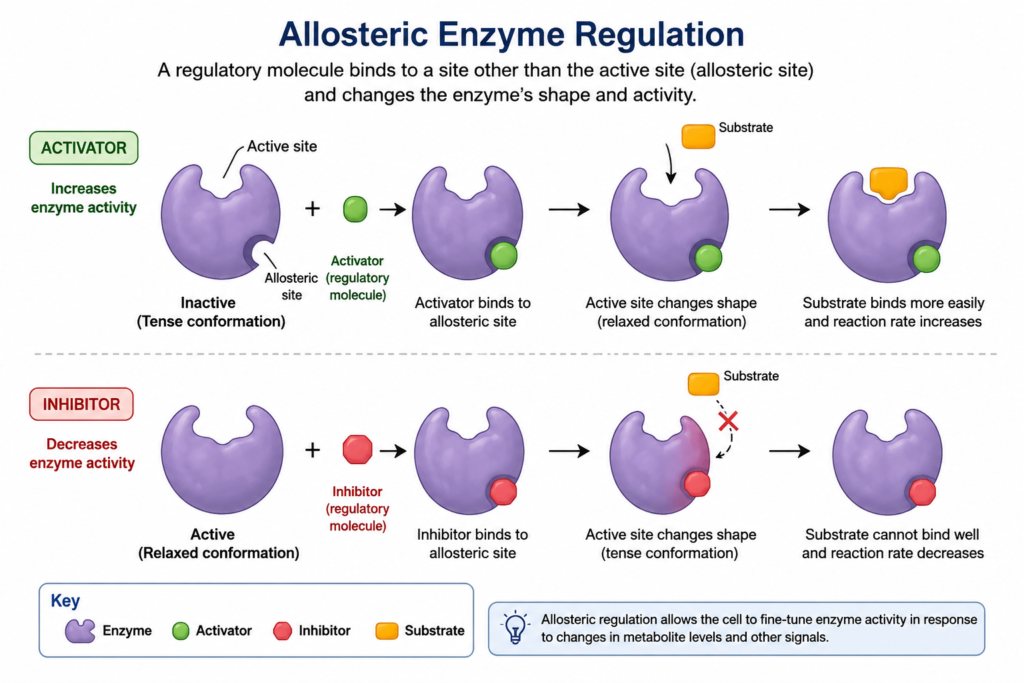
An allosteric enzyme contains a regulatory site that is different from its active site. When a regulatory molecule binds to this site, it can cause a change in the enzyme’s three-dimensional structure. This structural change can increase or decrease the activity of the catalytic site.
The term allosteric comes from Greek roots meaning approximately “other” and “structure,” referring to regulation through a site other than the active site.
How does allosteric regulation work?
A regulatory molecule may act as either:
- An allosteric activator, which increases enzyme activity
- An allosteric inhibitor, which decreases enzyme activity
Allosteric enzymes can also display cooperativity, in which the binding of a molecule at one site influences the behavior of other sites on the enzyme.
Feedback inhibition
A particularly important form of allosteric regulation is feedback inhibition.
In a metabolic pathway, the final product can inhibit an enzyme that functions early in the pathway. As the amount of final product rises, the pathway slows down. When the product is consumed and its concentration falls, inhibition decreases and the pathway can become more active again.
This provides an efficient way for cells to avoid producing unnecessary amounts of a metabolic product. Feedback inhibition is a well-established form of metabolic control. This type of metabolic control is also important when regulating pathways involved in energy production, such as glycolysis.
Example: Allosteric Regulation of Aspartate Transcarbamoylase
Aspartate transcarbamoylase (ATCase) is a classic example used to understand allosteric regulation.
ATCase catalyzes an early, committed step in the biosynthesis of pyrimidine nucleotides. Its activity is regulated by nucleotide signals associated with the metabolic state of the cell.
The best-known example is CTP (cytidine triphosphate), an end product of the pathway. CTP acts as a feedback inhibitor of ATCase, helping prevent excessive pyrimidine production. ATP can also influence ATCase activity in the opposite direction.
In simple terms:
High CTP → ATCase activity decreases → pyrimidine synthesis slows
Low CTP → inhibition is relieved → pathway activity can increase
This is an excellent example of how a cell can use the concentration of a metabolic product as a signal to control enzyme activity.
Key point: In feedback inhibition, the end product of a pathway reduces the activity of an enzyme involved earlier in producing that product.
Multiple Forms of Enzymes: Isozymes
Not every tissue requires an enzyme to behave in exactly the same way. Cells can solve this problem by producing different molecular forms of enzymes that catalyze the same reaction but have different regulatory or kinetic properties.
These different forms are called isozymes or isoenzymes.
Isozymes are generally related proteins that catalyze the same biochemical reaction but can differ in properties such as substrate affinity, maximum catalytic activity, regulation, and tissue distribution.
Because of these differences, isozymes allow metabolism to be fine-tuned for the needs of particular tissues or developmental stages.
Example: Lactate dehydrogenase
Lactate dehydrogenase (LDH) provides a classic example.
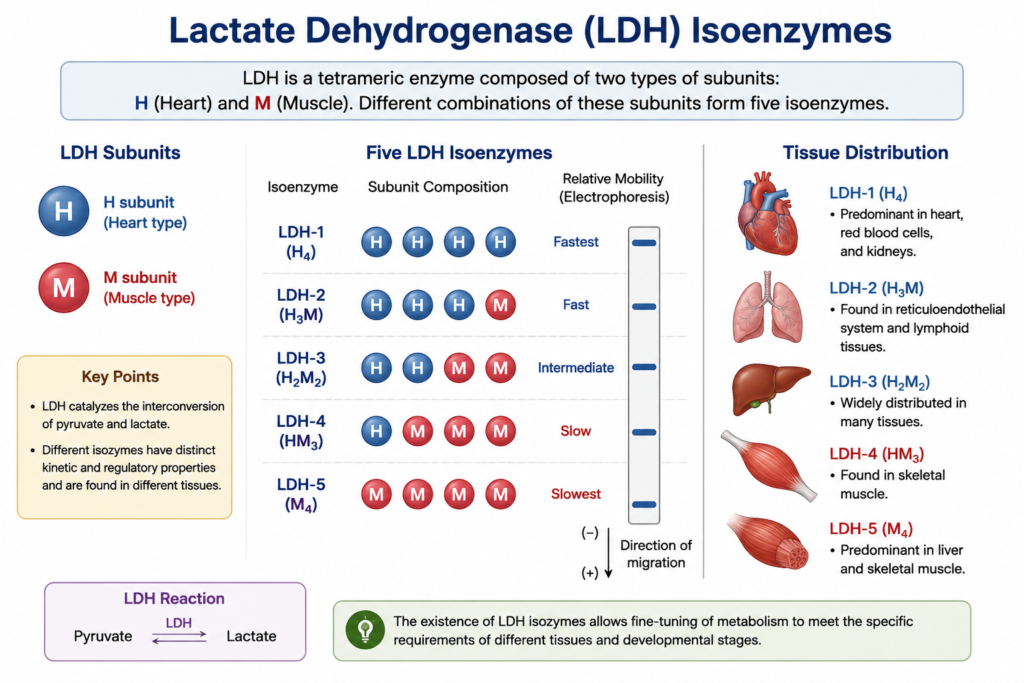
In humans, LDH can contain different types of subunits, traditionally designated H (heart) and M (muscle). These subunits can combine in different proportions to produce different LDH isozyme forms.
For example:
- H₄ is associated predominantly with cardiac tissue.
- M₄ is associated predominantly with skeletal muscle.
- Hybrid forms contain combinations of H and M subunits.
The different forms have different kinetic and regulatory properties, allowing LDH function to be adapted to the metabolic environment of different tissues.
Why are isozymes important?
Isozymes allow the same basic biochemical reaction to be adjusted to different physiological conditions.
For example, an enzyme operating in heart muscle may need different kinetic properties from the same enzyme operating in skeletal muscle. Producing different isoforms provides the cell with a built-in mechanism for metabolic specialization.
Reversible Covalent Modification
Another major mechanism of enzyme regulation involves reversible covalent modification. This type of regulation is particularly important in controlling enzymes involved in cellular energy metabolism.
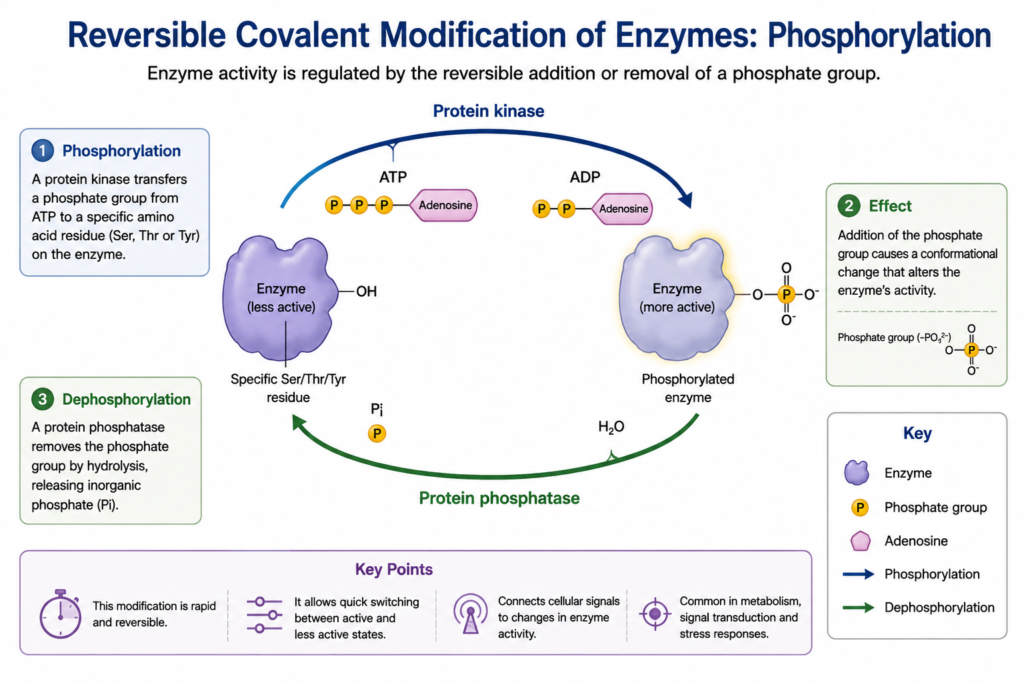
In this mechanism, a chemical group is temporarily attached to or removed from an enzyme. The modification changes the enzyme’s structure or its interaction with substrates and therefore alters its activity.
One of the most common examples is phosphorylation.
Enzyme phosphorylation
During phosphorylation, a phosphoryl group is added to a specific amino acid residue of a protein. Protein kinases commonly catalyze this reaction using ATP as the phosphoryl donor.
The modification can subsequently be removed by protein phosphatases.
Therefore:
Protein kinase → adds phosphate
Protein phosphatase → removes phosphate
Because these reactions are reversible, cells can rapidly switch certain enzymes between different functional states.
Example: Regulation of Glycogen Phosphorylase
Glycogen phosphorylase is an important enzyme involved in glycogen breakdown.
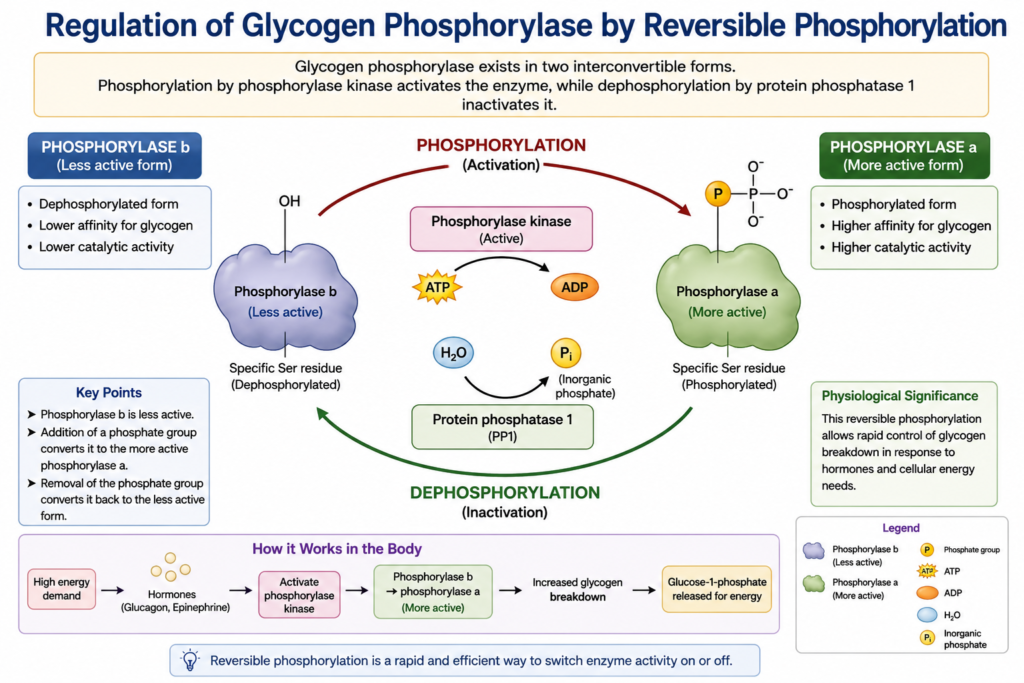
It occurs in two major functional states:
- Phosphorylase a — more active form
- Phosphorylase b — less active form
Phosphorylation of specific serine residues can promote conversion toward the more active form. The enzyme phosphorylase kinase adds phosphoryl groups, while protein phosphatase 1 (PP1) removes them.
This mechanism provides an efficient way of adjusting glycogen breakdown according to the energy requirements of the cell.
Why is this mechanism useful?
Reversible phosphorylation can connect enzyme activity to larger cellular signaling systems.
Hormonal and intracellular signals can activate protein kinases or phosphatases, which then modify metabolic enzymes. In this way, information received by a cell can be translated into changes in metabolic activity.
Proteolytic Activation of Enzymes
Proteolytic activation is different from the previous mechanisms because it is generally irreversible.
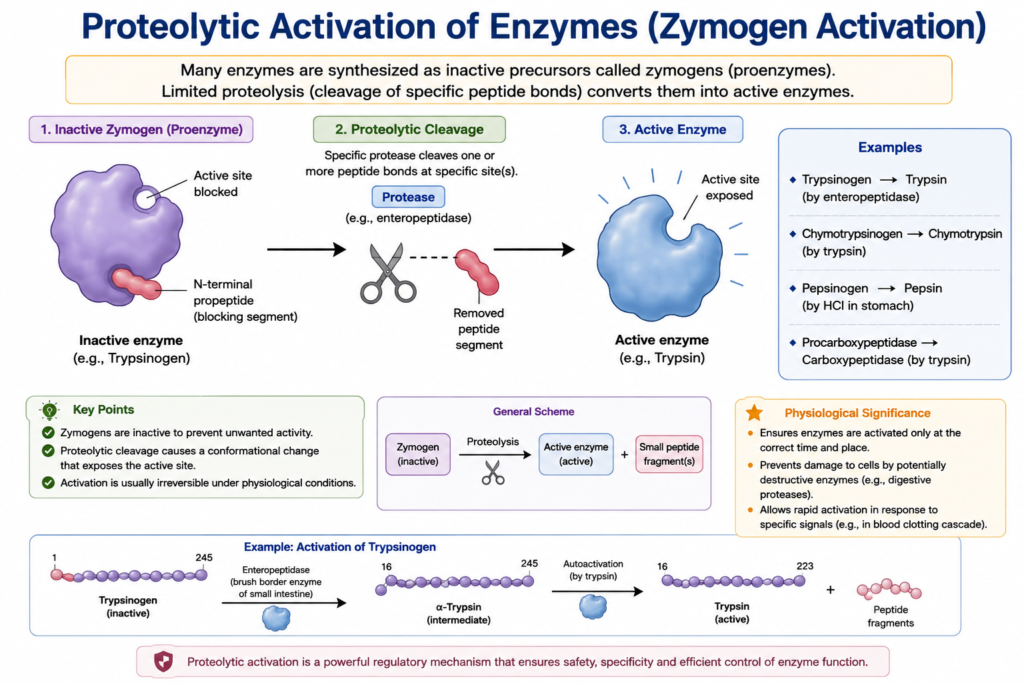
Some enzymes are synthesized as inactive precursor proteins called zymogens or proenzymes. They become active only after specific peptide bonds are cleaved.
This prevents potentially dangerous enzymes from becoming active before they are needed.
Examples include:
- Trypsin
- Chymotrypsin
- Pepsin
- Several blood-clotting proteases
- Caspases involved in programmed cell death
Once the appropriate peptide segment has been removed, the protein undergoes structural changes that produce the active enzyme.
Why are zymogens important?
Imagine digestive proteases being synthesized in their active forms inside the cells that produce them. They could begin digesting cellular proteins before reaching the digestive tract.
Producing them as inactive precursors provides an important safety mechanism.
Proteolytic Activation in Blood Coagulation
Blood coagulation is one of the most impressive examples of enzyme regulation through proteolytic activation.
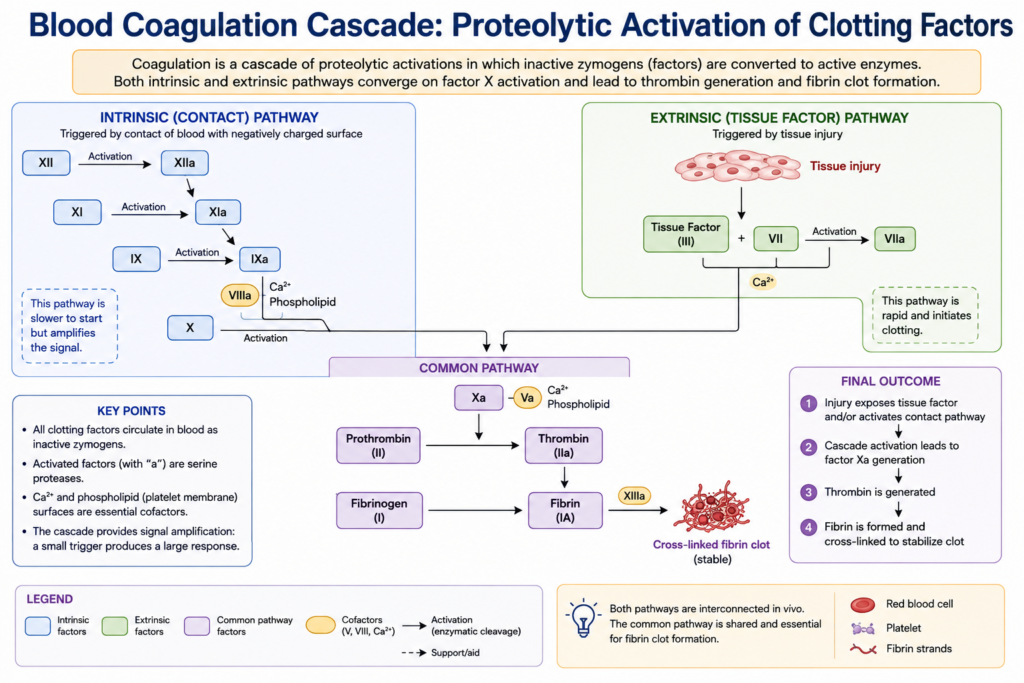
Many clotting factors circulate in the blood as inactive precursors. When coagulation begins, one activated factor can activate another, producing a cascade of proteolytic reactions.
This cascade provides substantial signal amplification.
The classical coagulation model contains intrinsic and extrinsic initiation pathways that converge on the activation of factor X. Factor Xa then participates in the conversion of prothrombin into thrombin. Thrombin subsequently converts fibrinogen into fibrin, which contributes to formation of the stable clot.
Extrinsic pathway
The extrinsic or tissue-factor pathway begins when tissue factor becomes exposed following tissue injury. Tissue factor interacts with factor VIIa and contributes to activation of factor X.
Intrinsic pathway
The intrinsic or contact pathway involves sequential activation of several coagulation factors, including factors XII, XI and IX, with factor VIII acting as an important cofactor.
Both pathways ultimately contribute to factor X activation and thrombin generation. Modern descriptions of coagulation emphasize that the pathways are interconnected rather than completely independent.
How the Four Mechanisms of Enzyme Regulation Differ
| Mechanism | Basic principle | Typical feature | Example |
|---|---|---|---|
| Allosteric regulation | Regulatory molecule binds at a regulatory site | Rapid and reversible | ATCase |
| Isozymes | Different forms catalyze the same reaction | Tissue-specific regulation | LDH |
| Reversible covalent modification | Chemical group is added or removed | Often rapidly reversible | Glycogen phosphorylase |
| Proteolytic activation | Specific peptide bond is cleaved | Usually irreversible | Trypsin, clotting factors |
Understanding these differences makes it easier to see why cells use more than one regulatory strategy. Some situations require rapid switching, while others require tissue-specific specialization or permanent activation of an enzyme precursor.
Why Is Regulation of Enzyme Action Important?
Enzyme regulation is essential for maintaining metabolic balance.
Without appropriate regulation:
- Metabolic pathways could become excessively active.
- Cellular resources could be wasted.
- Harmful intermediates could accumulate.
- Energy production could become poorly coordinated.
- Different tissues could fail to meet their specific metabolic requirements.
- Processes such as digestion and blood coagulation could become dangerous if activated at the wrong location or time.
The cell therefore uses several complementary mechanisms rather than relying on a single form of control.
Allosteric regulation can provide rapid responses to metabolites. Isozymes allow tissue-specific specialization. Reversible covalent modification connects enzyme activity to signaling pathways, while proteolytic activation allows carefully controlled activation of enzymes that are potentially hazardous in their active form.
Quick Revision: Regulation of Enzyme Action
Key Takeaways
For examination purposes, remember these four major mechanisms:
- Allosteric regulation :- A regulatory molecule binds to a site other than the active site and changes enzyme activity. Example: ATCase regulated by nucleotide signals such as CTP.
- Isozymes :- Different molecular forms of an enzyme catalyze the same reaction but possess different biochemical or regulatory properties. Example: LDH isoenzymes in different tissues.
- Reversible covalent modification :- A chemical group, commonly a phosphoryl group, is added to or removed from an enzyme. Example: Glycogen phosphorylase.
- Proteolytic activation :- An inactive precursor is converted into an active enzyme by cleavage of a specific peptide bond. Examples: Trypsinogen → trypsin and activation of coagulation factors.
Frequently Asked Questions
Frequently Asked Questions
What is regulation of enzyme action?
Regulation of enzyme action is the control of enzyme activity so that biochemical reactions occur at appropriate rates according to the needs of the cell.
What are the four major mechanisms of enzyme regulation?
The major mechanisms covered here are allosteric regulation, regulation through isozymes, reversible covalent modification, and proteolytic activation.
What is allosteric regulation?
Allosteric regulation occurs when a regulatory molecule binds to a site separate from the enzyme’s active site and changes the enzyme’s activity.
What is feedback inhibition?
Feedback inhibition occurs when the end product of a metabolic pathway inhibits an enzyme involved earlier in that pathway.
What are isozymes?
Isozymes are different molecular forms of enzymes that catalyze the same reaction but may differ in kinetic, structural, or regulatory properties.
What is reversible covalent modification?
It is a regulatory mechanism in which a chemical group is reversibly attached to or removed from an enzyme. Phosphorylation is one of the most common examples.
What are zymogens?
Zymogens are inactive enzyme precursors that require a specific activation step, commonly proteolytic cleavage, before becoming functional enzymes.
How is blood coagulation related to enzyme regulation?
Blood coagulation involves a cascade of proteolytic activation in which inactive enzyme precursors are converted into active proteases. This produces amplification of the initial signal and ultimately contributes to thrombin and fibrin formation.
Conclusion
The activity of an enzyme is not simply determined by whether the enzyme is present in a cell. Cells have sophisticated mechanisms for controlling enzyme activity according to their immediate and long-term requirements.
Allosteric regulation provides rapid control through regulatory molecules, while feedback inhibition prevents metabolic pathways from producing unnecessary quantities of their end products. Isozymes allow the same biochemical reaction to be adapted to different tissues. Reversible covalent modification, particularly phosphorylation, provides another powerful way to switch enzyme activity in response to cellular signals. Finally, proteolytic activation converts inactive zymogens into active enzymes when their activity is required.
Together, these mechanisms allow cells to maintain metabolic efficiency and coordinate energy metabolism
Understanding the regulation of enzyme action is therefore essential for studying biochemistry, metabolism, molecular biology, physiology, and related areas of life science.
References and Further Reading
- Nelson DL, Cox MM. Lehninger Principles of Biochemistry. 7th ed. — the source text listed in the uploaded material.
- NCBI Bookshelf: Regulation of Protein Function, including allosteric regulation and feedback inhibition.
- Gerhart and Pardee’s classic work on ATCase and the development of the concept of feedback inhibition and allostery is reviewed in PubMed. PubMed: From feedback inhibition to allostery — ATCase
- Research on the regulation of glycogen phosphorylase by phosphorylation and allosteric effectors. PubMed: Glycogen phosphorylase — control by phosphorylation and allosteric effectors
- NCBI Bookshelf: Biochemistry, Glycogen, including regulation of glycogen phosphorylase.
- NCBI Bookshelf: Physiological Haemostasis covering intrinsic, extrinsic and common coagulation pathways.
- PubMed: Back to basics — the coagulation pathway, providing a modern overview of the coagulation cascade.
Discover more from Zoologyverse
Subscribe to get the latest posts sent to your email.