
Ecological succession is the natural process by which the structure and composition of an ecological community change over time. One community of organisms gradually replaces another. Species diversity, population size, and soil conditions change as it happens. The process may take years, decades, or even centuries.
In this guide, you will learn the types of ecological succession, the stages of ecological succession, and clear examples of primary succession and secondary succession.
Ecological succession begins when organisms colonize a newly formed or disturbed habitat. For example, lichens and mosses may grow on bare rocks, followed by grasses, shrubs, and trees as soil develops. In another example, after a forest fire, grasses and herbs may grow first, followed by shrubs and young trees.
Ecological succession is broadly classified into primary succession and secondary succession. Primary succession begins in areas where soil is absent or largely undeveloped, whereas secondary succession occurs in previously inhabited areas where a disturbance has removed much of the existing vegetation but soil remains.
The study of ecological succession helps us understand ecosystem development, biodiversity, community interactions, and the recovery of habitats after natural or human-induced disturbances.
Definition of Ecological Succession
Ecological succession is the gradual and orderly change in the species composition and structure of a community over time. One community modifies the environment. This makes it suitable for other organisms to establish. Environmental conditions and species interactions then shape how the community develops.
Ecological succession may begin on newly exposed surfaces, such as bare rocks and newly formed volcanic islands, or in habitats disturbed by events such as forest fires, floods, and agricultural activities.
Key Characteristics of Ecological Succession
- Gradual change: Community composition changes over time.
- Species replacement: Some species establish themselves and may later be replaced by other species.
- Environmental modification: Organisms alter conditions such as soil composition, moisture, and light availability.
- Community development: The structure and interactions of the community change as succession proceeds.
- Variable outcomes: The final community depends on climate, soil, disturbance history, species availability, and other environmental factors.
Ecological succession is not always a fixed sequence ending in one permanent climax community. Disturbances and changing environmental conditions may redirect succession or maintain ecosystems in different states.
Types of Ecological Succession
Ecological succession is classified by the starting condition of the habitat, the driving factors, and the direction of change. The two major types are primary succession and secondary succession.
1. Primary Succession
Primary succession begins in a newly exposed or formed habitat where soil is absent or very poorly developed. Organisms gradually colonize the area, and their activities contribute to the development of soil and more complex communities.
Examples:
- Colonization of bare rocks by lichens and mosses.
- Development of vegetation on newly formed volcanic islands.
- Colonization of newly exposed surfaces left by retreating glaciers.
Primary succession is generally slow because soil formation and the accumulation of organic matter take time.
2. Secondary Succession
Secondary succession occurs in an area that previously supported a biological community but has experienced a disturbance. Soil usually remains, along with some seeds, roots, microorganisms, or other biological components that can support recovery.
Examples:
- Regrowth of vegetation after a forest fire.
- Recovery of a grassland after grazing pressure is reduced.
- Vegetation returning to abandoned agricultural land.
Secondary succession is often faster than primary succession because soil and some biological resources are already present.
Other Classifications
Ecological succession may also be described according to the forces driving it or the habitat in which it occurs.
- Autogenic succession: Changes are driven mainly by organisms modifying their environment, such as plants adding organic matter to soil.
- Allogenic succession: Changes are driven mainly by external factors, such as flooding, sediment deposition, or climatic shifts.
- Hydrarch succession: Traditionally describes succession beginning in very wet or aquatic habitats.
- Xerarch succession: Traditionally describes succession beginning in very dry habitats, such as bare rock or dry sand.
These categories describe different aspects of succession and are not all mutually exclusive. For example, succession can be both secondary and autogenic.
Stages of Ecological Succession
Ecological succession generally moves through a series of stages. Species composition and community structure change at each one. The exact sequence varies with habitat, climate, type of disturbance, and available colonizers.
The following stages describe a traditional model of ecological succession.
1. Nudation
Nudation is the formation or exposure of a bare area where a biological community is absent or greatly reduced. It may occur due to volcanic eruptions, landslides, glacial retreat, floods, forest fires, or other disturbances.
For example, newly exposed rock provides a surface that can be colonized by organisms adapted to harsh conditions.
2. Invasion
Invasion is the arrival and establishment of organisms in the newly available habitat. It is commonly divided into three processes:
- Migration: Seeds, spores, larvae, or other propagules reach the area through wind, water, or animals.
- Ecesis: The arriving organisms successfully establish themselves and begin to grow or reproduce.
- Aggregation: Established organisms increase in number and spread within the habitat.
Lichens may establish on bare rock, while grasses and herbs may colonize disturbed soil.
3. Competition and Coaction
As organisms become established, they compete for limited resources such as light, water, nutrients, and space. They also interact through processes such as facilitation, herbivory, and mutualism.
These interactions influence which species persist, expand, or decline as the community develops.
4. Reaction
During reaction, organisms modify the physical and chemical conditions of their habitat. These changes can influence the establishment of later species.
For example, lichens may contribute to rock weathering, while dead plant material adds organic matter to developing soil. As soil depth and nutrient availability increase, conditions may become suitable for grasses, shrubs, and eventually trees in appropriate climates.
5. Stabilization or Later Community Development
Over time, the community may develop into a relatively stable state suited to the prevailing environmental conditions. In the traditional model, this stage is called the climax community.
However, ecological succession does not always lead to one permanent climax community. Repeated disturbances, climate change, competition, and other ecological processes may maintain or produce different community states.
Ecological succession involves habitat exposure or disturbance, colonization, interactions among organisms, environmental modification, and continuing community development. These stages provide a useful framework, but real ecosystems do not always follow a rigid, universal sequence.
Primary Succession vs Secondary Succession
Primary succession and secondary succession are the two major types of ecological succession. Both involve changes in community composition over time. They differ mainly in the starting conditions: whether soil and biological resources are present.
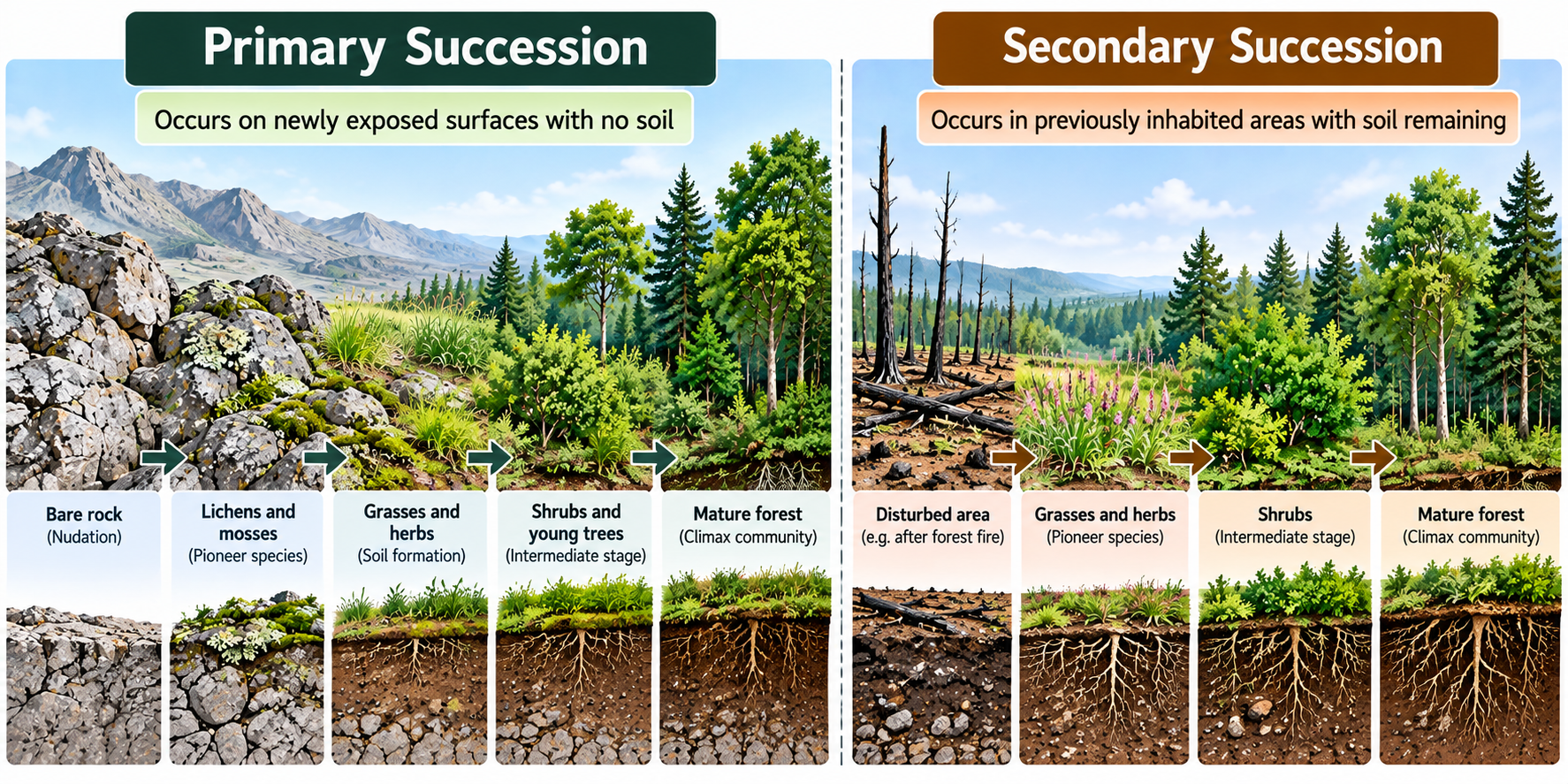
Differences Between Primary and Secondary Succession
| Feature | Primary Succession | Secondary Succession |
|---|---|---|
| Initial habitat | Newly formed or exposed habitat | Previously inhabited habitat affected by disturbance |
| Soil | Absent or poorly developed initially | Usually already present |
| Organic matter | Must accumulate or develop over time | Often remains in the soil |
| Pioneer organisms | May include lichens, microbes, and mosses | Often includes grasses, herbs, and surviving plants |
| Speed | Generally slower | Generally faster |
| Nutrient availability | Often very limited initially | Often greater because soil and nutrients remain |
| Previous community | Not established on the newly exposed surface | A previous community existed before disturbance |
| Examples | Bare rock, new volcanic surfaces, newly exposed glacial terrain | Abandoned farmland, burned forests, disturbed grasslands |
Example of Primary Succession
On bare rock, microorganisms and lichens may establish first. Weathering and the accumulation of organic matter gradually contribute to soil development. Mosses and herbaceous plants may then establish, followed by shrubs and trees where environmental conditions permit.
Example of Secondary Succession
After a forest fire, soil may remain along with seeds, roots, microorganisms, and surviving organisms. Grasses and herbs can regenerate first, followed by shrubs and young trees. The recovery pattern depends on fire severity, climate, seed availability, and the characteristics of the original forest.
Secondary succession is usually faster because soil and some biological resources remain. However, severe disturbances can remove these resources and slow recovery.
Examples of Ecological Succession
Ecological succession occurs in many terrestrial and aquatic environments. It can begin on newly formed surfaces or follow disturbances that alter an existing community. The following examples illustrate how ecological communities change over time.
1. Succession on Bare Rock
Bare rock provides little soil, organic matter, or available nutrients. In a typical example of primary succession, microorganisms and lichens colonize the surface. Lichens contribute to rock weathering, while dead organic material gradually accumulates.
As conditions become suitable, mosses and herbaceous plants may establish, followed by shrubs and trees where climate and soil development permit.
2. Succession After a Forest Fire
A forest fire may destroy vegetation while leaving much of the soil intact. Seeds, roots, underground stems, and microorganisms can survive, depending on the fire’s intensity.
Grasses and herbs often regenerate first, followed by shrubs and trees. This is an example of secondary succession, although severe fires can make recovery more complex.
3. Succession on Abandoned Agricultural Land
When cultivated land is no longer farmed, weeds and other fast-growing herbaceous plants may establish first. Grasses and perennial plants can become more abundant, followed by shrubs and trees if the climate, soil, and seed supply permit.
This is a common example of secondary succession because the land previously supported a biological community and usually retains its soil.
4. Succession on Newly Formed Volcanic Land
Volcanic eruptions can create new surfaces of lava or volcanic deposits. Pioneer organisms gradually colonize these surfaces as weathering and organic matter accumulation improve conditions.
Over time, more plant species may establish. The rate of succession depends on the nature of the volcanic material, moisture, temperature, and the arrival of propagules.
5. Succession in a Pond or Lake
In some freshwater environments, sediments and organic matter gradually accumulate. Aquatic plants may establish in suitable areas, and changes in water depth and habitat conditions can alter the composition of the biological community.
Traditional ecological descriptions call succession beginning in wet or aquatic habitats hydrarch succession. However, ponds and lakes do not all follow the same sequence, and many remain aquatic for long periods.
6. Succession After a Glacier Retreats
When a glacier retreats, it can expose bare rock, sediment, or poorly developed soil. Microorganisms, lichens, mosses, and pioneer plants may gradually colonize the exposed terrain.
As organic matter accumulates and soil develops, additional plants and animals may establish. This is a useful example of primary succession, although the initial conditions vary among sites.
These examples show that ecological succession is a dynamic process rather than a fixed sequence. The organisms that establish, the speed of change, and the eventual community depend on environmental conditions, disturbance history, and interactions among species.
Pioneer Species and Climax Community
Pioneer species and climax communities are key ideas in the traditional study of succession. Pioneer species are among the first to establish in a new habitat. A climax community is a relatively stable community that develops in the later stages.
Pioneer Species
Pioneer species are organisms that colonize a newly formed or disturbed habitat during the early stages of ecological succession. They are often adapted to environmental conditions that limit the growth of other organisms.
Common examples include:
- Lichens: Colonize exposed rocks and contribute to rock weathering.
- Mosses: Grow in suitable moist habitats and can help retain water and trap organic material.
- Grasses and herbs: Rapidly colonize disturbed soil and may stabilize the surface.
- Microorganisms: Help decompose organic material and influence nutrient availability.
The identity of pioneer species depends on the habitat. Lichens may be important on bare rock, while grasses and herbs may establish rapidly in disturbed grassland or abandoned farmland.
Characteristics of Pioneer Species
- They can establish under the conditions present in an early-stage habitat.
- Many disperse effectively through seeds, spores, or other propagules.
- Some tolerate limited nutrients, exposure, or fluctuating moisture.
- They may alter environmental conditions and influence which species establish later.
- Their presence can initiate changes in community composition and ecosystem structure.
Not every pioneer species improves conditions for later species. Some may compete with or inhibit other organisms, so succession depends on several interacting processes.
Climax Community
In the traditional model, a climax community is a relatively stable community that develops in the later stages of succession and remains broadly similar while environmental conditions remain relatively unchanged.
Its characteristics may include:
- Community structure suited to the local climate and soil.
- Established relationships among plants, animals, and microorganisms.
- Ongoing nutrient cycling and energy transfer.
- Continued changes in species abundance despite relative stability in overall structure.
For example, a mature forest may represent a later successional community in a region where climate, soil, and disturbance patterns support forest development.
Is a Climax Community Permanent?
A climax community is not necessarily permanent. Fires, floods, storms, grazing, human activities, and climate change can alter the community and restart or redirect succession. Some ecosystems also remain naturally dynamic, with disturbances helping maintain their characteristic structure.
Modern ecology therefore recognizes that communities can follow different successional pathways rather than always progressing toward one universal climax state.
Pioneer species characterize early colonization, while the term climax community traditionally describes a relatively stable later-stage community.
Hydrarch and Xerarch Succession
Succession can also be classified by the moisture conditions where it begins. Two traditional categories are hydrarch succession and xerarch succession. They differ mainly in initial water availability and the challenges colonizing organisms face.
1. Hydrarch Succession
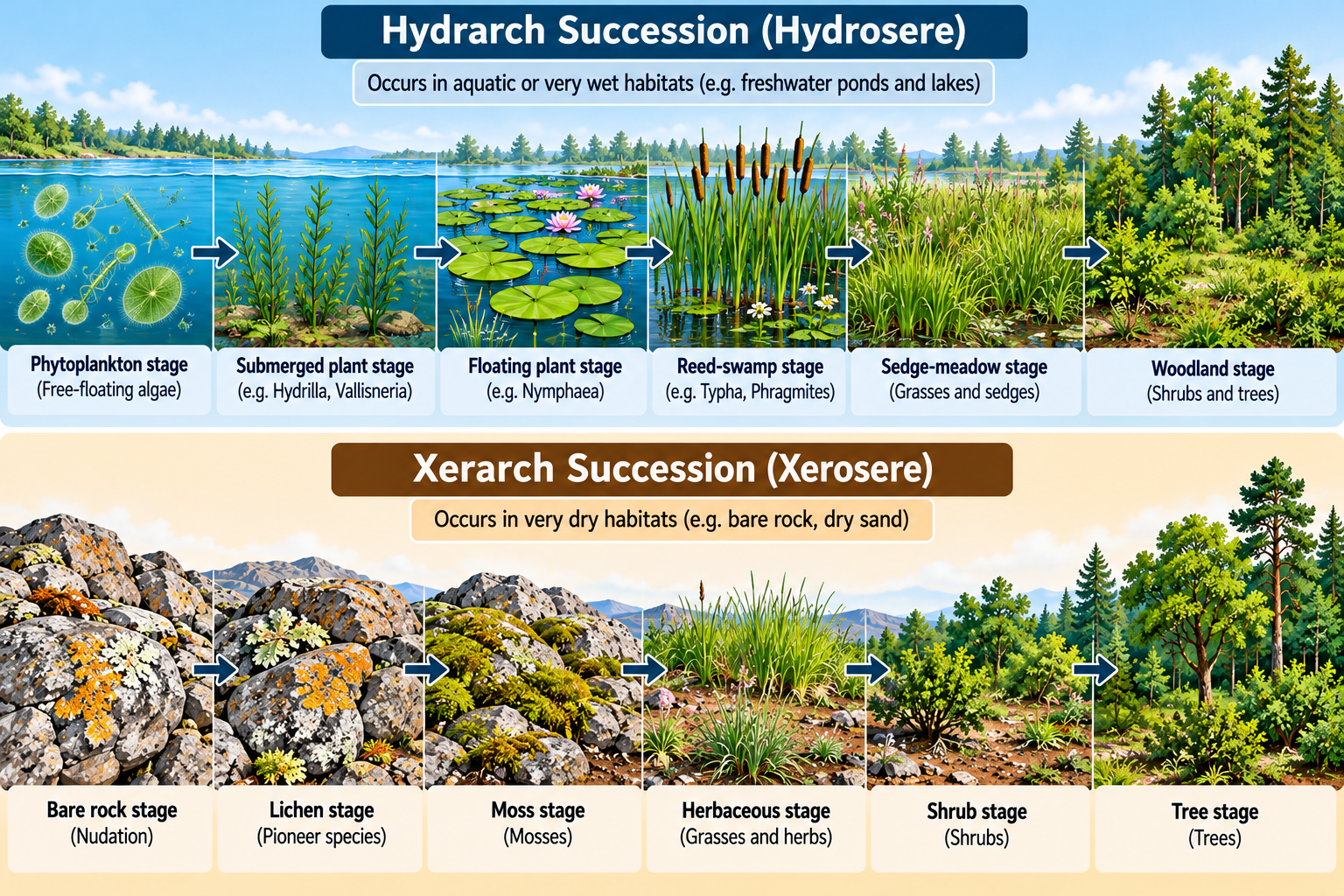
Hydrarch succession is a traditional term for succession that begins in aquatic or very wet habitats, such as ponds, lakes, and marshes. It is also known as hydrosere when describing a succession sequence beginning in freshwater.
In a simplified traditional model, sediment and organic matter gradually accumulate, and changing water depth and habitat conditions allow different plant communities to establish.
Typical sequence in a freshwater hydrosere:
- Phytoplankton stage: Microscopic photosynthetic organisms and other microorganisms occur in the water.
- Submerged plant stage: Plants such as Hydrilla may grow in suitable shallow water.
- Floating plant stage: Plants such as water lilies may establish where water depth and light conditions are appropriate.
- Reed-swamp stage: Emergent plants such as reeds may grow in shallow water.
- Sedge-meadow stage: Sedges and grasses may become established as conditions change.
- Woodland or forest stage: In suitable climates and landscapes, shrubs and trees may develop if the habitat becomes sufficiently terrestrial.
This sequence is a simplified model, not a universal progression. Many aquatic ecosystems remain aquatic, and their development depends on hydrology, sediment supply, climate, and disturbance.
2. Xerarch Succession
Xerarch succession begins in a very dry habitat, such as bare rock or dry sand. When succession begins on bare rock, the sequence is often called a xerosere.
Pioneer organisms must tolerate limited water availability, strong sunlight, and sometimes large temperature fluctuations.
Typical sequence in a lithosere on bare rock:
- Crustose lichen stage: Crust-like lichens colonize exposed rock and contribute to weathering.
- Foliose lichen stage: Leaf-like lichens may establish as conditions change.
- Moss stage: Mosses may grow where moisture and suitable surface material become available.
- Herbaceous stage: Grasses and other small plants may establish as soil and organic matter accumulate.
- Shrub stage: Shrubs may develop where soil depth and water availability permit.
- Tree stage: Trees may establish in climates and locations capable of supporting woodland or forest.
The exact stages vary considerably. For example, succession on dry sand may begin with grasses and other sand-adapted plants rather than lichens.
Differences Between Hydrarch and Xerarch Succession
| Feature | Hydrarch Succession | Xerarch Succession |
|---|---|---|
| Initial habitat | Aquatic or very wet | Very dry |
| Initial water availability | Abundant | Limited |
| Common pioneer organisms | Algae, phytoplankton, or aquatic plants, depending on the habitat | Lichens, microbes, or drought-tolerant plants, depending on the substrate |
| Pioneer organisms | May include lichens, microbes, and mosses | Often includes grasses, herbs, and surviving plants |
| Major environmental changes | Changes in water depth, sediment, and vegetation | Rock weathering, soil development, and changes in moisture retention |
| Traditional example | Freshwater hydrosere | Lithosere beginning on bare rock |
Hydrarch and xerarch succession describe traditional patterns of community development based on initial habitat conditions. Neither guarantees that the ecosystem will eventually become a forest; the outcome depends on the prevailing environmental conditions
Factors Affecting Ecological Succession
Several environmental and biological factors influence ecological succession. They determine which organisms can colonize a habitat and how communities change. They also decide whether succession leads toward woodland, grassland, or another state.
1. Climatic Factors
Climate strongly influences the distribution and growth of organisms during succession. Important climatic factors include:
- Temperature: Affects seed germination, growth, reproduction, and survival.
- Rainfall: Determines water availability and influences which plants can establish.
- Light: Influences photosynthesis and competition among plants.
- Wind: Helps disperse seeds and spores but can also cause physical damage.
- Humidity: Affects water loss and the survival of moisture-sensitive organisms.
For example, succession in a moist tropical region may support forest development, whereas low rainfall may favor grassland or shrubland.
2. Soil Factors
Soil conditions influence plant establishment and ecosystem development. Important factors include soil depth, texture, pH, nutrient availability, organic matter, and water-holding capacity.
During succession, plant growth and decomposition may add organic matter and change soil structure. These changes can make the habitat suitable for additional species.
3. Topographic Factors
The physical features of an area can influence succession by affecting sunlight, drainage, temperature, and erosion.
- Slope: Steep slopes may experience greater erosion and soil loss.
- Aspect: The direction a slope faces affects sunlight exposure and moisture.
- Elevation: Influences temperature, growing seasons, and the types of organisms that can survive.
Consequently, two nearby locations may develop different communities even under similar regional climatic conditions.
4. Biological Factors
Interactions among organisms can promote or inhibit succession. These include competition, facilitation, predation, herbivory, mutualism, and decomposition.
Competition, predation, herbivory, and mutualism influence which organisms establish and survive as a community changes. These interactions also shape food chains and food webs, which show how organisms are connected through feeding relationships.
For example, nitrogen-fixing plants may increase nitrogen availability in some habitats, while dense vegetation may reduce light reaching the ground and affect the establishment of other species.
5. Disturbance
Disturbances can remove organisms, alter soil conditions, or create opportunities for colonization. Common disturbances include:
- Forest fires
- Floods
- Storms
- Landslides
- Volcanic eruptions
- Grazing
- Deforestation and other human activities
The effect depends on the type, severity, frequency, and timing of the disturbance. A mild disturbance may create new opportunities for some species, whereas a severe disturbance may remove soil and slow recovery.
6. Availability of Seeds and Other Propagules
Succession depends partly on whether organisms can reach a habitat. Seeds, spores, larvae, and other propagules may arrive through wind, water, or animals.
If nearby source populations are absent or dispersal is limited, some species may take a long time to colonize even when the habitat is suitable.
7. Interactions Among Factors
These factors rarely operate independently. For example, rainfall influences soil moisture, which affects plant growth and competition. Plant growth then changes shade, organic matter, and nutrient availability, influencing later community development.
Ecological succession results from the combined effects of climate, soil, topography, organisms, disturbance, and dispersal. Their interactions determine the pathway and speed of community change.
Importance of Ecological Succession
Ecological succession is important for understanding how ecosystems develop, recover from disturbances, and respond to environmental changes. It influences biodiversity, soil formation, nutrient cycling, habitat availability, and ecosystem stability.
1. Development of Ecosystems
Ecological succession helps explain how biological communities establish and change in newly formed or disturbed habitats. Pioneer organisms may colonize exposed surfaces, followed by other species as environmental conditions change.
Changes in community composition also influence feeding relationships and the distribution of organisms across trophic levels. These relationships can be understood further through ecological pyramids and their types, which illustrate the distribution of numbers, biomass, or energy within an ecosystem.
2. Soil Formation and Improvement
During succession, organisms can contribute to soil development through rock weathering, organic matter accumulation, and decomposition. These processes may improve soil structure, nutrient availability, and water retention.
3. Changes in Biodiversity
As habitats change, different species may establish, decline, or disappear. Succession can increase local species richness in some situations, although biodiversity does not necessarily increase at every stage or in every ecosystem.
4. Nutrient Cycling
Plants, animals, fungi, and microorganisms contribute to nutrient cycling through feeding, waste production, and decomposition. As communities develop, these processes influence the availability and movement of nutrients such as nitrogen and phosphorus.
As ecosystems develop, feeding relationships and decomposer activity influence the movement of energy and nutrients. Learn more about energy flow in an ecosystem, including trophic-level transfer and the 10% law, to understand how energy moves through biological communities.
5. Recovery After Disturbances
Secondary succession helps explain the recovery of ecosystems following events such as forest fires, floods, storms, or the abandonment of agricultural land. The rate and outcome of recovery depend on the disturbance’s severity, surviving organisms, soil conditions, and the availability of colonizing species.
6. Habitat Development
Changes in vegetation and physical conditions create habitats for different organisms. For example, the development of shrubs and trees may provide nesting sites, shelter, and food resources for birds, insects, and mammals.
7. Ecosystem Management and Conservation
Knowledge of ecological succession helps ecologists plan habitat restoration, manage disturbed landscapes, and identify the conditions needed for native species to recover. It also helps distinguish natural ecosystem change from degradation caused by repeated or severe disturbances.
8. Understanding Environmental Change
Succession provides insight into how communities respond to changing climate, soil conditions, resource availability, and human activities. It also helps explain why the same disturbance can produce different outcomes in different locations.
Ecological succession is a fundamental ecological process that shapes community composition and ecosystem function. Understanding it supports biodiversity conservation, habitat restoration, and the sustainable management of natural environments.
Frequently Asked Questions About Ecological Succession
What is ecological succession?
What are the two main types of ecological succession?
What is primary succession?
What is secondary succession?
What are pioneer species?
What is a climax community?
What are the main stages of ecological succession?
Why is primary succession slower than secondary succession?
What is hydrarch succession?
What is xerarch succession?
What factors affect ecological succession?
Does ecological succession always end in a forest?
What is the importance of ecological succession?
What is the difference between autogenic and allogenic succession?
Conclusion
Ecological succession is a natural process through which the composition and structure of biological communities change over time. It helps explain how organisms colonize new habitats, modify environmental conditions, and establish communities following disturbances.
The two major types, primary succession and secondary succession, differ mainly in the initial availability of soil and biological resources. Pioneer species contribute to early colonization, while interactions among organisms and environmental factors influence subsequent community development. Hydrarch and xerarch succession provide traditional models for understanding succession in wet and dry habitats.
Understanding ecological succession is essential for studying ecosystem development, biodiversity, nutrient cycling, and habitat recovery. Although traditional models describe a progression toward a climax community, real ecosystems may follow different pathways and remain dynamic in response to disturbances and environmental change.
References
- OpenStax. Biology 2e: Community Ecology. Covers community dynamics, primary succession, secondary succession, and pioneer species.
https://openstax.org/books/biology-2e/pages/45-6-community-ecology - OpenStax. Concepts of Biology: Community Ecology. An introductory resource explaining ecological succession and community change.
https://openstax.org/books/concepts-biology/pages/19-4-community-ecology - Khan Academy. Ecological Succession. Explains primary succession, secondary succession, pioneer species, and changes in communities over time.
https://en.khanacademy.org/science/biology/ecology/community-structure-and-diversity/a/ecological-succession - INFLIBNET. Ecological Succession – Part 1: Ecosystem Structures and Functions. Discusses traditional succession terminology, stages, and classifications.
https://ebooks.inflibnet.ac.in/esp01/chapter/19-ecological-succession-part-1/ - Poorter, L. et al. (2023). Successional theories. Biological Reviews, 98(6), 2049–2077. A scientific review of ecological succession theories and models.
https://doi.org/10.1111/brv.12995
Discover more from Zoologyverse
Subscribe to get the latest posts sent to your email.