
Introduction to Endoplasmic Reticulum
Cells contain several specialized organelles, and each performs specific tasks that help the cell survive and function properly. One of these important organelles is the endoplasmic reticulum (ER).
The endoplasmic reticulum is an extensive network of membranes present in the cytoplasm of eukaryotic cells.
It consists of interconnected sacs and tubules and is closely associated with the nucleus.
Depending on whether ribosomes are attached to its surface, the endoplasmic reticulum is broadly divided into rough endoplasmic reticulum (RER) and smooth endoplasmic reticulum (SER).
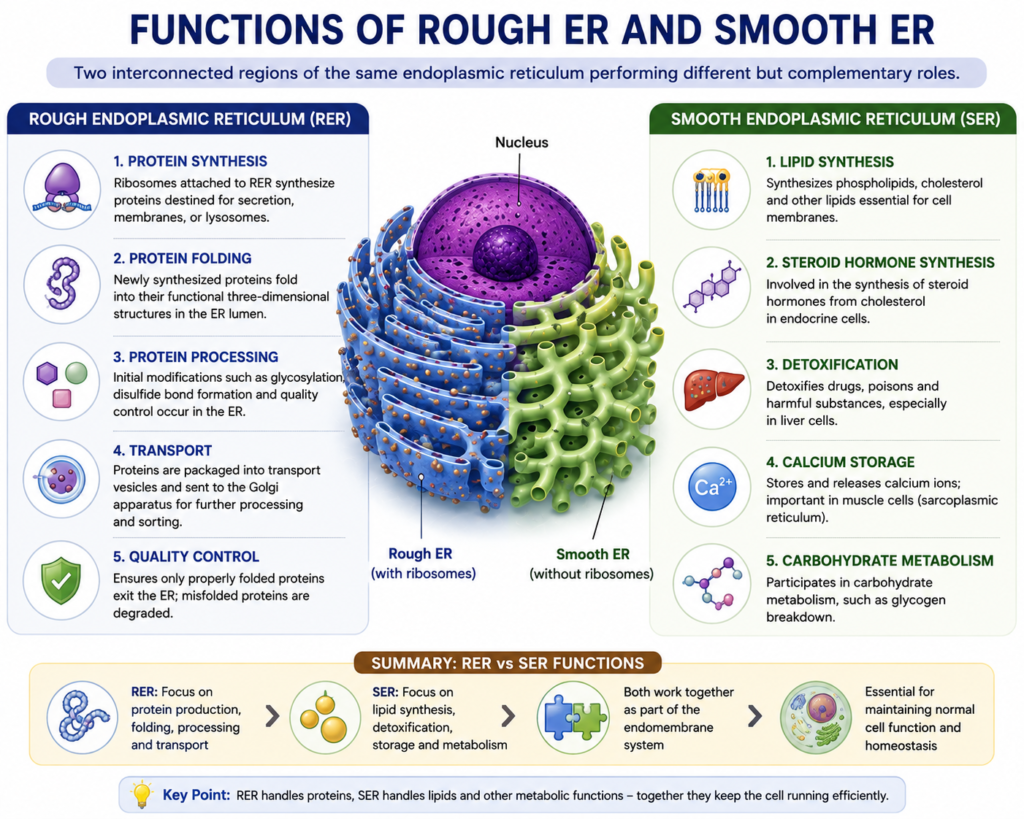
The rough ER is mainly involved in the synthesis, folding, and initial processing of proteins, while the smooth ER has important roles in lipid metabolism, detoxification, steroid synthesis, and calcium storage.
Understanding the structure and functions of the endoplasmic reticulum is therefore essential for understanding how eukaryotic cells produce, process, and transport important biological molecules.
What is Endoplasmic Reticulum?
The endoplasmic reticulum is a membrane-bound organelle forming a continuous network of flattened sacs and branching tubules throughout much of the cytoplasm.
The word endoplasmic refers to its location within the cytoplasm, while reticulum means a network.
The ER membrane is continuous with the outer membrane of the nuclear envelope, allowing close communication between the nucleus and the ER.
The interior space enclosed by the ER membrane is called the ER lumen or cisternal space.
The ER has two major regions:
- Rough endoplasmic reticulum (RER)
- Smooth endoplasmic reticulum (SER)
Although these regions differ in appearance and function, they form parts of the same interconnected membrane system.
Endoplasmic reticulum = interconnected membrane network + lumen + rough and smooth regions.
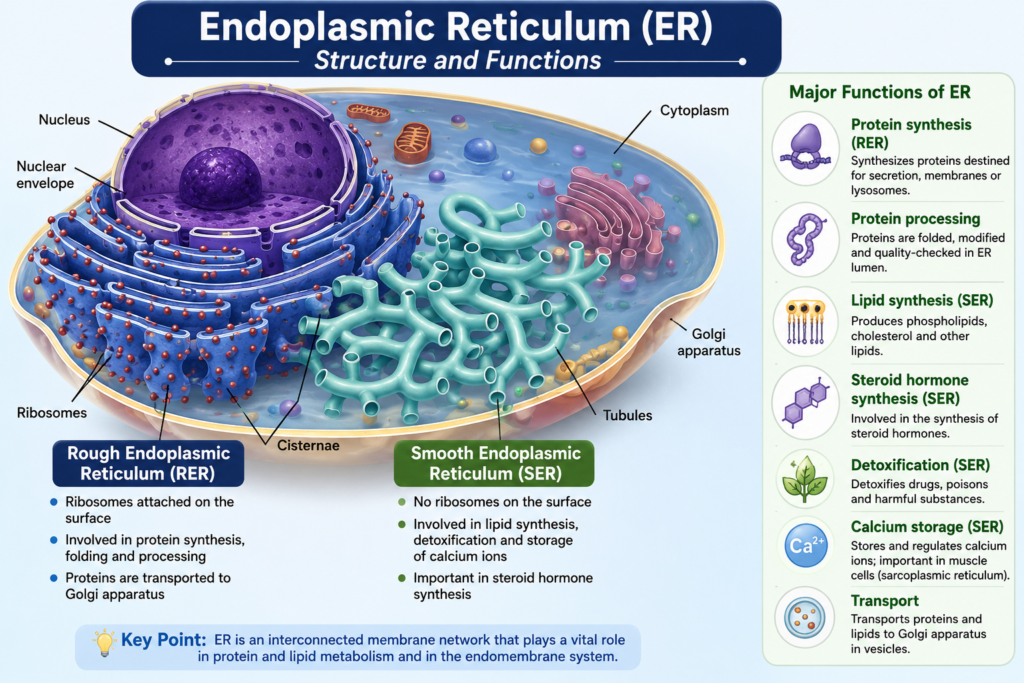
Structure of Endoplasmic Reticulum
The endoplasmic reticulum is composed mainly of a phospholipid bilayer containing proteins.
Its membrane encloses a fluid-filled internal space called the lumen.
The ER occurs in different structural forms, including flattened membrane sacs called cisternae and branching membrane tubules.
The relative amount of sheets and tubules varies according to the specialized functions of a cell.
Cells that produce large amounts of proteins generally have extensive rough ER, whereas cells specialized in lipid metabolism often contain abundant smooth ER.
The ER is closely connected to the nuclear envelope. This structural relationship helps coordinate activities between the nucleus and the cytoplasm.
1. Rough Endoplasmic Reticulum
The rough ER consists largely of flattened membrane sacs with ribosomes attached to the cytoplasmic surface.
These ribosomes give the organelle its characteristic rough or granular appearance under an electron microscope.
The ribosomes are not permanent structural components of the ER.
They associate with the ER membrane when they are synthesizing proteins that enter the secretory pathway.
The rough ER is particularly abundant in cells that produce and secrete large quantities of proteins, such as pancreatic secretory cells.
2. Smooth Endoplasmic Reticulum
The smooth ER lacks ribosomes on its cytoplasmic surface, giving it a smooth appearance.
It usually forms a more tubular network and is especially abundant in cells involved in lipid metabolism, steroid hormone production, detoxification, and calcium regulation.
The rough and smooth ER are not two completely separate organelles.
They are interconnected regions of the same ER system.
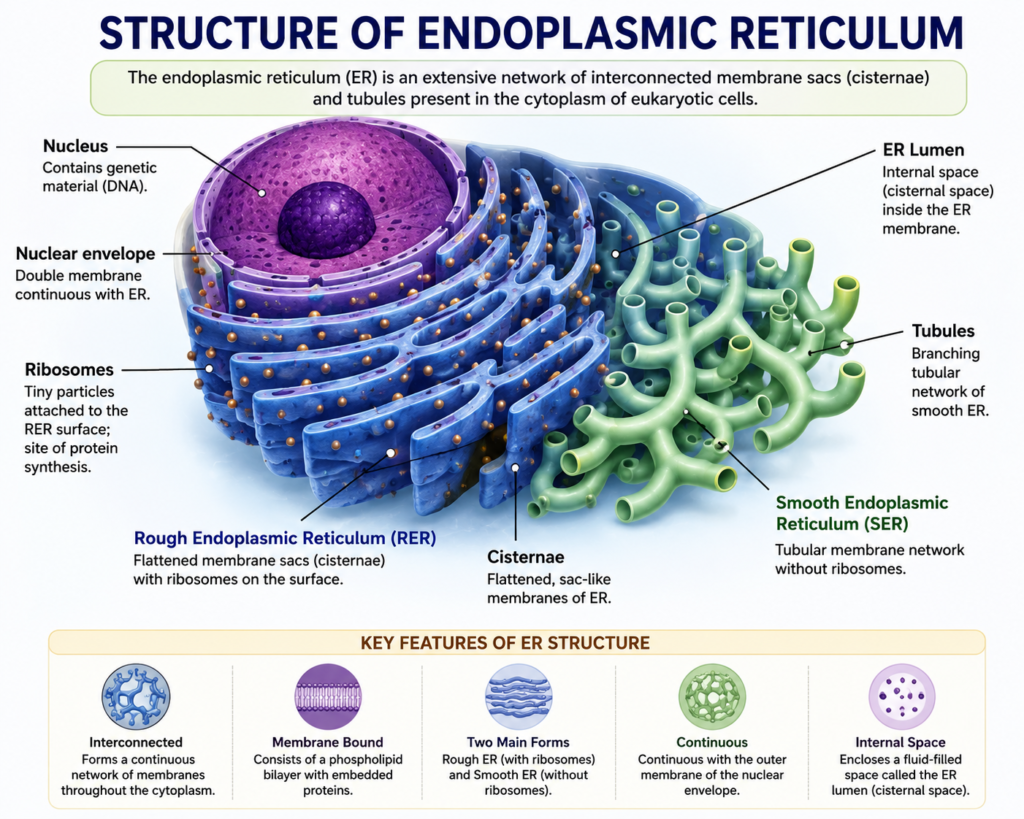
Types of Endoplasmic Reticulum
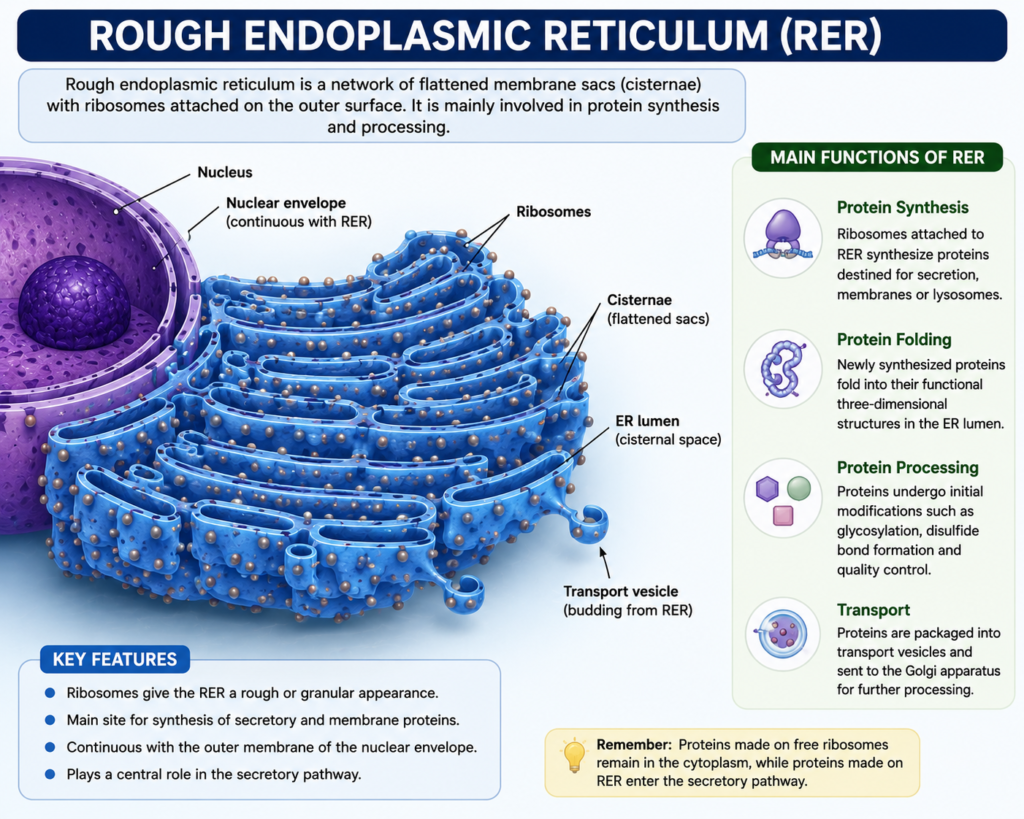
Rough Endoplasmic Reticulum
The rough ER is mainly associated with protein production and processing.
Proteins destined for secretion outside the cell, insertion into membranes, or delivery to certain organelles are directed to the rough ER.
A signal sequence on the newly forming protein helps target the ribosome to the ER membrane.
The growing protein then enters the ER lumen or becomes inserted into the ER membrane.
Smooth Endoplasmic Reticulum
The smooth ER performs functions that are largely different from those of the rough ER.
Its major activities include lipid synthesis, steroid production, detoxification, carbohydrate metabolism, and calcium storage.
A specialized form of smooth ER in muscle cells is called the sarcoplasmic reticulum.
It stores and releases calcium ions that are essential for muscle contraction.
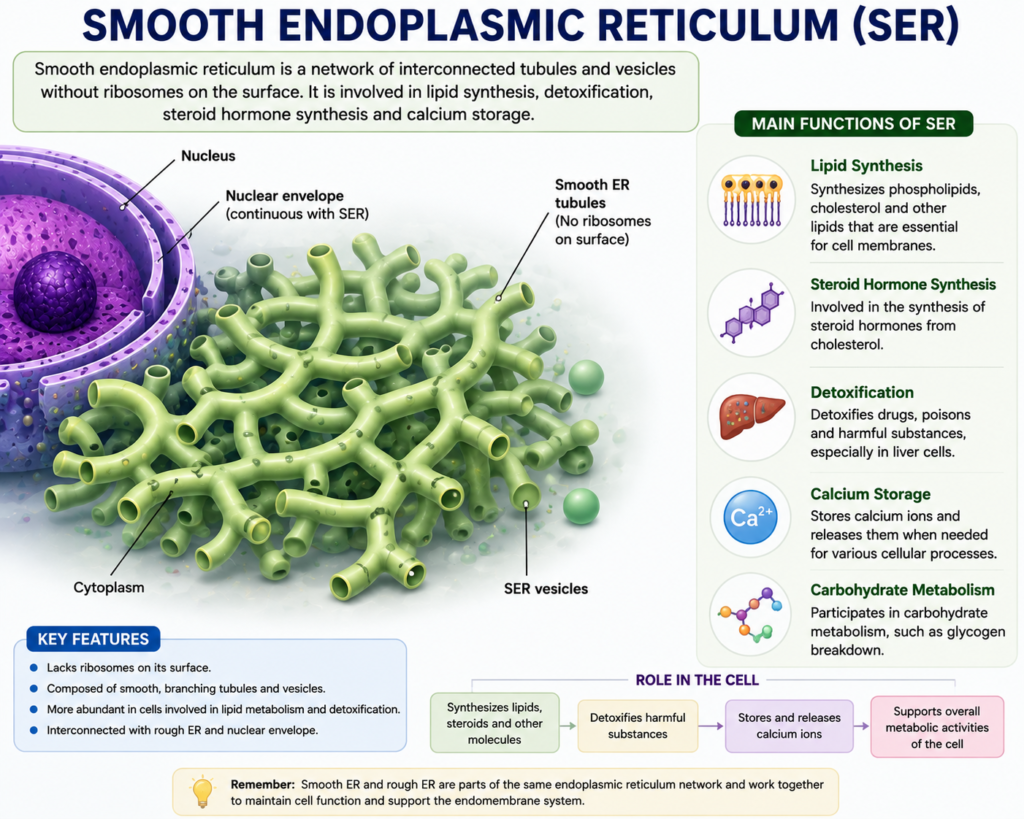
Functions of Endoplasmic Reticulum
The endoplasmic reticulum performs many important functions in eukaryotic cells.
1. Protein Synthesis
One of the best-known functions of the rough ER is its involvement in protein synthesis.
Ribosomes attached to the rough ER synthesize proteins that are entering the secretory pathway. These include many secreted proteins and membrane proteins.
The ER therefore acts as an important starting point for the production and distribution of many proteins.
2. Protein Folding and Processing
Newly synthesized proteins entering the ER do not always have their final three-dimensional structure immediately.
Inside the ER, proteins undergo folding and processing. The ER also provides an environment where processes such as disulfide bond formation and N-linked glycosylation can occur.
Properly folded proteins can then continue through the secretory pathway.
Proteins that fail to fold correctly can be recognized and removed through quality-control mechanisms.
3. Lipid Synthesis
The ER is a major site of lipid synthesis, producing many phospholipids required to build cellular membranes such as the plasma membrane.
It produces many phospholipids and other lipid molecules that are required to build cellular membranes.
Lipid products can subsequently be distributed to other cellular membranes through vesicular transport and other mechanisms.
The smooth ER is particularly important in this process.
4. Steroid Hormone Synthesis
The smooth ER contributes to the synthesis of steroid hormones from cholesterol.
Cells specialized for steroid production, such as certain cells of the adrenal glands and gonads, contain extensive smooth ER because they require large amounts of enzymes involved in steroid metabolism.
5. Detoxification
The smooth ER is involved in the metabolism of various lipid-soluble drugs and harmful compounds, especially in liver cells.
Enzymes associated with the smooth ER modify certain substances, often making them more water-soluble and easier for the body to eliminate.
6. Calcium Storage
The ER can act as an important intracellular calcium store.
Calcium ions are released from the ER when they are needed for cellular signaling and other processes. In muscle cells, the specialized smooth ER called the sarcoplasmic reticulum stores calcium required for muscle contraction.
7. Transport of Proteins and Lipids
The ER also acts as an important starting point for the movement of proteins and lipids through the endomembrane system.
Proteins and lipids that are not intended to remain in the ER can be packaged into transport vesicles and delivered to other destinations, including the Golgi apparatus.
8. Quality Control of Proteins
The ER has mechanisms that help ensure proteins are correctly folded before they move onward through the secretory pathway.
When improperly folded proteins accumulate, cells can activate an unfolded protein response (UPR). This response helps the cell reduce the burden on the ER and restore protein-folding capacity.
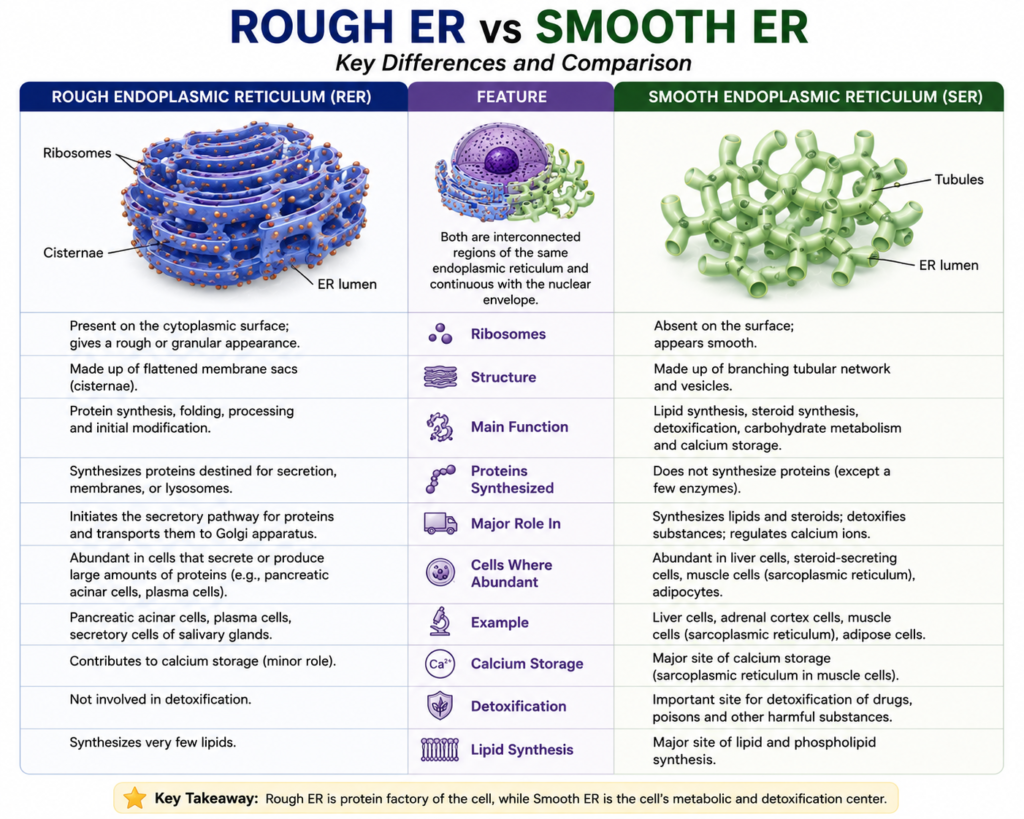
Rough ER vs Smooth ER
| Feature | Rough ER | Smooth ER |
|---|---|---|
| Ribosomes | Present on cytoplasmic surface | Absent |
| Appearance | Rough or granular | Smooth |
| Main structure | Often extensive flattened sheets | Often branching tubules |
| Major function | Protein synthesis and processing | Lipid metabolism and synthesis |
| Protein folding | Important role | Not its primary role |
| Steroid synthesis | Limited | Important |
| Detoxification | Not its main function | Important |
| Calcium storage | Contributes | Important, especially in muscle |
| Common abundance | Protein-secreting cells | Liver and steroid-producing cells |
Important: Rough and smooth ER are interconnected regions of one continuous endoplasmic reticulum system rather than completely separate organelles.
Importance of Endoplasmic Reticulum in Cells
The endoplasmic reticulum is essential because it connects several major cellular activities. Like other major cell organelles such as the mitochondria, the ER has specialized structures that allow it to perform specific cellular functions.
The rough ER helps produce and prepare proteins, while the smooth ER contributes to lipid metabolism, detoxification, steroid synthesis, and calcium regulation.
The ER also communicates with other parts of the endomembrane system and helps direct newly produced proteins and lipids toward their appropriate destinations.
Its importance becomes especially clear in specialized cells.
For example, protein-secreting cells contain extensive rough ER, whereas steroid-producing cells contain abundant smooth ER.
Thus, the structure of the ER is closely related to the specific metabolic needs of a cell.
Key Takeaways
- The endoplasmic reticulum (ER) is an interconnected membrane network found in eukaryotic cells.
- The ER is continuous with the outer nuclear envelope.
- Its internal space is called the ER lumen.
- The two major regions are rough ER and smooth ER.
- Rough ER contains ribosomes and is mainly involved in protein synthesis and processing.
- Smooth ER lacks ribosomes and is important for lipid synthesis, steroid production, detoxification, and calcium storage.
- The ER helps transport proteins and lipids toward other parts of the endomembrane system.
- The ER also performs protein quality control and responds to the accumulation of misfolded proteins.
- The structure of the ER varies according to the functional requirements of different cell types.
Frequently Asked Questions
What is the endoplasmic reticulum?
The endoplasmic reticulum is a membrane-bound network of interconnected sacs and tubules found in the cytoplasm of eukaryotic cells. It is involved in protein processing, lipid metabolism, calcium storage, and several other cellular functions.
What are the two types of endoplasmic reticulum?
The two major types are rough endoplasmic reticulum (RER) and smooth endoplasmic reticulum (SER).
Why is rough ER called rough?
Rough ER is called rough because ribosomes are attached to its cytoplasmic surface, giving it a granular appearance.
What is the main function of rough ER?
The rough ER is mainly involved in the synthesis, folding, processing, and initial sorting of proteins entering the secretory pathway.
What is the main function of smooth ER?
The smooth ER is involved in lipid synthesis and metabolism, steroid hormone production, detoxification, carbohydrate metabolism, and calcium storage.
Is the endoplasmic reticulum present in prokaryotic cells?
No. A membrane-bound endoplasmic reticulum is characteristic of eukaryotic cells. Prokaryotic cells do not contain an ER.
What is the ER lumen?
The ER lumen is the internal, membrane-enclosed space of the endoplasmic reticulum where several protein-processing and other biochemical activities occur.
What is the difference between RER and SER?
The major difference is the presence of ribosomes. RER has ribosomes attached to its cytoplasmic surface and specializes in protein-related functions, whereas SER lacks ribosomes and is particularly important in lipid metabolism, detoxification, steroid synthesis, and calcium regulation.
Conclusion
The endoplasmic reticulum (ER) is an essential membrane network that performs several important functions in eukaryotic cells.
Its two interconnected regions, the rough ER and smooth ER, are structurally different but work together to maintain normal cellular activities.
The rough ER is mainly involved in protein synthesis, folding, processing, and transport, while the smooth ER plays important roles in lipid synthesis, steroid production, detoxification, calcium storage, and metabolism.
The ER also works closely with the nucleus, Golgi apparatus, and other components of the endomembrane system.
Therefore, the structure of the endoplasmic reticulum is closely related to its functions.
Together, rough and smooth ER help cells produce, process, store, and transport essential molecules needed for growth, metabolism, and survival.
References
- Cooper, G. M. The Cell: A Molecular Approach. NCBI Bookshelf.
- OpenStax. Biology 2e – The Endomembrane System and Proteins.
- Alberts et al. Molecular Biology of the Cell.
- Sanvictores, T. & Davis, D. D. Histology, Rough Endoplasmic Reticulum.
- Anatomy and Physiology 2e – The Cytoplasm and Cellular Organelles.
Discover more from Zoologyverse
Subscribe to get the latest posts sent to your email.