
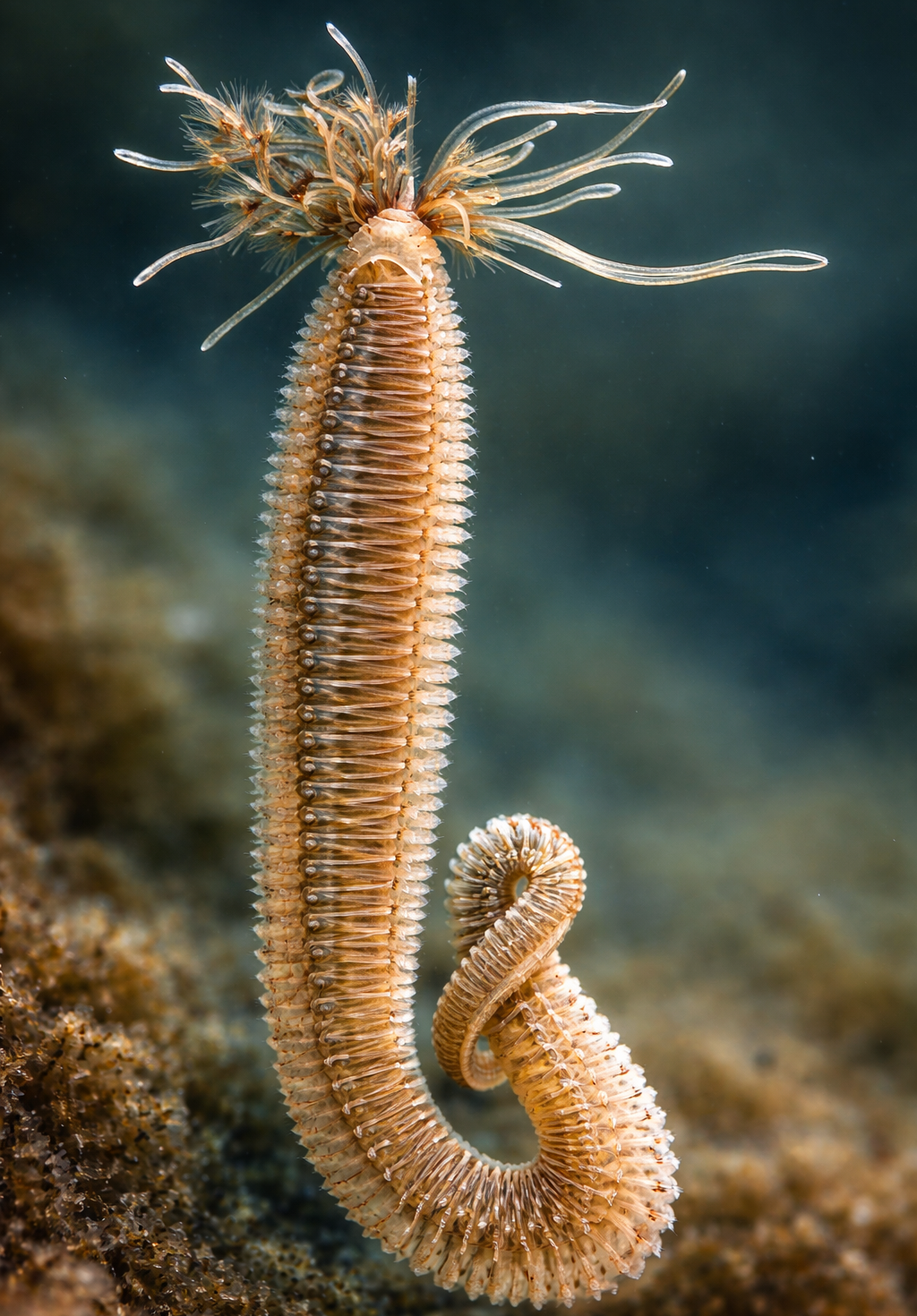
The Amphitrite worm lives in a solid, sand-encrusted tube and can reach a length of forty centimeters. The three brilliant red bushy gills and a spread of long peach-colored tentacles above them are all that are visible. The tentacles are always moving, looking for food particles, and they can reach a length of forty centimeters. The remainder of the worm’s tapering, segmented body is still hidden inside the tube.
Classification of Amphitrite
Kingdom :- Animalia (Multicellular eukaryotic organisms)
Phylum :- Annelida (Segmented worms with true coelom and metamerism)
Class :- Polychaeta (Marine bristle worms with parapodia)
Order :- Terebellida (Tubicolous, sedentary and proboscis not-protrusible, without jaws or teeth)
Genus :- Amphitrite (ornate worm)
Habit and habitat of Amphitrite
Amphitrite is a marine, sedentary polychaete, very common along the eastern coast of the United States. The animal dwells near the low tide level in tubes lined with mucus and buried in sand or mud.
Distribution
It is found in Europe and U.S.A. (North Carolina to Cape Cod).
Comments on Amphitrite
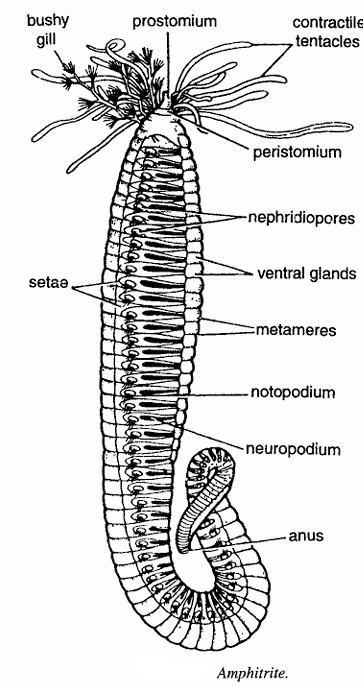
- Animal is long cylindrical, and pinkish in colour measuring 20 to 30 cm in length.
- Body is divided into metameres and regionated into somewhat thickened anterior region (head), middle region (trunk) and posterior narrow region.
- Prostomium forms the upper lip and peristomium lower lip of the mouth.
- No eyes and palps in prostomium. Peristomium is also without appendages.
- Prostomium forms proboscis. Just behind the head is a transverse ridge crowned with several, long hollow, yellowish and contractile tentacles having coelomic extension. They are feeding organs and have poor vascularization having a ciliated groove on one side.
- Branchial region consists of many segments bearing notopodia with setae and neuropodia with uncini.
- The first three segments of the middle region contain three pairs of bushy gills placed dorso-laterally.
- Gills contract rhythmically. Ventrally few thoracic segments have shield glands or ventral glands for mucus secretion.
- Abdomen is long and each segment contains notopodia and neuropodia (uncini).
- Caudal segments lack notopodia and anu:; is found terminally in the last segment as elongated aperture.
Special features
Generally Lepidometria a symbiont lives in the same tube with Amphitrite.
Identification
Since the specimen contains anterior feathery tentacles and all above characters and hence it is Amphitrite.
See other posts also
- PRIMITIVE NERVOUS SYSTEM OF COELeNTERATES AND ECHINODERMS
- EXCRETION IN HIGHER TERRESTRIAL INVERTEBRATES
- EXCRETION IN HIGHER AQUATIC INVERTEBRATES
- ORGANS AND MECHANISM OF RESPIRATION IN LOWER INVERTEBRATES
- PHORONIDA – STRUCTURE, AFFINITY AND LIFE HISTORY
Discover more from Zoologyverse
Subscribe to get the latest posts sent to your email.