
Stegostoma is a distinctive genus of cartilaginous fishes belonging to the family Stegostomatidae and order Orectolobiformes. The accepted living species is Stegostoma tigrinum, commonly known as the Zebra Shark. It is a marine, bottom-dwelling shark found mainly in tropical and subtropical regions of the Indo-West Pacific.
The Zebra Shark has a characteristic elongated body, broad and flattened head, large spiracles, two short barbels near the mouth, and a remarkably long caudal fin. Its appearance also changes considerably during growth. Young individuals have prominent dark-and-light stripes, while adults generally develop a pattern of spots, which explains the common name Zebra Shark.
Stegostoma is an important specimen in zoology practical studies because its external features clearly demonstrate several characteristic adaptations of benthic sharks. Its unusual body form, posteriorly positioned dorsal fin, prominent body ridges, and distinctive colour pattern make it relatively easy to identify.
This article covers the classification of Stegostoma, characteristics of Stegostoma, its distribution, habitat, and external features. It also explains the digestive and respiratory systems, reproduction, and how to identify the Zebra Shark.
For Practical Study
The following notes are arranged in a practical examination format for easy study and identification.
Classification of Stegostoma (Zebra Shark)
| Rank | Classification | Characteristic |
|---|---|---|
| Kingdom | Animalia | Multicellular, heterotrophic organisms without a cell wall. |
| Phylum | Chordata | Dorsal nerve cord and other chordate features are present during development. |
| Subphylum | Vertebrata | Cranium and vertebral column are present. |
| Division | Gnathostomata* | Jaws and paired appendages are present. |
| Superclass | Pisces* | Traditional zoological grouping of aquatic vertebrates with fins and gills. |
| Class | Chondrichthyes | Endoskeleton is predominantly cartilaginous |
| Subclass | Elasmobranchii | Includes sharks and rays |
| Order | Orectolobiformes | Carpet sharks |
| Family | Stegostomatidae | Single living genus |
| Genus | Stegostoma | Zebra-patterned shark |
Note: Gnathostomata and Pisces are traditional practical-zoology ranks and may be retained for examination purposes. Modern sources recognize Stegostoma tigrinum as the accepted species name and place it in the order Orectolobiformes and family Stegostomatidae. Its standard English common name is Zebra Shark.
Geographical Distribution
Stegostoma tigrinum occurs mainly throughout the tropical Indo-West Pacific. Its range extends from the Red Sea and East Africa eastward through South and Southeast Asia to northern Australia and the western Pacific, including areas around New Caledonia and Fiji. It is also recorded from the Persian Gulf.
Habit and Habitat
The Zebra Shark is primarily a marine, bottom-dwelling and reef-associated shark. It is commonly found around:
- Coral reefs
- Rocky reefs
- Sandy bottoms
- Lagoons
- Shallow coastal waters
It is usually found at depths of about 5–30 m, but has been recorded to depths of roughly 60–90 m depending on the source.
Characteristics Of Stegostoma (Zebra Shark)
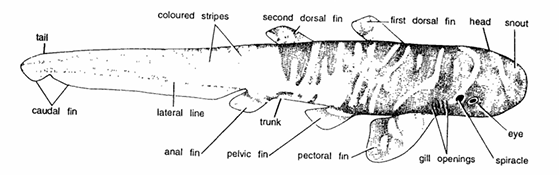
- Body elongated and somewhat flattened.
- Head broad and depressed.
- Two short barbels present near the mouth.
- Spiracles large and bean-shaped.
- Five pairs of gill slits present.
- Fourth and fifth gill slits are closely positioned, making the last pair less conspicuous from a distance.
- Five prominent longitudinal ridges occur along the dorsal body surface.
- Pectoral fins are broad and rounded.
- First dorsal fin is positioned far back, approximately above the pelvic fins.
- Caudal fin is exceptionally long and characteristic of the species.
- Juveniles show bold zebra-like stripes, while adults generally become spotted.
Special Features
Stegostoma is a distinctive, elongated shark with a broad, flattened head and a very long caudal fin. Juveniles have prominent dark-and-light stripes, whereas adults commonly develop a spotted pattern, giving rise to the name Zebra Shark.
The body bears five dorsolateral ridges, while the eyes are relatively small and the spiracles are large and conspicuous. Two short barbels occur near the mouth.
Identification of Stegostoma tigrinum
Specimen identified as Stegostoma tigrinum (Zebra Shark) based on its elongated body, broad flattened head, large spiracles, two barbels, prominent dorsal ridges, posteriorly positioned dorsal fin, very long caudal fin, and characteristic juvenile stripes or adult spots.
External Morphology of Stegostoma
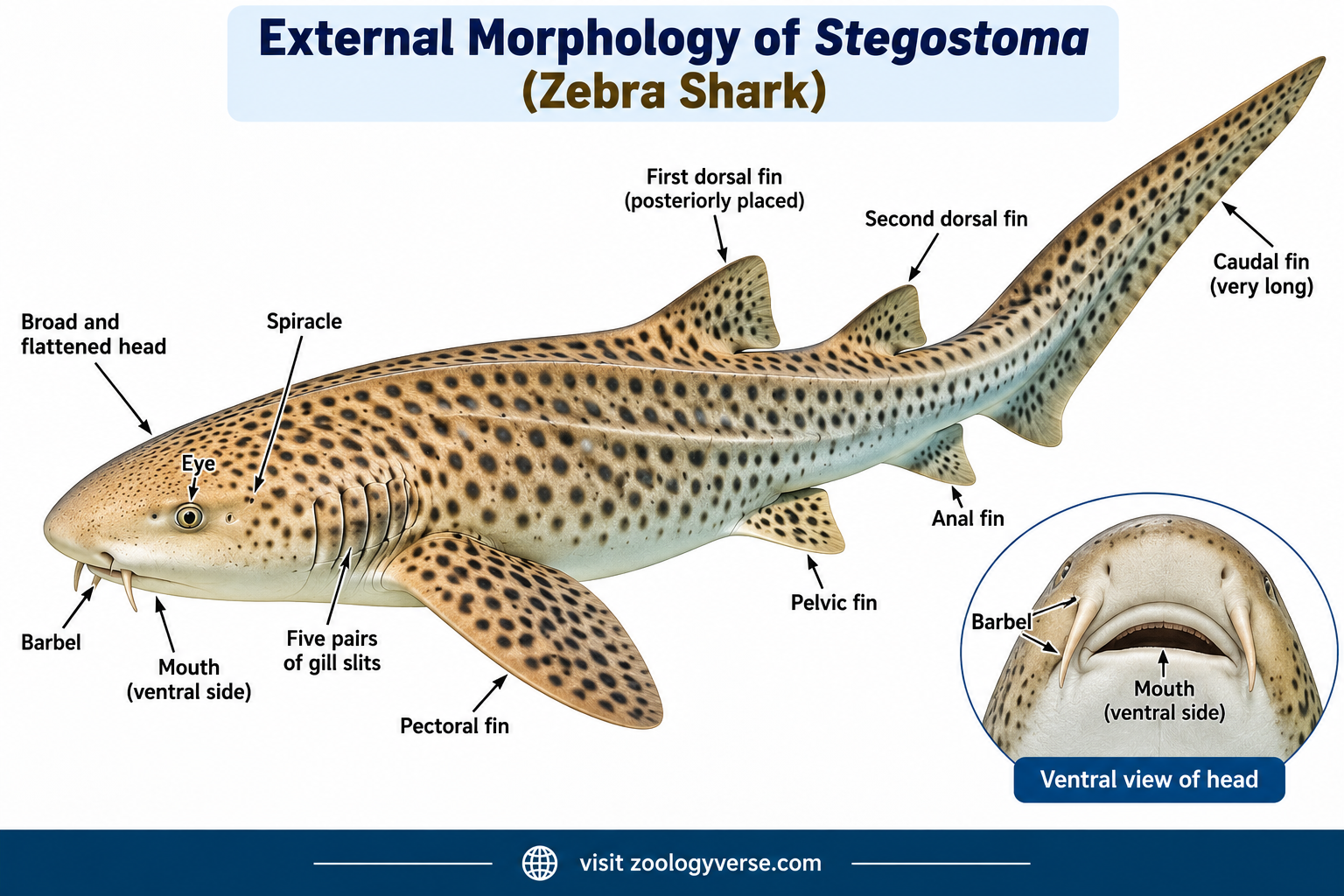
The external morphology of Stegostoma tigrinum is distinctive. The Zebra Shark has an elongated, slender body, a broad and flattened head, prominent body ridges, and a remarkably long caudal fin. Its body form is well adapted to a bottom-associated marine lifestyle.
1. Body
The body is elongated and somewhat depressed, particularly toward the head. The trunk gradually narrows posteriorly and continues into a very long tail. The caudal fin forms a substantial part of the total body length and is one of the most conspicuous features of the species.
Five prominent dorsolateral ridges occur along the body and are useful for identification.
2. Head
The head is broad, flattened and relatively short compared with the elongated body. The snout is blunt and rounded.
The eyes are relatively small, with large, bean-shaped spiracles situated behind them. A pair of short, fleshy barbels is present near the front of the mouth.
3. Mouth
The mouth is positioned on the ventral side of the head, an arrangement associated with its bottom-feeding habit.
Numerous small teeth occur in several rows. They are mainly suited for grasping and handling food rather than cutting large prey.
4. Gill Slits
Five pairs of gill slits are present on the sides of the head. The fourth and fifth gill slits are closely positioned, making the posterior pair less conspicuous when viewed from a distance.
5. Fins
The Zebra Shark possesses paired and median fins.
- Pectoral fins: Broad and rounded.
- Pelvic fins: Situated posterior to the pectoral fins.
- Dorsal fins: Two dorsal fins are present; the first is positioned relatively far posteriorly, approximately above the pelvic-fin region.
- Anal fin: Present behind the pelvic fins.
- Caudal fin: Extremely long and characteristic of the species.
6. Colouration
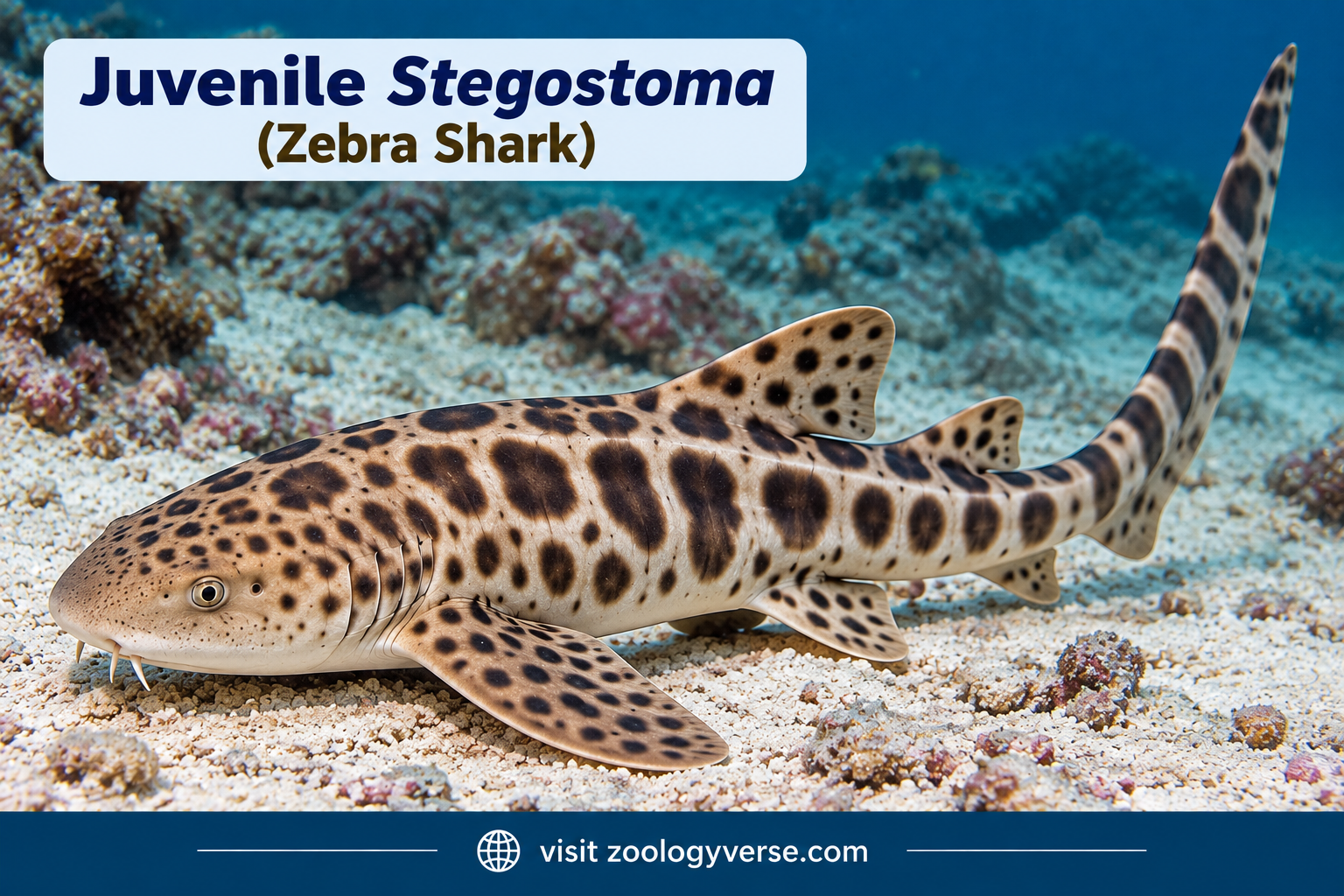
Colouration changes considerably with age. Juveniles have prominent dark-and-light transverse stripes, producing a zebra-like appearance. With maturity, these stripes generally become less prominent and the body develops numerous dark spots on a lighter background.
7. Skin
The body is covered with placoid scales (dermal denticles), characteristic of cartilaginous fishes. They give the skin a rough texture and provide protection.
Key External Features for Identification
For practical identification, the most useful features are:
- Elongated body
- Broad, flattened head
- Small eyes and large spiracles
- Pair of short barbels
- Five pairs of gill slits
- Five dorsolateral ridges
- Broad pectoral fins
- Posteriorly positioned first dorsal fin
- Very long caudal fin
- Striped juveniles and spotted adults
Digestive System of Stegostoma
The digestive system of Stegostoma tigrinum suits a carnivorous, bottom-feeding life. The tract runs from the mouth to the cloaca. The liver and pancreas assist with digestion.
1. Mouth and Buccal Cavity
The mouth is located on the ventral surface of the head. The jaws bear numerous small teeth that help in grasping and manipulating food.
The mouth opens into the buccal cavity, which leads posteriorly into the pharynx.
2. Pharynx
The pharynx is a muscular region situated behind the buccal cavity. It serves as a common passage associated with both feeding and respiration.
3. Oesophagus
The pharynx continues into a short, muscular oesophagus. It transports swallowed food toward the stomach.
4. Stomach
The oesophagus opens into a well-developed stomach. The stomach provides temporary storage of food and begins substantial chemical digestion through gastric secretions.
5. Intestine
The stomach opens into the intestine, where digestion is completed and nutrients are absorbed.
The intestine contains a spiral valve, a typical shark feature. Its folds increase the absorptive surface and slow the passage of food. This helps the shark absorb more nutrients.
6. Rectum and Cloaca
The posterior part of the intestine continues into the rectum, which leads into the cloaca. The cloaca is a common chamber receiving the terminal portions of the digestive and urogenital systems.
7. Digestive Glands
Two major digestive glands are associated with the digestive tract:
Liver: The liver is large and well developed. It produces bile and also stores considerable quantities of oil, which contributes to buoyancy.
Pancreas: The pancreas produces digestive enzymes and other secretions involved in the digestion of food.
Digestive Tract in Sequence
Mouth → Buccal cavity → Pharynx → Oesophagus → Stomach → Intestine with spiral valve → Rectum → Cloaca
The spiral valve is particularly important in practical zoology because it is a characteristic modification of the elasmobranch intestine that increases the efficiency of digestion and absorption.
Feeding and Food
Stegostoma tigrinum is a carnivorous, bottom-feeding shark. It usually searches for food close to the sea floor, particularly around coral reefs, rocky areas, sandy bottoms, and other shallow coastal habitats.
Feeding Habit: The Zebra Shark is generally a slow-moving bottom feeder. Its flattened head and ventrally positioned mouth are well suited for locating and taking food from the substrate. The short barbels near the mouth may help detect prey close to the sea floor.
Food: Its diet consists mainly of small marine animals, including:
- Small fishes
- Crustaceans such as crabs and shrimps
- Molluscs
- Other small benthic invertebrates
The numerous small teeth help grasp and manipulate prey before swallowing.
Feeding Adaptations and Their Functions: The Zebra Shark feeds close to the sea floor. Several body features help it find, reach, and handle bottom-dwelling prey. They work together.
| Feature | Function in feeding |
|---|---|
| Flattened head | Allows close contact with the sea floor while searching for prey |
| Ventral mouth | Positioned for taking food from sand, rock, and reef surfaces |
| Short barbels | May help detect prey near the substrate |
| Numerous small teeth | Grasp and hold small fishes, crustaceans, and molluscs |
| Slender, elongated body | Helps the shark reach prey in crevices and among rocks |
| Large spiracles | Allow water intake while the shark rests on the bottom |
Respiratory System of Stegostoma
The respiratory system of Stegostoma tigrinum is adapted for extracting dissolved oxygen from seawater. Like other elasmobranchs, it uses gills as the principal respiratory organs.
1. Gill Slits: There are five pairs of gill slits on either side of the head. They provide the external exit openings for water after it has passed over the gills.
2. Spiracles: A pair of large spiracles is present behind the eyes. They provide additional openings for water to enter the pharyngeal region, particularly when the shark is resting close to the sea floor.
3. Water Flow and Gas Exchange: Water enters the pharyngeal cavity through the mouth and the spiracles. It then flows over the gills.
As water passes over the gill filaments and secondary lamellae, oxygen diffuses into the blood, while carbon dioxide diffuses from the blood into the water.
After passing over the gills, the water leaves the pharyngeal region through the five pairs of gill slits.
Water flow:
Mouth / Spiracles → Pharyngeal cavity → Gill surfaces → Gill slits → Outside
The water therefore does not pass through the digestive tract during respiration. The pharyngeal cavity serves as the passage through which water reaches the gills.
4. Gill Structure and Gas Exchange: Each gill is supported by a gill arch bearing numerous gill filaments. The filaments contain fine secondary lamellae, which provide a large surface area for gas exchange.
The thin respiratory surfaces and rich blood supply facilitate efficient diffusion between the water and blood.
Significance:The five pairs of gill slits, well-developed gills, and prominent spiracles are important features when studying respiration in Stegostoma. The spiracles are particularly useful for water intake when the shark is resting near the bottom.
Reproduction in Stegostoma
Stegostoma tigrinum is dioecious, with separate males and females. After fertilization, the embryo develops inside a protective egg case.
1. Sexual Dimorphism
Males and females show some external differences.
- Male: Possesses a pair of claspers associated with the pelvic fins. These modified structures transfer sperm to the female during mating.
- Female: Lacks claspers and has a broader abdominal region, particularly when mature.
2. Fertilization
Fertilization is internal. During mating, the male uses a clasper to transfer sperm into the female reproductive tract, where fertilization of the egg occurs.
3. Oviparity
The Zebra Shark is oviparous. After fertilization, the female lays the developing eggs enclosed within tough, leathery egg cases, commonly called mermaid’s purses.
The egg case protects the developing embryo and allows water exchange with the surrounding seawater.
4. Egg-Case Development
Development follows a simple sequence:
Fertilization → Egg enclosed in egg case → Egg case laid in the marine environment → Embryo develops using yolk → Embryo completes development → Juvenile emerges
The developing embryo remains inside the protective egg case and obtains nourishment from the yolk. The leathery case protects it from physical damage while allowing the exchange of water.
The egg cases have characteristic fibrous tendrils that can help them become anchored to suitable surfaces in the surrounding habitat.
5. Hatching and Young
After completing development, the young Zebra Shark hatches from the egg case as a free-living juvenile. Unlike animals with a larval stage, it emerges in a form broadly resembling the adult body plan.
Stegostoma vs Chiloscyllium
Stegostoma and Chiloscyllium are both cartilaginous sharks belonging to the order Orectolobiformes, but they differ in body form, colour pattern, caudal fin, and other external features.
| Feature | Stegostoma | Chiloscyllium |
|---|---|---|
| Common practical name | Zebra Shark | True dogfish |
| Family | Stegostomatidae | Hemiscylliidae |
| Body | Elongated and slender | Slender and elongated |
| Head | Broad and flattened | Shorter and moderately flattened |
| Barbels | One pair present | One pair present |
| Dorsal ridges | Five prominent dorsolateral ridges | Ridges less prominent |
| Caudal fin | Extremely long and conspicuous | Relatively shorter |
| Juvenile colouration | Bold dark-and-light stripes | Species-dependent bands or spots |
| Adult colouration | Generally spotted | Commonly patterned with bands or spots |
| First dorsal fin | Positioned relatively far posteriorly | Positioned more anteriorly |
| Habitat | Reef-associated and sandy benthic habitats | Mainly shallow coastal and reef-associated habitats |
Key Identification Difference
The very long caudal fin, five prominent dorsolateral ridges, and striking juvenile stripes are particularly useful for recognizing Stegostoma. In contrast, Chiloscyllium is generally recognized by its slender body and characteristic species-specific bands or spots.
Thus, although both sharks share several features of orectolobiform sharks, their body proportions, colour patterns, and caudal-fin structure help distinguish them during practical identification.
Economic and Ecological Importance of Stegostoma
Stegostoma tigrinum has ecological importance as a component of tropical marine ecosystems and also has value in education, research, and ecotourism.
1. Ecological Importance
The Zebra Shark is a benthic predator that feeds on fishes, crustaceans, molluscs, and other small marine animals. By feeding on organisms near the sea floor, it forms part of the food web of coral reef and coastal ecosystems.
2. Role in Marine Food Webs
As a predator, Stegostoma participates in the transfer of energy between different trophic levels. Its feeding activity contributes to the natural regulation of populations of its prey species.
3. Ecotourism
Zebra Sharks are valued attractions for marine tourism and responsible wildlife observation, particularly in areas where they occur around reefs and shallow coastal habitats. Their distinctive appearance and generally non-aggressive behaviour make them of interest to divers and underwater observers.
4. Educational and Scientific Importance
Stegostoma is useful in zoology education because it demonstrates several characteristic features of elasmobranchs, including:
- Cartilaginous endoskeleton
- Five pairs of gill slits
- Spiracles
- Placoid scales
- Internal fertilization
- Male claspers
- Oviparous reproduction
- Protective leathery egg cases
Its distinctive morphology also makes it a useful specimen for comparative studies of shark anatomy, taxonomy, reproduction, and adaptation.
5. Fisheries and Human Use
Zebra Sharks may be encountered in fisheries and can be affected by targeted and incidental capture. Their body parts may enter local trade, although the species’ greater long-term value is associated with healthy marine ecosystems, conservation, research, and sustainable wildlife tourism.
Globally, the Zebra Shark is listed as Endangered on the IUCN Red List (assessed 2023), mainly because of fishing pressure across much of its range. Populations off Australia are considered less threatened and are assessed as Least Concern.
Overall Importance
The importance of Stegostoma extends beyond direct human use. As a benthic predator and reef-associated shark, it contributes to marine ecosystem functioning, while its distinctive biology makes it valuable for zoological education, scientific research, and responsible ecotourism. Protecting reef habitats and regulating fishing pressure therefore helps conserve this species for future study and observation.
Key Takeaways
- Stegostoma is a genus of cartilaginous sharks belonging to the family Stegostomatidae.
- The accepted living species is Stegostoma tigrinum, commonly known as the Zebra Shark.
- It belongs to the order Orectolobiformes.
- It is mainly a marine, bottom-associated shark of tropical and subtropical Indo-West Pacific waters.
- The body is elongated, with a broad and flattened head and a remarkably long caudal fin.
- A pair of barbels and prominent spiracles are present.
- Five pairs of gill slits occur on the sides of the head.
- Five prominent dorsolateral ridges are characteristic of the species.
- Juveniles have prominent zebra-like stripes, while adults generally become spotted.
- It is a carnivorous benthic feeder, consuming small fishes, crustaceans, molluscs, and other marine invertebrates.
- The intestine contains a spiral valve, which increases the efficiency of digestion and absorption.
- Fertilization is internal, and males possess claspers.
- The Zebra Shark is oviparous, producing leathery egg cases containing developing embryos.
- Its ecological importance is associated with its role as a benthic predator in marine food webs.
- For modern zoological accuracy, Zebra Shark should be used rather than Tiger Shark; the true Tiger Shark is Galeocerdo cuvier.
- The Zebra Shark is listed as Endangered globally on the IUCN Red List.
Frequently Asked Questions
What is Stegostoma?
Stegostoma is a genus of cartilaginous sharks belonging to the family Stegostomatidae and order Orectolobiformes. The accepted living species is Stegostoma tigrinum, commonly known as the Zebra Shark.
What is the scientific name of the Zebra Shark?
The scientific name of the Zebra Shark is Stegostoma tigrinum.
Why is Stegostoma called the Zebra Shark?
Young Zebra Sharks have prominent dark-and-light stripes across the body, giving them a zebra-like appearance. Adults generally develop numerous spots as they mature.
Is Stegostoma the Tiger Shark?
No. In modern zoological usage, the Tiger Shark is Galeocerdo cuvier, whereas Stegostoma tigrinum is the Zebra Shark. Some older practical-zoology materials have used “Tiger Shark” for Stegostoma, which can cause confusion.
Where is Stegostoma tigrinum found?
It occurs mainly in the tropical and subtropical Indo-West Pacific, including areas from the Red Sea and East Africa through South and Southeast Asia to parts of northern Australia and the western Pacific.
What does the Zebra Shark eat?
The Zebra Shark feeds mainly on small fishes, crustaceans, molluscs, and other small marine invertebrates associated with the sea floor.
How does Stegostoma reproduce?
It reproduces sexually with internal fertilization. The species is oviparous, and females lay leathery egg cases in which the embryos develop.
What are the important identifying features of Stegostoma?
Important identifying features include its elongated body, broad flattened head, short barbels, large spiracles, five pairs of gill slits, five dorsolateral ridges, posteriorly positioned first dorsal fin, very long caudal fin, and distinctive juvenile stripes.
Is Stegostoma a bony fish?
No. Stegostoma is a cartilaginous fish belonging to Class Chondrichthyes. Its internal skeleton is primarily composed of cartilage rather than bone.
Is the Zebra Shark dangerous to humans?
The Zebra Shark is generally considered a non-aggressive species and is not regarded as a typical threat to humans. Like any wild marine animal, however, it should be observed responsibly and without direct interference.
Is the Zebra Shark endangered?
Yes, globally. The IUCN Red List classifies Stegostoma tigrinum as Endangered, mainly because of fishing pressure across much of its range. Populations off Australia are considered Least Concern.
Recommended Study Resource
Sharks of the World
by Rodney Steel (Author)
Practical Zoology: Vertebrate
by S. S. Lal (Author)
As an Amazon Associate I earn from qualifying purchases.
References
- FishBase. Stegostoma tigrinum (Forster, 1781), Zebra Shark.
- World Register of Marine Species (WoRMS). Stegostoma tigrinum (Forster, 1781).
- Zebra shark
- Stegostoma tigrinum – Zebra Shark
- IUCN Red List. Stegostoma tigrinum (Zebra Shark)
Discover more from Zoologyverse
Subscribe to get the latest posts sent to your email.