
Chromosomes usually become highly condensed during cell division, making their individual structures easier to observe.
However, some cells contain unusual chromosomes that become exceptionally large and structurally distinctive. One of the best-known examples is the lampbrush chromosome.
Lampbrush chromosomes are giant, highly extended chromosomes that occur during a particular stage of meiotic prophase in growing oocytes. They are especially well known in amphibians and birds, although lampbrush chromosomes have also been observed in fishes, reptiles, some insects, and other organisms.
Their most distinctive feature is the presence of numerous lateral loops projecting from a central chromosome axis.
These loops contain highly active transcription units and can therefore be observed as visible manifestations of gene activity.
The enormous size and unusual organization of lampbrush chromosomes have made them an important model for studying chromosome structure, transcription, RNA processing, chromatin organization, and genome mapping.
What Is a Lampbrush Chromosome?
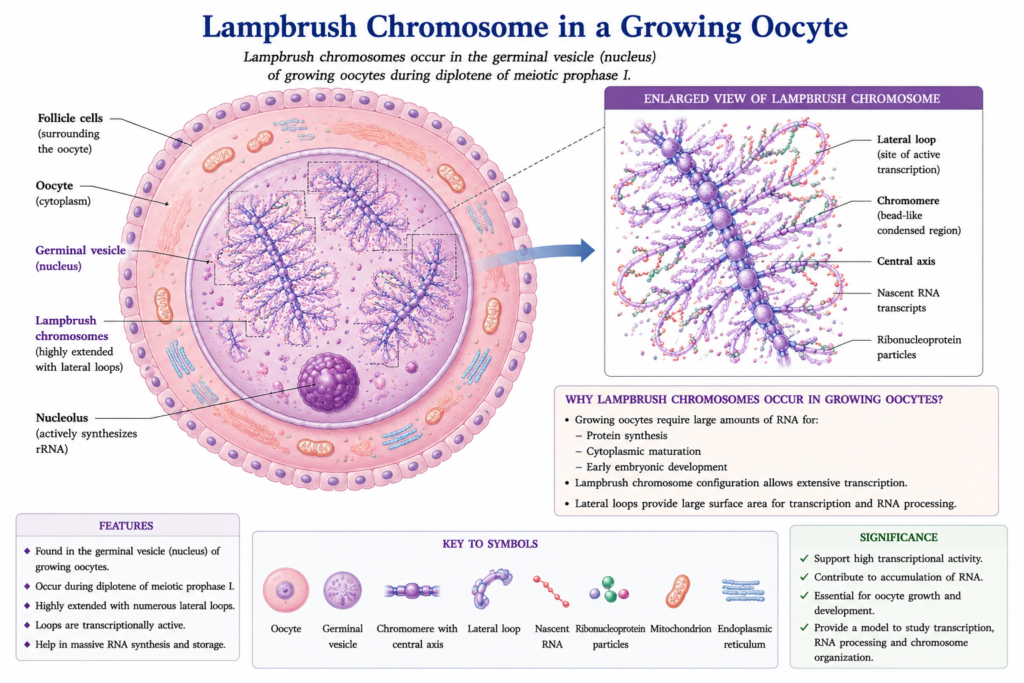
A lampbrush chromosome is a giant, highly extended chromosome that develops during the prolonged diplotene stage of meiotic prophase I in growing oocytes.
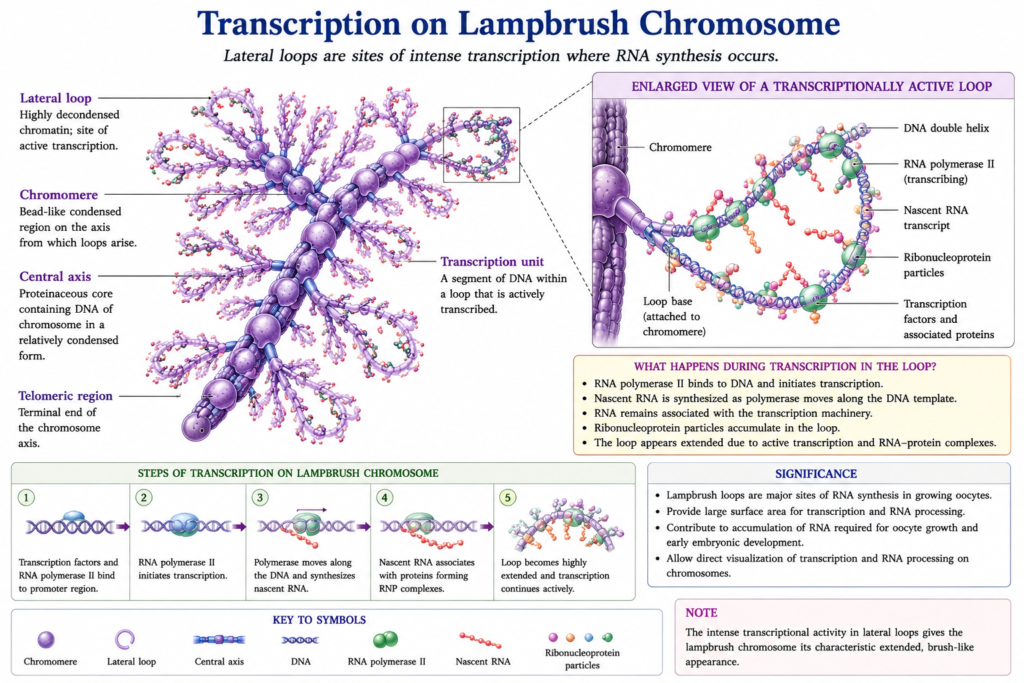
The chromosome consists of a relatively compact axial region containing chromomeres, from which numerous lateral loops extend.
The loops contain actively transcribed regions and give the chromosome its characteristic brush-like appearance.
The term lampbrush was given because the chromosome resembles the brushes historically used for cleaning the chimneys of kerosene lamps.
Unlike ordinary condensed metaphase chromosomes, lampbrush chromosomes remain highly extended during the stage in which they are observed.
This extended organization allows individual chromosome regions and transcriptional activity to be studied using microscopy.
Where Are Lampbrush Chromosomes Found?
Lampbrush chromosomes are primarily associated with large growing oocytes.
They are particularly well known in:
- Amphibians
- Birds
- Fishes
- Reptiles
- Some other vertebrate and invertebrate organisms
They have been especially extensively studied in amphibian and avian oocytes.
The classic lampbrush state occurs during oocyte growth, when the oocyte needs to synthesize and accumulate large quantities of RNA before fertilization and early embryonic development.
It is important to note that classical lampbrush chromosomes are not a normal feature of mammalian oocytes, including humans.
Experimental work has shown that mammalian sperm chromatin can be induced to adopt a lampbrush-like state when placed in an appropriate amphibian oocyte environment, demonstrating that the lampbrush configuration is a specialized chromatin state rather than a permanently fixed chromosome characteristic.
When Do Lampbrush Chromosomes Develop?
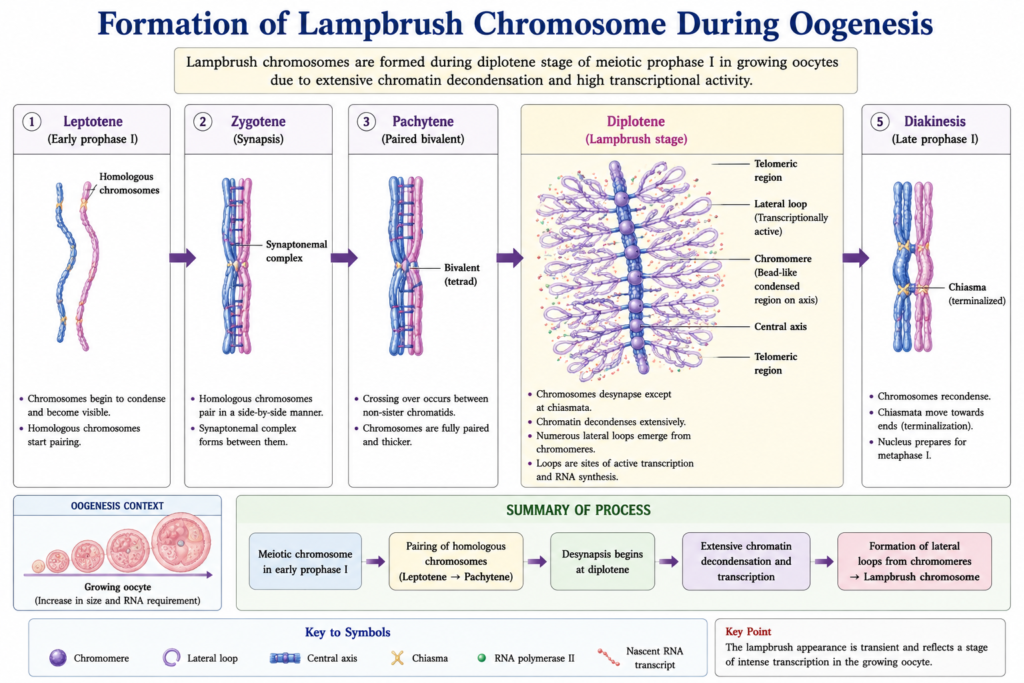
Lampbrush chromosomes develop during diplotene of meiotic prophase I.
The simplified sequence is:
Meiosis I → Prophase I → Diplotene → Lampbrush chromosome state
During diplotene, homologous chromosomes remain associated at chiasmata, while the chromosomes become highly extended and transcriptionally active.
The lampbrush state can persist for a considerable period during oocyte growth, allowing the cell to produce large quantities of RNA.
Why Do Lampbrush Chromosomes Become So Large?
The giant appearance of a lampbrush chromosome is primarily related to extensive chromatin decondensation and transcription, rather than repeated rounds of DNA replication.
During the lampbrush stage, many chromosome regions become highly extended. Transcriptionally active DNA forms lateral loops that project from the chromosome axis.
These loops can contain RNA polymerase and associated transcription machinery, together with newly synthesized RNA.
Thus, a simplified explanation is:
Chromosome decondensation → formation of extended transcription units → lateral loops → giant lampbrush appearance
This is fundamentally different from the mechanism responsible for the large size of polytene chromosomes.
Structure of Lampbrush Chromosome
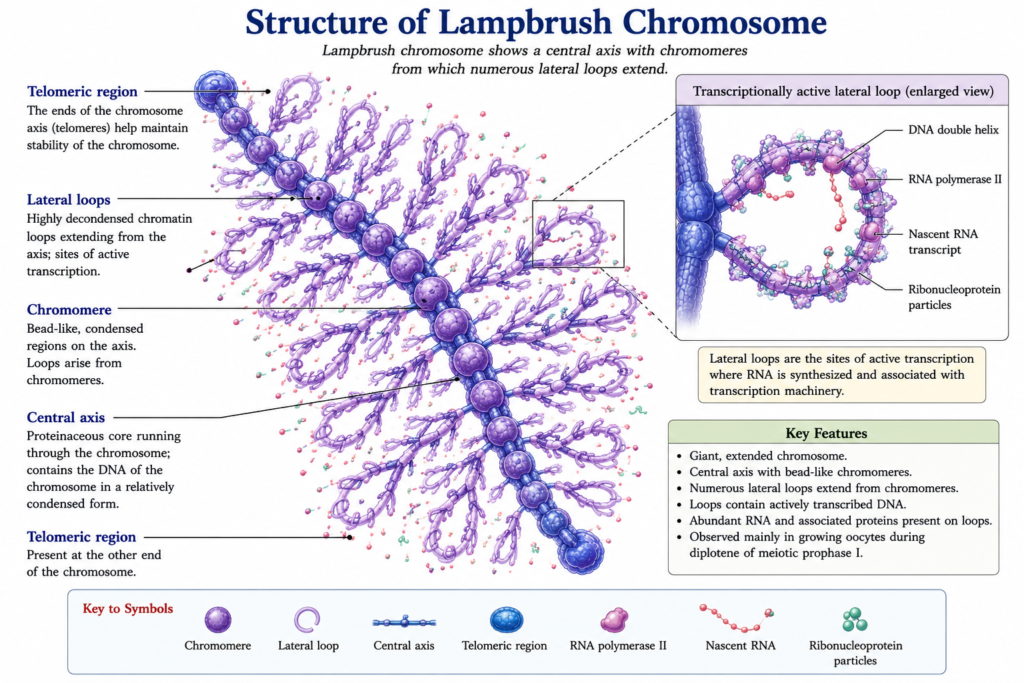
The lampbrush chromosome has a distinctive chromomere-loop organization.
Its major structural components include:
- Chromosomal axis
- Chromomeres
- Lateral loops
- Transcription units
- Telomeric regions
- Associated RNA and proteins
1. Chromosomal Axis
The chromosomal axis forms the central framework of the lampbrush chromosome.
It consists of a series of compact chromatin regions from which lateral loops extend.
When viewed microscopically, the axis appears as a relatively condensed central structure with numerous loops projecting outward.
The axis therefore provides the structural framework that organizes the extended chromosome.
2. Chromomeres
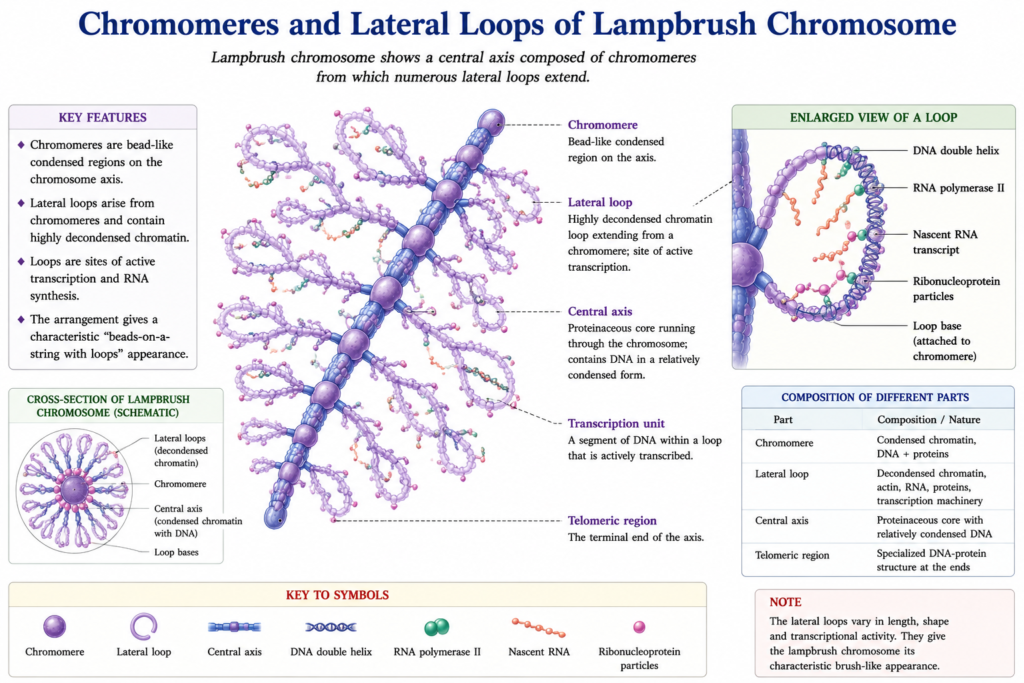
Chromomeres are bead-like, relatively compact regions arranged along the chromosome axis.
They are among the most recognizable structural features of lampbrush chromosomes.
The chromomeres contain condensed chromatin, while the lateral loops extending from them represent highly decondensed regions.
In a lampbrush chromosome, the chromosome axis can therefore be visualized as a sequence of chromomeres connected along the chromosome.
Research has shown that chromomeres correspond to important structural units of the chromosome and can be associated with specific genomic regions.
3. Lateral Loops
The lateral loops are the defining feature of lampbrush chromosomes.
They project outward from the chromomeres and contain highly extended chromatin.
Many lateral loops represent transcriptionally active regions. RNA polymerase II and associated factors can be found along actively transcribed loops, where RNA is synthesized.
The loops may vary considerably in:
- Length
- Shape
- Position
- Transcriptional activity
- Associated RNA and proteins
This variation allows individual chromosome regions to be distinguished cytologically.
4. Transcription Units
A lateral loop can contain one or more transcription units.
During transcription, RNA polymerase moves along the DNA template while newly synthesized RNA remains associated with the transcription machinery.
Because transcription is exceptionally active in the lampbrush state, many newly synthesized RNA molecules can be associated with a single loop.
This produces the characteristic expanded appearance of the loops.
5. Telomeric Regions
Like other linear chromosomes, lampbrush chromosomes possess telomeric regions at their chromosome ends.
The telomeres are located at the ends of the chromosome axis and help maintain the stability of chromosome termini.
6. RNA and Ribonucleoprotein Components
The lateral loops are not composed solely of naked DNA.
Actively transcribed loops contain newly synthesized RNA together with proteins involved in transcription and RNA processing.
This produces ribonucleoprotein structures associated with the loops.
Consequently, the visible appearance of a lampbrush chromosome reflects not only DNA organization but also the accumulation of transcription-related molecular components.
How Are Lampbrush Chromosomes Formed?
Lampbrush chromosomes arise as meiotic chromosomes enter the prolonged diplotene stage of oocyte development.
The basic process can be represented as:
Meiotic chromosome → extensive decondensation → high transcriptional activity → lateral loop formation → lampbrush chromosome
During this stage, selected regions of chromatin become greatly extended.
These extended regions form lateral loops, while more compact regions remain visible as chromomeres.
Important point
Lampbrush chromosome formation should not be confused with polytenization.
The chromosome does not become giant primarily because it contains many newly replicated copies of DNA. Instead, its existing chromatin becomes highly extended and transcriptionally active.
Experimental studies have also shown that transcription is important for maintaining the lampbrush-loop morphology.
Role of Transcription in Lampbrush Chromosomes
Transcription is central to the biology of lampbrush chromosomes.
The oocyte is a very large cell that must accumulate substantial amounts of RNA during its growth.
The lampbrush chromosome configuration provides extensive access to transcriptionally active chromosome regions.
At active lateral loops:
DNA → RNA polymerase activity → nascent RNA → RNA-processing complexes
The high transcriptional activity is therefore closely associated with the characteristic looped morphology of the chromosome.
Functions of Lampbrush Chromosomes
It is important to distinguish between the structural state of a lampbrush chromosome and its biological significance. Lampbrush chromosomes are not separate chromosome types with completely different genetic functions. Rather, they represent a specialized structural and transcriptional state of chromosomes during oocyte development.
1. Supports Extensive RNA Production
The most important significance of lampbrush chromosomes is their association with very high levels of transcription.
Growing oocytes require large amounts of RNA, and the lampbrush configuration facilitates extensive transcriptional activity.
2. Contributes to Maternal RNA Accumulation
Growing oocytes accumulate RNA that can support processes occurring after fertilization.
Transcripts from protein-coding genes can contribute to the maternal RNA pool, although not every transcript produced from lampbrush loops necessarily serves as a functional maternal mRNA. Some transcription of repetitive sequences may be non-productive.
Therefore, it is more accurate to say that lampbrush chromosome transcription contributes to the RNA pool of the growing oocyte, rather than claiming that every loop directly produces maternal mRNA.
3. Facilitates Study of Gene Transcription
Lampbrush chromosomes provide an unusually clear system for observing transcription at the level of individual chromosome regions.
Researchers can visualize:
- Transcriptionally active loops
- RNA polymerase
- Nascent RNA
- RNA-processing factors
- Specific genomic sequences
This makes them particularly valuable for studying the relationship between chromosome structure and gene expression.
4. Helps in Studying RNA Processing
Because newly synthesized RNA remains associated with transcription sites, lampbrush chromosomes provide an excellent model for investigating processes that occur during and immediately after transcription.
These include aspects of:
- RNA maturation
- RNA processing
- Ribonucleoprotein formation
- Association of RNA-processing proteins with transcription sites
5. Reveals Chromosome Organization
The visible separation between chromomeres and lateral loops provides valuable information about how chromatin is organized.
Researchers can study relationships between:
Chromatin structure → transcription → chromosome morphology
This makes lampbrush chromosomes important in chromosome biology.
6. Helps in Cytogenetic Mapping
The large size of lampbrush chromosomes makes it possible to identify chromosome regions at relatively high cytological resolution.
Modern methods such as fluorescence in situ hybridization (FISH) can be applied to lampbrush chromosome preparations to locate specific DNA sequences.
This has been particularly useful in studying genome organization and chromosome evolution in birds and amphibians.
7. Helps Study Chromosome Evolution
Lampbrush chromosomes contain many recognizable structural landmarks.
Their large size and distinctive morphology have made them valuable for studying:
- Chromosomal rearrangements
- Chromosome evolution
- Sex chromosomes
- Genome organization
- Karyotype evolution
These applications have been especially important in amphibian and avian cytogenetics.
Characteristics of Lampbrush Chromosomes
The important characteristics can be summarized as follows:
| Characteristic | Description |
|---|---|
| Type | Giant specialized chromosome |
| Main location | Growing oocytes |
| Meiotic stage | Diplotene of prophase I |
| Commonly studied in | Amphibians and birds |
| Main structural feature | Chromomere-loop organization |
| Central structure | Chromosomal axis |
| Condensed regions | Chromomeres |
| Extended regions | Lateral loops |
| Major activity | Very high transcription |
| Major RNA polymerase associated with loops | RNA polymerase II |
| DNA replication at lampbrush stage | Not the main reason for its giant structure |
| Major importance | Study of transcription, RNA processing, chromosome organization and cytogenetics |
Lampbrush Chromosome and Hypertranscription
The term hypertranscription is often used to describe the unusually high transcriptional activity associated with lampbrush chromosomes.
During oocyte growth, the nucleus must support the production and accumulation of large amounts of RNA.
Consequently, many chromosome regions become transcriptionally active.
The relationship can be summarized as:
High transcriptional demand → chromatin decondensation → extended transcription loops → lampbrush morphology
This is why the lateral loops are such an important characteristic of these chromosomes.
Are All Lateral Loops Equally Active?
No.
Lateral loops can differ in:
- Size
- Shape
- Position
- Transcriptional activity
- DNA sequence composition
- Associated proteins
Some loops can be highly active, while others may show lower or different patterns of transcription.
Furthermore, lampbrush chromosomes can contain transcription of both unique sequences and repetitive DNA sequences.
Therefore, it is an oversimplification to state that every lateral loop represents a conventional protein-coding gene.
Lampbrush Chromosomes and Meiosis
Lampbrush chromosomes are closely associated with meiotic prophase I, but their formation should not be considered an essential feature of meiosis.
Many meiotic cells do not develop classical lampbrush chromosomes.
Instead, the lampbrush configuration is a specialized state associated with exceptionally active transcription during oocyte growth.
During the lampbrush stage, homologous chromosomes remain paired as a bivalent and are associated at chiasmata.
This is one reason lampbrush chromosomes are particularly useful for studying meiotic chromosome organization.
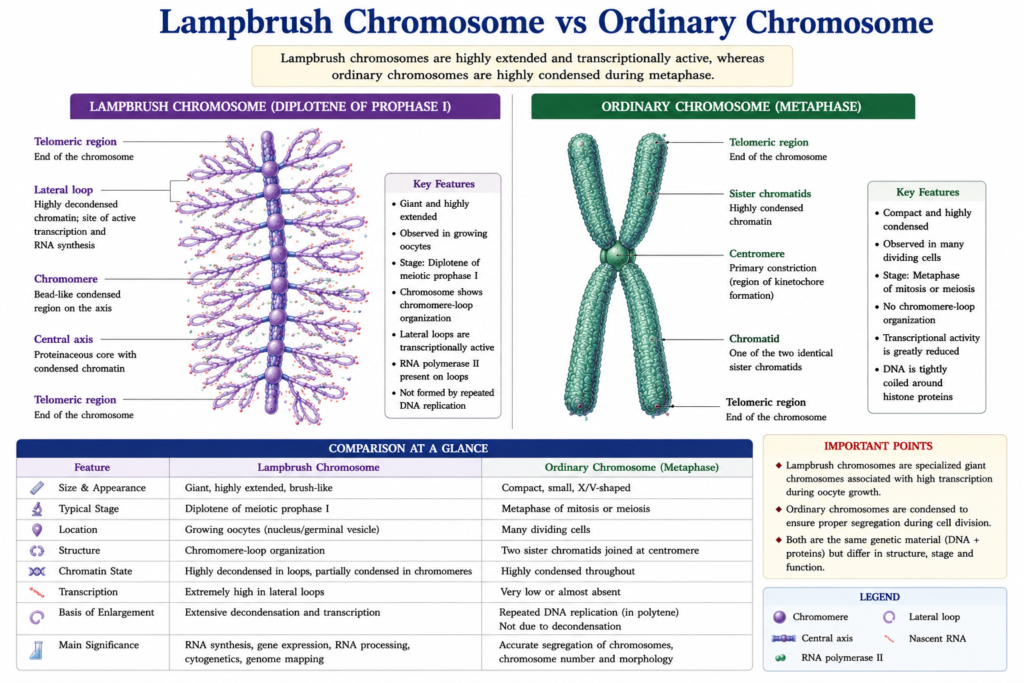
Lampbrush Chromosome vs Ordinary Chromosome
| Feature | Lampbrush chromosome | Ordinary condensed chromosome |
|---|---|---|
| Appearance | Extremely extended | Highly condensed during metaphase |
| Size | Giant | Comparatively small |
| Typical context | Growing oocyte | Many cell types |
| Main stage | Diplotene of meiotic prophase I | Especially visible during cell division |
| Chromatin state | Highly extended in active regions | Strongly condensed during metaphase |
| Lateral loops | Prominent | Not visible in this form |
| Chromomere-loop organization | Characteristic | Not characteristic |
| Transcriptional activity | Extremely high in loop regions | Greatly reduced in highly condensed metaphase chromosomes |
| Main research value | Transcription and chromosome organization | Chromosome number, morphology and segregation |
Lampbrush Chromosome vs Polytene Chromosome
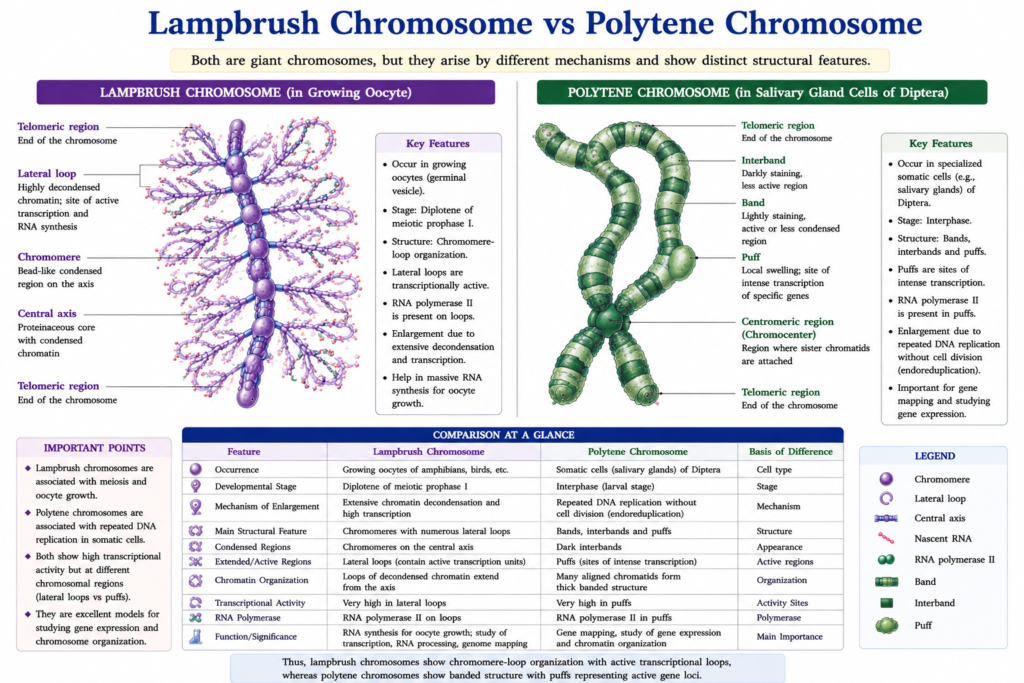
Both lampbrush and polytene chromosomes are giant chromosomes, but their origins are different.
| Feature | Lampbrush chromosome | Polytene chromosome |
|---|---|---|
| Main occurrence | Growing oocytes | Specialized somatic cells |
| Developmental context | Meiotic prophase I | Repeated replication without normal cell division |
| Main mechanism of enlargement | Extensive chromatin decondensation and transcription | Repeated DNA replication with aligned chromatids |
| Characteristic structure | Chromomeres and lateral loops | Bands, interbands and puffs |
| Major transcriptional feature | Lateral loops | Puffs |
| Common model organisms | Amphibians and birds | Drosophila and other dipterans |
| Main research applications | Transcription, RNA processing, cytogenetics | Gene mapping, transcription and chromatin organization |
So, the simplest distinction is:
Lampbrush chromosome = extended transcriptional loops
Polytene chromosome = repeated DNA replication and aligned chromatids
Scientific Importance of Lampbrush Chromosomes
Lampbrush chromosomes have had a major influence on chromosome biology.
Their large size allows scientists to observe chromosome regions that would be extremely difficult to resolve in ordinary chromosomes.
They have helped researchers investigate:
Chromosome architecture
The chromomere-loop arrangement provides a visible model of chromosome organization.
Gene transcription
The lateral loops reveal transcriptionally active chromosome regions.
RNA synthesis
Nascent RNA can be observed directly at transcription sites.
RNA processing
Transcription-associated RNA-processing components can be studied in their chromosome context.
Genome mapping
Specific DNA sequences can be localized to individual chromosome regions using cytogenetic techniques.
Chromosome evolution
Comparisons of lampbrush chromosomes have provided information about chromosomal rearrangements and karyotype evolution.
Importance in Modern Research
Although lampbrush chromosomes were discovered more than a century ago, they remain useful in modern chromosome research.
Modern genomic and microscopy techniques can be combined with lampbrush chromosome preparations to investigate:
- Genome organization
- Chromatin domains
- Transcriptional activity
- Non-coding RNA
- Repetitive DNA
- RNA processing
- Chromosome evolution
- Three-dimensional chromosome organization
Recent research continues to use lampbrush chromosomes because their enormous size makes chromosome architecture unusually accessible to microscopy.
Conclusion
Lampbrush chromosomes are remarkable giant chromosomes that develop during the prolonged diplotene stage of meiotic prophase I in growing oocytes.
Their defining feature is a central chromosome axis containing compact chromomeres, from which numerous transcriptionally active lateral loops extend.
Their unusual structure reflects the exceptionally high transcriptional demands of the growing oocyte.
The loops provide visible sites of RNA synthesis and have made lampbrush chromosomes one of the most informative classical models for studying the relationship between chromosome structure and gene activity.
Beyond transcription, lampbrush chromosomes have contributed to research on RNA processing, chromatin organization, genome mapping, chromosome evolution, and meiotic chromosome biology.
Although they are a specialized chromosomal state rather than a completely different kind of genetic material, their distinctive morphology provides an extraordinary window into how DNA can be organized and utilized within a living cell.
Key Takeaways
- Lampbrush chromosomes are specialized giant chromosomes associated mainly with growing oocytes.
- They develop during diplotene of meiotic prophase I.
- They are particularly well studied in amphibians and birds.
- Their central axis contains compact regions called chromomeres.
- Numerous lateral loops extend from the chromomeres.
- The lateral loops are highly decondensed and generally associated with active transcription.
- Lampbrush chromosomes do not become giant simply because their DNA is repeatedly replicated.
- Their unusual appearance is primarily associated with extensive chromatin decondensation and very high transcriptional activity.
- They help the growing oocyte produce and accumulate large amounts of RNA.
- They are valuable experimental models for studying transcription, RNA processing, chromosome organization, and cytogenetics.
Frequently Asked Questions
1. What is the definition of a lampbrush chromosome?
A lampbrush chromosome is a giant, highly extended chromosome found primarily in growing oocytes during diplotene of meiotic prophase I. It has a central axis containing chromomeres and numerous lateral loops associated with high transcriptional activity.
2. Why are lampbrush chromosomes called giant chromosomes?
They are called giant chromosomes because their highly extended structure makes them much larger and more visible than typical condensed chromosomes.
3. What is the most important feature of a lampbrush chromosome?
The most characteristic feature is its numerous lateral loops extending from chromomeres along the chromosome axis.
4. What is the function of chromomeres?
Chromomeres are compact chromatin regions that form part of the chromosome axis and serve as sites from which lateral loops emerge.
5. Why are lateral loops important?
Lateral loops contain highly decondensed chromatin and are associated with active transcription. They allow researchers to observe transcriptional activity directly at chromosome regions.
6. In which stage of meiosis are lampbrush chromosomes found?
They are characteristically found during diplotene of prophase I in growing oocytes.
7. Do lampbrush chromosomes replicate their DNA repeatedly?
No. Repeated DNA replication is not the basis of their giant structure. Their characteristic appearance primarily results from extensive chromatin decondensation and transcriptional activity.
8. What is the role of lampbrush chromosomes in oocytes?
They support extensive transcription during oocyte growth, contributing to the production and accumulation of RNA required by the developing oocyte.
9. Can lampbrush chromosomes be seen under a light microscope?
Yes. Their unusually large size and extended organization make them exceptionally suitable for microscopic observation.
10. Why are lampbrush chromosomes important in genetics?
They provide a powerful model for studying chromosome organization, transcription, RNA processing, genome mapping, and chromosome evolution.
References
- Krasikova A, Fishman V, Kulikova T. (2023). Lampbrush chromosome studies in the post-genomic era. BioEssays.
Excellent modern review covering chromomeres, lateral loops, hypertranscription, genome organization, and modern research. - Sommerville J, Malcolm DB, Callan HG. (1978). The organization of transcription on lampbrush chromosomes. Philosophical Transactions of the Royal Society B.
A classic paper specifically discussing chromomeres, lateral loops, transcription units, RNA, and RNP particles. - Gall JG, Murphy C. (1998). Assembly of Lampbrush Chromosomes from Sperm Chromatin. Molecular Biology of the Cell.
Useful for explaining formation of lampbrush chromosomes and the role of transcription in maintaining the loops. - Imaging the dynamics of transcription loops in living chromosomes. (2018). Chromosoma.
Particularly useful for the section on transcription, RNA polymerase II, nascent RNA, and the dynamic nature of lateral loops. - Gaginskaya E, Kulikova T, Krasikova A. (2017). Transcription of highly repetitive tandemly organized DNA in amphibians and birds: A historical overview and modern concepts.
Very useful for lampbrush chromosome structure, chromomere-loop organization, transcription, and repetitive DNA. - Zlotina A, et al. (2020). New Insights Into Chromomere Organization Provided by Lampbrush Chromosome Microdissection and High-Throughput Sequencing. Frontiers in Genetics.
Good source for the organization and genomic significance of chromomeres. - Induction of human lampbrush chromosomes.
Useful for the occurrence of lampbrush chromosomes, their structure, and the distinction between classical lampbrush chromosomes and experimentally induced lampbrush-like configurations in mammalian chromosomes. - Chromatin Higher-order Structure and Dynamics — Lampbrush and Polytene Chromosomes.
A useful textbook-style source for explaining lampbrush chromosomes as a specialized form of chromatin organization and comparing them with polytene chromosomes. - Assignment of the somatic A/B compartments to chromatin domains in giant transcriptionally active lampbrush chromosomes.
A more recent research paper useful for the modern significance of lampbrush chromosomes in studying genome organization and chromatin domains.
Discover more from Zoologyverse
Subscribe to get the latest posts sent to your email.