
Salpa is a genus of free-swimming marine tunicates commonly known as salps. It belongs to Phylum Chordata, Subphylum Tunicata, Class Thaliacea, Order Salpida and Family Salpidae. Salps are transparent, gelatinous animals that live in the open ocean and move through the water by jet propulsion.
The Classification of Salpa is important in zoology because salps show several specialized adaptations for a pelagic lifestyle. Their barrel-shaped body, muscular bands, pharyngeal basket and efficient filter-feeding system allow them to capture suspended food particles while continuously moving through seawater.
The Characteristics of Salpa include a transparent body enclosed by a gelatinous tunic, prominent circular muscle bands, oral and atrial openings, a large pharyngeal basket and an endostyle. Salps can occur as solitary individuals as well as interconnected aggregate forms during different stages of their life cycle.
The Life cycle of Salpa is particularly interesting because it involves alternating solitary and aggregate generations. Asexual reproduction produces new individuals that form an aggregate generation, while the aggregate individuals reproduce sexually and produce the next solitary generation.
This article covers the Classification of Salpa, Characteristics of Salpa, physical features, feeding adaptations, jet propulsion, solitary and aggregate forms, reproduction, Life cycle of Salpa and ecological importance.
For Practical Study
The following notes are arranged in a practical examination format for easy study and identification.
Classification of Salpa
| Rank | Classification | Characteristic |
|---|---|---|
| Kingdom | Animalia | Multicellular animals |
| Phylum | Chordata | Animals showing fundamental chordate features during development |
| Subphylum | Tunicata | Marine chordates enclosed by a protective tunic |
| Class | Thaliacea | Pelagic tunicates adapted for free-swimming life |
| Order | Salpida | Transparent, gelatinous tunicates with muscular bands and jet propulsion |
| Family | Salpidae | Salps with solitary and aggregate forms in their life cycle |
| Genus | Salpa | Barrel-shaped pelagic tunicates with prominent muscle bands and efficient filter feeding |
Geographical Distribution
Salpa occurs in marine waters of different oceanic regions, with individual species occupying particular geographic and temperature ranges.
Salps are mainly associated with open-ocean and pelagic environments.
Habit and Habitat
Salpa is a free-swimming pelagic tunicate that remains suspended in the water column.
It is adapted for continuous swimming and filter feeding and may occur as solitary individuals or as connected aggregate forms.
Comments
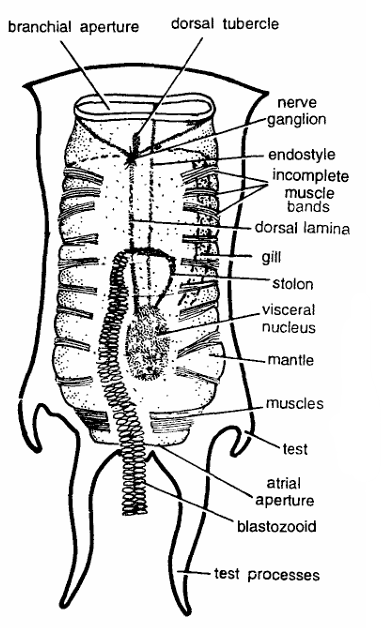
- Body of the animal is cask-shaped, measuring 1 to 8 cm in length and covered by a thick test.
- The branchial and atrial apertures are at opposite ends. Posteriorly the test in produced into two tail processes. Below test in mantle.
- Salp exhibits polymorphism and exists in two phases
- oozooid or asexual phase
- blastozooid or sexual phase or aggregate type.
- Two phases are very much alike, but oozooids aresmaller in size and having lesser number of muscle bands.
- Sexually produced Salp is called as solitary type or oozooid, while alternate generation produced by budding is called as aggregate type or blastozooid.
- Typical oozooid consists of branchial and atrial apertures at opposite ends.
- A ciliated funnel is present on dorsal side. Nerve ganglion, dorsal lamina and pharynx which has endostyle, peripharyngeal band gill present.
- Oesophagus, stomach, intestine and gonad constitute a compact mass along the postero-ventral side which is called as visceral nucleus. Muscle bands incomplete.
- A stolon originates from ventral side and it carries endostylic and mesenchymal extensions. Stolon produces buds or blastozooids.
- Blastozooid is a sexual phase, having paired testes and a single ovary.
- Blastozooid is protogynous. Fertilization is internal. Ovum gives rise to a single sexless free oozooid.
- Important character of the animal is locomotion by propelling mechanism in which active muscle bands contract and inturned water is ejected through atrial pore.
Special Features
- Sexual and asexual generations alternate a single adult asexually produces several hundred individuals connected to one another.
- Small fragments of such a chain consisting of several animals, sometimes break loose from parent. Both connected and separated individuals reproduce sexually.
- Each individual produces one or several eggs that remain connected to parent by a placenta like structure, analogous to that of higher chordates where the maternal and embryonic circulation are closely related during development. The hatching egg becomes asexual form.
- Bioluminescence: Produces light through symbiotic bacteria, which aids in communication and predator deterrence.
- Dual Reproduction: Alternates between solitary and colonial phases, enabling rapid adaptation to environmental conditions.
- Efficient Filter Feeding: Processes large volumes of water, removing plankton and organic particles.
- Transparency: Almost completely transparent, making them nearly invisible to predators.
- Rapid Growth: Exhibits exponential growth in favorable conditions, with colonies forming quickly.
Identification
A transparent, gelatinous, barrel-shaped marine tunicate with prominent circular muscle bands, large openings and a free-swimming pelagic habit can be identified as a salp.
Quick Identification of Salpa
Salpa is a free-swimming marine tunicate characterized by its transparent, gelatinous body, prominent muscular bands and efficient filter-feeding system.
- Common name: Salp
- Scientific name: Salpa
- Phylum: Chordata
- Subphylum: Tunicata
- Class: Thaliacea
- Order: Salpida
- Family: Salpidae
- Body: Transparent, gelatinous and barrel-shaped
- Lifestyle: Free-swimming and pelagic
- Feeding: Suspension or filter feeding
- Locomotion: Jet propulsion by muscular contractions
- Key feature: Solitary and aggregate forms occur during its life cycle
- Important adaptation: Large pharyngeal basket with an endostyle for efficient filtration of suspended food particles.
Physical Characteristics of Salpa
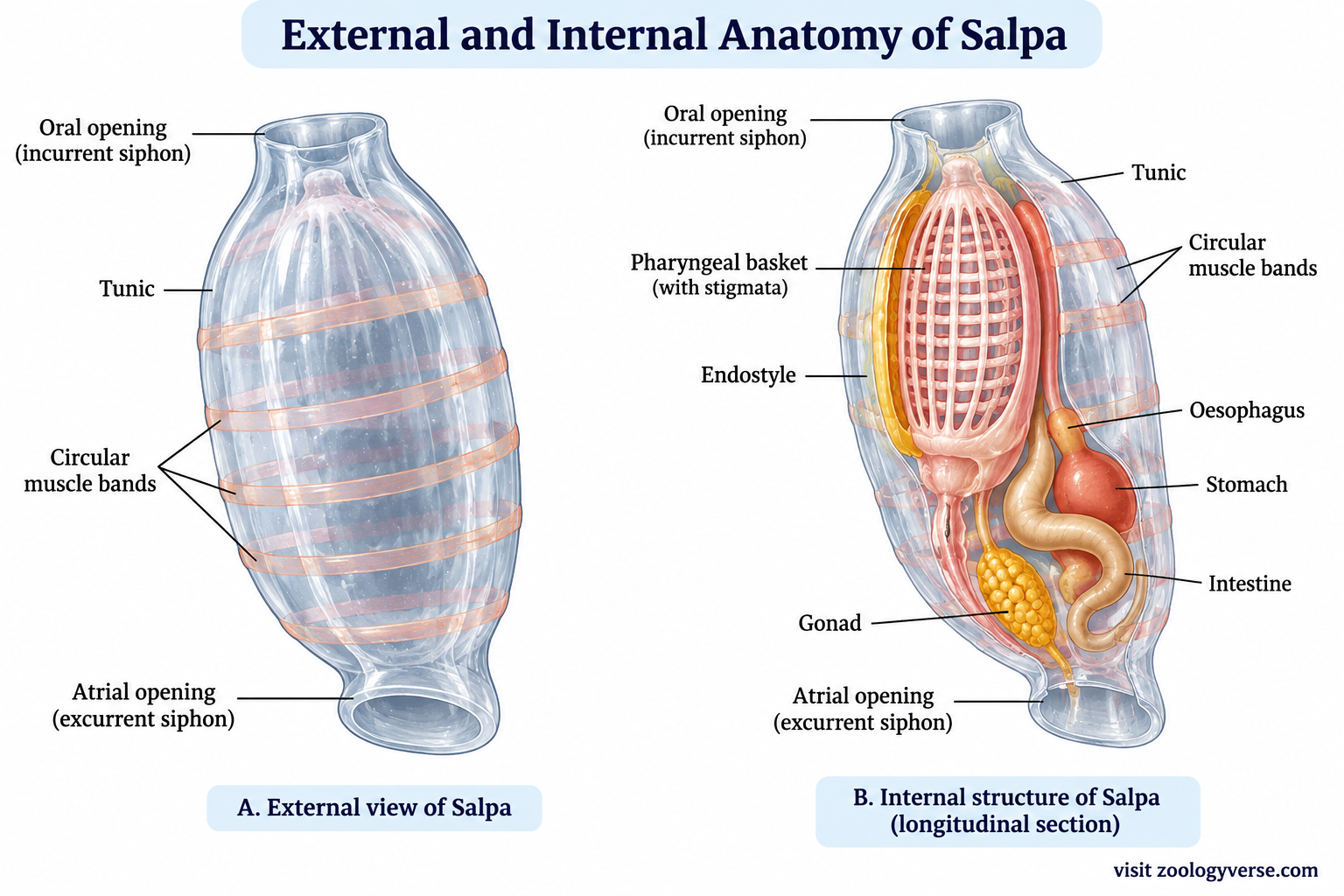
Salpa has a transparent, gelatinous and barrel-shaped body adapted for a pelagic lifestyle. Its body is enclosed by a thin tunic and contains prominent circular muscle bands that help in swimming and water movement.
- The body is generally cylindrical or barrel-shaped and highly transparent.
- A gelatinous tunic surrounds and supports the body.
- The body has prominent circular muscle bands arranged around the trunk.
- The oral opening allows seawater to enter the body.
- The atrial opening allows filtered water to leave the body.
- A large pharyngeal basket occupies much of the body and is specialized for filter feeding.
- The endostyle produces mucus used in trapping suspended food particles.
- The digestive tract is compact and adapted to the pelagic lifestyle.
- Muscular contractions force water through the body and provide jet propulsion.
- Salpa occurs in both solitary and aggregate forms, which are associated with different phases of its life cycle.
Feeding and Filter-Feeding Adaptations of Salpa
Salpa is an efficient filter feeder that obtains food by continuously filtering suspended particles from seawater. Its large pharyngeal basket and mucus-based feeding system are especially important for its pelagic lifestyle.
- Seawater enters through the oral opening during swimming.
- The water passes through the large pharyngeal basket.
- The endostyle produces mucus that forms a feeding filter.
- Suspended food particles such as phytoplankton and other small organic particles become trapped in the mucus.
- Ciliary activity moves the food-containing mucus toward the digestive region.
- Food is transferred to the digestive tract, where digestion and absorption occur.
- Filtered water passes toward the atrial opening and is expelled from the body.
- Continuous water flow allows Salpa to combine feeding with respiration and locomotion.
These adaptations make Salpa an important component of pelagic food webs and allow it to efficiently utilize suspended organic matter in the ocean.
Locomotion and Jet Propulsion in Salpa
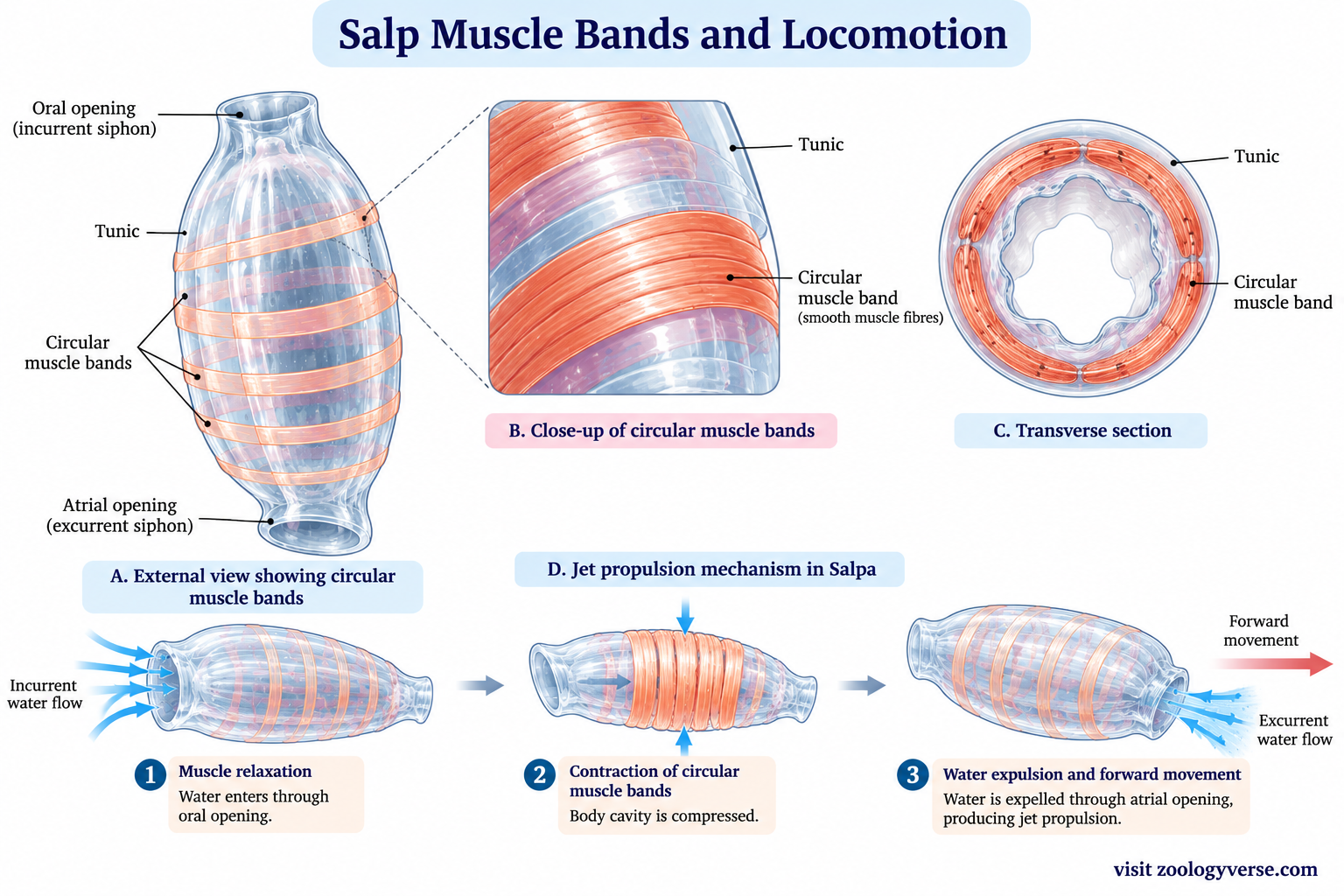
Salpa moves through seawater by jet propulsion, using rhythmic contractions of its circular muscle bands to force water through the body.
- Circular muscle bands contract around the body and reduce its internal volume.
- Water is forced out through the atrial opening.
- The expelled water produces a backward-directed jet.
- The resulting reaction force moves the animal forward through the water.
- Successive muscle contractions produce rhythmic swimming and maintain continuous water circulation.
- The same water current also supports filter feeding and respiration.
- This efficient jet-propulsion system is an important adaptation for the pelagic lifestyle of Salpa.
Solitary and Aggregate Forms of Salpa
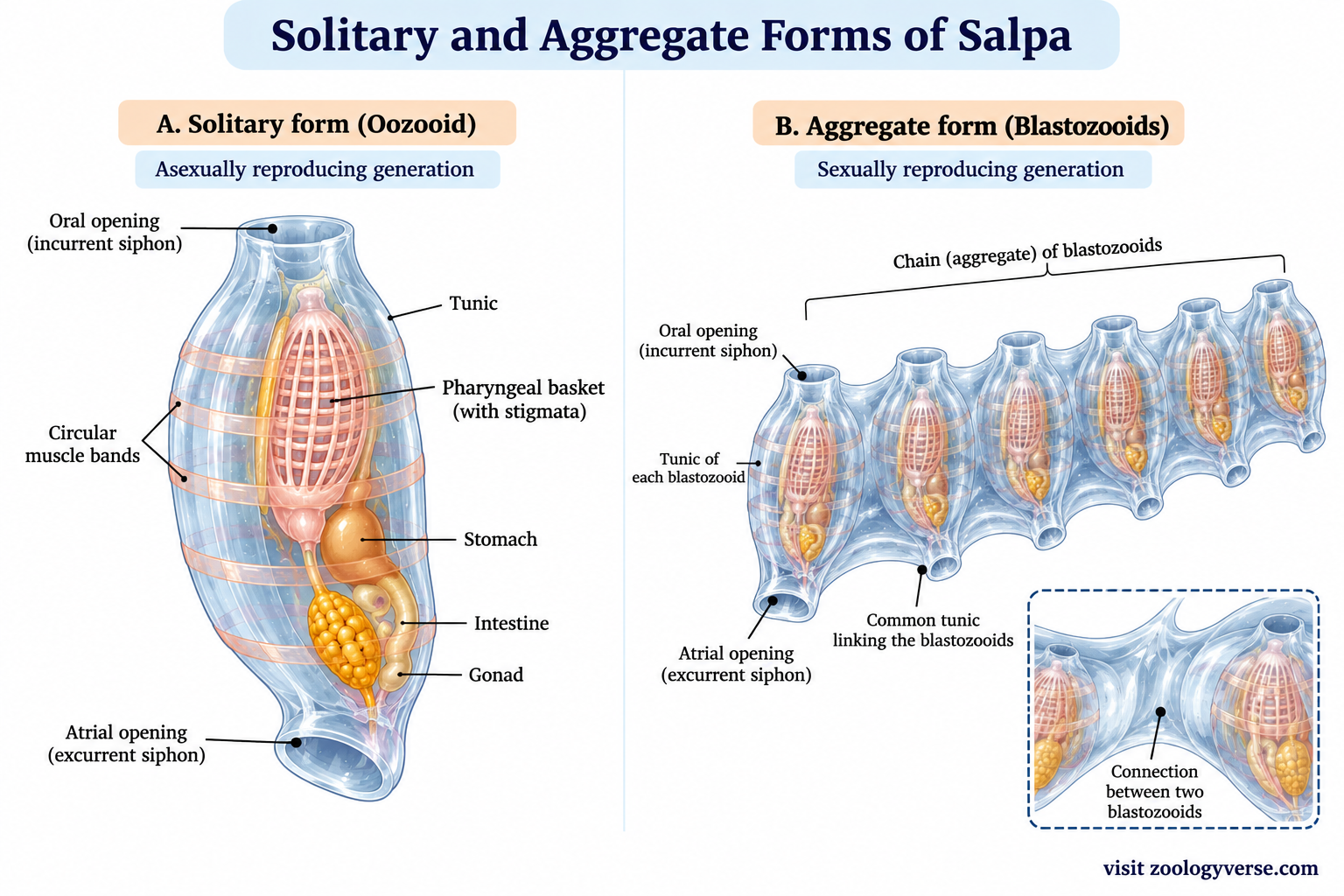
Salpa has two distinct forms during its life cycle: a solitary form and an aggregate form. These forms differ in their organization and reproductive role.
1. Solitary Form
The solitary form develops from a sexually produced embryo and is commonly called the oozooid.
- It is an individual, free-swimming salp.
- It reproduces asexually by budding.
- Budding produces numerous young individuals that remain connected.
- These individuals develop into the aggregate form.
2. Aggregate Form
The aggregate form consists of numerous individuals, called blastozooids, that remain connected in a chain or cluster.
- Individuals are produced asexually by the solitary form.
- The blastozooids are specialized for sexual reproduction.
- They remain connected for a period before separating or completing their reproductive cycle.
- The aggregate form can increase the feeding and reproductive capacity of the population.
Thus, the alternation between solitary and aggregate forms is a distinctive feature of the Salpa life cycle.
Reproduction and Life Cycle of Salpa
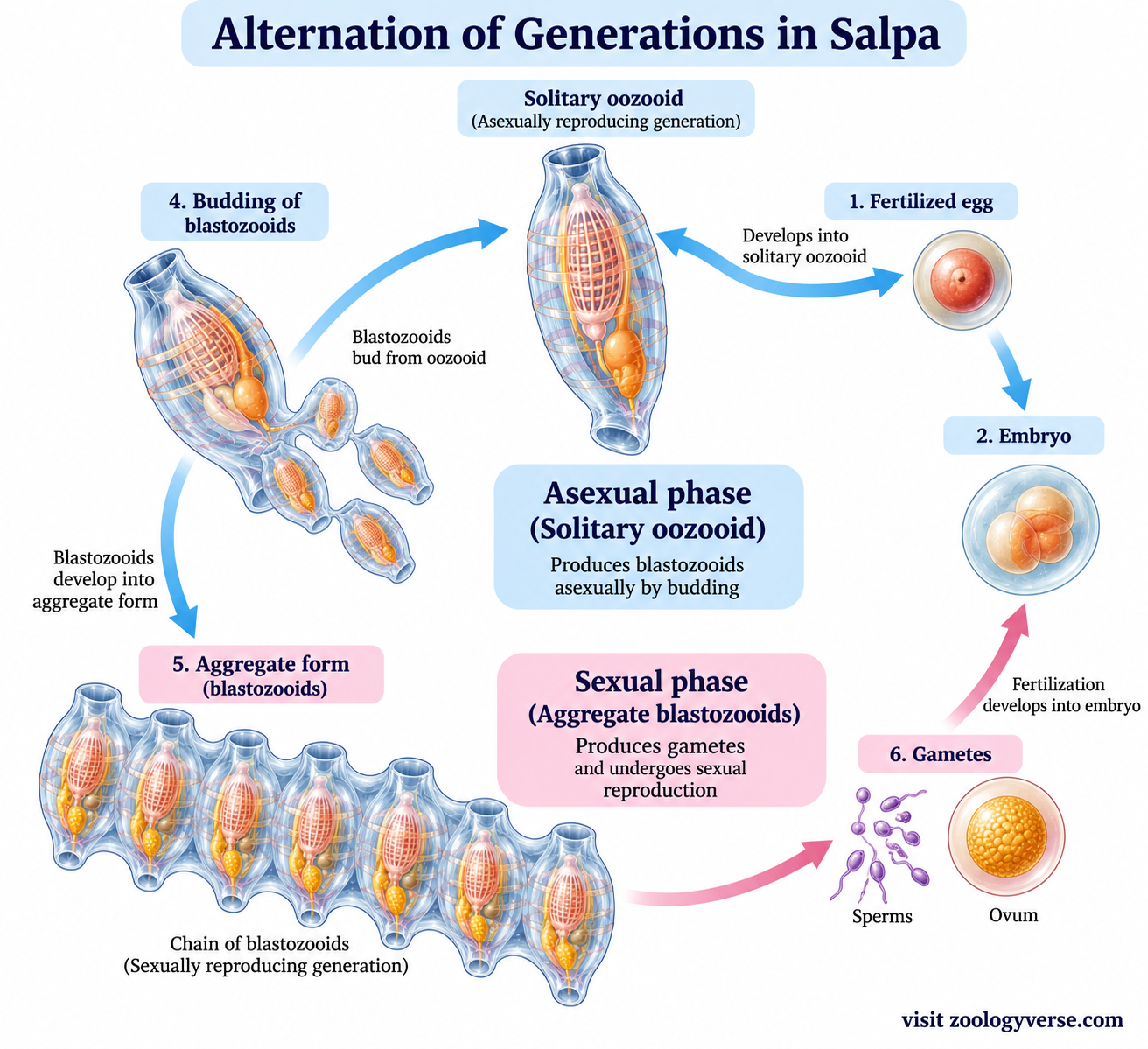
The life cycle of Salpa is characterized by an alternation between asexual and sexual phases. The solitary form produces the aggregate form by asexual budding, while the aggregate form produces the next solitary generation through sexual reproduction.
Asexual Phase
The life cycle begins with a sexually produced embryo that develops into a solitary oozooid.
- The oozooid grows into a free-swimming solitary salp.
- It reproduces asexually by budding.
- Numerous buds develop into young blastozooids.
- The developing blastozooids remain connected, forming an aggregate chain or group.
Sexual Phase
The aggregate blastozooids represent the sexual phase.
- Blastozooids develop reproductive organs and produce gametes.
- Fertilization results in the formation of an embryo.
- The embryo develops into a new solitary oozooid.
- The new oozooid begins another cycle of asexual budding.
Life Cycle Sequence
Embryo → Solitary oozooid → Asexual budding → Aggregate blastozooids → Sexual reproduction → Fertilization → Embryo → New solitary oozooid
This alternation of solitary and aggregate generations is one of the most distinctive features of the life cycle of Salpa.
Alternation of Generations in Salpa
The life cycle of Salpa shows a clear alternation between an asexual solitary generation and a sexual aggregate generation. This reproductive pattern allows salps to rapidly increase their numbers when environmental conditions are suitable.
Solitary Generation
The solitary oozooid develops from a fertilized embryo. It reproduces asexually by budding and produces a series of genetically similar blastozooids.
Aggregate Generation
The blastozooids remain connected to form an aggregate chain or group. They develop reproductive organs and participate in sexual reproduction, eventually producing embryos that develop into new solitary individuals.
Importance of the Alternation
This reproductive strategy combines:
- Asexual reproduction for rapid population growth.
- Sexual reproduction for producing new generations.
- Solitary and aggregate forms specialized for different stages of the life cycle.
Thus, the alternation of generations is a major biological characteristic of Salpa and distinguishes its life cycle from that of many other tunicates.
Respiration and Circulation in Salpa
Salpa performs respiration mainly through its pharyngeal basket, which provides a large surface area for exchange of respiratory gases.
- Seawater continuously passes through the pharyngeal basket during filter feeding.
- Oxygen dissolved in the water diffuses across the thin tissues of the pharyngeal region.
- Carbon dioxide produced by metabolism diffuses into the passing water.
- The extensive pharyngeal surface allows efficient gas exchange during continuous swimming.
- A simple circulatory system transports nutrients and respiratory gases within the body.
- A tubular heart and associated vessels help circulate the internal fluid.
- Continuous water movement through the body supports both respiration and filter feeding.
Thus, the respiratory and circulatory systems of Salpa are closely associated with its pelagic, filter-feeding lifestyle
Nervous System and Sensory Features of Salpa
The nervous system of Salpa is relatively simple and is adapted to its free-swimming pelagic lifestyle. It coordinates swimming, feeding and responses to environmental stimuli.
- A cerebral ganglion acts as the main nervous centre.
- Nerve fibres extend from the ganglion to different regions of the body.
- Sensory structures detect changes in the surrounding water and environmental conditions.
- The nervous system coordinates the rhythmic contraction of the circular muscle bands during swimming.
- It also helps coordinate feeding movements and responses to external stimuli.
- The simple organization of the nervous system reflects the highly specialized body plan of pelagic thaliacean tunicates.
Ecological Importance of Salpa
Salpa plays an important role in marine ecosystems through its filter-feeding activity, nutrient cycling and transfer of organic matter through the pelagic food web.
- Salpa consumes phytoplankton and other suspended organic particles from seawater.
- By filtering large volumes of water, salps can influence the abundance and distribution of planktonic particles.
- Their feeding activity contributes to the transfer of organic matter within marine food webs.
- Salp fecal material can transport consumed organic carbon downward through the water column, contributing to marine carbon cycling.
- Large increases in salp abundance can temporarily influence plankton communities and the availability of food for other organisms.
- Salps themselves provide food for various marine predators.
- Their rapid reproduction under favourable conditions can make them an important component of some pelagic ecosystems.
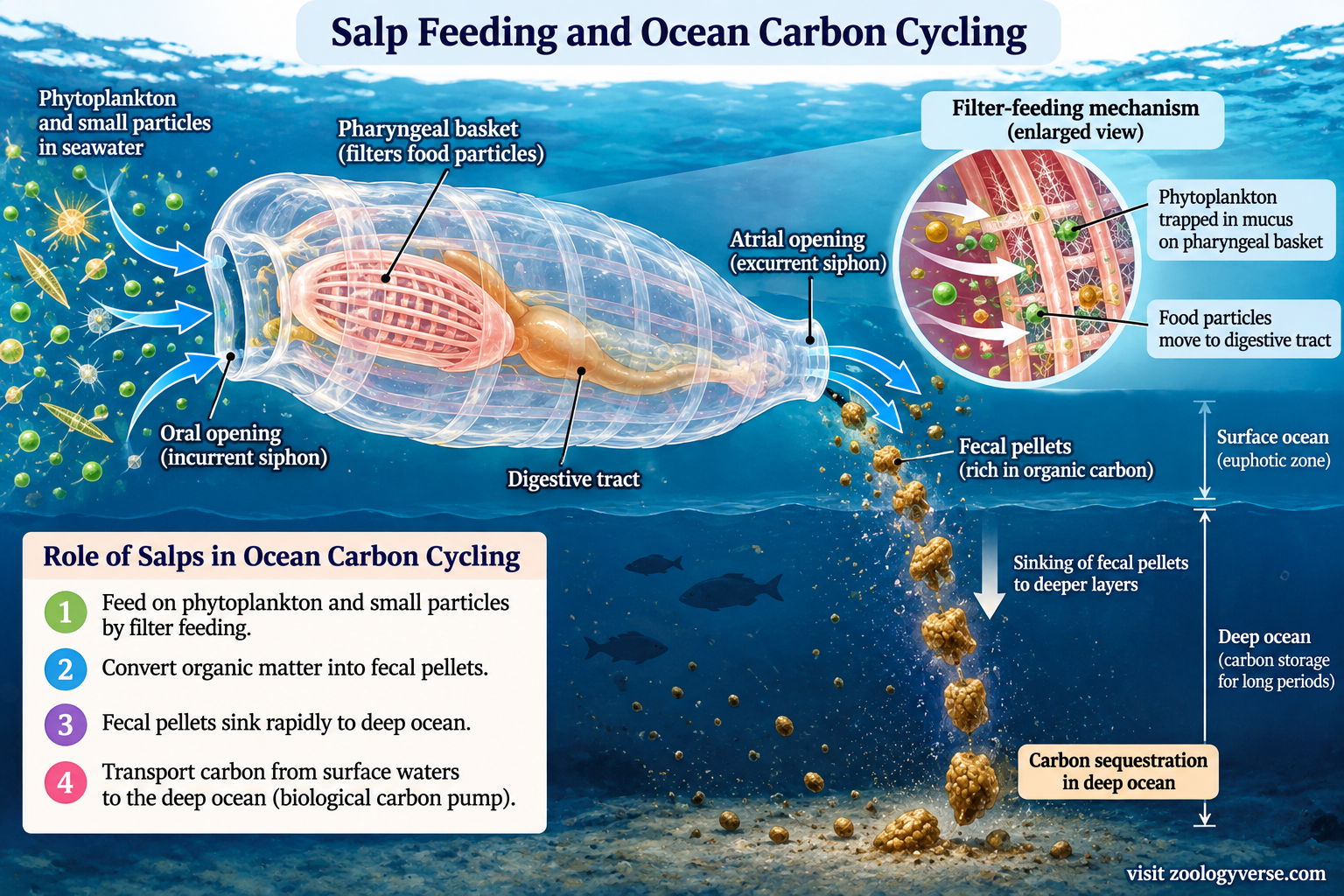
Thus, Salpa contributes to plankton dynamics, food-web interactions and oceanic carbon cycling.
Key Takeaways
- Salpa is a marine pelagic tunicate belonging to Phylum Chordata.
- It is classified under Subphylum Tunicata, Class Thaliacea, Order Salpida and Family Salpidae.
- The body is transparent, gelatinous and barrel-shaped.
- Prominent circular muscle bands help in jet propulsion.
- A large pharyngeal basket and endostyle support efficient filter feeding.
- Salpa occurs in both solitary and aggregate forms during its life cycle.
- The solitary oozooid reproduces asexually by budding.
- Aggregate blastozooids represent the sexual phase of the life cycle.
- Salps contribute to plankton dynamics, marine food webs and carbon cycling.
- Their specialized pelagic body plan makes Salpa an important example for studying tunicate biology and marine ecology.
Frequently Asked Questions
What is Salpa?
Salpa is a genus of free-swimming marine tunicates commonly known as salps. They have a transparent, gelatinous body and are adapted for filter feeding and pelagic life.
What is the classification of Salpa?
Salpa belongs to Kingdom Animalia, Phylum Chordata, Subphylum Tunicata, Class Thaliacea, Order Salpida and Family Salpidae.
Where does Salpa live?
Salpa lives in marine environments, mainly in the open ocean and pelagic water column.
What does Salpa eat?
Salpa is a filter feeder that mainly consumes phytoplankton and other small suspended organic particles.
How does Salpa move?
It moves by jet propulsion. Contraction of its circular muscle bands forces water out through the atrial opening and produces forward movement.
What are the main identifying features of Salpa?
The major features include a transparent gelatinous body, barrel-like shape, prominent circular muscle bands, large pharyngeal basket and pelagic habit.
What are the solitary and aggregate forms of Salpa?
The solitary form is the oozooid, which reproduces asexually by budding. The resulting blastozooids form the aggregate generation involved in sexual reproduction.
What is the life cycle of Salpa?
The life cycle involves alternating solitary and aggregate generations: solitary oozooid → asexual budding → aggregate blastozooids → sexual reproduction → embryo → new oozooid.
Why is Salpa important in marine ecosystems?
Salpa contributes to plankton dynamics, marine food webs, nutrient cycling and the transport of organic carbon through the ocean.
Recommended Study Resource
A Manual of Practical Zoology – Chordates
by P S Verma (Author)
A Manual of Practical Zoology Chordates : For Undergraduate, Postgraduate Students | 12th Edition | Basic Lab Methods Book | Experimental Biochemistry, Physiology, Osteology, Embryology
by Dr. P S Verma (Author)
As an Amazon Associate I earn from qualifying purchases.
References
- National Center for Biotechnology Information (NCBI). Salpa Taxonomy and Classification.
- World Register of Marine Species (WoRMS). Salpa and Salpida classification.
- National Center for Biotechnology Information (NCBI). Thaliacea Taxonomy.
- Ruppert, E. E., Fox, R. S., & Barnes, R. D. Invertebrate Zoology: A Functional Evolutionary Approach. Brooks/Cole.
- Brusca, R. C., Moore, W., & Shuster, S. M. Invertebrates. Sinauer Associates.
Discover more from Zoologyverse
Subscribe to get the latest posts sent to your email.