
1. Introduction
The Modern Synthetic Theory of Evolution is one of the most comprehensive scientific explanations of evolutionary change in living organisms. It combines Charles Darwin’s principle of natural selection with Mendelian genetics, population genetics, cytology, palaeontology and other branches of biological science. The Modern Synthetic Theory of Evolution explains how genetic variations arise, how they are inherited and how evolutionary processes influence the genetic composition of populations over successive generations.
The development of this theory during the twentieth century marked a major advancement in evolutionary biology. Although Darwin had explained the importance of natural selection in evolution, he could not describe the genetic mechanisms responsible for the origin and inheritance of variations. The rediscovery of Gregor Mendel’s laws of inheritance and subsequent advances in genetics helped scientists understand how hereditary characteristics are transmitted from parents to offspring. These discoveries eventually contributed to the establishment of the Modern Synthetic Theory of Evolution.
According to the Modern Synthetic Theory of Evolution, evolution occurs primarily through changes in allele frequencies within populations over generations. These changes are influenced by several important evolutionary mechanisms, including mutation, genetic recombination, natural selection, genetic drift and gene flow. Together, these processes generate and modify genetic variation, producing evolutionary changes that may eventually contribute to adaptation, population divergence and the formation of new species.
An important aspect of the Modern Synthetic Theory of Evolution is its explanation of evolution at different biological scales. Small-scale evolutionary changes occurring within populations are described as microevolution, whereas large-scale evolutionary patterns involving species diversification and major biological transformations are studied under macroevolution. Both concepts are important for understanding the continuity of evolutionary processes across generations and geological time.
The study of the Modern Synthetic Theory of Evolution, microevolution and macroevolution provides a foundation for understanding population genetics, adaptation, speciation, biodiversity and evolutionary relationships. It also connects classical evolutionary explanations with modern discoveries in molecular biology, developmental biology and genomics. Therefore, this theory remains a fundamental framework for studying the mechanisms, patterns and long-term consequences of biological evolution.
The study of evolution is closely connected with the origin and early diversification of life. To understand the earliest explanations for the emergence of living organisms, read our detailed article on Origin of Life and Its Theories.
2. Historical Development of the Modern Synthetic Theory
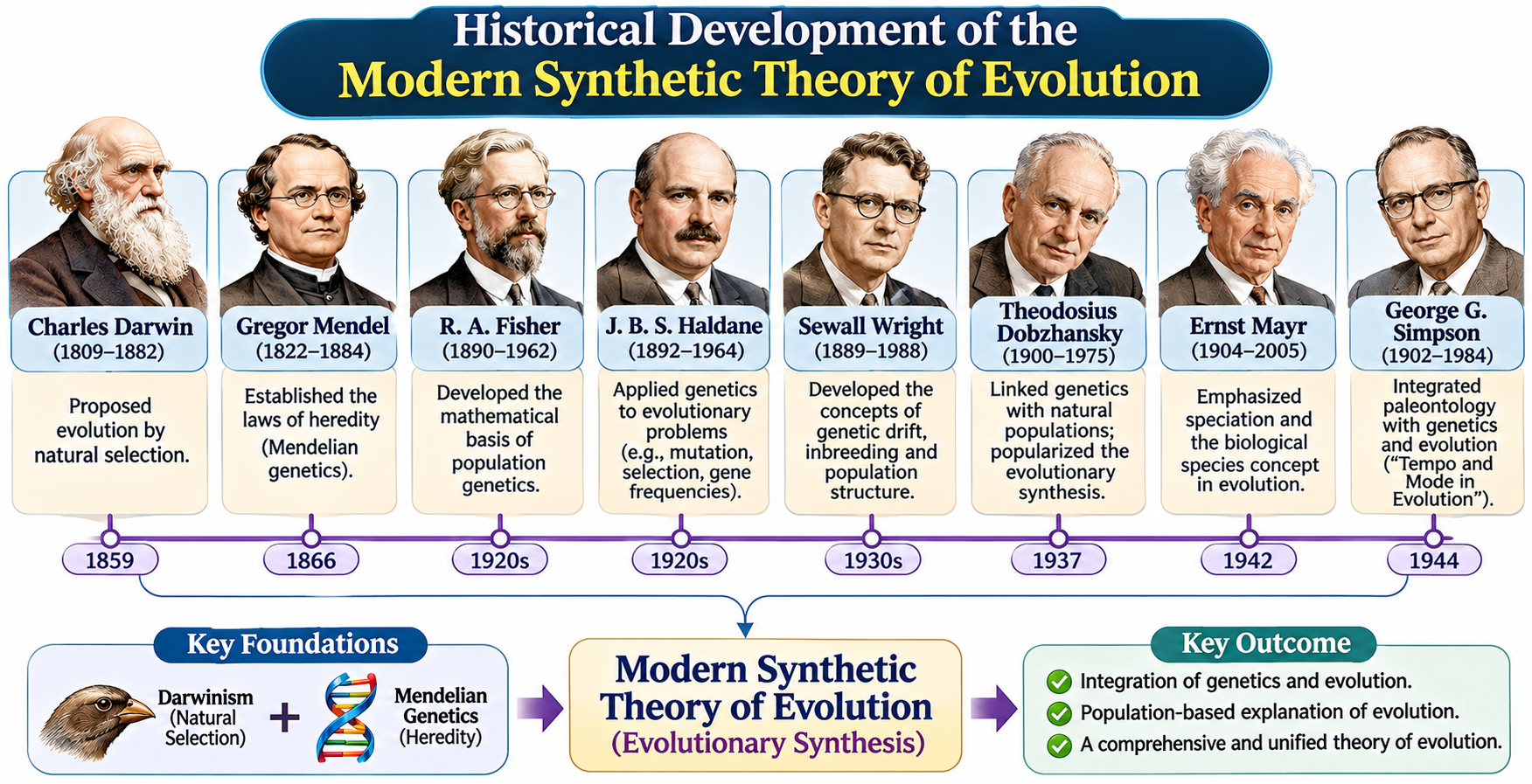
The development of the Modern Synthetic Theory of Evolution was a gradual process that brought together several branches of biological science. Although Charles Darwin explained evolution through natural selection, his theory did not provide a satisfactory explanation of heredity or the origin of variations. The Modern Synthetic Theory of Evolution emerged when Mendelian genetics was integrated with Darwinian natural selection and later supported by population genetics, cytology, palaeontology and other biological disciplines.
The development of evolutionary biology was supported by several lines of scientific evidence, including fossil records, comparative anatomy, embryology and molecular biology. These lines of evidence are discussed in detail in our article on Evidences of Evolution: Types, Examples and Importance.
2.1 Limitations of Darwin’s Original Theory
Charles Darwin proposed that natural selection acts on heritable variations and favours individuals possessing characteristics that improve their survival and reproductive success. However, during Darwin’s lifetime, the mechanisms responsible for the transmission of hereditary characters were not understood.
The major limitations of Darwin’s original explanation included:
- Uncertainty about heredity: Darwin could not explain precisely how favourable characteristics were transmitted from parents to offspring.
- Origin of variations: The sources responsible for the appearance of new variations were not clearly understood.
- Inheritance of acquired characters: Darwin considered the possible inheritance of acquired characteristics, although he did not establish a satisfactory genetic mechanism for their transmission.
- Genetic basis of evolution: The relationship between hereditary factors and evolutionary change remained unexplained.
These limitations created a need for a theory that could explain both the origin and inheritance of variations. The later Modern Synthetic Theory of Evolution addressed this gap by incorporating the principles of genetics into evolutionary biology.
2.2 Rediscovery of Mendel’s Laws (1900)
A major step towards the development of the Modern Synthetic Theory of Evolution occurred in 1900, when the work of Gregor Mendel was independently rediscovered by Hugo de Vries, Carl Correns and Erich von Tschermak.
Mendel’s experiments on pea plants demonstrated that hereditary characters are transmitted through discrete units, now known as genes. His principles of segregation and independent assortment provided a scientific explanation for the inheritance of characteristics.
The rediscovery of Mendelian genetics helped resolve an important problem in Darwinism. It demonstrated that hereditary variations do not necessarily disappear through blending but can be transmitted from one generation to another. This understanding provided the genetic foundation on which the Modern Synthetic Theory of Evolution was subsequently developed.
2.3 Contribution of Hugo de Vries and Mutation Theory
Hugo de Vries proposed the Mutation Theory of Evolution in the early twentieth century, based on his studies of the evening primrose (Oenothera lamarckiana). He suggested that sudden, heritable changes called mutations could produce new characteristics and contribute to evolutionary change.
Although some of de Vries’s observations were later understood differently in the light of chromosome genetics, his work drew attention to mutation as an important source of hereditary variation.
The recognition of mutation became essential to the Modern Synthetic Theory of Evolution, because mutations introduce new genetic variations into populations. These variations can subsequently be affected by natural selection, genetic drift and other evolutionary mechanisms.
2.4 Development of Population Genetics
During the early twentieth century, scientists began applying mathematical principles to the study of heredity and evolution. This led to the development of population genetics, which became a central foundation of the Modern Synthetic Theory of Evolution.
Three scientists made particularly important contributions:
- Godfrey H. Hardy: Independently formulated the Hardy–Weinberg principle with Wilhelm Weinberg in 1908.
- Wilhelm Weinberg: Independently developed the mathematical relationship describing allele and genotype frequencies in populations.
- Sewall Wright: Investigated genetic drift, inbreeding and the effects of population structure on evolutionary change.
The Hardy–Weinberg principle showed that allele frequencies remain constant across generations under specific conditions, including random mating, a very large population, and the absence of mutation, migration and natural selection. Deviations from these conditions can help explain changes in genetic composition.
Population genetics provided a mathematical framework for understanding evolution as changes in allele frequencies within populations. This framework became a central component of the Modern Synthetic Theory of Evolution.
2.5 Integration of Genetics with Darwinian Natural Selection
The synthesis developed further during the 1930s and 1940s, when several scientists demonstrated how Mendelian inheritance and natural selection could operate together.
Important contributors included:
- Ronald A. Fisher: Connected Mendelian genetics with natural selection and developed mathematical models of evolutionary change.
- J. B. S. Haldane: Used mathematical methods to investigate the effects of natural selection on populations.
- Sewall Wright: Explained the importance of genetic drift, population structure and interactions among evolutionary factors.
- Theodosius Dobzhansky: Connected population genetics with natural populations through his work on genetic variation and evolution.
- Ernst Mayr: Contributed to the biological species concept and explained the importance of reproductive isolation in speciation.
- George Gaylord Simpson: Integrated palaeontological evidence with evolutionary theory.
- G. Ledyard Stebbins: Demonstrated the importance of genetics, particularly plant genetics and hybridisation, in evolutionary change.
The publication of Dobzhansky’s Genetics and the Origin of Species in 1937 was an important milestone in the development of the evolutionary synthesis. It helped establish the connection between genetic variation in populations and evolutionary processes in nature.
2.6 Establishment of the Modern Evolutionary Synthesis
By the 1940s, contributions from genetics, systematics, palaeontology, ecology and other disciplines had produced a more unified explanation of evolutionary change. The Modern Synthetic Theory of Evolution established natural selection as a major evolutionary mechanism while recognising the importance of mutation, recombination, genetic drift and gene flow.
Julian Huxley’s book Evolution: The Modern Synthesis, published in 1942, helped popularise the term and present the developing synthesis as a unified framework.
The Modern Synthetic Theory of Evolution therefore did not originate from a single scientist or one discovery. It developed through the combined work of researchers who connected Darwin’s principle of natural selection with Mendelian genetics and population-level evolutionary processes.
3. Fundamental Principles of the Modern Synthetic Theory
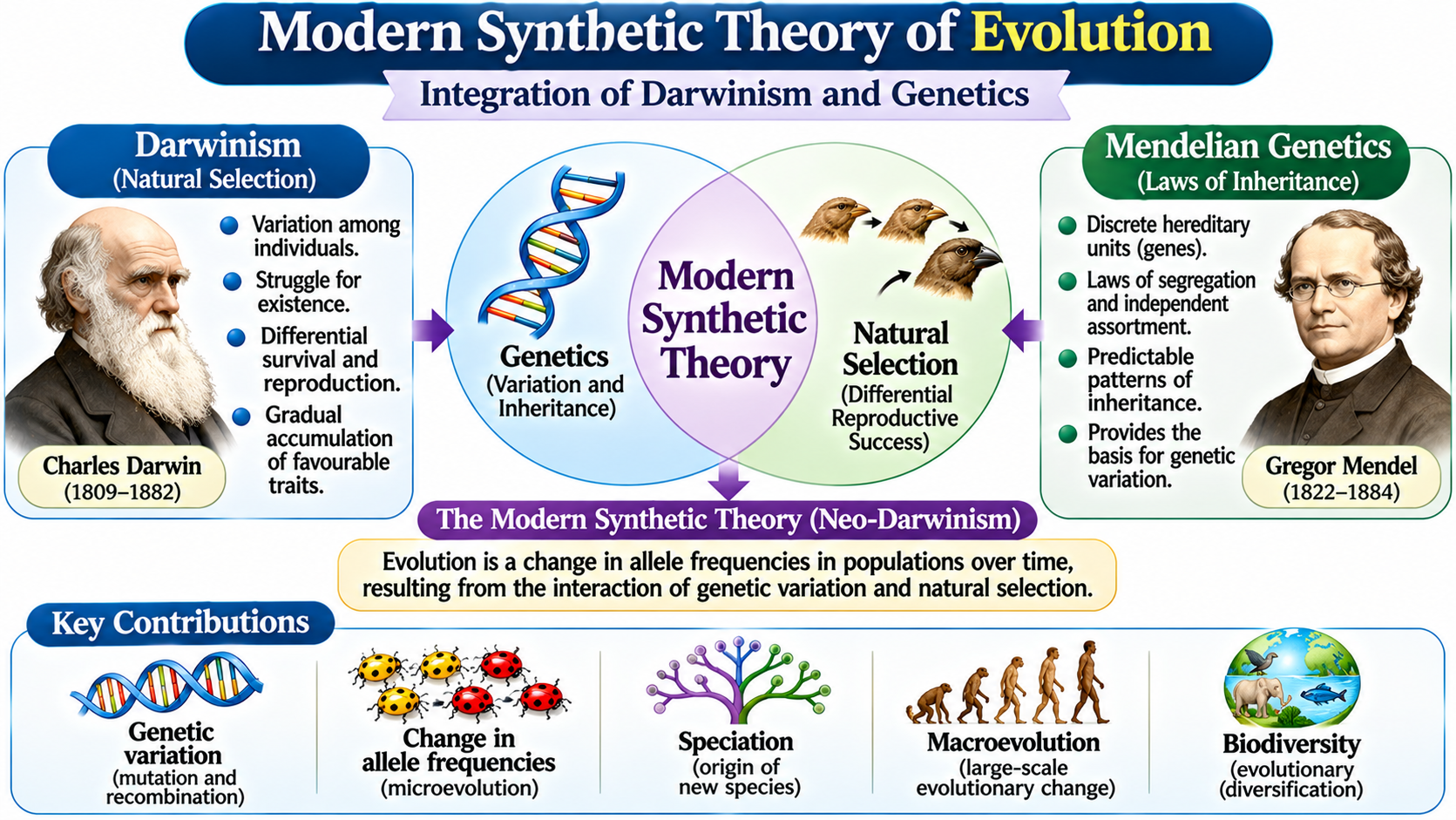
The Modern Synthetic Theory of Evolution explains evolutionary change through the interaction of genetic variation, heredity and evolutionary mechanisms acting on populations over successive generations. It combines Mendelian principles of inheritance with Darwinian natural selection and population genetics. According to the Modern Synthetic Theory of Evolution, evolution is not simply the change in the characteristics of individual organisms; it involves changes in the genetic composition of populations over time.
The major principles of the Modern Synthetic Theory of Evolution are discussed below.
3.1 Evolution Occurs at the Population Level
A population is a group of individuals belonging to the same species that live in a particular geographical area and have the potential to interbreed.
The Modern Synthetic Theory of Evolution considers the population, rather than an individual organism, as the basic unit of evolutionary change. An individual may grow, develop or acquire certain characteristics during its lifetime, but evolution occurs when the genetic composition of a population changes across generations.
The genetic constitution of a population is represented by its gene pool, which includes all the genes and their different alleles present in that population.
Evolution can therefore be understood as a change in allele frequencies within a population over successive generations.
3.2 Genetic Variation Is the Raw Material of Evolution
Genetic variation refers to differences in the genetic constitution of individuals belonging to the same population. It is essential for evolutionary change because evolutionary mechanisms act on existing genetic differences.
According to the Modern Synthetic Theory of Evolution, genetic variation arises mainly through the following processes:
- Mutation: Changes in DNA sequences introduce new alleles into a population.
- Genetic recombination: During meiosis, crossing over and independent assortment produce new combinations of alleles.
- Random fertilisation: The fusion of genetically different gametes produces genetically varied offspring.
- Gene flow: The movement of individuals or gametes between populations introduces or redistributes alleles.
Genetic variation may influence characteristics such as body size, colouration, physiological tolerance, disease resistance and reproductive success. These differences provide the material upon which natural selection and other evolutionary mechanisms act.
3.3 Genes and Alleles Form the Basis of Heredity
Genes are functional units of heredity located at specific positions on chromosomes. Different forms of the same gene are called alleles.
The Modern Synthetic Theory of Evolution recognises that hereditary characteristics are transmitted through genes from one generation to another. The combination of alleles inherited by an organism contributes to its genotype, while the observable characteristics produced through the interaction of genotype and environment constitute its phenotype.
For example, a population may contain different alleles associated with body colour. If these alleles are inherited and affect survival or reproductive success, their frequencies may change over generations.
Thus, the genetic basis of heredity provides the mechanism through which evolutionary changes can be transmitted across generations.
3.4 Natural Selection Acts on Phenotypic Variation
Natural selection is a process in which individuals possessing heritable characteristics that improve reproductive success tend to contribute more offspring to subsequent generations.
The Modern Synthetic Theory of Evolution explains natural selection through differences in reproductive success associated with genetic variation. Although selection acts directly on observable phenotypes, evolutionary consequences occur when the associated hereditary variations are transmitted to offspring.
For example, in an environment where darker-coloured insects are better camouflaged against a dark background, they may experience lower predation than lighter-coloured insects. If colour differences are heritable, the frequency of alleles associated with darker colouration may increase over generations.
Natural selection does not produce variations according to the needs of organisms. Instead, it acts on variations that already exist or arise through genetic processes.
3.5 Mutation Provides New Genetic Variations
Mutation refers to a heritable change in the genetic material. Mutations may occur spontaneously or result from exposure to certain physical and chemical agents.
The Modern Synthetic Theory of Evolution recognises mutation as the ultimate source of new alleles. Mutations may be harmful, beneficial or neutral, depending on their effects and the environmental conditions in which organisms live.
Although many mutations do not provide an immediate adaptive advantage, they increase the genetic variation available within populations. Some mutations may become more common through natural selection, while others may change in frequency through genetic drift.
3.6 Genetic Drift Produces Random Changes in Allele Frequencies
Genetic drift refers to random changes in allele frequencies caused by chance events rather than differences in survival or reproduction.
According to the Modern Synthetic Theory of Evolution, genetic drift has a particularly strong effect in small populations. Some alleles may become more common or disappear completely simply because of random differences in reproductive success.
Two important examples are:
- Founder effect: Occurs when a new population is established by a small number of individuals from a larger population. The new population may have allele frequencies that differ from those of the original population.
- Bottleneck effect: Occurs when a population undergoes a sudden and substantial reduction in size due to events such as natural disasters, disease or habitat destruction. The surviving individuals may represent only a small portion of the original genetic variation.
Genetic drift can reduce genetic diversity and produce differences between populations, even in the absence of natural selection.
3.7 Gene Flow Connects Different Populations
Gene flow refers to the transfer of alleles between populations through the movement of individuals or reproductive cells.
When individuals migrate from one population to another and reproduce, they introduce their alleles into the recipient population. This process may increase genetic variation within a population and reduce genetic differences between populations.
The Modern Synthetic Theory of Evolution recognises gene flow as an important factor influencing population genetics. Its effects depend on the frequency and direction of migration, the reproductive success of migrants and the genetic differences between populations.
3.8 Reproductive Isolation Promotes Speciation
Reproductive isolation refers to the prevention or restriction of gene exchange between populations. It may develop through geographical separation, differences in reproductive behaviour, breeding seasons, reproductive structures or genetic incompatibilities.
When populations remain reproductively isolated, they may accumulate genetic differences through mutation, natural selection and genetic drift.
Over extended periods, these differences may become sufficient to produce new species. Therefore, the Modern Synthetic Theory of Evolution connects changes in population genetics with the process of speciation.
3.9 Evolution Is a Continuous Population-Level Process
Evolutionary changes occur over generations and may vary in their rate and magnitude. Small genetic changes within populations are generally described as microevolution, whereas large-scale evolutionary patterns and changes above the species level are studied under macroevolution.
The Modern Synthetic Theory of Evolution provides a framework for understanding how changes in allele frequencies, genetic divergence and reproductive isolation contribute to evolutionary diversification.
The theory also recognises that evolutionary outcomes are influenced by interactions among several mechanisms rather than by a single factor operating independently.
4. Population Genetics and Evolution
Population genetics is the branch of biology that studies the genetic composition of populations and the factors responsible for changes in allele frequencies over generations. It provides the mathematical and theoretical foundation for understanding evolutionary processes. The Modern Synthetic Theory of Evolution relies heavily on population genetics to explain how genetic variation arises, is inherited and becomes distributed within populations.
According to the Modern Synthetic Theory of Evolution, evolution can be measured through changes in the frequencies of alleles in a population across successive generations. Population genetics therefore connects Mendelian inheritance with Darwinian natural selection and explains evolution in terms of genetic changes.
4.1 Gene Pool
A gene pool refers to the total collection of genes and their different alleles present in an interbreeding population at a particular time.
For example, consider a population of beetles in which a gene controlling body colour has two alleles:
- A: Allele responsible for dark body colour.
- a: Allele responsible for light body colour.
The gene pool includes both alleles and all their combinations in the population. The relative frequency of each allele determines the genetic composition of that population.
The gene pool is not fixed. It may change due to mutation, natural selection, genetic drift, gene flow and other evolutionary processes. The Modern Synthetic Theory of Evolution uses changes in the gene pool to explain the genetic basis of evolutionary change.
4.2 Allele Frequency
Allele frequency refers to the proportion of a particular allele among all copies of that gene in a population.
For a gene with two alleles, A and a, their frequencies are generally represented by:
- (p) = frequency of allele A
- (q) = frequency of allele a
Since these are the only two alleles considered:
[
p+q=1
]
For example, if the frequency of allele A is 0.7 and the frequency of allele a is 0.3, then:
[
p=0.7,\qquad q=0.3
]
The sum of their frequencies is:
[
0.7+0.3=1
]
Changes in allele frequencies across generations indicate evolutionary change at the population level. This is one of the central concepts of the Modern Synthetic Theory of Evolution.
4.3 Genotype Frequency
Genotype frequency refers to the proportion of individuals in a population possessing a particular genotype.
For a gene with two alleles, A and a, three possible genotypes are:
- AA: Homozygous dominant.
- Aa: Heterozygous.
- aa: Homozygous recessive.
The genotype frequencies can be represented as:
[
AA+Aa+aa=1
]
The relationship between allele frequencies and genotype frequencies can be predicted under the Hardy–Weinberg principle.
4.4 Hardy–Weinberg Principle
The Hardy–Weinberg principle was independently formulated in 1908 by Godfrey H. Hardy, a British mathematician, and Wilhelm Weinberg, a German physician.
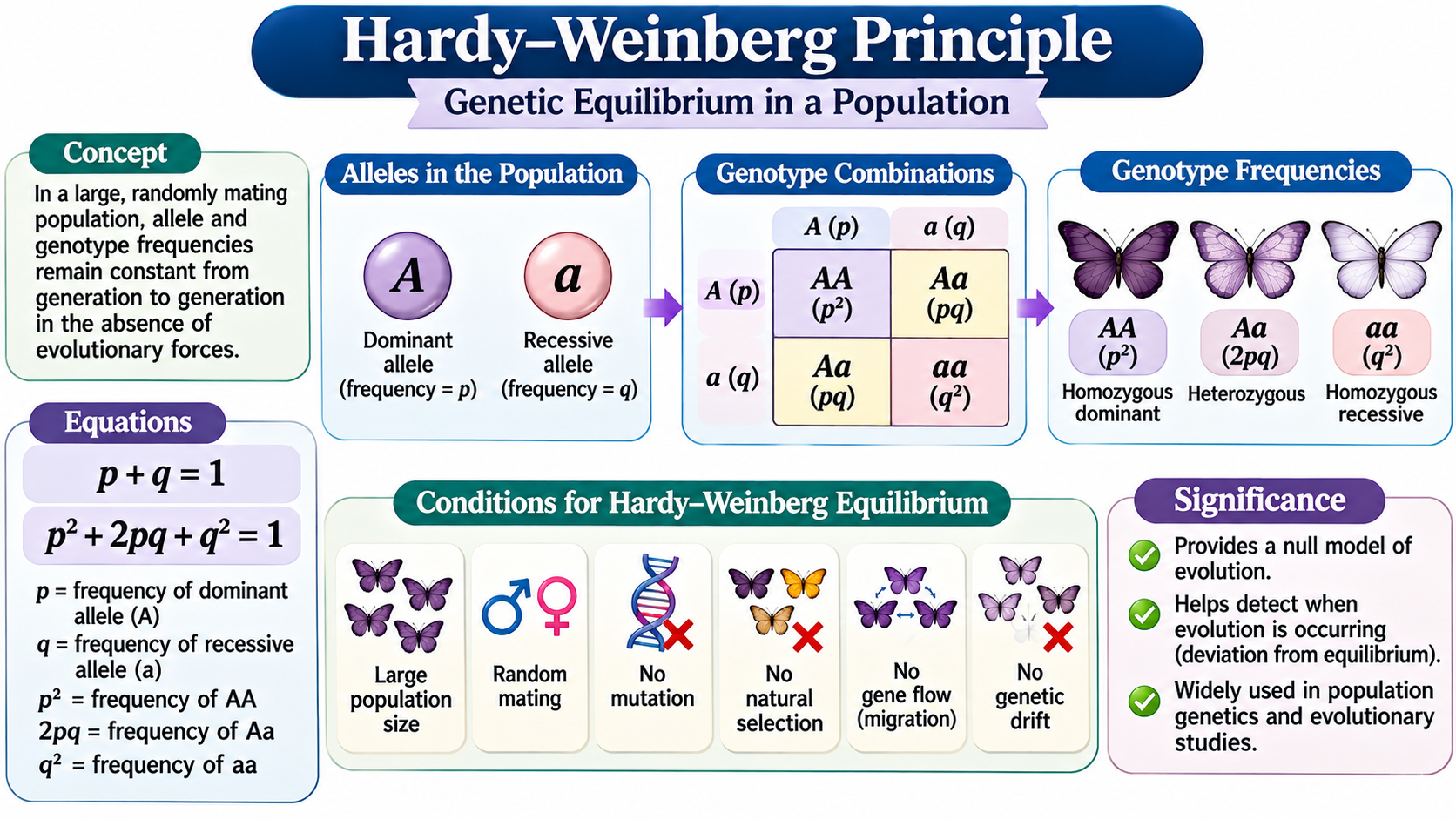
It states that allele and genotype frequencies in a large, randomly mating population remain constant from generation to generation in the absence of evolutionary influences.
For a population containing two alleles, A and a, the allele frequencies are represented by:
[
p+q=1
]
The expected genotype frequencies are expressed as:
[
p^2+2pq+q^2=1
]
Where:
- (p^2) = frequency of homozygous dominant genotype (AA).
- (2pq) = frequency of heterozygous genotype (Aa).
- (q^2) = frequency of homozygous recessive genotype (aa).
Example:
Suppose the frequency of allele A is 0.6 and that of allele a is 0.4.
Therefore:
[
p=0.6,\qquad q=0.4
]
Applying the Hardy–Weinberg equation:
[
p^2+2pq+q^2=1
]
[
(0.6)^2+2(0.6)(0.4)+(0.4)^2=1
]
[
0.36+0.48+0.16=1
]
Thus, the expected genotype frequencies are:
| Genotype | Calculation | Frequency |
|---|---|---|
| AA | (p^2) | 0.36 (36%) |
| Aa | (2pq) | 0.48 (48%) |
| aa | (q^2) | 0.16 (16%) |
| Total | 1.00 (100%) |
The Hardy–Weinberg principle provides a reference model for studying evolutionary change. When observed allele or genotype frequencies differ from the expected equilibrium, it may indicate the influence of evolutionary factors or violations of the model’s assumptions. Such deviations must be interpreted carefully because population structure, non-random mating and other biological factors can also affect genotype frequencies.
4.5 Conditions for Hardy–Weinberg Equilibrium
The Hardy–Weinberg equilibrium is maintained when the following conditions are satisfied:
- Large population size: The population must be sufficiently large to minimise random fluctuations caused by genetic drift.
- Random mating: Individuals must mate without preference for particular genotypes or phenotypes at the gene being studied.
- Absence of mutation: No new alleles should be introduced through mutation.
- Absence of migration: There should be no movement of individuals or genes into or out of the population.
- Absence of natural selection: All genotypes should have equal survival and reproductive success.
When these conditions are not met, allele or genotype frequencies may change. The Modern Synthetic Theory of Evolution explains how such changes contribute to evolutionary processes.
4.6 Population Genetics as the Foundation of Evolutionary Study
Population genetics helps scientists investigate the effects of natural selection, mutation, genetic drift and gene flow on the genetic composition of populations. It also provides methods for studying genetic variation, adaptation, population divergence and the formation of new species.
The Modern Synthetic Theory of Evolution uses this population-level approach to explain how small genetic changes accumulate and contribute to broader evolutionary patterns. It demonstrates that evolutionary change can be studied scientifically by measuring and comparing genetic frequencies across generations.
5. Mechanisms of Evolutionary Change
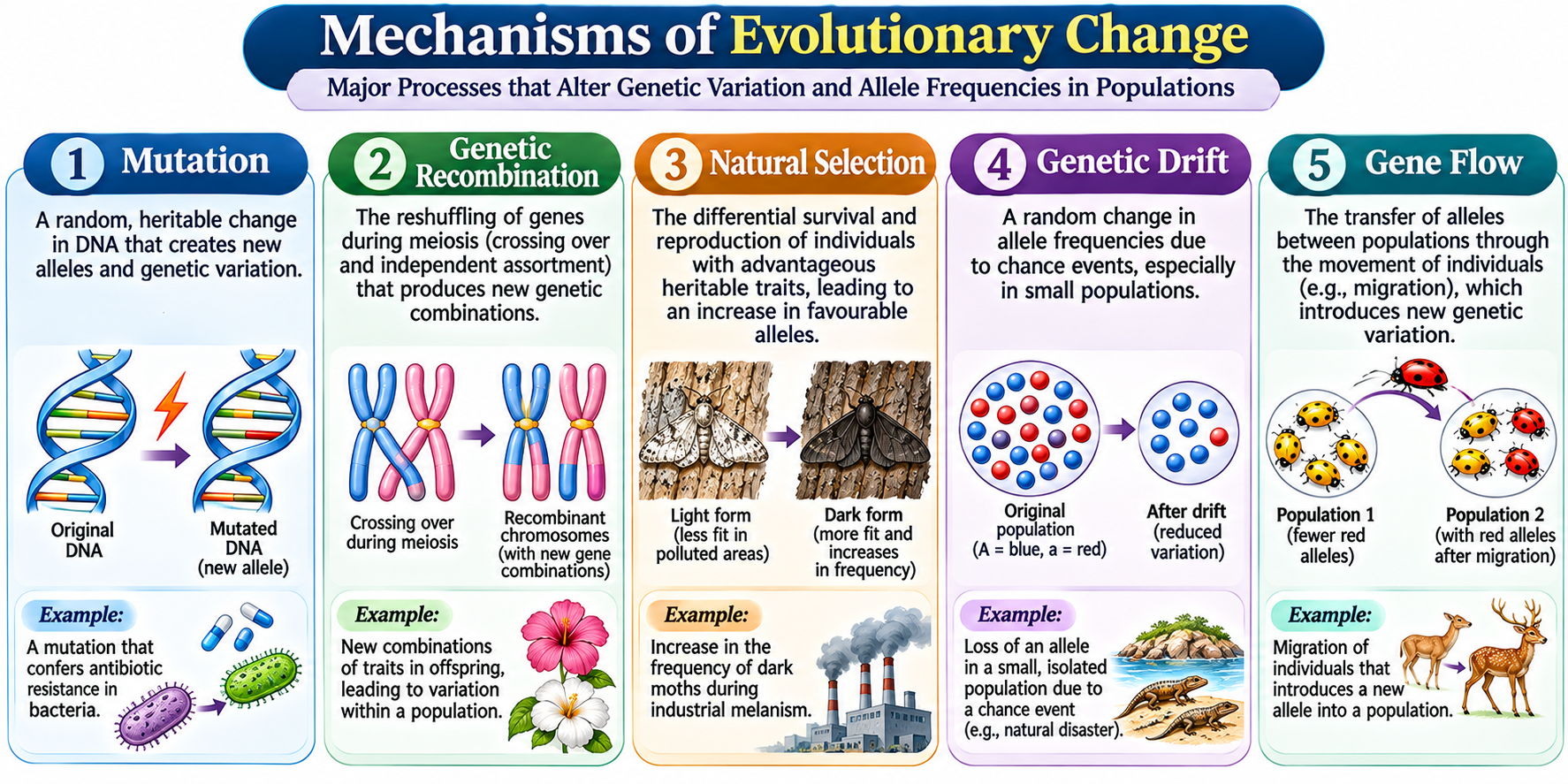
Evolutionary change occurs through several biological mechanisms that influence the genetic composition of populations over successive generations. These mechanisms determine how genetic variations originate, are inherited, redistributed or eliminated from populations. The Modern Synthetic Theory of Evolution recognises mutation, genetic recombination, natural selection, genetic drift and gene flow as major factors responsible for evolutionary change.
These mechanisms do not operate independently in nature. They often interact, influencing genetic diversity, adaptation, population differentiation and speciation.
These mechanisms also contribute to different evolutionary patterns, including divergent evolution, convergent evolution and parallel evolution, which are discussed in our article on Trends in Evolution.
5.1 Mutation
Mutation refers to a sudden, heritable change in the genetic material of an organism. It may involve a change in a single nucleotide, alteration of a chromosome segment or a change in chromosome number.
Mutations are important because they introduce new alleles into populations. Without mutation, no entirely new alleles would arise through ordinary inheritance.
Types of mutations:
- Gene mutations: Changes in the nucleotide sequence of a gene. Examples include substitution, insertion and deletion.
- Chromosomal mutations: Structural changes in chromosomes, such as deletion, duplication, inversion and translocation.
- Genomic mutations: Changes in chromosome number, including aneuploidy and polyploidy.
Mutations may be spontaneous or induced by mutagens such as certain chemicals and radiation. Their effects may be harmful, beneficial or neutral, depending on the genetic and environmental context.
The Modern Synthetic Theory of Evolution considers mutation the ultimate source of new genetic variation, although mutation alone does not determine the direction of evolutionary change.
5.2 Genetic Recombination
Genetic recombination is the formation of new combinations of alleles through the rearrangement of genetic material during sexual reproduction.
It increases genetic variation without necessarily creating new alleles.
The major processes responsible for genetic recombination include:
- Crossing over: Exchange of corresponding chromosome segments between homologous chromosomes during prophase I of meiosis.
- Independent assortment: Random distribution of maternal and paternal homologous chromosomes into gametes during meiosis.
- Random fertilisation: Fusion of genetically different male and female gametes to produce offspring with new allele combinations.
Recombination produces genetically diverse offspring. This variation provides different phenotypes upon which natural selection and other evolutionary mechanisms can act.
5.3 Natural Selection
Natural selection is the process through which individuals possessing heritable characteristics associated with greater reproductive success contribute more offspring to subsequent generations.
The Modern Synthetic Theory of Evolution explains natural selection as a major mechanism responsible for adaptive evolutionary change. Selection acts on phenotypic differences, while changes in the frequencies of associated inherited alleles occur across generations.
The main requirements for natural selection are:
- Variation: Individuals within a population must differ in their characteristics.
- Heritability: Some of these differences must have a genetic basis and be transmissible to offspring.
- Differential reproductive success: Individuals must differ in survival or reproductive output.
- Change across generations: Heritable characteristics associated with greater reproductive success may become more common over time.
Example: Industrial melanism in peppered moths
The peppered moth (Biston betularia) provides a well-known example of natural selection. During the industrial period in Britain, soot darkened many tree trunks, making darker moths less conspicuous to predators in affected areas. As a result, dark-coloured moths gained a survival advantage in those environments.
When pollution levels later declined and tree surfaces became lighter, the relative advantage changed. This example demonstrates how environmental conditions can influence the frequency of heritable variations in populations.
5.4 Genetic Drift
Genetic drift refers to random changes in allele frequencies from one generation to another. Unlike natural selection, genetic drift does not depend on whether an allele provides an adaptive advantage.
It is particularly influential in small populations, where chance events can produce substantial changes in genetic composition.
Two important forms of genetic drift are:
A. Founder Effect
The founder effect occurs when a small number of individuals become separated from a larger population and establish a new population. Because the founders carry only a sample of the original gene pool, the new population may have different allele frequencies.
B. Bottleneck Effect
The bottleneck effect occurs when a population experiences a sudden reduction in size due to events such as disease, natural disasters, hunting or habitat destruction. The surviving individuals may possess only a limited portion of the original genetic diversity.
Genetic drift may result in the loss of alleles, reduced genetic variation and increased genetic differences between isolated populations.
5.5 Gene Flow
Gene flow refers to the movement of alleles between populations through the migration of individuals or the transfer of reproductive cells such as pollen.
When migrants reproduce in a new population, they introduce their alleles into its gene pool. This can increase genetic variation within the receiving population and reduce genetic differences between populations.
For example, when individuals migrate between two geographically separated populations and successfully reproduce, alleles may be exchanged between them.
Gene flow can therefore influence adaptation and population differentiation. It may also reduce the likelihood of divergence between populations by maintaining genetic connections.
5.6 Non-Random Mating
Non-random mating occurs when individuals do not mate purely by chance. Mate selection may be influenced by body size, colouration, courtship behaviour, territory, social status or genetic compatibility.
Sexual selection is an important form of selection associated with differences in mating success. Individuals possessing certain traits may obtain more mates even when those traits do not directly improve survival.
Non-random mating can change genotype frequencies and influence the distribution of genetic variation. However, non-random mating alone does not necessarily change allele frequencies. Its evolutionary effects depend on how mating patterns interact with inheritance, selection and other population processes.
5.7 Interaction of Evolutionary Mechanisms
The major evolutionary mechanisms often operate simultaneously within natural populations. Mutation introduces new alleles, recombination creates new combinations of existing alleles, and gene flow transfers alleles between populations. Natural selection favours certain heritable variations under particular environmental conditions, while genetic drift changes allele frequencies through chance events.
The Modern Synthetic Theory of Evolution explains evolutionary change through the combined effects of these mechanisms. Their relative importance varies according to population size, environmental conditions, reproductive patterns and the genetic characteristics of organisms.
| Evolutionary mechanism | Main effect |
|---|---|
| Mutation | Introduces new alleles |
| Genetic recombination | Produces new combinations of alleles |
| Natural selection | Causes non-random differences in reproductive success |
| Genetic drift | Produces random changes in allele frequencies |
| Gene flow | Transfers alleles between populations |
| Non-random mating | Alters mating patterns and genotype frequencies |
Together, these mechanisms explain how genetic variation is generated and redistributed, how populations adapt to changing environments and how genetic differences may accumulate during evolutionary divergence.
6. Microevolution
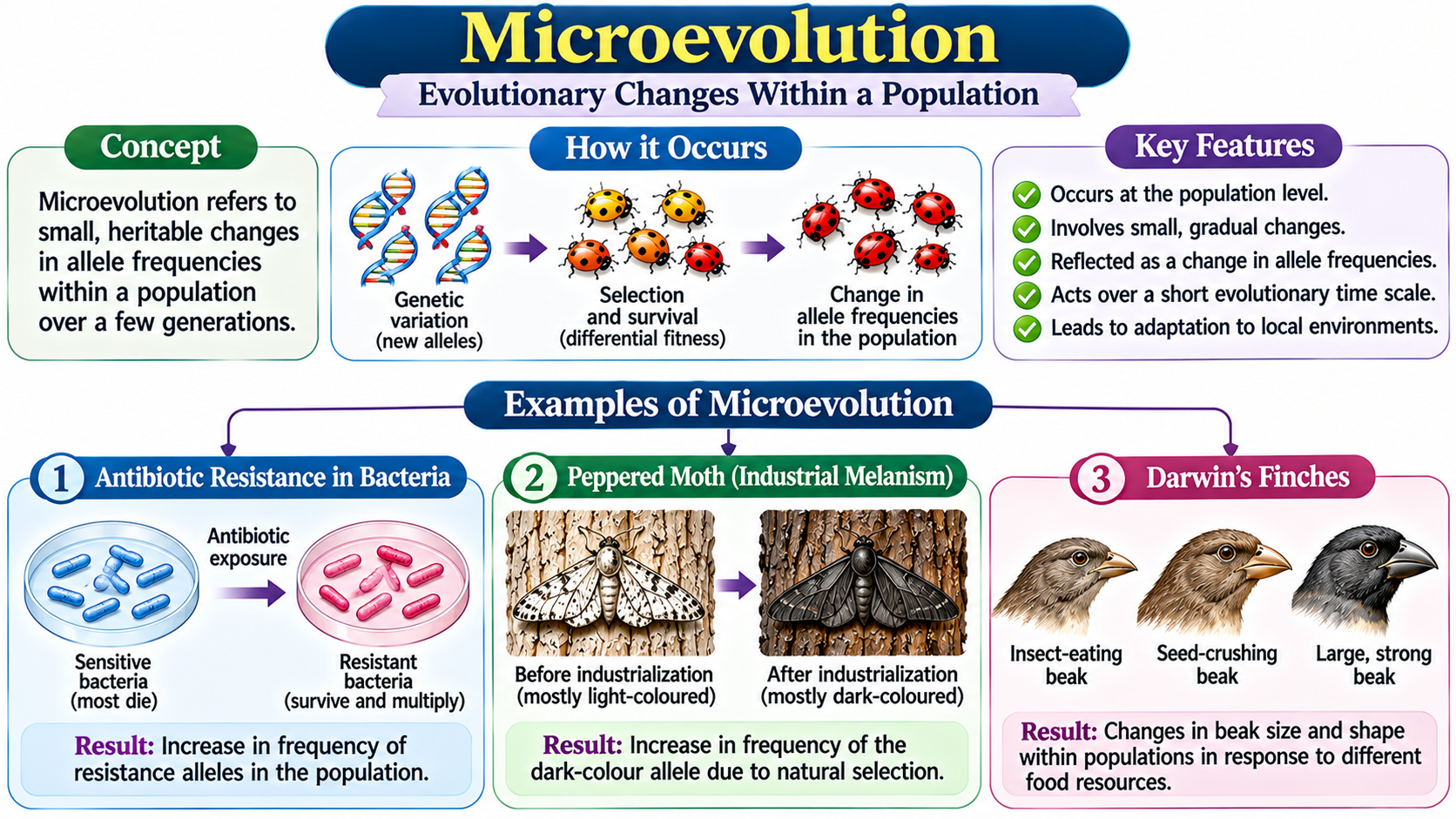
Microevolution refers to small-scale evolutionary changes occurring within a population over relatively short periods of time. It involves changes in the frequencies of alleles and genotypes across successive generations. These changes may result from mutation, natural selection, genetic drift, gene flow and other population-level processes.
The Modern Synthetic Theory of Evolution explains microevolution as a change in the genetic composition of populations over generations. Unlike individual growth or development, microevolution involves heritable changes that become distributed within a population through reproduction.
Microevolution can occur within a single species without necessarily producing a new species. However, when populations become genetically differentiated and reproductive isolation develops, microevolutionary changes may contribute to speciation.
6.1 Characteristics of Microevolution
The important characteristics of microevolution are:
- Population-level change: Microevolution occurs within populations rather than within individual organisms.
- Change in allele frequencies: It involves changes in the relative frequencies of different alleles over generations.
- Heritable variation: It depends on genetic differences that can be transmitted from parents to offspring.
- Influence of evolutionary mechanisms: Mutation, natural selection, genetic drift and gene flow can produce microevolutionary changes.
- Relatively small-scale changes: It generally involves changes within existing populations or species.
- Environmental influence: Environmental conditions can affect the survival and reproductive success of individuals carrying different genetic variations.
6.2 Causes of Microevolution
Microevolution occurs through several mechanisms that alter the genetic composition of populations.
A. Mutation
Mutations introduce new alleles into a population. Although many mutations are neutral or harmful, some may provide advantages under particular environmental conditions. These new genetic variations can contribute to evolutionary change.
B. Natural Selection
Natural selection changes allele frequencies when individuals carrying certain heritable characteristics have greater reproductive success than others.
For example, bacteria carrying mutations that provide resistance to an antibiotic may survive treatment and reproduce. Over successive generations, resistance-associated alleles can become more common in the bacterial population.
C. Genetic Drift
Genetic drift produces random changes in allele frequencies. It can have a considerable effect in small populations, where chance events may cause certain alleles to become common or disappear.
D. Gene Flow
Gene flow introduces alleles into populations through migration and reproduction. It can increase genetic variation within a population and reduce genetic differences between populations.
E. Non-Random Mating
Non-random mating influences the combinations of alleles found in individuals. It can change genotype frequencies and interact with other evolutionary mechanisms to influence population evolution.
6.3 Examples of Microevolution
Microevolution can be observed in natural populations and in organisms exposed to changing environmental conditions. Some important examples are described below.
6.3.1 Antibiotic Resistance in Bacteria
Antibiotic resistance is a widely studied example of microevolution. Bacterial populations may contain genetic variations that influence their susceptibility to antibiotics.
When an antibiotic is applied, susceptible bacteria are more likely to die, whereas bacteria carrying resistance-conferring genetic variations may survive and reproduce. The frequency of resistance-associated alleles can consequently increase in the population.
This process demonstrates how natural selection changes the genetic composition of a population in response to an environmental pressure.
6.3.2 Industrial Melanism in Peppered Moths
The peppered moth (Biston betularia) demonstrates microevolution through changes in the frequency of colour forms.
In industrial areas of Britain, dark-coloured moths became more common when pollution darkened tree surfaces and altered their visibility to predators. Following reductions in industrial pollution, lighter-coloured forms increased in frequency in many areas.
This example illustrates how changes in environmental conditions can influence the reproductive success of individuals with different inherited characteristics.
6.3.3 Changes in Beak Size in Galápagos Finches
Galápagos finches provide an important example of evolutionary responses to environmental changes. During periods of drought, the availability of different seed types changes. Birds with beak characteristics better suited to the available food may have greater survival and reproductive success.
Over generations, the frequencies of inherited beak characteristics can change within populations. Such changes demonstrate the role of natural selection in microevolution.
6.3.4 Insecticide Resistance in Insects
Insect populations may contain individuals with genetic variations that provide resistance to particular insecticides. Repeated exposure to an insecticide can favour resistant individuals because susceptible insects are more likely to die.
Surviving resistant insects reproduce and transmit resistance-associated alleles to their offspring. Consequently, insecticide resistance may become increasingly common within the population.
6.4 Microevolution and Changes in Allele Frequencies
A central feature of microevolution is the alteration of allele frequencies across generations.
For example, consider a population in which an allele A has a frequency of 0.40 and an allele a has a frequency of 0.60. If natural selection favours individuals carrying allele A, its frequency may increase in subsequent generations.
The change can be represented as:
[
\Delta p=p_{\text{after}}-p_{\text{before}}
]
Where:
- (\Delta p) = change in the frequency of allele A.
- (p_{\text{before}}) = initial frequency of allele A.
- (p_{\text{after}}) = frequency of allele A in a later generation.
Suppose the frequency of allele A increases from 0.40 to 0.55:
[
\Delta p=0.55-0.40=0.15
]
The frequency of allele A has increased by 0.15, or 15 percentage points.
This illustrates how population genetics can be used to measure microevolutionary change.
6.5 Significance of Microevolution
Microevolution is important for understanding how populations respond to environmental conditions and how genetic variation changes over time. It helps explain the development of adaptations, the spread of beneficial alleles, the emergence of resistance to antibiotics and insecticides, and genetic differences between populations.
Within the Modern Synthetic Theory of Evolution, microevolution provides a population-genetic explanation of evolutionary change. It also helps connect changes occurring within populations to larger evolutionary patterns, including population divergence and speciation.
7. Macroevolution
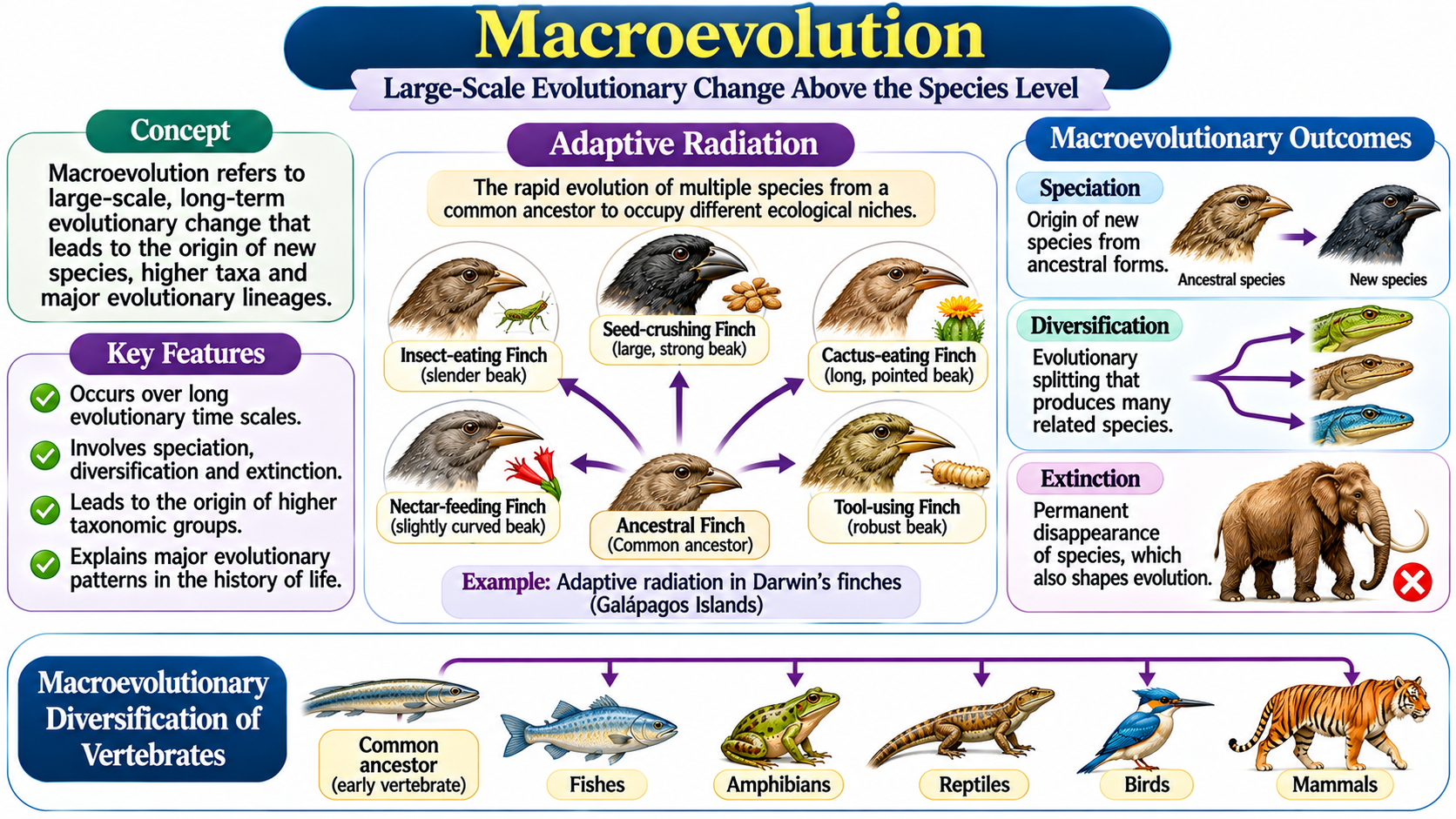
Macroevolution refers to large-scale evolutionary changes that occur over extended periods of geological time, particularly those associated with the origin of new species, the diversification of major evolutionary groups and the development of broad patterns of biodiversity. It includes evolutionary changes at and above the species level and helps explain the history of life on Earth.
The Modern Synthetic Theory of Evolution provides a genetic and population-based framework for understanding macroevolution. It explains how genetic changes within populations, combined with reproductive isolation and the accumulation of evolutionary differences, can contribute to the formation of new species and larger evolutionary patterns.
Macroevolution is studied through evidence from fossils, comparative anatomy, embryology, molecular biology, biogeography and phylogenetic relationships.
The long-term diversification of organisms produces several recognizable evolutionary patterns. These patterns are explained in greater detail in our article on Trends in Evolution: Types, Examples and Mechanisms.
7.1 Characteristics of Macroevolution
The major characteristics of macroevolution include:
- Large-scale evolutionary changes: It involves broad evolutionary patterns occurring over long periods of time.
- Origin of new species: Speciation is an important process contributing to macroevolutionary diversity.
- Evolutionary diversification: It includes the diversification of organisms into different species and higher taxonomic groups.
- Long geological timescales: Many macroevolutionary patterns become evident over thousands or millions of years.
- Extinction and replacement: The extinction of some groups and diversification of others influence the history of biodiversity.
- Evolutionary trends: It includes broad patterns such as changes in body structure, ecological specialisation and adaptive diversification.
The fossil record provides important evidence for understanding macroevolutionary patterns, including the appearance, diversification and extinction of organisms throughout geological history. Explore our detailed article on the Geological Time Scale, Fossil Record and Mass Extinctions to understand these changes across Earth’s history.
7.2 Major Processes Involved in Macroevolution
Macroevolution is influenced by several interconnected evolutionary processes. These processes contribute to the origin, diversification and extinction of species.
7.2.1 Speciation
Speciation is the evolutionary process through which new species arise from existing populations. It generally involves the development of reproductive isolation and the accumulation of genetic differences.
Two major forms of speciation are:
A. Allopatric Speciation
Allopatric speciation occurs when populations become geographically separated by physical barriers such as mountains, rivers, oceans or large distances.
Once separated, the populations may experience different mutations, environmental conditions, natural selection and genetic drift. Over time, genetic differences may accumulate until reproductive isolation develops.
B. Sympatric Speciation
Sympatric speciation occurs when new species develop within the same geographical region without an initial physical barrier separating the populations.
It may arise through mechanisms such as polyploidy, ecological specialisation, host shifts or differences in mating behaviour. Polyploidy is particularly important in the evolution of many plant species.
Speciation is an important outcome of evolutionary processes and involves the development of reproductive isolation between populations. To understand how species are defined and distinguished, read our detailed article on the Species Concept.
7.2.2 Adaptive Radiation
Adaptive radiation refers to the relatively rapid diversification of an ancestral lineage into multiple species adapted to different ecological niches.
It commonly occurs when organisms enter new environments, encounter vacant ecological niches or experience changes in environmental conditions.
Example: Darwin’s finches
The Galápagos finches are a classic example of adaptive radiation. Their ancestral lineage diversified into several species with different beak shapes and feeding habits. Different beak structures became associated with the use of different food resources.
Example: Australian marsupials
Australian marsupials diversified into several ecological forms, including kangaroos, koalas, wombats and marsupial carnivores. Their diversification illustrates how related organisms can occupy different ecological niches.
7.2.3 Extinction
Extinction refers to the complete disappearance of a species when all its individuals die and no living population remains.
Extinction is an important component of macroevolution because it influences the composition of biodiversity through geological time. It may occur gradually or during relatively short geological intervals.
Major extinction events, known as mass extinctions, have affected large proportions of Earth’s species. The end-Cretaceous mass extinction approximately 66 million years ago eliminated non-avian dinosaurs and many other organisms.
Extinction may create ecological opportunities for surviving groups, allowing them to diversify and occupy previously available niches.
7.2.4 Evolutionary Divergence
Evolutionary divergence occurs when related populations or species accumulate differences over time. These differences may involve morphology, physiology, behaviour, genetics and ecological adaptations.
Divergence can result from geographical isolation, different selective pressures, genetic drift and restricted gene flow.
As evolutionary differences accumulate, related lineages may become increasingly distinct. This process contributes to the branching pattern of evolutionary relationships.
7.2.5 Coevolution
Coevolution refers to reciprocal evolutionary changes in two or more interacting species. Changes in one species may create selective pressures that influence the evolution of another species.
Examples include:
- Predator–prey relationships: Predators may evolve improved hunting abilities, while prey species develop defensive adaptations.
- Plant–pollinator relationships: Flowers and their pollinators may develop complementary structural and behavioural characteristics.
- Host–parasite relationships: Changes in host defence mechanisms may influence the evolution of parasite adaptations, and vice versa.
Coevolution contributes to evolutionary diversification and the development of complex biological interactions.
7.3 Major Patterns of Macroevolution
Macroevolutionary patterns describe broad trends in the evolutionary history of organisms. Some important patterns include:
7.3.1 Divergent Evolution
Divergent evolution occurs when related organisms evolve different characteristics as they adapt to different environmental conditions.
A common example is the modification of vertebrate forelimbs into different structures, such as the human arm, whale flipper, bat wing and horse forelimb. These structures share a common evolutionary origin but perform different functions.
7.3.2 Convergent Evolution
Convergent evolution occurs when unrelated or distantly related organisms independently develop similar adaptations because they experience comparable environmental pressures.
For example, the streamlined body shape of sharks and dolphins is associated with efficient movement through water, although sharks are cartilaginous fishes and dolphins are mammals.
7.3.3 Parallel Evolution
Parallel evolution occurs when related evolutionary lineages independently develop similar characteristics under comparable environmental conditions.
It differs from convergent evolution mainly in the evolutionary relatedness of the groups involved. In parallel evolution, the lineages share a relatively recent common ancestry and may possess similar developmental or genetic foundations.
7.3.4 Gradualism
Gradualism describes evolutionary change occurring through the accumulation of small changes over long periods of time.
Under this pattern, major evolutionary differences develop through many successive modifications across generations.
7.3.5 Punctuated Equilibrium
Punctuated equilibrium is a model of evolutionary change proposed by Niles Eldredge and Stephen Jay Gould in 1972. It suggests that some species show relatively long periods of morphological stability interrupted by comparatively short periods of rapid evolutionary change associated with speciation.
It does not mean that evolution occurs without genetic changes during periods of stability. Rather, it describes a pattern in the fossil record in which major morphological changes may appear concentrated around particular intervals.
7.4 Significance of Macroevolution
Macroevolution helps explain the origin and diversification of major groups of organisms, the appearance and disappearance of species, and the broad patterns observed in the history of life.
It provides a framework for understanding evolutionary relationships, adaptive radiation, mass extinction and the development of biodiversity. The Modern Synthetic Theory of Evolution connects these large-scale patterns with genetic variation, population divergence, natural selection, genetic drift and speciation.
By studying macroevolution, evolutionary biologists can investigate how changes occurring within populations contribute to the long-term diversification of life on Earth.
8. Differences Between Microevolution and Macroevolution
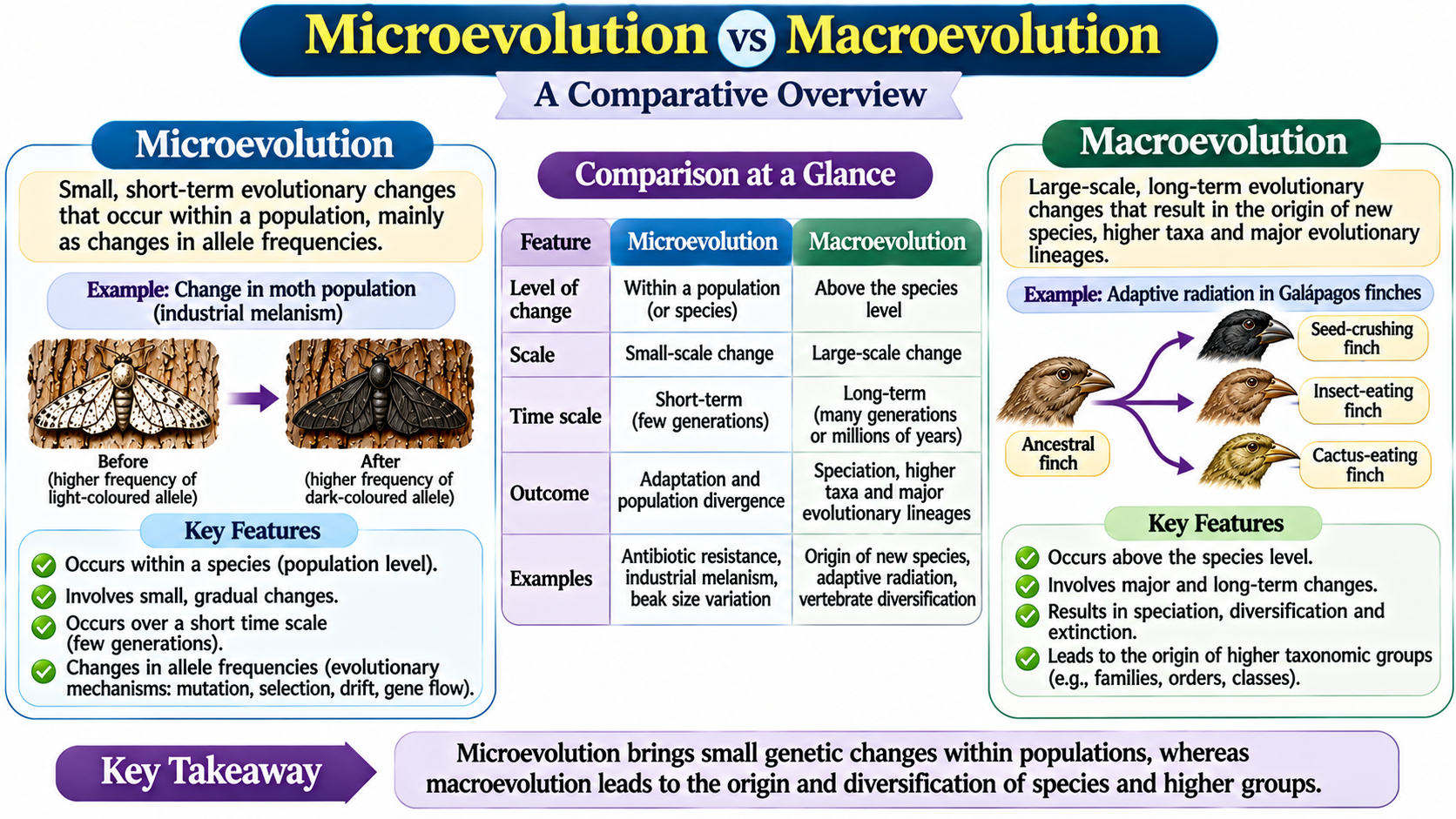
Microevolution and macroevolution are two important aspects of evolutionary biology. Both describe changes in the genetic and biological characteristics of organisms over time, but they differ in their scale, timescale and evolutionary patterns.
Microevolution involves changes in allele frequencies within populations, whereas macroevolution examines large-scale evolutionary patterns, including speciation, diversification and extinction. The Modern Synthetic Theory of Evolution provides a framework for understanding how population-level genetic changes can contribute to broader evolutionary patterns.
The distinction between microevolution and macroevolution can also be understood through different types of evolutionary evidence, particularly fossil, anatomical and molecular evidence. Read more in our guide to Evidences of Evolution.
8.1 Comparative Differences
| Basis of comparison | Microevolution | Macroevolution |
|---|---|---|
| Definition | Small-scale evolutionary changes within populations. | Large-scale evolutionary changes occurring over extended geological periods. |
| Level of study | Mainly within populations of a species. | At and above the species level. |
| Scale | Relatively small-scale genetic changes. | Broad evolutionary patterns and diversification. |
| Timescale | May occur over relatively few generations. | Commonly studied over thousands to millions of years. |
| Main focus | Changes in allele and genotype frequencies. | Speciation, extinction, adaptive radiation and evolutionary diversification. |
| Major mechanisms | Mutation, natural selection, genetic drift and gene flow. | Includes population divergence, speciation, extinction and long-term evolutionary diversification. |
| Evidence | Genetic variation, allele frequencies and observed changes in populations. | Fossil records, comparative anatomy, molecular evidence and phylogenetic relationships. |
| Examples | Antibiotic resistance in bacteria and insecticide resistance in insects. | Diversification of mammals and adaptive radiation of major evolutionary groups. |
| Evolutionary outcome | Genetic changes within populations. | Origin and diversification of species and higher evolutionary groups. |
8.2 Relationship Between Their Evolutionary Processes
Although microevolution and macroevolution are studied at different scales, they are closely connected. Microevolutionary processes can produce genetic differences between populations. When populations become isolated, these differences may accumulate through mutation, natural selection and genetic drift.
If reproductive isolation develops and persists, the populations may eventually become separate species. The formation and diversification of species contribute to macroevolutionary patterns.
The Modern Synthetic Theory of Evolution explains this connection by linking changes in allele frequencies within populations with population divergence and speciation.
8.3 Examples Illustrating the Difference
Example 1: Antibiotic resistance in bacteria
The increasing frequency of antibiotic-resistance alleles within a bacterial population is an example of microevolution. It involves changes in the genetic composition of an existing population.
Example 2: Adaptive radiation of mammals
The diversification of ancestral mammalian lineages into different groups adapted to terrestrial, aquatic and aerial environments represents a broad macroevolutionary pattern.
Example 3: Darwin’s finches
Changes in beak characteristics within a finch population in response to food availability can illustrate microevolution. Over longer periods, the diversification of ancestral finch populations into multiple species represents a macroevolutionary pattern.
8.4 Are Microevolution and Macroevolution Connected?
Microevolution and macroevolution should not be considered completely separate processes. They represent different scales at which evolutionary change is investigated.
Changes in allele frequencies, genetic divergence and reproductive isolation can contribute to speciation. Repeated processes of speciation, extinction and diversification shape the evolutionary history of organisms.
The Modern Synthetic Theory of Evolution established an important connection between population genetics and evolutionary diversification. However, explaining every macroevolutionary pattern may also require consideration of additional factors, including developmental constraints, ecological interactions and large-scale environmental changes.
9. Relationship Between Microevolution and Macroevolution
Microevolution and macroevolution are closely related components of the evolutionary process. Microevolution explains genetic changes occurring within populations, whereas macroevolution describes broader evolutionary patterns involving speciation, diversification and extinction over geological time.
The Modern Synthetic Theory of Evolution connects these two levels of evolutionary change by explaining how changes in allele frequencies can lead to genetic divergence, reproductive isolation and eventually the formation of new species.
9.1 Microevolution as the Foundation of Macroevolution
Microevolutionary changes provide the genetic foundation for many macroevolutionary patterns. Mutation introduces new alleles, recombination produces new genetic combinations, and natural selection and genetic drift influence their frequencies within populations.
When populations become separated, they may experience different evolutionary pressures. Over generations, genetic differences can accumulate between them. If these differences eventually result in reproductive isolation, the populations may develop into separate species.
Thus, population-level genetic changes can contribute to large-scale evolutionary diversification.
9.2 Role of Reproductive Isolation
Reproductive isolation is an important link between microevolution and macroevolution. It restricts or prevents gene exchange between populations and allows them to evolve independently.
Reproductive isolation may develop through several mechanisms:
- Geographical isolation: Physical barriers separate populations and restrict gene flow.
- Ecological isolation: Populations occupy different habitats or ecological niches.
- Temporal isolation: Populations reproduce during different seasons or at different times.
- Behavioural isolation: Differences in courtship behaviour or mating signals prevent interbreeding.
- Mechanical isolation: Differences in reproductive structures prevent successful mating.
- Gametic isolation: Reproductive cells are unable to fuse successfully.
As reproductive isolation becomes established, genetic differences may accumulate through mutation, natural selection and genetic drift. This can ultimately contribute to speciation.
9.3 Accumulation of Genetic Differences
When populations remain separated, their genetic compositions may gradually become different. Several mechanisms contribute to this process:
- Mutation introduces new genetic variations independently in different populations.
- Natural selection favours variations suited to the local environment.
- Genetic drift produces random differences in allele frequencies.
- Restricted gene flow reduces the exchange of genetic material between populations.
Over extended periods, these changes may produce substantial genetic and morphological differences.
The Modern Synthetic Theory of Evolution explains how these population-level processes contribute to evolutionary divergence and the origin of new species.
9.4 Speciation as a Link Between the Two Levels
Speciation provides an important connection between microevolutionary changes and macroevolutionary diversification.
For example, consider an ancestral population divided into two geographically isolated groups. Differences in environmental conditions may favour different adaptations in each group. Genetic drift and mutation may also cause their genetic compositions to diverge.
If reproductive isolation eventually develops, the two populations may become distinct species. Repeated speciation events over geological time can produce numerous evolutionary lineages and contribute to biodiversity.
9.5 From Speciation to Evolutionary Diversification
Macroevolutionary diversity develops through the combined effects of speciation, extinction and changes in ecological conditions.
When new species arise, they may occupy different ecological niches and undergo further evolutionary diversification. Some lineages may expand into multiple habitats, while others may become extinct because of environmental changes, competition or other factors.
The accumulation of these events produces the branching patterns observed in evolutionary history.
9.6 Role of the Modern Synthetic Theory
The Modern Synthetic Theory of Evolution provides a unified explanation of the relationship between genetic changes within populations and large-scale evolutionary patterns.
It establishes that:
- Genetic variation is essential for evolutionary change.
- Evolutionary mechanisms alter allele frequencies within populations.
- Restricted gene flow can promote genetic divergence.
- Reproductive isolation can contribute to the formation of new species.
- Speciation, extinction and diversification shape the history of biodiversity.
However, the relationship between microevolution and macroevolution remains an important area of evolutionary research. Although population genetics explains many evolutionary changes, additional processes involving development, ecology and environmental history also contribute to large-scale evolutionary patterns.
10. Evidences and Examples of the Modern Synthetic Theory
The Modern Synthetic Theory of Evolution is supported by evidence from genetics, population biology, molecular biology, palaeontology, comparative anatomy and biogeography. These fields demonstrate that genetic variation occurs within populations, evolutionary mechanisms alter genetic composition, and populations can diverge over generations.
The theory is particularly important because it connects observable evolutionary changes in living populations with the long-term evolutionary history of organisms.
10.1 Evidence from Population Genetics
Population genetics provides direct evidence of evolutionary change by measuring differences in allele frequencies across generations.
When allele frequencies change due to natural selection, genetic drift, mutation or gene flow, the genetic composition of a population changes.
For example, the increasing frequency of antibiotic-resistance genes in bacterial populations demonstrates how natural selection can influence genetic composition. Similarly, changes in insecticide-resistance alleles in insect populations provide evidence of evolutionary responses to environmental pressures.
These observations support the population-level explanation of evolution provided by the Modern Synthetic Theory of Evolution.
10.2 Evidence from Natural Selection
Natural selection has been observed in numerous natural populations and experimental studies.
A. Industrial Melanism in Peppered Moths
The peppered moth (Biston betularia) is a classical example of natural selection. During industrialisation in Britain, dark-coloured moths became more common in many polluted areas because their colouration provided better camouflage on soot-darkened surfaces.
Following reductions in pollution, lighter-coloured moths increased in frequency in many locations.
B. Antibiotic Resistance in Bacteria
Bacterial populations may contain genetic variations that provide resistance to particular antibiotics. When antibiotics are used, susceptible bacteria are more likely to die, while resistant bacteria may survive and reproduce.
The increasing frequency of resistance-associated genetic variations demonstrates evolution through natural selection.
C. Beak Variation in Darwin’s Finches
Studies of Galápagos finches have demonstrated that environmental conditions, particularly food availability, can influence the survival and reproductive success of individuals with different beak characteristics.
These observations show how natural selection can produce measurable changes in populations.
10.3 Evidence from Experimental Evolution
Experimental evolution involves studying evolutionary changes under controlled laboratory or field conditions.
Researchers can maintain populations of microorganisms, such as bacteria and yeast, under defined environmental conditions and observe changes across successive generations.
For example, long-term experiments with Escherichia coli have demonstrated changes in growth characteristics, metabolic abilities and genetic composition during prolonged laboratory evolution.
Such studies help scientists investigate the effects of mutation, natural selection and genetic drift and provide direct evidence that populations can undergo evolutionary change.
10.4 Evidence from Molecular Biology
Molecular biology provides important evidence for evolutionary relationships by comparing DNA, RNA and protein sequences among organisms.
Closely related organisms generally share more similarities in their genetic sequences than distantly related organisms, although the extent of similarity depends on the genes and evolutionary history being compared.
Important molecular evidence includes:
- DNA sequence similarities: Comparison of DNA sequences helps identify genetic relationships between organisms.
- Protein similarities: Similarities in amino acid sequences of proteins provide evidence of common ancestry.
- Conserved genes: Some genes remain relatively similar across widely separated groups because of their important biological functions.
- Molecular phylogenetics: Genetic data can be used to reconstruct evolutionary relationships and prepare phylogenetic trees.
Molecular evidence supports the evolutionary framework of the Modern Synthetic Theory of Evolution by connecting inherited genetic variations with common ancestry and evolutionary divergence.
10.5 Evidence from the Fossil Record
Fossils provide information about organisms that lived in the geological past. They reveal changes in the structure, distribution and diversity of organisms through geological time.
The fossil record includes extinct organisms, transitional forms and sequences of fossils that help scientists investigate evolutionary relationships.
For example, fossils documenting the evolution of whales show a transition from terrestrial ancestors to fully aquatic forms. These fossils reveal changes in limb structure, skull morphology and other anatomical characteristics.
Although fossils do not directly reveal allele frequencies in ancient populations, they provide important evidence of large-scale evolutionary changes and diversification.
10.6 Evidence from Comparative Anatomy
Comparative anatomy involves studying similarities and differences in the body structures of different organisms.
A. Homologous Organs
Homologous organs have a common evolutionary origin but may perform different functions.
Examples include:
- Human forelimb
- Whale flipper
- Bat wing
- Horse forelimb
These structures share a basic skeletal arrangement despite their different functions. They provide evidence of divergent evolution from common ancestors.
B. Analogous Organs
Analogous organs perform similar functions but have different evolutionary origins and structural organisation.
For example, the wings of birds and insects perform the function of flight but developed independently through different evolutionary pathways.
They provide evidence of convergent evolution.
10.7 Evidence from Biogeography
Biogeography is the study of the geographical distribution of organisms across different regions of the Earth.
The distribution of species is influenced by geographical isolation, migration, environmental conditions, evolutionary history and the availability of ecological niches.
For example, the distinctive diversity of marsupials in Australia is associated with the continent’s long geographical isolation. Similarly, the diversification of Galápagos finches illustrates how ancestral populations can become differentiated in isolated island environments.
Biogeographical patterns provide evidence of evolutionary divergence and help explain the geographical history of biodiversity.
10.8 Evidence from Speciation
The formation of new species provides evidence that evolutionary changes can lead to reproductive isolation and biological diversification.
Speciation may occur when populations become geographically separated or develop reproductive barriers while occupying the same geographical region.
Examples include:
- Formation of plant species through polyploidy.
- Divergence of isolated populations.
- Ecological specialisation accompanied by reproductive isolation.
The study of speciation connects genetic changes within populations with the emergence of distinct evolutionary lineages.
10.9 Combined Significance of Evolutionary Evidence
No single branch of biology provides a complete explanation of evolutionary history. Instead, evidence from genetics, molecular biology, fossils, comparative anatomy and biogeography contributes complementary information.
Together, these fields demonstrate how genetic variation, inheritance, selection, genetic drift and population divergence contribute to evolutionary change. They provide strong support for the central principles of the Modern Synthetic Theory of Evolution.
11. Significance of the Modern Synthetic Theory
The Modern Synthetic Theory of Evolution represents a major advancement in evolutionary biology because it combines Darwin’s concept of natural selection with Mendelian genetics and population genetics. It provides a scientific explanation of how hereditary variations arise, how they are transmitted and how evolutionary mechanisms influence populations over generations.
By integrating knowledge from different biological disciplines, the Modern Synthetic Theory of Evolution established a comprehensive framework for studying the origin, adaptation and diversification of organisms.
11.1 Integration of Genetics and Darwinism
One of the most important contributions of the Modern Synthetic Theory of Evolution is the integration of Mendelian genetics with Darwin’s theory of natural selection.
Darwin explained how natural selection favours individuals possessing advantageous variations, but he could not adequately explain the mechanism of heredity. Mendelian genetics subsequently demonstrated how hereditary characteristics are transmitted through genes.
The synthesis of these concepts provided a genetic explanation of natural selection and helped establish the scientific foundation of modern evolutionary biology.
11.2 Explanation of the Genetic Basis of Evolution
The theory explains evolution through changes in allele frequencies within populations over successive generations.
It identifies mutation and genetic recombination as important sources of genetic variation, while natural selection, genetic drift and gene flow influence the distribution of genetic variations within populations.
This population-genetic approach made it possible to investigate evolutionary change through measurable genetic parameters.
11.3 Understanding Adaptation
Adaptation refers to inherited characteristics that improve the survival or reproductive success of organisms in particular environmental conditions.
The theory explains how natural selection can increase the frequency of advantageous hereditary variations within populations.
Examples include:
- Camouflage in insects that reduces their visibility to predators.
- Antibiotic resistance in bacteria.
- Insecticide resistance in certain insect populations.
- Variations in feeding structures associated with different food resources.
These examples demonstrate how populations can become adapted to environmental conditions through evolutionary processes.
11.4 Explanation of Speciation
The Modern Synthetic Theory of Evolution provides an important explanation of speciation through genetic divergence and reproductive isolation.
When populations become separated, mutation, natural selection and genetic drift may produce differences in their genetic compositions. If reproductive isolation develops, the populations may eventually become distinct species.
This explanation connects small-scale genetic changes with the origin of biological diversity.
11.5 Development of Population Genetics
The theory established population genetics as a central component of evolutionary biology.
The Hardy–Weinberg principle provides a mathematical model for studying allele and genotype frequencies under specific equilibrium conditions. Deviations from these expectations can help researchers investigate the effects of evolutionary mechanisms and population structure.
Population genetics is now widely used in studies of biodiversity, conservation, adaptation and evolutionary relationships.
11.6 Contribution to Understanding Biodiversity
Biodiversity refers to the variety of living organisms present on Earth, including diversity within species, between species and among ecosystems.
The theory helps explain how genetic variation, natural selection, genetic drift, gene flow and reproductive isolation contribute to the formation and diversification of species.
It also provides a framework for understanding how evolutionary processes have produced the wide variety of organisms found in different geographical regions and ecological habitats.
11.7 Importance in Modern Biological Research
The principles of the Modern Synthetic Theory of Evolution are important in several branches of contemporary biological research.
- Conservation biology: Population genetics helps assess genetic diversity, inbreeding and the evolutionary potential of endangered populations.
- Medical biology: Evolutionary principles help researchers understand antibiotic resistance and the changing genetic composition of disease-causing organisms.
- Agriculture: Evolutionary knowledge helps explain the development of pesticide resistance and supports the management of crop pests.
- Systematics: Genetic and evolutionary evidence helps reconstruct relationships among organisms and improve biological classification.
- Ecology: Evolutionary processes help explain how organisms respond to environmental changes and ecological interactions.
- Molecular biology: Comparisons of DNA and protein sequences help investigate evolutionary relationships and common ancestry.
11.8 Foundation for Further Developments in Evolutionary Biology
The evolutionary synthesis provided a foundation for subsequent developments in evolutionary research. Advances in molecular genetics, genomics, developmental biology, evolutionary ecology and computational biology have expanded the understanding of evolutionary processes.
The Modern Synthetic Theory of Evolution remains an important framework for understanding population-level genetic change, while contemporary evolutionary biology also investigates additional mechanisms and processes that contribute to evolutionary patterns.
12. Conclusion
The Modern Synthetic Theory of Evolution represents a major advancement in the understanding of evolutionary biology. It combines Darwin’s principle of natural selection with Mendelian genetics, population genetics and contributions from other biological disciplines to explain how evolutionary changes occur in living populations.
According to the Modern Synthetic Theory of Evolution, evolution occurs through changes in allele frequencies over successive generations. Mutation and genetic recombination provide genetic variation, while natural selection, genetic drift and gene flow influence the genetic composition of populations. These mechanisms contribute to adaptation, genetic divergence and reproductive isolation.
The distinction between microevolution and macroevolution helps explain evolutionary changes at different biological scales. Microevolution involves genetic changes within populations, whereas macroevolution examines broader patterns such as speciation, adaptive radiation, extinction and evolutionary diversification. These processes are interconnected and contribute to the origin and diversity of life on Earth.
The Modern Synthetic Theory of Evolution established a scientific foundation for understanding heredity, variation and natural selection within a unified evolutionary framework. Although modern research has expanded evolutionary biology through advances in genomics, developmental biology and molecular ecology, the central principles of the evolutionary synthesis continue to play an important role in explaining the history and diversity of living organisms.
13. References
- Dobzhansky, T. (1937). Genetics and the Origin of Species. Columbia University Press. View publication details
- Huxley, J. S. (1942). Evolution: The Modern Synthesis. Harper & Brothers. View the modern edition – MIT Press
- Mayr, E. (1942). Systematics and the Origin of Species. Columbia University Press.
- Simpson, G. G. (1944). Tempo and Mode in Evolution. Columbia University Press. Read publication information – NCBI Bookshelf
- Stebbins, G. L. (1950). Variation and Evolution in Plants. Columbia University Press.
- OpenStax. (2018). Biology 2e: Population Evolution. Rice University. Read the chapter
- OpenStax. (2018). Biology 2e: Population Genetics. Rice University. Read the chapter
- OpenStax. Concepts of Biology: Mechanisms of Evolution. Rice University. Read the chapter
- Myers, C. E. (2013). A macroevolutionary expansion of the modern synthesis and the importance of extrinsic abiotic factors. Palaeontology. Read the research article
- National Academies of Sciences. Tempo and Mode in Evolution: Genetics and Paleontology 50 Years After Simpson. National Academies Press. Read online
Discover more from Zoologyverse
Subscribe to get the latest posts sent to your email.