
The largest family of the order Mantodea (mantises) is the Mantidae family, which includes the European mantis (Mantis religiosa), a huge hemimetabolic insect. The term “praying mantis” comes from the characteristic position of the mantis’s first pair of legs, which resembles a position of prayer when it is in repose. The elongated bodies of both sexes include two pairs of wings. The species’ (and all mantodeans’) most remarkable characteristics are a highly mobile, triangular head with big compound eyes and their first pair of legs, known as “raptorial legs,” which are highly specialized for the effective capture and restraint of flying or fast-moving prey.
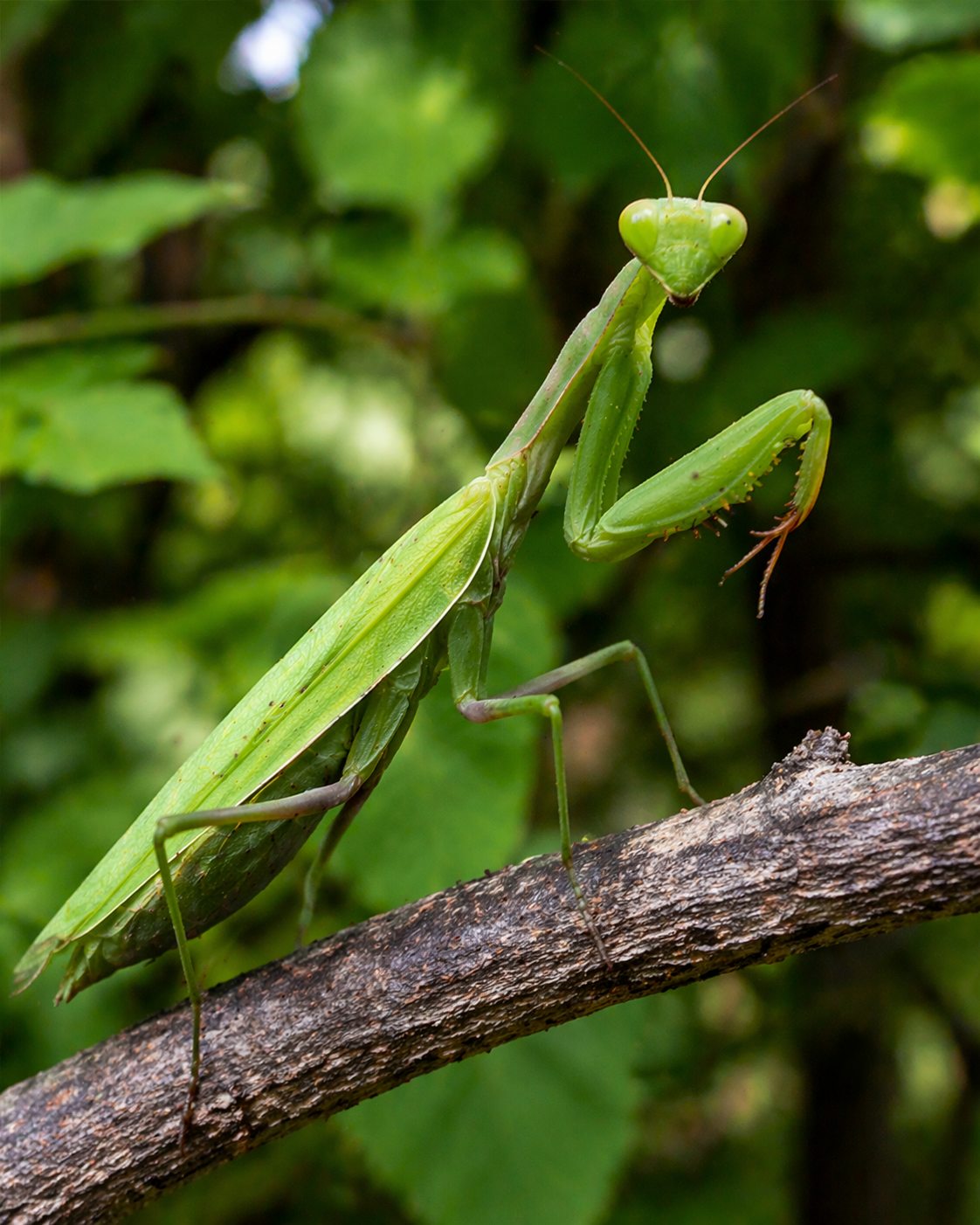
Classification of Mantis religiosa (Praying Mantis)
Phylum – Arthropoda (Jointed Appendages)
Class – Insecta (3 pairs of legs.)
Sub-class – Pterygota (Winged insects.)
Division – Exopterygota (Wings develop externally.)
Order – Orthoptera (Straight wings.)
Genus – Mantis
Species :- religiosa
Habit and habitat
Mantis is commonly found in green vegetation and other garden places. It is canibolic, pugnacious and predacious.
Distribution
It is found in U.S.A. North America, Africa, South Europe and Western Asia. Most of the Indian mantis are spread over India and Malaysia region.
Comments on Mantis religiosa (Praying Mantis)
- Commonly called as praying mantis.
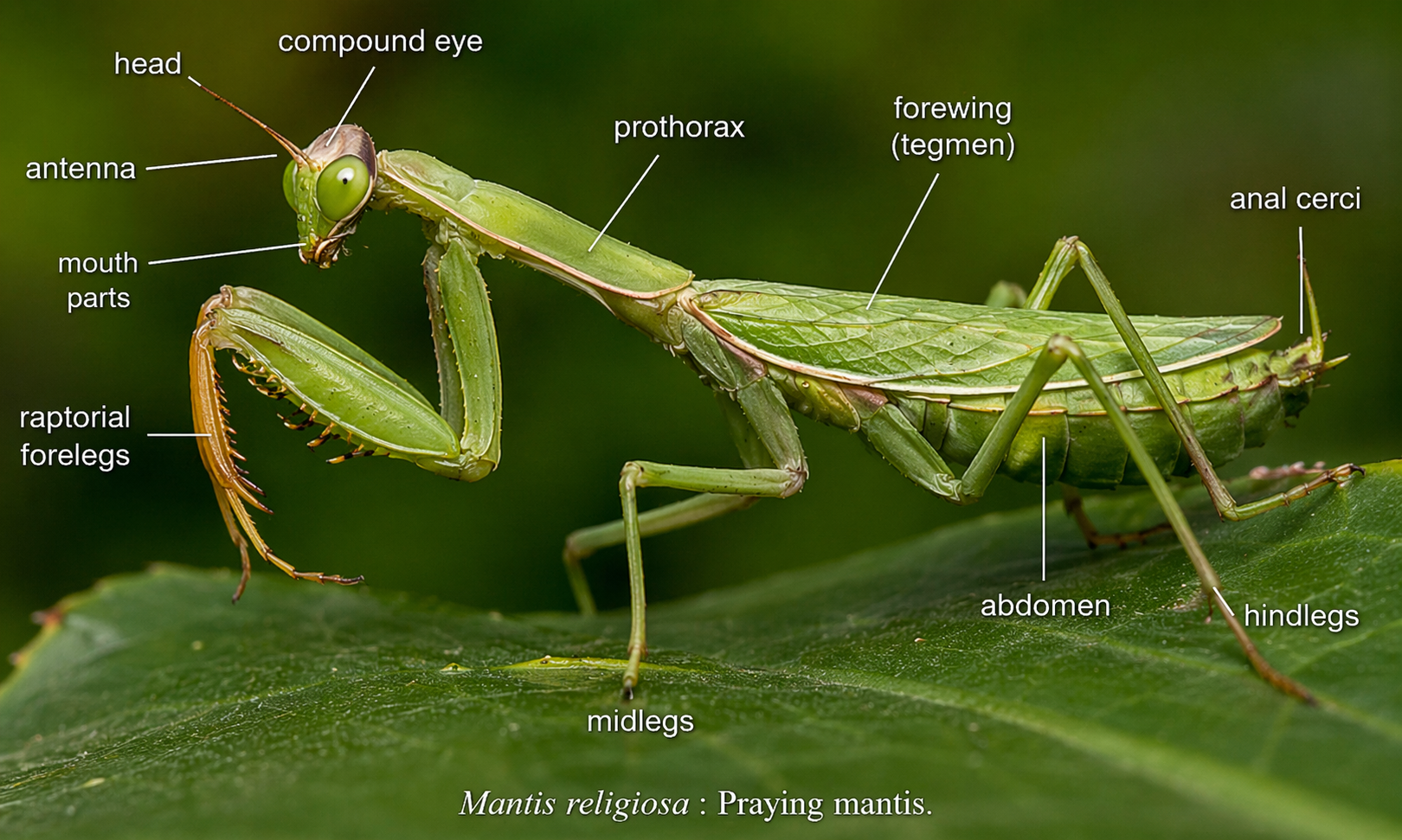
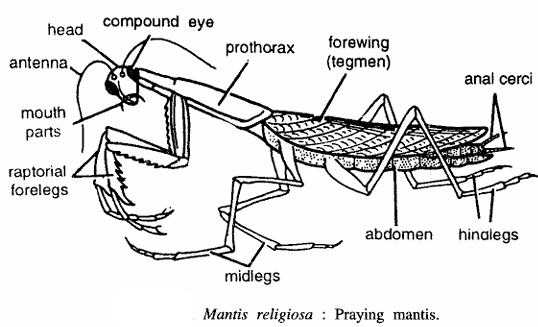
- Body of the animal is differentiated into head, thorax and abdomen and it is not dorsoventrally flattened.
- Eyes are large and set on extremely mobile triangular head.
- There are three ocelli mouth parts of biting type.
- Head contains compound eyes, a pair of antennae and biting mouth parts.
- Prothorax is elongated and fused with the head.
- Mantis is called as praying mantis because its forelegs remain clasped like folded hands during rest like in praying and thus waiting for some unwary insect to approach within striking distance.
- Middle and hind legs are elongated.
- Its pincer-like or raptorial tibia of sub-chelate forelegs are modified for grasping prey.
- Wings are folded flat and overlapping the sides of the body.
- Abdomen has 10 segment.
- Last abdominal segment contains a pair of anal cerci.
- They are pugnacious, that is, larger forms attack smaller forms and females eat males after nuptials and lay their eggs.
- Ovipositor is not erected. Eggs are laid in ootheca formed by viscid secretion, which becomes hard and eggs are arranged in chambers.
Special features
Many legends and superstitions are associated with the species M. religiosa. The ancient Greeks endowed it with supernatural powers; some of the Muslim people maintain that it prays with its face turned towards Mecca and in other countries it is called as saint. The colouration and form of the body is usually adapted to resemble parts of plants.
Identification
Since the specimen contains clasped forelegs and all above features, hence it is praying mantis
See other posts also
- Schistocerca (Locust)
- Melanoplus (Grasshopper)
- Periplaneta americana (Cockroach)
- Carausius (Stick Insect)
- Larval Forms of Crustaceans
Discover more from Zoologyverse
Subscribe to get the latest posts sent to your email.