
Introduction
Enzymes are biological catalysts that make the chemical reactions of living organisms possible at useful rates. Almost every major biochemical process depends on enzymes, including digestion, cellular respiration, energy production, DNA synthesis, metabolism and the formation of biological molecules.
Without enzyme catalysis, many biochemical reactions would occur too slowly to support life.
Enzymes accelerate reactions by providing a suitable environment for the reaction and lowering the activation energy required to reach the transition state. Importantly, an enzyme changes the rate of a reaction without changing the overall equilibrium of the reaction.
Enzymes are generally proteins and are characterized by remarkable catalytic efficiency and specificity. They recognize particular substrates through specialized regions called active sites.
Some enzymes also require non-protein components called cofactors or coenzymes for catalytic activity.
The study of enzymes is important not only in biochemistry but also in medicine, biotechnology, food science, agriculture and pharmaceutical research.
Changes in enzyme activity can be associated with disease, while many drugs exert their effects by interacting with specific enzymes.
The source material likewise emphasizes the importance of enzyme activity measurements in biological and clinical investigations.
Why are enzymes important?
Enzymes are important because they:
- Accelerate biochemical reactions.
- Show considerable substrate specificity.
- Help regulate metabolic pathways.
- Participate in energy production and nutrient metabolism.
- Assist in the synthesis and degradation of biological molecules.
- Provide important targets for many drugs.
- Have applications in medicine, agriculture, food technology and biotechnology.
What Are Enzymes?
An enzyme is a biological catalyst that accelerates a chemical reaction without being consumed in the overall reaction. Most enzymes are proteins, although some RNA molecules can also possess catalytic activity.
The catalytic ability of enzymes depends on their three-dimensional structure. A particular region of the enzyme, known as the active site, binds the substrate and provides the chemical environment required for catalysis.
Enzymes are especially effective because their active sites position substrates appropriately and stabilize important reaction states. Weak interactions such as hydrogen bonding, ionic interactions and hydrophobic interactions contribute to substrate recognition and catalytic activity.
Enzyme specificity
One of the important properties of enzymes is specificity. An enzyme generally recognizes a particular substrate or a group of structurally related substrates.
For example:
- Lactase acts on lactose.
- Urease catalyzes the hydrolysis of urea.
- Amylase acts on starch and related carbohydrates.
- Lipases catalyze reactions involving lipids.
The specificity of an enzyme is closely related to the structure and chemical properties of its active site.
Enzyme Active Site
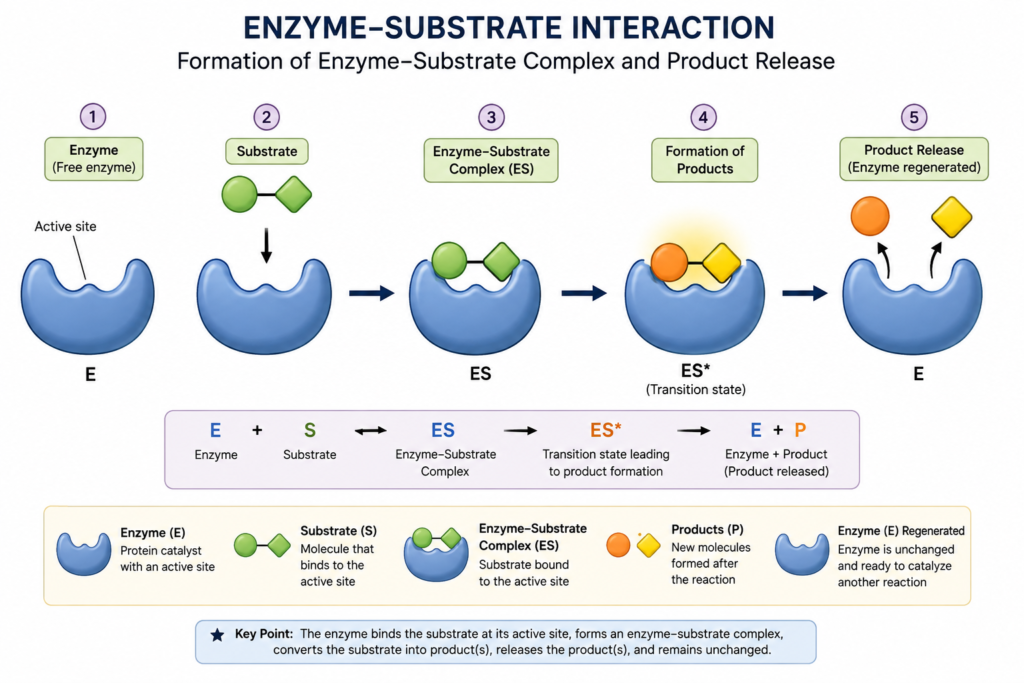
The active site is the region of an enzyme where substrate binding and catalysis occur. It contains amino acid residues arranged in a particular three-dimensional configuration.
The interaction between an enzyme and its substrate can be represented as:
E + S ⇌ ES → E + P
Where:
- E = enzyme
- S = substrate
- ES = enzyme–substrate complex
- P = product
The enzyme first interacts with the substrate to form the enzyme–substrate complex. The complex subsequently undergoes chemical transformation, releasing the product and regenerating the free enzyme.
Cofactors, Coenzymes, Apoenzymes and Holoenzymes
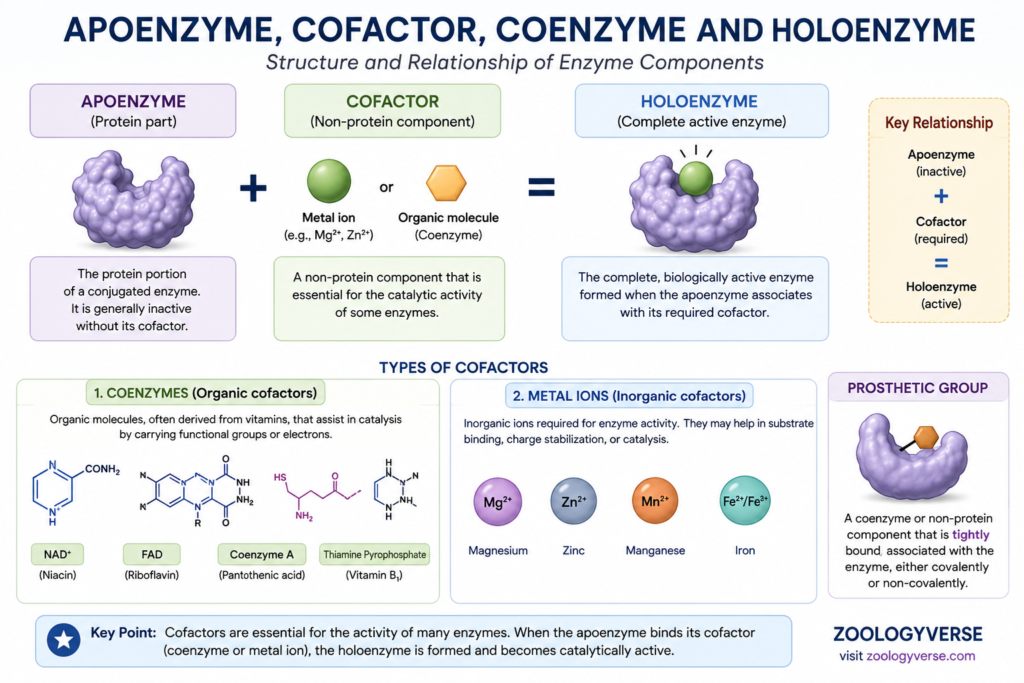
Not every enzyme consists entirely of amino acids. Some enzymes require additional non-protein components for their catalytic activity.
The source material divides proteinaceous enzymes into simple enzymes and conjugated enzymes. A simple enzyme consists only of protein, whereas a conjugated enzyme contains a protein component together with a non-protein component.
Cofactor
A cofactor is a non-protein component required for the activity of certain enzymes.
Cofactors may include:
- Metal ions
- Organic molecules
- Other tightly or loosely associated chemical components
Examples of metal cofactors include ions such as Mg²⁺, Zn²⁺ and Mn²⁺.
Coenzyme
A coenzyme is an organic molecule that participates in enzyme-catalyzed reactions. Many coenzymes are derived from vitamins or contain vitamin-derived structures.
Examples include:
- NAD⁺
- FAD
- Coenzyme A
- Tetrahydrofolate
- Thiamine pyrophosphate
Some coenzymes interact temporarily with enzymes and act as cosubstrates, whereas others remain more closely associated with the enzyme.
Prosthetic group
A coenzyme that is tightly associated with an enzyme, either covalently or non-covalently, is called a prosthetic group.
Apoenzyme
The protein component of a conjugated enzyme, when separated from its required cofactor, is called the apoenzyme. It is generally inactive without the required component.
Holoenzyme
The complete, biologically active enzyme consisting of the protein component and its required cofactor is called a holoenzyme.
Apoenzyme vs holoenzyme
| Term | Meaning |
|---|---|
| Apoenzyme | Protein portion of an enzyme without its required cofactor |
| Cofactor | Non-protein component required by some enzymes |
| Coenzyme | Organic cofactor involved in enzyme activity |
| Prosthetic group | Tightly associated coenzyme or non-protein component |
| Holoenzyme | Complete active enzyme containing its required components |
Classification of Enzymes
Enzyme names can be based on the substrate on which they act or on the type of reaction they catalyze. Many enzyme names end with the suffix -ase, such as lactase, amylase and ATPase.
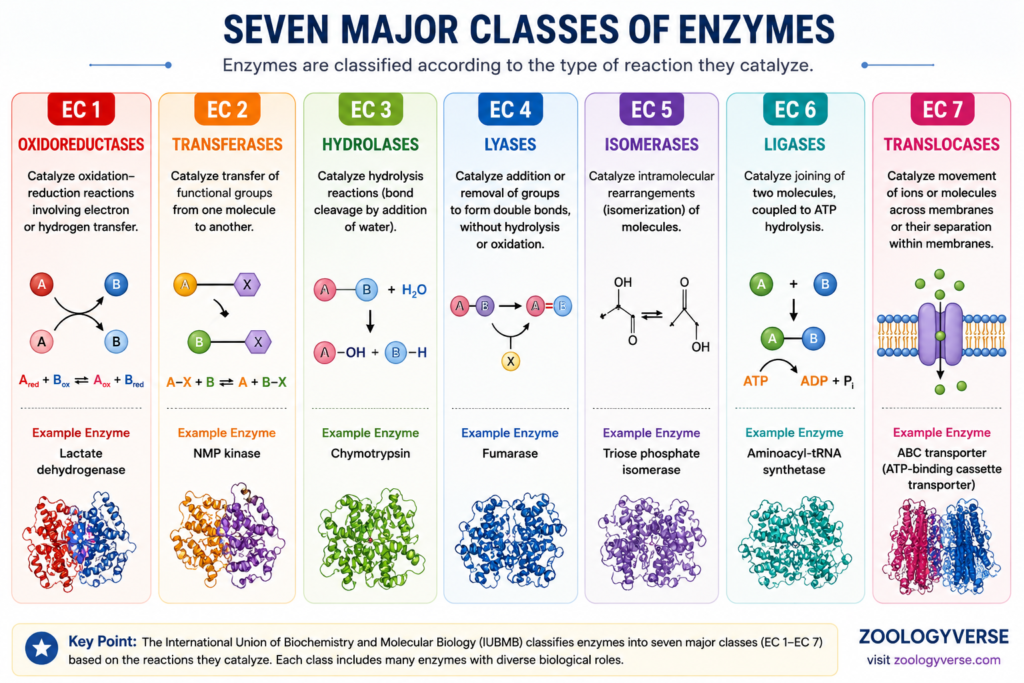
The International Union of Biochemistry and Molecular Biology (IUBMB) maintains the enzyme nomenclature and classification system. Enzymes are assigned EC numbers, which provide a systematic way of identifying enzymes according to the reactions they catalyze.
The source material describes six major classes, but the current IUBMB system includes seven major enzyme classes, with translocases added as EC class 7.
Seven major classes of enzymes
| EC Class | Enzyme Class | Main Type of Reaction | Example |
|---|---|---|---|
| EC 1 | Oxidoreductases | Oxidation-reduction reactions | Lactate dehydrogenase |
| EC 2 | Transferases | Transfer of functional groups | NMP kinase |
| EC 3 | Hydrolases | Hydrolysis reactions | Chymotrypsin |
| EC 4 | Lyases | Addition or removal of groups without hydrolysis | Fumarase |
| EC 5 | Isomerases | Intramolecular rearrangements | Triose phosphate isomerase |
| EC 6 | Ligases | Joining of molecules using energy, commonly from ATP | Aminoacyl -tRNA synthetase |
| EC 7 | Translocases | Catalysis of translocation of ions or molecules across membranes or their separation within membranes | Various membrane transport enzymes |
The first six classes correspond to the classification presented in the original source, while the current IUBMB nomenclature additionally recognizes EC 7 translocases.
1. Oxidoreductases
Oxidoreductases catalyze oxidation-reduction reactions involving the transfer of electrons or hydrogen atoms.
Common names include:
- Dehydrogenases
- Reductases
- Oxidases
Example: Lactate dehydrogenase.
2. Transferases
Transferases transfer a functional group from one molecule to another.
Groups that can be transferred include:
- Phosphoryl groups
- Methyl groups
- Glycosyl groups
- Amino groups
For example, NMP kinase transfers a phosphoryl group from ATP to a nucleoside monophosphate. The source identifies NMP kinase as EC 2.7.4.4
3. Hydrolases
Hydrolases catalyze hydrolytic reactions in which chemical bonds are broken with the participation of water.
Examples include:
- Proteases
- Lipases
- Nucleases
- Phosphatases
Example: Chymotrypsin is a proteolytic enzyme that hydrolyzes peptide bonds.
4. Lyases
Lyases catalyze the addition or removal of groups to form or break double bonds, generally without hydrolysis or oxidation-reduction being the primary reaction.
Example: Fumarase.
5. Isomerases
Isomerases catalyze structural or geometric rearrangements within a molecule.
Examples include:
- Racemases
- Epimerases
- Mutases
- Other isomerases
Example: Triose phosphate isomerase.
6. Ligases
Ligases catalyze the joining of two molecules, commonly coupled to the hydrolysis of ATP or another nucleoside triphosphate. The IUBMB classification defines ligases as enzymes that join molecules using energy associated with phosphate-bond hydrolysis.
Example: Aminoacyl-tRNA synthetases.
7. Translocases
Translocases form the current EC 7 class and catalyze the movement or translocation of ions or molecules across membranes or their separation within membranes.
The current IUBMB database lists subclasses including translocation of hydrons, inorganic cations, inorganic anions and amino acids or peptides.
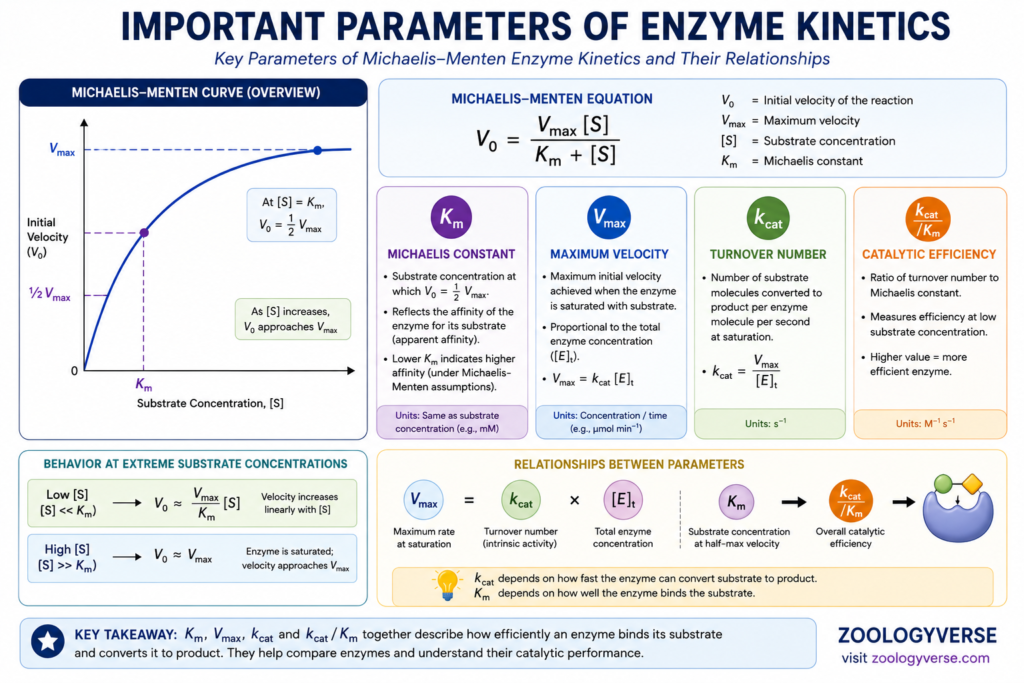
Enzyme Kinetics
Enzyme kinetics is the study of the rates of enzyme-catalyzed reactions and the factors that influence those rates.
One of the most important variables in enzyme kinetics is the concentration of the substrate, represented by [S].
At the beginning of an enzyme-catalyzed reaction, the initial velocity (V₀) can be measured before substantial substrate depletion occurs. Under these conditions, substrate concentration can be treated as approximately constant for the kinetic analysis. The original source emphasizes this initial-rate approach.
Effect of substrate concentration
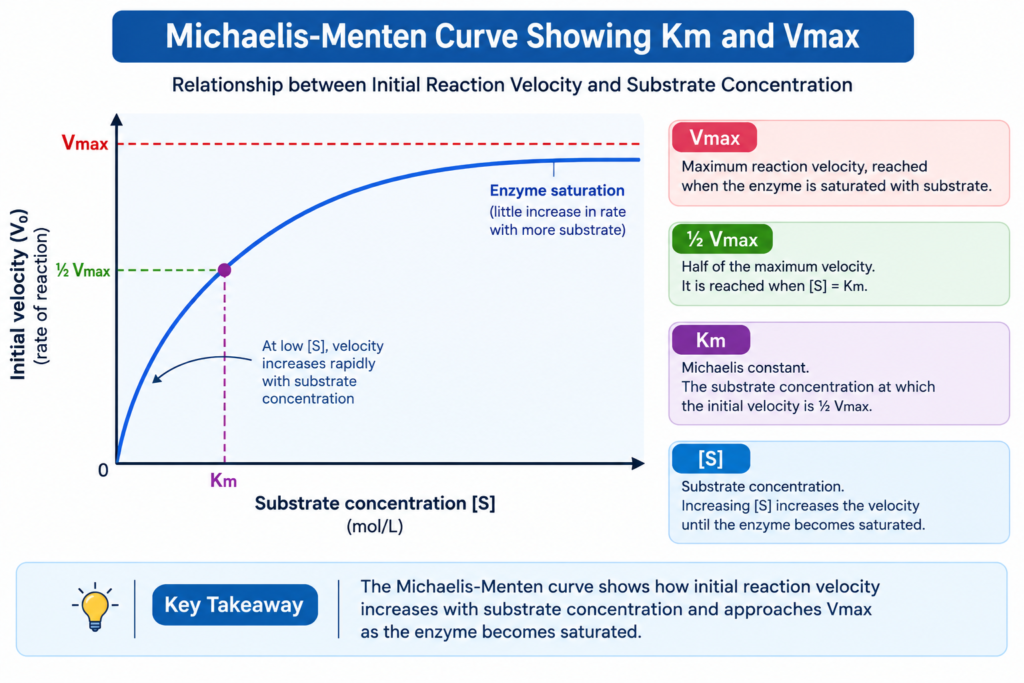
At relatively low substrate concentrations, increasing [S] produces a nearly proportional increase in reaction velocity.
As substrate concentration increases further, the enzyme becomes progressively occupied by substrate. The increase in velocity therefore becomes smaller.
Eventually, most available active sites are occupied, and the reaction approaches a maximum velocity called Vmax.
This produces the characteristic hyperbolic curve of Michaelis–Menten kinetics.
Michaelis-Menten Kinetics
The Michaelis-Menten model describes the relationship between the initial velocity of an enzyme-catalyzed reaction and substrate concentration.
The basic reaction scheme is:
E + S ⇌ ES → E + P
where:
- E = free enzyme
- S = substrate
- ES = enzyme-substrate complex
- P = product
The model was developed from work by Leonor Michaelis and Maud Menten and remains one of the fundamental models used to describe enzyme kinetics.
Formation of the enzyme-substrate complex
The enzyme first binds its substrate:
E + S ⇌ ES
The enzyme-substrate complex can then proceed toward product formation:
ES → E + P
The reaction velocity is related to the concentration of the enzyme-substrate complex. As substrate concentration increases, more enzyme becomes associated with substrate until the enzyme approaches saturation.
Vmax: Maximum Velocity
Vmax is the maximum initial reaction velocity observed when the enzyme is effectively saturated with substrate.
At very high substrate concentrations, almost all available enzyme molecules are present in the enzyme-substrate state. Increasing substrate concentration further produces little additional increase in reaction rate.
Therefore, the curve approaches a plateau known as Vmax.
Vmax depends on the amount of enzyme present. Increasing the enzyme concentration can increase the maximum reaction rate when other conditions remain suitable.
Michaelis Constant (Km)
The Michaelis constant (Km) is one of the most important parameters in Michaelis-Menten kinetics.
It is defined as the substrate concentration at which:
V₀ = ½ Vmax
Therefore:
Km = [S] when V₀ = ½ Vmax
This relationship provides a practical way to determine Km from a Michaelis-Menten saturation curve.
A lower Km often corresponds to a higher apparent affinity under the assumptions of the Michaelis-Menten model, although Km is a kinetic constant and should not automatically be treated as a direct measure of binding affinity in every enzymatic system.
Michaelis-Menten Equation
The Michaelis-Menten equation is:
V₀ = Vmax[S] / (Km + [S])
Where:
- V₀ = initial reaction velocity
- Vmax = maximum reaction velocity
- [S] = substrate concentration
- Km = Michaelis constant
The equation describes how enzyme velocity changes as substrate concentration changes under the conditions of the model.
What happens at low substrate concentration?
When:
[S] << Km
the equation approaches:
V₀ ≈ (Vmax/Km)[S]
Under these conditions, the reaction rate depends strongly on substrate concentration.
What happens at high substrate concentration?
When:
[S] >> Km
the equation approaches:
V₀ ≈ Vmax
The enzyme is approaching saturation, so additional substrate has little effect on the reaction velocity.
Steady-State Assumption
The derivation of the Michaelis-Menten equation commonly uses the steady-state assumption.
Under this assumption, after the initial transient period, the concentration of the enzyme-substrate complex remains approximately constant because its rate of formation becomes approximately equal to its rate of breakdown.
In simplified form:
Rate of ES formation = Rate of ES breakdown
The original source presents this as an important step in deriving the Michaelis-Menten equation.
The steady-state treatment leads to:
[ES] = [Et][S] / (Km + [S])
Substituting this relationship into the expression for reaction velocity gives the Michaelis-Menten equation:
V₀ = Vmax[S] / (Km + [S])
This derivation is also described in modern biochemical kinetics resources.
Turnover Number (kcat)
The turnover number, represented by kcat, describes the maximum number of substrate molecules converted to product per enzyme molecule per unit time when the enzyme is operating under substrate-saturating conditions.
The relationship between Vmax and kcat is:
Vmax = kcat[Et]
where [Et] represents the total enzyme concentration.
A high kcat indicates that an enzyme can carry out many catalytic cycles per unit time under saturating conditions.
Catalytic Efficiency
The ratio:
kcat / Km
is commonly used as a measure of catalytic efficiency under appropriate Michaelis-Menten conditions.
It can be useful when comparing how effectively an enzyme acts on different substrates. The source material also identifies kcat/Km as an important measure of catalytic efficiency.
Catalytic efficiency therefore combines information about:
- How effectively substrate participates in catalysis.
- How rapidly the enzyme can process substrate.
- The kinetic behavior of the enzyme at relatively low substrate concentrations.
Importance of Enzymes in Biology and Medicine
Enzymes are essential to almost every aspect of cellular metabolism.
They participate in:
Digestion :- Digestive enzymes break large food molecules into smaller molecules that can be absorbed and used by the body.
Cellular respiration :- Numerous enzymes participate in glycolysis, the citric acid cycle, oxidative phosphorylation and other energy-producing pathways.
DNA and RNA metabolism :- Enzymes are involved in DNA replication, repair, recombination and RNA synthesis.
Protein metabolism :- Proteases and other enzymes participate in protein synthesis, processing and degradation.
Lipid metabolism :- Lipases and other metabolic enzymes help synthesize and degrade lipids.
Medical diagnosis :-Measurements of enzyme activity in biological samples can provide useful information in clinical investigations. The source material specifically highlights enzyme activity measurements in plasma, erythrocytes and tissues.
Drug development :- Because enzymes control many biochemical pathways, they are important targets for pharmaceutical drugs.
Factors Affecting Enzyme Activity
Although the original document focuses mainly on enzyme classification and kinetics, enzyme activity in biological systems is also influenced by environmental and chemical conditions.
Important factors include:
- Substrate concentration
- Enzyme concentration
- Temperature
- pH
- Availability of cofactors
- Presence of inhibitors or activators
- Nature of the substrate
Changes in these factors can alter enzyme activity because enzyme catalysis depends on molecular interactions and the structural integrity of the enzyme.
Key Takeaways
- Enzymes are biological catalysts that accelerate biochemical reactions.
- Most enzymes are proteins.
- The active site is the region where substrate binding and catalysis occur.
- The enzyme-substrate complex is represented as ES.
- Some enzymes require cofactors for activity.
- Organic cofactors are called coenzymes.
- The protein component without its required cofactor is called an apoenzyme.
- The complete active enzyme is called a holoenzyme.
- Enzymes are classified according to the reactions they catalyze.
- The current IUBMB system recognizes seven major EC classes.
- Enzyme kinetics studies the rates of enzyme-catalyzed reactions.
- Vmax represents the maximum reaction velocity under substrate-saturating conditions.
- Km is the substrate concentration at which the initial velocity is half of Vmax.
- The Michaelis-Menten equation is V₀ = Vmax[S]/(Km + [S]).
- kcat represents the turnover number.
- kcat/Km is commonly used as a measure of catalytic efficiency..
Conclusion
Enzymes are fundamental biological catalysts that allow the complex chemistry of life to occur at useful rates. Their remarkable specificity and catalytic efficiency arise from the precise molecular organization of their active sites and their ability to stabilize favorable reaction pathways.
Understanding enzymes requires knowledge of their structure, active sites, cofactors and classification as well as the principles of enzyme kinetics. The Michaelis-Menten model provides a fundamental framework for understanding how reaction velocity changes with substrate concentration. Important kinetic parameters such as Km, Vmax and kcat allow researchers and students to describe and compare enzyme-catalyzed reactions.
The relationship between substrate concentration and reaction velocity also explains why enzyme activity eventually reaches a plateau. At sufficiently high substrate concentrations, the available enzyme becomes saturated and the reaction approaches its maximum velocity.
For students of zoology, biology and biochemistry, enzymes are therefore an essential topic because they connect molecular structure with metabolism, physiology, disease and biotechnology.
Frequently Asked Questions
What are enzymes?
Enzymes are biological catalysts that increase the rate of biochemical reactions without being consumed in the overall reaction.
What is an active site?
The active site is the specific region of an enzyme where the substrate binds and catalytic reactions occur.
What is an enzyme-substrate complex?
An enzyme-substrate complex is the temporary complex formed when an enzyme binds its substrate. It is represented as ES.
What is a cofactor?
A cofactor is a non-protein component required by some enzymes for catalytic activity. Cofactors can include metal ions and certain organic molecules.
What is the difference between apoenzyme and holoenzyme?
An apoenzyme is the protein component of an enzyme without its required cofactor, whereas a holoenzyme is the complete active enzyme containing the necessary cofactor.
What is Km in enzyme kinetics?
Km is the substrate concentration at which the initial reaction velocity is equal to half of Vmax under the Michaelis-Menten model.
What is Vmax?
Vmax is the maximum reaction velocity approached when an enzyme becomes saturated with substrate.
What is the Michaelis-Menten equation?
The Michaelis-Menten equation is:
V₀ = Vmax[S] / (Km + [S])
It describes the relationship between initial reaction velocity and substrate concentration under the model’s assumptions.
How many major classes of enzymes are currently recognized?
The current IUBMB enzyme classification recognizes seven major EC classes: oxidoreductases, transferases, hydrolases, lyases, isomerases, ligases and translocases.
References and Further Reading
- IUBMB Enzyme Nomenclature
- IUBMB Enzyme Classification Rules
- OpenStax Biology: Enzymes
- OpenStax Organic Chemistry: Enzymes and Coenzymes
- NCBI Bookshelf: Protein Function
- Chemistry LibreTexts: Michaelis-Menten Kinetics
- Chemistry LibreTexts: Equations of Enzyme Kinetics
- Nelson, D. L. & Cox, M. M. Lehninger Principles of Biochemistry.
- Kumar, P. & Mina, U. Life Sciences: Fundamentals and Practices.
- Stryer, L. Biochemistry.
Discover more from Zoologyverse
Subscribe to get the latest posts sent to your email.