
Long before dinosaurs walked the Earth, Limulus was already crawling along ancient seafloors — and it hasn’t changed much since.
Commonly known as the horseshoe crab, Limulus is one of the oldest surviving animal lineages on the planet, with a fossil record stretching back roughly 450 million years. Despite its name, it isn’t a crab at all — it’s a distant relative of spiders and scorpions.
Only one species, the Atlantic horseshoe crab (Limulus polyphemus), survives today, found along the coasts of eastern North America and eastern Asia.
Beyond its strange, armored appearance, Limulus plays an outsized role in modern medicine: its unusual blue blood is used worldwide to test the safety of vaccines and injectable drugs.
Below, we break down its classification, habitat, anatomy, and the biology that makes it so remarkable.
Classification of Limulus (Horseshoe crab)
| Rank | Classification | Characteristics |
|---|---|---|
| Kingdom | Animalia | Multicellular, eukaryotic organisms that consume food for energy. |
| Phylum | Arthropoda | Segmented body with jointed appendages and a chitinous exoskeleton. |
| Class | Arachnida | Terrestrial or aquatic arthropods with book-lungs or tracheae; lack antennae, mandibles, and jaws. |
| Order | Xiphosura | Delobranchiate arthropods with a body covered by a horseshoe-shaped carapace. |
| Family | Limulidae | Sole surviving family of the order Xiphosura; marine bottom-dwellers. |
| Genus | Limulus | Horseshoe crab; only genus in Limulidae with a living representative. |
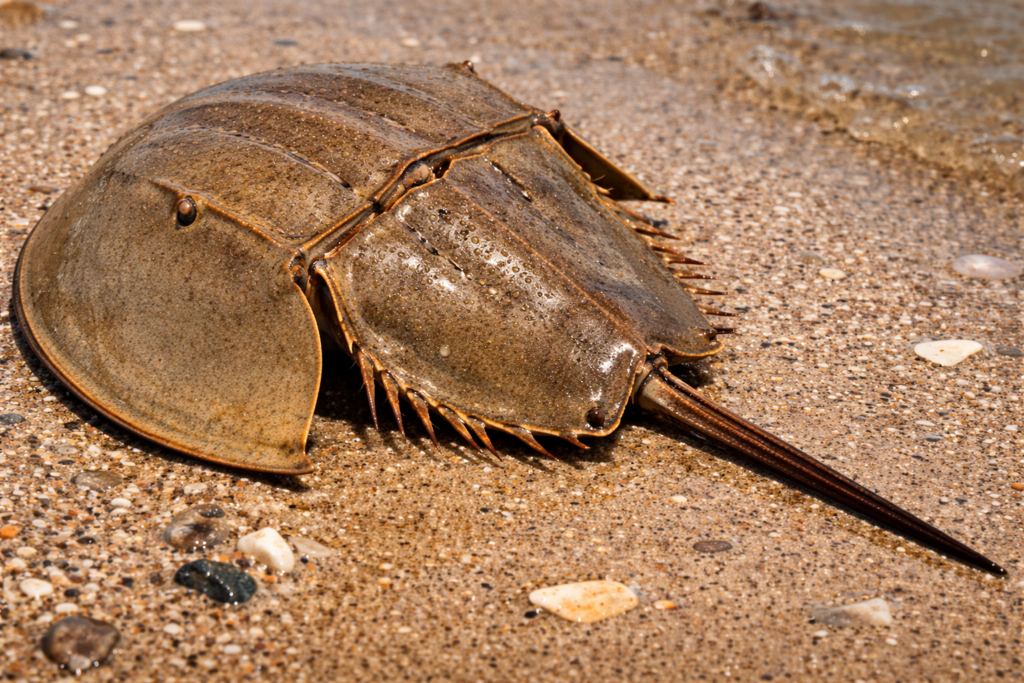
Habit and habitat
Limulus is a marine bottom-dweller. It lives on muddy or sandy seafloors, usually 2 to 6 fathoms deep, where it partly buries itself while foraging.
The horseshoe crab feeds mainly on worms, mollusks, and other small invertebrates it finds in the sediment.
Its habits shift with the seasons. In early summer, adults migrate from deeper water to sandy beaches to breed, often in large numbers during high tides around the full and new moon.
Females dig shallow nests above the tide line and lay thousands of eggs, which shorebirds rely on as a critical food source during migration.
Distribution
It inhabits eastern coast of Asia and its island and eastern cost of North American from Nova Scotia to Florida. It has restricted and discontinuous distribution.
Comments on Limulus (Horseshoe crab)
- Commonly called as Horseshoe crab.
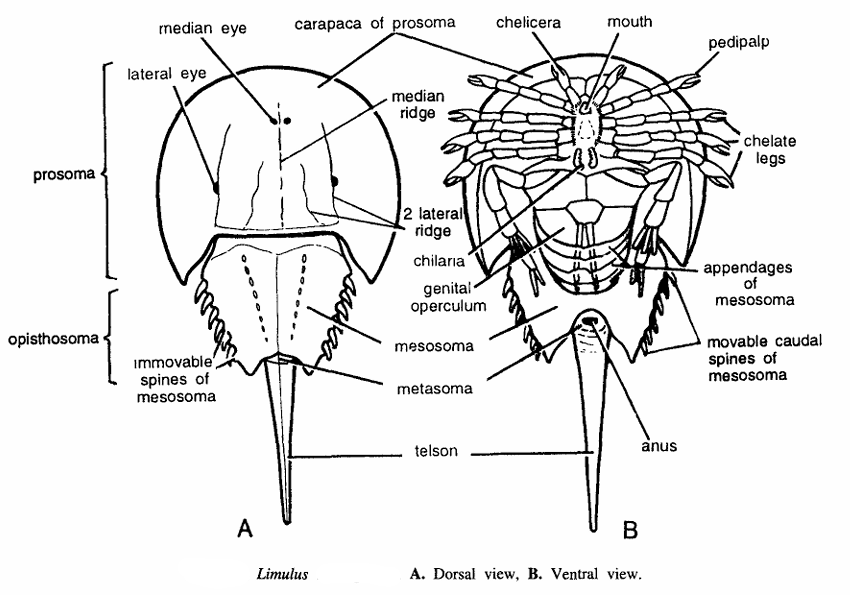
- Body is differentiated into a broad horseshoe-shaped prosoma and a small nearly triangular opisthosoma.
- Body regions are cephalothorax, abdomen and a long spike like telson or tail.
- Prosoma is convex above with sloping sides. It contains one median and two lateral longitudinal ridges.
- Prosoma is covered by a large semicircular carapace and joined to opisthosoma by a broad hinge.
- The prosomatic appendages are ftrst pair of chelate chelicerae, while 2 to 7 segments bear a pair of chelate walking legs each.
- Carapace also bears one pair of median and two large composite sub-dorsal or lateral eyes.
- Opisthosoma comprises of six segments, the mesosoma, a vestigial metasoma and a long spine like telson.
- Mesosoma contains 6 pairs of immovable spines. Chelicerae are 3-jointed small and chelate.
- Legs are biramous and the last pair are not paddle-shaped. First pair of mesosomatic appendages form the genital operculum.
- Opisthosoma has book gills. The post anal caudal spine is hinged and freely movable. Young are planktonic larvae (Trilobite stage).
Special features
Limulus is often called a “living fossil.” Fossils nearly identical to modern horseshoe crabs date back roughly 450 million years, meaning the genus has survived largely unchanged through multiple mass extinctions — long before dinosaurs existed.
Its blood is one of the most valuable substances in medicine. Limulus blood is blue, colored by copper-based hemocyanin instead of iron-based hemoglobin, and contains a compound called Limulus Amebocyte Lysate (LAL).
LAL clots instantly in the presence of bacterial toxins, which makes it the global standard test for contamination in vaccines, IV fluids, and injectable drugs.
This has made wild horseshoe crab populations a conservation concern, since large numbers are harvested each year for blood collection.
Beyond medicine, the horseshoe crab has little direct economic value — it’s occasionally used as bait or animal feed — but its ecological and biomedical importance far outweighs its size.
Identification
Since the specimen contains semicircular carapace and all above features, hence it is Horseshoe crab.
Frequently Asked Questions
Is a horseshoe crab actually a crab?
No. Despite the name, Limulus isn’t a crustacean at all — it’s more closely related to spiders and scorpions. It belongs to the class Arachnida and the order Xiphosura, not the crab order Decapoda.
How long has Limulus existed on Earth?
Fossils nearly identical to living Limulus date back around 450 million years, making it one of the oldest surviving animal lineages — often called a “living fossil.”
Why is horseshoe crab blood valuable?
Its blue, copper-based blood contains Limulus Amebocyte Lysate (LAL), a compound that clots on contact with bacterial toxins. This makes it the global standard for testing vaccines, IV fluids, and medical devices for contamination.
Where is Limulus found?
It’s found along the eastern coast of North America (from Nova Scotia to Florida) and along parts of the eastern coast of Asia, typically in shallow coastal waters and sandy or muddy seafloors.
What does Limulus eat?
It feeds on worms, mollusks, and other small invertebrates found in sand and mud on the seafloor.
Is the horseshoe crab endangered?
Populations have declined in parts of its range, largely due to biomedical blood harvesting and habitat loss, making conservation an active concern in areas like the U.S. Atlantic coast.
Recommended Study Resource
Horseshoe Crab Animal Science Guide for Kids and Teens: How Horseshoe Crabs Survive, Migrate, and Thrive Along Coastal Shores: 1
by Roggie Clark (Author), Raj Clark (Author)
The Complete Horseshoe Crab Handbook: A Comprehensive Guide to Horseshoe Crab Anatomy, Habitat, Evolution, Behavior, Conservation, and Their Importance to Science and Medicine
by Kassie Frogley (Author)
As an Amazon Associate I earn from qualifying purchases.
Discover more from Zoologyverse
Subscribe to get the latest posts sent to your email.