
A class of eusocial insects known as termites eats a wide range of decomposing plant matter, usually in the form of wood, leaf litter, and soil humus. They have been referred to as “white ants” because of their soft-bodied, unpigmented worker caste and beaded (moniliform) antennae, but they are actually highly derived cockroaches rather than ants; they are genetically closer to some cockroach groups than to others. There are currently 2,997 known species, 2,125 of which belong to the Termitidae family.

Classification of Termites
Phylum – Arthropoda (Jointed Appendages)
Class – Insecta (3 pairs of legs.)
Sub-class – Pterygota (Winged insects.)
Division – Exopterygota (Wings develop externally.)
Order – Isoptera (Wings are equal.)
Genus – termites
Habit and habitat
The termites may be wood dwelling or subterranean. They form nests which consist of numberless chambers and galleries having moderately hard walls. The wood dwelling species, excavate galleries in the logs, planks, fences, poles, door frames, furniture and piles of books. The ground dwelling species form nest or termitarium. They feed on cellulose.
Distribution
They are found throughout temperate and tropical countries. They have cosmopolitan distribution.
Comments on Termites
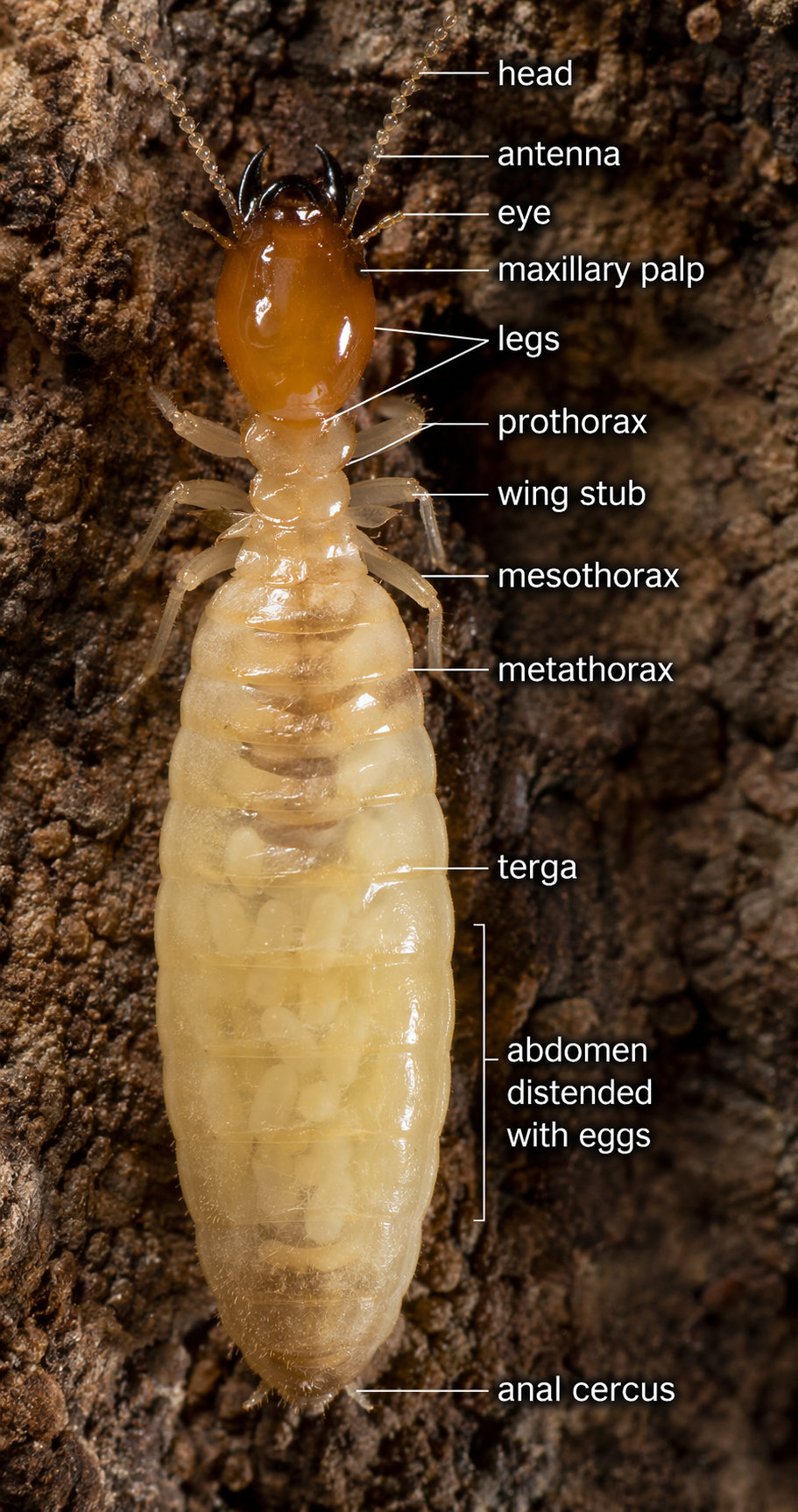
- Commonly called as Queen termite. Body divided into head, thorax and abdomen.
- Head contains paired compound eyes, paired antennae and a pair of small maxillary palp.
- Thorax divisible into prothorax, mesothorax and metathorax.
- Tergum of prothorax (pronotum) does not cover head.
- Thorax contains a pair of short reduced wing stubs and 3 pairs of legs.
- Head and thorax comparatively shorter while abdomen is much elongated and swollen for accommodating large number of eggs.
- Last abdominal segment contains a pair of anal cerci.
- Mouth parts are of biting type.
Special Features
Termites have caste system,’ comprising three fertile reproductive castes and two sterile caste. Reproductive system includes 3 forms : (i) Winged forms having true kings and Queens. Queen termite is a sexually mature female of the colony with elongated abdomen. Queen termite produces large number of eggs. (ii) Short winged forms having neotenic kings and queens. (iii) Wingless forms comprising worker like substitute kings and queens.
Identification
Since the specimen contains elongated and expanded abdomen and all above characters, hence it is termite.
See other posts also
- Mantis religiosa (Praying Mantis)
- DISSECTION OF RAT
- Periplaneta americana (Cockroach)
- Carausius (Stick Insect)
- Phyllium (Leaf Insect)
Discover more from Zoologyverse
Subscribe to get the latest posts sent to your email.